Lifestyle
In a hot L.A. neighborhood full of brown lawns, his DIY native plant garden thrives

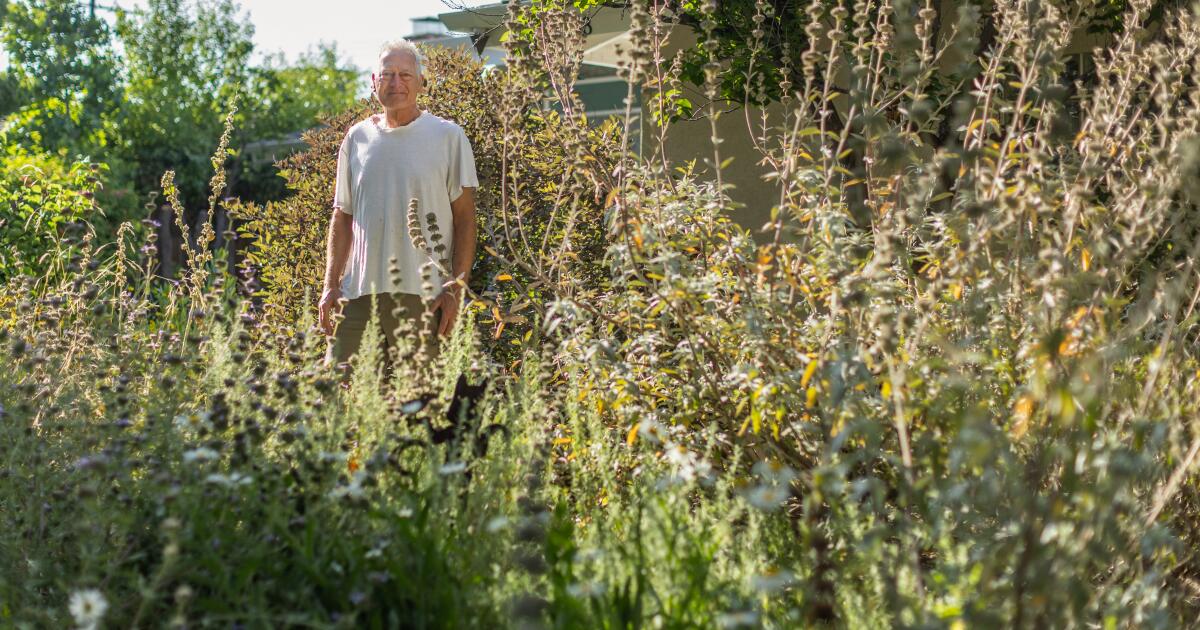
Water-hungry lawns are symbols of Los Angeles’ past. In this series, we spotlight yards with alternative, low-water landscaping built for the future.
The temperature was in the 90s in West Hills, but that didn’t deter an astonishing number of monarch butterflies, hummingbirds and bees from feeding on the California-friendly plants — sages, salvias and flowering milkweed — in Eric Augusztiny’s front yard.
Pollinators, however, aren’t the only ones who call the front yard home. “This is our buddy, Lizzy,” Augusztiny said with a smile as he and his wife, Lise Ransdell, greeted an enormous lizard who crawled out from under a large salvia ‘Desperado’ plant.
“It’s just a postage stamp suburban yard, but there’s a lot going on here,” Ransdell said of the yard’s abundant wildlife, which counts rabbits, skunks, raccoons and possums as visitors.
It wasn’t always like this. When Augusztiny purchased the home in 1996, the traditional yard looked like many others on his street with a Bermuda grass lawn, assorted shrubs and an apricot tree.
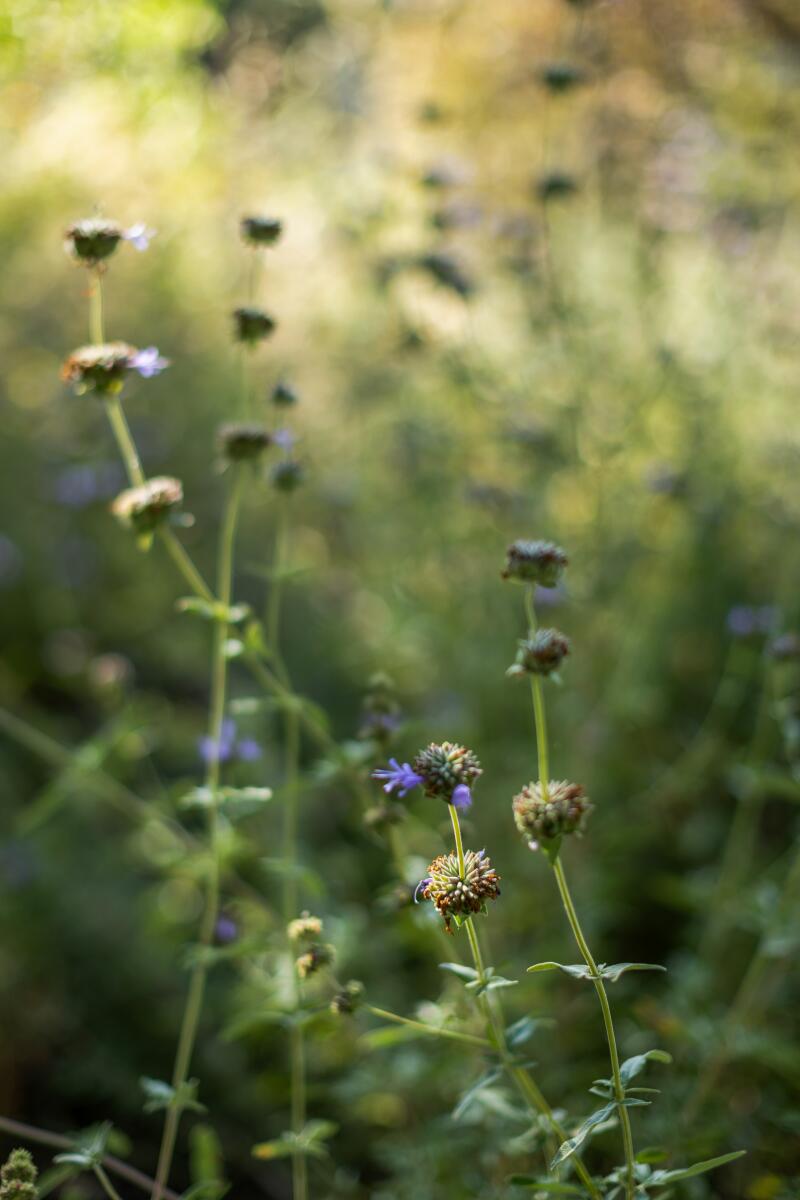
Milkweed, a favorite of monarch butterflies, left. Cleveland sage, Salvia clevelandii. (Myung J. Chun / Los Angeles Times)
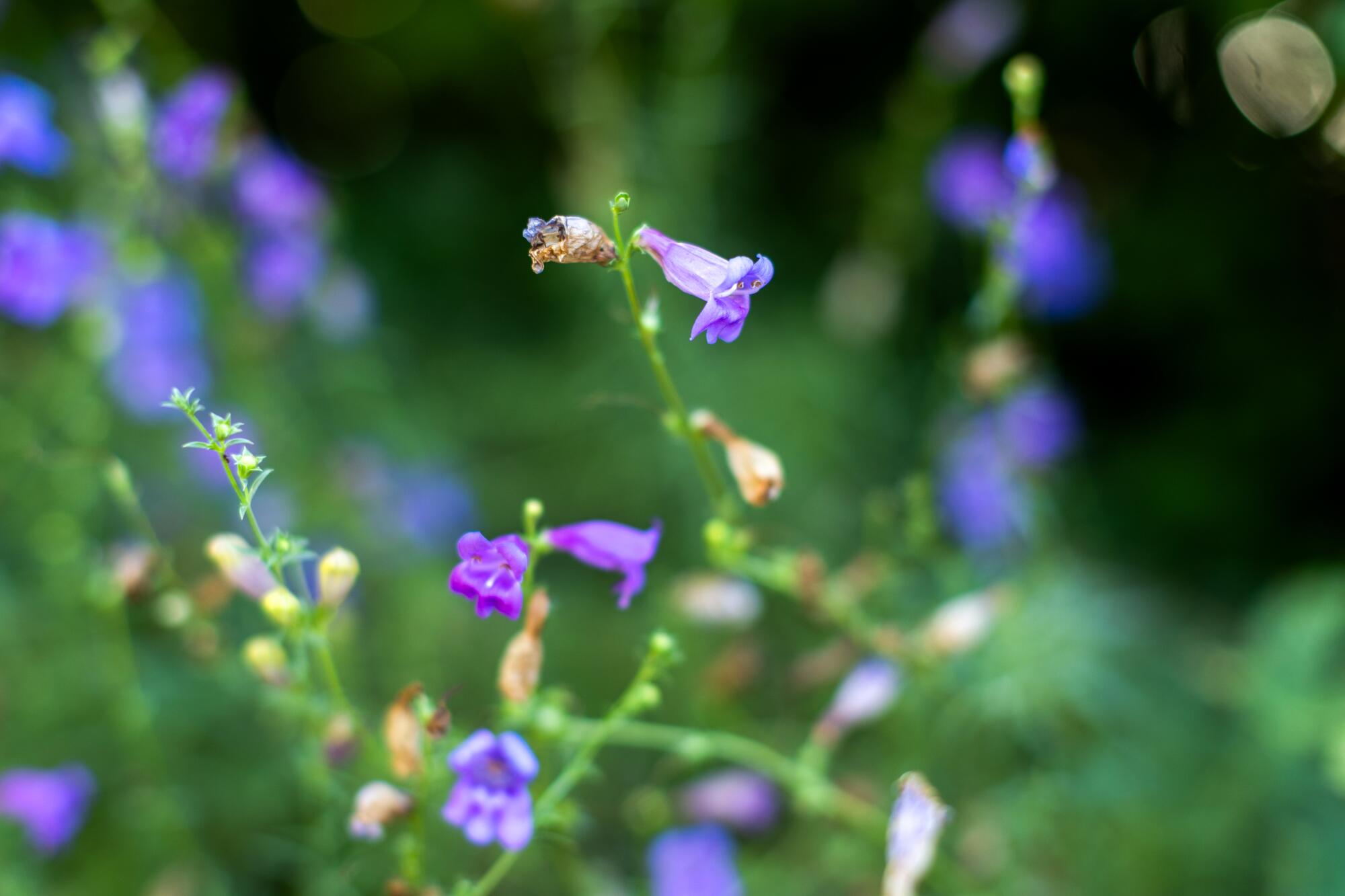
Foothill penstemon grows in Eric Augusztiny’s drought-tolerant front yard.
Yes, Augusztiny acknowledges, lawns have appeal, but not in his West Valley neighborhood where “concrete is the equivalent of a frying pan,” and sustaining thirsty turf in triple-digit heat is impossible. “Even if I wanted a lawn — and I don’t — you can’t keep one alive here,” he said, pointing to the brown lawns that border his tree-lined street.
“The garden goes dormant in the summer but doesn’t die. Drought-tolerant plants are survivors. The sugar bush, toyon, manzanita, coffee berry, ceanothus and hummingbird sage hold their vivid green color year-round. The California fuchsia blooms into the fall, and although the salvias’ spikes above the foliage die back after flowering, the structure and leaves remain vital.”
Besides mowing the lawn, Augusztiny was not much of a gardener before he purchased his home. “I knew how to reseed the lawn. Again and again,” he said with a laugh. So he decided to learn all he could about removing his lawn, building healthy soil and replacing it with a drought-tolerant alternative.
He started by attending a demonstration on lasagna mulching led by artist-in-residence and horticulturist Leigh Adams at the Los Angeles County Arboretum’s Crescent Farm. The class inspired Augusztiny, who then checked out books on California native plants from the Los Angeles Public Library and attended a hands-on workshop at the Metropolitan Water District of Southern California Field Office.
When the couple remodeled their home in 2018, they decided it was a good time to remove the lawn. The LADWP’s lawn conversion program — which currently pays $5 per square foot to remove turf and replace it with low-water landscapes — was an incentive but not the primary driving force. “I wasn’t in it for the money,” Augusztiny said of the $2,000 rebate they received then, “but it helped cover the cost.”
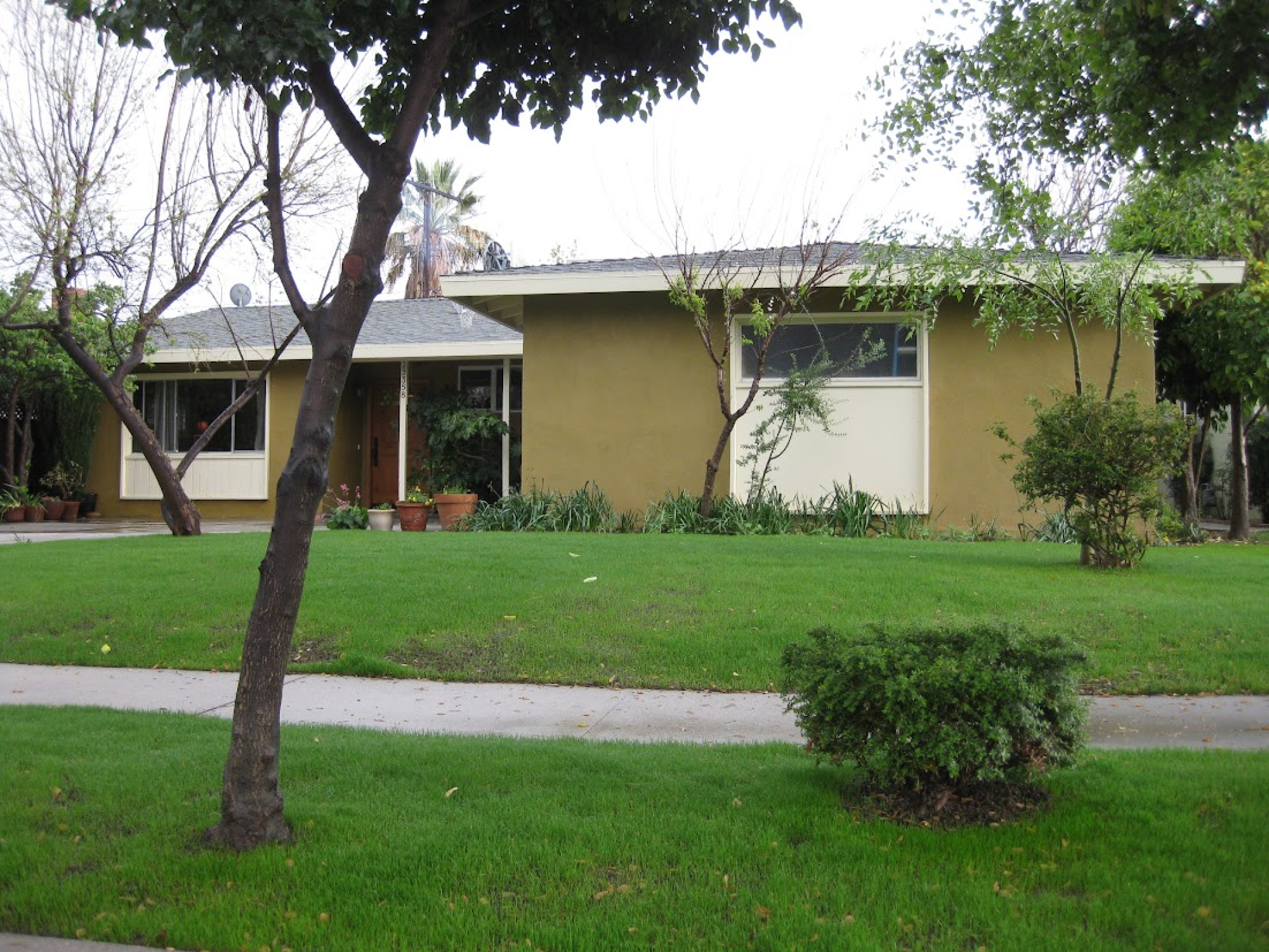
Eric Augusztiny’s front yard in West Hills before he removed his lawn and replaced it with a drought-tolerant alternative.
(Eric Augusztiny)
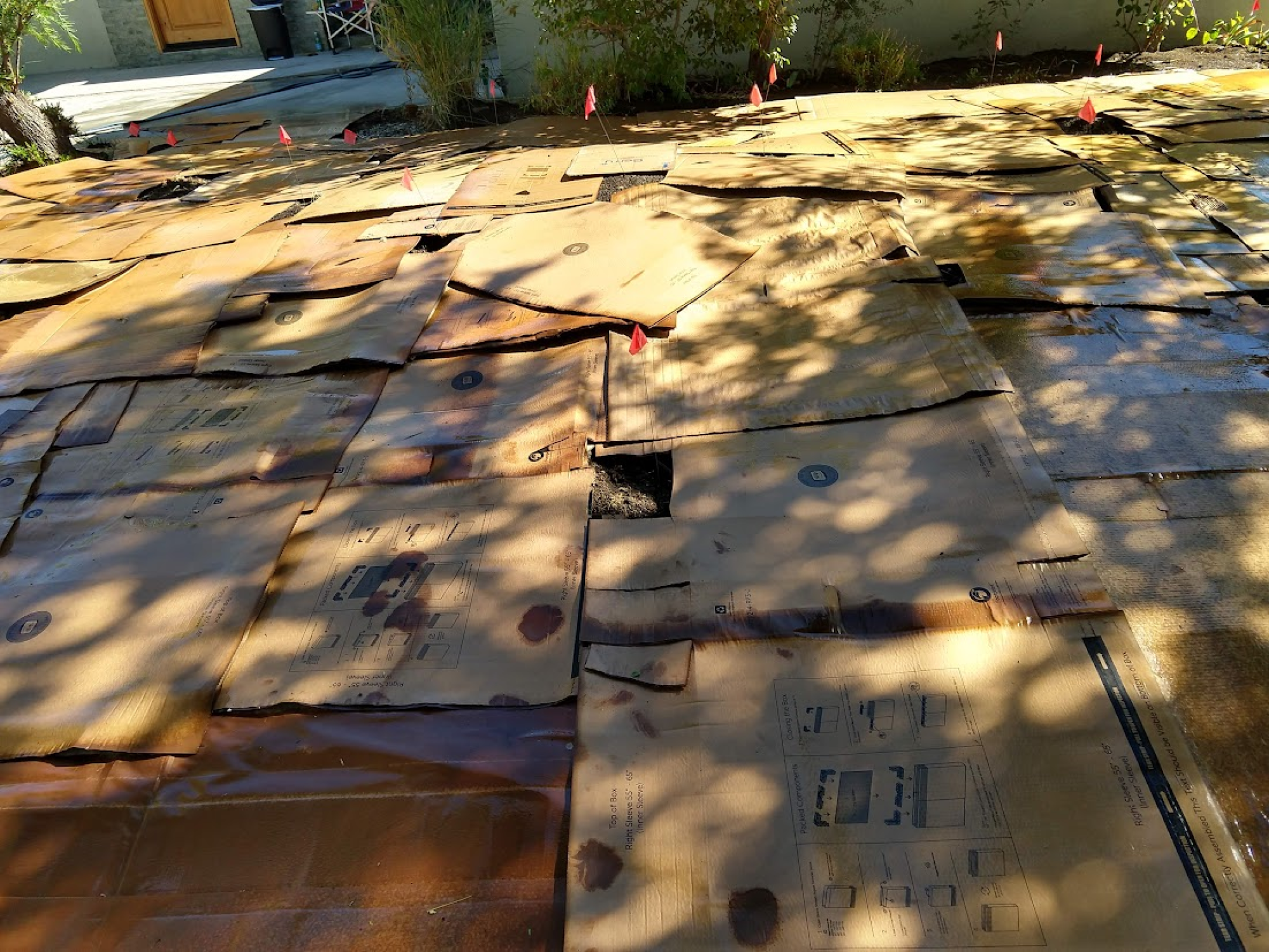
Eric Augusztiny’s front lawn is smothered in cardboard during the sheet mulching process.
(Eric Augusztiny)
Suitably educated, Augusztiny decided to tear out his lawn and plant a low-water substitute himself. Just don’t call him a designer. “It was a process of figuring out a simple design, getting the drip system in and putting down the cardboard,” Augusztiny said of the process known as sheet mulching, where the cardboard is wetted down and covered with 3 inches of mulch.
When he smothered his lawn with cardboard, his neighbors often asked him what he was doing. “I told them I was getting rid of the Bermuda grass,” he recalled. “They all told me, ‘Good luck with that.’”
Taking classes offered Augusztiny some revelations as he planned his garden. He followed Adams’s suggestion to “paint with wildflowers” and scattered wildflower seeds on top of established plants. He planted hummingbird sage after he read that it grows well in the shade of oak trees. Concerned about the depletion of Western monarch butterflies due to habitat loss, he felt it was important to plant Narrow-leaf milkweed (Asclepias fascicularis). “They have since shown up in droves,” he said.
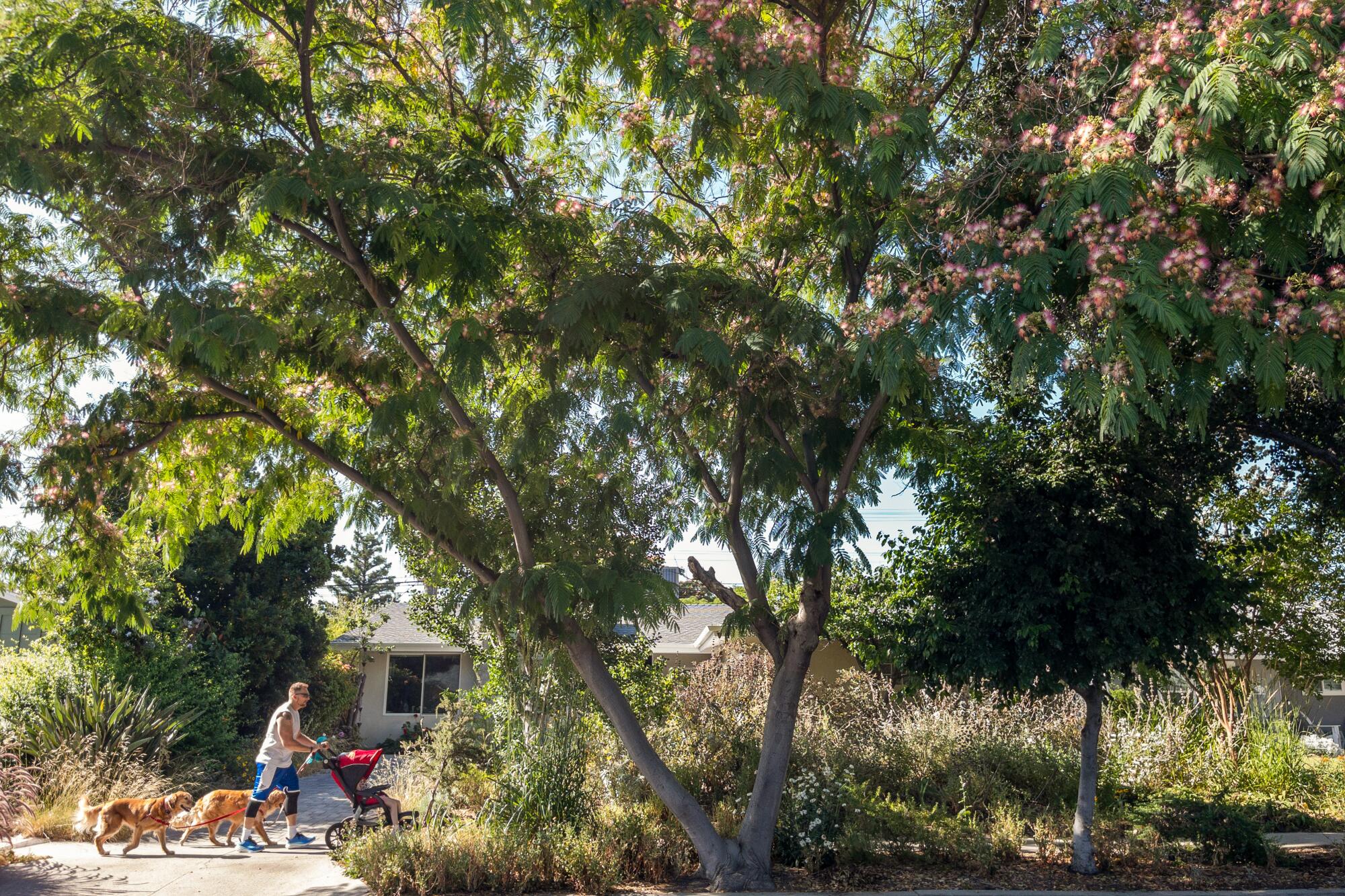
On the parkway, a coast live oak, Catalina cherry and silk tree provide shade. Augusztiny collects water using a rain barrel and rain chains. He also installed drip irrigation.
Regarding plants, Augusztiny made treks to native plant nurseries all over Los Angeles, including the California Botanic Garden in Claremont, Theodore Payne Foundation in Sunland and Pierce College in Woodland Hills. “Now, I have to stop because I’m generating my plants from harvesting the seeds and taking cuttings,” he said. “You can generate and regenerate the garden.” He even picked up free animal waste from the Los Angeles Zoo (known as “zoo doo”) at the Griffith Park Composting Facility.
He admits he killed some native plants initially because he overwatered them in the summer. That ended when he took a three-month hands-on course in native garden maintenance with Antonio Sanchez of the Santa Monica Mountains Fund in 2022. “I learned that drought-tolerant plants strengthen during the rainy season to ride out the dry season,” he said. He stopped drowning plants in the summer because he thought they were thirsty.
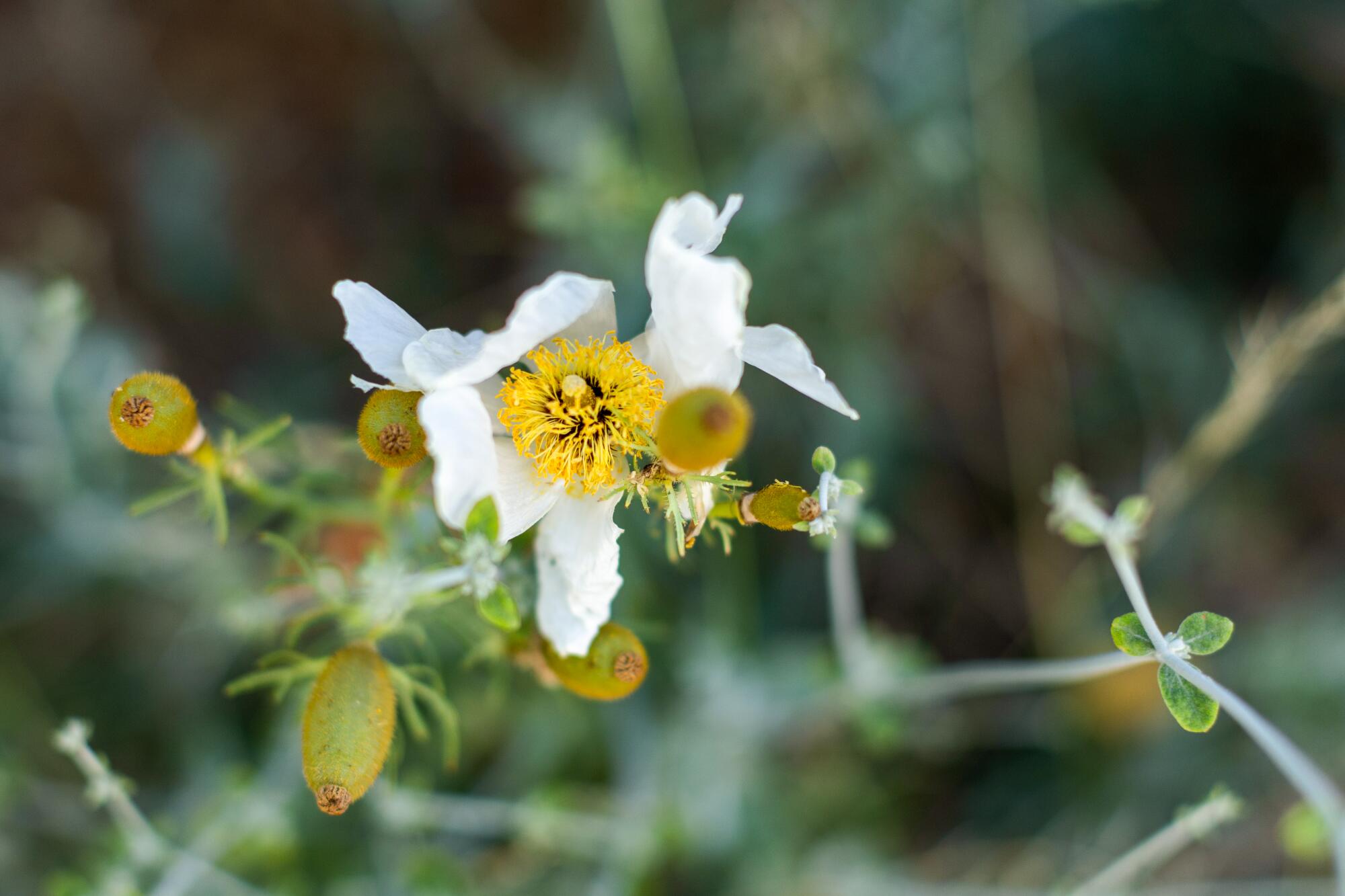
A Matilija poppy grows in Eric Augusztiny’s drought-tolerant front yard.
After six years, Augusztiny thinks Adams’ “sleep, creep, leap” mantra has finally materialized. “She told us the plantings would sleep the first year, creep the second and then leap in the third,” he explained. “Ah, but with only 11.5 inches from 2020-2022, the garden wasn’t moving.”
Fast-forward two years. After two years of record rainfall in Los Angeles, the California native habitat has overwhelmed the front yard.
“I hate to steal a title from a Hollywood film,” said the actor, “but suddenly it was everything, everywhere all at once.”
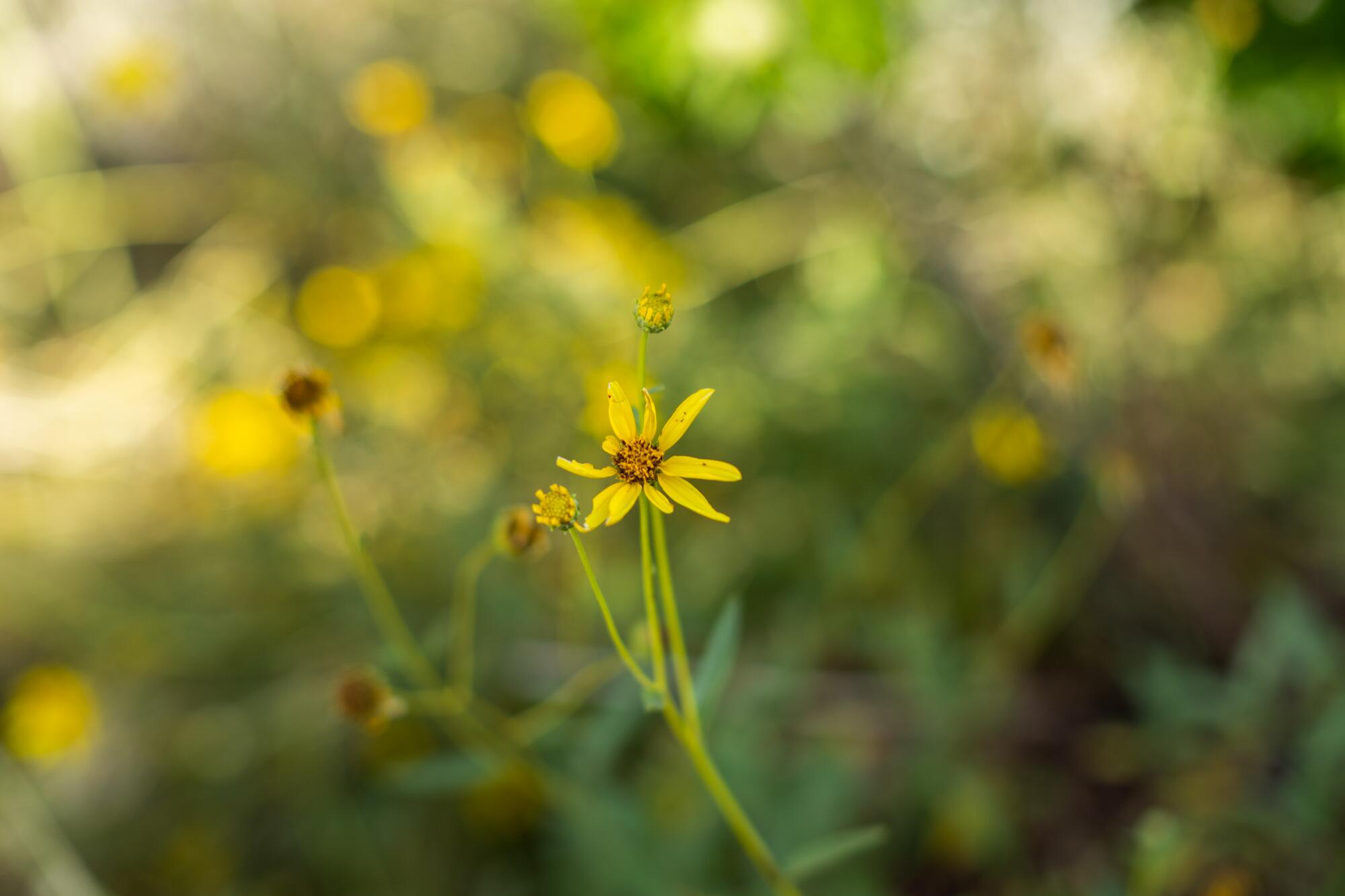
Narrowleaf sunflower grows in the garden.
The garden is wild and colorful with a heavenly fragrance attributed to the exploding sages — Cleveland (Salvia clevelandii), hummingbird (Salvia spathacea) and white (Salvia apiana) — along with colorful wildflowers like the fire-resistant California fuchsia (Epilobium canum) and purple Foothill penstemon (Penstemon heterophyllus).
Although many of the larger drought-tolerant plants are planted away from the street, some, such as bigberry manzanita (Arctostaphylos glauca), are dwarfed by California buckeye (Aesculus californica), coffeeberry (Frangula californica) and sugar bush (Rhus ovata).
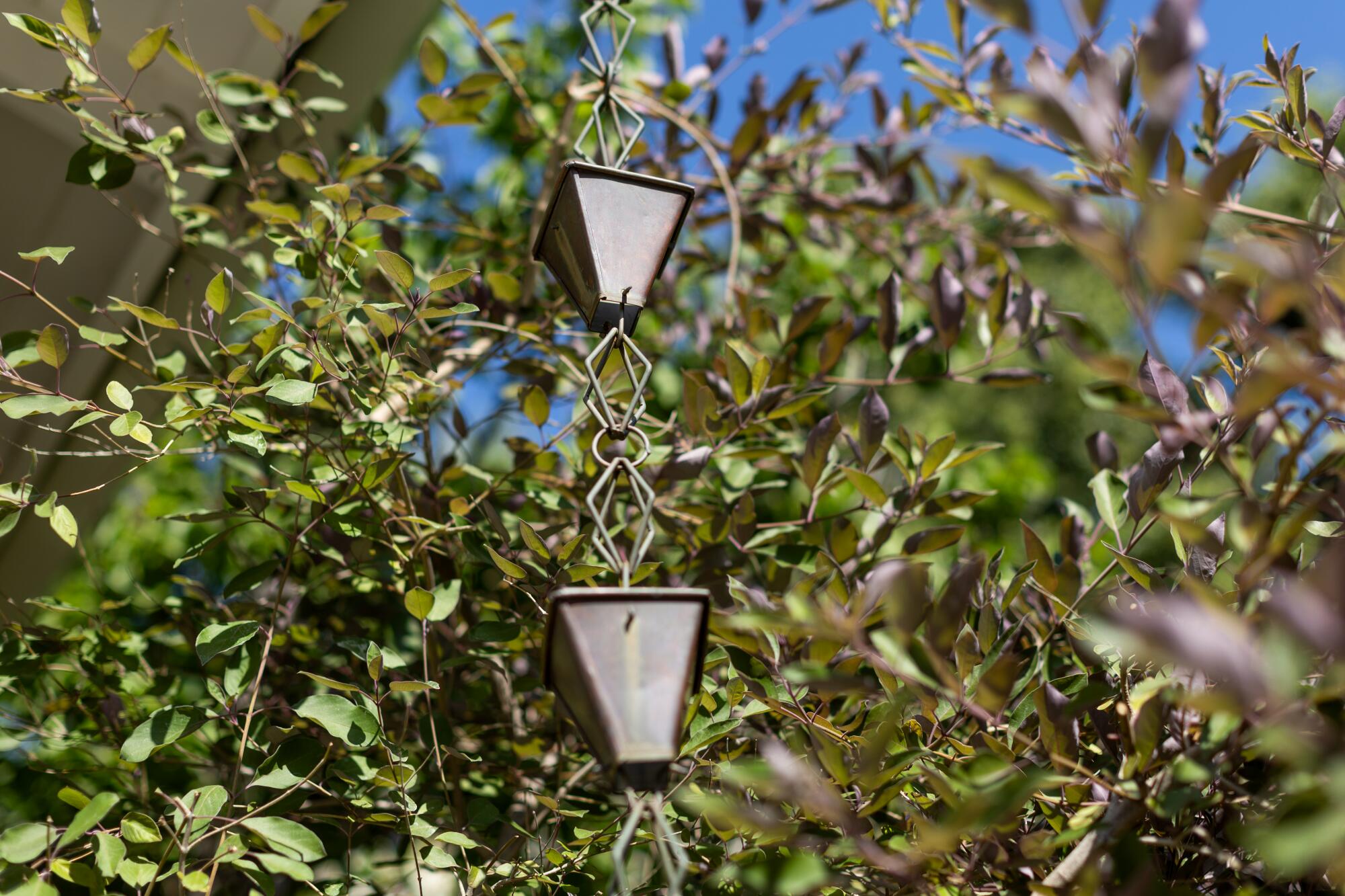
Rain chains capture rainwater from the roof.
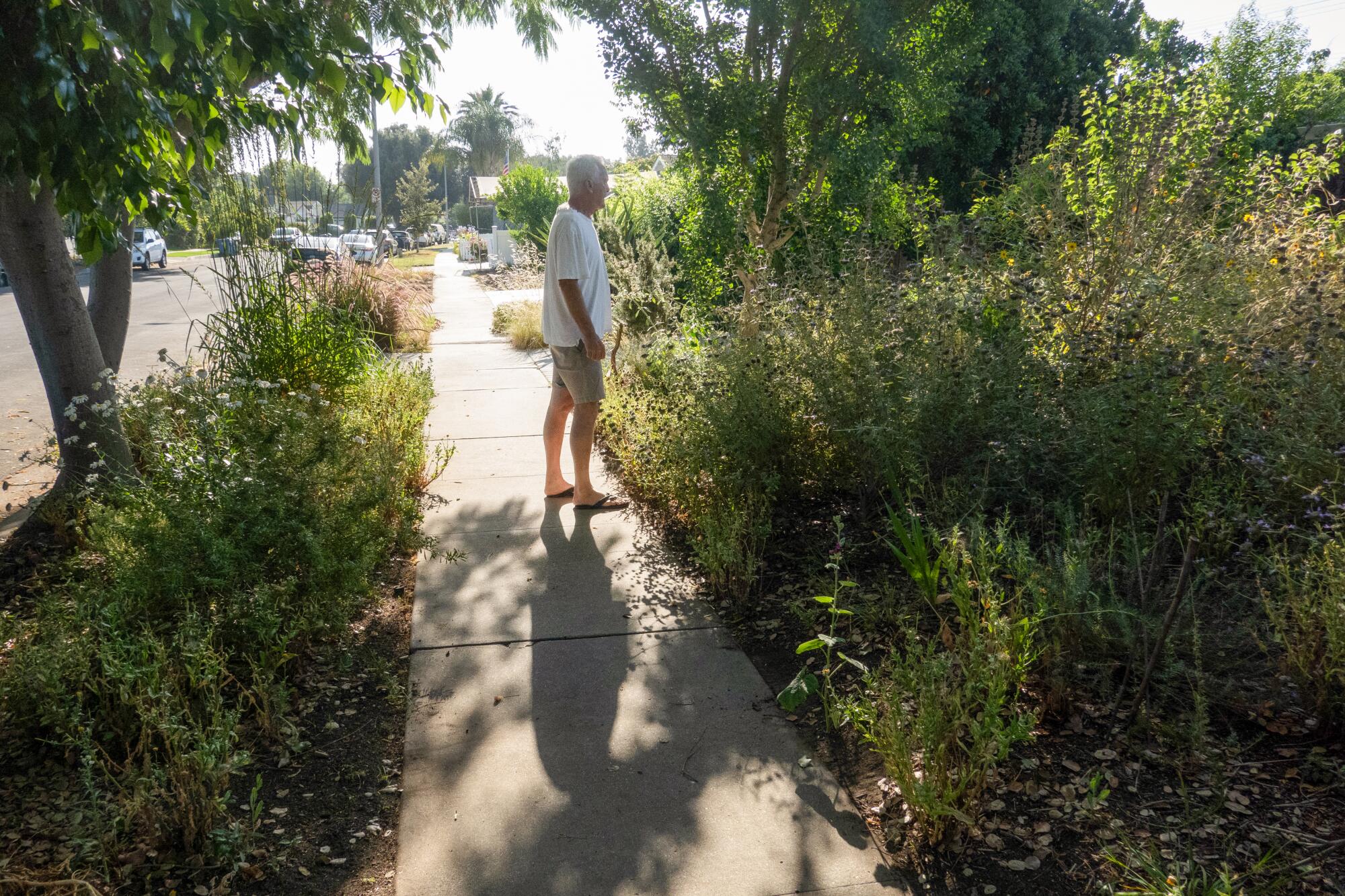
Augusztiny’s front yard and parking strip are overflowing with drought-tolerant plants.
No longer a gardening novice, the Seattle native passionately advocates the “need to do our small part to help stem climate change.” He thinks creating a native habitat in his front yard and installing rain barrels and a permeable driveway in the face of record-breaking heat waves is a good place to start.
“I enjoy nature, and Los Angeles has it all,” he said. “I’m not a purist when it comes to plants. I like to refer to them as climate-appropriate. But the more blacktops we can eliminate and the less stormwater runoff there is, the better our water quality and lives will be.”
Now, when neighbors walk their kids to school, they don’t ask him what he’s doing in his front yard. “They compliment the garden,” said Augusztiny, who waters twice a month. “The garden is not just for me. It’s for everyone.”
Plants in this garden
Arabian lilac (Vitex trifolia)
Coffee berry (Frangula californica)
Sugar bush (Rhus ovata)
Cleveland sage (Salvia clevelandii)
Narrow leaf milkweed (Asclepias fascicularis)
Black sage (Salvia mellafera)
White sage (Salvia apiana)
Purple sage (Salvia leucophylla)
Bigberry manzanita (Arctostaphylos glauca)
Palmer’s abutilon (Abutilon palmeri)
Desperado sage (Salvia desperado)
Penstemon heterophyllus ‘Margarita BOP’
California fuchsia (Epilobium canum)
Purple needle grass (Nassella pulchra)
Australian emu bush (Eremophila glabra)
Snow berry (Symphoricarpos mollis)
California buckwheat (Eriogonum fasciculatum)
Hummingbird sage (Salvia spathacea ‘Las Pilitas’)
Nuttall’s sunflower (Helianthus nuttallii)
Giant wildrye (Elymus condensatus)
Toyon ( Heteromeles arbutifolia )
Dudleya abramsii
Coulter’s Matilija poppy (Romneya coulteri)
Ceanothus griseus var. horizontalis ‘Yankee Point’
Fiesta Marigold monkeyflower (Mimulus ‘Fiesta Marigold)
Mimulus (Diplacus) ‘Fiesta Marigold’

Lifestyle
Terry Tempest Williams on why women with big ideas get labeled ‘crazy’ : Wild Card with Rachel Martin

A note from Wild Card host Rachel Martin: I met Terry Tempest Williams about 25 years ago at a writer’s conference in Yosemite Valley. I was a young reporter who was there to do a story about how literature was addressing climate change and she made such a huge impression on me. I had never heard someone talk about the natural world the way Terry did and she had a spiritual depth I hadn’t encountered in my life at that point.
To this day, Terry’s writing always reorients me towards what is good, what is beautiful, and what is true. Her newest book is called “The Glorians.”

For its upcoming Los Angeles venue, experiential art firm Meow Wolf will focus on the art of storytelling, with a specific eye toward skewering our city’s moviemaking magic. To help bring that vision to life, Meow Wolf has entered into a creative partnership with Titmouse, one of L.A.’s most renowned independent animation houses.
The Hollywood-based studio behind popular series such as “Big Mouth” and “Star Trek: Lower Decks” will create animation that will be shown throughout the West L.A. venue, which is on target for a late 2026 opening at the Howard Hughes entertainment complex.
It’s a move that represents a shift for Santa Fe, N.M.-based Meow Wolf. Over the last decade-plus, the art collective has grown beyond its anything-goes, punk-meets-psychedelic roots into an organization with full-scale, maximalist installations in its hometown, Denver, Las Vegas, Houston and the Dallas suburbs. In the past, Meow Wolf kept most of its media in-house.
As part of its larger-than-life participatory art installations, Meow Wolf L.A. will feature a mix of live action and animation, the former filmed by Meow Wolf in its Santa Fe studio. Meow Wolf’s James Stephenson, a senior VP with the company and its creative director of emerging media, said the degree to which the L.A. exhibition will lean into various animation styles necessitated an outside partner. Titmouse’s work, in development by a number of directors with contrasting tones, will be shown on a variety of formats, ranging from cinema screens to full-room projections.
“I really believe in animation as an art form, and I know the Titmouse folks do too,” Stephenson says. “Animation is made by artists. It’s made by artists with their own hands. It’s something that is still very rooted in craft.”
Meow Wolf’s L.A. space is set in a former cinema complex, and will champion its location, taking guests on a journey through a converted movie house and beyond, into a sci-fi-inspired fantasyland with sentient spaceships and a 30-foot-tall mushroom tower. Meow Wolf creatives have spoken of the fantastical movie theater as one that will feature animated, self-aware candy before attendees enter the main exhibition space, making Titmouse’s work some of the first art guests will encounter. Titmouse co-founder Chris Prynoski has said the studio has lined up at least six directors for the exhibit.
An in-progress art installation destined for Meow Wolf L.A. at the art collective’s Santa Fe, N.M., headquarters. The L.A. exhibition will feature animation from Titmouse.
(Gabriela Campos / For The Times)
Titmouse, says Stephenson, is the right partner because “they’re known less for a house style, and more for a house vibe.” Over the years, Titmouse has been behind such diverse shows as “Scavengers Reign,” owning a Jean Giraud influence rooted in French and Spanish surrealism, the lively “Jentry Chau vs. the Underworld,” with an unique color palette that took inspiration from anime and Chinese mythology, the exaggerated comic book feel of Adult Swim’s “Metalocalypse,” and the approachable yet expressive tone of “Star Trek: Lower Decks.”
“Meow Wolf’s vibe is similar to Titmouse’s vibe,” Stephenson says. “It’s artist-first, artist-driven, independent and kinda edgy. They are always trying to find the edge of what’s possible. They try to see how far they can go, and it’s done for fun and in the spirit of taking risks.”
Prynoski says working with Meow Wolf will give Titmouse a sense of artistic freedom it doesn’t always have when delivering content for more traditional Hollywood partners. He says the multi-director approach is a callback to the early days of Warner Bros. Animation, when individual creators put their own stamp on Looney Tunes material.
“I use Bugs Bunny as an example,” Prynoski says. “You’ve got a Friz Freleng Bugs Bunny short. You’ve got a Chuck Jones Bugs Bunny short. You’ve got a Tex Avery Bugs Bunny short. They’re all different versions of Bugs Bunny, and people who are really paying attention can tell which director directed each one. Even though to the layman, these are all Bugs Bunny, but if you lined them up, they are drawing in different styles, sensibilities and techniques.”
Prynoski says that was a centerpiece of his pitch to Meow Wolf, noting that characters will reappear in multiple installations, each handled by a different artist. Meow Wolf L.A., in fact, will be the firm’s most character-driven exhibition, as guests will follow the storylines of three main protagonists throughout the space.
In announcing the partnership, Meow Wolf and Titmouse released an image from an animated work directed by Luca Vitale. It features a key character having a moment with a hummingbird and it’s done in an elegant, slightly anime-influenced style. It’s an image full of movement, reflecting a character in transition with inviting pastels and bold dashes.
“I like that image because I think it captures some of the sense of wonder that we want people to feel,” Stephenson says. “The character is having an encounter with the elusive nature of creativity and reality in a way that makes them have a different perspective of what’s possible.”
Other contributing animation directors to Meow Wolf L.A. include Space Dawg, Felix Colgrave, Alexander Vanderplank and Phimémon Martin, and Jun Ioneda.
Titmouse’s partnership with Meow Wolf will extend beyond the L.A. exhibition. The two will be working on the development of Meow Wolf New York, which is slated to open some time after Los Angeles, and are collaborating on a planned animated series, which Prynoski is spearheading.
Meow Wolf exhibits are the result of sometimes hundreds of disparate artists coming together in a shared space. Distilling that into a signature, singular style for a series could be a challenge. Stephenson pinpoints some guiding principles.
“You really need to feel the hand of the artist,” he says. “You need to feel a DIY aesthetic. You need to feel the materiality. Those are very specific to what we are.”

The Kennedy Center on June 28, with its facade signage still covered by a tarp and scaffolding.
Alex Wroblewski/AFP via Getty Images
hide caption
toggle caption
Alex Wroblewski/AFP via Getty Images
On Wednesday, a federal appeals court denied President Trump’s request to stop the removal of his name from Washington, D.C.’s Kennedy Center. The signage on the building has been covered with tarp and scaffolding since June 13, but in a court filing last month, the center’s current executive director said that Trump’s name has been removed.
In their decision, three judges from the U.S. District Court of Appeals for the District of Columbia Circuit said that the president had failed to prove that the arts center would be “irreparably injured” without Trump’s name attached to it.
NPR requested comment from the Kennedy Center, but did not receive an immediate reply.
This latest round of court decisions is part of the ongoing litigation filed by Rep. Joyce Beatty, D-Ohio, against President Trump and the board of the Kennedy Center. In a statement emailed Wednesday to NPR, Beatty said: “Today’s ruling again affirms that this administration’s efforts to rename the Kennedy Center were unlawful. His name no longer desecrates this sacred memorial, which belongs to the American people. Now it is time for the Trump administration to accept this, comply with the law, and take the tarps down.”
In previous court filings, Trump’s legal team had asserted that removing the president’s name from the arts complex, both on the physical building and in its digital materials, would inflict irreparable harm in both time and money already spent. In the denial, the three judges — Patricia Millett, Robert Wilkins and Gregory Katsas — wrote that since Trump’s name has already been removed, “a stay would not avert those harms.”
Furthermore, Trump had claimed that without his name attached, future fundraising would be threatened “and [will] contribute to the financial decline of the Center.” In response, the appeals judges wrote: “Appellants, however, have failed to support this assertion with any specific facts or evidence. They offer only the conclusory assertions of the Kennedy Center’s Executive Director that were made in a factually unsupported declaration.” The center’s current executive director, Matt Floca, specializes in physical plant management.
The presiding judge in the case, Christopher R. Cooper, has ordered that the center provide him a status report on the center’s operation and programming before the end of this month. As of Wednesday, the center’s calendar lists a small roster of programs, including outdoor free movie screenings, workshops for children, and five free live performances in July on its Millennium Stage. In the past, the Kennedy Center presented over 2,000 arts and education events each year, including free daily Millennium Stage performances.

-

 San Francisco, CA7 minutes ago
Man reported missing in San Francisco
-

 Dallas, TX12 minutes ago
How to buy France World Cup semifinal soccer tickets in Dallas
-

 Miami, FL19 minutes ago
Miami-Dade Schools names six semifinalists for superintendent
-

 Boston, MA22 minutes ago
Lawsuit: ICE detained East Boston father despite legal status
-

 Denver, CO27 minutes ago
Victor Marx wins GOP primary for Colorado governor, defeating veteran lawmaker after unorthodox campaign
-

 Seattle, WA34 minutes ago
Widower of pregnant woman who was shot to death in Seattle sues homelessness authority
-

 San Diego, CA37 minutes ago
Terrifying moment huge sea lions chase tourists off popular California beach
-

 Milwaukee, WI49 minutes ago
Milwaukee leaders condemn ICE arrests as agency ignores City mask ordinance

