Lifestyle
In a hot L.A. neighborhood full of brown lawns, his DIY native plant garden thrives

Water-hungry lawns are symbols of Los Angeles’ past. In this series, we spotlight yards with alternative, low-water landscaping built for the future.
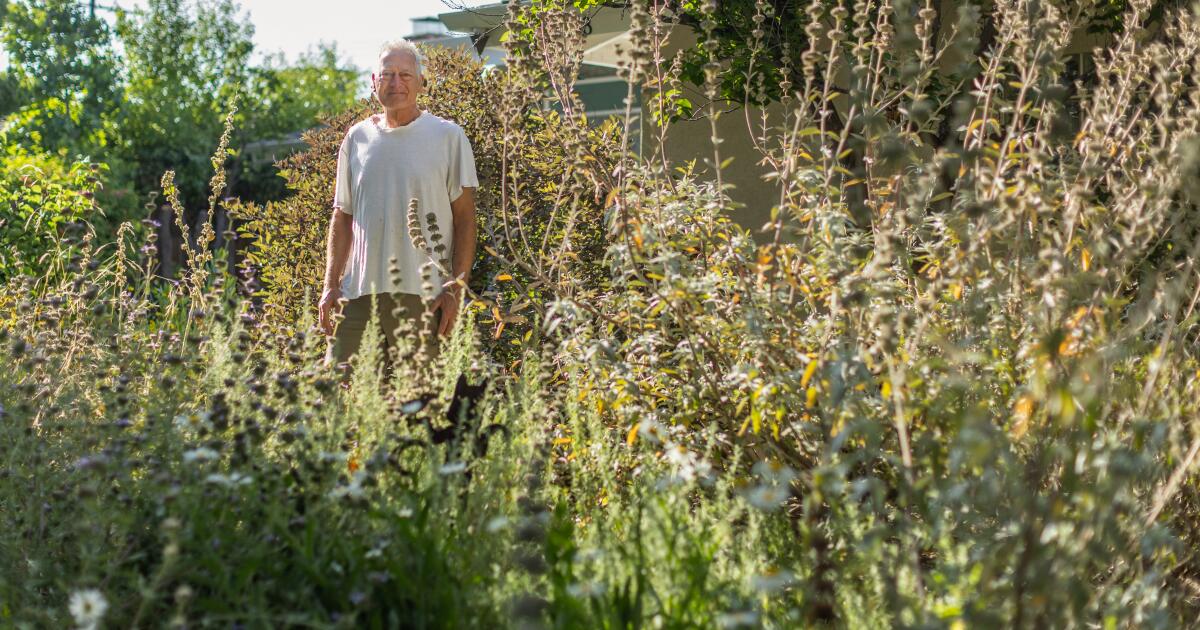
The temperature was in the 90s in West Hills, but that didn’t deter an astonishing number of monarch butterflies, hummingbirds and bees from feeding on the California-friendly plants — sages, salvias and flowering milkweed — in Eric Augusztiny’s front yard.
Pollinators, however, aren’t the only ones who call the front yard home. “This is our buddy, Lizzy,” Augusztiny said with a smile as he and his wife, Lise Ransdell, greeted an enormous lizard who crawled out from under a large salvia ‘Desperado’ plant.
“It’s just a postage stamp suburban yard, but there’s a lot going on here,” Ransdell said of the yard’s abundant wildlife, which counts rabbits, skunks, raccoons and possums as visitors.
It wasn’t always like this. When Augusztiny purchased the home in 1996, the traditional yard looked like many others on his street with a Bermuda grass lawn, assorted shrubs and an apricot tree.
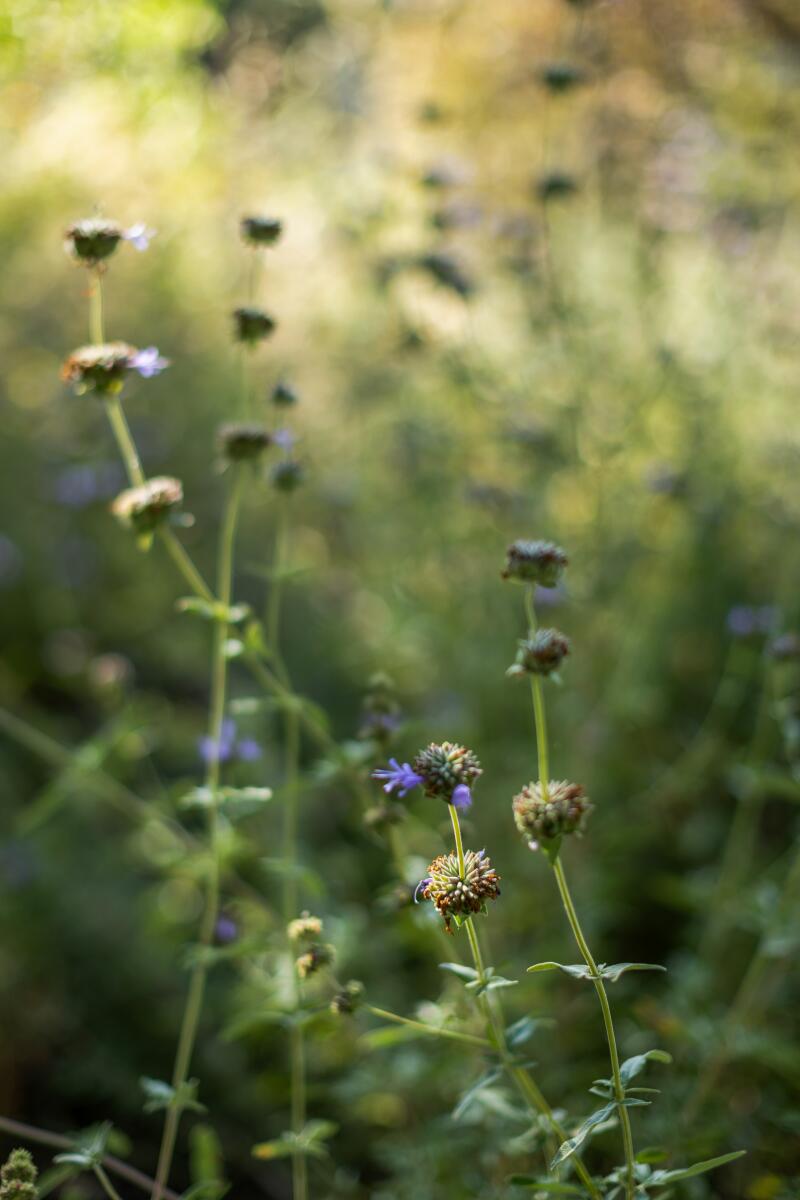
Milkweed, a favorite of monarch butterflies, left. Cleveland sage, Salvia clevelandii. (Myung J. Chun / Los Angeles Times)
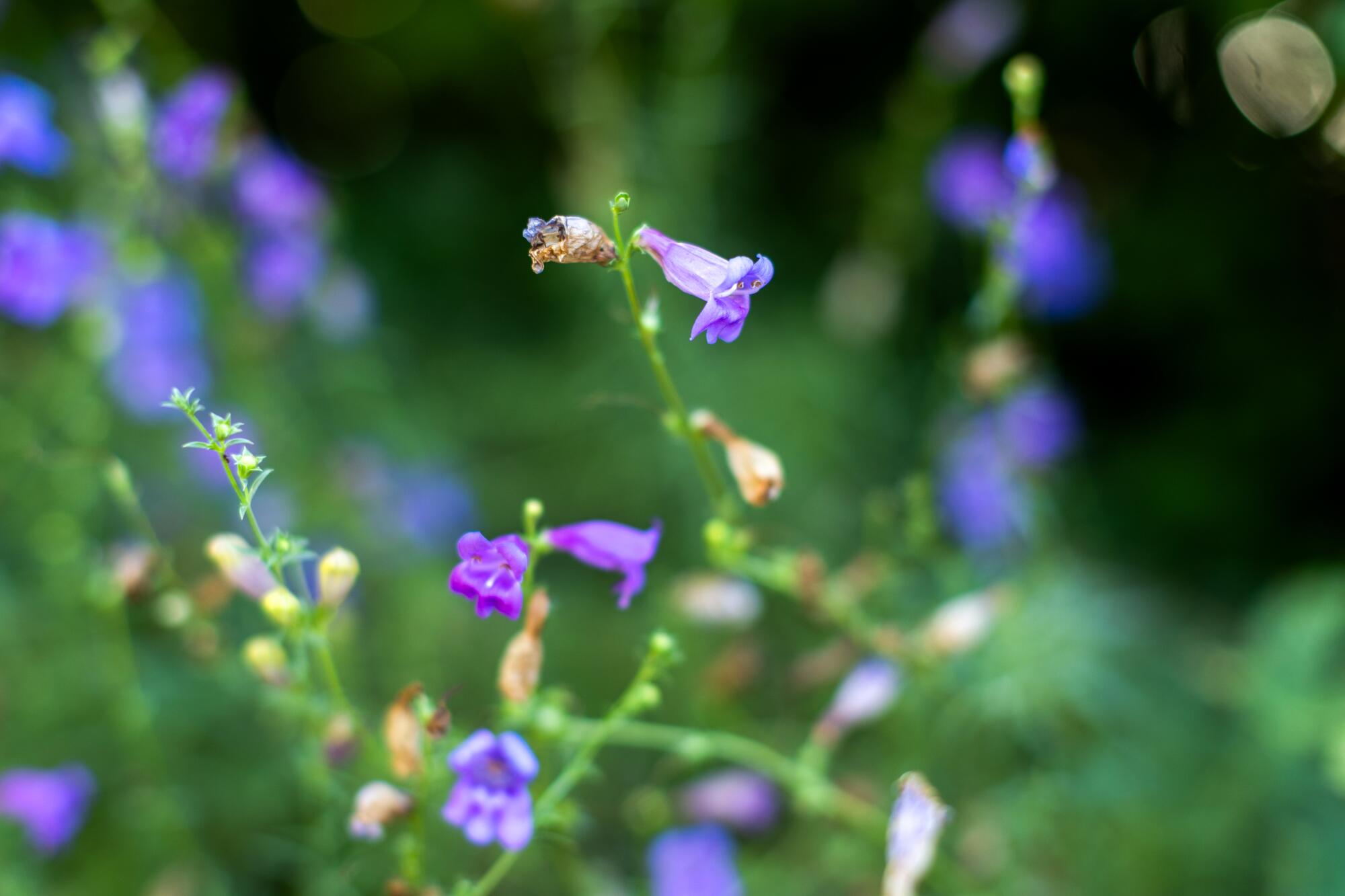
Foothill penstemon grows in Eric Augusztiny’s drought-tolerant front yard.
Yes, Augusztiny acknowledges, lawns have appeal, but not in his West Valley neighborhood where “concrete is the equivalent of a frying pan,” and sustaining thirsty turf in triple-digit heat is impossible. “Even if I wanted a lawn — and I don’t — you can’t keep one alive here,” he said, pointing to the brown lawns that border his tree-lined street.
“The garden goes dormant in the summer but doesn’t die. Drought-tolerant plants are survivors. The sugar bush, toyon, manzanita, coffee berry, ceanothus and hummingbird sage hold their vivid green color year-round. The California fuchsia blooms into the fall, and although the salvias’ spikes above the foliage die back after flowering, the structure and leaves remain vital.”
Besides mowing the lawn, Augusztiny was not much of a gardener before he purchased his home. “I knew how to reseed the lawn. Again and again,” he said with a laugh. So he decided to learn all he could about removing his lawn, building healthy soil and replacing it with a drought-tolerant alternative.
He started by attending a demonstration on lasagna mulching led by artist-in-residence and horticulturist Leigh Adams at the Los Angeles County Arboretum’s Crescent Farm. The class inspired Augusztiny, who then checked out books on California native plants from the Los Angeles Public Library and attended a hands-on workshop at the Metropolitan Water District of Southern California Field Office.
When the couple remodeled their home in 2018, they decided it was a good time to remove the lawn. The LADWP’s lawn conversion program — which currently pays $5 per square foot to remove turf and replace it with low-water landscapes — was an incentive but not the primary driving force. “I wasn’t in it for the money,” Augusztiny said of the $2,000 rebate they received then, “but it helped cover the cost.”
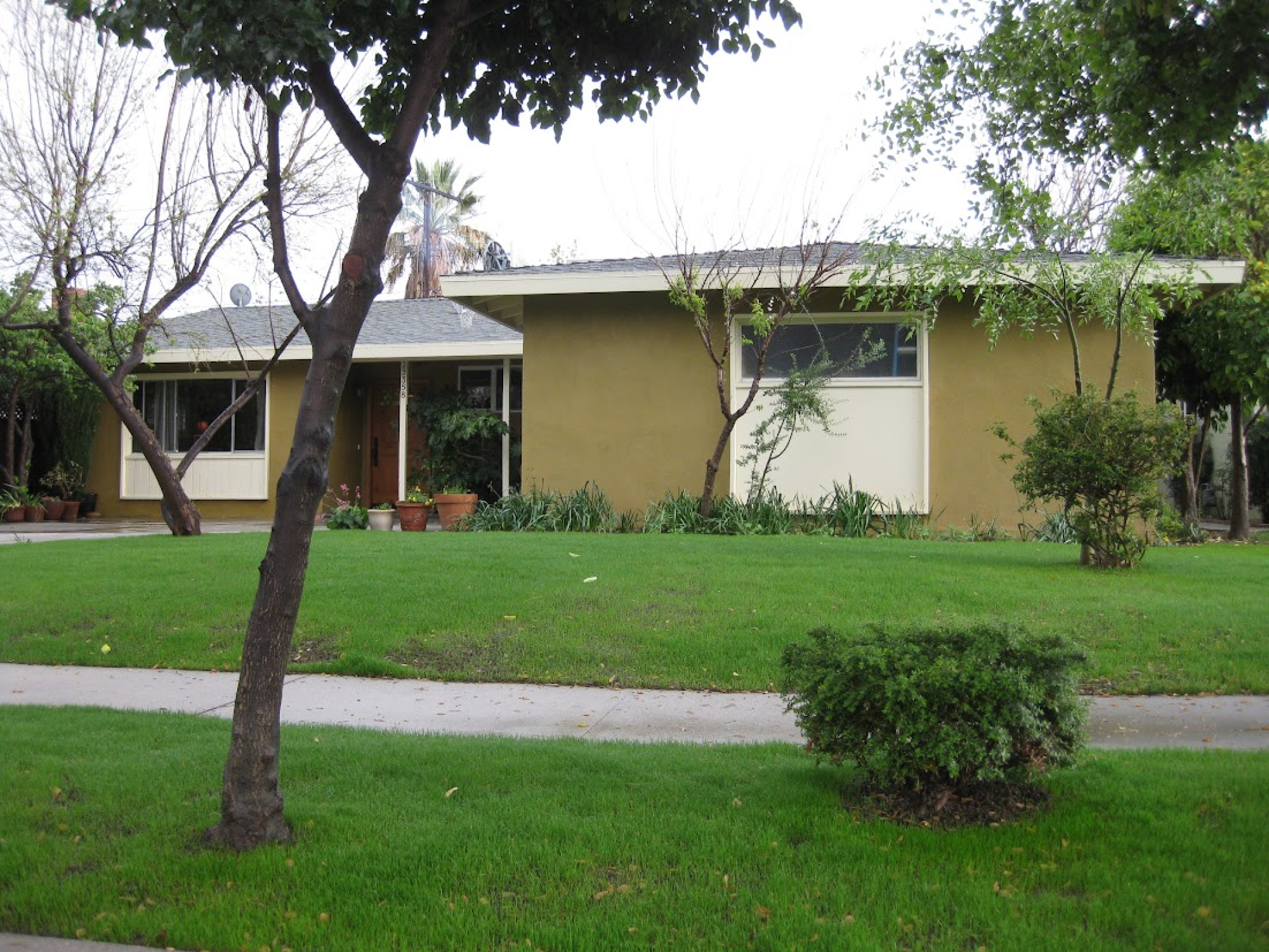
Eric Augusztiny’s front yard in West Hills before he removed his lawn and replaced it with a drought-tolerant alternative.
(Eric Augusztiny)
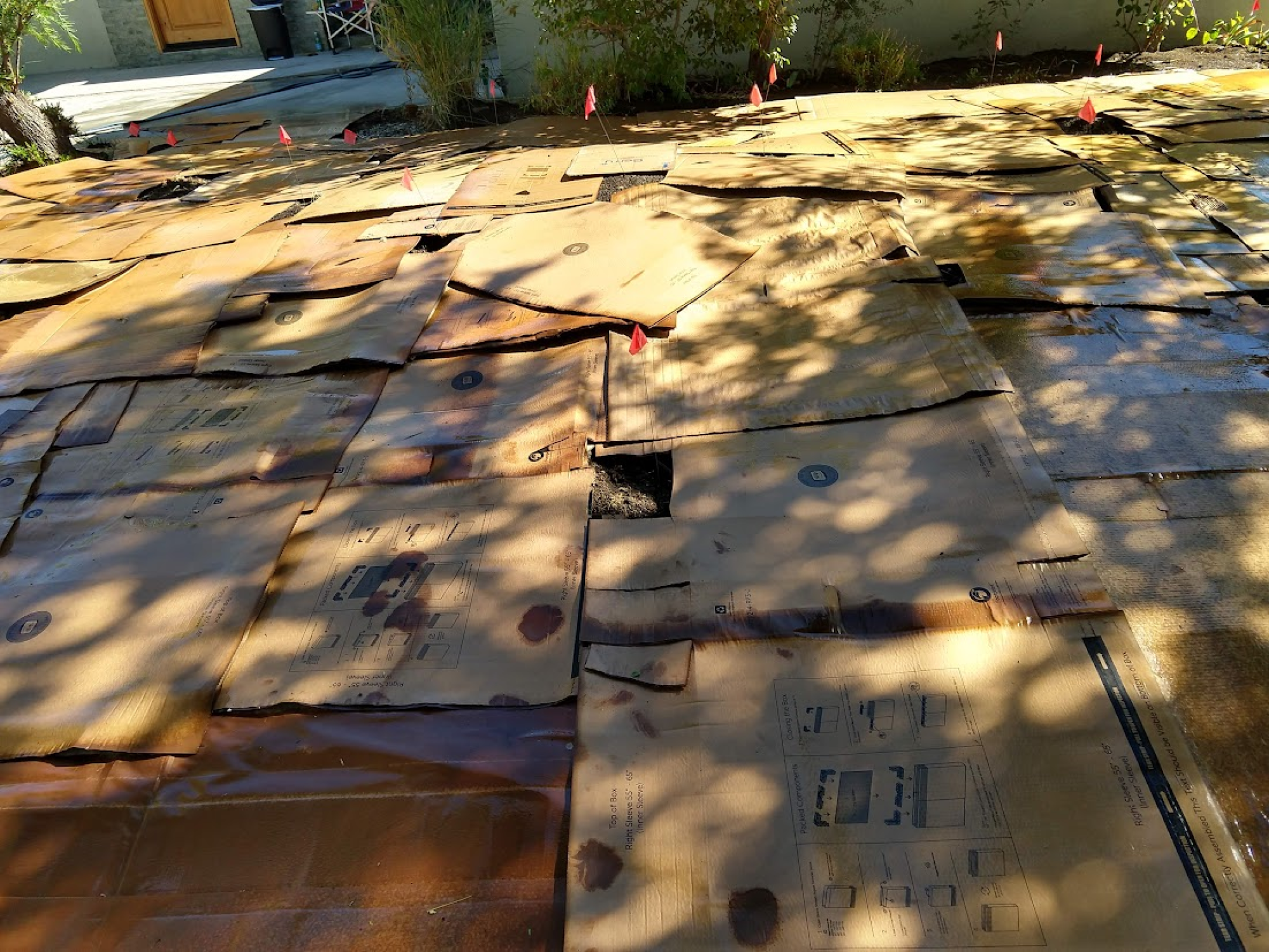
Eric Augusztiny’s front lawn is smothered in cardboard during the sheet mulching process.
(Eric Augusztiny)
Suitably educated, Augusztiny decided to tear out his lawn and plant a low-water substitute himself. Just don’t call him a designer. “It was a process of figuring out a simple design, getting the drip system in and putting down the cardboard,” Augusztiny said of the process known as sheet mulching, where the cardboard is wetted down and covered with 3 inches of mulch.
When he smothered his lawn with cardboard, his neighbors often asked him what he was doing. “I told them I was getting rid of the Bermuda grass,” he recalled. “They all told me, ‘Good luck with that.’”
Taking classes offered Augusztiny some revelations as he planned his garden. He followed Adams’s suggestion to “paint with wildflowers” and scattered wildflower seeds on top of established plants. He planted hummingbird sage after he read that it grows well in the shade of oak trees. Concerned about the depletion of Western monarch butterflies due to habitat loss, he felt it was important to plant Narrow-leaf milkweed (Asclepias fascicularis). “They have since shown up in droves,” he said.
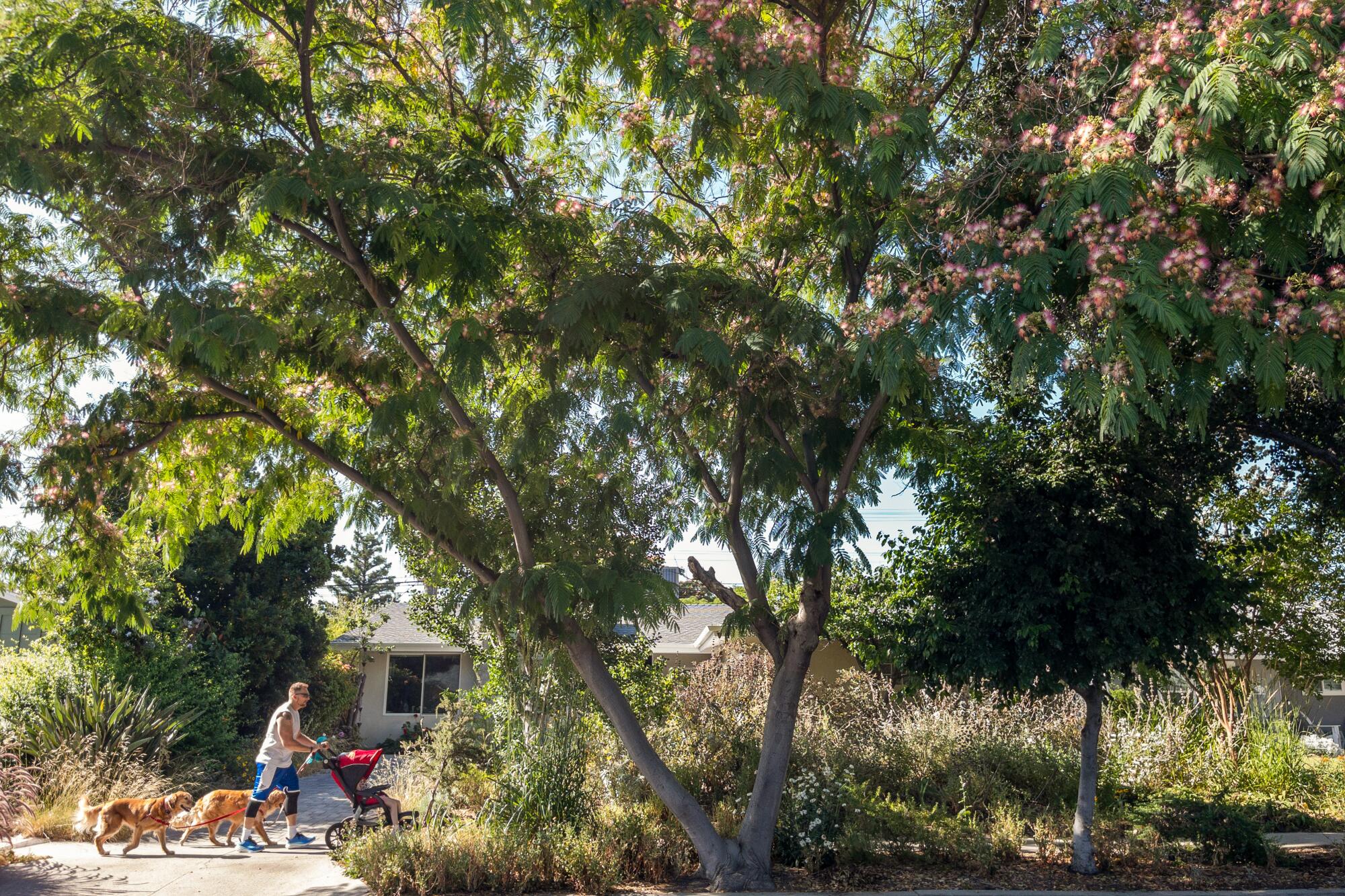
On the parkway, a coast live oak, Catalina cherry and silk tree provide shade. Augusztiny collects water using a rain barrel and rain chains. He also installed drip irrigation.
Regarding plants, Augusztiny made treks to native plant nurseries all over Los Angeles, including the California Botanic Garden in Claremont, Theodore Payne Foundation in Sunland and Pierce College in Woodland Hills. “Now, I have to stop because I’m generating my plants from harvesting the seeds and taking cuttings,” he said. “You can generate and regenerate the garden.” He even picked up free animal waste from the Los Angeles Zoo (known as “zoo doo”) at the Griffith Park Composting Facility.
He admits he killed some native plants initially because he overwatered them in the summer. That ended when he took a three-month hands-on course in native garden maintenance with Antonio Sanchez of the Santa Monica Mountains Fund in 2022. “I learned that drought-tolerant plants strengthen during the rainy season to ride out the dry season,” he said. He stopped drowning plants in the summer because he thought they were thirsty.
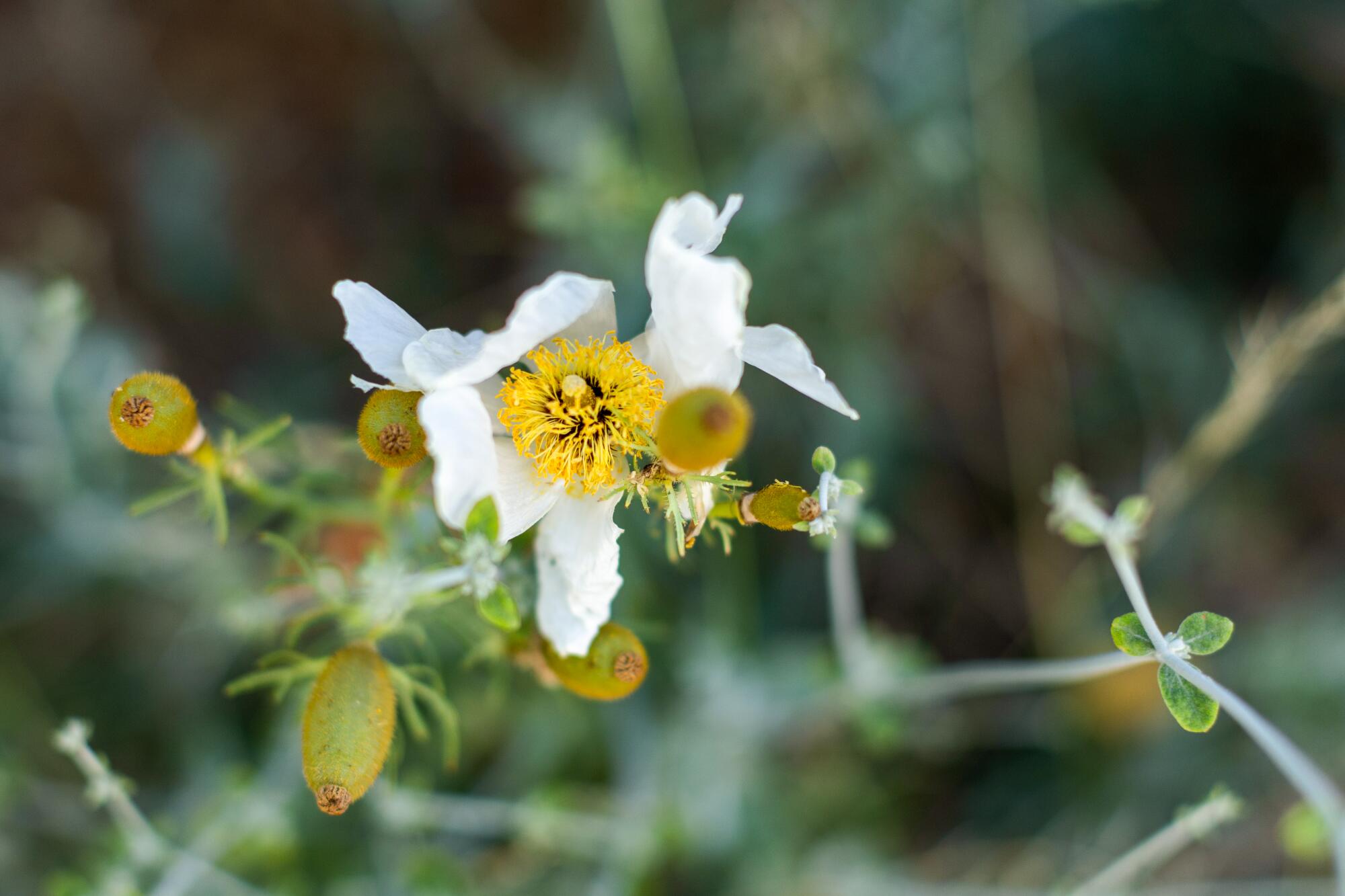
A Matilija poppy grows in Eric Augusztiny’s drought-tolerant front yard.
After six years, Augusztiny thinks Adams’ “sleep, creep, leap” mantra has finally materialized. “She told us the plantings would sleep the first year, creep the second and then leap in the third,” he explained. “Ah, but with only 11.5 inches from 2020-2022, the garden wasn’t moving.”
Fast-forward two years. After two years of record rainfall in Los Angeles, the California native habitat has overwhelmed the front yard.
“I hate to steal a title from a Hollywood film,” said the actor, “but suddenly it was everything, everywhere all at once.”
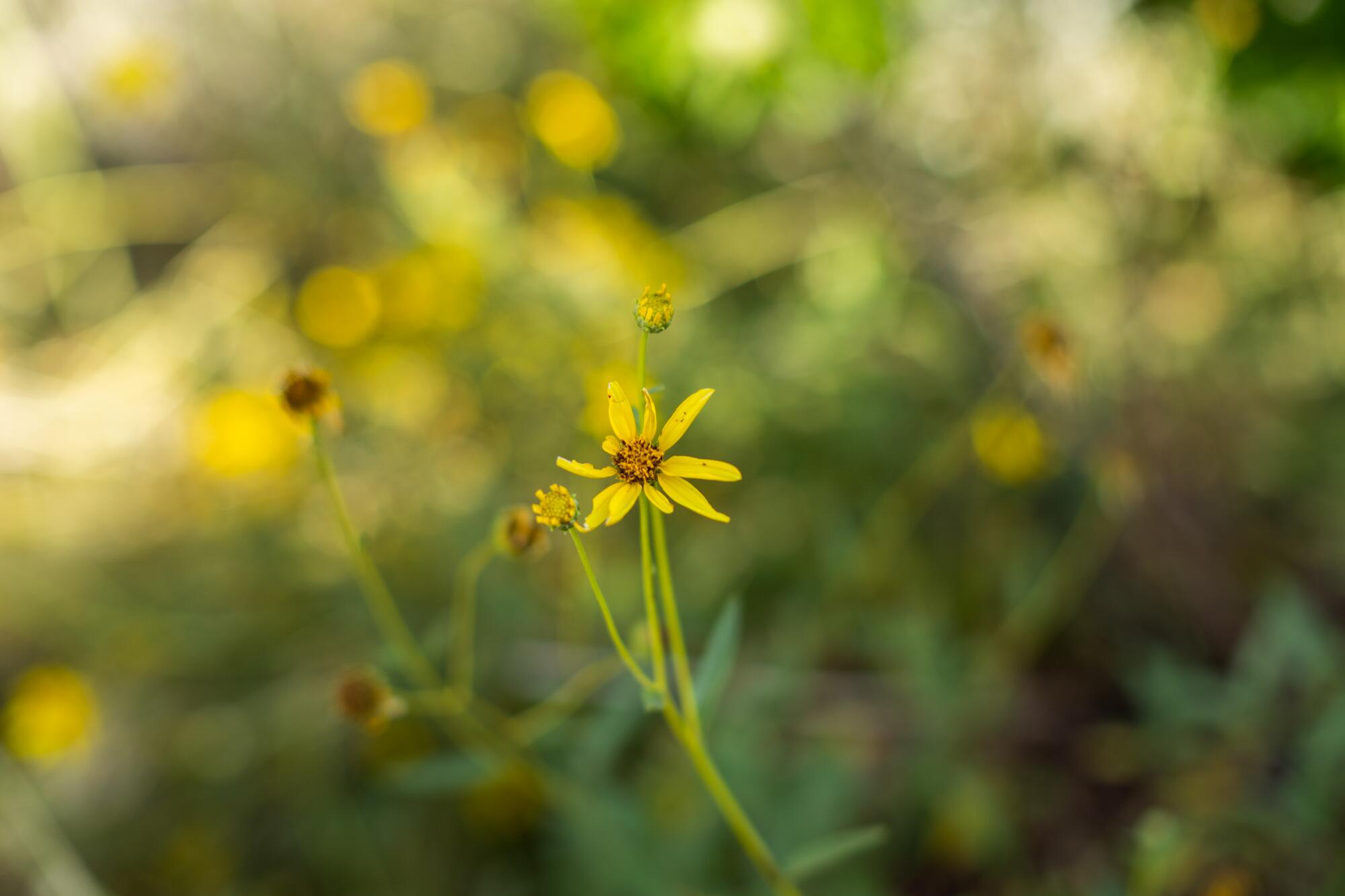
Narrowleaf sunflower grows in the garden.
The garden is wild and colorful with a heavenly fragrance attributed to the exploding sages — Cleveland (Salvia clevelandii), hummingbird (Salvia spathacea) and white (Salvia apiana) — along with colorful wildflowers like the fire-resistant California fuchsia (Epilobium canum) and purple Foothill penstemon (Penstemon heterophyllus).
Although many of the larger drought-tolerant plants are planted away from the street, some, such as bigberry manzanita (Arctostaphylos glauca), are dwarfed by California buckeye (Aesculus californica), coffeeberry (Frangula californica) and sugar bush (Rhus ovata).
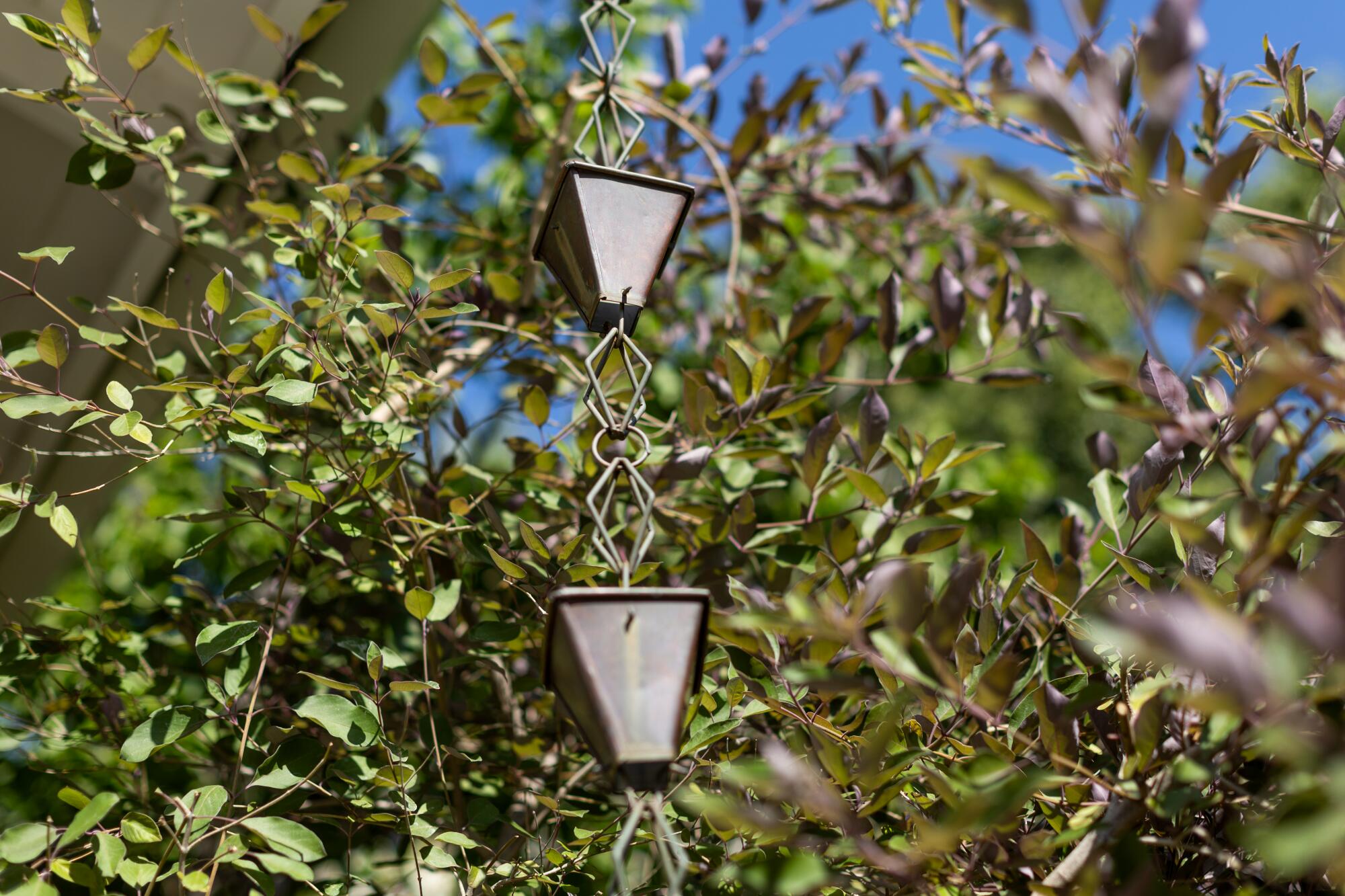
Rain chains capture rainwater from the roof.
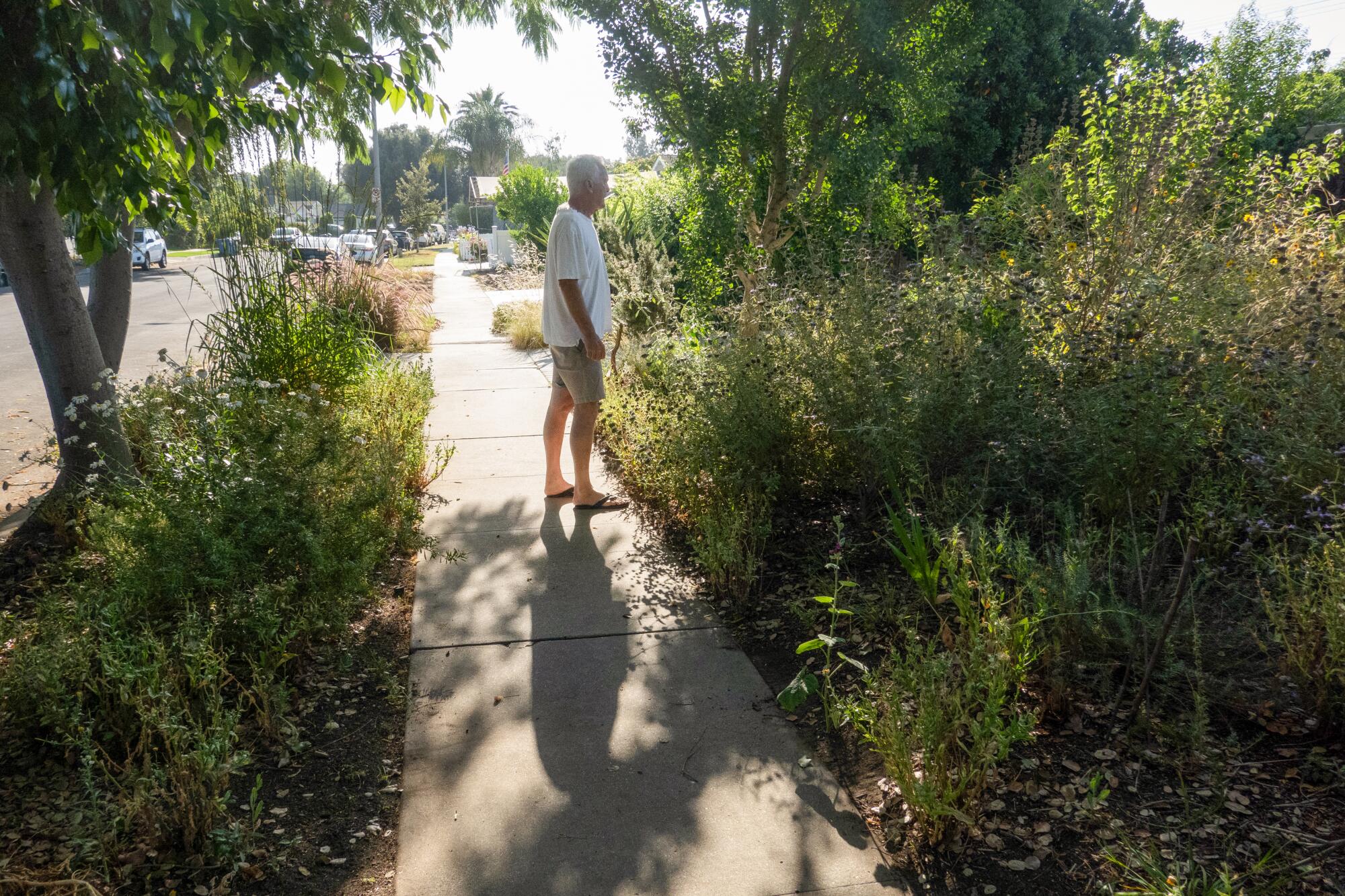
Augusztiny’s front yard and parking strip are overflowing with drought-tolerant plants.
No longer a gardening novice, the Seattle native passionately advocates the “need to do our small part to help stem climate change.” He thinks creating a native habitat in his front yard and installing rain barrels and a permeable driveway in the face of record-breaking heat waves is a good place to start.
“I enjoy nature, and Los Angeles has it all,” he said. “I’m not a purist when it comes to plants. I like to refer to them as climate-appropriate. But the more blacktops we can eliminate and the less stormwater runoff there is, the better our water quality and lives will be.”
Now, when neighbors walk their kids to school, they don’t ask him what he’s doing in his front yard. “They compliment the garden,” said Augusztiny, who waters twice a month. “The garden is not just for me. It’s for everyone.”
Plants in this garden
Arabian lilac (Vitex trifolia)
Coffee berry (Frangula californica)
Sugar bush (Rhus ovata)
Cleveland sage (Salvia clevelandii)
Narrow leaf milkweed (Asclepias fascicularis)
Black sage (Salvia mellafera)
White sage (Salvia apiana)
Purple sage (Salvia leucophylla)
Bigberry manzanita (Arctostaphylos glauca)
Palmer’s abutilon (Abutilon palmeri)
Desperado sage (Salvia desperado)
Penstemon heterophyllus ‘Margarita BOP’
California fuchsia (Epilobium canum)
Purple needle grass (Nassella pulchra)
Australian emu bush (Eremophila glabra)
Snow berry (Symphoricarpos mollis)
California buckwheat (Eriogonum fasciculatum)
Hummingbird sage (Salvia spathacea ‘Las Pilitas’)
Nuttall’s sunflower (Helianthus nuttallii)
Giant wildrye (Elymus condensatus)
Toyon ( Heteromeles arbutifolia )
Dudleya abramsii
Coulter’s Matilija poppy (Romneya coulteri)
Ceanothus griseus var. horizontalis ‘Yankee Point’
Fiesta Marigold monkeyflower (Mimulus ‘Fiesta Marigold)
Mimulus (Diplacus) ‘Fiesta Marigold’



The Kennedy Center on June 28, with its facade signage still covered by a tarp and scaffolding.
Alex Wroblewski/AFP via Getty Images
hide caption
toggle caption
Alex Wroblewski/AFP via Getty Images
On Wednesday, a federal appeals court denied President Trump’s request to stop the removal of his name from Washington, D.C.’s Kennedy Center. The signage on the building has been covered with tarp and scaffolding since June 13, but in a court filing last month, the center’s current executive director said that Trump’s name has been removed.
In their decision, three judges from the U.S. District Court of Appeals for the District of Columbia Circuit said that the president had failed to prove that the arts center would be “irreparably injured” without Trump’s name attached to it.
NPR requested comment from the Kennedy Center, but did not receive an immediate reply.
This latest round of court decisions is part of the ongoing litigation filed by Rep. Joyce Beatty, D-Ohio, against President Trump and the board of the Kennedy Center. In a statement emailed Wednesday to NPR, Beatty said: “Today’s ruling again affirms that this administration’s efforts to rename the Kennedy Center were unlawful. His name no longer desecrates this sacred memorial, which belongs to the American people. Now it is time for the Trump administration to accept this, comply with the law, and take the tarps down.”
In previous court filings, Trump’s legal team had asserted that removing the president’s name from the arts complex, both on the physical building and in its digital materials, would inflict irreparable harm in both time and money already spent. In the denial, the three judges — Patricia Millett, Robert Wilkins and Gregory Katsas — wrote that since Trump’s name has already been removed, “a stay would not avert those harms.”
Furthermore, Trump had claimed that without his name attached, future fundraising would be threatened “and [will] contribute to the financial decline of the Center.” In response, the appeals judges wrote: “Appellants, however, have failed to support this assertion with any specific facts or evidence. They offer only the conclusory assertions of the Kennedy Center’s Executive Director that were made in a factually unsupported declaration.” The center’s current executive director, Matt Floca, specializes in physical plant management.
The presiding judge in the case, Christopher R. Cooper, has ordered that the center provide him a status report on the center’s operation and programming before the end of this month. As of Wednesday, the center’s calendar lists a small roster of programs, including outdoor free movie screenings, workshops for children, and five free live performances in July on its Millennium Stage. In the past, the Kennedy Center presented over 2,000 arts and education events each year, including free daily Millennium Stage performances.

Lifestyle
A meal with an animated Mona Lisa? Immersive dining goes high tech — but will L.A. eat it up?
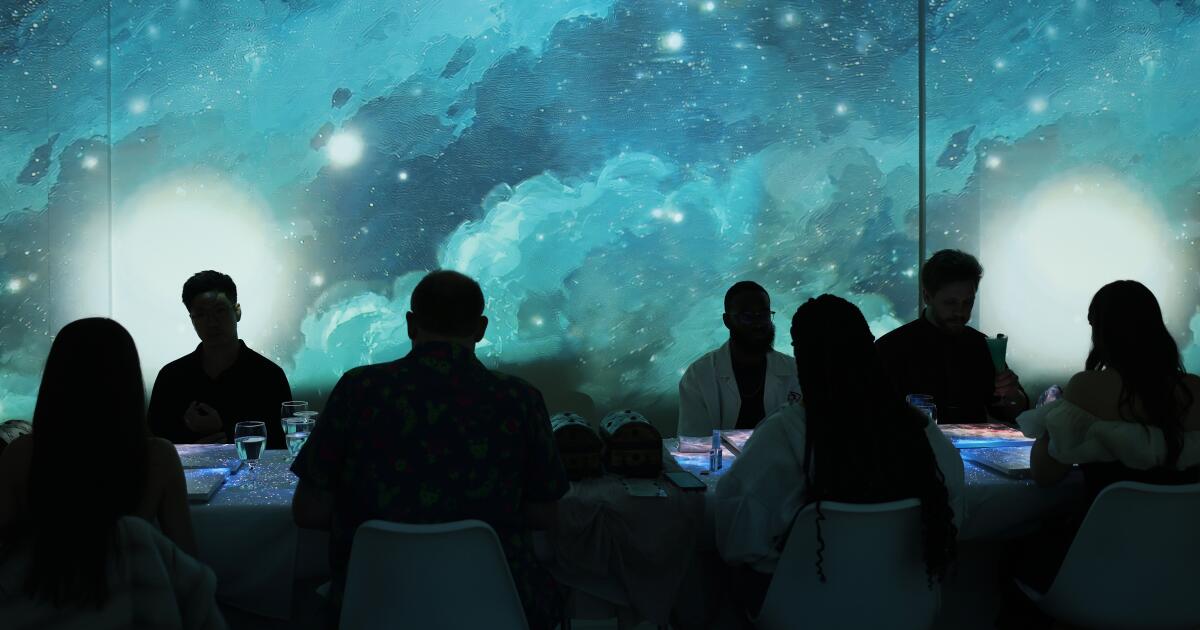
My dinner course is served. It is a Campbell’s-inspired soup can, lightly angled so strands of broccoli are peeking out. I lift the can to uncover a slow-braised short rib and mashed potatoes. An American dish to represent an American artist, here Andy Warhol.
The room is overtaken with projections, scenes of bustling New York traffic paired with bachelor-pad-like guitar riffs. Shown on a wall above a dinner table is a selection of Warhol silkscreens. It’s a Friday night in West Hollywood, and I’m surrounded by a mix of out-of-towners and those celebrating an anniversary. And while this is a special occasion, we’re urged to get a little messy with our food — to use our hands, to paint with a salad, to draw on a cookie.
The main course: A tomato soup can? “7 Paintings” is an immersive event that occasionally hides dishes in artist-inspired presentations.
(Christina House / Los Angeles Times)
Play is the primary side dish at “7 Paintings,” a tech-infused dinner theater that aims to be a crash course in fine art. That selection of veggies paired with multiple mini cups of colorful dressings? Guests are encouraged to mix and match the vinaigrettes into a mess of hues, a nod to abstractionist Jackson Pollock. And yellowfin tuna with dashes of avocado and taro chips? That’s an edible tribute to Banksy, of course. What does raw fish have to do with stenciled street art? It’s bold, heavily angled and has a short shelf life? Maybe? Perhaps don’t overthink it.

Even the paper is edible.
(Christina House / Los Angeles Times)
“Have you ever eaten a painting before?” says Nadine Beshir, the Dubai-based creator of “7 Paintings.” “We try to get people out of their comfort zones and eating paper. I want to bring out the child in them.”
“7 Paintings,” held at Sunset House L.A. through the end of August, is the latest example of immersive dining to arrive in this city. These experiences often involve guest participation and are accentuated with advanced multimedia technology and sometimes theatrical elements.
Worldwide, there have been standouts. For instance, Eatrenalin at Germany’s Europa-Park, a dining room-meets-ride where participants are whisked around the space on trackless “floating chairs,” has just received a coveted Michelin star. Ibiza’s Sublimotion has similar haute ambitions, pairing 12 diners together in a room that will come alive with otherworldly projections and performers. At times, diners will win don virtual reality headgear.
But tech-driven immersive dining experiences have never quite taken off in Los Angeles as a trend. Last year, the Gallery, where fantastical cityscapes and projections surrounded downtown L.A. diners, stood just a couple months before the concept was abandoned.

“7 Paintings” pairs food with art and music. It’s “fun dining, not fine dining,” says its founder.
(Christina House / Los Angeles Times)

Bartender Luca Famulari shakes a cocktail at the immersive dining event.
(Christina House / Los Angeles Times)
“The economics of a restaurant are not the same as the economics of theater and the challenge of combining the two lies in thinking outside the box with respect to pricing and cost structure, such that the customer perceives high value from both the food and the experience,” says the Gallery co-founder Daren Ulmer.
Entrepreneurs keep aiming for that careful balance. “Le Petit Chef and Friends” is currently running at Tangier at downtown’s Hotel Figueroa, an event in which a fully animated film is projected on our plates and tables. Long-running pop-up event Fork N’ Film leans more dinner and movie, pairing dishes directly inspired by what is happening on screen. Upcoming films include “Ratatouille” and “Lilo and Stitch.”
The field comes with challenges. “The costs are very high,” says Joanna Garner, an immersive designer and former creative director with experiential art firm Meow Wolf. Garner has been experimenting herself with communal, immersive dinner events, and her next, the flirtatious “Please Open Your Mouth,” is set for July 11. (No tech there, as Garner is after a more sensual, adult-focused gathering.) Tickets for her event are $150 and a spot in the “7 Paintings” dining room runs $175, priced on par with a number of city’s most acclaimed restaurants.
There is also the reality that all public dining is in some fashion immersive, usually requiring varying combinations of engagement, communication and presentation. And then, are all these added elements distracting?

An animated Mona Lisa sits on the wall as guests enjoy their meals. Throughout the dinner, the painting provides factoids on various artists.
(Christina House / Los Angeles Times)
Throughout “7 Paintings,” for instance, an animated Mona Lisa, situated on the wall next to the main dinner table, will provide brief biographical details of each artist represented.
“Being able to nail the food, and nail the story, those are two very difficult threads to weave,” Garner says. “I do think, ultimately, people come to a dinner table to talk to the people at the table and to have intimate experiences. To have an experience where you’re constantly being taken away from the food, I’m not so sure if that’s what people are looking for.”
Food is framed as a star of “7 Paintings” but tasting it is just one component. At one point, we must uncover a cheese course in a tiny treasure chest, the code for the lock hidden in the projections (don’t stress, it’s not a hard puzzle). Beshir highlights the Pollock-inspired salad course, which is accentuated with a jazz soundtrack, as the thesis of the evening.
1

2

1. A guest uses a silicon brush to apply sauces onto an entree, a nod to abstractionist Jackson Pollock. 2. Projections fill up the dining table during meals.
“This course is really about getting people to free their minds from preconceived ideas,” Beshir says. “Like, you have to eat with a fork and knife, or the salad comes and then the dressing. No, the dressing comes and then the salad, and it’s trying with big brushes to paint the way he did. A lot of people do not understand Abstract Expressionism, and they think it’s people just splashing colors around. But when you understand the link between the rhythm of the music and painting, you live it. We give you time to paint with your salad dressing.”
In L.A., Beshir has partnered with nightlife impresario Kim Kelly, who is plotting a “Sleep No More”-inspired walk-around theatrical show for the Sunset House venue later this year. “7 Paintings,” however, is fully seated, and purposefully a little silly. Beshir and Kelly have been evolving it during its L.A. run, recently adding a stronger painting component by giving guests their own canvas to work on throughout the evening. Each night crowns a winner.
“Everyone comes over to look at their art,” Kelly says. “It just kind of changed the whole thing, to be honest. People are now being creative throughout the entire evening. Instead of just watching and occasionally painting, you’re now painting the whole time.”
As for what, perhaps, soba noodles with edamame and mushrooms have to do with Pablo Picasso, or why Salvador Dali gets an unexpected dessert course of a white chocolate potato souffle, Beshir clarifies the goal of the evening. While the animated Mona Lisa will provide backstories on each painter, this isn’t an educational night. “It’s fun dining, not fine dining,” Beshir says.
And by the end of my night, strangers were socializing, showing off their painted cookie creations, sharing Banksy tidbits and asking for recommendations on various vinaigrette combinations. Ultimately, it’s an evening of discovery, packed with surprises like finding an entire course hidden under a canvas.

Darryl Mayes of Charlotte, N.C., left, and Taylor Smith of North Hollywood, right, uncover their course.
(Christina House / Los Angeles Times)
“We try not to have too much sophistication, like fried ants or something. I’m personally very adventurous in how I eat, but if I want to have this in 100 cities around the world, I cannot be too meticulous.”
And Beshir has big goals.
“I want this be your movie and dinner thing,” Beshir says. “I want people to be waiting for our next show, and to be able to afford to come every couple months.”
And to come home not with leftovers, but perhaps a painting of their own.
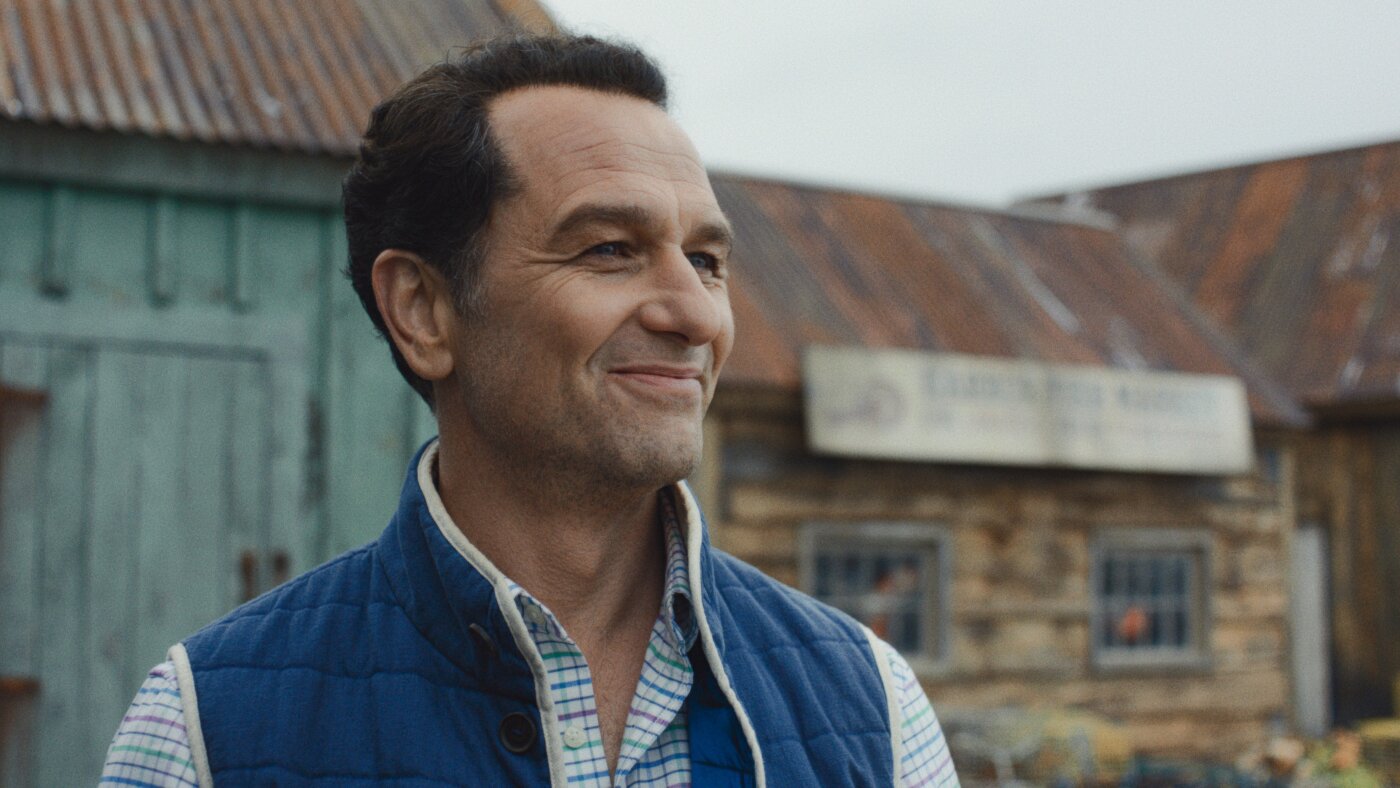
Matthew Rhys was nominated for his role in Widow’s Bay.
Apple TV
hide caption
toggle caption
Apple TV
The 2026 Emmy nominations are here. We’re unpacking the record-breaking nominations for Hacks, plus a big day for Widow’s Bay, The Pitt, and The Bear. We’ll also talk about the snubs and make some early predictions of who will win.
Connect with Pop Culture Happy Hour:
Letterboxd / Facebook
Our weekly newsletter
Support Pop Culture Happy Hour+
-
 News7 minutes ago
Former Olympian pleads not guilty in reflecting pool vandalism charges
-

 Los Angeles, Ca1 hour ago
Heat advisory, beach hazards in effect as Southern California sizzles
-

 Detroit, MI2 hours ago
Teen on moped hit by car after cruising through stop sign in Detroit
-

 San Francisco, CA2 hours ago
Flight of fancy: San Francisco moves to build private luxury airport terminal
-

 Dallas, TX2 hours ago
Dallas’ digital creator economy is booming. Burnout is too.
-
Miami, FL2 hours ago
I went to 2 famous Miami restaurants, a flashy steakhouse and a Cuban hot spot. Here’s how they compared.
-

 Boston, MA2 hours ago
Pedestrian struck and killed in Roxbury – Boston News, Weather, Sports | WHDH 7News
-

 Denver, CO2 hours ago
Santa Fe Drive in Denver closed this weekend for pedestrian bridge construction

