Lifestyle
How to have the best Sunday in L.A., according to Victoria Monét


Like most busy working mothers who struggle with work-life balance, three-time Grammy Award winner Victoria Monét cherishes spending time with her 4-year-old daughter, Hazel, who she shares with ex-boyfriend fitness trainer John Gaines.

In Sunday Funday, L.A. people give us a play-by-play of their ideal Sunday around town. Find ideas and inspiration on where to go, what to eat and how to enjoy life on the weekends.
Known for writing hits like Ariana Grande’s “Thank U, Next,” Blackpink and Selena Gomez’s “Ice Cream” and Chloe x Halle’s “Do It,” in addition to “On My Mama” from her debut album “Jaguar II,” the L.A.-based R&B singer-songwriter recently penned something for younger audiences: the heartwarming children’s picture book “Everywhere You Are,” due out June 24.
In a recent interview, Monét revealed the inspiration behind her book. (She will discuss her new book at Malik Books on Saturday and the Reparations Club along with moderator Gabrielle Union on Sunday. Tickets are required.)
“As a parent, it’s hard to miss those pivotal moments,” she said of the separation anxiety that many children feel when their parents are working and unavailable. “It’s important for children to know that there is a purpose behind them. I wanted to offer assurance and relay an important message: Everything will be OK.”
Despite her demanding schedule, Monét always finds a way to make quality time for Hazel. In 2023, Hazel, then 2, became the youngest Grammy nominee in history when she was nominated for her vocals in “Hollywood” alongside her mother. And when Beyoncé kicked off her “Cowboy Carter” tour at Sofi Stadium in Inglewood last month, Monét took Hazel to her first concert. Their ideal Sunday in L.A., which Monét fondly calls “me time,” would involve playing outdoors, enjoying a visit to a family fun center, indulging in vegan sweet treats and reading “Everywhere You Are” to one another before bed. Here, Monét shares a joy-filled Sunday spent with her daughter.
This interview has been lightly edited for length and clarity.

8:30 a.m.: Awake with gratitude
On Sundays, me and Hazel wake up later than usual because we probably stayed up late the night before if I didn’t have to work. We normally start our day by doing our gratitude journaling, where she doodles and I write. Then we do our self-care, where we brush our hair and teeth. I will then go downstairs and make her character pancakes with chocolate chips or Fruity Pebbles cereal.
After that, we may make some art. She loves to draw, and we have a nice art section in the house featuring everything from crayons to markers, scratch-off art, watercolors and rainbow paints.

10 a.m.: Dance, dance, dance!
Hazel is active and enjoys doing things, but on the weekends, we have instructors come to the house for dance lessons. So far, she has taken ballroom dance, ballet and tap. She was in gymnastics for a while. We’re looking forward to taking ballet and tumbling at To The Pointe Dance and Pilates Centre.
She loves being outside and enjoys riding her bike or visiting the park. During the week, she plays soccer twice a week. She loves it because it isn’t serious yet. It’s more about giving them a chance to have fun. They do drills on how to kick and run at the same time. It’s hard when you think about it.
12 p.m.: Indulge in fresh pasta at Uovo
Hazel loves pasta, so we often go to Uovo Pasta, which has several locations in Los Angeles. Their handmade al dente noodles are perfect — they overnight them from Italy. We would get the pomodoro and make sure that it’s not too spicy. Their cacio e pepe is great, but that’s a once-in-a-blue-moon thing for me because I’m [mostly] plant-based. Hazel usually gets what I get. When I was pregnant with her, I ate Flamin’ Hot Cheetos all the time, and now she likes them too. After lunch, I’d have to bring her home because she naps around 1 p.m.

2:30 p.m.: Jump for joy at Off the Wall
After her nap, we’ll hit Off the Wall in Woodland Hills. It’s trampoline heaven, where you can catapult higher than you intended to. There are rock climbing walls, an arcade and food. They have an air-filled basketball court that’s on a soft floor and there are birthday party rooms in the back. Hazel loves that place, especially the trampoline. She likes me to chase her, so I get a workout while we are there. I’ll literally be sweating when we leave.

4 p.m.: Sample sweet treats at Happy Ice or Magpies
For a sweet treat, Happy Ice is a favorite. It’s the best-tasting slushy snow cone, especially during the summer when it’s hot. They have locations in Northridge and Hollywood, but they also have a truck [at Smorgasburg on Sundays in downtown L.A.]. For Hazel’s birthday party, we had the truck come to our house. I usually get the Rainbow Rocket, which is a mix of all their Italian ice flavors, and Hazel gets the same thing I do. She is happy to get anything, frankly. Magpies Softserve is another one of our favorites. Their vegan honeycomb soft serve is so good. Hazel likes their soft-serve pies.
6 p.m.: Tapas-style dining at Joey
Hazel is newly picky, but if she were to go out to dinner with me, she would love Joey in Woodland Hills, which offers a wide-ranging menu. They check off a box for everybody. I’m a tapas-style girl, so I like to order a variety of different dishes: guacamole, tuna and avocado crunch roll and Korean fried cauliflower. I’ll order the sake-glazed Chilean sea bass and pasta for Hazel.
We’re homebodies, so another dinner option would be spending time together at home, cooking and playing in the pool. We enjoy making veggie and tofu tacos together. Things you can eat with your hands are always fun with kids. That’s one reason they like s’mores so much. Occasionally, we’ll make something pescatarian like grilled salmon or other fish.

8 p.m.: Watch “Moana 2” … again
At night, we would watch a movie and wind down with some Skinny Pop popcorn. Hazel would probably watch “Moana 2” again right now. We saw it in the theaters, and she goes through phases where she wants to watch different things, but she recently said that she wants a “Moana 2” party for her fifth birthday. I thought she’d like something else by then. But then, she thinks there will be 20 Moanas.

10 p.m.: Read “Everywhere You Are” before bed
Before bed, Hazel often asks me to read “Everywhere You Are” to her. She loves to read and enjoys being read to. I’ve read it to her so many times that she can read it back to me. She recorded a segment of the audiobook with me and was excited to hear herself when she recorded it in the studio. Reading the book to her, I realized that missing a parent is a lot like losing a loved one. You can still feel their presence even though they’re not around. Love binds people together despite physical distance. Even when they don’t see you, children need to know that you’re still there and that you’ll always be with them.

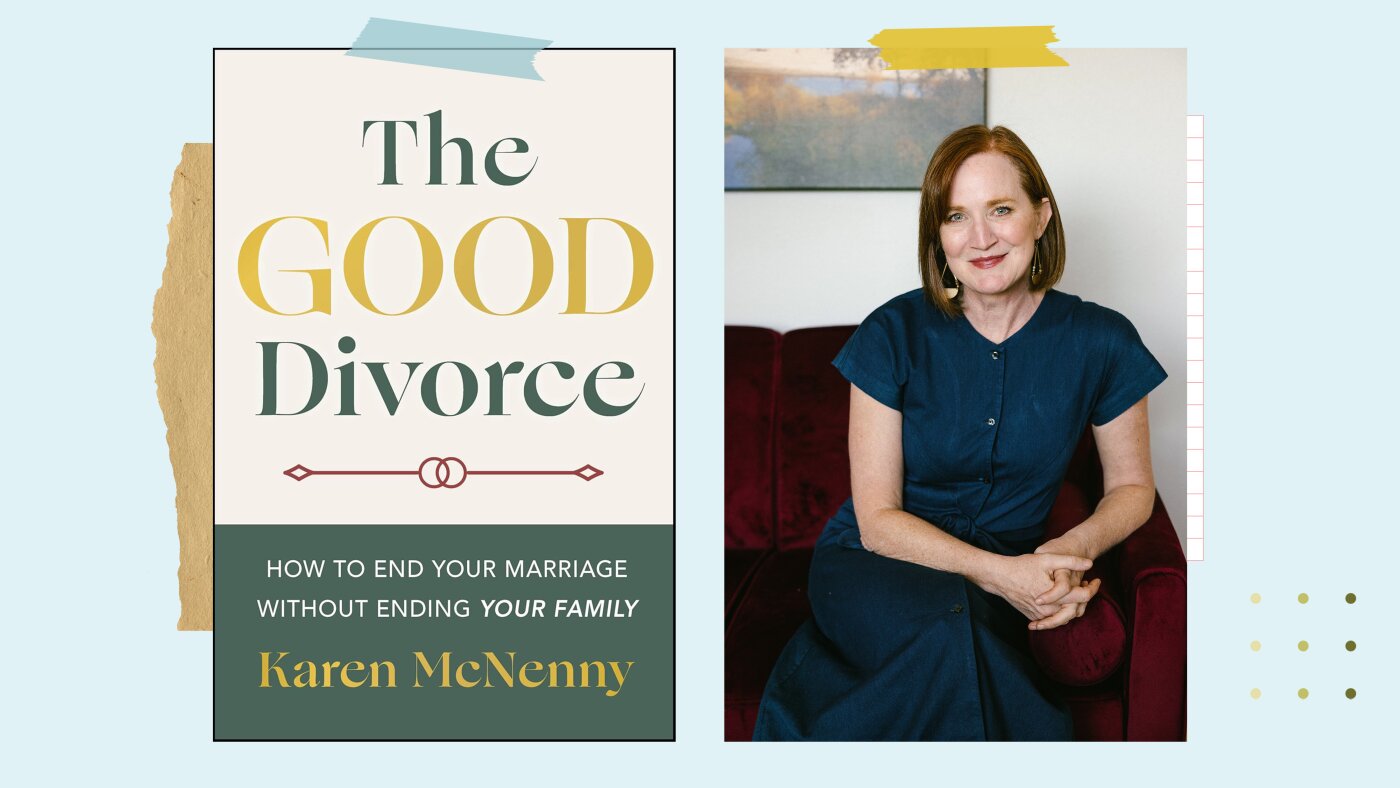
Karen McNenny is a certified divorce coach, certified co-parenting specialist and author of the book The Good Divorce: How to End Your Marriage Without Ending Your Family.
Wiley/Jossey-Bass/NPR, Nicole Wickens/NPR
hide caption
toggle caption
Wiley/Jossey-Bass/NPR, Nicole Wickens/NPR
When Karen McNenny was facing divorce about 15 years ago, she was afraid of what it would mean for her future: despair, debt and a lifetime of resentment, she says.
At the same time, she was thinking of her two children, she says. She didn’t want their father to become her enemy.
So she and her former husband chose to approach divorce differently as a couple. “We’re going to renovate and transform this family. We’re not going to destroy it,” she says. “The marriage is ending, not your relationship.”
For McNenny, a mediator, certified divorce coach and certified co-parenting specialist, divorce is a tool, not a weapon. She expands on this concept in The Good Divorce: How to End Your Marriage Without Ending Your Family, which came out this spring. The book offers guidance on how to maintain compassionate and respectful ties with a former spouse while also healing and moving forward.
According to Pew Research Center, a third of Americans who have ever been married had a first marriage that ended in divorce. For that reason, McNenny hopes her book becomes a must-read for couples before they get married. “The best time to talk about divorce is before you need to talk about it,” she says.
She shared insights from her book in a conversation with Life Kit. This interview has been edited for length and clarity.
The book is called The Good Divorce. What does that mean?
[For those with kids,] the good divorce is about protecting the future of the family while we dissolve the marriage.
After the paperwork is done and the assets have been divided, can you and your co-parent sit on the same side of the bleachers during the basketball game? Can you still see yourselves as a partnership, with the ability to have thoughtful conversations about your kids?
For those who don’t have kids, [the good divorce is] about protecting your health — your mental health and your physical health. If we are doubling down with resentment and bitterness, all of that gets stored in the body and shows up in different ways. You deserve a pathway that’s less destructive.
Let me also be clear: There are times when an amicable, collaborative process is not possible and maybe even inappropriate. For instance, where there’s active addiction, abuse, domestic violence, coercion or unmanaged mental health issues.
How do you get to a place where you don’t feel triggered by your partner, so you both can work together toward a good divorce?
That, my dear, does not happen overnight. That is more like a dimmer switch going up and down and up and down, and the gift of time helps to get there.
It’s a complex emotional journey because we do feel relief in walking away from our spouse and the challenges. But with it, there is extraordinary grief that comes with divorce that I think is often underestimated and undersupported.

If my spouse had died, people would’ve been checking in with me regularly. I never would’ve spent a holiday alone in that first year. There probably would’ve been a meal train.
But he didn’t die. My marriage died, my family structure died, my identity as a wife and a partner died. There’s so much grief through these transformations that come with divorce that we don’t see.
So supporting friends in all those ways that you would as if there had been an actual death is doing a lot for your friends who are going through divorce.
How do you let your friends, family and community know that you’re getting a divorce and that you might need support?
Put a communication strategy together. It’s not just for how we tell the kids. It’s also a communication strategy for the grandparents; to the circle of support around the kids, like teachers, coaches and mentors; and our shared community.
It’s extraordinary when a couple can write that message together, not unlike a marriage announcement. [You might say:] We’ve made a really difficult decision. We wanted to let you know. We’re not going to court. Don’t expect a battle. Please don’t ask us why. Just ask us how we’re doing. We’re on the same side as the kids. You don’t need to pick sides.
In doing so, we’ve given everyone the same information at once. It’s a unified message that comes from the parent team, and it allows your community to know how best to support you. And it takes out all the gossip and wonder about what is going on.
If you have kids and they’re splitting time between two homes, what are some ways to make that change easier for them?
Our kids were 5 and 7 when we divorced, so it was three or four nights at a time in each home. By the time they got to be about 8 or 10, it made sense to go a week in each residence. After COVID, the kids came to us and said, “Can we just have two weeks in a house? We wanna be able to settle in more.” [So we said] OK.
A lot of parents are so rigid about the schedule. There’s no flexibility. That doesn’t serve anyone. So I recommend liberating yourselves from the calendar and letting it grow and bend with your kids appropriately.
Knowing what you know now about divorce, what questions do you think couples should ask themselves before they get married?
So often when people arrive at the threshold of divorce, couples are like, “We don’t know what we’re doing.” Get educated about the business part of it.
There is no harm in having a prenuptial agreement. Even if you decided not to file it, have the conversation about the implications. What does it mean if we buy this house together? What does it mean if one of us works more and one of us works less?
We also underestimate what it means to be roommates. What are your value systems around cooking and cleaning? How much alone time do you need? It’s easy to fall in love and not know if you’re compatible.
Do you think you’d get married again?
I absolutely hope that I get to say yes to a lifelong commitment with a partner, as I believe we often are given the opportunity to become a better version of ourself through partnership.
The story was edited by Meghan Keane. The visual editor is CJ Riculan. We’d love to hear from you. Leave us a voicemail at 202-216-9823, or email us at LifeKit@npr.org.
Listen to Life Kit on Apple Podcasts and Spotify, and sign up for our newsletter. Follow us on Instagram: @nprlifekit.

In Alice and Steve, Jemaine Clement and Nicola Walker play long-time friends who turn on each other after he gets involved with her 26-year-old daughter.
Lara Cornell/Disney+
hide caption
toggle caption
Lara Cornell/Disney+
I grew up watching episodic shows on network TV, nearly all of them formulaic but some indelibly great. Then, like everyone else, I moved into the days of what my colleague David Bianculli dubbed Platinum TV, where series like The Sopranos and The Wire and Fleabag aspired to something higher. What both these eras had in common was that their shows were carefully crafted — they had an internal logic, and a tone, that held them together.
In recent years, though, there’s been a proliferation of shows that, possibly obeying some algorithm, care less for coherence than sensation. They lurch among tones, from cuteness to sentimentality to meanness, stirring in random plot twists along the way. Bouncing all over the emotional map, these shows depend on compelling actors and a few memorable scenes to make us overlook their loose construction.
A great example is Alice and Steve, an entertaining but sometimes exasperating six-part British comedy on Hulu about two 50-something best friends who turn on each other after he gets involved with her 26-year-old daughter.


While the premise is juicy, it’s also a tad yucky, and I mainly tuned in because its title characters are played by performers Jemaine Clement from Flight of the Conchords and Nicola Walker, whom I’ve raved up on this show more than once.
The series starts poorly with Steve and Alice going on a cutesy bender after a friend’s funeral. Now, I always hate drunk scenes, which are an invitation to overact. As Clement and Walker bray their lines, we learn that Steve’s a divorced celebrity hair stylist who can’t find a girlfriend while Alice is a clothes designer with a doting younger husband, nicely played by Joel Fry, a sweetie-pie of a teenage son — that’s Tyrese Eaton-Dyce — and, of course, that 26-year-old daughter, Izzy, who has inherited her mother’s willfulness. Played by Yali Topol Margalith, Izzy kickstarts the plot by flirting with Steve. Predictably, he succumbs.

Almost immediately, they think they’re in love. While the weak-willed Steve wants to hide their romance — he knows it’s inappropriate — Izzy just blurts out the facts to her mom. Alice flips. And from hereon out in this series where the women are as alpha as the men are hangdog, Alice drives the action. Betrayed and violently angry, she’ll do whatever it takes to break them up — no matter who gets hurt. Her antics unleash Steve’s own malice. We’re in Beef territory.
At its core, Alice and Steve hinges on the way that platonic friendships are often richer and more powerful than romantic ones. It’s a fascinating subject, which may be why I found the script by Sophie Goodhart so frustrating. I wanted her to dig deeper. While the show’s got some very funny bits — Alice’s sharp-tongued mother is a blast — it’s often annoyingly lax.

If Steve really does the hair of Charli XCX, how come he’s a clueless older guy whose pop culture references are Willie Nelson and Woody Allen? If Izzy truly adores her mother as she claims, why does she keep rubbing her relationship with Steve in her mom’s face? Halfway through, one character nukes the other’s career, but this life-shattering event has no real weight: It’s barely even mentioned for the rest of the series.
That said, Alice and Steve is worth seeing for scenes like the one in which Steve spinelessly sells Izzy out or the lacerating discussion between Alice and her husband when he fully grasps that he adores a woman who views him as a reliable but dull concierge, not a man she likes hanging with. Most touching of all may be the lovely sequence when Alice, wise for once, smooths a romantic crisis between her son and his would-be girlfriend, a pair who are the show’s emblem of hope. For once, we understand why people love her.

While most viewers will find Steve more likable than Alice — the show takes pains not to make him appear predatory or creepy — the role doesn’t give Clement a whole lot to do except play variations on shambolic dread and discomfort. The show gets its galvanizing zing from Walker, a beloved star in England with amazing, luminous eyes. Her Alice is the kind of complicated, volcanic heroine that you don’t see in movies and rarely see on TV, one who shows her apocalyptic rage freely and in many different forms.
At least once in every episode, something would lead me to say, “Man, is this show a mess.” But that wasn’t a deal breaker. I kept watching. After all, life is messy, too.


How to enter your Sporty Spice era.
Getty Images/quantic69/Olga Kurbatova/Anastasiia Zvonary/Photo Illustration by NPR
hide caption
toggle caption
Getty Images/quantic69/Olga Kurbatova/Anastasiia Zvonary/Photo Illustration by NPR
Reality dating and professional sports are not as different as you’d think.
Brittany is in her Sporty Spice era – she watched the NBA playoffs, she’s following World Cup games, and she’s watching the New York Liberty play their WNBA season. These games are daily – and so is the reality dating show Love Island. And she noticed that the two formats are not very different at all. Defector.com staff writer and co-owner Kelsey McKinney came to the same conclusion – so the two of them discuss why these games of athleticism and love can bring us together… and why they get valued differently in our culture.
For more episodes on sports and reality TV, check out:
Get rich or die trying: how sports betting is changing our love of the game
Is this the end of reality TV?
The ugly truth of America’s expensive homes
Support Public Media. Join NPR Plus.
Follow Brittany on Instagram: @bmluse
This episode was produced by Liam McBain. It was edited by Neena Pathak. Our Supervising Producer is Cher Vincent. Our Executive Producer is Barton Girdwood. Our VP of Programming is Yolanda Sangweni.
-
Politics52 seconds ago
Preliminary Hearing for Man Accused of Killing Charlie Kirk Starts in Utah
-
Lifestyle31 minutes ago
What a divorce coach wishes couples knew before ending a marriage
-

 Technology39 minutes ago
Hoto’s PixelDrive screwdriver is down to $60, matching its best price
-

 World46 minutes ago
Cuba plunges into third major blackout this year as power crisis worsens
-

 Politics49 minutes ago
Top Platner ally turns on him after bombshell rape allegation rocks campaign: ‘Red line’
-

 Health54 minutes ago
Experimental vaccine shows promise against dangerous intestinal illness
-

 Sports1 hour ago
England’s Jordan Henderson officially ruled out after freak fall causes fracture, opts for surgery
-

 Technology1 hour ago
Starship delivery robots leave campuses for cities

