Lifestyle
How to have the best Sunday in L.A., according to Todd Selby

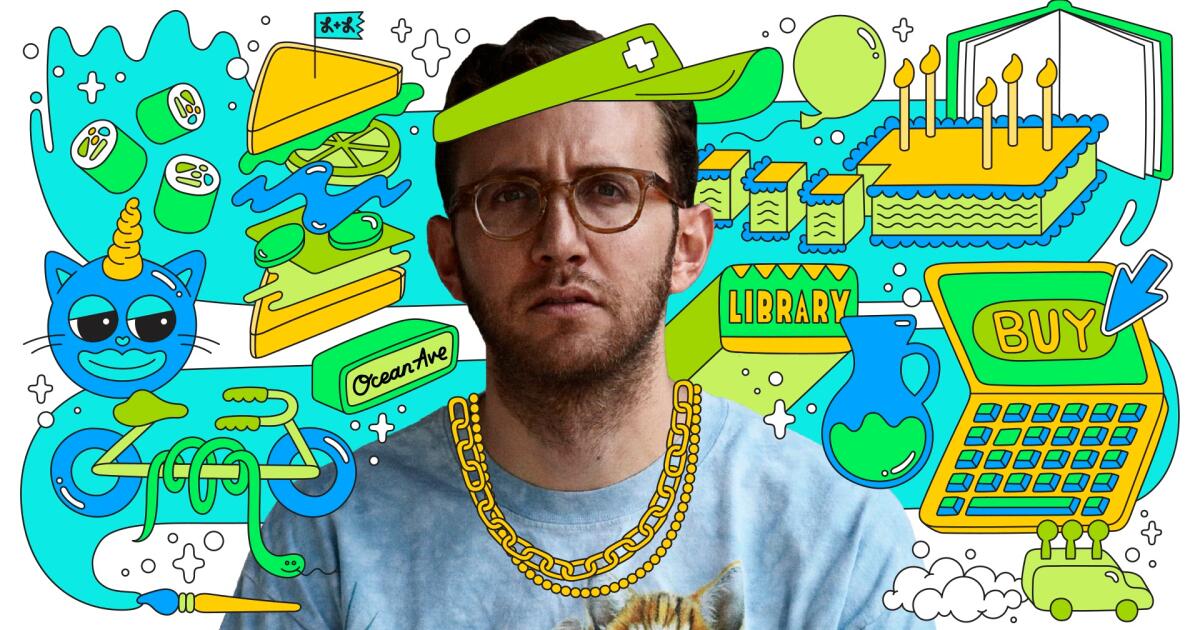
Skateboarders, creative directors, chefs and hip designers are all captivating subjects for photographer Todd Selby, who has traveled the world for more than 20 years, capturing creatives at home for his blog, the Selby.
“I have always been interested in outside-the-box people who live in vibrantly colorful homes,” Selby says. “When I was growing up in Orange County during the 1980s, the most interesting person in my world was a classmate who used to draw Garfield at lunch every day. He’d ask me, ‘What do you want Garfield to do?’ To me, he was a hero in a cliquish school.”
After he became a father, Selby’s interest shifted to how other parents managed their chaotic domestic life. His latest book, “The Selby Comes Home: An Interior Design Book for Creative Families” (Abrams, $65), is a testament to this curiosity. It features a diverse array of families — 41 — from Echo Park to Tokyo. Among them are a family of four residing in a one-bedroom apartment in Kawasaki City and a family of five tending to ducks, chickens, a dog and donkeys on a 20-acre wilderness retreat outside of Portland.
In Sunday Funday, L.A. people give us a play-by-play of their ideal Sunday around town. Find ideas and inspiration on where to go, what to eat and how to enjoy life on the weekends.
Selby says traveling the world has given him an appreciation for Los Angeles. “L.A. is so spread out, and there are so many cities and they are all so different,” he says. “It’s an interesting place for a person who likes to explore.”
Selby travels less than he used to so that he can be at home with his two children, 6 and 8. Below, he details his ideal Sunday itinerary in which, like his subjects, he juggles family and home life, interspersed with some time for himself.
This interview has been lightly edited and condensed for length and clarity.
5:45 a.m.: Online shopping under the covers
My luxury is waking up really early and hiding under the covers to do some silent online shopping and then going back to sleep. I’ll read my buddy Laurel Pantin’s Earl Earl newsletter and buy the silky men’s scarf she recommended from Etsy. Or I’ll log on to Wayfair and snag a two-seat camping chair. I am a camping chair aficionado. I have five of them just for me, for different occasions and backups. Full disclosure: I have directed a bunch of Kelly Clarkson for Wayfair commercials, but I am a big-time fan of the brand and camping chairs!

6:15 a.m: Go back to sleep
After a little more sleep, I’ll wake up at 7 a.m. and go downstairs for coffee and breakfast with my wife, Danielle, and our kids. I make coffee the night before in my beloved Chemex with Groundworks beans. I always buy 5-pound bags of their Black Magic Espresso as I am afraid I will run out, which I have never done. Then, in the morning, I pour the room-temperature coffee over ice and add some extra creamy Califia Farms oat milk.
7:15 a.m. Test jewelry
My wife usually gifts me a piece of jewelry to test for her jewelry line, Sherman Field. Today, it will probably be a 25-inch Double Chain Medium so I can rock two chains like one of my top musical influences, 2 Chainz. I’m an official wear tester, meaning you wear a sample and ensure it functions.
7:45 a.m. Game of Life with the kids
I’ll continue the Game of Life with my kids at our dining table. The classic board game chooses your career path and loans from the bank. The more babies you get, the more money you get, which is confusing.
8:30 a.m.: Do a back workout for photographers
After Life, I’ll do my photographers back workout developed by Jason Whitman at Positive Physical Therapy. One of the exercises involves lying on a psoas ball. It’s like a big puffy yet firm ball on your stomach, and somehow, it makes your back feel amazing.

9 a.m.: Bike ride with the Cobrasnake
I’ll do a quick bike ride with local photography celebrity Mark Hunter, a.k.a the Cobrasnake. We are both “old school bloggers” and like riding our bikes down Ocean Avenue. I have a beach cruiser with a coconut drink holder. We will pass 21st Place and 21st Street in Santa Monica on our bike ride. I always wonder why there is both a 21st Street and a 21st Place.
11:15 a.m.: Order the secret sandwich at Lady & Larder
Then we’ll stop by Lady & Larder for a Scribe rosé pinot noir, colorful candles and crackers. We like to support local small businesses. They are famous for their cheese boards. Sometimes, I may even order a secret sandwich. Why is it a secret? I have no idea — that’s just what they call it. But who doesn’t like a tasty secret?
11:45 a.m.: Piggies and play at the Mar Vista farmers’ market
Around noon, the whole family will head to the Mar Vista farmers’ market to buy our fruits and veggies for the week and play with Steve’s Machines. He has kid-operated cranes and wild robots. We usually buy some “piggies” (as my daughter calls them) — pig-shaped red bean dumplings.
1 p.m.: Hit the birthday party circuit
We usually end up at one or two kids’ birthday parties during the weekend. The kids often head straight in to pound as many treats and fruity beverages as quickly as possible. I will check out the food options; usually, it’s Fresh Brothers Pizza cut up into small squares. I will eye the pizza, think about skipping it, and then eat it.

2 p.m.: Paint in the art studio
For a long time, the kids were totally uninterested in my art studio, which is a special place. At one point, I told them they weren’t allowed to go into my art studio, and the next day, they were all about my art studio. They love doing watercolors with me. I am trying to get them to do the “paint by numbers” in my new book, but they haven’t been interested. We usually paint kitties, unicorns or other creatures with “cutie eyes.”
3 p.m. Pick up dinner at the Tehran Market
We like to go to the Tehran Market, a great Persian grocery store in Santa Monica, to pick up dinner and some groceries. On Sundays, they have people out back grilling in the parking lot. You place your order, and then you can shop it up inside. I usually load up on labneh while I wait for my huge grilled salmon and vegetable plate.
4 p.m.: Lifeguard
I’ll sit in one of my camping chairs and lifeguard while the kids swim.

5 p.m.: Cook dinner together as a family
My youngest daughter is a hard-core sushi lover, and she rolls it herself with fish we buy at Eataly and Santa Monica Seafood — Eataly has great salmon eggs. My younger daughter will hand-roll some salmon egg sushi, and my older daughter will help make some mac and cheese. Both kids help make kale chips for the whole family. Then our family and some friends will eat our Tehran Market takeout.
7 p.m.: Read library books
We read to our kids with books from the library. I am a huge Los Angeles and Santa Monica library system fan. You can request any book you want, and they ship it to your local library for pickup. Even DVDs. Our family currently has 51 titles out! I stop by a library every week, drop off books and pick up new ones. That way, the books are always fresh for the kids, and we can follow their interests daily. Currently, we love reading the Isadora Moon series and the Real Pigeons series. Isadora Moon is about a kid that’s half fairy and half vampire.
8 p.m.: Bloons and bath
After the kids are asleep I will play a bit of Bloons TD 6 — a video game where little monkeys throw darts at balloons — on my iPad. It captivates me. I don’t know why. Then it’s time for a Lush bath bomb and a soak.
9 p.m. Books and Zs
Currently, I am loving “The Lost City of Z.” It was a rumored city in the Amazon rainforest, and all these people went to find it, and they didn’t come back. I’m on the third round of people who don’t come back. I’ve been to the Amazon with my dad, and we went for three days, but we didn’t see any pink river dolphins. I feel fortunate that I didn’t disappear.


In central London’s Waterloo Place, a life-size statue that emerged overnight in late April has been creating a stir. When I visited a few weeks after it was erected, local authorities had already set up protective barriers around it.
The installation — signed by the famed street artist Banksy — depicts a man in a suit hoisting a flag as he strides over a precipice. As he marches on, the flag blows backward to cover his face, leaving him unaware he’s only a step away from a perilous fall.
Set among grand monuments celebrating Britain’s past, the “flag man” takes on a particular visual irony at a time when the country — and much of the world — is debating its path forward.
Like many viewers there, I found myself wondering whether this statue is Banksy’s warning about the consequences of uncritical nationalism, or simply a reflection on human shortsightedness. Or, perhaps, it is just prompting us to ponder a broader question: What happens when devotion to a symbol prevents us from seeing what lies ahead?
Whatever the message, the work feels remarkably attuned to the current moment.
For more Far-Flung Postcards, click here.
Lifestyle
Wait, it’s a candle? Her beeswax fruit and veggie ones look so real, you’ll want to take a bite
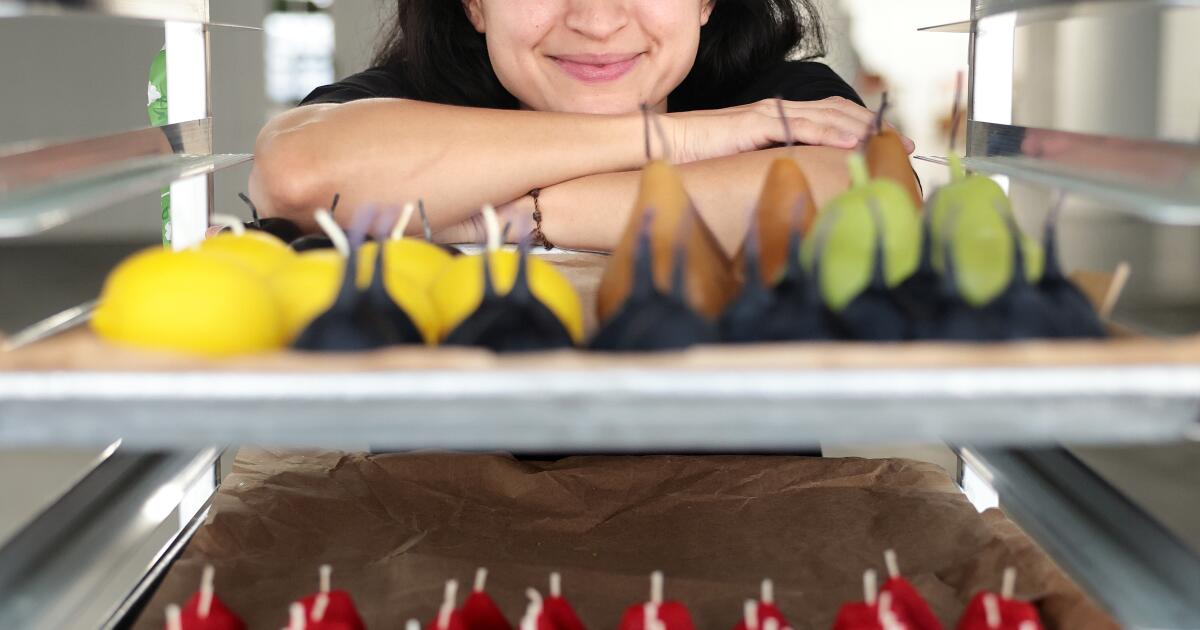
Jessica Gonzalez hustles behind her booth at the recent Renegade Craft Fair, frantically ringing up sales, answering questions and packaging her beeswax candles.
It’s hot on the grounds of the Los Angeles State Historic Park in April, but 35-year-old Gonzalez and her fiancé, Jordan Colindres, keep their cool as a crowd gathers to admire her Happy Organics candle collection, a homage to her family’s produce company in the Central Valley that looks like real fruits and vegetables.
“I love doing in-person events because it’s so fun to see people’s reactions,” she said a few months later. “It makes me feel good to see other people finding joy in my candles. They often say, ‘Oh, that’s really funny.’ And it is funny to have a cherry candle on top of your birthday cake.”

3

1. A staff member pulls a beeswax corn candle, $26, out of its mold at Happy Organics’ studio in downtown Los Angeles. 2. Each Beeswax Mixed Berry Birthday Candles set is cast from real mixed berries — strawberries, raspberries, blackberries, blueberries and cherries. A set of 10 is $30. 3. Bartlett green pears and heirloom tomatoes, $24 to $40.
Judging by the smiles and charmed looks on shoppers’ faces, her produce-inspired candles are less about illuminating rooms and more about sharing the joy she sought when she first started the company in 2018.
In this series, we highlight independent makers and artists, from glassblowers to fiber artists, who are creating original products in and around Los Angeles.
But then, it’s hard not to smile at the playfully elegant Bosc pears, puckered mandarins and green-and-purple asparagus taper candles which range in price from $12 to $40. Some are molded into corn on the cob, celery and rhubarb shapes. Others are made to look like mushrooms, figs, tomatoes and snap peas. The most popular are the small birthday candles shaped like raspberries, cherries and blackberries, packed in molded-pulp baskets just like you’d find at the grocery store or farmers market.

-
Share via
Gonzalez didn’t start out as a designer. The youngest of nine children, she was born in 1991 in Salinas and later moved to Merced, where she grew up on a 10-acre farm. She studied computer science at Mills College, then worked in tech consulting in the Bay Area and eventually became the CTO of an ag-tech company. When her mother, Angela, became ill in 2016, she returned to Merced to be with her family.
When her mom died suddenly soon after she moved home, Gonzalez left the tech industry. “I wasn’t connected with what I was doing,” she said. “I wanted to find something more meaningful; something I loved. I didn’t want my ego to keep me stuck in what I studied in college. I decided to let myself try new hobbies and passions and look for joy again.”
After her mother’s death, she began working with her father, Salvador, and her uncles at the family’s apiary, where they managed more than 30 hives. (Her grandfather was also a beekeeper in Michoacán, Mexico.) Soon, she began selling their raw honey at local farmers markets. In a heartbreaking turn, her father was diagnosed with cancer a year later, so she started making cannabis-infused honey, balms and chocolates to help ease his pain.
When she saw that the beeswax candles, which last significantly longer than paraffin candles, were selling faster than the honey, she decided to focus on making candles from the leftovers from her uncles’ hives.
She was only 25, but it was a turning point. “It was one of those moments where I felt like I needed to change my path,” she said. “I needed to change everything in my life.”

Jessica Gonzalez and her father Salvador on their family farm in Merced. (Gonzalez family)

Gonzalez at Happy Organics’ studio in downtown Los Angeles. (Christina House / Los Angeles Times)
When her father died in 2018, she inherited his bees and started Happy Organics, although she hadn’t planned on starting a business. After experiencing so much loss, making candles became a kind of therapy. “It felt great to work with my hands again, something I thought I’d never have time for,” she said.
Her oldest sister, Sonia Gonzalez, said Gonzalez reminds her a lot of their father, who reinvented himself many times over the years.


The nopal cactus is cast from a real nopal and hand-poured in 100% pure beeswax in the Los Angeles studio.
“He grew up as a village boy in the rural mountains of Michoacán, Mexico, and went on to work in restaurants, cut down Christmas trees and pick strawberries and broccoli in the fields of Salinas,” she wrote in an email. “From there, he started selling produce door-to-door, then at flea markets and eventually built his own produce distribution business from the ground up. As the youngest of nine kids from a working-class family, Jessica’s always been incredibly resourceful, responsible, and amazing at reinventing herself.”
Like a lot of millennials, Gonzalez taught herself how to make candles by watching YouTube videos. She started with hand-dipped tapers, working in the garage on the farm that helped her feel safe and connected to her parents. “It was a really nice environment to try something new and creative,” she said.
Inspired by her family’s produce, she cast real corn, strawberries and cherries in plaster, then made a silicone mold to create copies. Even when using the same mold, color can vary from batch to batch, and how it cools also affects the result. “That’s just how handmade things are,” she said. “There’s always some variation.”

Cherry molds make cherry candles at Happy Organics’ studio in downtown Los Angeles.

A variety of fruit and veggie candles.
When she moved to Los Angeles in 2023 to be with Colindres, her business took off. “L.A. is a great place to grow,” she said. “There’s so much opportunity here. When I go to a farmers market, I never know who I’ll meet.”
She sold her candles in person at craft shows, the Hollywood Farmers’ Market and most recently, during a residency at the P.F. Candle Co. showroom in Echo Park.

2

3

1. A staff member trims the wicks on a pair of carrot birthday candles, $22. 2. Gonzalez passes by shelves of candles at Happy Organics’ studio in downtown Los Angeles. 3. Asparagus taper candles, $30.
“I have a lot of respect for her as a fellow candle maker (making molds is not easy), but getting to know her story more and how her choice of foods and wax is reflective of her family’s history gave it so much meaning,” P.F. Candle Co. founder and creative director Kristen Pumphrey said in an email. “It’s been a tough couple of years for L.A. businesses, so we gotta stick together — there’s this wonderful sense of community hosting a local brand that’s so passionate about their work.”
As her business has expanded, her products are now available at Terrain, Joan’s on Third and the MoMA Design Store in addition to her website. She has also had to source beeswax from other vendors across the country to keep up with demand.
Kimberly Curtis, owner of Hide & Seek Vintage in Studio City, said Gonzalez’s strawberry and cherry birthday candles “flew off the shelves last year” during the holidays. “Our customers love them,” she added.

Gonzalez holds a cabbage candle.
Still, Gonzalez stays connected to her Central Valley roots. Everything she and her small team make in downtown Los Angeles is handmade and “takes time,” she said, describing the steps involved in crafting quality candles. Right now, her favorite is the Nopal Cactus candle, which she made using a clipping from an employee’s yard. While others help her with production, wholesale management and packaging, she focuses on sales, content and all-new product development.
When asked if she has advice for others who want to start their own business, Gonzalez admits she sometimes feels overwhelmed.

In 2013, Gonzalez and her family gathered at their Merced ranch to celebrate her parents’ anniversary.
(Gonzalez family)
“The biggest thing that has gotten me through the toughest spots is my why or my reason for starting,” she said. “I think that has to be really strong. That’s what brought me a lot of comfort when I felt like quitting: going back to the beginning and remembering why I started this.”
For Gonzalez, her reason is always close to her heart. “I wanted to feel connected to my parents in some way,” she said. “This was a good representation of my upbringing.”

The Kennedy Center, the facade of which remains covered with a tarp, is seen in Washington, DC, on June 28, 2026. A US federal judge asked on June 24 for an explanation for why a tarpaulin continues to cover the facade of the Kennedy Center where President Donald Trump’s name was recently removed. District Judge Christopher Cooper gave the board of trustees of the performing arts venue until the end of July to explain “the purpose for and status of the tarp and scaffolding that Defendants have erected on the front portico of the Center.”
ALEX WROBLEWSKI/AFP via Getty Images
hide caption
toggle caption
ALEX WROBLEWSKI/AFP via Getty Images
More than two weeks ago, President Trump’s name was removed from the Kennedy Center facade though it is still covered by a tarp and the legal battle continues.
On Monday, a U.S. Department of Justice filing on behalf of the Kennedy Center included some surprises. The document was submitted in response to issues raised by lawyers for ex-officio board member Rep. Joyce Beatty of Ohio who is suing to remove President Trump’s name from the center and stop its closure for renovations.
Among the revelations, the Kennedy Center admitted that, during a board meeting on December 18, 2025, Beatty had been “muted and prevented from speaking.” It was at that meeting that the board voted to add President Trump’s name to the center. The filing later acknowledges the congresswoman was “prevented from voicing her opposition.”
The John F. Kennedy Center for the Performing Arts is a living memorial to its namesake. The guidelines for how the theatre complex spends federal dollars are very specific. Among other rules, it states that “no additional memorials or plaques shall be designated or installed.” Beatty argues adding Trump’s name runs afoul of those rules and that any change requires approval from Congress.
According to one of Beatty’s filings, “There was no advance notice in the agenda that the Board would be considering a name change,” a statement the Kennedy Center now does not deny. The center admits that, prior to voting, there was “no discussion about potential risks or downsides of the vote to adopt a secondary name for the Center.” Nor was there a board discussion “about any potential conflict of interest that might result from the vote.”
The center’s lawyers previously contended that if Trump’s name were to be removed, it would “lose money from donors who support” him and “impede the Center’s fundraising efforts.”
Closing for renovations
Earlier this year, Trump announced on social media that the Kennedy Center would close for two years for renovations. He wrote that he made the decision after “a one year review” with “Contractors, Musical Experts, Art Institutions, and other Advisors and Consultants.”
But, according to the center’s lawyers, Trump’s announcement “was made without presenting any plans, analyses, timelines, or funding information to his cotrustees and without any Board vote.”
The Kennedy Center has long denied reporting by The Washington Post that ticket sales plummeted after President Trump became the Center’s board chair. In Monday’s legal filing, the Center admits that, by October 2025, “nearly half of the Center’s tickets were going unsold.”
-

 Montana6 minutes ago
University of Montana welcomes Jeremiah Shinn as 20th president
-

 Nebraska9 minutes ago
Two high schools will represent Nebraska in the National Independence Day Parade
-
 Nevada14 minutes ago
Tesla Semi involved in first fatal crash, killing 2 in Nevada
-

 New Hampshire22 minutes ago
Have You Ever Actually Talked to a New Hampshire Police Officer? Here’s Your Chance
-

 New Jersey24 minutes ago
Exclusive | NJ’s suburbs are in a full-blown bidding war frenzy — with houses going 33% above asking
-

 New Mexico30 minutes ago
Dispatches from Route 66: Finding queer hope in New Mexico and Arizona
-

 North Dakota40 minutes ago
WATCH LIVE: Trump speaks in North Dakota ahead of July Fourth
-
Ohio44 minutes ago
Children found in ‘deplorable’ Ohio home were part of same family


