Lifestyle
How L.A. Chess Club is giving nerd culture a Gen Z makeover

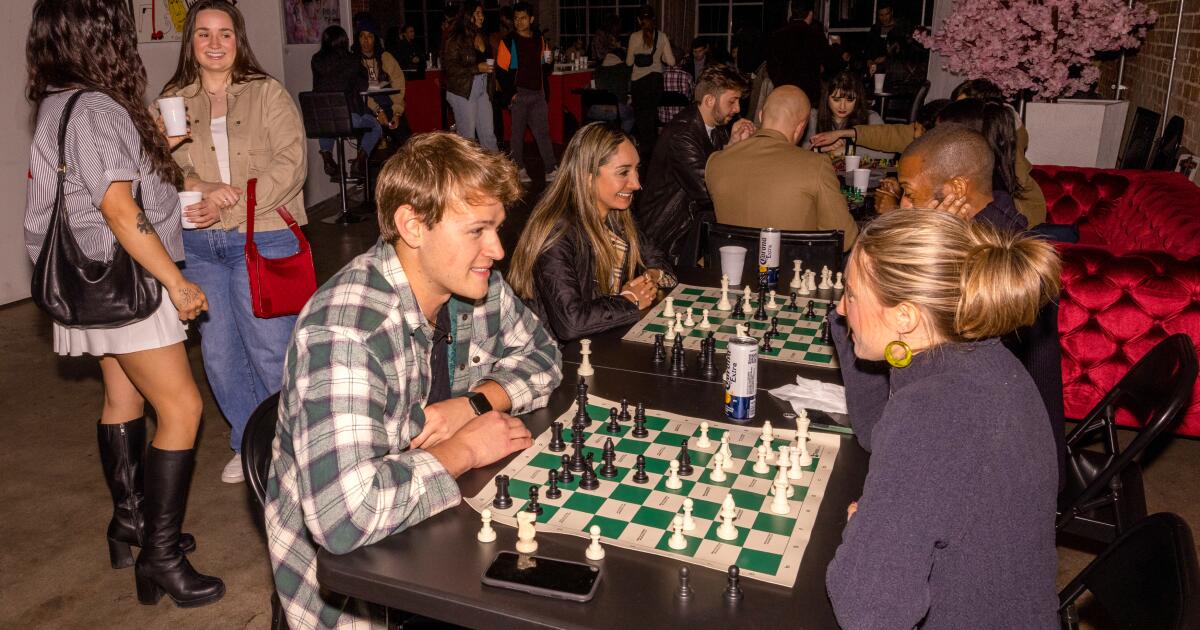
Picture this: It’s a Thursday night in Santa Monica, and you’re feeling good. You’re sitting across from a cute stranger, and the vibes are vibing. In a spacious warehouse-style space, which might sound a tad sketch but somehow isn’t at all, 20- and 30-somethings are seated around rows of tables with chess boards. House music is bumping, and drinks are flowing. There’s pizza being made on-site, and two tattoo artists are around if you’re feeling adventurous and looking to commemorate the experience. And if you need a buffer for maintaining conversation with someone unfamiliar, no worries.
All of this is unfolding as you play a low-stakes game of chess. This is the magic of L.A. Chess Club.
From 8 p.m. to midnight every Thursday, happy regulars and excited first-timers show up to play chess and exercise their social muscles. On this particular night in early April, 250 people show up, some opting for heels and outfits you’d see at a chic lounge, with many others going the casual route — yet neither group looks out of place. Whether you’re looking to competitively play chess, learn the game , meet new friends or mingle as a single person, all are welcome by founder Michelle Kong.
A circular chess board made by an event attendee is shown at a weekly L.A. Chess Club meetup.
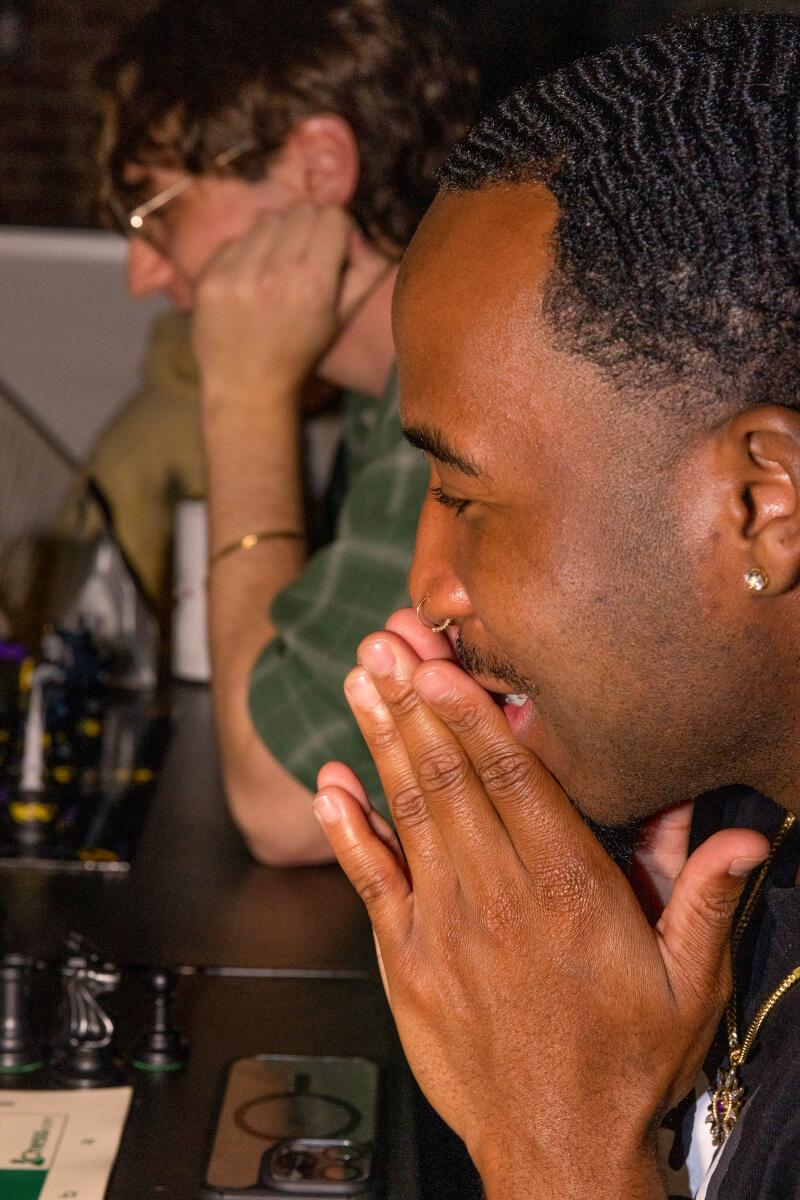
Chess player Jonathan Erving waits for his opponent to make a move.
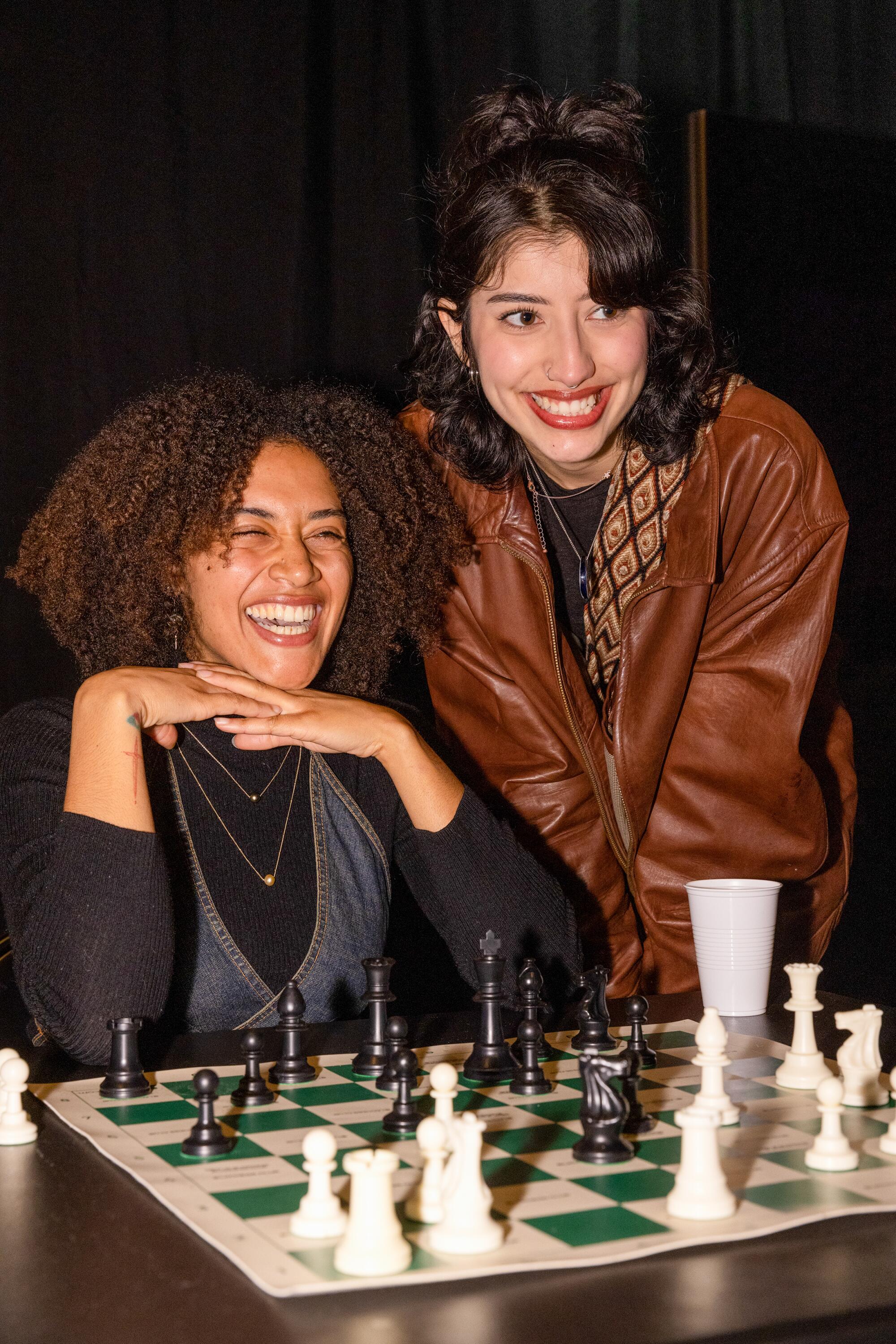
Imani Cheadle, left, and Mandy Sherma play a game of chess together with new friends.
Around the country, people are hungry for connection and eager to seek it out following the collective trauma of COVID-19 closures. In-person gatherings that lean into the preciousness of sharing space and being still with one another are on the rise, and Los Angeles is no exception. More supper clubs have emerged, while slow burns like magazine collaging are a hit. There’s more emphasis on romanticizing and reimagining everyday activities and an increased interest in speed dating. The need for more thoughtful spaces to connect with new friends or romantic prospects for a few hours of casual conversation is palpable, and L.A. residents are stepping up.
Liam Blackburn, 22, has been coming to L.A. Chess Club for the last nine months. The exciting rounds of speed chess plus the consistent young crowd initially piqued Blackburn’s interest. But the meaningful connections he’s made while attending are what quickly turned him into a regular.
“I feel like I can actually talk to people and even meet them at a deeper level instead of ‘Hey, how you doing? Wanna dance?’” Blackburn says, emphasizing the refreshing change of pace that low-key, mellow-yet-lively chess meetups offer versus the loud music and social pressure of being at L.A. bars and nightclubs.
On this night, Blackburn arrived at L.A. Chess Club with his girlfriend, Courtney Zajac, 23. After the two met and played a game of chess at a past Chess Club event, sparks flew, and they decided to spend time together again. Now the couple, both of whom were already seasoned chess players, count the Thursday event as a regular stop on their social calendar.
“Sometimes you just cross paths with someone who is an absolute breath of fresh air, and Liam is undoubtedly one of those people no matter the setting,” Zajac says of her experience connecting with Blackburn. “I didn’t attend Chess Club with the intention of finding a romantic connection but I left my first evening in attendance knowing I’d met someone whose company I couldn’t get enough of — and whose chess skills were truly humbling. It was absolutely special and memorable, and I can’t say I’ve experienced anything quite like it before.”
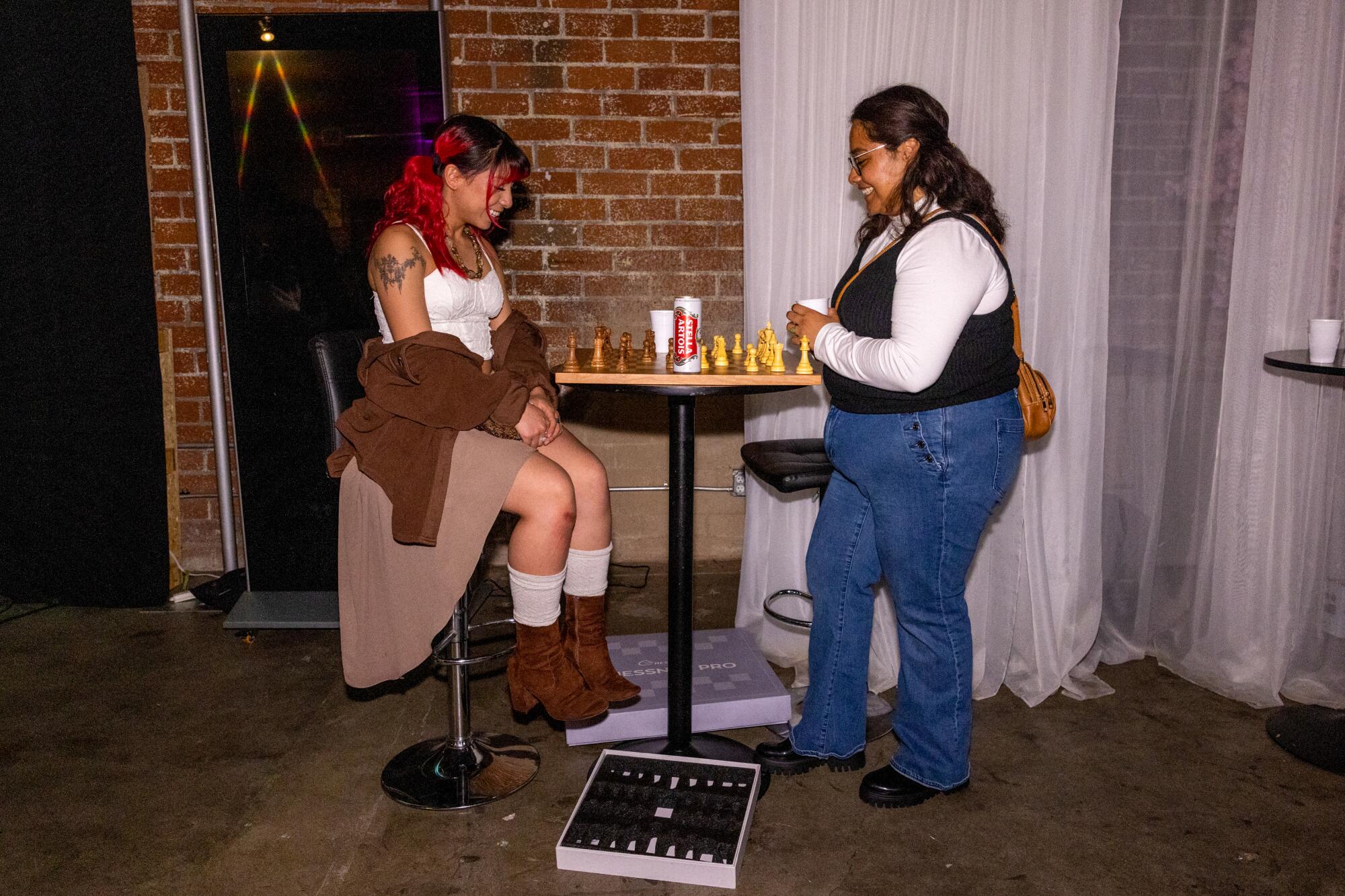
New friends Sofia Contreras, left, and Jen Castro play a game of chess together.
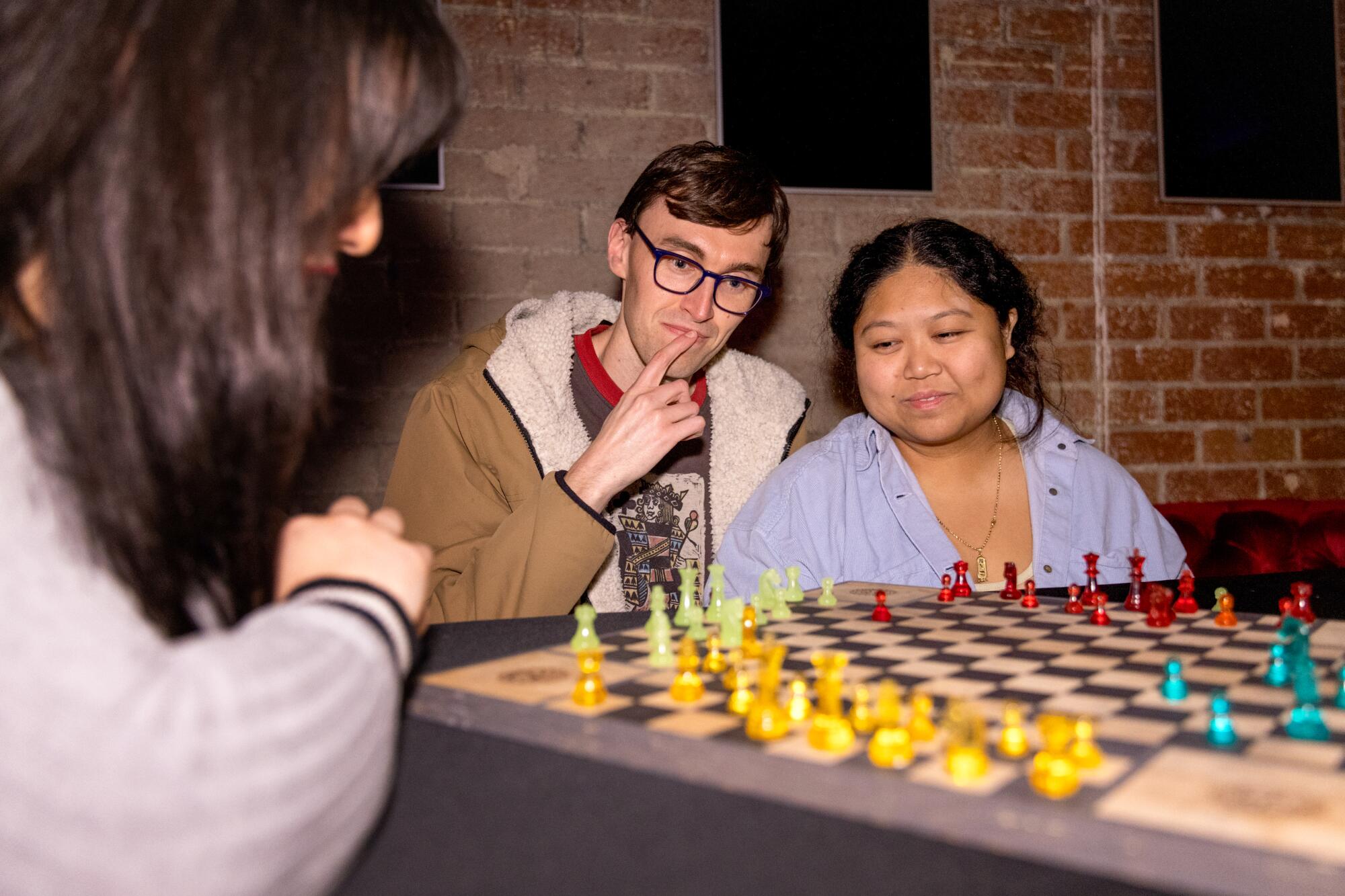
Suha Kalish, left, and couple Fred Muth and Hanz Legaspi play chess together on a multi-player board during an L.A. Chess Club night.
Founder Kong, 26, has struck gold with this formula: an event with the laid-back ease of a chill game night and all the social and romantic possibility of a night out on the town. However, what the popular weekly chess events have grown into was never Kong’s intention when she launched the club in June 2023. “I just wanted to play chess,” she says lightheartedly.
About two years ago, when Kong first started playing chess, she was “immediately hooked” and became an avid online player. “My friends didn’t play chess, and I was like, ‘I need to find people to play chess with in person,’” Kong says. “I did my own research and went to a chess club, and it was just all older men playing chess in silence in this basement.” After Kong did some additional research and checked in with friends, she noticed that chess clubs for children and adult clubs made up almost exclusively of men seemed to be the norm.
“I really needed a chess club for people my age and in my proficiency level as well, so I made one,” she says.
After the success of L.A. Chess Club’s singles event for Valentine’s Day in February, Kong better understood how many people came to the events in search of deeper, meaningful connections. The club has relocated to a permanent location in the downtown Arts District to accommodate its growing roster of regulars.
Actor and event producer DeShawn Cavanaugh says L.A. Chess Club is helping to meet the growing need for fresh social spaces beyond the typical nightlife scene.
Cavanaugh, who produces comedy events around L.A. such as Curson n’ Screamin’ and A Tribe Called Melanin through his company 3mpower Media, enjoyed himself during his first Chess Club experience.
“I think people are looking for activities and something stimulating that’s not just drinking or listening to music,” he says. “All of those things are great, but especially in L.A., we have so many artists, they need something to chew on. These types of social events have been a really great way for people to reconnect with others and themselves.”
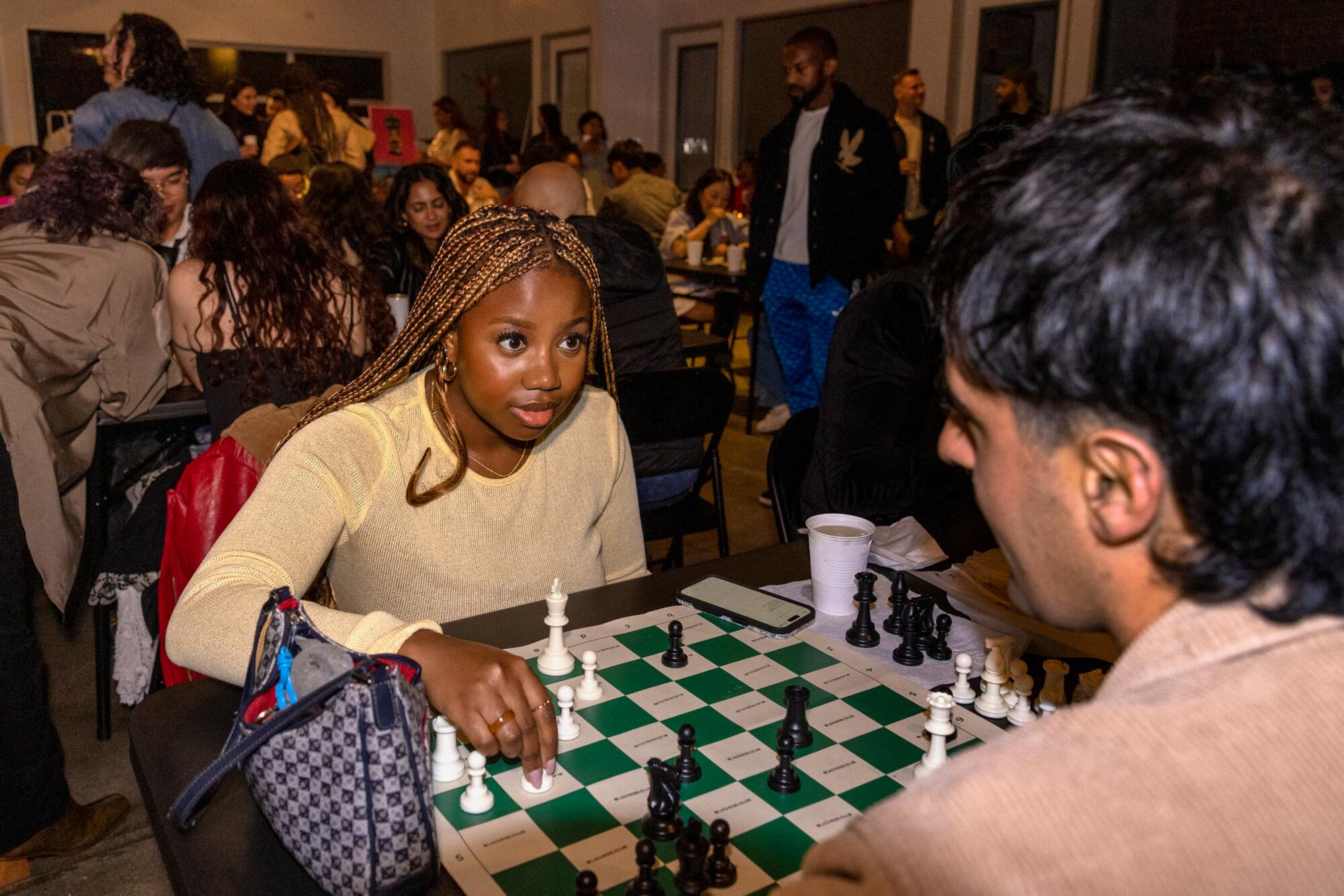
Janet Akisanmi, left, from Dallas, plays a game against Kabir Kang, of Los Angeles. Akisanmi and her friend Grace Feyisetan were visiting L.A. for a month from Dallas and saw the event on TikTok, so they decided to check it out.
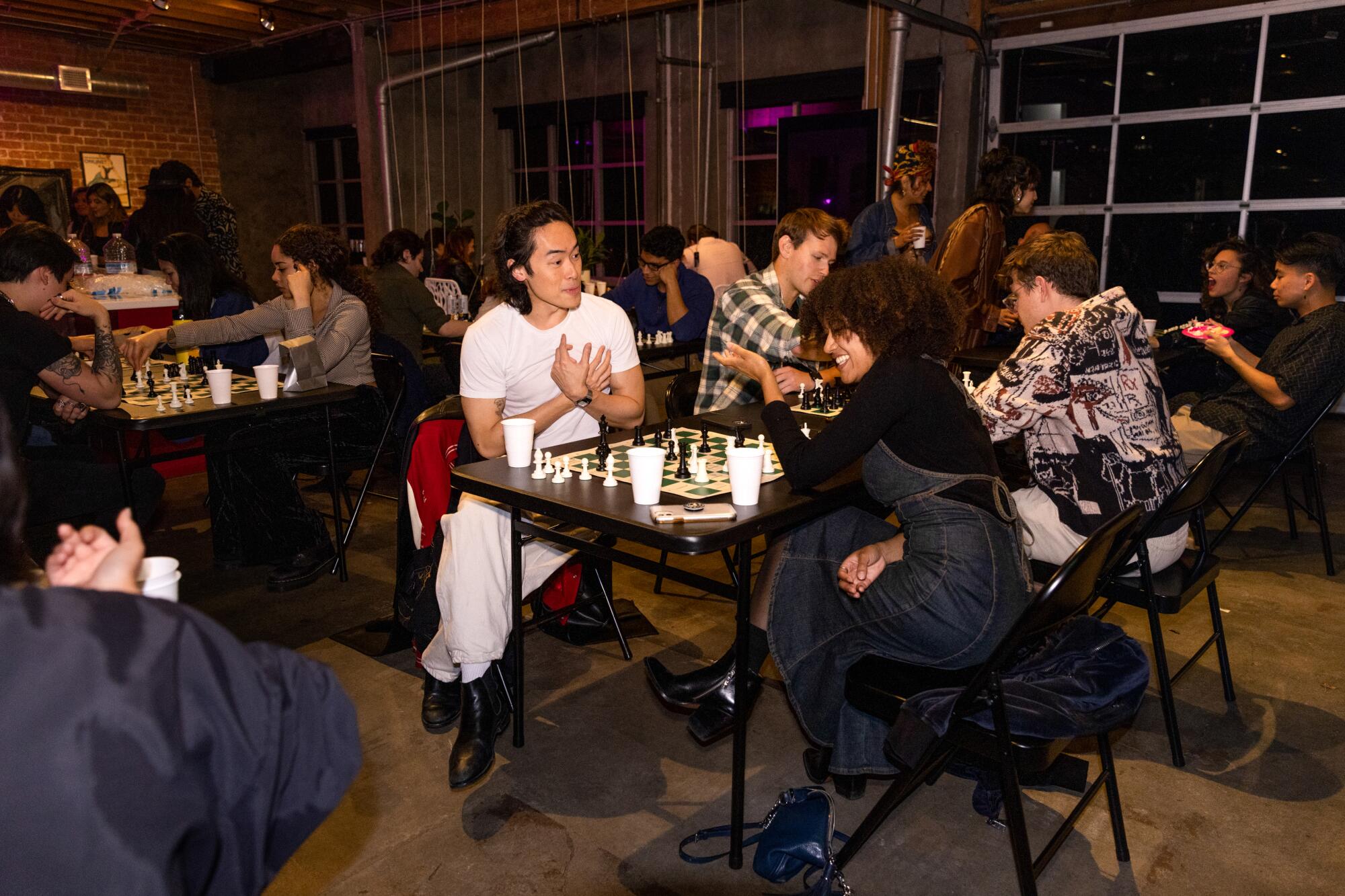
Tiger Ji, left, and Imani Cheadle play chess together during a recent L.A. Chess Club night. It was Ji and Cheadle’s first time at the event. “It’s really fun,” Ji says. “I got really into chess during COVID, but most of it was playing online. It’s rarely social. This is less so about playing chess and much more about getting to know people. I just moved to L.A., and this is great.”
Bijan Sanchez, 30, has been in quite a few chess communities in L.A., but none were a great fit. “I stopped playing chess for the longest time, and I just joined Catan clubs. I feel like the community is more friendly,” Sanchez says.
After friends recommended he visit L.A. Chess Club, Sanchez has finally found a chess environment that resonates. “I loved it a lot. I think it was one of my favorite nights out in L.A.,” he says. “I like that there was a good diversity of different people. I feel like everyone is kinda like cool nerds, and I think I identify as that, as someone that’s an outgoing nerdy guy. I vibe with the culture and people.”
Sofia Contreras felt compelled to visit L.A. Chess Club after seeing the event highlighted on TikTok by Taylor Morgan McPherson, a.k.a. the Sparkle Queen. McPherson featured the event in her “Where to Meet Men” series, which has grown increasingly popular among L.A. singles, and helped boost awareness of Chess Club. “She motivated me to come out. The [turnout] was a lot better than what I expected it to be,” Contreras says with a smile, standing next to Jen Castro, a friend she made earlier in the evening. “I’m here now and I’m having fun.”
“I’m always checking out what’s new in L.A. to meet people in person because I don’t have the best luck on dating apps,” says McPherson. “You know, being a Black woman, dating apps aren’t really skewed for us.” On McPherson’s first visit to Chess Club, she arrived solo and had a pleasant experience. “I was a little nervous. I was a little timid,” she says.
“Men approached me immediately. It was really nice,” McPherson says, recounting a positive experience at the bar and that more seasoned male players patiently walking her through the game. “Everyone was so open and willing to teach, which was so refreshing.” By the end of the night, McPherson had made a connection and exchanged numbers with someone. Now, McPherson is another attendee-turned-vendor who offers a range of glittery body, face and hair embellishments to Chess Club members each week through her Kourtney Kardashian-approved biodegradable Sparkle Bar.
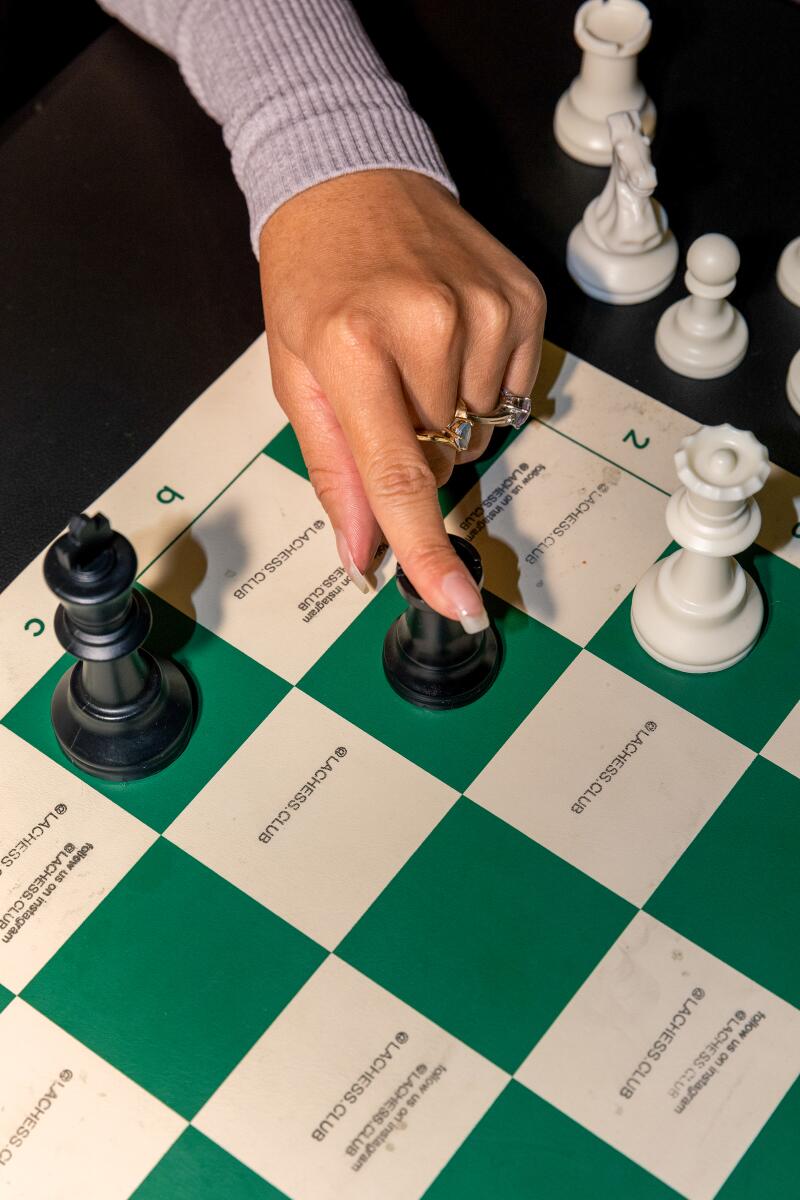
Kamarya Singh makes a move against her opponent at L.A. Chess Club.
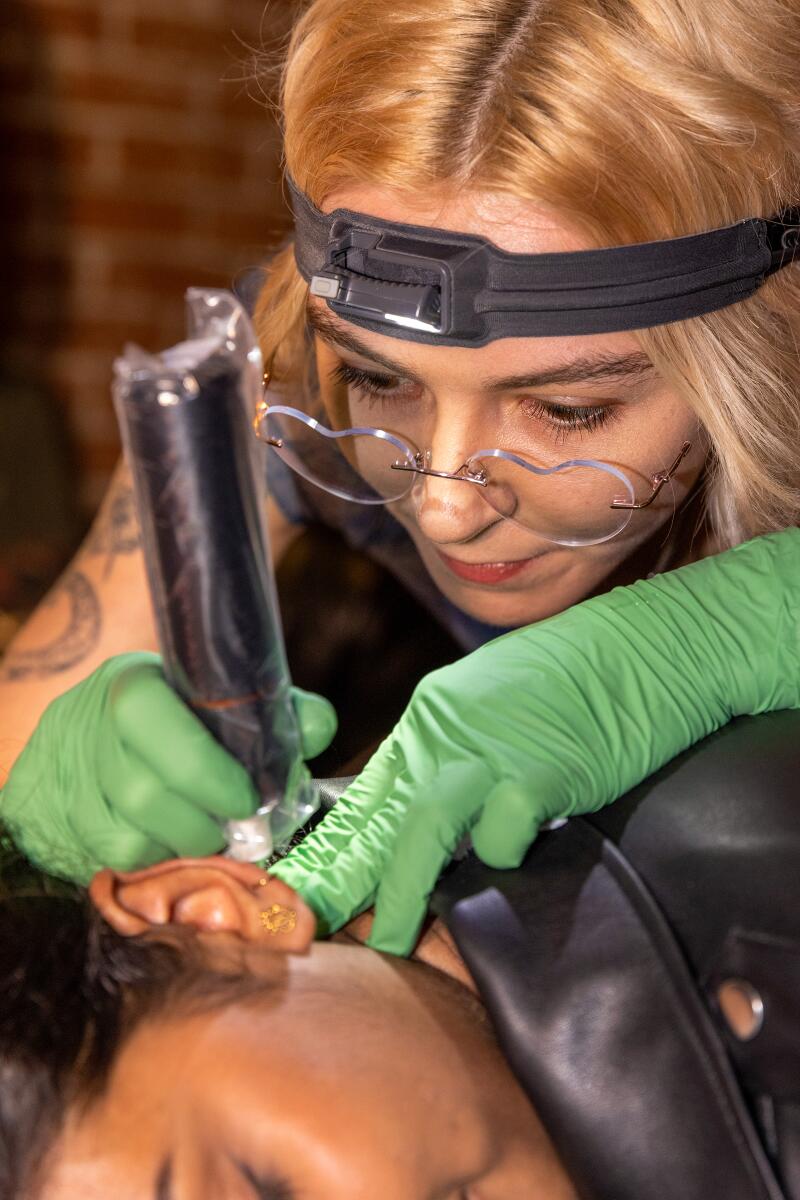
Tattoo artist Clover Fields gives Eliana Pandian a small heart tattoo behind her ear during L.A. Chess Club. Other highlights included a DJ, glitter tattoos, hair tinsel and tarot readings.
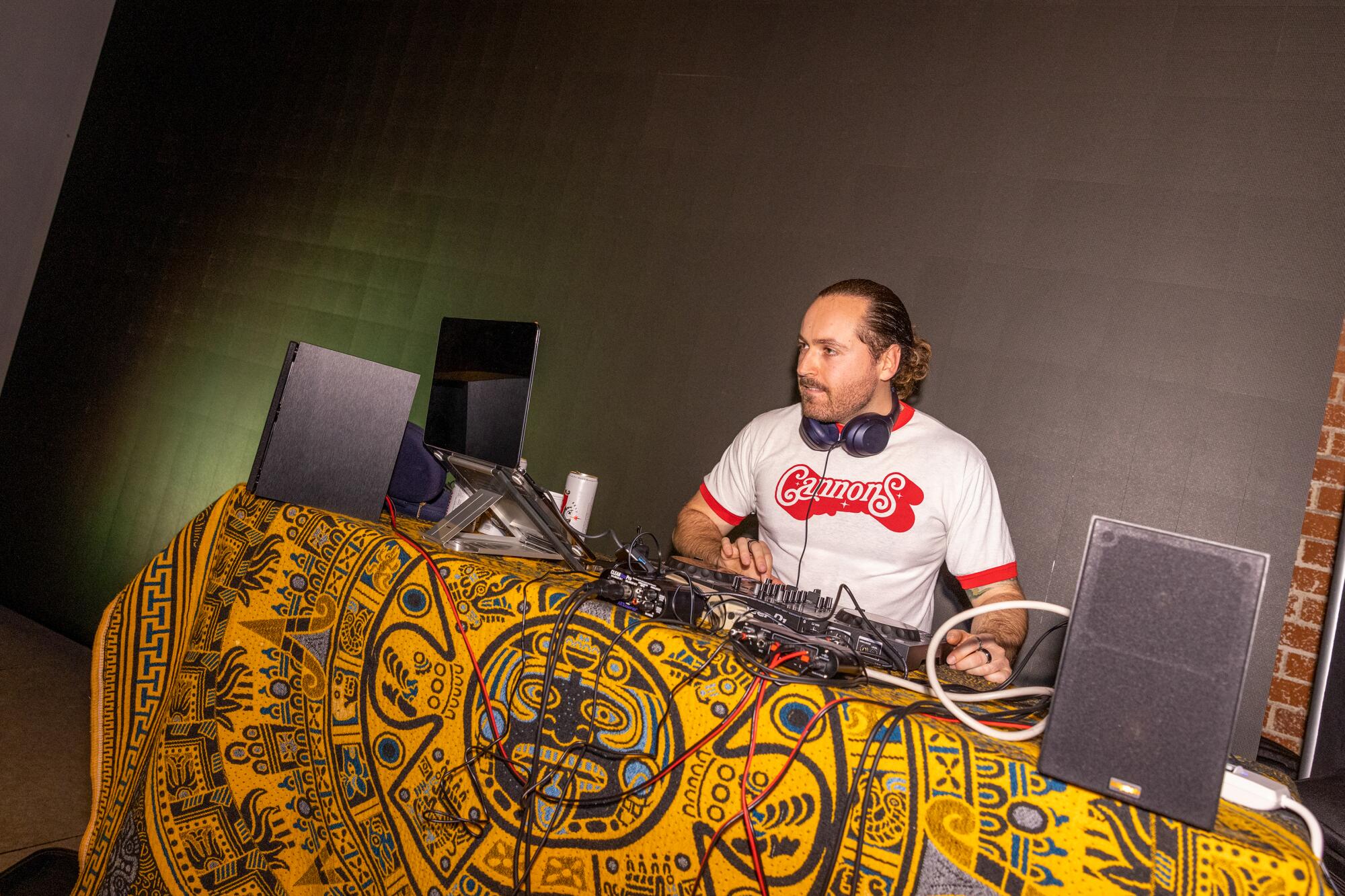
Dennis Neymit, a.k.a. DJ Dill, plays music during the second half of L.A. Chess Club on a recent April night.
Attending the event cost $60 for men, with free admission for women. Regulars can access a discounted rate through a recently launched loyalty program.
The price structure is a move that aims to boost the low number of women in chess while eliminating barriers to entry, says Kong, adding that many of the club’s long-term male members were supportive and willing to pay double in support of the mission.
“Women making up only 10% of chess players is crazy,” Kong says. “The statistics do not look great. Our ratio is almost 2 to 1 now, women to men, and it’s proven that it works. A lot of people are very supportive. It’s really great to see.”
Ultimately, the event is what you make of it, Kong says, noting that people who’ve attended L.A. Chess Club have made all sorts of connections: finding roommates, meeting romantic partners (straight and queer) and making new friends.
For Nyne Nelson, 33, an intuitive and attendee-turned-vendor at L.A. Chess Club, getting to know people within the chess community has been rewarding, especially after enduring the intense isolation of the COVID-19 shutdown. “I’m a very introverted person, so coming to a place where I can play a game and talk to people works out very well for me — and also reading people and giving guidance,” says Nelson, who offers tarot readings on a sliding scale at the weekly event. “Sometimes people just need guidance, and that’s what I’m here to do. I don’t tell the future. I just give a direction on where to go.”
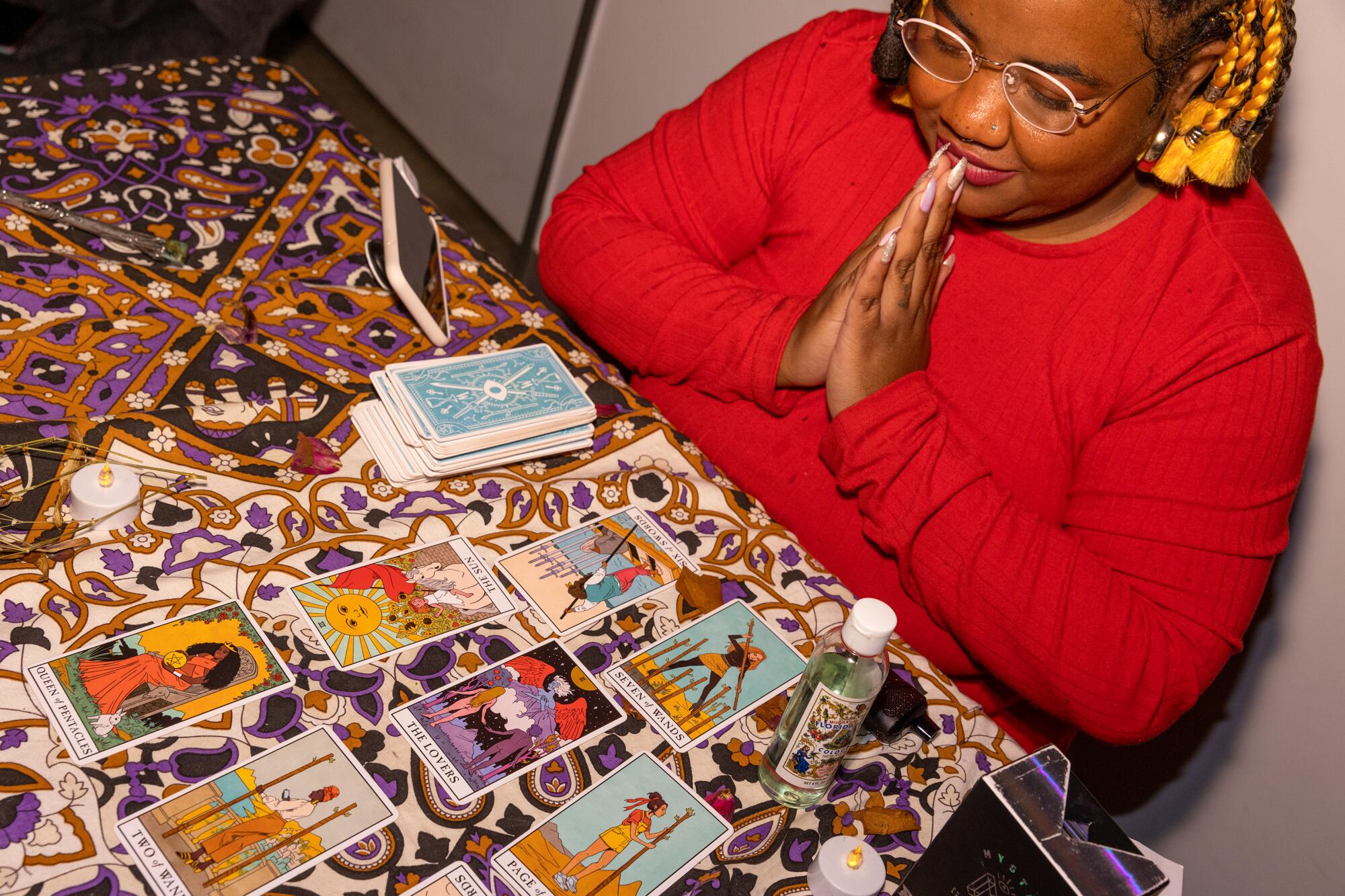
Nyne Nelson, a.k.a. Haus of 9 Tarot, gives a reading during L.A. Chess Club.
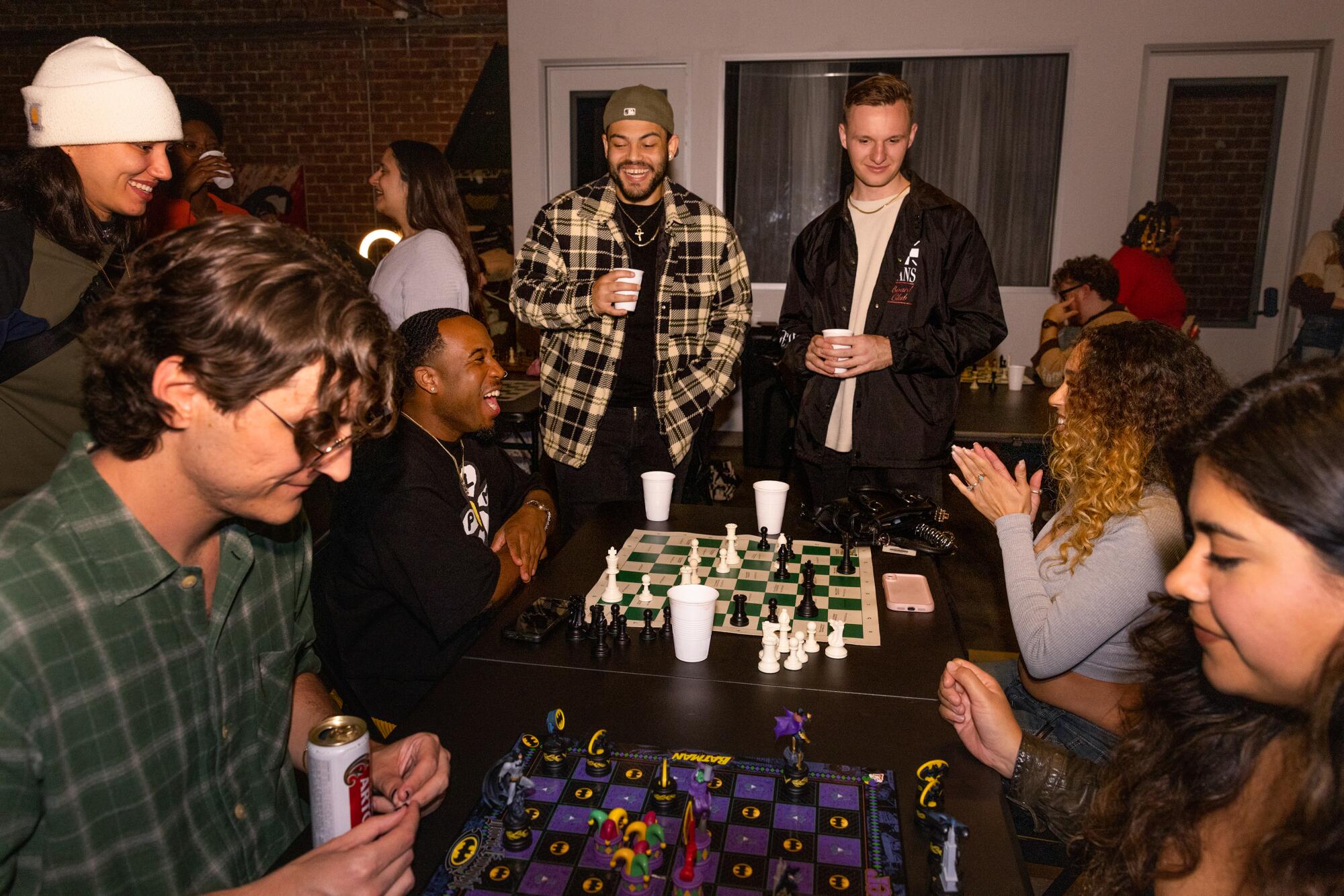
Jonathan Erving, center left, and Kamarya Singh play chess against each other as friends Jared Washington and Brandon Walker cheer them on.
Kong left her finance job and focused on L.A. Chess Club full time. “I think betting on yourself when you’re young yields good returns,” she says. “I invested everything I had to keep Chess Club running every week for nine months before I monetized [it]. It’s not easy. I’m just very determined.”
Despite the club still being in its infancy, the growth has been rapid, with weekly events averaging about 200 people.
“When you’re waking up at 5 a.m. and listening to Bloomberg in the morning and looking at stocks, it’s a very different start of the day than when you get to wake up and work on something you’re passionate about,” she says. “There’s so much opportunity here, especially compared to the environments that I was exposed to when I first went to chess clubs. I’m so happy that I’m able to bring this type of positive experience to people for the first time they interact with chess.”




An underwater view shows US’ Lilly King competing in a heat of the women’s 200m breaststroke swimming event during the Paris 2024 Olympic Games at the Paris La Defense Arena in Nanterre, west of Paris, on July 31, 2024. (Photo by François-Xavier MARIT / AFP) (Photo by FRANCOIS-XAVIER MARIT/AFP via Getty Images)
François-Xavier Marit/Getty Images
hide caption
toggle caption
François-Xavier Marit/Getty Images
This week’s show was recorded in Bloomington, Indiana with host Peter Sagal, judge and scorekeeper Bill Kurtis, Not My Job guest Lilly King and panelists Alonzo Bodden, Josh Gondelman, and Faith Salie. Click the audio link above to hear the whole show.
Who’s Bill This Time
State of the Union is Hot; The Tribal Council Convenes Again; A Glow Up In the Doll Aisle
Panel Questions
The Toot Tracker
Bluff The Listener
Our panelists tell three stories about a travel hack in the news, only one of which is true.
Not My Job: Olympic Swimmer Lilly King answers our questions about Lil’ Kings
Olympic Swimmer Lilly King plays our game called, “Lilly King meet these Lil’ Kings” Three questions about short kings.
Panel Questions
Cleaning Out The Cabinet; Bedtime Stacking
Limericks
Bill Kurtis reads three news-related limericks: Getting Cozy With Cross Country Skiing; Pickleball’s New Competition; Bees Get Freaky
Lightning Fill In The Blank
All the news we couldn’t fit anywhere else
Predictions
Our panelists predict, after American Girls, what’ll be the next toy to get an update.

Law Roach
Zendaya and Tom’s Wedding Already Happened …
Y’all Missed It!!!
Published
Zendaya and Tom Holland are married … so claims her longtime stylist, Law Roach.
Here’s the deal … the celebrity stylist — who started styling Zendaya way back in 2011 — spoke to Access Hollywood on the Actors Awards red carpet where he sang out “The wedding has already happened, you missed it.”
Waiting for your permission to load the Instagram Media.
The AH reporter asks in shock if that’s true … and, Law responds by saying it’s “very true” before walking off.
This isn’t the first time Tom and Zendaya’s relationship status has made headlines on a red carpet … remember at the Golden Globes in 2025, Zendaya had a ring on that finger — and, the next day, we found out the two were engaged.

TMZ.com
Zendaya and Tom met on the set of “Spider-Man: Homecoming” in 2016, started dating a couple years later and went public with their relationship in 2021.
We’ve reached out to Tom and Zendaya’s teams … so far, no word back.

Online prediction market platforms allow people to place bets on wide-ranging subjects such as sports, finance, politics and currents events.
Photo Illustration by Scott Olson/Getty Images
hide caption
toggle caption
Photo Illustration by Scott Olson/Getty Images
The rise of prediction markets means you can now bet on just about anything, right from your phone. Apps like Kalshi and Polymarket have grown exponentially in President Trump’s second term, as his administration has rolled back regulations designed to keep the industry in check. Billions of dollars have flooded in, and users are placing bets on everything from whether it will rain in Seattle today to whether the US will take over control of Greenland. Who’s winning big on these apps? And who is losing? NPR correspondent Bobby Allyn joins The Sunday Story to explain how these markets came to be and where they are going.
This episode was produced by Andrew Mambo. It was edited by Liana Simstrom and Brett Neely. Fact-checking by Barclay Walsh and Susie Cummings. It was engineered by Robert Rodriguez.
We’d love to hear from you. Send us an email at TheSundayStory@npr.org.
Listen to Up First on Apple Podcasts and Spotify.

West Virginia Surrenders Six-Run Lead, Falls in Series Finale to Kennesaw State

Meyer’s Late Score Lifts Wyoming past Air Force – SweetwaterNOW

Crypto Sector Suffers Exodus of Reliable Retail Investors | PYMNTS.com

Canton High School students find success in personal finance

The Workout Habit That Can Become Harm

Florida High School Football Rankings: Top 25 teams – Oct. 21

Cleary's 21 help Le Moyne down Central Connecticut State 69-64 in OT

How old is Bo Nix? What to know about Oregon quarterback ahead of 2024 NFL Draft

99th annual Pony Swim held in Virginia

Indiana Members Credit Union announced as new anchor tenant at Bottleworks District

House Republicans push Johnson to go to war with Senate over SAVE Act

Israel FM says Europe too divided, slams Spanish PM

Satellite images provide view inside Iran at war

Video: What the Texas Primary Battle Means for the Midterms

Dems’ potential 2028 hopefuls come out against US strikes on Iran
-

 World4 days ago
Exclusive: DeepSeek withholds latest AI model from US chipmakers including Nvidia, sources say
-

 Massachusetts4 days ago
Mother and daughter injured in Taunton house explosion
-

 Montana1 week ago
2026 MHSA Montana Wrestling State Championship Brackets And Results – FloWrestling
-

 Denver, CO4 days ago
10 acres charred, 5 injured in Thornton grass fire, evacuation orders lifted
-

 Louisiana7 days ago
Wildfire near Gum Swamp Road in Livingston Parish now under control; more than 200 acres burned
-

 Technology1 week ago
YouTube TV billing scam emails are hitting inboxes
-

 Politics1 week ago
OpenAI didn’t contact police despite employees flagging mass shooter’s concerning chatbot interactions: REPORT
-

 Technology1 week ago
Stellantis is in a crisis of its own making