Lifestyle
From the 1976 political earthquake to Wisconsin birders, check out these new podcasts


WFAE; KCRW; KUT; Iowa Public Radio; WBUR; NPR

WFAE; KCRW; KUT; Iowa Public Radio; WBUR; NPR
Make spring cleaning a little easier this month with a new podcast. The NPR One Team has recommendations from across the NPR Network to get you started.
The podcast episode descriptions below are from podcast webpages and have been edited for brevity and clarity.
Landslide – WFAE
“When President Richard Nixon resigns in disgrace, three unlikely candidates emerge to fill the vacuum: Gerald Ford, savvy veteran of partisan wars. Ronald Reagan, fringe reactionary. Jimmy Carter, cutthroat political animal. These presidents aren’t who you thought they were, and their battles against each other redefined the American political landscape.
The result: the hot-button issues, the culture war, and the path to the partisan divide we live with today. For those wondering what happened to American politics and what forces have driven our current division, Landslide is essential listening, and a compelling, stunning true story.” Listen to episode one, “Trust.”
Embedded – NPR
“NPR’s longtime Jerusalem correspondent Daniel Estrin has been covering the war in Gaza almost nonstop for the past five months. In our first episode of a special two-part series, Daniel talks with Embedded host Kelly McEvers about some of the people he’s reported on and how he approaches covering this difficult and divisive story.” Start listening to the two-part series, Field Notes.
Unsettled – Iowa Public Radio
“We’ve come a long way, baby! But how far? Women’s roles, women’s rights and women’s identities in our culture are constantly shifting. On the new season of Unsettled, we explore different aspects of womanhood. We’re starting with pivotal moments for women in popular culture. Then we talk feminism, women’s reproductive responsibilities, women’s labor at home and in the workplace. And – we ask: what does it mean to be a woman today?” Listen to “The Caitlin Clark Effect.”
Booming – KUOW
“The Seattle area’s been home to many booms over the years. It’s brought jobs, people and wealth to the region, but also real growing pains that people here feel every day.
In Booming, KUOW economy reporters Joshua McNichols and Monica Nickelsburg explore hidden connections between technology, cities, work and our day-to-day experiences. We’ll ask the important question: how can more of us benefit from the booms and weather the busts?” Start listening to “Dorms for adults.”
The Open Ears Project – WNYC Radio
“From tales of memorable moments in nature and fleeting encounters with strangers – to recollections of music that helped in difficult times – The Open Ears Project features people sharing a personal story about the classical track that means the most to them, and why. Part mixtape, part sonic love letter, each episode creates a moment to reflect on the question, what if we made a habit of opening our ears — to classical music and to each other? Whether seeking an introduction to new pieces or encounters with powerful storytelling, listeners will enjoy brief but enduring meditations with artistic works and soulful stories spanning the range of the human experience.” Listen to “Tom Hiddleston on Arvo Pärt and the Infinite.”
Beyond All Repair – WBUR
“Imagine if, one day, you are accused of something. Something horrible, violent, heinous. Something you swear you did not do, and nothing you say can convince anyone otherwise — even the people closest to you. That’s Sophia Johnson’s story. Sophia was starting fresh: A new life, a new husband, a baby on the way. But it all unraveled on January 10, 2002, when her mother-in-law Marlyne Johnson was found bludgeoned to death in her home. Days later, Sophia was charged with the murder. To this day, Sophia swears she didn’t do it. But someone says they witnessed it — her own brother. When family betrays family, who do you believe?
In this story of a sibling rivalry beyond compare, WBUR’s Amory Sivertson turns the clock back. She reexamines an unsolved case, a family torn apart, and a woman who wasn’t believed. From WBUR and ZSP Media, Beyond All Repair is a 10-part true crime investigation into a cold case. The series ends with an answer.” Start listening to part one, “Ch. 1: Boxes.”
Chirp Chat – WUWM
“With the sun shining a little more lately, you may have noticed more birds chirping — making it a great time to head outdoors and explore our feathered friends. Wisconsin birders join Lake Effect’s Xcaret Nuñez monthly to chirp about all things birds.” Listen to “A beginner’s guide on how to start birding in Milwaukee.”
Lost Notes – KCRW
“Long before ‘Tainted Love’ was an ’80s anthem, it was a 1965 B-side by LA’s Gloria Jones. We trace the song’s journey from a warehouse floor to the annals of pop history.
In season 4 of Lost Notes co-hosts Novena Carmel and Michael Barnes guide you through eight wildly different and deeply human stories, each set against the kaleidoscopic backdrop of LA’s soul and R&B scene of the 1950s-1970s. It’s a must-listen event for any aficionado of music history and great storytelling.” Start listening to “The True Story of ‘Tainted Love.’”
¡Vamos Verde! – KUT
“¡Vamos Verde! is a podcast about Austin FC and the community that has grown up around the team. Hosts Jimmy Maas and Juan Garcia talk to players, staff, fans, musicians, and artists to bring you an inside look at the culture of Austin’s only professional sports team. From player interviews to looks behind the curtain at what makes the team and the community thrive – it’s a soccer podcast for everyone.” Listen to “A New Hope: Austin FC’s season opener w/ goalie Brad Stuver and singer Mélat.”
NPR’s Jessica Green and Jack Mitchell curated and produced this piece.


Can you say no to a friend’s wedding?
Getty Images/Getty images
hide caption
toggle caption
Getty Images/Getty images
Are we spending too much on other people’s weddings?
Going to a friend’s weddings can be so fun and meaningful… but it can also really hurt your wallet. A survey by LendingTree found that 31% of people who had been to a wedding in the past five years had accrued debt to attend. So what’s driving up the cost of weddings for guests? And what makes it so hard to say no to these expenses?
Brittany breaks it down with Allyson Rees, senior analyst at trend forecasting firm WGSN, and Annie Joy Williams, assistant editor at The Atlantic.
This episode was produced by Liam McBain, with additional support from Corey Antonio Rose. It was edited by Neena Pathak. Our Supervising Producer is Cher Vincent. Our Executive Producer is Barton Girdwood. Our VP of Programming is Yolanda Sangweni.
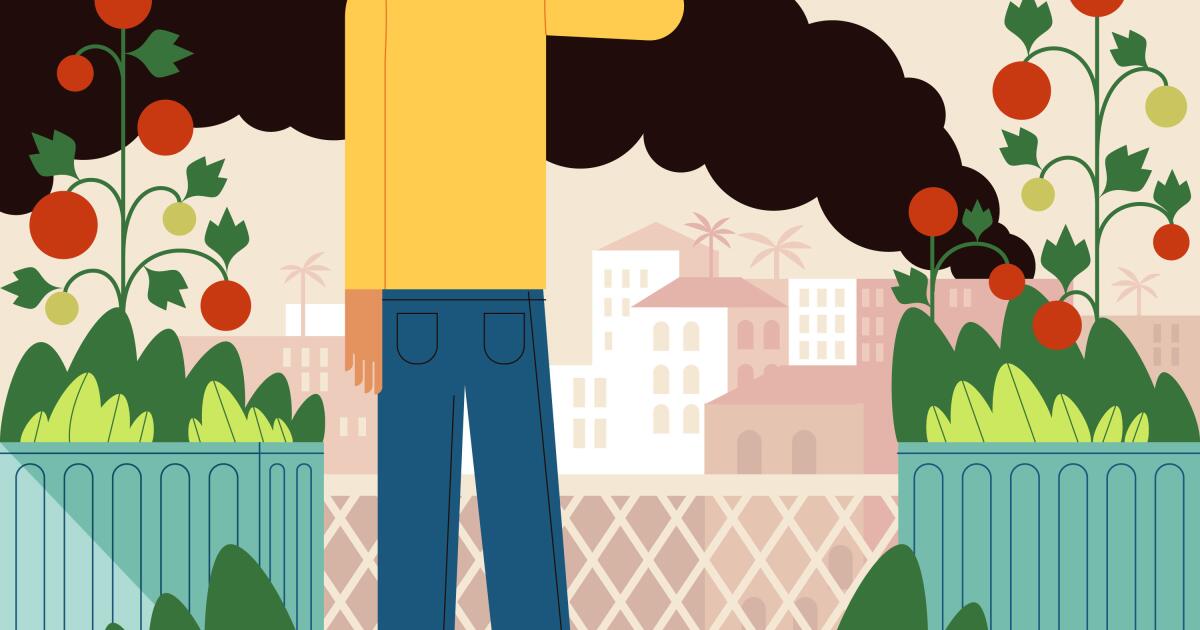
After the eight-day-long fire in a 500,000-square-foot Boyle Heights warehouse, eastern Los Angeles residents are contending with putrid smells, soot and potentially hazardous airborne chemicals after heavy plumes of smoke spread throughout the city. But those who grow food in nearby neighborhoods may also be wondering: How will the fires affect the plants and produce in my garden?
The Boyle Heights warehouse, owned by Lineage — a global temperature-controlled storage facility operator — housed 85 million pounds of frozen food and other products. In the days since the fire, local emergency visits for smoke inhalation and throat pain spiked while agencies still scramble to measure the amount of PM 2.5 — harmful fine particles — and heavy metals, like lead and arsenic, in the air.
According to researchers, any toxic airborne chemicals would likely stem from the charred foam insulation, metal exterior, burned solar panels and any lithium batteries that might have been present inside the warehouse.
After a fire, heavy metal particles can spread through ash and smoke over gardens and inhibit growth, said Olukayode Jegede, an agricultural toxicologist and assistant professor at UC Davis. Since the warehouse fire is so recent and cleanup has just begun, Jegede said the precise impact on gardens can’t be measured until comprehensive soil tests are conducted in the area.
While the L.A. city government hasn’t announced plans for soil testing, the Contaminant Level Evaluation and Analysis for Neighborhoods project at USC is offering free contaminant testing for Boyle Heights and East L.A. residents. Residents can collect soil samples and deliver them to Boyle Heights City Hall and other locations for an evaluation of lead, arsenic, chromium and mercury levels.
The good news is produce, plants and roots can still be preserved. According to Jegede, many of the soil tests conducted last year in the Altadena area after the Eaton fire showed that gardens and poultry were not as contaminated as one might expect.
“Quite a number of the soils we tested [in Altadena] were not really contaminated,” Jegede said. “We weren’t seeing many soils with concerning elevated levels of metal, so gardeners should not be too alarmed when these things happen.”
Nevertheless, there are several measures that gardeners can take to keep themselves, their children, plants and produce safe from potentially harmful contaminants stemming from the fire. Researchers, gardening experts and horticulturists offered some guidance on the handling, recultivation and cleanup that can keep you and your garden in good health.
How do I remove ash and contaminants from my garden?
Altadena horticulturist Leigh Adams said Boyle Heights plants and produce already live in a difficult environment, surrounded by industrial warehouses that spread contaminants daily.
“That area has been used industrially for 100 years, and the soil is impacted by many, many, many things,” Adams said. “Low-income neighborhoods and gardens usually don’t have a lot of resistance against dominant manufacturing.”
This means that the contamination of gardens in eastern L.A. won’t be as catastrophic as compared with those in Altadena, a more suburban environment, Adams said. But fallen ash still poses major health risks if ingested or inhaled.
An advisory from University of California Agricultural and Natural Resources last year recommended suiting up in an N95/KN95 mask, long sleeves, pants, close-toed shoes and gloves before attempting to deal with ash in the garden to limit exposure to potentially toxic contaminants. The advisory added that individuals should make sure all of this gear is cleaned thoroughly before bringing it back inside.
Once in the proper gear, Adams recommends removing the top two inches of topsoil from gardens, where the highest concentration of contaminants will settle after a fire. Using a plastic bag to collect the soil and disposing of it in the garbage — not green yard waste bins — will help to reduce the spread of airborne chemicals.
Gardeners with raised beds are advised to remove approximately six inches of soil, because excess ash can raise the pH level and prevent nutrients from soaking into the soil bed.
After this, watering the garden gently but plentifully will help to promote soil health and get rid of most of the ash present on plant leaves and stems. Adams said replacing the top two inches of soil with store-bought mulch or straw will help to contain any remaining ash and prevent it from spreading any further.
Experts say to avoid using leaf blowers if ash is present in the garden because they can send particles airborne. Doing so will increase the likelihood of heavy metal particles, which can carry lung irritants and carcinogens, being spread and inhaled.
A Boyle Heights resident keep a watchful eye on the fire at the 5,000-square-foot commercial building, which stores 85 million pounds of frozen food.
(Genaro Molina / Los Angeles Times)
Is it safe for me to eat produce from my garden?
Several studies, including one from the UC Cooperative Extension of Sonoma County, have shown that consuming produce in a fire-affected area poses minimal health risks.
Jegede said most root vegetables like potatoes and carrots, along with any fruit that has an outer layer, can be washed to remove potential contaminants, even if they were covered in ash. Peeling the outer layer of your produce can also help to reduce potential risks, he said.
Lettuce and other leafy foods with multiple layers pose a higher risk of contamination, but with a vigorous wash and peeling the outer layers, even the greens can be saved. The County of Los Angeles Department of Public Health recommends soaking leafy produce and fuzzy fruits like peaches in a 10% white vinegar and 90% water mixture.
Jegede said if the leaves or fruit are too delicate to wash or ash is still visible, it would be best to dispose of the produce.
How can I tell if my soil is contaminated?
After ridding your garden of visible ash, you might wonder how to tell if your plants will still thrive in the soil.
At-home soil tests that measure for alkaline, fertility and pH levels are widely available and can be purchased for $15 to $100 (for more detailed results) online. But Jegede said these tests can’t tell the full story of soil health.
Comprehensive soil testing is “something you can’t do properly at home,” Jegede said. “In labs, we are testing for metals like lithium and zinc, stuff that an at-home test will not show … If it comes to the point that you’re worried about your soil, I would just send it out to a lab.”
Wallace Laboratories in El Segundo, Babcock Laboratories in Riverside, Waypoint Analytical in Anaheim and other labs offer more detailed soil tests that measure heavy metal particles in addition to other fertility factors. Prices at Wallace Laboratories can range from $115 to $295 for a complete compost test.
The soil below two inches should be unharmed, Adams said, so long as new compost is set and plants are watered plentifully, which will promote natural biological cycles.
“What you’re doing is capping the soil, so that moisture stays in there, and instead of being dirt, it’s a living system called soil,” Adams said. “The more carbon we can get into our soil, the better.”
What can I do to help my soil recover?
For the last 12 years, Adams has been working with Metabolic Studio, a Los Angeles-based art and research hub focused on environmentalism, on methods for bioremediation, the practice of using additional fungi, plants and compost to decontaminate ash and break down contaminants.
Adams said straw, mushrooms, corn, rye and sunflowers are great bioremediators that can help to repair damage to soils. She said certain samples she’s worked on with Metabolic Studio have gone from testing at high heavy metal levels to nearly contaminant-free.
But for a more immediate fix, wash your produce, water your plants and have a little patience during ash cleanups. Your garden should look better in no time, Adams and Jegede said.

Inde Navarrette and Michael Johnston in Obsession.
Focus Features
hide caption
toggle caption
Focus Features
Two big horror films, Obsession and Backrooms, just smashed all box office expectations. So much of their success has been driven by Gen Z, which is now the biggest moviegoing demographic. But what makes a movie a Gen Z movie? Today we’re bringing you an episode of NPR’s It’s Been a Minute. Host Brittany Luse talks about this trend with Sam Adams and Reanna Cruz.
If you want to hear more about these movies, check out these episodes:
In ‘Obsession,’ love hurts. It really, really, really hurts.
‘Backrooms’ brings YouTube horror to the big screen
Zendaya brings ‘The Drama,’ we bring the spoilers
Connect with Pop Culture Happy Hour:
Letterboxd / Facebook
Our weekly newsletter
Support Pop Culture Happy Hour+
-

 Finance2 minutes ago
How Natura &Co Is Transforming Finance with Generative AI on SAP S/4HANA
-

 Fitness7 minutes ago
This 30-second walking habit can make every walk more effective and boost your fitness in less time
-

 Movie Reviews17 minutes ago
Film Review: ‘Gail Daughtry and the Celebrity Sex Pass’ Throws a Ton of Jokes at the Wall (and Enough Stick) – Awards Radar
-

 World32 minutes ago
‘The Kitchen’ Director Alonso Ruizpalacios at BAM: ‘We Need More Trojan Horses’
-

 News37 minutes ago
Manhattan Building’s Columns Buckled Beneath New Addition, Images Show
-
Lifestyle1 hour ago
Can you say no to a friend’s wedding? : It’s Been a Minute
-

 Technology1 hour ago
The robotaxi law that could ban Tesla
-

 World1 hour ago
US urges donors to abandon UNRWA funding as UN defends agency’s mission

