Lifestyle
‘Everything I knew burned down around me’: A journalist looks back on LA’s fires


A firefighter works as homes burn during the Eaton fire in the Altadena area of Los Angeles County, Calif., on Jan. 7, 2025.
Josh Edelson/AFP via Getty Images
hide caption
toggle caption
Josh Edelson/AFP via Getty Images
On New Year’s Eve 2024, journalist Jacob Soboroff was sitting around a campfire with a friend when he made an offhand comment that would come back to haunt him: The last thing he wanted to do in the new year, Soboroff said, was cover a story that would require donning a fire-safe yellow suit.
Just one week later, Soboroff was dressed in the yellow suit, reporting live from a street corner in Los Angeles as fire tore through the Pacific Palisades, the community where he was raised.
“This was a place that I could navigate with my eyes closed,” Soboroff says of the neighborhood. “Every hallmark of my childhood I was watching carbonize in front of me. … There were firefighters there and first responders and other journalists there, but it was an extremely lonely, isolating experience to be standing there as everything I knew burned down around me in real time.”

In his new book, Firestorm: The Great Los Angeles Fires and America’s New Age of Disaster, Soboroff offers a minute-by-minute account of the catastrophe, told through the voices of firefighters, evacuees, scientists and political leaders. He says covering the wildfires was the most important assignment he’s ever undertaken.
“The experience of doing this is something that I don’t wish on anybody, but in a way I wish everybody could experience,” he says. “It’s given me insane reverence for our colleagues in the local news community here, who, I think, definitionally were exercising a public service in the street-level journalism that they were doing and are still doing. … It was actually beautiful to watch because they are as much a first responder on a frontline as anybody else.”
Interview highlights

On the experience of reporting from the fires
You’re choking with the smoke. And I almost feel guilty describing it from my vantage point because the firefighters would say things to me like: “My eyeballs were burning. We were laying flat on our stomach in the middle of the concrete street because it was so hot, it was the only way that we could open the hoses full bore and try to save anything that we could.” …
I could feel the heat on the back of my neck as we stood in front of these houses that I remember as the houses that cars and people would line up in front of for the annual Fourth of July parade or the road race that we would run through town. Trees were on fire behind us — we were at risk of structures falling at any given minute. It was pretty surreal because this is a place I had spent so much time as a child and going back to as an adult. … I had no choice but to just open my mouth and say what I saw to the millions of people that were watching us around the country.
On undocumented immigrants being central to rebuilding the city

These types of massive both humanitarian and natural disasters give us X-ray vision for a time into sort of the fissures that are underneath the surface in our society. And Los Angeles, in addition to being one of the most unequal cities between the rich and the poor, has more undocumented people than virtually any other city in the United States of America. Governor Newsom knew that with the policies of the incoming administration, some of the very people that would be responsible for the cleanup and the rebuilding of Los Angeles may end up in the crosshairs of national immigration policy. And I think that that was an understatement. …
Pablo Alvarado in the National Day Laborer Organizing Network said to me that often the first people into a disaster — the second responders after the first — are the day laborers. They went to Florida after Hurricane Andrew, to New Orleans after Katrina, and they’d be ready to go in Los Angeles. And I went out and I cleaned up Altadena and Pasadena with some of them in real time.
And only months later did this wide-scale immigration enforcement campaign begin … on the streets of LA as sort of the Petri dish, the guinea pig for expanding this across the country. And it’s not an exaggeration to say that the parking lots of Home Depots, where workers [were] looking to get involved in the rebuilding of Los Angeles, has been ground zero for that enforcement campaign.
On efforts to rebuild
The pace is slow and it’s sort of a hopscotch of development. And I think for people who do come back, for people who can afford to come back, it’s going to be a long road ahead. You’re going to have half the houses on your street under construction for years to come. And for people that do inhabit those homes, it’s going to an isolating experience. But there’s an effort underway to rebuild. …
There’s also a lot of for-sale signs. And that’s the sad reality of this, is that there are people who, whether it’s that they can’t afford to come back … or that they just can’t stomach it, I think, sadly, a lot people are not going to be returning to their homes.
On what the Palisades and Altadena look like today

They both look like very big construction sites in a way. There are still some facades, some ruins of the more historic buildings in the Palisades. … But mostly it’s just empty lots. And in Altadena, the same thing. If you drive by the hardware store, the outside is still there. But it’s a patchwork of empty lots. Homes now under construction. And lots and lots of workers. … There are still a handful of people who are living in both the Palisades and in Altadena, but for the most part, these are communities where you’ve got workers going in during the day and coming out at night. …
We have designed this community to be one that’s in the crosshairs of a fire just like the one we experienced and that we will certainly, certainly experience again, because nobody’s packing it up and leaving Los Angeles. People may not return to their communities after they’ve lost their homes, but the ship has sailed on living in the wildland urban interface in the second largest city in the country.
On seeing this story, personally, as his “most important assignment”

Jacob Soboroff is a correspondent for MS NOW, formerly MSNBC.
Jason Frank Rothenberg/HarperCollins
hide caption
toggle caption
Jason Frank Rothenberg/HarperCollins
I don’t think I realized at the time how badly I needed the connections that I made in the wake of the fire, both with the people who have lost homes and the firefighters, first responders who were out there, but also honestly with my own family, my immediate family, my wife and my kids, my mom and my dad and my siblings and myself. I think that this was a really hard year in LA, and I think in the wake of the fire, I was experiencing some level of despair as well. Then the ICE raids happened here and sort of turned our city upside down. And this book for me was just this amazing cathartic blessing of an opportunity to find community with people I don’t think I ever would have otherwise spent time with, and to reconnect with people who I hadn’t seen or heard from in forever.
Anna Bauman and Nico Wisler produced and edited this interview for broadcast. Bridget Bentz, Molly Seavy-Nesper and Beth Novey adapted it for the web.




Abriana Vicioso is the host of the Flower Hour, which takes place monthly.
(Jennifer McCord / For The Times)
Each flower carries a personal history. For Abriana Vicioso, the calla lily was her parents’ wedding flower — a symbol of her mother’s beauty. “She had this big, beautiful white calla lily in her hair,” Vicioso says. “I love my parents. They’re the reason I’m here. I’ll never forget where I came from.”
The Flower Hour begins with Vicioso announcing, with a warm smile: “Today is about touching grass.” The florist-by-trade gestures behind her to hundreds of flowers contained in buckets — blue thistles, ivory anemones and calla lilies painted silver — all twisted and unfurling into the air. “Tonight is going to be so sweet and intimate,” Vicioso says, eyeing the beautiful chaos at her feet. A grin buds across her face.
Moments before the workshop, participants sit at candlelit tables exchanging horoscopes and comparing their favorite flowers. A mention of the illustrious bird-of-paradise flower elicits coos and awe from the women. Izamar Vazquez, who is from Jalisco, Mexico, reveals her fondness for roses, which make her feel connected to her Mexican roots.
Vicioso hosts her flower-themed wellness workshop near the iconic Original Los Angeles Flower Market in downtown L.A. In January, the first Flower Hour event sold out, prompting her to make it a monthly series. Vicioso describes the event as a “three-part journey” where participants are invited to drink herbal tea, smoke rose-petal-rolled cannabis joints and create a floral arrangement. “The guide is to connect with the medicine of flowers,” Vicioso says.


Rose petal joints, tea and flower arranging are all part of The Flower Hour event’s offerings.
The event is hosted at the Art Club, a membership-based co-working space. “The Flower Hour is really beautiful. Everyone gets to explore their creativity while meeting new people,” says Lindsay Williams, the co-owner of the Art Club.
The idea for Flower Hour came to Vicioso during a conversation with her mother. “We joke all the time that flowers were destined to make their way into my life,” she says. She works as a florist and models on the side, even appearing in the pages of Vogue. Vicioso grew up in a Caribbean household, where flowers and offerings were part of daily life. “In my culture and religion, a lot of my family practices — an Afro-Caribbean religion — we build altars.”
Like many cultures, flowers carry sentimental value in her religion. “I’m Caribbean, so a lot of my family practices a Yoruba religion, which comes from Africa. In the Caribbean, it’s well known as Santería.”

-
Share via
After a difficult year and a breakup, Vicioso wanted to marry her love of flowers with community building. Because Vicioso uses cannabis medicinally, the workshop naturally includes a smoking component. “My family has smoked cannabis for a lot of reasons for a long time. It’s a really healing plant,” she explains.
In the workshop, even the cannabis gets the floral treatment. Vicioso presents her rose-petal-wrapped joints on a silver platter at each table. She rolled each by hand. “If you’ve never smoked a rose-petal-rolled joint, the difference with this is it’s going to have roses that have a slight tobacco effect,” she announces.
During the workshop, Vicioso stresses the importance of buying cannabis from local vendors. The cannabis provided was purchased from a Northern Californian vendor. The wellness workshop aims to reclaim the healing ritual of smoking cannabis. “This is a plant that has been commercialized,” Vicioso says. “There’s a lot of Black and Brown people who are in jail for this plant.”
The resulting workshop is what Vicioso describes as “an immersive wellness experience that is the intersection of wellness, creativity, community and an appreciation of flowers.” The workshop serves as a reminder to enjoy Earth’s innate beauty in the form of flowers — including cannabis. “It’s this gift that the universe gave us for free and that I have this deep connection with,” Vicioso says.


Conversation cards to generate discussion among participants (top, letf). The workshop serves as a “third space” for Angelenos to engage in tactile creativity and community building outside of traditional nightlife settings.
After enjoying lavender chamomile tea and smoking a joint, Vicioso introduces the flowers to the group before inviting them to pick their own. She emphasizes each flower’s personality traits, describing green dianthus as a “Dr. Seuss” plant. Then, there are calla lilies with their “main character moment.” It gets personal. “Start thinking of a flower in your life that you can discover,” she says. “If you’re feeling like you need inspiration, you can always remember that these flowers have stories.”
Vicioso infuses wisdom into her instruction on floral arrangements: There are no mistakes. Let the flowers tell you where they want to go, she urges. Intuition will be your guide — the wilder, the better.
“Hecho in Mexico” reads a sticker on a bunch of green stems. “Like me,” says Vazquez with a laugh. “They’re all doing their own thing. Like a family,” she says later, arranging stems.

The Flower Hour participants and Vicioso, center, chat as they build their own floral arrangements at the sold-out event.
Two participants — Vazquez and Rebeca Alvarado — are friends who run a floral design company together called Izza Rose. Like Vicioso, the friends have a connection to flowers through their Latin American culture. They met Vicioso in the floral industry and were overjoyed to discover her workshop.
“This is a great way to connect with other people,” says Vazquez.
Alvarado agrees, adding: “You’re getting to know people outside of going to bars. You can connect in different ways when there’s an activity.”
Vazquez uses flowers to stay connected to her Mexican heritage, adding that she prefers to support Mexican vendors. In recent months, the downtown L.A. flower market has struggled to recover from ongoing ICE raids. “Some are scared to come back,” says Vazquez.


Hand-rolled cannabis joints wrapped in rose petals are presented on a silver platter at The ArtClub (top, right). The Flower Hour aims to reclaim the healing rituals of cannabis and flowers.
Another participant, Barbara Rios, was attracted to the workshop for stress relief. “You can hang out with your friends, but it’s nice to do things with your hands,” she says. “I work a stressful job, and it’s nice to have that third space that we’re all craving.”
On this February night, the participants were predominantly women, save for one man. In the future, Vicioso hopes that more men learn to engage with flowers. “There’s a statistic about men receiving flowers for the first time at their funerals, and I think we have changed that,” she says.
To conclude the workshop, Vicioso encourages participants to build lasting friendships and incorporate flower arranging into their daily practice — even if it’s just with a small, inexpensive bouquet.
“Get some flowers together, go to the park, hang out with each other and hang out with me,” she says. Participants leave with flower arrangements in hand. In the darkness of the night air, it briefly looks as though the women carry silver calla lilies that are blooming from their palms.


An underwater view shows US’ Lilly King competing in a heat of the women’s 200m breaststroke swimming event during the Paris 2024 Olympic Games at the Paris La Defense Arena in Nanterre, west of Paris, on July 31, 2024. (Photo by François-Xavier MARIT / AFP) (Photo by FRANCOIS-XAVIER MARIT/AFP via Getty Images)
François-Xavier Marit/Getty Images
hide caption
toggle caption
François-Xavier Marit/Getty Images
This week’s show was recorded in Bloomington, Indiana with host Peter Sagal, judge and scorekeeper Bill Kurtis, Not My Job guest Lilly King and panelists Alonzo Bodden, Josh Gondelman, and Faith Salie. Click the audio link above to hear the whole show.
Who’s Bill This Time
State of the Union is Hot; The Tribal Council Convenes Again; A Glow Up In the Doll Aisle
Panel Questions
The Toot Tracker
Bluff The Listener
Our panelists tell three stories about a travel hack in the news, only one of which is true.
Not My Job: Olympic Swimmer Lilly King answers our questions about Lil’ Kings
Olympic Swimmer Lilly King plays our game called, “Lilly King meet these Lil’ Kings” Three questions about short kings.
Panel Questions
Cleaning Out The Cabinet; Bedtime Stacking
Limericks
Bill Kurtis reads three news-related limericks: Getting Cozy With Cross Country Skiing; Pickleball’s New Competition; Bees Get Freaky
Lightning Fill In The Blank
All the news we couldn’t fit anywhere else
Predictions
Our panelists predict, after American Girls, what’ll be the next toy to get an update.

Law Roach
Zendaya and Tom’s Wedding Already Happened …
Y’all Missed It!!!
Published
Zendaya and Tom Holland are married … so claims her longtime stylist, Law Roach.
Here’s the deal … the celebrity stylist — who started styling Zendaya way back in 2011 — spoke to Access Hollywood on the Actors Awards red carpet where he sang out “The wedding has already happened, you missed it.”
Waiting for your permission to load the Instagram Media.
The AH reporter asks in shock if that’s true … and, Law responds by saying it’s “very true” before walking off.
This isn’t the first time Tom and Zendaya’s relationship status has made headlines on a red carpet … remember at the Golden Globes in 2025, Zendaya had a ring on that finger — and, the next day, we found out the two were engaged.

TMZ.com
Zendaya and Tom met on the set of “Spider-Man: Homecoming” in 2016, started dating a couple years later and went public with their relationship in 2021.
We’ve reached out to Tom and Zendaya’s teams … so far, no word back.

Block to cut more than 4,000 jobs amid AI disruption of the workplace

Kurt Cobain’s Fender, Beatles drum head among $1-billion collection going to auction
Smoke a joint and get deep with flowers at this guided floral design workshop in DTLA
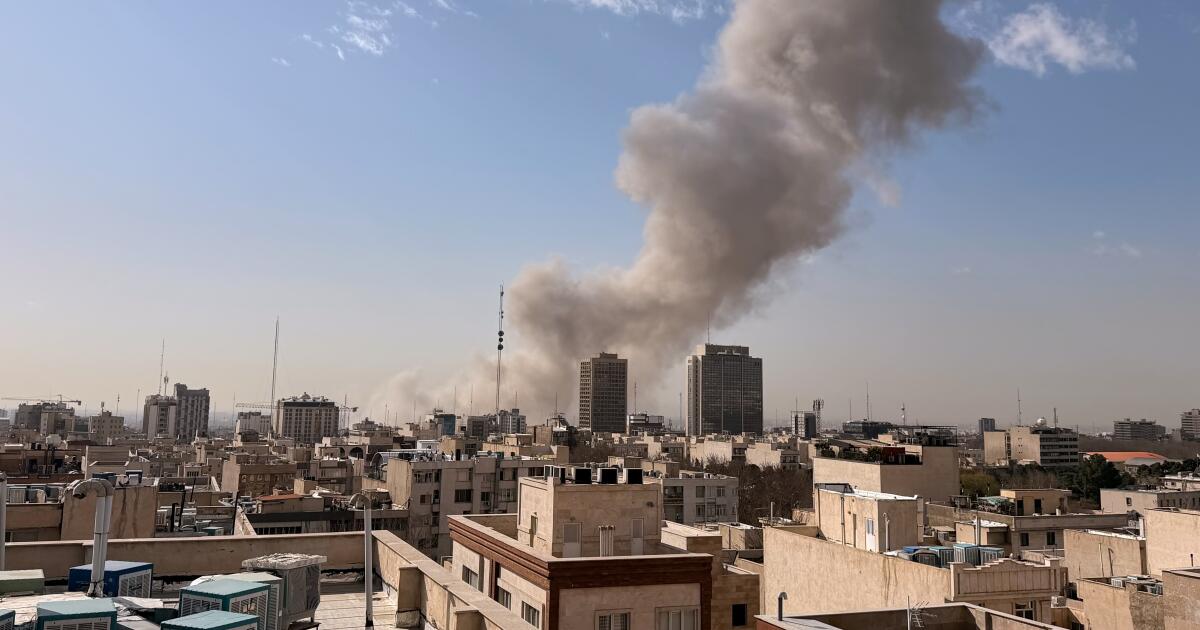
Iran’s supreme leader killed in U.S.-Israeli attack, Trump says

Prep talk: Birmingham’s Slava Shahbazyan celebrates winning state wrestling title

Florida High School Football Rankings: Top 25 teams – Oct. 21

Cleary's 21 help Le Moyne down Central Connecticut State 69-64 in OT

How old is Bo Nix? What to know about Oregon quarterback ahead of 2024 NFL Draft

99th annual Pony Swim held in Virginia

Indiana Members Credit Union announced as new anchor tenant at Bottleworks District

Pakistan calls troops, orders 3-day curfew as 24 killed in pro-Iran rallies

US says Kuwait accidentally shot down 3 American jets

House Republicans push Johnson to go to war with Senate over SAVE Act

Israel FM says Europe too divided, slams Spanish PM

Satellite images provide view inside Iran at war
-

 World4 days ago
Exclusive: DeepSeek withholds latest AI model from US chipmakers including Nvidia, sources say
-

 Massachusetts5 days ago
Mother and daughter injured in Taunton house explosion
-

 Denver, CO5 days ago
10 acres charred, 5 injured in Thornton grass fire, evacuation orders lifted
-

 Louisiana1 week ago
Wildfire near Gum Swamp Road in Livingston Parish now under control; more than 200 acres burned
-

 Technology1 week ago
YouTube TV billing scam emails are hitting inboxes
-

 Politics1 week ago
OpenAI didn’t contact police despite employees flagging mass shooter’s concerning chatbot interactions: REPORT
-

 Technology1 week ago
Stellantis is in a crisis of its own making
-

 News1 week ago
World reacts as US top court limits Trump’s tariff powers