Lifestyle
'Beautiful, happy, dopamine-injected.' Louis Vuitton and Takashi Murakami's frenzied comeback


In January, I was in a taxi driving through London’s Soho neighborhood when I looked out the window and saw a line of people stretched down an entire city block. It was after dark, but folks were still crowded onto the sidewalk, some huddled together to shield themselves from the cold and mist. Was it for a concert? A show? What was I missing? As my car turned the corner, it became clear: They were all waiting to enter the Louis Vuitton x Takashi Murakami pop-up.
The space occupied two stories, with a cafe on the top. The bottom floor was painted a bright “Brat” green, and the upper floor a sweet Hello Kitty-esque shade of pink. The windows, like the products inside, were covered in the brand’s signature interlocking L and V monogram. I was amazed not only by the scale of the operation but also by the fact that, over two decades since the original collaboration, the reissue, which is twofold and will see the release of a total of around 200 pieces starting this year, was able to attract such frenzied attention.

Louis Vuitton x Murakami Speedy Bandoulière 25 (top) and Coussin PM
When fashion designer Marc Jacobs debuted his Louis Vuitton collection with Murakami, a Japanese artist, in the spring of 2003, he called their mind-meld a “monumental marriage between art and business.” It marked the fact that, by that point, fashion and pop culture had become one, with celebrities on the cover of Vogue magazine instead of models, and paparazzi photos dictating sales.
A similar thing was happening in the art world too. Murakami, who is credited with founding the Superflat movement, which finds inspiration and art historical significance in two-dimensional imagery like Japanese manga and anime, was making a career out of combining what was then considered “highbrow” and “lowbrow.” The piece that got Jacobs’ attention, for example, was a fiberglass cartoon sculpture of a woman called “Hiropon,” whose super-size breasts produced a thick stream of milk that wrapped around her like a lasso. Jacobs, who served as creative director of Louis Vuitton from 1997 to 2013, told reporters at the time that “something snapped” when he saw Murakami’s Hiropon on the cover of a Christie’s catalog, and he reached out for a meeting. Murakami, meanwhile, said he’d never heard of Louis Vuitton before.
Before the Vuitton x Murakami collaboration, cross-pollination of this nature was rare. “I grew up in the art world with a lot of quote-unquote ‘serious artists’ who would certainly look down upon getting involved in a more commercial thing like that,” says Gabriel Held, 39, a New York-based stylist and vintage archivist. “But [Jacobs] got heavy-hitters in the art world to participate.”

Louis Vuitton x Murakami Nice Mini

Louis Vuitton x Murakami Monogram Multicolor LV Outline Headband
In 2001, Vuitton collaborated with pop-punk artist Stephen Sprouse on a run of handbags featuring the brand’s logo in a graffiti-like font, and in 2002, British artist Julie Verhoeven covered bags in colorful graphics. Following Murakami, other big-ticket artists including Richard Prince, Yayoi Kusama, Cindy Sherman and Jeff Koons expressed their Vuitton vision as well. The collaboration boosted Murakami’s profile to new heights, with his pop-y, rainbow aesthetic providing a fresh update to the brown-on-brown monogram from 1896 that the brand was known for, ultimately helping it capture the attention of a younger audience. Fandom on both sides for the limited-edition products created what we now commonly refer to as “hype.”
“I always describe the bags as being like beautiful white jawbreakers with saccharine colors all over them,” says Liana Satenstein, 35, a writer who focuses on the vintage market. The iconic “Monogram Multicolore” that Murakami introduced in 2003 fused the “LV” monogram with small florals, creating a new pattern with 33 colors that popped on an all-white background. “A beautiful, happy, dopamine-injected piece,” in Satenstein’s eyes. He also introduced panda and pink cherry blossom motifs.
In December, when Vuitton announced that it was reissuing the Murakami collaboration with a campaign starring Zendaya, Satenstein covered the news on her Substack, “Neverworns.” She declared that the bags “defined the maximalist ’00s.” Stars of the decade, including Paris Hilton, Nicole Richie, Lindsay Lohan and Kim Kardashian, were all photographed carrying one. In 2004, Vogue asked if Jessica Simpson’s choice of a Murakami buckle bag made her “the next Sarah Jessica Parker,” Satenstein pointed out.
“I worked with somebody over the summer who is not really a fashion person but of my age, and one thing on her wish list was a Murakami bag,” says Held. “Even for people who aren’t that invested in fashion, they have a desire for it still. It was a pop-culture moment.”
According to Kelly McSweeney, senior merchandising manager at the RealReal, a vintage marketplace, search interest in the original Louis Vuitton x Murakami collaboration “skyrocketed overnight” when the reissue was released on Jan. 3, with a 463% increase in searches day-over-day. The momentum continued into Jan. 4, climbing another 55% as the buzz around the collaboration intensified. “Reflecting this renewed excitement, resale prices for pieces from the collection have also soared, up 50% year-over-year,” McSweeney adds.


Louis Vuitton x Murakami Monogram Multicolor Chouchous
All of the links to vintage bags that Satenstein shared in her newsletter have since sold. “I should have bought like, five, of them,” she says in retrospect.
With the Y2K revival trend seemingly at its peak, nostalgia for the carefree innocence of the ’00s made this moment ripe for a Murakami relaunch. In fact, it’s a wonder Vuitton didn’t do it sooner. Some collectors will seek out the originals they maybe couldn’t afford at full price in high school, and others will line up for a second chance at the new thing. Judging by the crowd waiting outside the pop-up in London, many eager customers are perhaps excitedly discovering the collaboration for the first time, as they were probably in diapers in 2003.
Archival pieces are displayed behind glass across seven Louis Vuitton x Murakami pop-ups worldwide, from Milan to New York to Seoul to Shanghai to Tokyo to Singapore. But of course, the main draw is the new accessories, which will be released in various “chapters” throughout 2025, according to the brand. Chapter 1 celebrated Murakami’s original Multicolore monogram, while Chapter 2, launching this month, will feature 2003’s equally sought-after “Cherry Blossom” pattern on bags, shoes and trunks.
Before it closed on Feb. 9, customers at the London pop-up sipped from Murakami-branded cups at the cafe and ate cakes and pastries off Murakami-branded napkins. The staff wore kimono pajamas and sat on smiling Murakami flower pillows. The scene was simultaneously futuristic and nostalgic. After making a purchase, customers were given a token to put into a special vending machine, which spat out Louis Vuitton x Murakami novelty items, including stickers and trading cards.
When I got out of my taxi and arrived at my hotel, I told the friend I was meeting to pull her original Vuitton x Murakami bag out of her closet immediately. She was thrilled, but also, her curiosity was piqued. Should we get in line too?

Emilia Petrarca is a freelance fashion and culture writer based in Brooklyn.






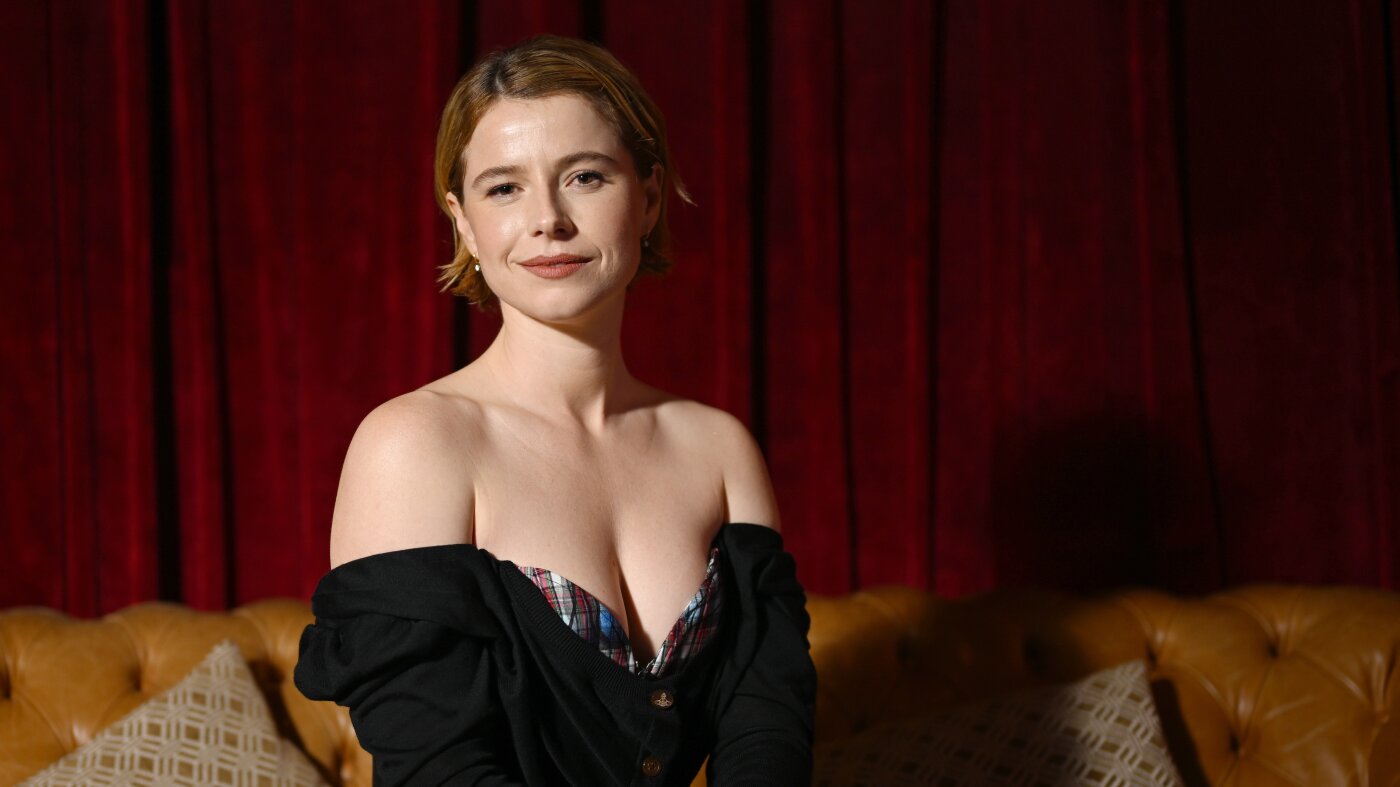
Jessie Buckley has been nominated for an Academy Award for best actress for her portrayal of William Shakespeare’s wife in Hamnet.
Kate Green/Getty Images
hide caption
toggle caption
Kate Green/Getty Images
Actor Jessie Buckley says she’s always been drawn to the “shadowy bits” of her characters — aspects that are disobedient, or “too much.” Perhaps that’s what led her to play Agnes, the wife of William Shakespeare, in Hamnet.
Buckley says the film, which is based on Maggie O’Farrell’s 2020 novel, offered a chance to counter a common narrative about the playwright’s wife: that she “had kept him back from his genius,” Buckley says.

But, she adds, “What Maggie O’Farrell so brilliantly did, not just with Agnes and Shakespeare’s wife, but also with Hamnet, their son, was to bring these people … and give them status beside this great man. … [And] give the full landscape of what it is to be a woman.”
The film is nominated for eight Academy Awards, including best actress for Buckley. In it, she plays a woman deeply connected to nature, who faces conflicts in her marriage, as well as the death of their son Hamnet.
Buckley found out she was pregnant a week after the film wrapped. She’s since given birth to her first child, a daughter.

“The thing that this story offered me, that brought me into this next chapter of my life as a mother was tenderness,” she says. “A mother’s tenderness is ferocious. To love, to birth is no joke. To be born is no joke. And the minute something’s born into the world, you’re always in the precipice of life and death. That’s our path. … I wanted to be a mother so much that that overrode the thought of being afraid of it.”

Jessie Buckley stars as Agnes and Joe Alwyn plays her brother Bartholomew in Hamnet.
Courtesy of Focus Features/Courtesy of Focus Features
hide caption
toggle caption
Courtesy of Focus Features/Courtesy of Focus Features
Interview highlights
On filming the scene where she howls in grief when her son dies
I didn’t know that that was going to happen or come out, it wasn’t in the script. I think really [director] Chloé [Zhao] asked all of us to dare to be as present as possible. Of course, leading up to it, you’re aware this scene is coming, but that scene doesn’t stand on its own. By the time I’d met that scene, I had developed such a deep bond with Jacobi Jupe, who plays Hamnet, and [co-stars] Paul [Mescal] and Emily Watson, and all the children and we really were a family. And Jacobi Jupe who plays Hamnet is such an incredible little actor and an incredible soul, and we really were a team. …

The death of a child is unfathomable. I don’t know where it begins and ends. Out of utter respect, I tried to touch an imaginary truth of it in our story as best I could, but there’s no way to define that kind of grief. I’m sure it’s different for so many people. And in that moment, all I had was my imagination but also this relationship that was right in front of me with this little boy and that’s what came out of that.
On what inspired her to pursue singing growing up
I grew up around a lot of music. My mom is a harpist and a singer and my dad has always been passionate about music, so it was always something in our house and always something that was encouraged. … Early on, I have very strong memories of seeing and hearing my mom sing in church and this quite intense mercurial conversation that would happen between her, the story and the people that would listen to her. And at the end of it, something had been cracked between them and these strangers would come up with tears in their eyes. And I guess I saw the power of storytelling through my mom’s singing at a very young age, and that was definitely something that made me think I want to do that.
On her first big break performing as a teen on the BBC singing competition I’d Do Anything — and being criticized by judges about her physical appearance
I was raw. I hadn’t trained. I had a lot to learn and to grow in. I was only 17. I think there was part of their criticism which I think was destructive and unfair when it became about my awkwardness, or they would say I was masculine and send me to kind of a femininity school. … They sent me to [the musical production of] Chicago to put heels on and a leotard and learn how to walk in high heels, which was pretty humiliating, to be honest, and I’m sad about that because I think I was discovering myself as a young woman in the world and wasn’t fully formed. … I was different. I was wild, I had a lot of feeling inside me. I could hardly keep my hands beside myself and I think to kind of criticize a body of a young woman at that time and to make her feel conscious of that was lazy and, I think, boring.
On filming parts of the 2026 film The Bride! while pregnant
I really loved working when I was pregnant. I thought it was a pretty wild experience, especially because I was playing Mary Shelley and I was talking about [this] monstrosity, and here I was with two heartbeats inside me. Becoming a mom and being pregnant did something, I think, for me. My experience of it, it’s so real that it really focuses [me to be] allergic to fake or to disconnection.
Since my daughter has come and I know what that connection is and the real feeling of being in a relationship with somebody … as an actress, it’s very exciting to recognize that in yourself and really take ownership of yourself.
I’m excited to go back and work on this other side of becoming a mother in so many ways, because I’ve shed 10 layers of skin by loving more and experiencing life in such a new way with my daughter. I’m also scared to work again because it’s hard to be a mother and to work. That’s like a constant tug because I love what I do and I’m passionate and I want to continue to grow and learn and fill those spaces that are yet to be filled — and also be a mother. And I think every mother can recognize that tug.
On the possibility of bringing her daughter to travel with her as she works
I haven’t filmed for nearly a year and I cannot wait. I’m hungry to create again. And my daughter will come with me. She’s seven months, so at the moment she can travel with us and it’s a beautiful life. And she meets all these amazing people and I have a feeling that she loves life and that’s a great thing to see in a child. And I hope that’s something that I’ve imparted to her in the short time that she’s been on this earth is that life is beautiful and great and complex and alive and there’s no part of you that needs to be less in your life. You might have to work it out, but it’s worth it.
Lauren Krenzel and Susan Nyakundi produced and edited this interview for broadcast. Bridget Bentz, Molly Seavy-Nesper and Beth Novey adapted it for the web.

Bruce Campbell
I’m Battling Cancer
Published
Bruce Campbell has revealed he has cancer, but says it’s a type that’s treatable, though not curable.
“The Evil Dead” actor shared the news Monday in a message to fans, writing, “Hi folks, these days, when someone is having a health issue, it’s referred to as an ‘opportunity,’ so let’s go with that — I’m having one of those.” He continued, “It’s also called a type of cancer that’s ‘treatable’ not ‘curable.’ I apologize if that’s a shock — it was to me too.”

Campbell said he wouldn’t go into further detail about his diagnosis, but explained his work schedule will be changing. “Appearances and cons and work in general need to take back seat to treatment,” he wrote, adding he plans to focus on getting “as well as I possibly can over the summer.”
As a result, Campbell says he has to cancel several convention appearances this summer, noting, “Treatment needs and professional obligations don’t always go hand-in-hand.”
He says his plan is to tour this fall in support of his new film, “Ernie & Emma,” which he stars in and directs.
Ending on a determined note, Campbell told fans, “I am a tough old son-of-a-bitch … and I expect to be around a while.”

Neve Campbell in Scream 7.
Paramount Pictures
hide caption
toggle caption
Paramount Pictures
The OG Scream Queen Neve Campbell returns. Scream 7 re-centers the franchise back on Sidney Prescott. She has a new life, a family, and lots of baggage. You know the drill: Someone dressing up as the masked slasher Ghostface comes for her, her family and friends. There’s lots of stabbing and murder and so many red herrings it’s practically a smorgasbord.
Follow Pop Culture Happy Hour on Letterboxd at letterboxd.com/nprpopculture

Trump claims US stockpiles mean wars can be fought ‘forever’; Kristi Noem testifies before Congress – US politics live

Ohio courtroom devolves into chaos after sentencing in death of teen

Travis County DA faces renewed ‘soft on crime’ criticism after career criminal charged with murder

Alleged criminal history of missing mom found after 24 years catches up with her

Millionaire philanthropist allegedly gunned down by worker in female wig; ambushes Maryland trooper: police

Florida High School Football Rankings: Top 25 teams – Oct. 21

Cleary's 21 help Le Moyne down Central Connecticut State 69-64 in OT

How old is Bo Nix? What to know about Oregon quarterback ahead of 2024 NFL Draft

99th annual Pony Swim held in Virginia

Indiana Members Credit Union announced as new anchor tenant at Bottleworks District
Trump claims US stockpiles mean wars can be fought ‘forever’; Kristi Noem testifies before Congress – US politics live

War in the Middle East: Iran’s broad retaliation in the Gulf • FRANCE 24 English

Trump sends official notification to Congress on strikes against Iran

Unexpected birth brings hope to near-extinct Amazon tribe

Supreme Court blocks redrawing of New York congressional map, dealing a win for GOP
-

 World5 days ago
Exclusive: DeepSeek withholds latest AI model from US chipmakers including Nvidia, sources say
-

 Massachusetts6 days ago
Mother and daughter injured in Taunton house explosion
-

 Denver, CO6 days ago
10 acres charred, 5 injured in Thornton grass fire, evacuation orders lifted
-

 Louisiana1 week ago
Wildfire near Gum Swamp Road in Livingston Parish now under control; more than 200 acres burned
-

 Oregon4 days ago
2026 OSAA Oregon Wrestling State Championship Results And Brackets – FloWrestling
-

 Technology1 week ago
Arturia’s FX Collection 6 adds two new effects and a $99 intro version
-

 News1 week ago
Video: How Lunar New Year Traditions Take Root Across America
-

 Florida2 days ago
Florida man rescued after being stuck in shoulder-deep mud for days