Lifestyle
A robot gets a face of living ‘skin’ that allows it to smile

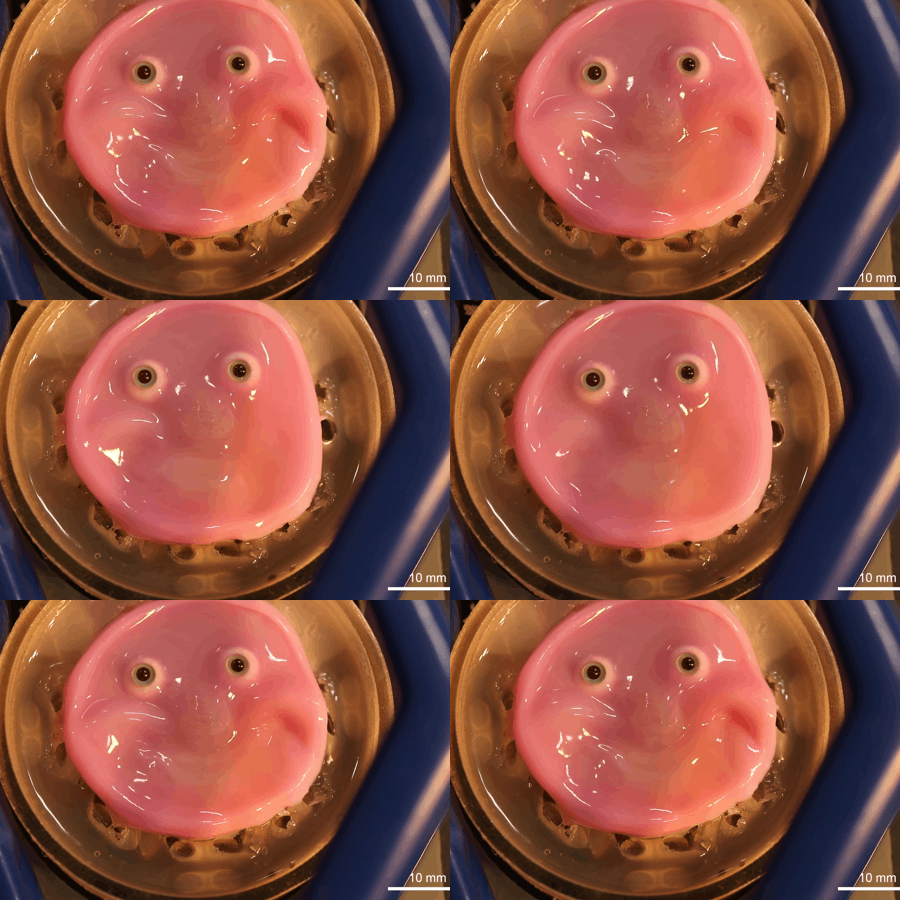
An image released by University of Tokyo researchers shows a robot smiling, with the help of mechanical actuators beneath a flexible layer of living skin.
Takeuchi et al. CC-BY-ND
hide caption
toggle caption
Takeuchi et al. CC-BY-ND
If humanoid robots make you a bit queasy — would it help if they had fleshy faces that can smile at you?
The uncanny feat is the result of new technology using engineered living skin tissue and human-like ligaments to give robots a more natural smile, according to Tokyo University researchers who unveiled their work this week.

“In this study, we managed to replicate human appearance to some extent by creating a face with the same surface material and structure as humans,” professor Shoji Takeuchi, the team leader, said in a news release. In the process, he added, “we identified new challenges, such as the necessity for surface wrinkles and a thicker epidermis to achieve a more humanlike appearance.”
The approach promises to make robots more lifelike — and in the future, the researchers say, similar techniques could also be used on humans, in the cosmetics and plastic surgery industries. Their findings were published in the journal Cell Reports Physical Science.

A new method of binding living skin tissue to a robotic skeleton will allow more humanlike expressions and better range of motion, according to researchers from the University of Tokyo.
Takeuchi et al. CC-BY-ND
hide caption
toggle caption
Takeuchi et al. CC-BY-ND
To overlay and connect the lab-produced skin on a robotic skeleton, a layer of collagen gel containing cultured human dermal fibroblasts (a type of connective tissue cell) binds to an innovative system of tiny V-shaped perforations in the surface, letting the skin move with the underlying structure without tearing or peeling. The work of muscles — creating a smile, and other motions — is done by actuators.
Takeuchi’s Biohybrid Systems Laboratory has previously engineered skin that can heal, created small robots with biological muscle tissue, and 3D printed lab-grown meat. He says the latest work on living skin has a string of potential next steps.
“Self-healing is a big deal — some chemical-based materials can be made to heal themselves, but they require triggers such as heat, pressure or other signals, and they also do not proliferate like cells,” he said. “Biological skin repairs minor lacerations as ours does, and nerves and other skin organs can be added for use in sensing and so on.”
It’s critical for robots to have the ability to heal and self-repair, the researchers said in their study, because even small scratches could develop into serious impairments.
Biomimetic robots could also become even more realistic with thicker skin, Takeuchi said, adding that future projects could look to add sensors, pores and even sweat glands and fat. The team’s paper says their work could also bring insights into how humans’ wrinkles are formed. And by incorporating more sophisticated actuators and eventually, cultured muscle tissue, their approach could help robots in the future move in fluid, humanlike ways.
For now, the robot can’t feel its face, putting it in a category pioneered by Abel Tesfaye, a.k.a. The Weeknd. Not long ago, many of us smiled when technology managed to put the singer’s words about his face into the mouth of a U.S. president.


Matthew Rhys was nominated for his role in Widow’s Bay.
Apple TV
hide caption
toggle caption
Apple TV
The 2026 Emmy nominations are here. We’re unpacking the record-breaking nominations for Hacks, plus a big day for Widow’s Bay, The Pitt, and The Bear. We’ll also talk about the snubs and make some early predictions of who will win.
Connect with Pop Culture Happy Hour:
Letterboxd / Facebook
Our weekly newsletter
Support Pop Culture Happy Hour+


Can you say no to a friend’s wedding?
Getty Images/Getty images
hide caption
toggle caption
Getty Images/Getty images
Are we spending too much on other people’s weddings?
Going to a friend’s weddings can be so fun and meaningful… but it can also really hurt your wallet. A survey by LendingTree found that 31% of people who had been to a wedding in the past five years had accrued debt to attend. So what’s driving up the cost of weddings for guests? And what makes it so hard to say no to these expenses?
Brittany breaks it down with Allyson Rees, senior analyst at trend forecasting firm WGSN, and Annie Joy Williams, assistant editor at The Atlantic.
This episode was produced by Liam McBain, with additional support from Corey Antonio Rose. It was edited by Neena Pathak. Our Supervising Producer is Cher Vincent. Our Executive Producer is Barton Girdwood. Our VP of Programming is Yolanda Sangweni.
-

 Maine30 seconds ago
Graham Platner says he’ll withdraw from Senate race in Maine
-

 Maryland8 minutes ago
Maryland man sentenced to 15 years for attempting to join ISIS
-

 Michigan11 minutes ago
Sherrone Moore’s former assistant sues University of Michigan over alleged FOIA violations
-

 Massachusetts16 minutes ago
Max McColgan and Joseph Lenane share stroke play medals at 118th Massachusetts Amateur Championship – The Boston Globe
-

 Minnesota23 minutes ago
Man seriously injured in north Minneapolis shooting; no arrests
-

 Mississippi25 minutes ago
Ben Crump seeks independent autopsy in Nolan Wells death
-

 Missouri30 minutes ago
Missouri politicians champion unity, diversity on America’s 250th
-

 Montana38 minutes ago
Montana signs onto data center energy cost protection pledge

