Lifestyle
8 of the best L.A.-area hikes, according to our readers


Truism No. 1: Los Angeles is a patchwork of vast hiking terrain, with about 1 million acres in the L.A. area. The Angeles National Forest alone offers 700,000 acres and 8,000-foot-plus peaks to explore.
Truism No. 2: Even the most comprehensive hiking guide can’t possibly incorporate every craggy nook and spindly trail. Which is partly what makes the area so inspiring — there’s a sense of expansive adventure, with still-uncharted territory ahead.
We asked Times readers for their favorite hidden or go-to hiking spots that were not included in our recent guide.
And in our request, we were reminded of Truism No. 3: Hikers can be secretive about their favorite getaway spots, lest they become overrun with foot traffic. Of the letters we received, a few said things like “I don’t want to tell you, b/c then it’ll get crowded. LOL!” and “I’ll keep it to myself. Don’t want the litter or the crowds.”
We can respect that.
Here are a few hiking journeys that readers were willing to share.
Victory Trailhead Loop
Distance and elevation gain: 5.1-mile loop, 408 feet
Why? “Has everything anyone would want from a local trail. Caves to explore and an overall great way to exercise on a daily basis.”
What makes it extra special: “It sits in a very suburban area but when you’re on the trail, it doesn’t feel that way. Feels very remote and far, good for clearing your mind without traveling too far.”
Address: Upper Las Virgenes Canyon Open Space Preserve, western end of Victory Boulevard in Woodland Hills
—Jose Arias, San Fernando Valley
A view of the Hollywood sign, with a backdrop of the snow-capped San Gabriel Mountains, from atop a hiking peak in the Kenneth Hahn State Recreation Area.
(Jay L. Clendenin / Los Angeles Times)
Kenneth Hahn Recreation Area
Distance and elevation gain: 2.8-mile loop, 393 feet
Why? “Some nice elevation, some good exercise if you use the entire loop, but it’s really for incredible, unobstructed, panoramic views.”
What makes it extra special: “Best of all, you can bring your dog. (On a leash, but please bring water for you and the dog!)”
Address: Kenneth Hahn State Recreation Area, 4100 S. La Cienega Blvd., Los Angeles
—Steven Matthews, Los Angeles

Janelle Matthews catches her breath after conquering the Baldwin Hills Scenic Overlook and Culver City steps in August 2023.
(Genaro Molina / Los Angeles Times)
Baldwin Hills Scenic Overlook and Culver City Steps
Distance and elevation gain: 1.4-mile loop, 334 feet
Why? “Stairs, stairs and stairs.”
What makes it extra special: “Four times up is roughly the equivalent number of floors to climbing the stairs to the top of the Empire State Building! And even the switchback way up still gets you a nice workout. (Many dogs seen, but not permitted legally!)”
Address: 6105 Hetzler Road (at Jefferson Boulevard), Culver City
—Steven Matthews, Los Angeles
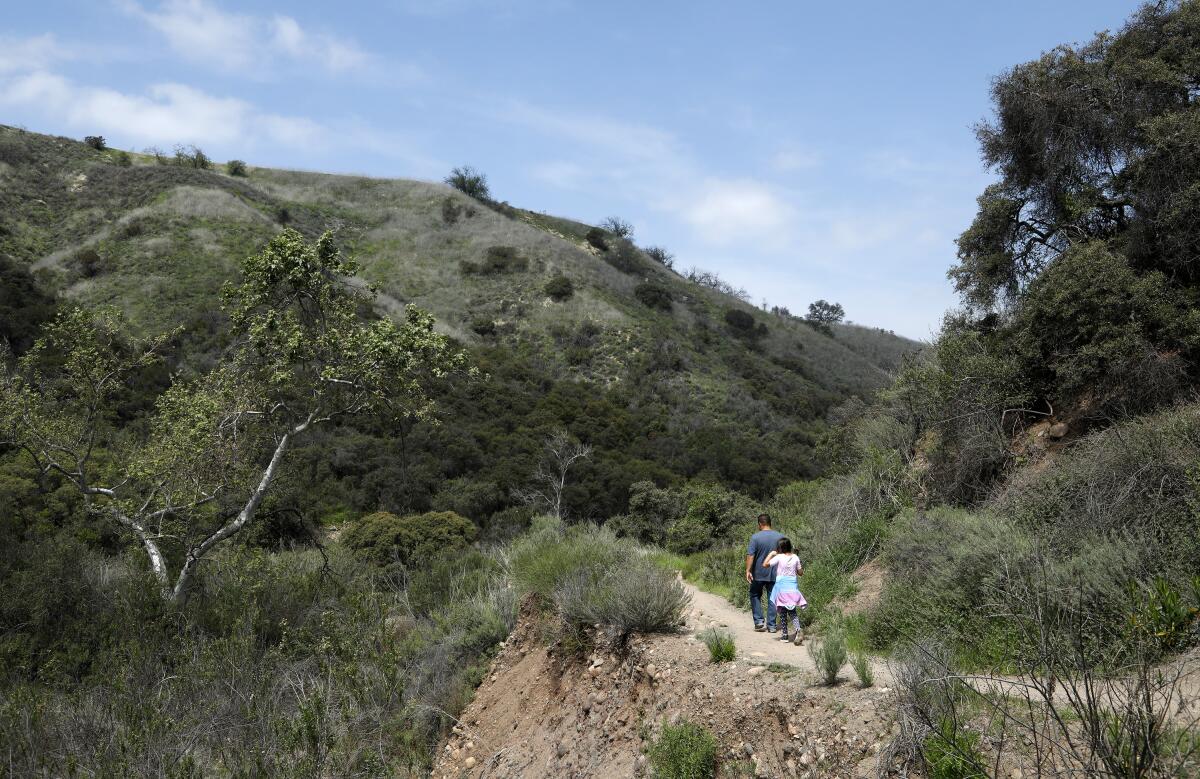
Caballero Canyon Trail begins off Reseda Boulevard in Tarzana, twisting and climbing its way to unpaved Mulholland Drive.
(Myung J. Chun / Los Angeles Times)
Caballero Canyon Trail
Distance and elevation gain: 1.4 miles out and back, 558 feet
Why? “Ideal for fleeing the oppressive heat notorious for yellowing armpits in that particular part of town. A few alluring features of this trail are the diversity of flora and fauna up for the gawking, the breath-snatching panoramic views, and the scarcity of crowds and inexplicable abundance of parking. It’s a veritable paradise plunked in the middle of sweltering nowhere.”
What makes it extra special: “I enjoy the scramble and huff up the challenging crags. I’ll sometimes trail run up and will have to bound over a basking, slumbering snake or two. Harmless but spooked. Not to mention the scramble of feral rabbits darting every which way as I come lumbering down the path. It’s that kind of ravenous tranquility no amount of yoga or meditation can ever hope to attain. No small amount of nirvana, I say.”
Address: Topanga State Park, 4047 Reseda Blvd. in Tarzana
—Tommy Vinh Bui, Pacoima

Sunrise at the Forrestal Nature Preserve, a coastal sage scrub habitat.
(Mark Boster / Los Angeles Times)
Forrestal Preserve Loop
Distance and elevation gain: 2.9-mile loop, 757 feet
Why? “I like to make a loop of the Pirate Trail, Mariposa Trail, Flying Mane Trail, Fossil Trail and back on Forrestal Drive to the starting point.”
What makes it extra special: “Stunning ocean and coastline views. Hillsides covered with wildflowers the last two springs in April and May. Even a small stream, which is very rare in Palos Verdes.”
Address: 32201 Forrestal Drive, Rancho Palos Verdes
—Jay Bacon, Palos Verdes Estates
Los Leones Trail
Distance and elevation gain: 4.0 miles out and back, 1,046 feet
Why? “Love this hike because it’s an easy-to-get-to hike with beautiful views. And it’s a good workout, but not too challenging to do every week.”
What makes it extra special: “For me, there’s a sense of peace here — you feel like you’re almost on a mini-vacation, even though you’re 20 minutes from home.”
Address: 585 Los Liones Drive, Pacific Palisades
—Janette Haddad, Santa Monica
The Griffith Park trail, en route to the Griffith Observatory.
(Jacqueline Pinedo / Los Angeles Times)
Griffith Zoo to Observatory Loop
Distance and elevation gain: 7.4-mile loop, 1,702 feet
Why? “Challenging, but worth the scenery and a pleasant walk in nature all year long.”
What makes it extra special: “[Taking] control of such tough hiking heights.”
Address: Griffith Park, merry-go-round lot 1 or 2, 4668 Crystal Springs Drive, Los Angeles
—Jaime Vargas Sr., San Bernardino
Upper Cabin Trail Loop
Distance and elevation gain: 8.8-mile loop, 2,683 feet
Why? “It’s secluded and dreamy, plus fun scrambling up to the backside of Sandstone Peak.”
What makes it extra special: “Wildflowers like nothing I’ve ever seen around the L.A. area in the spring. And when the clouds roll in as you hike to the summit above them, it’s quite magical. The way back has treacherous eroded mini-canyons, you have to surmount carefully, so the reward at the end makes it much better.”
Address: 4124 1/2 Potrero Road, Thousand Oaks
—Panit Buranapramest, Gardena




An underwater view shows US’ Lilly King competing in a heat of the women’s 200m breaststroke swimming event during the Paris 2024 Olympic Games at the Paris La Defense Arena in Nanterre, west of Paris, on July 31, 2024. (Photo by François-Xavier MARIT / AFP) (Photo by FRANCOIS-XAVIER MARIT/AFP via Getty Images)
François-Xavier Marit/Getty Images
hide caption
toggle caption
François-Xavier Marit/Getty Images
This week’s show was recorded in Bloomington, Indiana with host Peter Sagal, judge and scorekeeper Bill Kurtis, Not My Job guest Lilly King and panelists Alonzo Bodden, Josh Gondelman, and Faith Salie. Click the audio link above to hear the whole show.
Who’s Bill This Time
State of the Union is Hot; The Tribal Council Convenes Again; A Glow Up In the Doll Aisle
Panel Questions
The Toot Tracker
Bluff The Listener
Our panelists tell three stories about a travel hack in the news, only one of which is true.
Not My Job: Olympic Swimmer Lilly King answers our questions about Lil’ Kings
Olympic Swimmer Lilly King plays our game called, “Lilly King meet these Lil’ Kings” Three questions about short kings.
Panel Questions
Cleaning Out The Cabinet; Bedtime Stacking
Limericks
Bill Kurtis reads three news-related limericks: Getting Cozy With Cross Country Skiing; Pickleball’s New Competition; Bees Get Freaky
Lightning Fill In The Blank
All the news we couldn’t fit anywhere else
Predictions
Our panelists predict, after American Girls, what’ll be the next toy to get an update.

Law Roach
Zendaya and Tom’s Wedding Already Happened …
Y’all Missed It!!!
Published
Zendaya and Tom Holland are married … so claims her longtime stylist, Law Roach.
Here’s the deal … the celebrity stylist — who started styling Zendaya way back in 2011 — spoke to Access Hollywood on the Actors Awards red carpet where he sang out “The wedding has already happened, you missed it.”
Waiting for your permission to load the Instagram Media.
The AH reporter asks in shock if that’s true … and, Law responds by saying it’s “very true” before walking off.
This isn’t the first time Tom and Zendaya’s relationship status has made headlines on a red carpet … remember at the Golden Globes in 2025, Zendaya had a ring on that finger — and, the next day, we found out the two were engaged.

TMZ.com
Zendaya and Tom met on the set of “Spider-Man: Homecoming” in 2016, started dating a couple years later and went public with their relationship in 2021.
We’ve reached out to Tom and Zendaya’s teams … so far, no word back.

Online prediction market platforms allow people to place bets on wide-ranging subjects such as sports, finance, politics and currents events.
Photo Illustration by Scott Olson/Getty Images
hide caption
toggle caption
Photo Illustration by Scott Olson/Getty Images
The rise of prediction markets means you can now bet on just about anything, right from your phone. Apps like Kalshi and Polymarket have grown exponentially in President Trump’s second term, as his administration has rolled back regulations designed to keep the industry in check. Billions of dollars have flooded in, and users are placing bets on everything from whether it will rain in Seattle today to whether the US will take over control of Greenland. Who’s winning big on these apps? And who is losing? NPR correspondent Bobby Allyn joins The Sunday Story to explain how these markets came to be and where they are going.
This episode was produced by Andrew Mambo. It was edited by Liana Simstrom and Brett Neely. Fact-checking by Barclay Walsh and Susie Cummings. It was engineered by Robert Rodriguez.
We’d love to hear from you. Send us an email at TheSundayStory@npr.org.
Listen to Up First on Apple Podcasts and Spotify.

Arizona Lottery Pick 3, Fantasy 5 results for March 1, 2026

Come one, come all | Arkansas Democrat Gazette

Preliminary magnitude 3.3 earthquake strikes near San Ramon, USGS says

Colorado quarterback Dominiq Ponder dies in single-car crash at age 23, police say

Iranian Yale scholar in Connecticut celebrates fall of regime, calls for free elections

Florida High School Football Rankings: Top 25 teams – Oct. 21

Cleary's 21 help Le Moyne down Central Connecticut State 69-64 in OT

How old is Bo Nix? What to know about Oregon quarterback ahead of 2024 NFL Draft

99th annual Pony Swim held in Virginia

Indiana Members Credit Union announced as new anchor tenant at Bottleworks District

House Republicans push Johnson to go to war with Senate over SAVE Act

Israel FM says Europe too divided, slams Spanish PM

Satellite images provide view inside Iran at war

Video: What the Texas Primary Battle Means for the Midterms

Dems’ potential 2028 hopefuls come out against US strikes on Iran
-

 World4 days ago
Exclusive: DeepSeek withholds latest AI model from US chipmakers including Nvidia, sources say
-

 Massachusetts5 days ago
Mother and daughter injured in Taunton house explosion
-

 Denver, CO4 days ago
10 acres charred, 5 injured in Thornton grass fire, evacuation orders lifted
-

 Louisiana1 week ago
Wildfire near Gum Swamp Road in Livingston Parish now under control; more than 200 acres burned
-

 Technology1 week ago
YouTube TV billing scam emails are hitting inboxes
-

 Politics1 week ago
OpenAI didn’t contact police despite employees flagging mass shooter’s concerning chatbot interactions: REPORT
-

 Technology1 week ago
Stellantis is in a crisis of its own making
-

 News1 week ago
World reacts as US top court limits Trump’s tariff powers