Entertainment
With a full heart, 'Friday Night Lights' creator Jason Katims reflects on the 'emotional journey' of the series finale

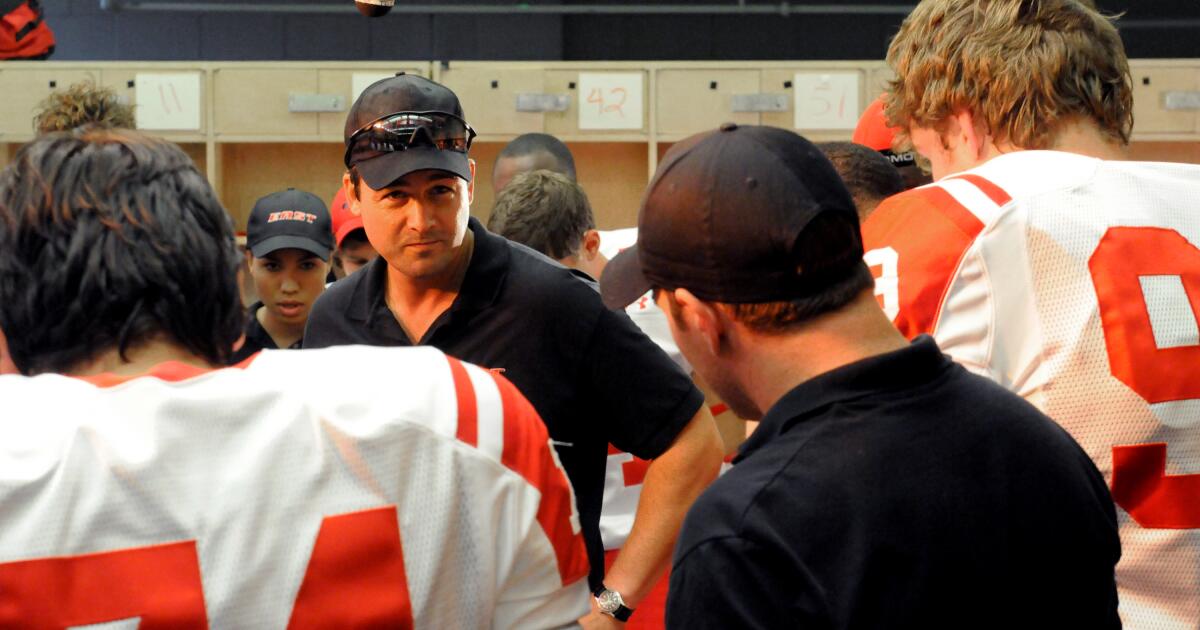
In “Inside the Episode,” writers and directors reflect on the making of their Emmy-winning episodes.
Clear eyes. Full hearts …
It took a lot of tears, both on- and offscreen, but “Friday Night Lights,” the drama about small-town high school football that was about way more than just small-town high school football, finally won two Primetime Emmys in its final season. At the 2011 ceremony, one award went to lead actor Kyle Chandler as the coach and (sometimes de facto) patriarch Eric Taylor. The other went to “FNL’s” behind-the-scenes father figure, showrunner Jason Katims, who wrote the drama’s series finale, “Always.”
“FNL” was beloved because it had the magical ability to be set around the lives of high schoolers and their parents — Coach Taylor was nothing without his wife, Tami (played by 2011 Emmy nominee Connie Britton) — but to not necessarily feel like a teen soap.
“It’s funny, when I first started talking to reporters and critics about it, they would ask, ‘How does this compare to other teen shows?’” said Katims, who wrote for “My So-Called Life” and created “Roswell.” “Until somebody mentioned it as a possible teen genre kind of show, I literally never even thought of it that way. … I thought of it as a story of this town, a story of these people.”
He speculates that perhaps this was because “even though those people are teens, they’re dealing with such adult things and themes.”
To wit: The series finale isn’t just about the football team making it to the state tournament, it’s about love, marriage and partnership. Just as Eric and Tami argue against their teen daughter Julie (Aimee Teegarden) getting engaged to her on-again, off-again boyfriend Matt Saracen (Zach Gilford), they have their own marital strife as they decide whether Eric should sign a new contract for a coaching job that would keep them in town or if Tami should have her moment and follow her career out of state.
Meanwhile, Tim Riggins (Taylor Kitsch) has grand plans to stay in his home of Dillon, Texas, forever while his ex-girlfriend Tyra Collette (Adrianne Palicki) explores new opportunities in college. Aspiring football coach Jess Merriweather (Jurnee Smollett) relocates to Dallas while her boyfriend, all-star player Vince Howard (Michael B. Jordan), starts his own journey. And, with his football career derailed after an injury, Luke Cafferty (Matt Lauria) joins the military. He and newly reunited girlfriend Becky Sproles (Madison Burge) share a tearful goodbye at the bus stop as he gives her his championship ring.
Over a decade later, The Times held it together long enough to speak with Katims about the events of “Always.”
This interview has been edited and condensed for clarity.
Jason Katims accepts the Emmy for writing for a drama series for “Friday Night Lights” in 2011.
(Mark J. Terrill / Associated Press)
The show aired on NBC before finishing its run on Audience Network. Given those changes and how this would affect cast availability, how far out did you start planning the series finale?
We didn’t really know in the fourth season exactly what we were going to do. We had it vaguely in our mind. But for the fifth season of the show, we really were planning it right from the beginning in the writers’ room.
Were there serious scheduling issues [with actors who’d already left the show]? I’m sure there were. But I think everybody who had been part of the show felt very committed and very, very, very much part of it and wanted to be there for the end.
There were the actors who really wanted to be part of it. Scott Porter [who played injured football star Jason Street earlier in the series’ run] showed up for the last scene, even though he wasn’t written into it. It was the scene where they were on Riggins’ land and he really wanted to be in that scene [because those characters were such good friends]. [That scene was cut from the finale.]
The show had some key phrases that you also worked into the finale. We see Coach Taylor, who relocates with his family to Philadelphia for Tami’s job, trying to teach a new group of football players the inspirational message “clear eyes, full hearts, can’t lose.” And we see Tim Riggins and his brother Billy (Derek Phillips) clinking longnecks and saying, “Texas forever.” Was there a conversation about who would get to utter those phrases?
It was really clear to me that Coach was going to be in the “clear eyes” and Riggins was going to be “Texas forever.”
Those weren’t conversations that happened in the writers’ room. Those happened when you were writing the script. But the big ideas, like the ball going up in the air at state and then landing in Philadelphia was not my idea. It was an idea that came out of the writers’ room.
Whether this team does win the state tournament is kind of like not seeing a body in a horror movie. It’s never explicitly shown or said.
It’s a funny thing about that because you do know who won the game because there were so many things in that final montage that were references to [them winning]. A lot of people had rings. They take down the championship sign from the [high school]. It was clear that they had won and the reason we didn’t see the win itself was because I felt that that football game should be poetic. There weren’t any more moves to make at that point in the show, in terms of the drama of the football game. To me, it was more the emotional journey that we’d all gotten to.
I’m really happy with the way the game transitioned into the final montage of the season. The whole episode is about closure. You don’t usually write that way. Usually there’s tension and then some catharsis, and these days, then another catharsis and then a cliffhanger. But there were five seasons leading up to that episode, and it was all about resolution. There were people declaring their love and all that stuff.
The tensions running through it were the questions of what’s going to happen to Coach and Tami. That was a serious dilemma. I felt like that made for the most dramatic tension in the episode.
Obviously, there were other things as well. There’s that scene with Tyra and [her ex-boyfriend] Tim where they’re talking about the future. It feels so beautiful to me to watch these two people who were so in love and put on divergent paths.
Why did you decide to call the episode “Always”?
The show is about love. It is a love story. It was about Coach and Tami and Matt and Julie and Vince and Jess and Luke and Becky.
But it was also the permanence of that culture of high school football. And there’s something touching to me, and moving to me, in that final montage. You see all these people playing in different stadiums, but they’re still playing the same game, but it doesn’t, weirdly, matter that much.
So much of this show, and its characters’, identity is wrapped up in Southern culture and lifestyle. So I always thought it was interesting that the Taylors moved out of the South.
What we were trying to do for the whole season was make this a really difficult choice for Coach. Coach and Tami, people would talk about that as such a great marriage. We knew, at a certain point, that we were never going to tell a story about one cheating on the other or divorce. Those stories were off the table. There was something sacred about that, about them. That’s wonderful to watch. But as a writer, it’s challenging because we need conflict.
In their particular marriage, it had always been that they were going where Coach would go [for work]. To me, the key to the whole episode and the whole season was him coming to her and saying, “It’s your turn.”
It’s very feminist and progressive of Coach to think this way.
You know, Coach is a very traditional guy. You see it when Matt says [to him that] he wants to marry his daughter. You see it at the dinner scene when they’re all together [and Coach and Tami tell them they’re too young to get married]. He doesn’t address his daughter. He addresses Matt.
There’s a lot of traditional thinking around Coach Taylor, which is why that decision he makes [with Tami] is so dramatic. It shows a man really changing.
This seems like something Tyra went through a lot. That’s a character who felt like she had to get out, otherwise nothing would change for her.
For Tyra, that’s a big thing. In the last episode, when she has that scene with Tim, she’s talking about wanting her life to be big and going into politics. … She was inspired by a woman like Tami, but she could see that her future should be bigger.
One of the things that’s so powerful about the show is that Dillon, Texas, is this beautiful town and you feel all these things about community and faith and lifting each other up and love and all that. But it’s also a place where you can get stuck and feel like you have limitations on you.
It was also really touching to see that last scene with Matt and Julie [when they move to Chicago and are engaged]. My thought about that is that they’ve become Coach and Tami. She looked a little more like Tami. But she was doing it in their world. It was a different, more urban world.



Lots of disturbing movies take place at summer camps. “Friday the 13th,” “Sleepaway Camp,” “Care Bears Movie II: A New Generation,” the list goes on, and it just keeps going because shoving dozens of kids into an emotional pressure cooker at the edge of civilization with minimal supervision and no escape is usually a bad idea. And that’s before you give them all bows and arrows.
Avalon Fast’s sophomore feature isn’t a typical summer camp horror movie. It’s a trippy, melancholic tragedy about healing psychic wounds, and finding out they’re already infected. Try to imagine an angsty, indie teen drama that’s parasitically burrowing its way into a Florence + The Machine music video. Now imagine it’s in theaters now and it’s called “Camp.”
“Truth or Dare” is a crappy game, even on “Love Island,” but it’s even crappier at the start of “Camp.” The halfhearted young friends of Emily (Zola Grimmer) can barely muster enough gusto to come up with a dare, and when they give up, their fallback “truth” is just asking her for her biggest regret. It may have been a haircut. It may have been the time she ran over a four-year-old with her car. Either way it’s a lousy icebreaker.
As if her night couldn’t get any worse, Emily’s best friend overdoses in her car, sending her spiraling into grief and misery. Months go by and her father arranges to get her a camp counseling gig, looking after other troubled youths at a place called only “Camp.” (I’d say the least plausible part of Fast’s film is that the domain name “camp.net” wasn’t already taken, but shut my mouth, because it really isn’t.)
The kids are non-entities, a vague distraction from her worries, but her fellow counselors are badasses. They smoke. They drink. They say things like, “I feel like doing drugs” and look, you gotta give ‘em credit, when they say they’re going to do something they do it. I can’t even take the recycling downstairs most of the time and here these girls are, saying they feel like doing drugs and then doing the damn drugs, making me feel like a lazy jerk.
There’s just one problem. Or maybe there isn’t. Emily’s new cohort, led by the alluring and oddly motherly Clara (Alice Wordsworth), begins each summer with a ritual to make their wishes come true. Nev (Lea Rose Sebastianis) wishes to have sex with their boss, Dan (Austyn Van De Camp), “really, really hard” and wouldn’t you know it, her wish was essentially a command.
Avalon Fast knows that’s wrong, but she knows her characters don’t care very much. Dan starts trudging across the camp grounds, confused and disturbed. He was saving himself for marriage, the poor guy, and looks like he’s on the verge of something terrible. But sacrificing Dan’s virginity gave Emily and her friends a taste of power, and it manifests in sparkly animated hand flourishes, which do nothing, it seems, except look cool. But it’s their power and they’re taking it, and they’ll take a lot more.
The problem with describing the plot of Fast’s “Camp” is that it places way, way too much emphasis on the plot. This movie doesn’t run from scene to scene, it gradually sinks into emotional rot. Emily thinks she’s getting better, finding friends and — in her own way — finding her spirituality. It’s just a selfish, detached spirituality and sees no value in anyone else’s feelings. Or anything else about them. What looks like a film about finding your way back from the darkness is, instead, a labyrinth that Emily probably can’t solve. She may not even want to.

“Camp” is a dreary, disturbing day dream of a movie, the kind you have when you’re all in your feels and close to getting heatstroke. It’s not about getting better, it’s about getting worse, and how that sometimes feels like getting better. You may not have worked through your baggage, you may not have processed your trauma, but at least everything looks simple. You can just while away your days with excess, abandoning all empathy, even for yourself.
It’s a sad film, “Camp,” and it’s a little tricky. Fast is working with familiar horror movie clichés, and falling into the old routine where witchcraft is initially empowering, then horrifying, and that probably doesn’t do real-life witches many favors. Then again, neither do a lot of the classic witch films — especially “The Craft,” the goth 1990s elephant in the room — and most of them aren’t as emotionally salient as Fast’s interpretation, although they’re typically more “fun.”
“Camp” isn’t a fun movie. That’s not a criticism, it’s just the way it is. Avalon Fast’s gloomy, lo-fi aesthetic occasionally segues into ornate, gorgeous imagery, proving the filmmaker — and cinematographer Eily Sprungman — are in total creative control. Fast wants us to feel Emily’s despair and the futile moral ambiguity of her distractions. It’s a cautionary tale, perhaps, about not hanging out with the wrong crowd, or taking solace in mind-altering experiences, but more than anything it’s a sympathetic mirror, and it’s pointed at anyone who ever got lost.


As La Cruz continues to break down barriers for the LGBTQ+ community in reggaeton, the rising Venezuelan star enjoys living out his gay fantasies in his music videos. Take the sultry video for his 2023 breakthrough single, “Quítate La Ropa,” which sees shirtless men perreando (twerking) before him in a locker room.
But at the same time, La Cruz has come to understand that his platform as a gay reggaeton artist coincides with a time when conservatism is sweeping the globe — and queer rights are receding.
“It fills me with happiness to represent a community that has been denigrated, treated badly and pushed into a corner for many years,” a bedheaded La Cruz says over Zoom from his New York City hotel room. (He had just performed at a Pride event the night before.)
“It’s a fact that [LGBTQ] rights are becoming progressive, but they’re rolled back even faster than they advance,” he adds. “This is very painful and concerning. This is happening in every country in different ways. During these difficult times, I’m going to keep putting my heart into my music more than ever.”
La Cruz is the stage name of Alfonso La Cruz. The native of La Guaira, a coastal city in Venezuela, pursued a music career after relocating to Spain in 2015. Following a brief stint on the singing competition “Operación Triunfo” three years later, La Cruz was closeted and found his momentum stifled. In 2022, he took the brave step of singing about his affection and lust for other men in his debut album, “Hawaira.”
Venezuelan reggaeton singer La Cruz released his new EP, “El Nene, Vol. 2,” on June 11.
(Maria Camila Pinzon)
Backed by the beats of reggaeton, a genre that had historically excluded the LGBTQ+ community, La Cruz found both his groove and his tribe with hits like “Te Conocí Bailando” and “Quítate La Ropa.” Early supporters included Colombian superstar Karol G, as well as Mexican American R&B singer Omar Apollo.
Alongside Puerto Rican provocateurs like Young Miko and Villano Antillano, La Cruz has continued to queer the heteronormative urbano space. He has also pushed his sound to broader horizons in his new EP, “El Nene, Vol. 2,” which includes “Sírveme,” a Brazilian funk banger with drag pop star Gloria Groove — and “Te Perdí,” a touching tribute to the victims and survivors of the 2016 Pulse nightclub shooting in Orlando, Fla.
La Cruz’s EP dropped on June 11, the day before the 10th anniversary of that tragedy, which largely impacted the queer Latino community. In an interview with The Times, he opened up about being a gay reggaetonero and “Te Perdi,” his tribute to the 49 people lost at Pulse.

It’s been three years since you first went viral with “Quítate La Ropa.” What have you learned about yourself during that time?
There are songs that have brought me a lot of love and I’m thankful to my fans that consider that song to be a classic. It’s brought me a lot of blessings. At this moment, I feel like I have the best opportunities in my life. However, I feel like the industry is a bit uncomfortable with an artist that’s openly gay and wants to be a part of this. That hasn’t stopped me at all. It’s the gasoline in my motor. It’s what pushes me to keep working hard. My fans are what’s building my career and I won’t let them down. I’m sticking with this until the end.
You connected with Karol G early in your career. Did she give you any advice when you met her?
I want to say publicly that I would love to open for her concerts on her Viajando Por El Mundo Tropitour. I’m very close to her. I love her so much. She has always treated me with so much love. I hope that something between me and her can happen sometime. I know everything happens in due time. I told her that I love the way she is and how she connects with her fans. When I see her singing and performing, I feel like she’s a sister to me. A big piece of advice that she gave me and that I’ll always carry with me is to never lose the humility and closeness that I have with my fans. The key to success is humility. I never want to be out of reach. I want people to see me and say, “I want to achieve my dreams like he has.”
How did your collaboration “Sírveme” with Gloria Groove come together?
I love her so much! I’ve always been a big fan of hers. I’ve gotten close to a lot of artists in Brazil and Gloria has been one of them. We didn’t think twice about making this song. Gloria was coincidentally traveling to the amusement parks in Orlando. I told her: “Baby, let’s go! I’m ready for you in Miami.” She told me: “Baby, I’m going to Miami!” We met one afternoon to create this song. She paused her vacation to go to the studio with me. It was very beautiful. I love my Brazilian fans.
With “El Nene, Vol. 2,” why was it important for you to also shed a light on the 10th anniversary of the Pulse nightclub shooting?
In 2016, when I recently arrived in Spain and my brother recently arrived in the U.S., we had a call with our family. My brother said, “There was a shooting close to where I live and it was in a gay club.” My family has supported me since I first told them about my sexuality. I thought that that could’ve happened to me.
I’m following up on this tragedy because it shaped my life. As the years go on, information about this attack has faded away. Each day people are talking less about it. It’s a tragedy that’s super important to remember, like 9/11 and the [2017] Las Vegas shooting, because it’s one of the worst attacks in U.S. history. Why are we not talking about it anymore? We have to keep talking about things so that they don’t happen again.
What inspiration did you pull from the Pulse tragedy for your song “Te Perdí”?
On this path, I’ve gotten to know the stories of people that survived that shooting. For example, there was a boy with his mother that lost her life and he survived. There’s a lot of stories of love from that club that have [since] come out. When I went to the studio, I was inspired by loss, or a love that’s gone away, with respect and love for the community that supports me. It is my gift, to be a voice for this situation that should never be repeated. There are people that don’t know about this tragedy and I want to let the world know that this happened. I hope that the victims’ families and the people that survived are living lives of peace and calm.

RICHMOND, Va. (WRIC) — In this episode of 8News Reel Talk, Julia Broberg sits down with Hekla Petursson and Catori Ryan to talk about “Toy Story 5.”
The hosts gave their reviews and provided the following star ratings:
Catori: ★★★★
Hekla: ★★★★★
Julia: ★★★★.2
To watch more livestreams and digital video content, head to the WRIC+ Originals page. You can also watch full on-demand videos on your smart TV using the WRIC+ app.
-
Oregon5 minutes ago
Oregon Lottery Pick 4 results for June 25
-

 Pennsylvania8 minutes ago
Measles detected in two more counties in Pennsylvania as health department recommends early vaccination
-
 South-Carolina20 minutes ago
A 1776 midnight battle in Laurens County: The Battle of Fort Lindley
-
South Dakota23 minutes ago
SD Lottery Millionaire for Life winning numbers for June 25, 2026
-
Tennessee28 minutes ago
TN Lottery Cash 3 Morning, Cash 3 Midday winning numbers for June 25, 2026
-
Texas35 minutes ago
Texas school board to vote on required Bible readings in public education
-

 Utah38 minutes ago
Lawsuit claims Utah prison wrongfully conducted mass strip search of more than 100 women
-
Vermont43 minutes ago
VT Lottery Gimme 5, Pick 3 results for June 25, 2026

