Entertainment
With a flailing Jo Koy at the helm, the Golden Globes' party seriously fizzled


The Golden Globes, the phoniest of the (almost) major screen awards, having briefly died on the operating table, was shocked back to life Sunday, its resurrection made available to the interested public over new home CBS and its streaming sister, Paramount+.
As detailed, if not instigated, by this paper, the Globes’ former administrators, the Hollywood Foreign Press Assn., finally dissolved in a flurry of bad publicity over an extreme lack of diversity among its relatively minuscule, dubiously credentialed, infamously persuadable, financially fiddly, disproportionately demanding membership. The brand is now co-owned by a billionaire and a media company among whose properties are the trade magazines Variety and the Hollywood Reporter, which not incidentally benefit from awards-related advertising. (Make of that what you will.) Still, with some fresh institutional oversight and an expanded, scrupulously diverse voting body, the new Globes are arguably less phony than of yore — which is good, but also, as an awards show, beside the point.
As television, the Globes’ reputation rests almost entirely on being more fun than the Oscars or the Emmys, whose combined territory the Globes encompass — an alcohol-fueled Hollywood party that might produce something wild, and which recalls the days when all such ceremonies were private banquets, before they turned into TV shows held in theaters with celebrities nailed in their seats for three hours, facing forward. (Indeed, some Globes guests are seated with their backs to the stage.)
So here we were, Sunday night, back at the Beverly Hilton hotel, on an elegant set, emphasizing gold, with table-filled terraces leading down to a circular stage. It was, if nothing else, nicely shot, emphasizing intimacy rather than grandness. The evening was genuinely star-studded — nearly all the nominees were present — and to the extent one enjoys watching celebrities in a room react, or not, to jokes at their expense, or tributes from their colleagues, one might account the broadcast a success.
Apart from that, the broadcast was watchable, like a handsome screen saver, without being interesting in any of the ways the announcer or producers promised. The absence of production numbers, tribute segments and self-congratulatory montages, while in some ways a good thing — it’s the only way to get through a show with so many categories in three hours — means that the evening has a structural repetitive sameness that depends entirely on the unpredictable human element to elevate it or subvert it.
There was a fair share of elevation; it’s nice to see people recognized, and most everyone who was seemed sincerely touched, though the countdown clock, which more than one recipient mentioned aloud, kept most to a litany of thanks to colleagues and families, and away from extracurricular speechifying. But there was very little subversion. Robert Downey Jr., winning a supporting actor prize for “Oppenheimer,” tried to get that party started — “I took a beta blocker, so this is going to be a breeze” — but no one joined him in the conga line. In a contrasting human moment, presenter Kevin Costner seemed up past his bedtime, and barely interested in holding up his end of the banter opposite America Ferrera. Will Ferrell and Kristen Wiig, who I’m guessing prepared their own material, were funny as music continually interrupted their presentation and forced them to dance. But by then we were very late in the broadcast.
Kristen Wiig and Will Ferrell dance onstage at the Golden Globe Awards.
(Sonja Flemming / CBS)
Cutaways in and out of commercials featured shots of famous people mingling, away from their tables, with a decided emphasis on shots of Bruce Springsteen; next year they might consider cutting the awards and just showing the mingling.
Selected to host, at the eleventh hour, was Jo Koy, a highly successful comedian who’s used to performing in big rooms to thousands of fans, largely about Filipino culture, but here seemed out of proportion, out of his depth and a fish out of water. His opening monologue seemed to consist mostly of high-volume pronouncements of famous people’s names, not followed necessarily by a joke.
“I got the gig 10 days ago,” he said defensively, never a good tack for a comic. “You want a perfect monologue?” He threw the show’s writers under the bus (“I wrote some of these and they’re the ones you’re laughing at”), which only compounded the sense that he was flailing; I feared at times the flop sweat might short out my television. Taylor Swift’s stone-faced reaction to a joke about the difference between an NFL broadcast and the Golden Globes — the punchline was that there were fewer shots of her on the Globes — is a meme by the time you read this. He could be surprisingly crude too. A prosthetic penis joke led from “Saltburn” to “Barbie” to “Maestro,” and the lesson he took away from “Succession” was “If you’re a billionaire, pull out.” Still, he soldiered on, and did not let his energy flag on his occasional, brief returns to the stage. And he did get Meryl Streep to say “Wakanda forever.”
Whatever its deficiencies as three hours of television, there is still something to be said for watching talented people honored, so this year’s Golden Globes, like any year’s, was not bereft of satisfying moments. For whatever reasons, institutional or otherwise, it was a diverse group of winners, so much so that it made diversity seem so normal and inevitable that it was almost not worth mentioning.
And there are other benefits to the Hollywood ecosystem, to be sure. Sunday night gave actors who have cooled their heels over much of 2023, awaiting the end of their strike, something to dress up for, a chance to step in front of a camera with a minimum of preparation and a maximum of exposure. After all, people do like getting awards, whatever the source. Plus, for the presenters and winners, there was a swag bag worth half a million dollars. And it is a fact of life that one is never too big to turn one’s nose up at free food and drink and $500,000 gift bags.






Just when you think Pixar’s petting-zoo cute new movie “Hoppers” is flagrantly ripping off James Cameron, the characters come clean.
movie review
HOPPERS
Running time: 105 minutes. Rated PG (action/peril, some scary images and mild language). In theaters March 6.
“You guys, this is like ‘Avatar’!,” squeals 19-year-old Mabel (Piper Curda), the studio’s rare college-age heroine.
Shoots back her nutty professor, Dr. Fairfax (Kathy Kajimy): “This is nothing like ‘Avatar!’”
Sorry, Doc, it definitely is. And that’s fine. Placing the smart sci-fi story atop an animated family film feels right for Pixar, which has long fused the technological, the fantastical and the natural into a warm signature blend. Also, come on, “Avatar” is “Dances With Wolves” via “E.T.”
What separates “Hoppers” from the pack of recent Pix flix, which have been wholesome as a church bake sale, is its comic irreverence.
Director Daniel Chong’s original movie is terribly funny, and often in an unfamiliar, warped way for the cerebral and mushy studio. For example, I’ve never witnessed so many speaking characters be killed off in a Pixar movie — and laughed heartily at their offings to boot.
What’s the parallel to Pandora? Mabel, a budding environmental activist, has stumbled on a secret laboratory where her kooky teachers can beam their minds into realistic robot animals in order to study them. They call the devices “hoppers.”
Bold and fiery Mabel — PETA, but palatable — sees an opportunity.
The mayor of Beaverton, Jerry (Jon Hamm), plans to destroy her beloved local pond that’s teeming with wildlife to build an expressway. And the only thing stopping the egomaniacal pol — a more upbeat version of President Business from “The Lego Movie” — is the water’s critters, who have all mysteriously disappeared.
So, Mabel avatars into beaver-bot, and sets off in search of the lost creatures to discover why they’ve left.
From there, the movie written by Jesse Andrews (“Luca”) toys with “Toy Story.” Here’s what mischief fuzzy mammals, birds, reptiles and insects get up to when humans aren’t snooping around. Dance aerobics, it turns out.
Per the usual, “Hoppers” goes deep inside their intricate society. The beasts have a formal political system of antagonistic “Game of Thrones”-like royal houses. The most menacing are the Insect Queen (Meryl Streep — I’d call her a chameleon, but she’s playing a bug), a staunch monarch butterfly and her conniving caterpillar kid (Dave Franco). They’re scheming for power.
Perfectly content with his station is Mabel’s new best furry friend King George (Bobby Moynihan), a gullible beaver who ascended to the throne unexpectedly. He happily enforces “pond rules,” such as, “When you gotta eat, eat.”
That means predators have free rein to nosh on prey, and everybody’s cool with it. Because of bone-dry deliveries, like exhausted office drones, the four-legged cast members are hilarious as they go about their Animal Planet activities.
No surprise — talking lizards, sharks, bears, geese and frogs are the real stars here. They far outshine Mabel, even when she dons beaver attire. Much like a 19-year-old in a job interview, she doesn’t leave much of an impression.
Yes, the teen has a heartfelt motivation: The embattled pond was her late grandma’s favorite place. Mabel promised her that she’d protect it.
But in personality she doesn’t rank as one of Pixar’s most engaging leads, perhaps because she’s past voting age. Mabel is nestled in a nebulous phase between teenage rebellion and adulthood that’s pretty blasé, even if a touch of tension comes from her hiding her Homo sapien identity from her new diminutive pals. When animated, kids make better adventurers, plain and simple.
“Hoppers” continues Pixar’s run of humble, charming originals (“Luca,” “Elio”) in between billion-dollar-grossing, idea-starved sequels (“Inside Out 2,” probably “Toy Story 5”). The Disney-owned studio’s days of irrepressible innovation and unmatched imagination are well behind it. No one’s awed by anything anymore. “Coco,” almost 10 years ago, was their last new property to wow on the scale of peak Pixar.
Look, the new movie is likable and has a brain, heart and ample laughs. That’s more than I can say for most family fare. “A Minecraft Movie” made me wanna hop right out of the theater.
Entertainment
Ulysses Jenkins, Los Angeles artist and pioneer of Black experimental video, dies at 79
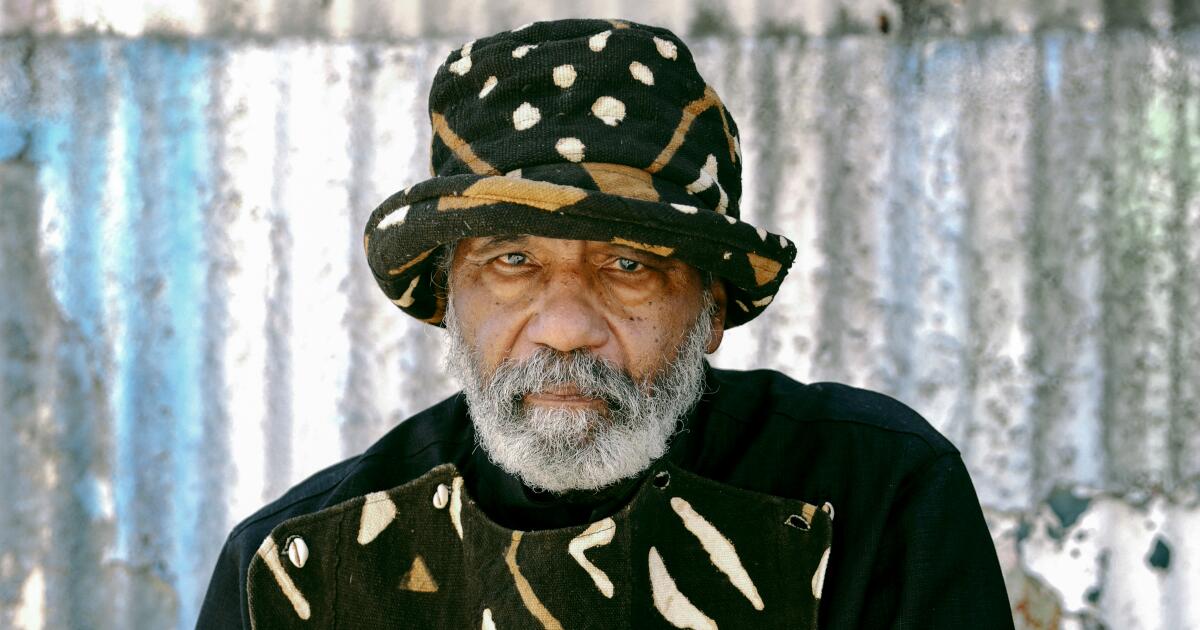
Ulysses Jenkins, the pioneering Los Angeles-born video artist whose avant-garde compositions embodied Black experimentalism, has died. He was 79.
Jenkins’ death was confirmed by his alma mater Otis College, where he studied under renowned painter and printmaker Charles White in the late 1970s and returned as an instructor years later. The Los Angeles art and design school shared a statement from the Charles White Archive, which said, “Jenkins had a profound impact on contemporary art and media practices.”
“A trailblazing figure in Black experimental video, he was widely recognized for works that used image, sound, and cultural iconography to examine representation, race, gender, ritual, history, and power,” the statement said.
A self-proclaimed “griot,” Jenkins throughout his decades-spanning career maintained an art practice grounded in the tradition of those West African oral historians who came before him. Through archival documentaries like “The Nomadics” and surrealist murals like “1848: Bandaide,” he leveraged alternative media to challenge Eurocentric representations of Black Americans in popular culture.
He was both an artist and a storyteller who sought to “reassert the history and the culture,” he told The Times in 2022. That year, the Hammer Museum presented Jenkins’ first major retrospective, “Ulysses Jenkins: Without Your Interpretation.”
“Early video art was about the problems with the media that we are still having today: the notions of truth,” Jenkins said. “To that extent, early video art was a construct that was anti-media … a critical analysis of the media that we were viewing every night.”
Born in 1946 to Los Angeles transplants from the South, Jenkins was ambivalent about the city, which offered his parents some refuge from the blatant systemic racism they encountered in their hometowns, but housed an entertainment industry that had long perpetuated anti-Black sentiment.
“What Hollywood represents, especially in my work, is the classic plantation mentality,” Jenkins told The Times in 1986. “Although people aren’t necessarily enslaved by it, people enslave themselves to it because they’re told how fantastic it is to help manifest these illusions for a corporate sponsor.”
Jenkins, who participated in a group of artists committed to spontaneous action called Studio Z, was naturally drawn to video art over Hollywood filmmaking. “I can address any issue and I don’t have to wait for [the studios’] big OK. I thought this was a land of freedom, and video allows me that freedom and opportunity that I can create for myself and at least feel that part of being an American,” he said.
Jenkins went on to deconstruct Hollywood’s vision of the Black diaspora in experimental video compositions including “Mass of Images,” which incorporates clips from D.W. Griffith’s notoriously racist “The Birth of a Nation,” and “Two-Tone Transfer,” which depicts, in Jenkins’ words, a “dreamscape in which the dreamer awakens to a visitation of three minstrels who tell the story of the development of African American stereotypes in the American entertainment industry.”
Jenkins’ legacy is not only artistic but institutional, with the luminary having held teaching appointments at UCSD and UCI, where he co-founded the digital filmmaking minor with fellow Southern California-based artists Bruce Yonemoto and Bryan Jackson.
As artist and educator Suzanne Lacy penned in her social media tribute to Jenkins, which showed him speaking to students at REDCAT in L.A., “he has been an important part of our histories here in Southern California as video and performance artists evolved their practices.”

4/5 stars
Bounding into cinemas just in time for spring, the latest Pixar animation is a pleasingly charming tale of man vs nature, with a bit of crazy robot tech thrown in.
The star of Hoppers is Mabel Tanaka (voiced by Piper Curda), a young animal-lover leading a one-girl protest over a freeway being built through the tranquil countryside near her hometown of Beaverton.
Because the freeway is the pet project of the town’s popular mayor, Jerry (Jon Hamm), who is vying for re-election, Mabel’s protests fall on deaf ears.
Everything changes when she stumbles upon top-secret research by her biology professor, Dr Sam Fairfax (Kathy Najimy), that allows for the human consciousness to be linked to robotic animals. This lets users get up close and personal with other species.

Ohio courtroom devolves into chaos after sentencing in death of teen

Travis County DA faces renewed ‘soft on crime’ criticism after career criminal charged with murder

Alleged criminal history of missing mom found after 24 years catches up with her

Millionaire philanthropist allegedly gunned down by worker in female wig; ambushes Maryland trooper: police

War in the Middle East: Iran’s broad retaliation in the Gulf • FRANCE 24 English

Florida High School Football Rankings: Top 25 teams – Oct. 21

Cleary's 21 help Le Moyne down Central Connecticut State 69-64 in OT

How old is Bo Nix? What to know about Oregon quarterback ahead of 2024 NFL Draft

99th annual Pony Swim held in Virginia

Indiana Members Credit Union announced as new anchor tenant at Bottleworks District
War in the Middle East: Iran’s broad retaliation in the Gulf • FRANCE 24 English

Trump sends official notification to Congress on strikes against Iran

Unexpected birth brings hope to near-extinct Amazon tribe

Supreme Court blocks redrawing of New York congressional map, dealing a win for GOP

Map: Earthquake Shakes Central California
-

 World5 days ago
Exclusive: DeepSeek withholds latest AI model from US chipmakers including Nvidia, sources say
-

 Massachusetts6 days ago
Mother and daughter injured in Taunton house explosion
-

 Denver, CO6 days ago
10 acres charred, 5 injured in Thornton grass fire, evacuation orders lifted
-

 Louisiana1 week ago
Wildfire near Gum Swamp Road in Livingston Parish now under control; more than 200 acres burned
-

 Oregon4 days ago
2026 OSAA Oregon Wrestling State Championship Results And Brackets – FloWrestling
-

 Technology1 week ago
Arturia’s FX Collection 6 adds two new effects and a $99 intro version
-

 News1 week ago
Video: How Lunar New Year Traditions Take Root Across America
-

 Florida2 days ago
Florida man rescued after being stuck in shoulder-deep mud for days