

Entertainment
Tom Girardi used client money to fund his wife's entertainment career, prosecutors say
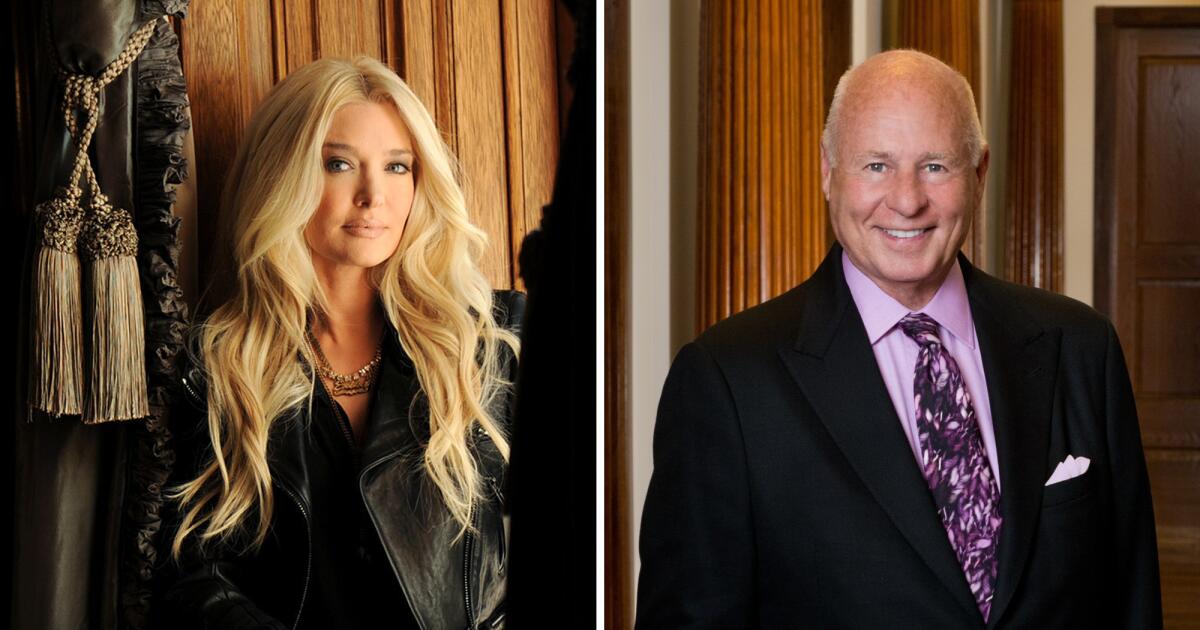
Six weeks before Tom Girardi’s criminal trial in Los Angeles is scheduled to begin, federal prosecutors revealed that they intend to introduce key evidence: that the disgraced former attorney allegedly spent more than $25 million of client and law firm money on the career of his reality TV star wife.
Until now, Erika Girardi — a mainstay of Bravo’s “Real Housewives of Beverly Hills” — has rarely been mentioned in her estranged husband’s federal prosecution. Tom Girardi — once a superstar plantiffs attorney and influential Democratic Party donor — and his law firm’s former chief financial officer are accused of stealing $15 million from several clients in a years-long scheme.
In a court filing Friday, prosecutors said they plan to show the jury evidence that Tom Girardi misappropriated far more than that from his law firm, Girardi Keese, and his clients, including the $25 million they allege he diverted to cover the “illegitimate expenses” of EJ Global LLC, a company he formed for his wife’s entertainment career.
“By directing Girardi Keese accounting personnel to make these payments for the benefit of EJ Global, defendant [Tom] Girardi knowingly and intentionally funneled payments sourced from client funds for the improper personal enrichment of his family members,” prosecutors wrote in their filing.
No underlying evidence was included in the filing, and it’s unclear how prosecutors plan to prove their assertion. They did not mention Erika Girardi by name, nor did they accuse her of wrongdoing or knowledge of her husband’s financial practices.
Instead, prosecutors want to rebut Tom Girardi’s defense strategy of blaming the CFO by showing that Girardi was also misappropriating money to spend on his wife and her career.
Erika Girardi’s lawyer, Evan Borges, emphasized that prosecutors did not say the “Housewives” star did anything wrong and that it was undisputed that Tom Girardi and his firm handled the finances and accounting of EJ Global LLC.
“She had no knowledge of the actions of Tom Girardi or Girardi Keese regarding client matters or finances,” Borges said, noting that one judge already dismissed a suit against her because of “ZERO evidence” of her involvement in client matters.
“Years ago, Erika filed for divorce and separated from Tom Girardi, and lives in a rental,” Borges said in a statement. “She is entitled to move on with her life.”
Prosecutors want to bring in the evidence related to Erika Girardi’s company, EJ Global, because of what Tom Girardi’s attorneys revealed at a hearing on Thursday. Deputy Public Defender Charles Snyder indicated at the hearing that the defense will point a finger at the law firm’s CFO, Christopher Kamon.
Snyder said his client wasn’t the one “running the machine” — it was Kamon, who oversaw the firm’s accounting department and 127 bank accounts.
In a separate federal prosecution, Kamon is charged with allegedly running a “side fraud” in which he embezzled millions from the law firm using sham vendors, then spent the funds on home renovations, exotic cars and “female escorts,” according to court papers. Kamon, who has pleaded not guilty in both cases, faces a second trial in October for the so-called side fraud.
Girardi’s legal team plans to cite the alleged “side fraud” by the CFO as a cause for large deficits in Girardi Keese’s accounts.
Further, they plan to argue that Girardi was liquidating his personal assets and putting those funds back into the firm for payroll and expenses to offset money depleted by Kamon’s alleged scheme.
In court Thursday, Snyder said that Girardi’s lies to clients about the whereabouts of their settlement money — what prosecutors called “lulling communications” meant to fend them off — were not meant to swindle victims but to permit Girardi himself to get to the bottom of his firm’s finances.
Kamon’s attorney, Michael Severo, poured cold water on the narrative: “It’s just fiction,” he said in court.
With Girardi’s lawyers suggesting that they’ll shift culpability onto Kamon, prosecutors wrote in their filing that evidence of money misappropriated to pay EJ Global’s bills is “essential” to telling “a coherent and complete story of the charged scheme.”
“Excluding such evidence would only serve to distort the truth and leave the jury with the mistaken impression that only defendant Kamon is to blame for such misappropriation when, in truth, defendant Girardi similarly misappropriated tens of millions himself,” the prosecutors wrote.
Girardi and Kamon are scheduled to go on trial together on Aug. 6. But late Friday, Girardi’s attorneys moved to try them separately, in part because their defense strategies are “mutually exclusive.”
That is, Girardi’s lawyers believe that each man will blame the other. They plan to argue that Kamon wanted to cheat and deceive his boss and exploit an elderly man facing cognitive decline. They also predict that Kamon will claim he was “pressured” into acting at Girardi’s command, according to court papers.
Whether to try the two men separately, or to allow evidence of improper payments to Erika Girardi’s limited liability company, will be decided by U.S. District Judge Josephine Staton, who previously ruled Girardi competent to stand trial.
Staton will also rule on a motion filed late Friday by Tom Girardi’s legal team, which asks the judge to suppress evidence provided to prosecutors by the bankruptcy trustee overseeing Girardi’s law firm, saying that a search warrant was never sought to obtain the firm’s internal files and records.
Girardi’s lawyers have argued that the 85-year-old, who resides in the dementia ward of a nursing home, has no short-term memory and does not recognize them or remember the criminal case against him.
But in her ruling earlier this year, Staton said Girardi “clearly understands the nature of the charges against him.”
Girardi was once a titan of the American legal community who won billions of dollars in settlements for clients in a career that spanned five decades. A landmark payout to residents of Hinkley, Calif., by Pacific Gas & Electric and its subsequent portrayal in the film “Erin Brockovich” helped raise Girardi’s public stature. But he was long an insider in California politics, raising sums for governors, senators and legions of local Democratic politicians.
His firm collapsed in late 2020 as evidence emerged that he had misappropriated millions of dollars of settlements that Boeing had paid to widows and orphans of an Indonesian plane crash. The money never reached the families, prompting a federal judge in Chicago to freeze Girardi’s assets and refer him for criminal investigation.
Girardi and his firm were forced into bankruptcy, and since then, scores of former clients have come forward alleging they did not receive all or part of their settlements.
Girardi and his son-in-law David Lira, along with Kamon, also face federal criminal charges in Chicago in connection with the misappropriation of $3 million from the Indonesian plane crash victims.
A trial in Chicago is scheduled for 2025.
Movie Reviews
‘The Blow’ Review: A Gripping, Feverishly Performed French Drama Explores Incest With Candor and Emotion
For his bracing first feature, The Blow (La Frappe), writer-director Julien Gaspar-Oliveri chose a subject so bleak, many filmmakers wouldn’t touch it with a ten-foot pole. And yet this raw and grippingly honest incest drama manages to find a bit of light in the darkness, showing how it’s possible to live with the traumas of sexual abuse. Feverishly performed by newcomer Diego Murgia, who stars alongside César award winner Bastien Bouillon, Gaspar-Oliveri’s moving debut reveals that he’s not only a talented director to watch, but one who’s unafraid to tackle tough scenarios.
The Blow focuses on a disarmingly troubled young man, Enzo (Murgia), who tries so hard to find affection in the eyes of his dad, Anthony (Bouillon), he’s willing to ignore the worst thing a father could ever do to his own son. Enzo spends much of the film in a crushing state of denial, hoping against hope that love will somehow emerge from this mess. He’s so vulnerable that you can’t help feeling his pain — even when he winds up inflicting that pain on others.
The Blow
The Bottom Line A powerful debut tackles a tough subject.
Venue: Cannes Film Festival (Critics’ Week)
Cast: Diego Murgia, Bastien Bouillon, Romane Fringeli, Héloïse Volle
Director: Julien Gaspar-Oliveri
Screenwriters: Julien Gaspar-Oliveri, Claudia Bottino
1 hour 46 minutes
Per the press notes, Gaspar-Oliveri (who co-created the successful high school series, Those Who Blush) partially based the story (co-written with Claudia Bottino) on his own life, which seems evident given the emotional authenticity of his characters. Murgia’s portrayal of Enzo is the movie’s breakthrough performance, although Romane Fringeli, who plays the 19-year-old’s abrasive older sister, Carla, is also a standout. Bouillon, meanwhile, continues a string of strong turns (including in The Birthday Party, which screened in Cannes’ main competition this year) that began back in 2022 with Dominik Moll’s thriller The Night of the 12th.
The opening scene, lensed by Martin Rit in grainy close-ups, shows Enzo and Carla carelessly sleeping in bed together, their bodies subtly rising and falling with each breath. It seems like a blissful moment between the two siblings, who share a tight if volatile bond. But as the film progresses and we learn more about their childhood, that scene takes on a very different meaning: one in which proximity can breed both affection and contempt.
With no parents in the picture and Carla moving out to a college dorm, Enzo’s whole life seems to be in front of him. It helps that he has a burgeoning and very loving relationship with new girlfriend Laura (Héloïse Volle), whose parents run a go-kart track that seems to be the main source of entertainment in their working-class suburb of Marseille.
But the state of independence Enzo has achieved at such a young age is broken when his dad returns home after a five-year stint in prison. A scene in which the two discuss Anthony’s future with a parole officer underlines to what extent Enzo has become the man of the household, hiring his own father to help sell kitchen appliances at local flea markets.
Bouillon creates a charming if menacing presence from the get-go, portraying Anthony as a father who’s been out of the loop for too long with regards to both family and civilian life, yet still wants to be in charge. In one sequence foreshadowing what’s to come, Enzo hides in a closet while his dad brings a woman home from the bar, witnessing some awkward and then off-putting sexual behavior. A latter scene in which the boy climbs in bed with Anthony reveals much worse, although it takes Gaspar-Oliveri a while to explain what exactly went down in the past.
What’s most moving about The Blow — whose French title can mean both a physical hit and a young hoodlum — is the way it charts Enzo’s gradual awakening from a kid who’s still too attached to his father, mostly for terrible reasons, to an adult who finally steps back and sees the truth, at which point the trauma is so overwhelming that it takes over. This happens during several explosive scenes in which Enzo lashes out at those who truly love him (his girlfriend; his sister, who wants nothing to do with their dad), searching in vain for someone to quell the suffering.
Murgia is a revelation here, playing a loose cannon who’s also deeply wounded, like a battered dog occasionally showing his teeth and sometimes biting those who feed him. The early moments in the drama, when Enzo is trying his best to please Anthony after he gets out of jail, offering to cook dinner or lending him a few bucks, will just about break your heart. Because deep down, Enzo knows that by getting closer to his dad, he’s also getting further away from his own recovery. It’s the constant push and pull between trauma and salvation that makes The Blow such a powerful experience.
Entertainment
Review: ‘Power Ballad’ is a one-scene wonder with a terrific start and a sloppy second act
“Power Ballad” is a cynical, sloppy comedy about a wedding singer (Paul Rudd) and a pop titan (Nick Jonas) who drunkenly tinker with an unfinished song, then squabble over who gets custody when it becomes a hit.
Disharmony is a new chord for filmmaker John Carney, who has specialized in films about collaboration since his 2007 art house hit “Once.” From the snotty ’80s synth music of “Sing Street” to the acoustic heartbreak of “Begin Again,” Carney loves to hear how a rough idea evolves into a polished track. Lately, he’s been trying to find new approaches to his formula. His 2023 “Flora and Son” was about a surly single mother who picks up a guitar and discovers that her life doesn’t change that much. I loved that one because it said we’re all entitled to noodle without having to make much fuss about it.
The problem with “Power Ballad” is that it’s all rough ideas itself. Like an album that kicks off with its single, it starts with a jazzy sequence of song creation that’s one of the best versions of the scene Carney has ever done. A faded teen icon, Danny (Jonas, gamely sending up his history as one of the platinum-selling Jonas Brothers), explains how to write a PG-rated hit to Paul Rudd’s cover band frontman Rick, who immediately tries to improvise lyrics with the word “titties.” (Or as he warbles it, “tit-taaays!”). It’s perfect casting — Rudd’s singing voice keeps up with his comic chops.
Fifteen years ago, Rudd’s Rick fancied himself an up-and-coming American rock god until his grunge act went on a transatlantic tour and he fell in love with an Irish girl, Rachel (Marcella Plunkett), and had a daughter named Aja, a feisty teen played by the scene-stealing Beth Fallon. Settling into a life of anonymity in the Dublin suburbs, Rick now has his wedding band Bride & Groove, which allows him brief flashes of cool — or at least the chance to strut into gigs wearing tight black jeans. His bandmates are pretty funny but so underwritten that one even gives a big speech about how he’s more than just a bit player in Rick’s life.
Straight away we’re suspicious that Carney and co-screenwriter Peter McDonald stashed this story in a drawer ages ago and didn’t bother to dust it off. If Rick quit his serious group during the Obama era, why does he consider himself a peer of Eddie Vedder? The character is written to be in his late 30s, but acts decades older than that, posturing like he’s one of the last ambassadors of authentic rock and roll while ripping through a setlist that’s mostly Hall & Oates. (Shouldn’t he at least be jamming the Killers’ indie-sleaze wedding staple “Mr. Brightside” that sends bridesmaids shrieking onto the dance floor like a maenad cult?)
At one soiree, Rick is asked to pass the mic to Danny, a boy-band celebrity struggling to make the leap to a solo artist. Rick has already mocked him earlier that day as “the death of the music industry,” but Danny proves to be a true performer with enough star power to electrify Rick, who starts copying his gestures, clapping alongside him and having a blast. Their chemistry carries over into an all-night jam session in which Danny and Rick share spliffs, whiskey and scraps of songs that they haven’t managed to perfect.
For a thrilling moment, the movie is a platonic rom-com about two dissatisfied artists coming together from opposite directions: Danny crumpling under mass scrutiny, Rick weary of obscurity. Danny is desperate to get back to playing Madison Square Garden; Rick has long since abandoned his dream of playing there even once. Having seen a movie or two before in my life, I assumed that “Power Ballad” would climax at that stadium with Danny and Rick harmonizing for a crowd of 15,000. Corny, sure, but satisfying.
But this banger of a bonding session is a one-night stand. In a shallow heel turn, Danny poaches one of Rick’s unfinished songs and blows it up into a chart-topper. It’s a major betrayal for Rick and a bummer for the audience, who never get to see the two make music together again. Instead, Jonas’ Danny becomes a callow Hollywood creep just like his manager, a menacing slickster named Mac Darling (Jack Reynor), who seems hip until he tries to explain an internet meme and it becomes obvious that Carney doesn’t understand what a meme is.
Meanwhile, Rick suffers a meltdown, haunted by the hit he can’t escape. The stolen track chases him everywhere: on the radio, overheard at the mall, even at his own gigs where newlyweds cluelessly ask him to play “their” special song. We’re forced to hear endless snippets of it, too, although the full lyrics are saved for the end when we discover that one of songwriters clumsily shoved in the word “albatross.”
“Power Ballad” nods toward a dozen interesting themes, none of which it bothers to explore. It could be about what turns a pretty melody into a mega-smash, about the value of songwriting versus charisma, about timid artists who hoard their best material and showboats obligated to satisfy their promotional teams, or even about how a song ultimately belongs less to its creator than its fans. It also flirts with being about how both men write for female approval — girls are Danny’s fanbase and Rick’s family is his entire world — only to have their women think most of their songs are pandering and dull.
“What are you interested in?” Rick finally huffs to his daughter.
“Revenge,” she says.
Well, Carney’s made a movie about darkness and it’s a total bummer. In a brutal little detail, he contrasts Danny’s bikini groupies with the women in Rick’s crowd, who clomp toward him with toilet paper stuck to their shoes.
“Power Ballad” postures like a sincere drama but has the set pieces of a giant slapstick farce. Rudd seems to have been told he’s in one, playing Rick’s humiliation so large that he looks unhinged, his face covered in cuts and bruises of his own doing that, distractingly, never seem to heal.
The result is punishing — and tone deaf.
‘Power Ballad’
Rated: R, for language throughout and some drug use
Running time: 1 hour, 38 minutes
Playing: Opening Friday, May 29, in limited release
Movie Reviews
Movie review: ‘Power Ballad’ follows a weak Nick Jonas/Paul Rudd feud – UPI.com
1 of 5 | Nick Jonas (L) and Paul Rudd star in “Power Ballad,” in theaters Friday. Photo courtesy of Lionsgate
LOS ANGELES, May 28 (UPI) — Power Ballad, in select theaters Friday, introduces several provocative themes about creativity and the music industry. Unfortunately, it only pays them lip service and leaves many important ones on the table.
Rick Power (Paul Rudd) is the lead singer of an Irish wedding band who loses the party crowd when he plays his own originals from his U.S. touring days. At one wedding, the bride invites her childhood friend, former boy band singer Danny Wilson (Nick Jonas).
After singing a duet at the wedding, Danny and Rick spend the night together jamming in Danny’s room. Danny even leaves Rick a generous parting gift, though his promise that Rick can get in touch with him through his managers seems empty.
When Danny’s manager, Mac (Jack Reynor) rejects his new solo submissions, Danny records “How to Write a Song (Without You)” which Rick played for him during their night in Ireland. Rick finds out when he hears it in the mall six months later.
This raises poignant questions about authorship. Rick wrote the song but never recorded it. Danny recorded it and made it a hit, but claimed authorship.
The script by John Carney and Peter McDonald goes into thorough detail about how Rick cannot establish a record of writing the song prior to meeting Danny. He has no demos, never shared it with his wedding band, and even his wife (Marcella Plunkett) and daughter (Beth Fallon) can’t remember it out of all the music he’s played in the house.
It’s less surprising that Mac shuts down Rick’s claim and threatens legal retaliation, which a humble Irish wedding singer could never afford to battle. What’s more surprising is which obvious questions Carney and McDonald never think to ask.
Danny got a hit out of “How to Write a Song (Without You).” He can ride that for a bit but what is he going to do when he has to write another and all he’s got are the same trite songs the label rejected before?
Mac and Danny allude to an EP he released that included “How to Write a Song” but we don’t hear any of the other tracks. What B-sides did Mac accept to justify a tour off one hit single?
Danny tells his girlfriend (Havana Rose Liu) that he wrote the song for her. Not only does she never find out, question or appear again in the film, she also doesn’t find out when he later takes two groupies to the hot tub.
Instead, Power Ballad seems more invested in mocking Rick for claiming he had a hand in a hit. It must be hard to live with the song ubiquitous everywhere he goes, and especially when a married couple requests he perform it for them. It seems particularly heartless when Rick’s wife and daughter mock him for it. That they don’t believe he wrote it suggests far deeper conflict in that family, but the film never gets into that either.
Rick also lashes out too hard when he’s defensive. It becomes uncharacteristically bitter for a John Carney movie.
The ultimate confrontation between Rick and Danny is unsatisfying. Their jam session was genuine, two musicians bonding over the art when Rick does not care about Danny’s celebrity.
By the time they meet again, Danny’s arc is reductively “hurt people hurt people.” He’s insecure, and boy, would it have been interesting to see him put to the test to follow up “How to Write a Song” by… writing another song.
It also strains credulity that “How to Write a Song (Without You)” is the comeback hit for Danny. It’s fine but not notably better than his other demos.
Begin Again and Sing Street had original music that sounded like it could sell albums on its own. Once literally became a Broadway musical. By Power Ballad, we’ve got a song less catchy than fictional movie songs like “That Thing You Do” or “Way Back Into Love” from Music & Lyrics.
The film does contrast Rick’s heartfelt performance with Danny’s poser version. A sold out Madison Square Garden doesn’t know the difference, but the viewer of Power Ballad does.
Other bright spots are sporadic and disjointed. Jonas takes some gentle jabs at boy band music. They’d land harder if his character ultimately did man up.
They do portray diverse weddings. Fortunately, LGBTQ unions get screen time along with more heteronormative ones.
A nightmare visualizes Rick’s real insecurities comically. Rick and bandmate Sandy (McDonald) perpetuate a cute scheme to get past security, and their actual “in” with Danny was legitimately established previously. Sandy choosing music over a party girl hitting on him is endearing.
Carney’s earlier movies were genuinely uplifting and inspiring even with their share of heartbreaks. His film about struggling to regain earlier inspiration ultimately faces the same very dilemma and blows it like the movie’s antagonist does.
Lionsgate will release Power Ballad nationwide June 5.
Fred Topel, who attended film school at Ithaca College, is a UPI entertainment writer based in Los Angeles. He has been a professional film critic since 1999, a Rotten Tomatoes critic since 2001, and a member of the Television Critics Association since 2012 and the Critics Choice Association since 2023. Read more of his work in Entertainment.
-
Washington2 minutes agoSounders FC, Starbucks and Washington Youth Soccer launch Washington Youth Soccer Match Pass to celebrate the next generation of soccer across the Evergreen State | Seattle Sounders
-
Wisconsin8 minutes agoWisconsin DOT announces revocation of licenses for wholesale dealers throughout the state
-
West Virginia14 minutes agoWest Virginia Scores Rehearing Over Drug Discount Injunction
-
Wyoming20 minutes agoOnce-bankrupt Wyoming pipeline could get a boost from massive Utah data center – WyoFile
-
Crypto26 minutes agoFBI Seizes Over $8 Billion In Cryptocurrency As Part Of The Largest Forfeiture In US Government History
-
Fitness38 minutes agoThe 150-minute Exercise Rule Helps Your Heart. But If You’re Serious About It, Better Aim for 600 Minutes
-
Movie Reviews50 minutes ago‘The Blow’ Review: A Gripping, Feverishly Performed French Drama Explores Incest With Candor and Emotion
-
World1 hour agoYoung MC Follows Morris Day in Exiting D.C. ‘Freedom 250’ Festival Over Trump Connection, as C+C Music Factory Weighs Options: ‘The Artists Were Never Told About Any Political Involvement’
