Entertainment
This country banned TikTok. What became of its influencers?

Is there life after TikTok?
The question is front of mind for U.S. influencers and many small businesses as lawmakers threaten to ban the Chinese-owned social media app that’s become a cornerstone of internet culture and e-commerce.
For an answer, they might turn to India, which has been surviving without TikTok since June 2020.
That month, after 20 of its soldiers were killed in a border clash with China, the Indian government gave TikTok users a day to post tearful goodbyes and steer followers to other social media accounts. Then the app went dark.
People light candles in Hyderabad on June 17, 2020, in tribute to the 20 soldiers killed during a border clash between Indian and Chinese forces in the Ladakh region.
(Mahesh Kumar A / Associated Press)
“When it got banned, I had nothing,” recalled Gaurav Jain, who was one of the country’s more than 200 million TikTok users.
He was 25 and had just notched his millionth follower making self-help videos about mental health, men’s style and relationships.
Four years later, Jain runs his own social media marketing agency in Delhi, managing Indian content creators who pivoted to other platforms or joined the influencer world more recently. He had tried to make the transition himself but found starting from scratch demoralizing.
“The counter became zero for everyone,” he said. “That gave rise to a lot of new creators.”
The results for former TikTok stars have been mixed.
Gautan Madhavan, founder of Mad Influence, a marketing agency that managed more than 300 content creators before the TikTok ban, said that about a third of them were able to recapture their reach on Instagram Reels or YouTube Shorts within three months and that many are still playing catch-up.
Those short-video platforms launched shortly after the TikTok ban. Users who found success got in early and posted as often as 10 times a day, according to Saptarshi Ray, a consultant for influencers trying to grow their followings.
“Most of them were just trying everything,” Ray said. “Those were the creators that really flourished.”
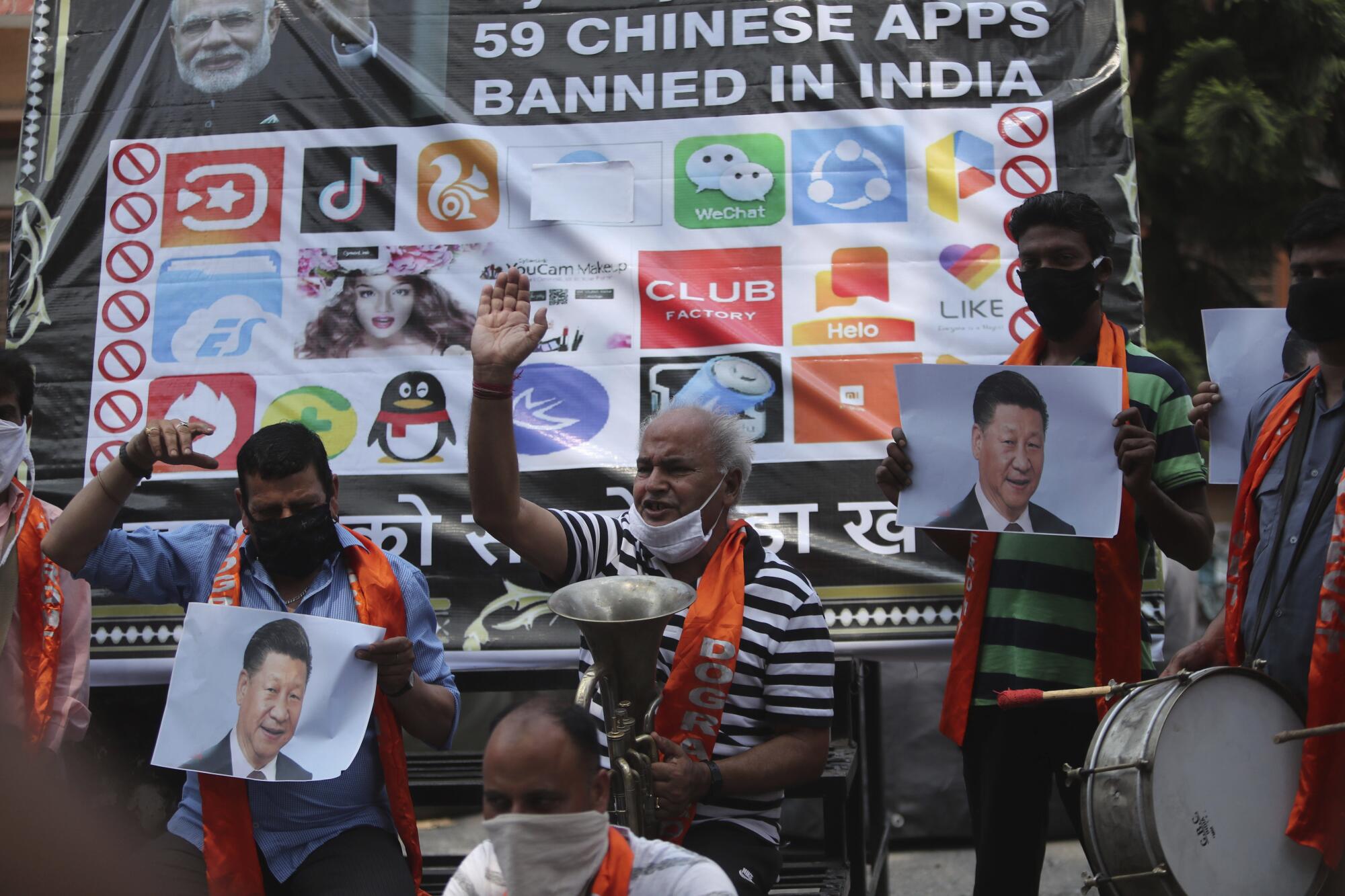
Activists shout slogans against Chinese President Xi Jinping next to a banner showing the logos of TikTok and other Chinese apps banned in India during a protest in Jammu, India, on July 1, 2020.
(Channi Anand / Associated Press)
India was TikTok’s fastest growing user base before the ban, which cut off a vital source of income for creators there.
The stakes are even higher in the United States, where the app has more than 170 million users, including 7 million businesses that TikTok says generated $14.7 billion in revenue last year from marketing on the platform. The Pew Research Center found that a third of Americans used TikTok last year, up from a fifth in 2021.
In April, President Biden signed a bill to ban the app by January 2025, unless Chinese parent company ByteDance Ltd. agrees to sells the app to somebody from a country that is not considered a foreign adversary.
The threat comes as suspicion between the U.S. and China has escalated, reviving concerns that TikTok could share sensitive data with the Chinese government.
The proposed ban still faces high hurdles. Both TikTok and a group of U.S. content creators separately filed lawsuits, arguing that blocking the app would be an unconstitutional assault on free speech. The Trump administration had also tried to ban TikTok but gave up after being challenged by federal courts.
TikTok has sought to assure the U.S. government that user data is protected on U.S. servers. And though its parent company is based in Beijing, TikTok moved operations to Singapore under a Singaporean chief executive.
The U.S. — along with Britain and Australia — has already prohibited the use of TikTok on government devices. But digital marketing experts said many U.S. users are still not seriously considering the possibility of a ban.
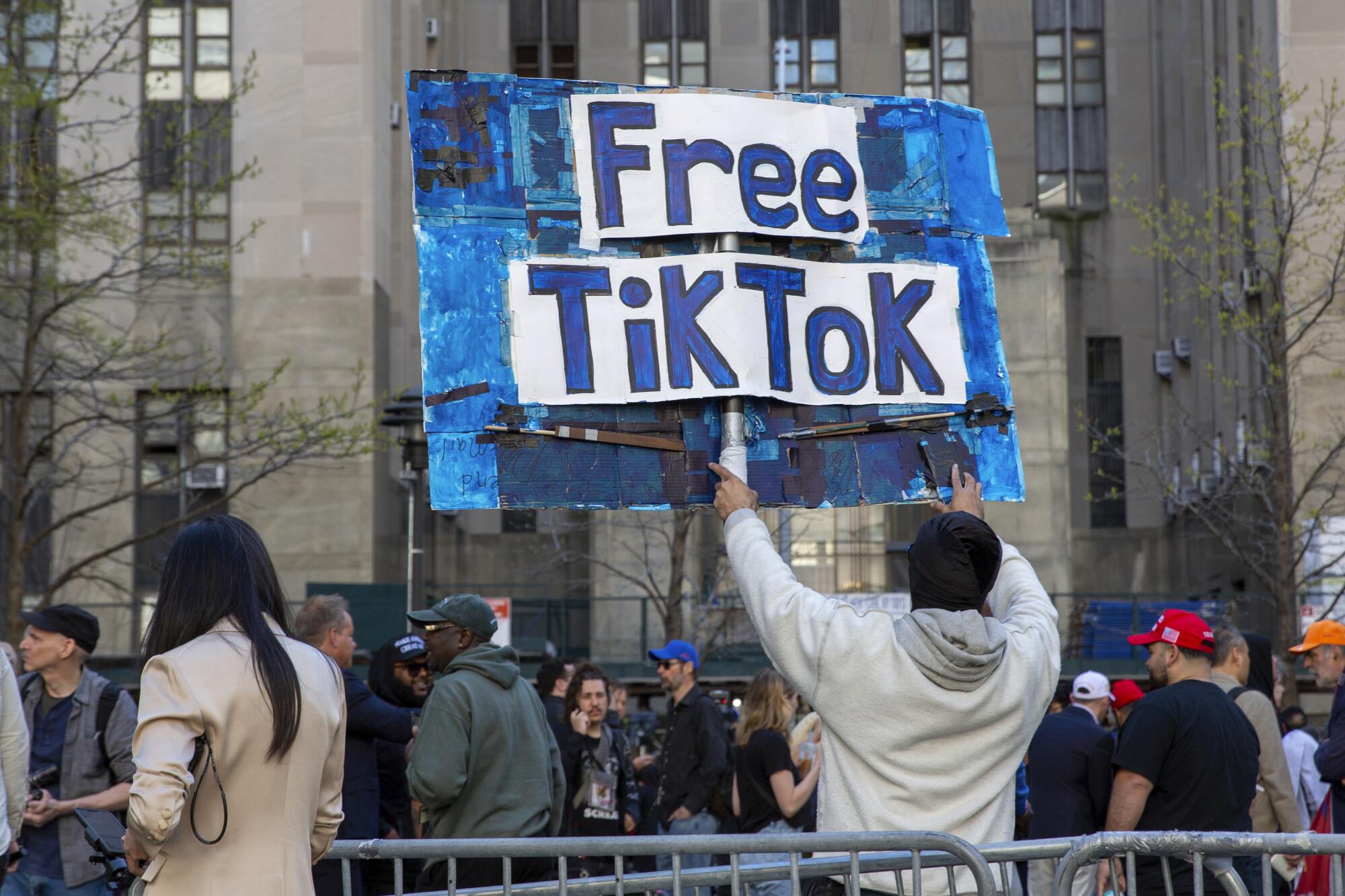
A man demonstrates outside the courthouse in New York where the hush money trial of Donald Trump got underway on April 15, 2024.
(Ted Shaffrey / Associated Press)
“I don’t think the average TikTok user has synthesized in their brain that this is going away,” said Lawrence Vincent, associate professor of the practice of marketing at USC’s Marshall School of Business. “They’ve heard about it, but it isn’t real until it’s real.”
There has been little anticipatory migration to other platforms. But former TikTokers in India advised their American counterparts to prepare for the worst.
“We used to hear rumors about this happening, but we never really believed it,” said Ashi Khanna, a 26-year-old influencer from Delhi.
She launched her TikTok career by posting lip-synching videos in 2017 — when the app was known as Music.ly — and eventually built a following of 1.7 million. She managed to post a farewell directing them to Instagram and YouTube, where she already had smaller followings. But fewer than 20,000 did so.
Since then, Khanna has concentrated on Instagram and managed to match her old following.
In contrast to TikTok, which never placed a premium on production quality, Instragram required a more polished aesthetic that could mean spending hours on a single reel.
“There’s a huge difference,” Khanna said. “You need to understand what your audience likes, and your audience is not the same on every platform.”
Ankita Chhetri, 22, who lives in Mumbai, said experimentation was the key to life beyond TikTok.
She became TikTok famous in 2019 after posting a video of herself lip-synching to a popular Bollywood song. With 8.2 million followers, she earned promotional deals with music labels and scrapped her plans to be a nurse in hopes of making it as an influencer and actor.
After the ban, she started a YouTube channel and branched out from lip-synching into carefully planned reels of beauty, travel, fashion and inspirational quotes. As she gradually increased her following to 1.6 million, she used her improved engagement statistics to pitch brands on potential partnerships.
Still, Chhetri said there are times she misses the old days.
“TikTok just had some crazy amount of loyalty among audiences,” she said. “On Instagram, even if people are watching and liking your content, they’re still hesitant to press that follow button.”
Indian entrepreneurs created their own versions of TikTok, but failed to get much of an audience.
“It still felt like I was invisible, nobody was really there,” said Shreyas Mendiratta, a 23-year-old hospital worker who posted his comedy videos on Indian startup apps for a few months before giving up. “On TikTok, I felt seen, I felt heard.”
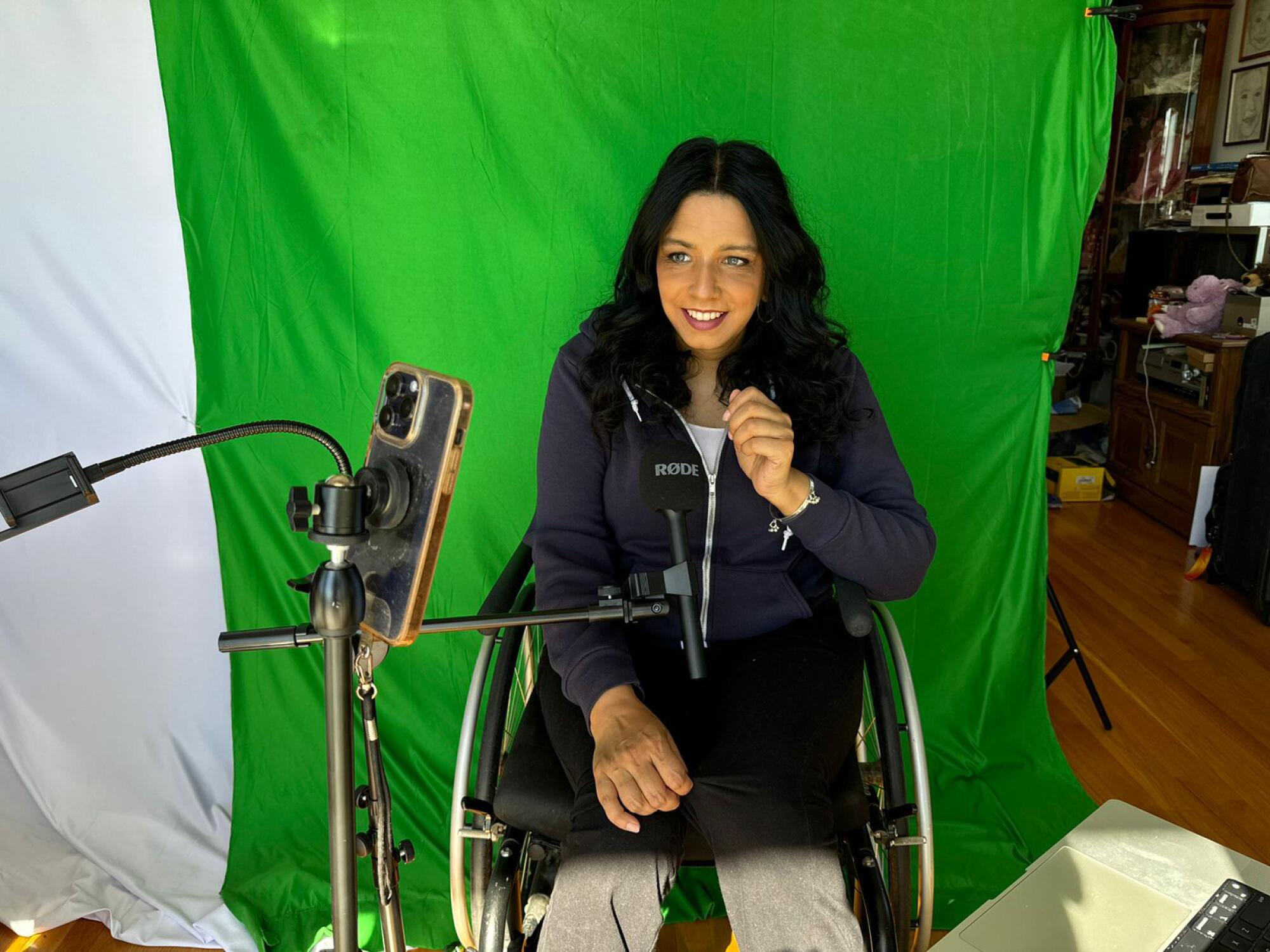
Geet Jain records herself for social media.
(Courtesy of Geet Jain)
His videos don’t do as well on Instagram and YouTube either, which he suggested lack TikTok’s broad international appeal.
“It reduces the chances of them going global,” he said. “This is what I face on Instagram daily. I am very restricted to the region that I am geographically located in.”
Geet Jain, an inspirational speaker and English teacher, was visiting the U.S. when India banned TikTok. She could still use the app, but none of her 7 million followers in India could see her posts offering relationship advice, comedy bits and English lessons.
“It was like this whirlwind of confusion of what do I do next,” said Jain, who declined to provide her age.
She turned to Instagram, growing 68,000 followers into 1.3 million. But she never achieved the same kind of exponential growth. Some of her TikTok fans had a difficult time finding her.
Back in the U.S. this year for an extended stay with her sister in Seattle, she has started posting on TikTok once more.
Geet Jain, an inspirational speaker and English teacher in India, was in the U.S. when India banned TikTok in June 2020.
Back in the U.S. this year for an extended stay in Seattle, she has started posting on TikTok once more.
(Courtesy of Geet Jain)
But she no longer knows what viewers want. Clips have gotten longer, with more casually narrated stories and less dancing and lip-synching than she remembers. There is more competition when it comes to her style of educational content.
While some of her English-language videos have gotten traction, she’s reluctant to invest too heavily in TikTok again.
“If it gets banned in America, it will be even more devastating for me,” she said. “Then my accounts are actually gone.”

Movie Reviews
‘Night Nurse’ Review: A Caretaker Explores Her Kink for Elder Abuse in the Year’s Strangest Erotic Thriller

There are any number of erotic thrillers in which rich old men are robbed blind and/or left for dead, but Georgia Bernstein’s admirably bizarre “Night Nurse” might be the first movie of its kind where elder abuse is the source — and possible subject— of its erotic thrills. If there are others, I’m not sure I want to know.
But this woozy debut feature doesn’t rely on its audience being turned on by the relationship between a nubile caretaker and her dementia-addled patient. Their psychosexual bond, meanwhile, hinges on cold-calling vulnerable old people under the guise of a grandchild in financial distress. (“I’m in trouble, nana, send me $10,000 or I’ll be left to rot in jail!” That sort of thing). With its slim wisp of a premise stretched into a Strickland-esque dreamscape that substitutes kink for conflict, the film itself hardly seems convinced by its own wrinkled lust — all desperate kisses and non-touching poses of subservience. More important to Bernstein is what that lust reveals about her characters’ deepest needs, specifically how their need to care and be cared for can be as easily perverted as any other form of desire.

As moody and weightless as the noir-accented score that blows through the movie like a curlicue gust of wind in an old cartoon (credit to musicians Sam Clapp and Steven Jackson), “Night Nurse” lacks the pulse required for its stray feelings to come alive. Still, the film ambiently taps into the latent eroticism of teasing out the distance between how you see yourself and who you really are. Bernstein plays with that distance like a telephone cord wrapped around her fingers, and Eleni — played by the excellent newcomer Cemre Paksoy, powerfully helpless — only frays even more as the receiver is brought near the hook. “Everything I did before today wasn’t me,” the nurse tells co-worker Mona (Eleonore Hendricks) after starting a new job at an Illinois retirement home. “It was somebody else.”
What she did before today remains unexplored (specifically, what she did to get herself fired from her last gig), but I’m guessing she’s probably changed less than she thought. There’s a faraway flicker in her eyes the moment she catches the vibe between Mona and Douglas (a ribald and elusive Bruce McKenzie), a white-haired seventysomething who shows early signs of dementia but still commands an undiminished sexual energy. “I’m not an invalid,” he coos as Mona bathes him in the tub, to which she replies, “yes, you are,” in a supplicant tone that hints at a rich history of power games between them.
Later that same night, Douglas will force Eleni to call a stranger, pretend that she’s their granddaughter, and ask for money — he’ll wrap the phone cord around the nurse’s body as she talks and shove her against the wall as they kiss. She’s into it. So into it that he has to clarify the terms of his whole deal: “If you’re looking for a pogo stick, I’m really not your guy.” But Eleni isn’t looking for anything to bounce on. She just wants to be needed, and maybe to need someone in return. Someone who will see her for who she really is and allow her the fantasy of pretending she isn’t being herself when she cons vulnerable strangers out of their money — when she exploits how enthralled those strangers are by the care they have for their loved ones.
“Night Nurse” doesn’t belabor the psychology, as Bernstein prefers to express her story through heavy-lidded suggestion. Somnambulating from the moment it starts, the film moves through a series of beautifully arranged poses that stretch their latent meaning thin across the surface (Lidia Nikonova’s cinematography lacquers every shot with a seductive dreaminess). We see Douglas smoking in a lawn chair with Mona and Eleni curled around his feet. Eleni riding in the backseat of a convertible as the wind blows through her curls. The full staff of nurses — all of them under Douglas’ sway — stumbling around his condo in a state of zonked out bliss as they roll on the prescription drugs they’ve stolen from the residents.
Once you’ve seen one shot of this movie, you’ve practically seen them all, at least until things escalate during a rushed and unsatisfying third act that forces Eleni into an honest confrontation with herself. People will do just about anything to feel needed — they’ll give whatever degree of care allows them to receive it in return. “Night Nurse” understands that desire, but remains far too numb to treat it.
Grade: C+
The Independent Film Company will relase “Night Nurse” in theaters on Friday, July 10.
Entertainment
Lucas Museum to give free annual passes to South L.A. neighbors, host community preview day

The Lucas Museum of Narrative Art, which is moving at light speed toward its Sept. 22 opening, announced Thursday that it will give free annual passes to its South L.A. neighbors living in the 90037 ZIP Code. The 300,000-square-foot, $1-billion museum located in Exposition Park will also host a special community preview day on Sept. 13, more than a week before the general public gets to step inside.
The 90037 ZIP Code has a population of more than 65,000 and is bordered roughly by the 110 Freeway to the west, Slauson Avenue to the south, Central Avenue to the east and Martin Luther King Jr. Boulevard to the north. Residents can register for passes at lucasmuseum.org/lm37 and will be alerted in August when the program launches. Pass holders can reserve tickets for themselves and one guest.
Tickets for non-pass holders go on sale July 21. They cost $25 for adults and $21 for seniors. Kids 17 and under are free.
“Storytelling has the power to bring people together and create a sense of community,” said Lucas Museum Chief Executive Tracey Bates in a news release about the program. “Through LM37, we are inviting our South Los Angeles neighbors to make the museum part of their lives and take their own path of discovery through the art, programs and experiences that will help shape this new cultural hub for Los Angeles.”
The community preview day is designed to give local business owners, community partners, civic leaders and registered LM37 pass holders a sneak peak of the 10,000 square feet of exhibition space, as well as the expansive gardens with 11 acres of park space.
The opening programming, curated by co-founder George Lucas, features 20 inaugural exhibitions across more than 30 galleries, including one titled “Star Wars in Motion,” containing vehicle designs, high-speed racers, flying vessels, props, costumes and illustrations from the first six films in the beloved franchise.
More than 1,200 objects will be on display from Lucas’ personal collection of narrative art. Highlights include work by Norman Rockwell and Dorothea Lange, as well as a variety of manga, children’s book illustrations and comics.

Last year’s “Superman” ended with Iggy Pop singing “Because I’m a punk rocker, yes I am” — an ironic coda for a superlatively square hero. But it rings straightforwardly true for Superman’s cousin.
Milly Alcock’s Kara Zor-El, or Supergirl, sports not a spandex suit but a Blondie T-shirt. When we meet her in Craig Gillespie’s “Supergirl,” she’s been on an interstellar bender for days. She’s more Courtney Love than Clark Kent.
Nonchalant and sarcastic, Kara is also a little Han Solo-ish, you might say, given that she moves capriciously through the galaxy in her junky spaceship while getting in fights in extraterrestrial bars. She’s a welcome, jagged riff on more buttoned-up superheroes, and Alcock is terrific in the role. If only “Supergirl” was as good as she is.
While the latest DC release, and second under James Gunn’s stewardship, has its moments, “Supergirl” struggles to match Kara’s punk-rock energy with an equally spirited supporting cast and story.
Skepticism seems to have gathered for “Supergirl” ahead of its release. Many fans have argued it wasn’t the right next step for DC Universe. But I’m not so sure. Alcock’s breezy cameo in “Superman” was one of that movie’s highlights. Handing the follow-up to her, and her faithful floating dog Krypto, strikes me as an extremely natural next step. When in doubt, follow the dog.
And much of “Supergirl” is winning. It resides almost entirely in space, touching down only momentarily on Earth. In its consistently creative production design, clever needle drops and underdog story arc, “Supergirl” resides a little closer to Gunn’s “Guardians of the Galaxy” movies than other DC entries. Its outer space is filled with cosmic detritus, mean characters and cute critters. Seth Rogen as the voice of a tiny alien co-piloting a space bus is an inspired concoction, as is a shabbier sci-fi realm with rest stops along the intergalactic highway.
-

 Miami, FL1 minute ago
Miami-Dade Schools names six semifinalists for superintendent
-

 Boston, MA4 minutes ago
Lawsuit: ICE detained East Boston father despite legal status
-

 Denver, CO9 minutes ago
Victor Marx wins GOP primary for Colorado governor, defeating veteran lawmaker after unorthodox campaign
-

 Seattle, WA16 minutes ago
Widower of pregnant woman who was shot to death in Seattle sues homelessness authority
-

 San Diego, CA19 minutes ago
Terrifying moment huge sea lions chase tourists off popular California beach
-

 Milwaukee, WI31 minutes ago
Milwaukee leaders condemn ICE arrests as agency ignores City mask ordinance
-

 Atlanta, GA34 minutes ago
Georgia Secretary of State opens investigation into voter registration mailers sent to deceased residents
-

 Minneapolis, MN39 minutes ago
Minneapolis chief communications officer Adam Fetcher out amid possible criminal charges

