Entertainment
'The White Lotus' critiques luxury tourism while also promoting it with partnerships


When it premiered back in 2021, “The White Lotus” was a sharp class satire aimed at skewering high-end tourism and the elite one-percenters willing to pay $9,000 a night to relax. Written and directed by Mike White, the darkly comic mystery followed the entitled guests and beleaguered employees at a luxurious Maui hotel over the course of an increasingly tense week.
A destination that was supposed to be a refuge from the world’s problems instead became a microcosm for them, a place where the class divide and legacy of American imperialism were on vivid display. “The White Lotus,” which was filmed its first season on location at the Four Seasons in Maui, somehow made an exclusive resort seem like a toxic pressure cooker. Working there was not just soul-crushing, it could even kill you.
Season 2, a bedroom farce set at a gorgeous beachfront resort in Sicily, looked at sex, money and power. Both installments lampooned the wealthy and depicted people dying under tragic circumstances in picturesque locations. And perhaps counterintuitively, both seasons led to a tourism boom in the filming locations. Somehow, a show that sharply critiqued luxury travel also functioned as a glossy advertisement for it.
This contradiction is even more pronounced in Season 3 of “The White Lotus,” which premiered on HBO last month. Set on the island of Koh Samui in Thailand, the latest installment follows tradition by opening with a dead body. But it also explores new themes, including the clash between Western materialism and Eastern spirituality, particularly Buddhism. This season’s fictional White Lotus is known for its wellness program. Guests are encouraged to put away their phones for the duration of their stay and avail themselves of offerings like yoga, meditation and massage.
Sam Nivola, Sarah Catherine Hook and Patrick Schwarzenegger in “The White Lotus.” Characters are encouraged to put away their phones for the week.
(Fabio Lovino / HBO)
Hollywood movies and TV shows tend to focus on the more decadent aspects of Thai culture — from the all-night Full Moon Party to sex tourism in Bangkok. The team behind “The White Lotus” wanted to showcase other sides of the country.
“Obviously that exists here, but it doesn’t define Thai culture,” executive producer David Bernad said in a phone interview last month from Bangkok, where the show was having a splashy local premiere attended by its cast, including Thai-born K-pop star Lalisa Manobal, a.k.a. Blackpink’s Lisa, who stars as a worker at the hotel. “What we attempted to do is depict Thailand in an authentic way — the beauty of the people and the culture — in a way that hopefully brings more positive interest back to Thailand.”
The season was made in partnership with the Tourism Authority of Thailand and the Four Seasons, which once again served as a filming location for the series. The government of Thailand also offered generous tax rebates to the production. HBO collaborated with a slew of brands to create an array of “White Lotus”-inspired products, including $98 scented candles, $48 sunscreen, $325 overnight bags, $725 dresses and $4.50 flavored coffee creamers. Despite its often dark themes and cynical take on humanity, the show clearly has become an aspirational marketing vehicle for brands across the spectrum. Why, exactly, is a show about terrible people behaving badly (and dying) so appealing to these companies?
“I genuinely don’t know the answer. It’s a very weird thing,” Bernad said. “It’s surreal, knowing that the original construction of the show was so intimate and small. For me, it still feels strange that anyone is paying attention.”
Given what a pop culture juggernaut “The White Lotus” has become, it is easy to forget it was conceived as a stopgap — a show that could be made quickly and safely in a single, isolated location during the height of the COVID-19 pandemic, when HBO was in desperate need of fresh programming.
The original plan was to film in Australia, where strict lockdowns helped keep the pandemic in check. When that proved too difficult, Hawaii became the obvious choice. The setting offered stunning natural beauty but also rich themes to explore, particularly American colonialism and the plight of Native Hawaiians.
Similarly, Season 2 was almost set in France but wound up in Sicily after a scouting trip to Taormina, where a tour guide told them the legend behind the decorative moor’s head statues found in the region that became a motif in the series. “That was the kickoff to Mike wanting to write this bedroom farce season about sexual politics,” Bernad said.
Season 3 was always envisioned as an “exploration of Eastern versus Western philosophy,” Bernad said. But Plan A was to film in Japan, a country where they’d been keen to make something for years. Largely as a courtesy to HBO, White and Bernad also visited Thailand. (White had negative associations with Koh Samui in particular because he’d been sequestered on the island after getting eliminated from “The Amazing Race.”)

Thai K-pop artist Lisa Manobal is one of the stars in “The White Lotus.” Season 3 of the show was always envisioned as an “exploration of Eastern versus Western philosophy.”
(Stefano Delia / HBO)
But ultimately they were charmed by the country and its people. White also was struck by a fit of inspiration when he came down with bronchitis while in the city of Chiang Mai. He was treated with potent steroids and “hallucinated the entire season,” Bernad said. “Honestly, the next day, we were scouting in the van, and he told me about his dream. It’s basically what we shot — his steroid-induced dream.”
Relocating the show to Thailand, where more than 90% of the population is Buddhist, “allowed us to explore Buddhism as a religion and a philosophy,” Bernad said. One of their creative goals was presenting a more nuanced version of Thai culture than is typical of Western media. “It’s usually like ‘The Hangover Part II,’ exploiting the darker side of Bangkok. But that’s not what we set out to do,” he said.
One of the characters this season, Piper Ratliff (Sarah Catherine Hook), is a religious studies major who has dragged her wealthy Southern family to Thailand so that she can interview a Buddhist monk for her thesis. Her spiritual curiosity is baffling to her family, who are skeptical of the many wellness offerings at the hotel.
Koh Samui is “like detox island,” a place well-heeled tourists come to engage in practices they associate with Buddhism but are often a mishmash of different spiritual traditions, said Brooke Schedneck, a religious studies professor at Rhodes College whose research centers on Buddhism and religious tourism in Thailand. “Everyone coming off the plane [in Koh Samui] has their yoga mats,” she said. Places like the fictional White Lotus “draw on this idea of Thailand as a Buddhist place but [offer] wellness options that don’t necessarily connect to Buddhism.” (You’d never practice yoga in a Buddhist temple, for instance.)
“I think it’s really funny how … most of them are going to this wellness resort, and then they’re like, ‘I don’t want to do wellness. Why do I have to do this?’” Schedneck said of the hotel’s spoiled guests. ”It shows the individualistic, Western mindset of ‘I want to do whatever I want.’”
Yet the contradiction between East and West may not be as stark as one might assume. Some Westerners wrongly assume that because Buddhism is so prevalent in Thailand, it means people are less interested in material things. “The idea that Buddhism can encompass and encourage wealth is something that’s difficult for people to grasp,” Schedneck said.
For the Four Seasons, “The White Lotus” has been an undeniably powerful marketing tool — despite the death and dissolute behavior that goes on at the resorts in the series. The formal partnership, launched ahead of Season 3, means the company can use “White Lotus” IP and do branded activations, including poolside cabanas and viewing parties, at its resorts. The Four Seasons also recently announced a 20-day excursion in which guests will travel aboard the company’s private jet to the show’s three filming locations.

As part of its partnership with HBO and “The White Lotus,” the Four Seasons is featuring food and experiences inspired by the show. (Courtesy of Four Seasons Resorts)

A poolside villa at the Four Seasons Resort Koh Samui, featured in the show. (Courtesy of Four Seasons Resorts)
As part of its marketing research, the company conducts monthly surveys with high-net-worth individuals. The questionnaire now includes questions about “The White Lotus.” Of the millennials surveyed, 88% were aware of both brands, and 71% said they were highly likely to visit properties featured in the series.
“We know that if we pick the right show, and if the hotel has been featured in the right way, it has a huge business impact, and it’s the best PR we can do,” said Marc Speichert, executive vice president and chief commercial officer at the Four Seasons. He is already seeing a surge of online interest in the Koh Samui property: Visits to the site are up nearly 600% over the same time last year.
“Everybody knows that this is obviously a fiction. The White Lotus isn’t the Four Seasons, per se. It just uses the hotel as a backdrop. The PR that we’re getting is about how incredible the hotel looks,” Speichert said. (He said that characters like Belinda, played by Natasha Rothwell in Seasons 1 and 3, and Valentina, played by Sabrina Impacciatore in Season 2, reflect the kind of people who do work at the Four Seasons.)
Previous seasons of “The White Lotus” led to a surge of visitors to Maui and Sicily. In Thailand, where tourism is a major industry, an influx would be welcome. The country saw 35 million foreign visitors last year, according to the Tourism Authority of Thailand, which aims to increase that number to 40 million in 2025.
“Thailand acting as the setting of ‘The White Lotus’ Season 3 allows us to reach a truly global audience, and offers a unique opportunity to showcase Thailand’s breathtaking landscapes, rich culinary scene, vibrant culture, natural beauty and, most importantly, the people and the warmth of Thai hospitality,” said Chompu Marusachot, director of the TAT’s New York office.
An increase in visitors would be an economic boon for Thailand, but there is also concern about the potential environmental impact more visitors would have on the country, particularly Koh Samui, which already struggles with a shortage of fresh water and an overflowing landfill, according to reports from local residents. Other Hollywood productions offer cautionary tales: “The Beach,” released in 2000, helped turn Maya Bay on the island of Ko Phi Phi Leh into a major tourist destination that received as many as 5,000 visitors a day. Because of the resulting pollution, an estimated 80% of the coral in the bay was destroyed. Authorities eventually closed the beach for several years and now restrict access. HBO did not provide comment when asked about the environmental impact of filming “The White Lotus” in Koh Samui.
But for Bernad, making the series in Thailand taught him the importance of treading lightly. “You have to come in with a humility that you’re not imposing your way of production,” he said. “You’re learning from the local crew and producers, and adjusting to their needs.” Good advice for producers — and tourists — alike.


Last year’s “Superman” ended with Iggy Pop singing “Because I’m a punk rocker, yes I am” — an ironic coda for a superlatively square hero. But it rings straightforwardly true for Superman’s cousin.
Milly Alcock’s Kara Zor-El, or Supergirl, sports not a spandex suit but a Blondie T-shirt. When we meet her in Craig Gillespie’s “Supergirl,” she’s been on an interstellar bender for days. She’s more Courtney Love than Clark Kent.
Nonchalant and sarcastic, Kara is also a little Han Solo-ish, you might say, given that she moves capriciously through the galaxy in her junky spaceship while getting in fights in extraterrestrial bars. She’s a welcome, jagged riff on more buttoned-up superheroes, and Alcock is terrific in the role. If only “Supergirl” was as good as she is.
While the latest DC release, and second under James Gunn’s stewardship, has its moments, “Supergirl” struggles to match Kara’s punk-rock energy with an equally spirited supporting cast and story.
Skepticism seems to have gathered for “Supergirl” ahead of its release. Many fans have argued it wasn’t the right next step for DC Universe. But I’m not so sure. Alcock’s breezy cameo in “Superman” was one of that movie’s highlights. Handing the follow-up to her, and her faithful floating dog Krypto, strikes me as an extremely natural next step. When in doubt, follow the dog.
And much of “Supergirl” is winning. It resides almost entirely in space, touching down only momentarily on Earth. In its consistently creative production design, clever needle drops and underdog story arc, “Supergirl” resides a little closer to Gunn’s “Guardians of the Galaxy” movies than other DC entries. Its outer space is filled with cosmic detritus, mean characters and cute critters. Seth Rogen as the voice of a tiny alien co-piloting a space bus is an inspired concoction, as is a shabbier sci-fi realm with rest stops along the intergalactic highway.
Entertainment
Justin Baldoni and wife break silence after ‘It Ends With Us’ legal battle with Blake Lively

Justin Baldoni has broken his silence after reaching a settlement in a lengthy and highly publicized legal dispute with Blake Lively.
Baldoni and his wife, Emily Baldoni, presented a united front in an Instagram video the couple shared Wednesday that began, “So we have not spoken publicly for the better part of the last two years, and it’s not because we haven’t had anything to say, because Lord knows we have.”
The “It Ends With Us” actor and director said that although they’d wanted to address the debacle that involved dueling lawsuits with Lively, nearly two years of tit-for-tat fodder and culminated in a confidential settlement, “something was telling us not to.”
The couple said they prayed about when to make a public statement. “This feels like the moment,” Emily said.
“What does feel important,” she continued, “is that we can genuinely say that we are sitting here today feeling immense gratitude for so many things and so many people and so many things that have happened to us.”
“Gratitude has saved us,” Justin added.
“I also feel that it’s important as we say that — in that gratitude — it doesn’t negate the injustice and the pain that we have also felt in the last few years, and we’ve had to wrestle with so many things and try to understand so many things,” Emily said. “How could something like this even happen? Let alone disguised as a fight for women. So much to unpack. And the truth is, reality is, is that there’s been a lot of trauma for us to move through as a family, which also makes it hard to speak.”
“We don’t even know this is the right thing to say, but we just know we need to share something,” Justin said. “What I will say is that there have been so many painful things that have been spoken into existence — “
“Untruthful,” Emily broke in.
“We didn’t want to add to the noise, so we just wanted to let the justice system run its course,” he said.
“And the truth and the facts have spoken for themselves,” Emily said.
The couple’s statement comes a year and a half after Lively filed a bombshell lawsuit against Baldoni alleging sexual harassment, retaliation and several other charges on the heels of a messy “It Ends With Us” summer release and press tour that fueled rumors of on-set turmoil.
Less than a month after the allegations against Baldoni rallied Hollywood against him, he countersued Lively, her publicist Leslie Sloane and her husband, Ryan Reynolds, for $400 million in damages, claiming they’d smeared his name in the press and wrestled away his control of the film. His suit was later dismissed.
In May, two weeks ahead of the trial, Lively and Baldoni reached an agreement to resolve their legal dispute, bringing an abrupt end to the contentious battle.
“The parties in the Blake Lively and Wayfarer Studios litigation have reached an agreement to resolve the matters,” lawyers for both sides said in a joint statement.
“The end product — the movie ‘It Ends With Us’ — is a source of pride to all of us who worked to bring it to life. Raising awareness, and making a meaningful impact in the lives of domestic violence survivors — and all survivors — is a goal that we stand behind. We acknowledge the process presented challenges and recognize concerns raised by Ms. Lively deserved to be heard. We remain firmly committed to workplaces free of improprieties and unproductive environments. It is our sincere hope that this brings closure and allows all involved to move forward constructively and in peace, including a respectful environment online.”
In June, a federal judge ordered Baldoni and his production company to pay Lively’s attorney fees related to his unsuccessful defamation lawsuit against her, but rejected her bid for additional damages.
“So, how are we doing?” the filmmaker said in the Instagram video. “We are healing, and if you’ve ever been through something traumatic, you know that healing isn’t linear. It lives different every day, and we have had to rethink for ourselves what is real. What matters, and it’s this. It’s our family. It’s our friends. It’s our community. It’s our faith.”
Times staff writer Josh Rottenberg contributed to this report.
Movie Reviews
‘The Guest’ Review: Trine Dyrholm Gives a Scorcher of a Performance in a Gutsy Danish Party-Gone-Wrong Drama

A family and friends gather for a naming-day ceremony at a Danish seaside hotel, but an unexpected appearance by one uninvited attendee (Trine Dyrholm) ruptures the veil of bland, happy-clappy familial unity in director Mads Mengel’s gutsy, well-wrought debut feature, The Guest.
The most audacious move here may be Mengel and co-screenwriter Christian Bengtson’s choice to write something that will inevitably invite comparisons with Festen (The Celebration), arguably the most notorious Danish-language film of the last 30 years, which similarly revolved around a bougie gathering disrupted by angry revelations. But there’s a savvy 2026 vibe about the way the film refuses to create florid melodrama out of quotidian crisis, and instead observes with generosity as the characters grope awkwardly toward emotional détente and mutual forgiveness.
The Guest
The Bottom Line When wetting the baby’s head goes too far.
Venue: Karlovy Vary Film Festival
Cast: Simon Bennebjerg, Trine Dyrholm, Josephine Park, Peter Gantzler, Petrine Agger, Mette Klakstein Wiberg, Kristine Kujath Thorp, Buster Lund Luscher
Director: Mads Mengel
Screenwriter: Christian Bengtson, Mads Mengel
1 hour 40 minutes
Festen-alumnus Dyrholm, having a bit of a career moment with outstanding performances both here and in the recent The Girl With the Needle among others, leads a uniformly excellent cast in a work that deserves celebration on the festival circuit and beyond.
Dyrholm’s Vibeke is technically the first person we meet, although she’s seen only in shadow at first as she smokes and drives while her unattached seatbelt, caught outside by a closed door, clatters on the road. This is the kind of unsafe driving her son Karl (Simon Bennebjerg) so deplores, a point of contention later on in the story when he will steal her car keys in interest of her own safety and that of others.
But well before we get to that flashpoint, the film introduces Karl, effectively the film’s protagonist, as he arrives at the swanky resort with his wife Emilie (Mette Klakstein Wiberg) and their infant son Elliot (Buster Lund Luscher). The young family, who’ve chosen this new, secular tradition instead of a christening to welcome their child to the world, are there a day before the ceremony to meet up with core family members.
As this advance party settles down for dinner, a table that includes Karl’s sister Rikke (Josephine Park) and Emilie’s parents Frank (Peter Gantzler) and Kirsten (Petrine Agger), there’s a surprise: Vibeke is coming, courtesy of Rikke’s invitation. Karl is quietly furious and seems determined to turn her away, even when she shows up minutes later. Poor Frank and Kirsten look on confused, determinedly polite in their insistence that all family members should be welcome.
Bengtson and Mengel’s economical script carefully dripfeeds backstory as the film unfolds to explain that Karl hasn’t spoken to his mother in years, that Rikke has taken over all the daily mom management and that she’s very worn out by it. Even so, she insists Vibeke is regularly taking her medication and isn’t a problem these days, although to Karl every weird anecdote and moment of emotional intensity is an augur of impending chaos. Rikke counters that their mother is just “big, that’s her personality not her condition.”
Interestingly, that specific condition is never named throughout, although armchair diagnosticians might spot many of the signs of bipolar disorder. But the film’s emotional focus on the person and her actions rather than the label is also very contemporary, reflecting a more holistic, inclusive mindset and approach to dealing with mental health issues.
Which is all fine and dandy, until Vibeke duly does skip a dosage and starts getting manic. One of the first signs of chemical imbalance arrives during the ceremony on the beach, when Vibeke carries little Elliot much further away from the shore than anyone wants, creating a panic. From there it just gets worse as Vibeke picks up on the censorious feeling emerging from the other party guests, who had found her so charming the night before when she’d led everyone to the casino to play roulette and diverted a bunch of partying teenagers from the room next to Karl and Emilie so they could get some sleep. When the toasts at the formal dinner begin, Vibeke’s mood darkens much further, and if we’ve all learned one thing from Festen, it’s be very afraid when a Dane gets up to make a toast.
Cinematographer David Bauer’s nimble-footed lensing and use of natural light does indeed hark back considerably to the look of those Dogme 95 movies back in the day, as does the naturalistic editing style deployed by Louis Emil Ramm Seeberg. But there are plenty of sins against the rules of cinematic chastity that marked that movement, such as the ample space made for Lasse Aagaard’s affecting, low-key score that amps up the anxiety as Vibeke starts to spiral.
That said, Mengel keeps things simple in sonic terms when it really counts, letting the musicality of Dyrholm’s deep, sonorous voice ring out on its own in the big monologue scenes. She is, as ever, utterly mesmerizing but the performance is made even more powerful by the muted, expressive reactions of the rest of the cast as they look on, frozen like deer in the headlights of the car crash of pseudo-christening. Moments of levity puncture the gloom, but the final feeling is one of numbed sorrow and pity for all these kind, fallible people, just trying to do their best.
-
 Science3 minutes ago
‘I’d rather my house burn down than get cancer’: Herbicide use upends California’s fight to save forests
-
 Sports8 minutes ago
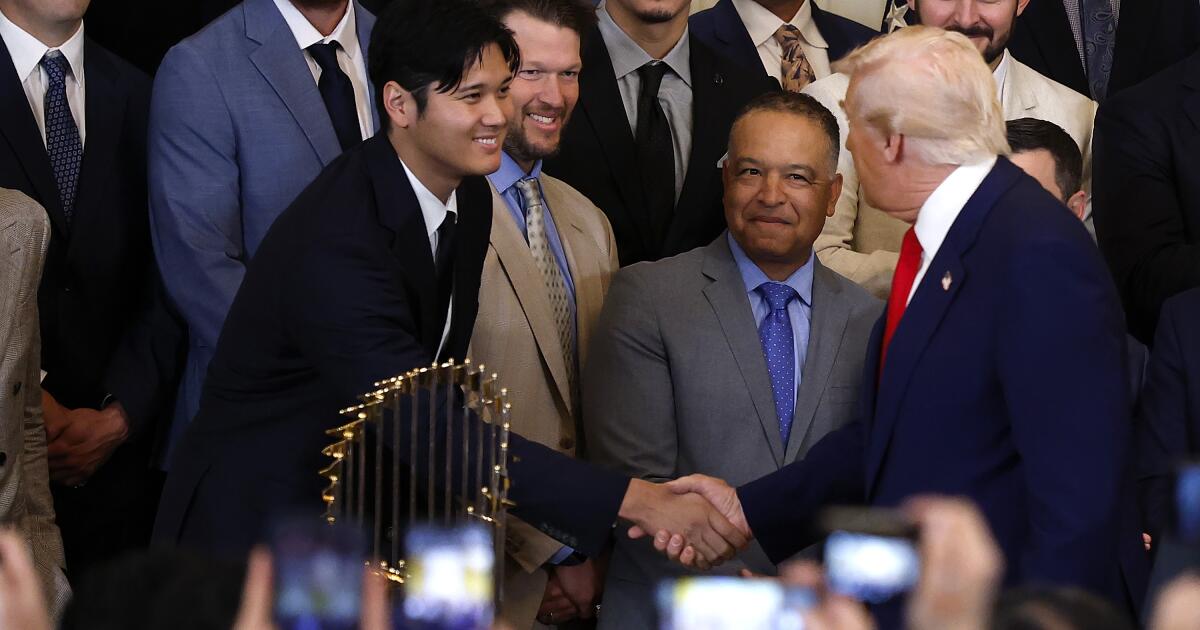
Dodgers scheduled to visit White House in late July to celebrate 2025 World Series win
-

 World18 minutes ago
Former US Olympian pleads not guilty in DC reflecting pool vandalism case
-
 News45 minutes ago
Former Olympian pleads not guilty in reflecting pool vandalism charges
-

 Los Angeles, Ca2 hours ago
Heat advisory, beach hazards in effect as Southern California sizzles
-

 Detroit, MI2 hours ago
Teen on moped hit by car after cruising through stop sign in Detroit
-

 San Francisco, CA3 hours ago
Flight of fancy: San Francisco moves to build private luxury airport terminal
-

 Dallas, TX3 hours ago
Dallas’ digital creator economy is booming. Burnout is too.

