A funny thing about this year’s best films: Half of them are adaptations. As a movie lover who’s always hunting for new talent, new ideas and new stimuli, I used to view that as creative inertia. But 2025 has changed my mind.
Now I see artists drawing inspiration from the past to show that Hollywood should trust the sturdy bones that have kept it running for over a century: good yarns, bold casting, films that don’t feel made by focus groups or doomsaying bean-counters (or, God help us, AI), but by blood and sweat.
Our picks for this year’s best in arts and entertainment.
Advertisement
From original tales to radical reworkings of classics both high-falutin’ and raucously lowbrow, these 10 filmmakers all know that the most vital part of the storytelling business has stayed exactly the same. They have to wow an audience. And they did.
1. ‘Sinners’
Michael B. Jordan as twins Smoke and Stack in the movie “Sinners.”
(Warner Bros. Pictures)
A period-piece-vampire-musical mashup could have been discordant, but writer-director Ryan Coogler confidently makes all three genres harmonize. In “Sinners,” Coogler double-casts his longtime collaborator Michael B. Jordan as twin bootleggers Smoke and Stack, then pits them against a pack of banjo-picking bloodsuckers helmed by a roguish Jack O’Connell. We’re expecting a big, bloody brouhaha and we get it. Underneath the playful carnage, however, the question at stake is: Why suffer the daily indignities of the Jim Crow-era South when you could outlive — and eat — your oppressors? “Sinners” is the most exciting film of 2025, both for what it is and for what it proves: that fresh blockbusters still exist and people are eager to gobble them up.
(“Sinners” is available on multiple platforms.)
Advertisement
2. ‘Hedda’
Tessa Thompson in the movie “Hedda.”
(Prime Video)
The stage’s iconic mean girl glides from 1890s Norway to 1950s England in this vibrant and venomous adaptation of Henrik Ibsen’s “Hedda Gabler.” Tessa Thompson stars as the restless housewife who needs to secure her milquetoast husband (Tom Bateman) a promotion and has a nasty habit of playing with guns. Keeping pace with her manipulative anti-heroine, writer-director Nia DaCosta (“Candyman”) makes a few calculated moves of her own, including gender-swapping Hedda’s ex into a curvaceous career woman (a haughty Nina Hoss) whose drab and geeky new girlfriend (Imogen Poots) irritates their hostess’ insecurities. As a capper, “Hedda” stages its brutal showdown at an all-night vodka-and-cocaine-fueled mansion shebang with a live jazz band, a lake for skinny-dippers and a hedge maze where former lovers are tempted to canoodle. The original play is over a century old, but every scene feels screamingly alive.
(“Hedda” is available on Prime Video.)
3. ‘Eddington’
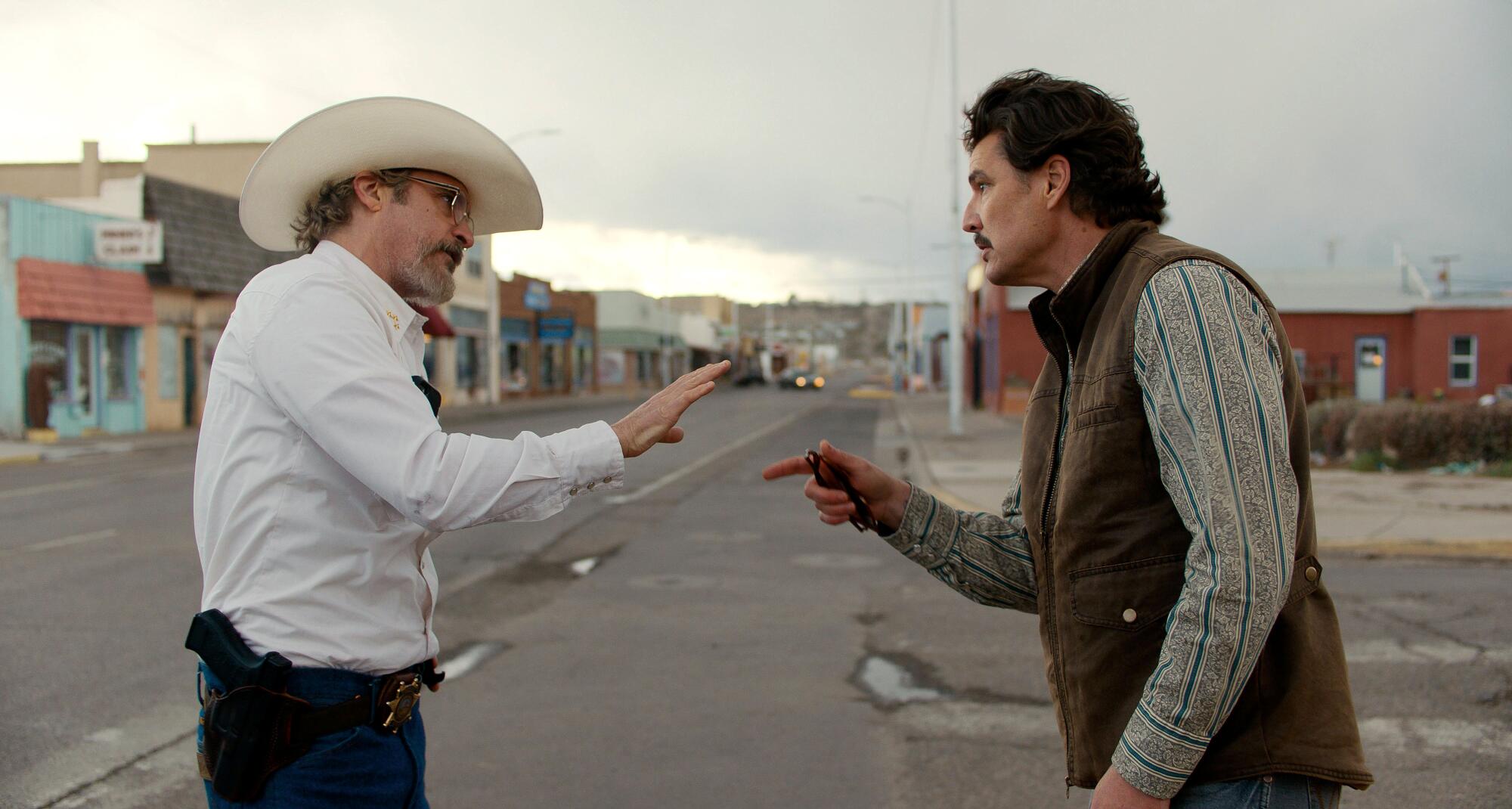
Joaquin Phoenix, left, and Pedro Pascal in “Eddington.”
(A24)
Advertisement
No film was more polarizing than Ari Aster’s COVID-set satire about a mask-hating sheriff (Joaquin Phoenix), a sanctimonious mayor (Pedro Pascal) and the high-tech cabal that benefits when these two modern cowboys come to blows. “Eddington” immortalizes the bleak humor and lingo of May 2020 (think murder hornets, Antifa and toilet paper hoarders). More stingingly, it captures the mental delirium of a small town — make that an entire planet — that hasn’t yet realized that there’s a second sickness seeping in through their smartphones. Everyone’s got a device in their hand pretty much all the time, aiming their cameras at each other like pistols in a Wild West standoff. Yet no character grasps what’s really going on. (I have a theory, but when I explain the larger conspiracy, I sound cuckoo too.) This is the movie that will explain pandemic brain to future generations. With distance, I’m pretty sure the haters will come around.
(“Eddington” is available on multiple platforms.)
4. ‘One Battle After Another’
Leonardo DiCaprio in the movie “One Battle After Another.”
(Warner Bros. Pictures)
Advertisement
Every shot in Paul Thomas Anderson’s invigorating nail-biter is a banger: sentinels skateboarding over rooftops, caged kids playing catch with a crumpled foil blanket, Teyana Taylor’s militant Perfidia Beverly Hills blasting an automatic rifle while nine months pregnant. It’s the rare film that instantly imprints itself on the viewer. On my second watch, I was shocked by how much of “One Battle After Another” already felt tattooed on my brain, down to the shudder I got from Sean Penn’s loathsome Col. Lockjaw licking his comb to tidy his bangs. Riffing from Thomas Pynchon’s “Vineland,” the central drama follows flunky anarchist Bob (Leonardo DiCaprio) fumblingly attempting to rescue his daughter (Chase Infiniti) from Lockjaw’s clutches. But he’s not much help to her, and as the title implies, this is merely one skirmish in humanity’s sprawling struggle for freedom that has, and will, drag on forever. Anderson’s knack for ensemble work stretches back as far as “Boogie Nights,” yet here, even his unnamed characters have crucial roles to play. His world-building has never before felt this holistic and inspirational.
(“One Battle After Another” is now playing in theaters.)
5. ‘Kiss of the Spider Woman’
Jennifer Lopez and Tonatiuh in the movie “Kiss of the Spider Woman.”
(Roadside Attractions)
The backstory behind this stunner couldn’t be more baroque: Director Bill Condon (“Dreamgirls”) boldly revamped a Broadway musical of an Oscar-winning drama (itself taken from an experimental novel) about two inmates in an Argentinean cell who mentally escape into the movies. Each incarnation has doubled down on the sensorial overload of what came before. If you know “Kiss of the Spider Woman’s” lineage, you’ll be impressed by how Condon ups the fantasy and stokes the revolutionary glamour with more Technicolor dance showcases for Jennifer Lopez’. (She’s doing her best Cyd Charisse, which turns out to be darned good.) If this is your first taste of the tale, give yourself over to the prickly but tender relationship between prisoners Luis and Valentin, played by feisty new talent Tonatiuh and a red-blooded Diego Luna. This is go-for-broke filmmaking with a wallop. As Luis says of his own version of “Kiss of the Spider Woman” playing in his head, “Call it kitsch, call it camp — I don’t care, I love it.”
Advertisement
(“Kiss of the Spider Woman” is available on multiple platforms.)
6. ‘A Useful Ghost’
A scene from the movie “A Useful Ghost.”
(TIFF)
Thai director Ratchapoom Boonbunchachoke’s Cannes Grand Prix winner opens with a haunted vacuum cleaner. From there, it gets even more surprising. Ghosts have infested a wealthy widow’s factory and are possessing appliances, seducing her son and cozying up to the prime minister for favors. Some of these people have died by accident, some by corporate neglect or worse. This droll spook show bleeds into romance and politics and, to our shock, becomes genuinely emotional. (It helps to remember that the military killed over 80 Bangkok protestors in 2010.) But why vacuum cleaners, you ask? The conceit is more than a sticky idea. Ordinary people can get crushed but the anger they leave behind lingers like fine dust.
(“A Useful Ghost” opens Jan. 16, 2026, in theaters.)
Advertisement
7. ‘The Roses’
Olivia Colman and Benedict Cumberbatch in the movie “The Roses.”
(Jaap Buitendijk / Searchlight Pictures)
Technically, “The Roses” is rooted in the 1980s hit novel and subsequent blockbuster “The War of the Roses,” which starred Michael Douglas and Kathleen Turner as an estranged couple who attack each other with lawyers, poison and chandeliers. In spirit, however, this redo is pure 1930s screwball comedy. Leads Benedict Cumberbatch and Olivia Colman are skilled verbal ninjas who hurl razor-sharp insults at each other’s egos, and although their characters’ divorce happens in California, director Jay Roach lets the actors keep their snippy British accents. The script by two-time Oscar nominee Tony McNamara (“The Favourite,” “Poor Things”) adds a cruel twist to the original: This time around, the marrieds truly do try their damnedest to love and support each other. And still, their walls come tumbling down.
(“The Roses” is available on multiple platforms.)
8. ‘In Whose Name?’
Ye and Elon Musk in the documentary “In Whose Name?”
(AMSI Entertainment)
Advertisement
Nico Ballesteros was a high schooler with an iPhone when he entered Kanye West’s orbit in 2018. Over the next six years, the Orange County kid shot over 3,000 hours of footage as Ye (as the artist legally became known in 2021) jetted from Paris to Uganda, Calabasas to the White House, meeting everyone from Kenny G to Elon Musk on a quest to fulfill his creative and spiritual goals while incinerating his personal life and public reputation. Ye gave the documentarian full access with no editorial oversight, besides one moment in which he tells the camera that he wants the film to be about mental health. This riveting tragedy definitely is. We see an egomaniac whose fear of being beholden to anything motivates him to go off his meds, a billionaire provocateur who believes he can afford the consequences of his bigotry and, above all, a deeply flawed man who nukes his entire world to insist he’s right.
(“In Whose Name?” is available on multiple platforms.)
9. ‘Sirāt’
An image from the movie “Sirāt,” directed by Oliver Laxe.
(Festival de Cannes)
Advertisement
The techno soundtrack of Oliver Laxe’s desolate road thriller has rattled my house for months. Lately, I’ve spent just as much time contemplating the movie’s silence — those hushed stretches in which this caravan of bohemians speeds across the Moroccan desert looking like the only free people left on Earth. A father, Luis (“Pan’s Labyrinth’s” Sergi López), and his 12-year-old son team up with this band of tattooed burnouts in the hope of finding the boy’s runaway sister. Before long, Luis is just hoping to make it to safety, assuming anywhere safe still exists. Static on the radio warns that World War III might be underway. These outsiders click off the news and crank up the music. The paradox of “Sirāt” is that I’m dying to talk about it more but I’ve got to keep my mouth shut until people experience its dramatic twists for themselves.
(“Sirāt” returns to theaters on Feb. 6, 2026.)
10. ‘The Naked Gun’
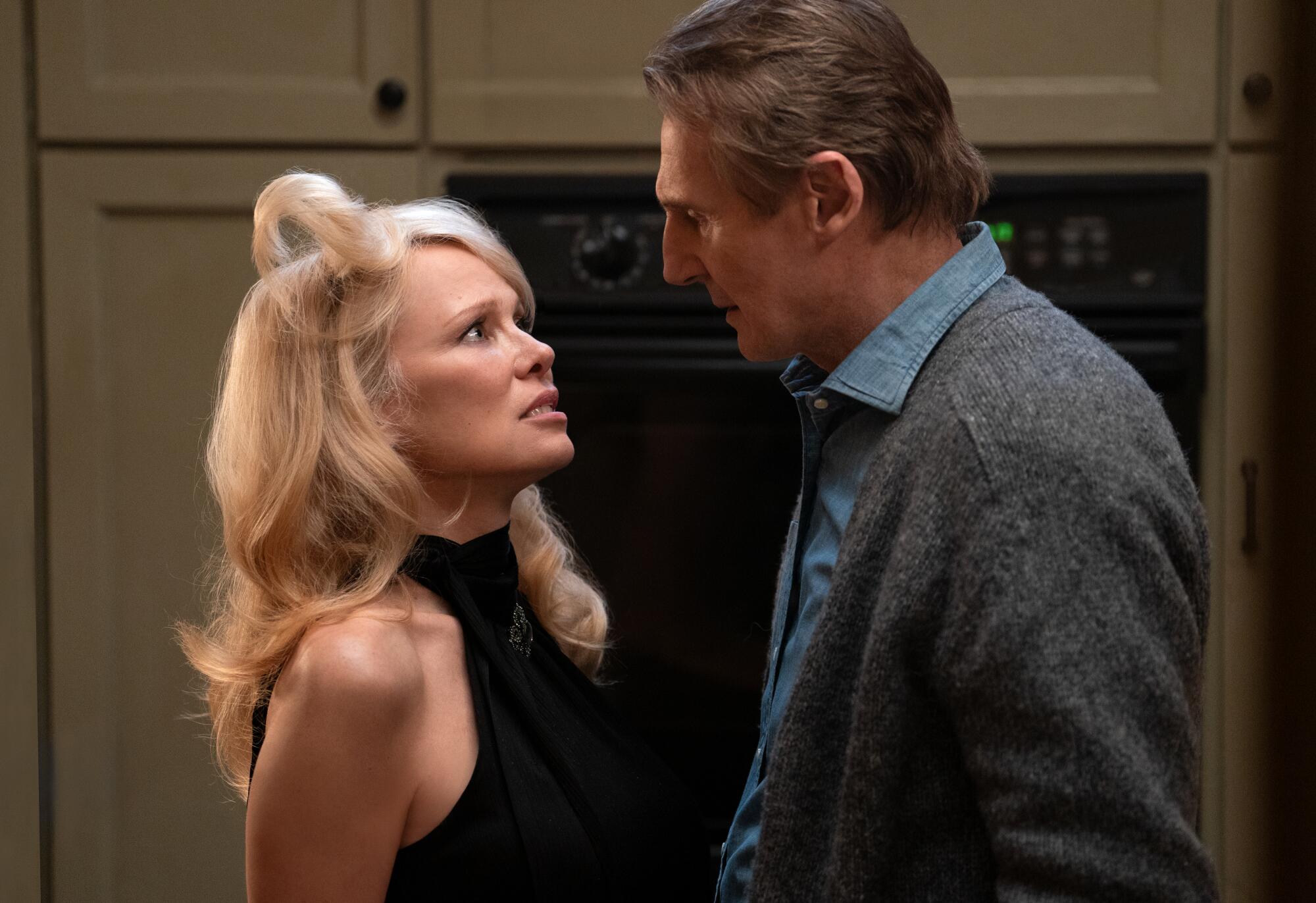
Pamela Anderson and Liam Neeson in the movie “The Naked Gun.”
(Frank Masi / Paramount Pictures)
Liam Neeson needed this pummeling pun-fest. So did everyone else in 2025. Director Akiva Schaffer’s continuation of the “Police Squad!” franchise let the 73-year-old “Taken” star poke fun at his own bruising gravitas. Playing the son of Leslie Nielsen’s Lt. Frank Drebin, Neeson kept us in hysterics with a stupid-brilliant barrage of surreal wordplay and daffy slapstick. The casting was as odd — and perfect — as rumors that he and his co-star Pamela Anderson started dating on set. This fourth sequel didn’t try to outsmart the classic Zucker, Abrahams and Zucker template. It simply told the same old story: Cop meets babe, cop and babe canoodle with a magical snowman, cop drops his trousers on live TV, this time minus the blimp. Goodyear? No, the worst — which made Neeson our hero.
Advertisement
(“The Naked Gun” is available on multiple platforms.)
Since I’m all jazzed-up about great movies, here are 10 honorable mentions very much worth a watch.
“The Ballad of Wallis Island” A kooky millionaire strong-arms his favorite mid-aughts folk duo into playing a reunion show on his Welsh island. Sounds cutesy, but it’s the movie I recommended most — to everyone from my mailman to my mother. They all loved it. Join the fan club.
“Bunny” This East Village indie by debut director Ben Jacobson is a scummy gem. A gigolo’s birthday goes very wrong. But all the characters racing up and down the stairs of his uber-New York walk-up hovel are a howl.
“If I Had Legs I’d Kick You” Rose Byrne excels equally at comedy and drama. This audit of a breakdown smashes both together and cranks the tension up to eleven. Playing a high-stress working mom of an ill child, her try-hard heroine leans in so harrowingly far, she goes kamikaze.
Advertisement
“Lurker” Today’s celebrity might be viral on Instagram and unknown everywhere else. Alex Russell’s stomach-churning psychodrama stars Archie Madekwe as an L.A.-based singer on the brink of genuine fame and Théodore Pellerin as the hanger-on who endures — and exploits — the fledgling star’s power moves and hazy boundaries.
“Magic Farm” Filmmaker Amalia Ulman’s rascally farce stars Chloë Sevigny and Alex Wolff as clickbait journalists who fly to Argentina to shoot a viral video about a singer in a bunny costume and wind up looking twice as ridiculous.
Keke Palmer, left, and SZA in the movie “One of Them Days.”
(Anne Marie Fox / Sony Pictures)
“One of Them Days” Keke Palmer and SZA play broke Baldwin Hills roommates who have nine hours to make rent. I’d happily watch their stoner hijinks in real time.
Advertisement
“The Perfect Neighbor” Pieced together primarily from police body-camera footage, Geeta Gandbhir’s documentary unfurls in a Florida cul-de-sac where a community — adults, kids and cops — agrees that one woman is an entitled pill. The problem is she thinks they’re the problem. And she has a gun.
“Sisu: Road to Revenge” If Buster Keaton were alive, he’d hail this grisly, mostly mute Finnish action flick as a worthy successor to “The General.” It even boasts a thrilling sequence on a train, although director Jalmari Helander also brazenly poaches from “Die Hard” and “Mad Max: Fury Road.”
“Train Dreams” Trees fall in the woods and a 20th-century logger (Joel Edgerton) plays an unheard, unthanked but beautiful role in the building of America.
“Wake Up Dead Man: A Knives Out Mystery” Detective Benoit Blanc (Daniel Craig) teams up with a soul-searching priest (Josh O’Connor) to solve a perplexing church stabbing. From deft plot twists to provocative Catholic theology, Rian Johnson’s crowd-pleasing murder mystery is marvelously executed.
A family and friends gather for a naming-day ceremony at a Danish seaside hotel, but an unexpected appearance by one uninvited attendee (Trine Dyrholm) ruptures the veil of bland, happy-clappy familial unity in director Mads Mengel’s gutsy, well-wrought debut feature, The Guest.
The most audacious move here may be Mengel and co-screenwriter Christian Bengtson’s choice to write something that will inevitably invite comparisons with Festen (The Celebration), arguably the most notorious Danish-language film of the last 30 years, which similarly revolved around a bougie gathering disrupted by angry revelations. But there’s a savvy 2026 vibe about the way the film refuses to create florid melodrama out of quotidian crisis, and instead observes with generosity as the characters grope awkwardly toward emotional détente and mutual forgiveness.
The Guest
The Bottom Line
When wetting the baby’s head goes too far.
Advertisement
Venue: Karlovy Vary Film Festival Cast: Simon Bennebjerg, Trine Dyrholm, Josephine Park, Peter Gantzler, Petrine Agger, Mette Klakstein Wiberg, Kristine Kujath Thorp, Buster Lund Luscher Director: Mads Mengel Screenwriter: Christian Bengtson, Mads Mengel
1 hour 40 minutes
Festen-alumnus Dyrholm, having a bit of a career moment with outstanding performances both here and in the recent The Girl With the Needle among others, leads a uniformly excellent cast in a work that deserves celebration on the festival circuit and beyond.
Dyrholm’s Vibeke is technically the first person we meet, although she’s seen only in shadow at first as she smokes and drives while her unattached seatbelt, caught outside by a closed door, clatters on the road. This is the kind of unsafe driving her son Karl (Simon Bennebjerg) so deplores, a point of contention later on in the story when he will steal her car keys in interest of her own safety and that of others.
Advertisement
But well before we get to that flashpoint, the film introduces Karl, effectively the film’s protagonist, as he arrives at the swanky resort with his wife Emilie (Mette Klakstein Wiberg) and their infant son Elliot (Buster Lund Luscher). The young family, who’ve chosen this new, secular tradition instead of a christening to welcome their child to the world, are there a day before the ceremony to meet up with core family members.
As this advance party settles down for dinner, a table that includes Karl’s sister Rikke (Josephine Park) and Emilie’s parents Frank (Peter Gantzler) and Kirsten (Petrine Agger), there’s a surprise: Vibeke is coming, courtesy of Rikke’s invitation. Karl is quietly furious and seems determined to turn her away, even when she shows up minutes later. Poor Frank and Kirsten look on confused, determinedly polite in their insistence that all family members should be welcome.
Bengtson and Mengel’s economical script carefully dripfeeds backstory as the film unfolds to explain that Karl hasn’t spoken to his mother in years, that Rikke has taken over all the daily mom management and that she’s very worn out by it. Even so, she insists Vibeke is regularly taking her medication and isn’t a problem these days, although to Karl every weird anecdote and moment of emotional intensity is an augur of impending chaos. Rikke counters that their mother is just “big, that’s her personality not her condition.”
Interestingly, that specific condition is never named throughout, although armchair diagnosticians might spot many of the signs of bipolar disorder. But the film’s emotional focus on the person and her actions rather than the label is also very contemporary, reflecting a more holistic, inclusive mindset and approach to dealing with mental health issues.
Which is all fine and dandy, until Vibeke duly does skip a dosage and starts getting manic. One of the first signs of chemical imbalance arrives during the ceremony on the beach, when Vibeke carries little Elliot much further away from the shore than anyone wants, creating a panic. From there it just gets worse as Vibeke picks up on the censorious feeling emerging from the other party guests, who had found her so charming the night before when she’d led everyone to the casino to play roulette and diverted a bunch of partying teenagers from the room next to Karl and Emilie so they could get some sleep. When the toasts at the formal dinner begin, Vibeke’s mood darkens much further, and if we’ve all learned one thing from Festen, it’s be very afraid when a Dane gets up to make a toast.
Advertisement
Cinematographer David Bauer’s nimble-footed lensing and use of natural light does indeed hark back considerably to the look of those Dogme 95 movies back in the day, as does the naturalistic editing style deployed by Louis Emil Ramm Seeberg. But there are plenty of sins against the rules of cinematic chastity that marked that movement, such as the ample space made for Lasse Aagaard’s affecting, low-key score that amps up the anxiety as Vibeke starts to spiral.
That said, Mengel keeps things simple in sonic terms when it really counts, letting the musicality of Dyrholm’s deep, sonorous voice ring out on its own in the big monologue scenes. She is, as ever, utterly mesmerizing but the performance is made even more powerful by the muted, expressive reactions of the rest of the cast as they look on, frozen like deer in the headlights of the car crash of pseudo-christening. Moments of levity puncture the gloom, but the final feeling is one of numbed sorrow and pity for all these kind, fallible people, just trying to do their best.
Rhea Seehorn was nervous about whether “Pluribus” would be recognized by Emmy voters Wednesday when nominations were announced. So she was jubilant when she and the surreal sci-series on Apple TV scored 18 nominations, the most for a first-year drama.
“I’m just so grateful,” the actor said in a phone interview. “People were like, ‘Why were you nervous?’ Honestly, you never actually know. I’m just so thrilled for the show, my co-stars, the production design, the editing, the writing, the music, the sound. I haven’t moved from my couch since they first announced everything because I’m still trying to call everybody on the show.”
Seehorn received a nomination for lead actress in a drama series for her portrayal of cynical Carol Sturka, a fantasy romance author who finds herself in a mystifying situation after a virus seems to have wiped out most of Earth’s population. The series was created by Vince Gilligan, who created the acclaimed series “Breaking Bad” and co-created its spinoff “Better Call Saul,” which also featured Seehorn.
The actor compared her experience of being nominated for “Pluribus” to “Better Call Saul,” which earned her two supporting actress nominations: “ ‘Better Call Saul’ was such a family that supported and cheered each other on, and I’m so grateful I have that environment again. People could not be happier for each other, and we get to celebrate the show together.”
She added, “The only part that feels different is that it’s my first nomination as a lead. It’s the process of Vince writing this for me and seeing the mountain which he wanted me to climb and going through that process. The whole thing has been its own journey, so ending up with awards and nominations, and being so well received by critics and fans is not lost on me.”
Advertisement
The series has been applauded for its mix of drama, comedy and strangeness in its portrait of a woman coming to terms to what seems like an impossible dilemma.
“I love the storytelling, how much Vince and I would drill down on making this as authentic as we could in terms of an everyman who has to deal with an insane situation,” Seehorn said. “Most of us are just not heroic or leaping off the couch to go save the world. And Carol is dealing with immense grief and confusion in an utter dystopian crisis. I love the humor and the drama that comes out of us being as realistic as we can with her amidst an unrealistic event.”
Fans of “Pluribus” have been relentlessly curious since the finale in December about when the second season will launch.
“I don’t know anything about that,” Seehorn said. “I don’t have to keep secrets because I’m not great at keeping them, and I know nothing. I don’t know what I’m doing with an atom bomb in the driveway. I can’t wait to find out. The writers want to have the same quality and reward the intelligence of the fans and never phone a single thing in. So their process is their process.”
In a roundabout way, the fact that I don’t have a strong attachment to The Wizard of Oz as a film (my late mother loved it, so that memory is deeply rooted in me, but the movie itself never did much for me) contributed directly to how amusing I found Gail Daughtry and the Celebrity Sex Pass to be. This comedy spoofs the plot of the classic fantasy movie, though the jokes are largely about Hollywood. The humor is big and broad, with some of the jokes really landing. Others? Not so much. Still, more than enough do to warrant a recommendation.
Gail Daughtry and the Celebrity Sex Pass gets a lot of mileage out of sending up show business, even if the observations, while funny, are not particularly new. Besides the deluge of jokes, there’s also a lot of likably broad characters to spend time with, especially our lead. They make the 90 minutes and change spent together with them go down very easy.
Sony Pictures Classics
For Gail Daughtry (Zoey Deutch), her life as a small town hairdresser is perfect. Engaged to her high school sweetheart Tom (Michael Cassidy), she’s the picture of happiness, at least until a trip to a celebrity book signing. There, Tom meets and ends up sleeping with his “celebrity pass,” a term Gail wasn’t even really previously aware of. Feeling betrayed, Gail impulsively joins her co-worker and friend Otto (Miles Gutierrez-Riley) on a trip to Los Angeles. There, a psychic convinces her that the can save her marriage by sleeping with her own celebrity pass: Jon Hamm (Jon Hamm).
Journeying through Tinseltown in a manner that recalls Dorothy’s adventure in Oz, Gail and Otto won’t have to find Hamm alone. Joining forces with talent agency assistant Caleb (Ben Wang), down on his luck paparazzo Vincent (Ken Marino), and actor John Slattery (John Slattery). As they search for Hamm, some for their own purposes, they meet other celebrities, while also being hunted by a group of Italian assassins after a case of mistaken identity. Eventually, they come across Hamm, and the moment of truth is at hand.
Sony Pictures Classics
Zoey Deutch dives headfirst into a broad comedy like this, absolutely relishing the opportunity to get silly again. She’s able to make Gail a babe in the woods but also someone you laugh with, not at. It’s a wildly enjoyable turn. Deutch started out in comedies and was always a talented comedic actress, so it’s a pleasure to watch her back at it. Miles Gutierrez-Riley and Ben Wang get some very funny moments, while Ken Marino is a reliable comic presence. Jon Hamm and John Slattery are delighted to be sending up themselves, with amusing results. Supporting players here, in addition to Michael Cassidy, also include Kerri Kenney, Richard Kind, Thomas Lennon, Joe Lo Truglio, Fred Melamed, and more, plus some cameos.
Advertisement
Filmmaker David Wain, again co-writing with Ken Marino, continues to make it look easy. Few can make a silly comedy like Marino and Wain, especially as they pack their flicks with extra bits that only subsequent viewings reveal. Is Gail Daughtry and the Celebrity Sex Pass on the same level as Wet Hot American Summer or They Came Together? No, not quite. At the same time, is this, scattershot approach and all, funnier than most other 2026 releases? You bet. Marino and Wain have a hit rate that allows some of the jokes to miss, as you only have seconds to wait before the next one, which probably will hit.
Gail Daughtry and the Celebrity Sex Pass is very amusing, and occasionally hilarious, even if not as many jokes land as you might expect. Zoey Deutch is great in the lead role, David Wain is in his comfort zone, and the laughs come hot and heavy. If you’re a Wain fan, this new movie should be a must see.










 Sony Pictures Classics
 Sony Pictures Classics