Entertainment
Review: Queer Black women shine at timely museum shows by Mickalene Thomas and Simone Leigh

Last week two solo exhibitions bearing voluminous — and timely — insight arrived at Los Angeles museums. Each is a mid-career survey of feminist painting, sculpture and video from the past 20 years, representing two very different artists for whom women’s place in the world is key.
“Mickalene Thomas: All About Love” is a vibrant show of more than 80 paintings, drawings and mixed-media installations downtown at the Broad. Her work builds on a simple but trenchant observation: In the long history of Western painting, monumental portraits of Black women are almost nonexistent. Most of Thomas’ paintings pile on vivid color, brash patterning and lots of sparkling rhinestones, taking an exultant step toward rectifying the omission.
“Simone Leigh,” which is divided between the California African American Museum in Exposition Park and the Los Angeles County Museum of Art in Mid-Wilshire, features 27 sculptures and three projections. Sober history is essential to Leigh’s often elegant work, which gives equal weight to the two adjectives joined in the term “African American.” Women’s images are abundant, and multiple artistic traditions gracefully entwine.
The fact that both artists are Black adds to the timely relevance. During the Jan. 6 domestic terrorist attack on Capitol Hill, a few Black faces were glimpsed amid the scandalously waved Confederate, Gadsden and “Appeal to Heaven” flags, but it is worth emphasizing that the number of those faces that belonged to women was roughly zero. Today, in a nation exhausted by dealing with the tenacity of systemic racism and riven with conflicts over straight white Christian male supremacy, Black women sometimes seem to be the linchpin barely holding things together.
Journalist Marianne Schnall, founder of the influential website feminist.com, once aptly noted that “Black women are by no means a monolith, and yet as a group have a deep understanding of the relational nature of freedom, precisely because they sit at various intersections of targeted oppression.” Add queer identity to the mix, and the comprehension deepens further.
Simone Leigh, “Cupboard,” 2022; stoneware, raffia and steel armature
(Christopher Knight/Los Angeles Times)
Thomas’ show was co-organized by Broad curator Ed Schad and Rachel Thomas of London’s Hayward Gallery, where it travels next year. (Stops are also planned for the Barnes Foundation in Philadelphia and Les Abattoirs in Toulouse, France.) The Los Angeles debut opens with an elaborate stage set that replicates façades of tidy row houses in Camden, N.J., just across the river from Philly, where the artist was born in 1971. More than a mere conceit, the theatrical façades establish domestic settings as integral to Thomas’ aesthetic. On doorsteps, welcome mats are laid out.
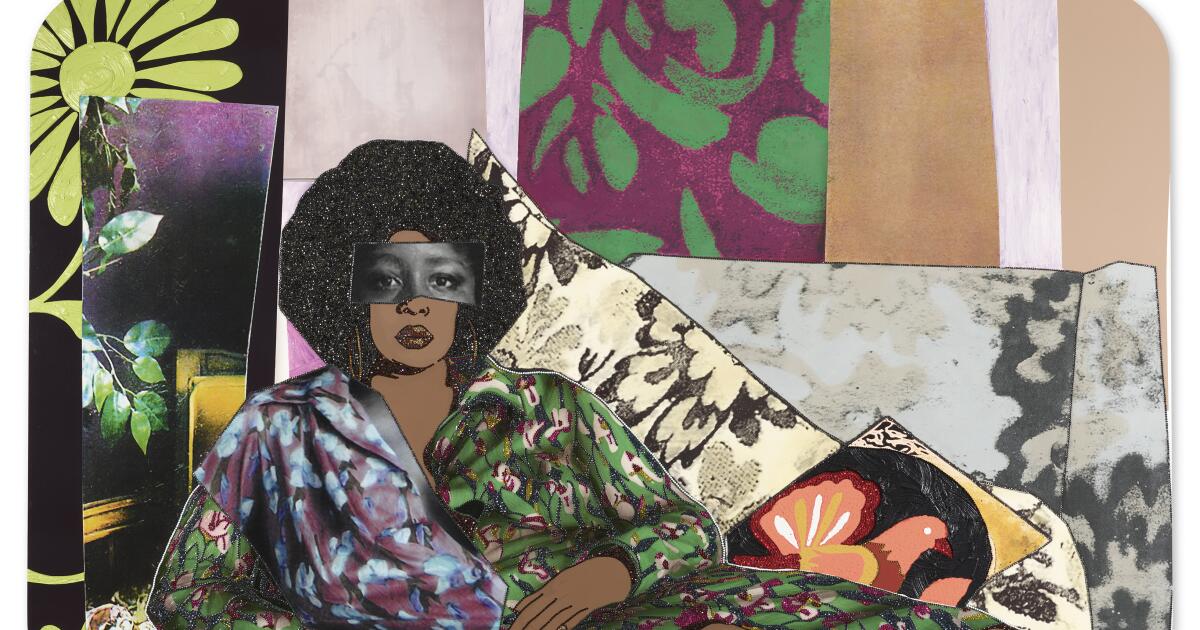
Living rooms, rec rooms and finished basements turn up as installation formats throughout the show, while the compositions in her monumental portraits tightly collage figure and ground. The self-portrait in “Afro Goddess Looking Forward” is typical: Black-and-white photographs of Thomas’ eyes, some tabletop greenery and a portion of her torso mix with abundant painted features. The entirety of the figure is part of a dynamic patchwork that incorporates furniture, pillows, wallpaper and other accoutrements of a homey interior. Thomas presents as a Gen X Matisse.
Visually, there’s no separating the artist from her domestic environment, even in the imagination, so dazzlingly exuberant are the two fabrications. The strategy is repeatedly employed in paintings of friends, lovers and family, where figures merge with ground. The union comes across not as a limiting confinement but as a refuge — a contained space of at times boisterous play in which creative exploration unfolds.
Queer artists often regard the private home as a safe place for resourceful invention, given a public realm that puts forward scant models for living a life, not to mention offering abundant danger for doing so. Thomas is no exception. In one room lined with faux-wood paneling and cherry-red ottomans, she even shows herself in each painting twice, dressed in form-fitting animal-print tights and happily engaged in wrestling matches with herself. In another, an elaborate video montage of the brilliant and outspoken singer Eartha Kitt can be viewed from comfortably upholstered furniture in a convivial living room.
Then there’s her trademark use of craft-store rhinestones, which is multipurpose. Hair, body contours and facial features are often lined with the glittery paste, sometimes multicolored. The pictures’ flatly painted skin and two-dimensional patterning in textiles and wallpaper are set into shimmering visual motion. The paintings become performers, like entertainers on TV or the stage.
Forget Hobby Lobby. This sparkly craft-store aesthetic perform a vernacular consecration of the women she paints (and she paints only women). Rather than tacky, the rhinestones are beguiling. They make you smile.
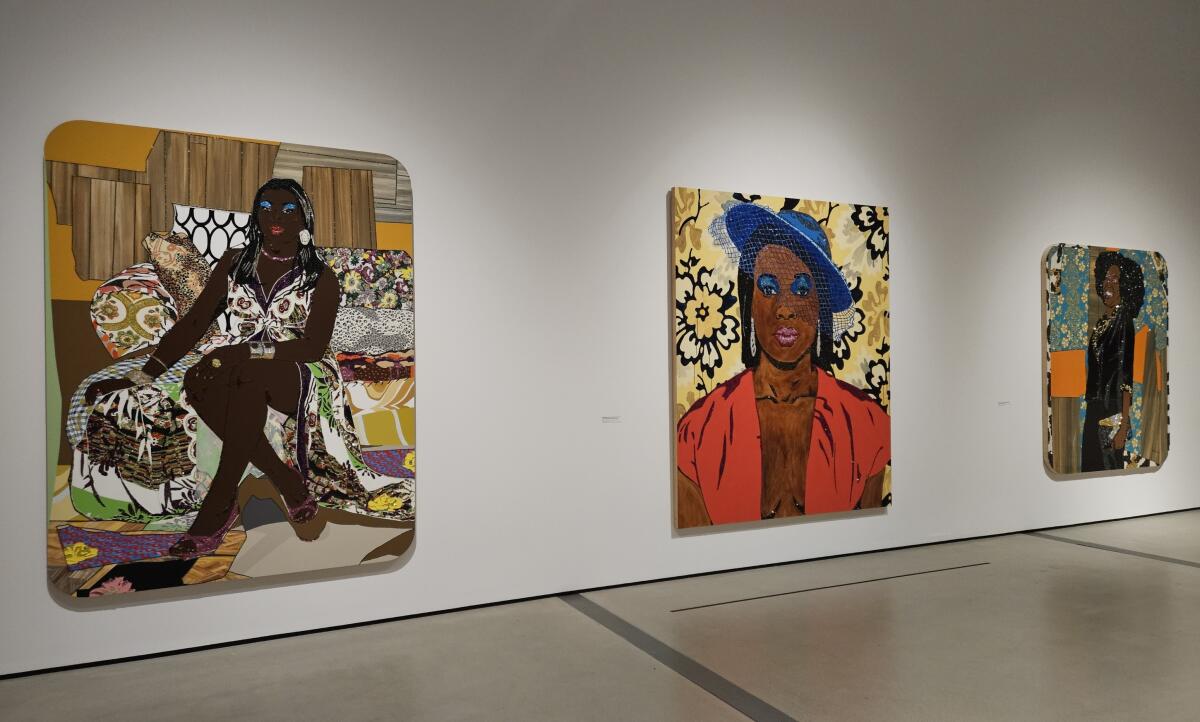
Mickalene Thomas embeds her portraits of Black women in decoarative interiors
(Christopher Knight/Los Angeles Times)
Elsewhere, Thomas incorporates queer predecessors in paintings of abstract heads. A borrowed Andy Warhol “Flower” becomes an eyepatch, while topsy-turvy eyeballs, pushed to the margins of a face, recall Jasper Johns’ borrowing of similar elements from Picasso’s “Woman in a Straw Hat.” Thomas is identifying family.
Sometimes the pictorial setting is layered into the exhibition’s physical installation. One gallery filled with potted plastic plants features collage-style paintings of pin-up nudes from Jet magazine. Thomas has installed several of them on a wall dominated by a photo-enlargement of a pointedly empty closet. Jet cheesecake photos were surely made with male subscribers in mind, but she identifies lesbian desire as a vital element within the magazine’s audience. Black diversity is real.
Over at CAAM and LACMA, “Simone Leigh” is a traveling exhibition organized by the Institute of Contemporary Art / Boston, where it was seen last year. Included are several sculptures shown in the American Pavilion at the 2022 Venice Biennale, where Leigh, now 56, represented the United States. As at the Broad, male figures are nowhere to be seen.
Leigh has said that her work represents a “creolization” of art, mixing prominent European and Black traditions. Some of what is implied by the term is evident in the remarkable “Martinique.”
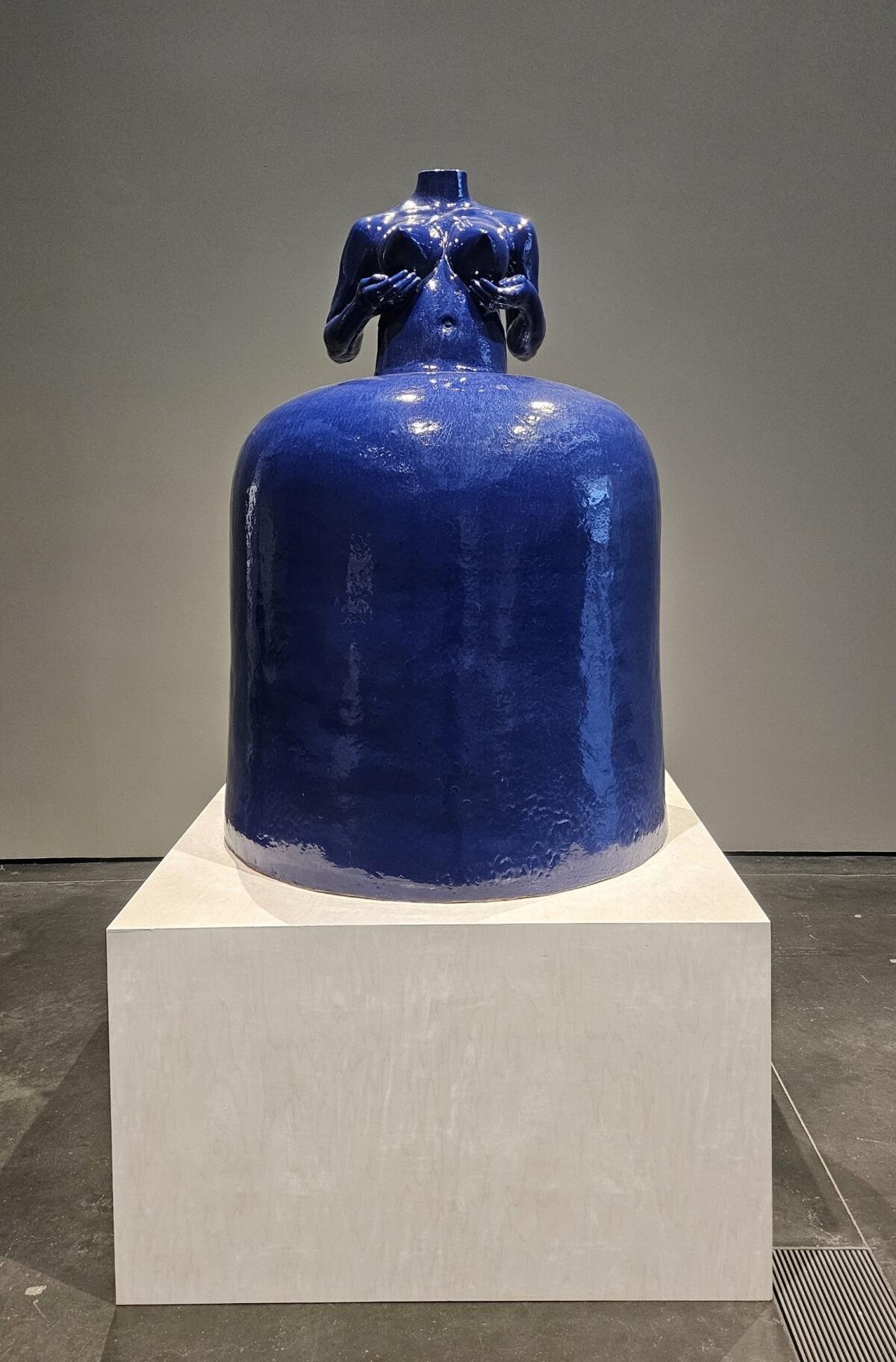
Simone Leigh, “Martinique,” 2022; stoneware
(Christopher Knight/Los Angeles Times)
Five feet tall, the cobalt blue stoneware figure of a lifesize headless women in a voluminous, bell-shaped skirt shows her cupping aggressive, bullet-like breasts in her hands. Titled for the island of Martinique, a former French colony in the Caribbean that legend held was once occupied solely by women, Leigh’s 2022 sculpture derives from a mid-19th century monument in the capitol, toppled during Black Lives Matter protests two years earlier.
The destroyed monument was a marble figure by French Salon artist Gabriel Vital Dubray that celebrated Martinique native Joséphine Bonaparte, first wife of Emperor Napoleon, who was instrumental in reviving slavery on the island despite its abolition in France. Dubray’s mediocre statue had already been beheaded three decades ago — a symbolic decapitation that couldn’t help but recall Marie-Antoinette’s actual fate at the guillotine. The sculpture stood headless in a public park until July 2020.
Think of Leigh’s subsequent sculpture as a monument to its headless-ness — at once a mockery of Joséphine’s thoughtless ignorance and a captivating salutation to the actual power of symbolic resistance. The volumetric, jug-like form of “Martinique” emphasizes clay’s eternal role as a vessel, which the artist fills with new meanings by virtue of her chosen forms and referents.
Clay is the medium most often encountered in Leigh’s art, whether in glazed form or as the raw material for works then cast in bronze. Shiny stoneware sphinxes in modulated natural hues, an 11-foot mound of raffia crowned by the feminine symbol of a cowrie shell, a suspended cluster of several dozen breast-shaped terracotta gourds with golden nipples and pierced by metal antennas — sculpture’s most ancient substance is typically made sleek and modern in her hands.
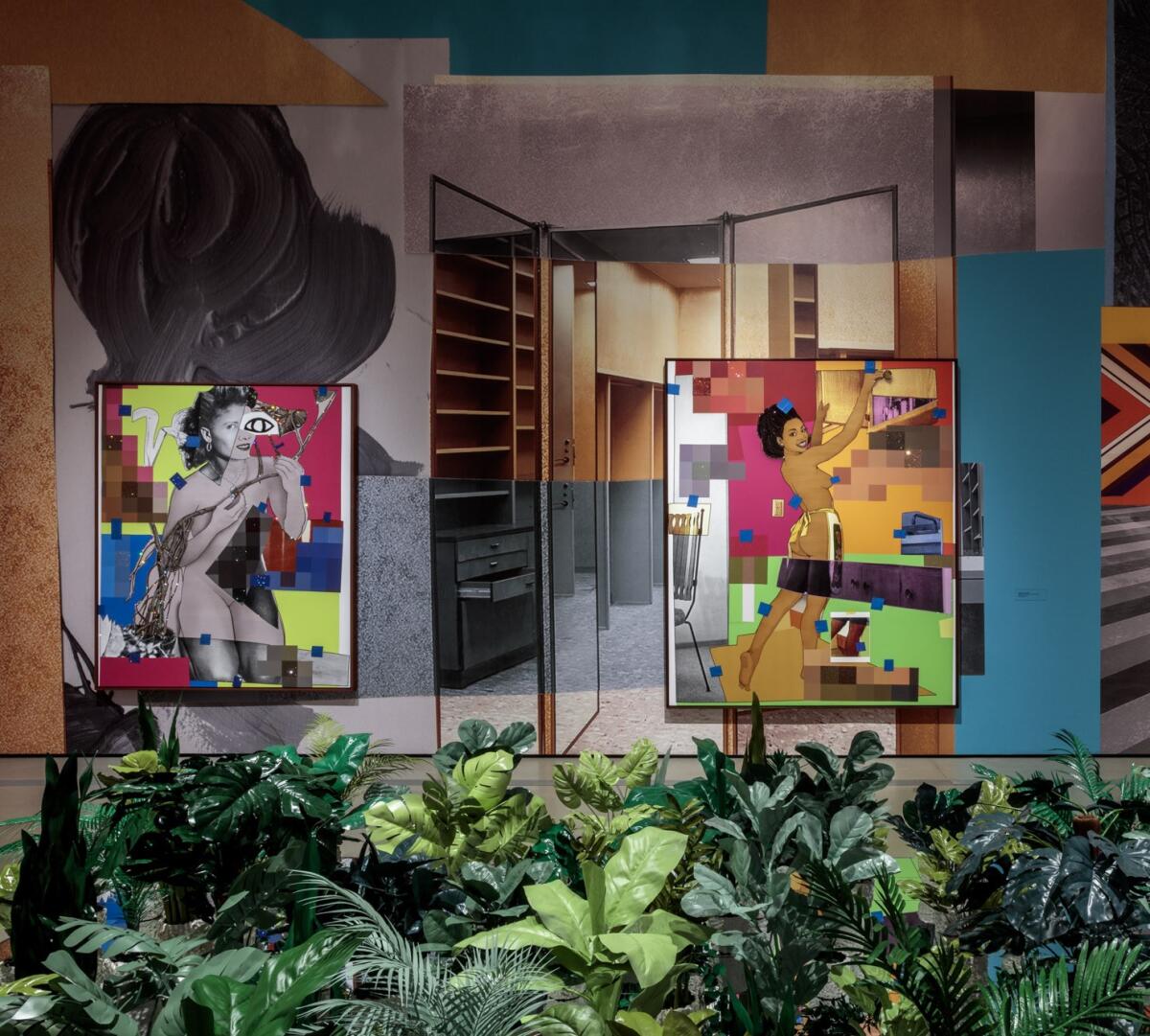
Mickalene Thomas installed pin-up paintings on a photo blow-up of an empty closet
(Joshua White)
Much of the work is a hybrid of female and architectonic forms — literally, woman as shelter.
“Herm” remakes an ancient Greek boundary marker or signpost, historically composed of a squared stone pillar with a carved male head on top. Leigh’s version employs a cruciform bust of a woman instead. A simple vertical slit is in front where a Greek phallus would protrude, and a shapely striding leg extends from the rear, together feminizing the bronze. Her signpost sculpture stands more than eight feet tall. Amazonian in scale, it insists that a viewer look up to the boundary it marks.
A bronze “Sentinel,” its surface featuring a rich black patina, transforms a traditional sphinx motif. A horizontal, corrugated body (think of the shape as a sheltering Quonset hut or nourishing grain shed) is topped at one end by a female head, its Afro hairstyle smoothed into a turban form. Incongruously, this watchful guardian’s face has no eyes, a motif common to all but one sculpture in the exhibition. The internalized, inward-looking result merges with a blank screen, onto which viewers project their own perceptions. Leigh’s best work generates a sense of intimate connection, even when its size approaches monumental.
One moving work is a wall-size, single-channel video projection of a recumbent Black torso, seen from behind, the head obscured beneath a stony pile of gray rubble. Made in tandem with Brooklyn-based artist Chitra Ganesh — when they work together, the duo goes by the name Girl — it turns the European tradition of a reclining female nude inside-out, making the gender ambiguous and burying the figure’s gaze. (A wistful musical soundtrack, all wind instruments and drums, was composed by Kaoru Watanabe.) Look closely, and the mountainous image, seemingly static, is gently breathing. Whether the barely rising and falling ribcage represents restorative sleep or a dying breath is hard to say.
In both parts of the show, a bothersome hunt is required of visitors to find object labels too discreetly printed in black typeface against dark brown walls (a phone flashlight comes in handy). The only real downside, though, is the bifurcation between two venues located across town from each other. The split diminishes the retrospective punch.
The more satisfying presentation is at CAAM, where the 13 works span two decades, allowing for some sense of artistic evolution and reverberation. At LACMA, all but four of the 17 pieces date from just the past two years; the installation is lovely, but it’s more like a contemporary gallery show than a museum survey.
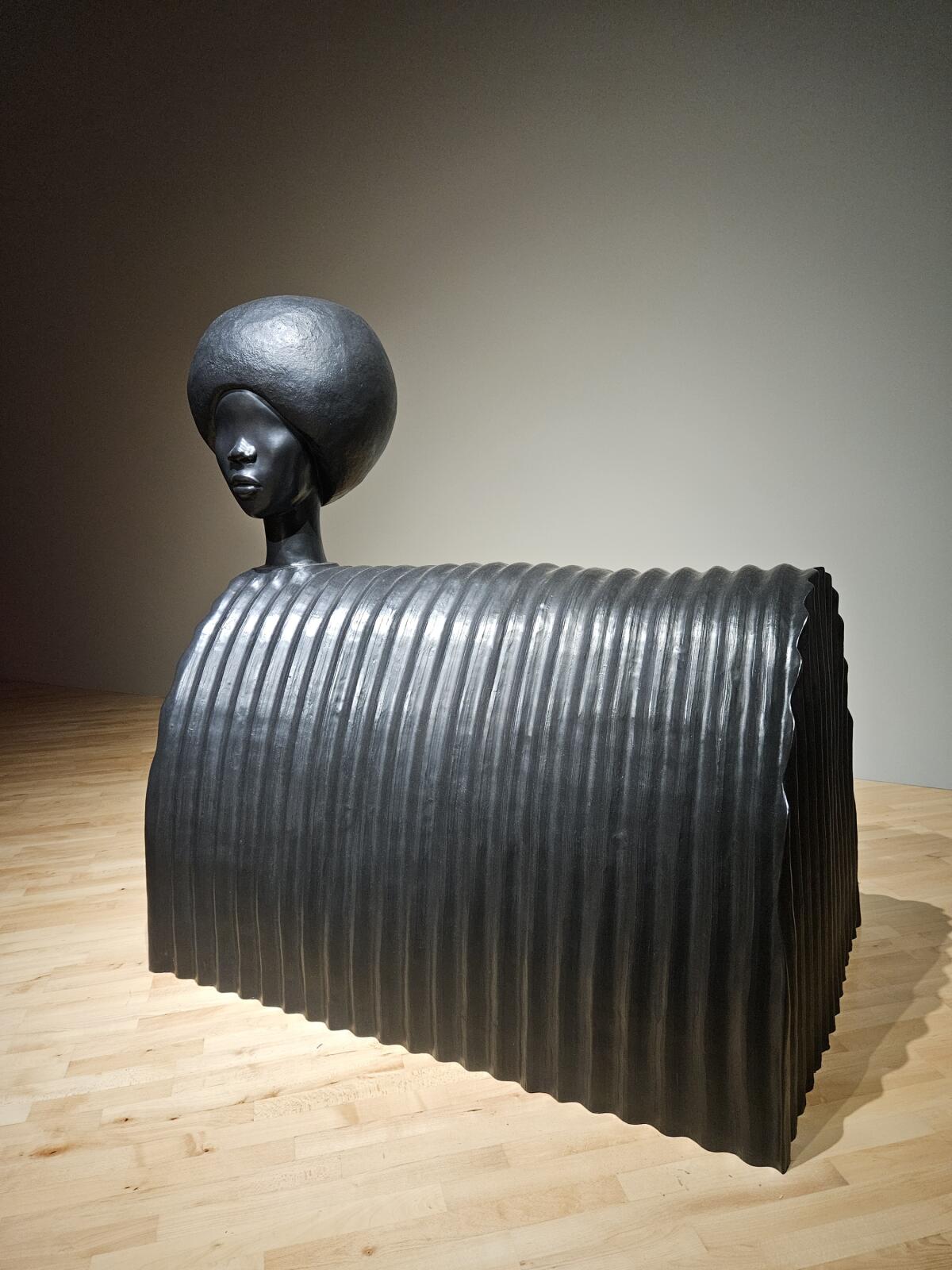
Simone Leigh, “Sentinel,” 2019; bronze
(Christopher Knight/Los Angeles Times)
The prominence of the exhibitions by Thomas and Leigh — highly accomplished, queer Black women — is crucial, however, especially as June’s Pride celebrations commence. At least 515 anti-LGBTQ bills, a record number, are pending in state legislatures across the country, representing an unspeakable mass of public hate. Misogyny, a core driver of homophobia, is deeply embedded in American life.
It has been since at least 1692. That was the year Bridget Bishop was ascertained to be a witch by frightened, conformist Puritan religious elders in the Province of Massachusetts Bay. Bishop, a thrice-married mother of four, was hauled away and lynched on Gallows Hill in Salem Village after a bizarre eight-day trial.
Three centuries later, as a criminally convicted former U.S. president bellows “witch hunt” into every available microphone, the madness endures, the cruelty continues. When Supreme Court Justice Samuel A. Alito Jr. and his cohort stripped women of bodily autonomy in overturning long-settled abortion rights two years ago, the conservative Catholic jurist resurrected the discredited opinions of British judge Matthew Hale for support. Hale, a Puritan sympathizer and later Lord Chief Justice of England, sent two women to their doom as “witches” after a trial in 1664.
Alito’s absurd citation of a notorious misogynist was widely greeted with a mix of disgust and ridicule, but not surprise. (Even though a nearly two-thirds majority of Americans say abortion should be legal in all or most cases, we live in a country where rule by a political minority is the norm.) Thomas and Leigh, judging from their generous and eloquent paintings, sculptures and videos, are unlikely to have been shocked. Saddened, for sure, and no doubt even scandalized — but not shocked.
More’s the pity. And more’s the reason for their bracing art.
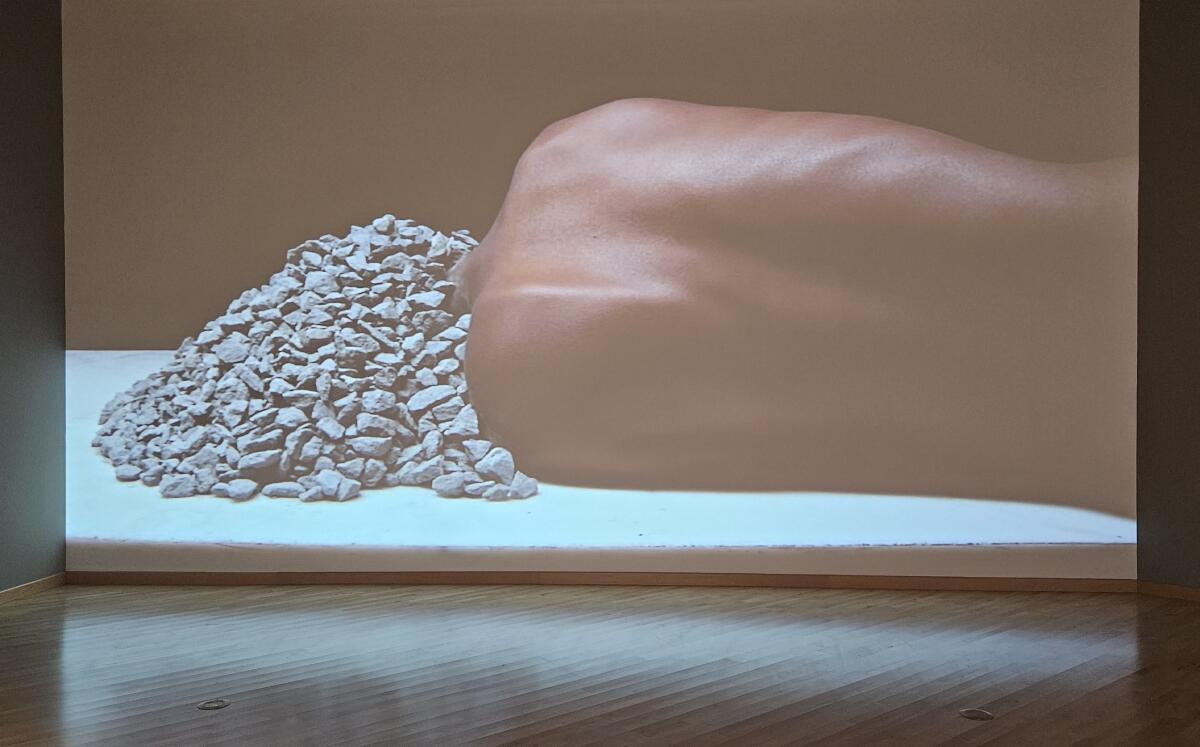
Girl (Simone Leigh and Chitra Ganesh), “my dreams, my works, must wait till after hell. . . ,” 2011; single-channel video, color, sound, 7:14 min.
(Christopher Knight/Los Angeles Times)
Mickalene Thomas and Simone Leigh
Mickalene Thomas
Through Sept. 29 (closed Mondays) at the Broad, 221 S. Grand Ave., L.A. (213) 232-6200, www.thebroad.org
Simone Leigh
Through Jan. 20 (closed Mondays) at the California African American Museum, Exposition Park, 600 State Drive, L.A., (213) 744-7432, www.caamuseum.org; and also the Los Angeles County Museum of Art, 5905 Wilshire Blvd., L.A., (323) 857-6000, www.lacma.org






PopHorror had the chance to check out Anacoreta (2022) ahead of its streaming release! Does this meta-horror flick provide interesting story telling or is it a confusing mess.
Let’s have a look…
Synopsis
A group of friends heads to a secluded woodland cabin for a weekend getaway, planning to film an experimental horror movie. As the shoot progresses, the project begins to fall apart—until a real and terrifying presence emerges from the darkness.
Anacoreta is directed by Jeremy Schuetze. It was written by Jeremy Schuetze and Matt Visser. The film stars Antonia Thomas (Bagman 2024), Jesse Stanley (Raf 2019), Jeremy Schuetze (Jennifer’s Body 2009), and Matt Visser (A Lot Like Christmas 2021)
My Thoughts
Antonia Thomas delivered an outstanding performance as the female lead in Anacoreta. It was remarkable to watch her convey such a wide range of emotions with authenticity and depth. I was continually impressed by her ability to switch seamlessly between different dialects. I absolutely loved her delivery of the dialogue of telling The Scorpion and the Frog fable.
Anacoreta employs a distinctive, meta-horror style of storytelling. The narrative follows a group of friends creating a “scripted reality” horror film, and as the plot unfolds, the boundary between their staged production and their actual lives becomes increasingly blurred. This was interesting, but at the same time frustrating as a viewer.

Check out Anacoreta on Prime Video and let us know your thoughts!

Todd Meadows, a crewmember on one of the fishing vessels featured on the long-running reality series “Deadliest Catch,” has died. He was 25.
Rick Shelford, the captain of the Aleutian Lady, announced in a Monday post on Facebook and Instagram that Meadows died Feb. 25. He called it “the most tragic day in the history of the Aleutian Lady on the Bering Sea.”
“We lost our brother,” Shelford wrote in his lengthy tribute. “Todd was the newest member of our crew, he quickly became family. His love for fishing and his strong work ethic earned everyone’s respect right away. His smile was contagious, and the sound of his laughter coming up the wheelhouse stairs or over the deck hailer is something we will carry with us always.
“He worked hard, loved deeply, and brought joy to those around him,” he added. “Todd will forever be part of this boat, this crew, and this brotherhood. Though we lost him far too soon, his legacy will live on through his children and in every memory we carry of him.”
A fundraiser set up in Meadows’ name described the deckhand from Montesano, Wash., as a father to “three amazing little boys” who died “while doing what he loved — crabbing out on Alaskan waters.”
According to the Associated Press, Meadows died after he was reported to have fallen overboard around 170 miles north of Dutch Harbor, Alaska.
“He was recovered unresponsive by the crew approximately ten minutes later,” Chief Petty Officer Travis Magee, a spokesperson with the Coast Guard’s Arctic District, told the AP. The Coast Guard is investigating the incident.
Meadows was a first-year cast member of “Deadliest Catch,” the Discovery Channel reality series that follows crab fishermen navigating the perilous winds and waves of the Bering Sea during the Alaskan king crab and snow crab fishing seasons. The show debuted in 2005. No episodes from Meadows’ season has aired.
Deadline reported that the show was in production on its 22nd season when the incident occurred, with the Shelford-led Aleutian Lady being the last of the vessels still out at sea at the time. Production has subsequently concluded, per the outlet.
“We are deeply saddened by the tragic passing of Todd Meadows,” a Discovery Channel spokesperson said in a statement that has been widely circulated. “This is a devastating loss, and our hearts are with his loved ones, his crewmates, and the entire fishing community during this incredibly difficult time.”
Meadows is the latest among “Deadliest Catch” cast members who have died. Previous deaths include Phil Harris, a captain of one of the ships featured on the show, who died after suffering a stroke while filming the show’s sixth season in 2010. Todd Kochutin, a crew member of the Patricia Lee, died in 2021 from injuries he sustained while aboard the fishing vessel, according to an obituary. Other cast members have died from substance abuse or natural causes.

“So it’s like Avatar?” one character quips in Disney and Pixar’s “Hoppers,” bluntly translating the film’s high-concept premise for the sugar-fueled kids in the audience. And yes, the comparison is apt. The story follows a nature-obsessed teenage girl who manages to quite literally “hop” her consciousness into the body of a robotic beaver in order to spark an animal rebellion against a greedy mayor determined to bulldoze their forest for a freeway.
It’s a clever hook. The kind of big, elastic idea Pixar used to make look effortless. “Hoppers” does not reach the rarified air of “Up,” “Wall-E,” or “Inside Out,” but after a stretch of uneven originals like “Turning Red” and “Luca,” and outright misfires such as “Elemental” and “Elio,” this feels like a genuine course correction. The environmental messaging is clear without being preachy, the animals are irresistibly anthropomorphized, and the studio’s once-signature emotional sincerity is back in sturdy form.
Pixar can afford to gamble on originals when it has a guaranteed cash cow like this summer’s “Toy Story 5” waiting in the wings, but “Hoppers” earns its place in the catalogue. Director Daniel Chong crafts a warm, heartfelt film that occasionally strains under the weight of its own ambition, yet remains grounded by character and theme. Its meditation on conservation and animal displacement feels timely in a way that never tips into after-school-special territory.
We meet Mabel, voiced with bright conviction by Piper Curda, as a child liberating her classroom pets and returning them to the wild. Her moral compass is shaped by her grandmother, voiced by Karen Huie, who imparts wisdom about nature’s sanctity. True to both Pixar tradition and the broader Disney playbook, this beacon of guidance does not survive past the opening act. Loss, after all, is Pixar’s favorite inciting incident.
Years later, Mabel is still fighting the good fight, squaring off against the smarmy Mayor Jerry, voiced with slick menace by Jon Hamm. He plans to flatten the glade where Mabel and her grandmother once found solace. Mabel’s resistance feels noble but futile. The animals have already mysteriously vanished, the machinery is coming, and her last-ditch plan involves luring a beaver back to the abandoned forest in hopes of jumpstarting the ecosystem.
That’s when the film gleefully pivots into mad-scientist territory. At Beaverton University, Mabel discovers her professor, voiced by Kathy Najimy, has developed a device that can project human consciousness into synthetic animals. The process, dubbed “hopping,” allows Mabel to inhabit a robotic beaver and infiltrate the forest from within. It’s an inspired escalation that keeps the film buoyant even when the plotting grows predictable.
Her new posse includes King George, a lovably beaver voiced by Bobby Moynihan with distinct Bing Bong energy; a sharp-tongued bear voiced by Melissa Villaseñor; a regal bird king voiced by the late Isiah Whitlock Jr.; and a fish queen voiced by Ego Nwodim. As is often the case with Pixar, even in its lesser efforts, the world-building is meticulous. The animal hierarchy, complete with titles like “paw of the king,” is layered with jokes that play for kids while slyly winking at adults.
The plot ultimately follows a familiar template. Scrappy underdog rallies community. Corporate villain twirls metaphorical mustache. Emotional third-act sacrifice looms. At times, you can feel the machinery working a little too cleanly. Pixar, and Disney at large, has grown increasingly reliant on sequels and established IP, and “Hoppers” does not radically reinvent the wheel. In an animated landscape where films like “K-Pop: Demon Hunters,” “Across the Spider-Verse,” and “Goat” are pushing stylistic and narrative boundaries, being safe and sturdy may not always be enough.
And yet, there is something refreshing about a Pixar original that remembers how to tug at the heart without squeezing it dry. “Hoppers” is playful, peppered with cheeky needle drops, and builds to a sweet emotional catharsis that may or may not have left this critic a little misty-eyed. It feels earnest and engaged.
“Hoppers” may not be top-tier Pixar. But it is a welcome return to form, a reminder that the studio still knows how to marry big ideas with a bigger heart.
HOPPERS opens in theaters Friday, March 6th.

After rash of overdose deaths, L.A. banned sales of kratom. Some say they lost lifeline for pain and opioid withdrawal

Lakers hope comeback win over Pelicans gives the team a timely boost

Which oil and gas facilities in the Gulf have been attacked?

Mojtaba Khamenei, son of former supreme leader, tipped to become Iran’s next head of state

Las Vegas first responders conduct seven-hour rescue of injured climber stranded 600 feet up rock face

Florida High School Football Rankings: Top 25 teams – Oct. 21

Cleary's 21 help Le Moyne down Central Connecticut State 69-64 in OT

How old is Bo Nix? What to know about Oregon quarterback ahead of 2024 NFL Draft

99th annual Pony Swim held in Virginia

Indiana Members Credit Union announced as new anchor tenant at Bottleworks District
Which oil and gas facilities in the Gulf have been attacked?
Mojtaba Khamenei, son of former supreme leader, tipped to become Iran’s next head of state

Video: Senators Question Kristi Noem on ICE Immigration Tactics

Combustible Republican Senate primary in Texas heading into overtime

Hungarian veto proves EU needs less unanimity, says new Dutch PM
-

 World6 days ago
Exclusive: DeepSeek withholds latest AI model from US chipmakers including Nvidia, sources say
-

 Massachusetts7 days ago
Mother and daughter injured in Taunton house explosion
-

 Denver, CO7 days ago
10 acres charred, 5 injured in Thornton grass fire, evacuation orders lifted
-

 Louisiana1 week ago
Wildfire near Gum Swamp Road in Livingston Parish now under control; more than 200 acres burned
-

 Oregon5 days ago
2026 OSAA Oregon Wrestling State Championship Results And Brackets – FloWrestling
-

 Florida3 days ago
Florida man rescued after being stuck in shoulder-deep mud for days
-

 Maryland3 days ago
AM showers Sunday in Maryland
-

 Culture1 week ago
Try This Quiz on Thrilling Books That Became Popular Movies