Entertainment
Review: In 'Gasoline Rainbow,' carefree kids hit the road during a fleeting moment when they can

The New Orleans-based filmmaking brothers Bill and Turner Ross have made a name for themselves over the past 15 years with their lyrical, poetic documentaries. But with 2020’s “Bloody Nose, Empty Pockets,” they blurred the line between fiction and nonfiction, setting up an imaginary scenario in an actual dive bar on its last night of business, observing a curated group of regulars as they shut it down for good.
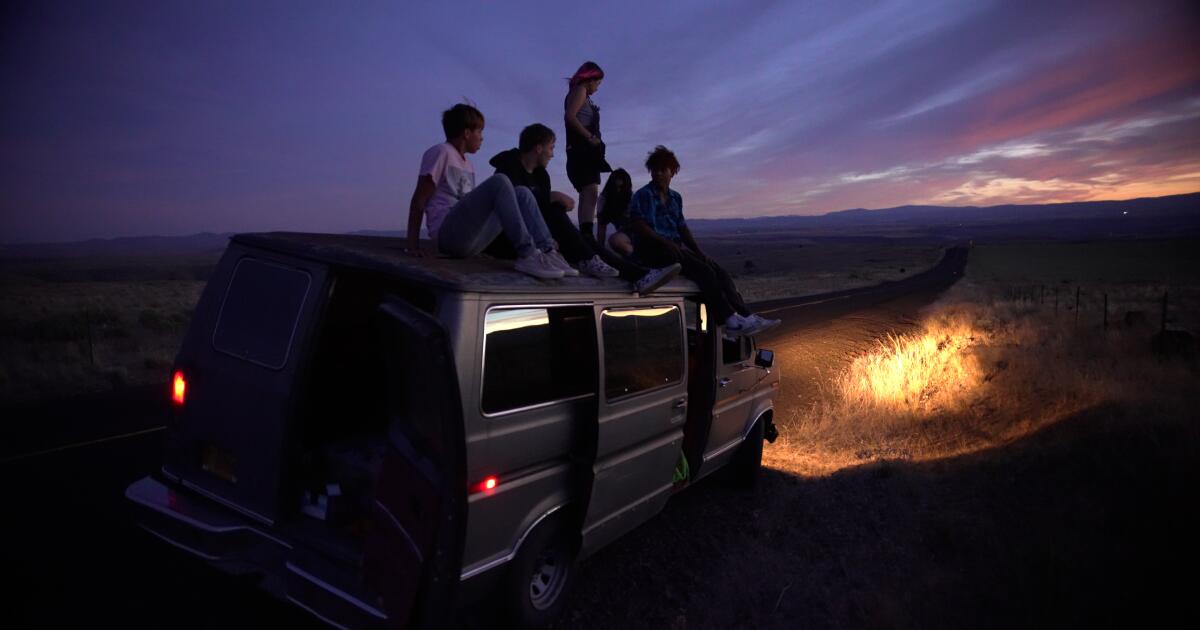
The new “Gasoline Rainbow” is their first official narrative feature, informed by their documentary roots and eye for capturing spontaneous beauty. During the Covid-19 quarantine of 2020, Bill and Turner Ross dreamed up a wild road film, which they loosely scripted and cast with five young first-time actors from Oregon. They play a group of friends from a small town called Wiley, who hit the road with the only things you need for an adventure: a dream, a posse, a van and the abiding belief that “anywhere’s better than here.”
The dream is to see the Oregon coast, 513 miles from their landlocked town. The posse is three boys — Makai Garza, Micah Bunch and Tony Aburto — and two girls, Nathaly Garcia and Nichole Dukes. The van gets them started on their adventure, but they soon learn that it’s not a necessary component. After spending the night partying in a cow field with a guy they meet on the side of the road, they return to find the van on blocks, vandalized, the tires stolen, and that’s when things really get interesting. They have to rely on each other and the kindness of strangers and community to make it all the way to the beach, to the Party at the End of the World, a mysterious event they hear about that becomes their ultimate destination.
Though the events on this journey are planned and produced by the filmmakers, the relationships are real, the interactions and conversations undeniably authentic. If pioneering English documentarian John Grierson’s definition of nonfiction filmmaking was the “creative treatment of actuality,” “Gasoline Rainbow” could ostensibly fit under that umbrella.
But this is not a documentary and it’s far more productive to consider the ways in which the Ross brothers have synthesized their influences and inspirations — such as “My Own Private Idaho,” “The Wizard of Oz,” “Easy Rider” and the 1984 documentary “Streetwise” — into their own unique form that exudes a singular kind of ragged, unpredictable vitality.
A scene from the movie “Gasoline Rainbow.”
(Department of Motion Pictures)
Each actor is a discovery with a special presence, but there is no one star or standout, which feels intentional. While “Gasoline Rainbow” is a heady slice of pure, uncut youthful energy, it is also a portrait of collectivism, caretaking and a celebration of mutual aid.
It’s apt that a film like this was born out of the isolation and confinement of 2020. There was a desire for freedom and movement, combined with the progressive value of taking care of each other that rose out of quarantine and the Black Lives Matter movement. In “Gasoline Rainbow,” the kids come by this sense of mutual protection naturally, but the value is reinforced along the way by the heavily-pierced punk hitchhikers who teach them how to hop a train to Portland in exchange for their leftover food, and the middle-aged rockers who provide a party, a couch to crash, breakfast and a boat ride. Micah’s cousin Noah underscores the importance, telling them, “I like the way you treat each other.”
These values of care and respect threaded throughout are why we never fear for their safety. They make decisions as a group, look out for each other and demonstrate their awareness by asking the strangers they meet, “Are you cool?” The film isn’t about the risks of a harrowing journey. In turn, it gives us a freedom as viewers to focus on their life stories that emerge in snippets of conversation, and those of the people they meet along the way. Their guides are fascinating in their own right, like Gary, a Portland skater who shepherds them through the city for a night, and later ferries them to the party.
This age — not kids, not quite adults — is such an impossibly short time, and it’s poignant to drink in their openness and pliability as people, their youthful trust and imperviousness, to watch them blossom and bond. They haven’t hardened into grown-ups yet and they know they have this one moment in time to enjoy fleeting youth, before jobs, bills and responsibilities. Nichole says that she fears not having enough time to figure things out, and this film is a celebration of that moment.
“Gasoline Rainbow” is also stunningly gorgeous, with carefully composed shots capturing the vast Oregon landscape, raspberry sunsets, golden fields, the beach at night and in the misty morning. The gritty urban space of Portland is so wildly different from their one-stoplight town, it’s intoxicating, the gang drawn in by the all-night parties, skate parks, rock festivals and free-flying freak flags.
Though a larger cultural commentary is not overt, certain realities necessarily come through, with jokes about cops, corporate logos emblazoned on train cars, discussions about parents in rehab and what it’s like to be the only black kid in small-town Oregon (“It sucks”). It’s a depiction of today’s youth, shaped by contemporary culture, but there is also a timelessness to their experience. The Ross brothers capture those universal feelings of a certain age: possibility, togetherness with your tribe, unmoored from traditional family structures.
The structuring destination of the Party at the End of the World speaks to this idea of time running out, and it imparts a sense of existential dread that hovers around the edges, but forces the characters, and the audience to remain in the moment, to embrace serendipity, surprise, and coincidence. As it all coalesces, there is a sense of visceral, emotional catharsis that could only be achieved at the end of a long journey. That the Ross brothers manage to impart this feeling to an audience after an hour-and-48-minute cinematic adventure is a true triumph. This wild, vicarious ride through youthful adventure is absolutely worth taking, for your own nostalgia and for the reminder that the kids are indeed alright.
‘Gasoline Rainbow’
Not rated
Running time: 1 hour, 48 minutes
Playing: Now in limited release








PopHorror had the chance to check out Anacoreta (2022) ahead of its streaming release! Does this meta-horror flick provide interesting story telling or is it a confusing mess.
Let’s have a look…
Synopsis
A group of friends heads to a secluded woodland cabin for a weekend getaway, planning to film an experimental horror movie. As the shoot progresses, the project begins to fall apart—until a real and terrifying presence emerges from the darkness.
Anacoreta is directed by Jeremy Schuetze. It was written by Jeremy Schuetze and Matt Visser. The film stars Antonia Thomas (Bagman 2024), Jesse Stanley (Raf 2019), Jeremy Schuetze (Jennifer’s Body 2009), and Matt Visser (A Lot Like Christmas 2021)
My Thoughts
Antonia Thomas delivered an outstanding performance as the female lead in Anacoreta. It was remarkable to watch her convey such a wide range of emotions with authenticity and depth. I was continually impressed by her ability to switch seamlessly between different dialects. I absolutely loved her delivery of the dialogue of telling The Scorpion and the Frog fable.
Anacoreta employs a distinctive, meta-horror style of storytelling. The narrative follows a group of friends creating a “scripted reality” horror film, and as the plot unfolds, the boundary between their staged production and their actual lives becomes increasingly blurred. This was interesting, but at the same time frustrating as a viewer.

Check out Anacoreta on Prime Video and let us know your thoughts!

Todd Meadows, a crewmember on one of the fishing vessels featured on the long-running reality series “Deadliest Catch,” has died. He was 25.
Rick Shelford, the captain of the Aleutian Lady, announced in a Monday post on Facebook and Instagram that Meadows died Feb. 25. He called it “the most tragic day in the history of the Aleutian Lady on the Bering Sea.”
“We lost our brother,” Shelford wrote in his lengthy tribute. “Todd was the newest member of our crew, he quickly became family. His love for fishing and his strong work ethic earned everyone’s respect right away. His smile was contagious, and the sound of his laughter coming up the wheelhouse stairs or over the deck hailer is something we will carry with us always.
“He worked hard, loved deeply, and brought joy to those around him,” he added. “Todd will forever be part of this boat, this crew, and this brotherhood. Though we lost him far too soon, his legacy will live on through his children and in every memory we carry of him.”
A fundraiser set up in Meadows’ name described the deckhand from Montesano, Wash., as a father to “three amazing little boys” who died “while doing what he loved — crabbing out on Alaskan waters.”
According to the Associated Press, Meadows died after he was reported to have fallen overboard around 170 miles north of Dutch Harbor, Alaska.
“He was recovered unresponsive by the crew approximately ten minutes later,” Chief Petty Officer Travis Magee, a spokesperson with the Coast Guard’s Arctic District, told the AP. The Coast Guard is investigating the incident.
Meadows was a first-year cast member of “Deadliest Catch,” the Discovery Channel reality series that follows crab fishermen navigating the perilous winds and waves of the Bering Sea during the Alaskan king crab and snow crab fishing seasons. The show debuted in 2005. No episodes from Meadows’ season has aired.
Deadline reported that the show was in production on its 22nd season when the incident occurred, with the Shelford-led Aleutian Lady being the last of the vessels still out at sea at the time. Production has subsequently concluded, per the outlet.
“We are deeply saddened by the tragic passing of Todd Meadows,” a Discovery Channel spokesperson said in a statement that has been widely circulated. “This is a devastating loss, and our hearts are with his loved ones, his crewmates, and the entire fishing community during this incredibly difficult time.”
Meadows is the latest among “Deadliest Catch” cast members who have died. Previous deaths include Phil Harris, a captain of one of the ships featured on the show, who died after suffering a stroke while filming the show’s sixth season in 2010. Todd Kochutin, a crew member of the Patricia Lee, died in 2021 from injuries he sustained while aboard the fishing vessel, according to an obituary. Other cast members have died from substance abuse or natural causes.

“So it’s like Avatar?” one character quips in Disney and Pixar’s “Hoppers,” bluntly translating the film’s high-concept premise for the sugar-fueled kids in the audience. And yes, the comparison is apt. The story follows a nature-obsessed teenage girl who manages to quite literally “hop” her consciousness into the body of a robotic beaver in order to spark an animal rebellion against a greedy mayor determined to bulldoze their forest for a freeway.
It’s a clever hook. The kind of big, elastic idea Pixar used to make look effortless. “Hoppers” does not reach the rarified air of “Up,” “Wall-E,” or “Inside Out,” but after a stretch of uneven originals like “Turning Red” and “Luca,” and outright misfires such as “Elemental” and “Elio,” this feels like a genuine course correction. The environmental messaging is clear without being preachy, the animals are irresistibly anthropomorphized, and the studio’s once-signature emotional sincerity is back in sturdy form.
Pixar can afford to gamble on originals when it has a guaranteed cash cow like this summer’s “Toy Story 5” waiting in the wings, but “Hoppers” earns its place in the catalogue. Director Daniel Chong crafts a warm, heartfelt film that occasionally strains under the weight of its own ambition, yet remains grounded by character and theme. Its meditation on conservation and animal displacement feels timely in a way that never tips into after-school-special territory.
We meet Mabel, voiced with bright conviction by Piper Curda, as a child liberating her classroom pets and returning them to the wild. Her moral compass is shaped by her grandmother, voiced by Karen Huie, who imparts wisdom about nature’s sanctity. True to both Pixar tradition and the broader Disney playbook, this beacon of guidance does not survive past the opening act. Loss, after all, is Pixar’s favorite inciting incident.
Years later, Mabel is still fighting the good fight, squaring off against the smarmy Mayor Jerry, voiced with slick menace by Jon Hamm. He plans to flatten the glade where Mabel and her grandmother once found solace. Mabel’s resistance feels noble but futile. The animals have already mysteriously vanished, the machinery is coming, and her last-ditch plan involves luring a beaver back to the abandoned forest in hopes of jumpstarting the ecosystem.
That’s when the film gleefully pivots into mad-scientist territory. At Beaverton University, Mabel discovers her professor, voiced by Kathy Najimy, has developed a device that can project human consciousness into synthetic animals. The process, dubbed “hopping,” allows Mabel to inhabit a robotic beaver and infiltrate the forest from within. It’s an inspired escalation that keeps the film buoyant even when the plotting grows predictable.
Her new posse includes King George, a lovably beaver voiced by Bobby Moynihan with distinct Bing Bong energy; a sharp-tongued bear voiced by Melissa Villaseñor; a regal bird king voiced by the late Isiah Whitlock Jr.; and a fish queen voiced by Ego Nwodim. As is often the case with Pixar, even in its lesser efforts, the world-building is meticulous. The animal hierarchy, complete with titles like “paw of the king,” is layered with jokes that play for kids while slyly winking at adults.
The plot ultimately follows a familiar template. Scrappy underdog rallies community. Corporate villain twirls metaphorical mustache. Emotional third-act sacrifice looms. At times, you can feel the machinery working a little too cleanly. Pixar, and Disney at large, has grown increasingly reliant on sequels and established IP, and “Hoppers” does not radically reinvent the wheel. In an animated landscape where films like “K-Pop: Demon Hunters,” “Across the Spider-Verse,” and “Goat” are pushing stylistic and narrative boundaries, being safe and sturdy may not always be enough.
And yet, there is something refreshing about a Pixar original that remembers how to tug at the heart without squeezing it dry. “Hoppers” is playful, peppered with cheeky needle drops, and builds to a sweet emotional catharsis that may or may not have left this critic a little misty-eyed. It feels earnest and engaged.
“Hoppers” may not be top-tier Pixar. But it is a welcome return to form, a reminder that the studio still knows how to marry big ideas with a bigger heart.
HOPPERS opens in theaters Friday, March 6th.

Which oil and gas facilities in the Gulf have been attacked?

Mojtaba Khamenei, son of former supreme leader, tipped to become Iran’s next head of state

Las Vegas first responders conduct seven-hour rescue of injured climber stranded 600 feet up rock face

Breaking: Arkansas Announces Significant Partnership With Tyson Foods, Including New Uniform Patch Logos

Ted Cruz endorses Texas state Rep Steve Toth in GOP primary challenge to Dan Crenshaw

Florida High School Football Rankings: Top 25 teams – Oct. 21

Cleary's 21 help Le Moyne down Central Connecticut State 69-64 in OT

How old is Bo Nix? What to know about Oregon quarterback ahead of 2024 NFL Draft

99th annual Pony Swim held in Virginia

Indiana Members Credit Union announced as new anchor tenant at Bottleworks District
Which oil and gas facilities in the Gulf have been attacked?
Mojtaba Khamenei, son of former supreme leader, tipped to become Iran’s next head of state

Video: Senators Question Kristi Noem on ICE Immigration Tactics

Combustible Republican Senate primary in Texas heading into overtime

Hungarian veto proves EU needs less unanimity, says new Dutch PM
-

 World6 days ago
Exclusive: DeepSeek withholds latest AI model from US chipmakers including Nvidia, sources say
-

 Massachusetts7 days ago
Mother and daughter injured in Taunton house explosion
-

 Denver, CO7 days ago
10 acres charred, 5 injured in Thornton grass fire, evacuation orders lifted
-

 Louisiana1 week ago
Wildfire near Gum Swamp Road in Livingston Parish now under control; more than 200 acres burned
-

 Oregon5 days ago
2026 OSAA Oregon Wrestling State Championship Results And Brackets – FloWrestling
-

 Florida3 days ago
Florida man rescued after being stuck in shoulder-deep mud for days
-

 Maryland3 days ago
AM showers Sunday in Maryland
-

 Culture1 week ago
Try This Quiz on Thrilling Books That Became Popular Movies