Entertainment
Review: Emotionally, 'Daughters' shows prisoners reuniting with their children, just for a night

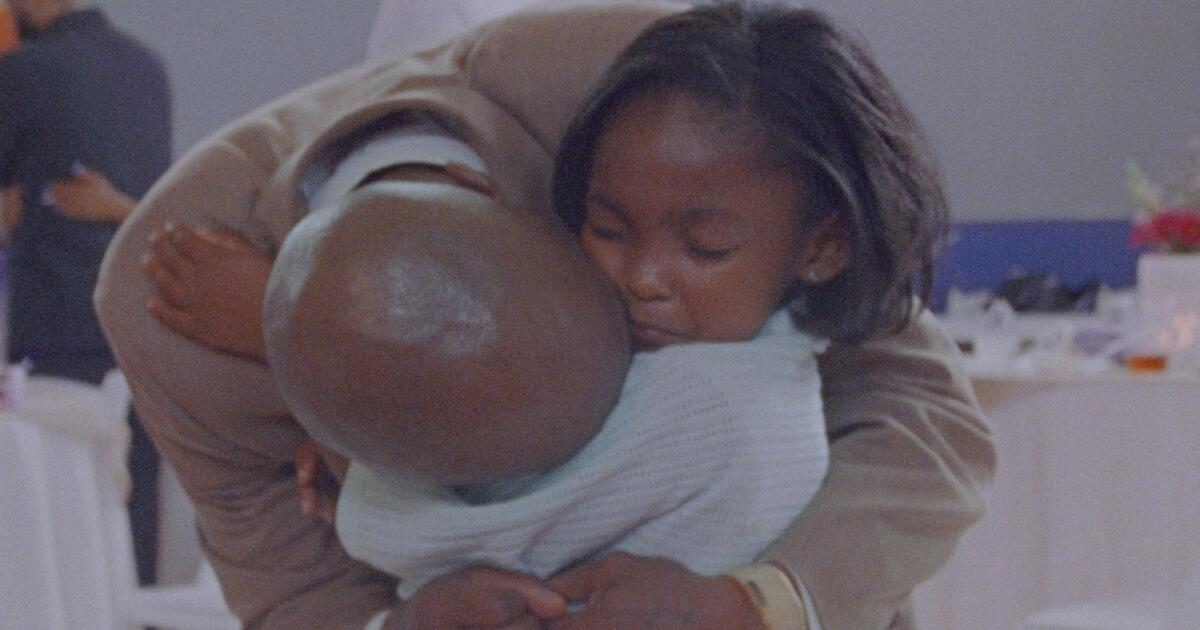
When a parent goes to jail, everyone in the family does time. And in Black communities most severely affected by the impersonal whims of the prison industry, a unique program has been fostered, intended for girls seeking a deeper connection to their incarcerated fathers: a date with them at the jail.
The documentary “Daughters,” from directors Natalie Rae and Angela Patton, follows one such Daddy Daughter Dance in Washington, D.C., a carefully arranged night in which orange prison uniforms are swapped for jackets and ties, the jail’s decorated gym takes on a prom-like air, and dressed-up girls get a few celebratory hours in which their separation anxiety is briefly, movingly set aside.
The film, which focuses on a handful of girls and their dads as the dance looms, is as touching as it sounds — and invariably as sad. It’s to the great wisdom of the collaboration between Rae, whose background is directing, and Patton, an activist whose nonprofit prioritizes the futures of Black girls, that while the dance is clearly intended to be positive and inspiring (we’re told 95% of the fathers who participate never go back to jail), the movie isn’t afraid to show just how much fragility and uncertainty goes into the buildup and its aftermath.
That commitment to the emotional integrity of a process that might reveal heartache as much as hope keeps “Daughters” from seeming like a commercial, even as it wholeheartedly sells us on the worth of this program. Your buttons will be pushed immediately when you meet the charming, chatty 5-year-old Aubrey, a math whiz whose joy at numbers is offset by their representing the years her dad, Keith, will be away. Elsewhere, 10-year-old Santana, who helps her mother raise an infant sibling, is a serious kid with an outer shell hardened by the weakness of the adults in her life, while 11-year-old Ja’Ana — who doesn’t know her dad at all — carries her mother’s doubts about his commitment level. And struggling high schooler Raziah has, according to her mother, already expressed worrying thoughts of self-harm.
The dads, required to meet in fatherhood circles led by a supportive coach in an airy room marked by a big circular window, are a believably nervous bunch. They reflect honestly on their predicaments and are encouraged to view the upcoming dance in terms that prioritize how their daughters need to view them: as potential promise-keepers.
We learn the men’s names, but the filmmakers never tell us what they’re in for, which feels right — who they are striving to become, as opposed to what they were, defines them for us. In a riskier but effective grace note, interspersed throughout are poetic, home-movie-fashioned interludes, scenes of the girls at play that suggest missed experiences.
Unsurprisingly, on the big day, when these spiffed-up fathers wait expectantly for their dates, your throat may not be able to handle the lumps. But while there are hugs, tears, laughs, more hugs, silly photos and adorable dances, there are also pockets of getting-to-know-you awkwardness and even full-on tension. Rae and Patton, who filmed their subjects across years, are attuned enough to the many feelings in play.
“Daughters” doesn’t have an obvious ending, and it’s in the realities of distance that we come to fully grasp the complexity of the dance, girls and fathers bonding without plexiglass barriers or pricey video calls separating them. To touch, and to be touched, makes “Daughters” an achingly beautiful case for second chances in an isolating, fractured world.
‘Daughters’
Rating: PG-13, for some thematic elements and language
Running time: 1 hour, 47 minutes
Playing: Opens Friday, Aug. 9 at the Bay Theater, Pacific Palisades; streaming on Netflix Aug. 14


As La Cruz continues to break down barriers for the LGBTQ+ community in reggaeton, the rising Venezuelan star enjoys living out his gay fantasies in his music videos. Take the sultry video for his 2023 breakthrough single, “Quítate La Ropa,” which sees shirtless men perreando (twerking) before him in a locker room.
But at the same time, La Cruz has come to understand that his platform as a gay reggaeton artist coincides with a time when conservatism is sweeping the globe — and queer rights are receding.
“It fills me with happiness to represent a community that has been denigrated, treated badly and pushed into a corner for many years,” a bedheaded La Cruz says over Zoom from his New York City hotel room. (He had just performed at a Pride event the night before.)
“It’s a fact that [LGBTQ] rights are becoming progressive, but they’re rolled back even faster than they advance,” he adds. “This is very painful and concerning. This is happening in every country in different ways. During these difficult times, I’m going to keep putting my heart into my music more than ever.”
La Cruz is the stage name of Alfonso La Cruz. The native of La Guaira, a coastal city in Venezuela, pursued a music career after relocating to Spain in 2015. Following a brief stint on the singing competition “Operación Triunfo” three years later, La Cruz was closeted and found his momentum stifled. In 2022, he took the brave step of singing about his affection and lust for other men in his debut album, “Hawaira.”
Venezuelan reggaeton singer La Cruz released his new EP, “El Nene, Vol. 2,” on June 11.
(Maria Camila Pinzon)
Backed by the beats of reggaeton, a genre that had historically excluded the LGBTQ+ community, La Cruz found both his groove and his tribe with hits like “Te Conocí Bailando” and “Quítate La Ropa.” Early supporters included Colombian superstar Karol G, as well as Mexican American R&B singer Omar Apollo.
Alongside Puerto Rican provocateurs like Young Miko and Villano Antillano, La Cruz has continued to queer the heteronormative urbano space. He has also pushed his sound to broader horizons in his new EP, “El Nene, Vol. 2,” which includes “Sírveme,” a Brazilian funk banger with drag pop star Gloria Groove — and “Te Perdí,” a touching tribute to the victims and survivors of the 2016 Pulse nightclub shooting in Orlando, Fla.
La Cruz’s EP dropped on June 11, the day before the 10th anniversary of that tragedy, which largely impacted the queer Latino community. In an interview with The Times, he opened up about being a gay reggaetonero and “Te Perdi,” his tribute to the 49 people lost at Pulse.

It’s been three years since you first went viral with “Quítate La Ropa.” What have you learned about yourself during that time?
There are songs that have brought me a lot of love and I’m thankful to my fans that consider that song to be a classic. It’s brought me a lot of blessings. At this moment, I feel like I have the best opportunities in my life. However, I feel like the industry is a bit uncomfortable with an artist that’s openly gay and wants to be a part of this. That hasn’t stopped me at all. It’s the gasoline in my motor. It’s what pushes me to keep working hard. My fans are what’s building my career and I won’t let them down. I’m sticking with this until the end.
You connected with Karol G early in your career. Did she give you any advice when you met her?
I want to say publicly that I would love to open for her concerts on her Viajando Por El Mundo Tropitour. I’m very close to her. I love her so much. She has always treated me with so much love. I hope that something between me and her can happen sometime. I know everything happens in due time. I told her that I love the way she is and how she connects with her fans. When I see her singing and performing, I feel like she’s a sister to me. A big piece of advice that she gave me and that I’ll always carry with me is to never lose the humility and closeness that I have with my fans. The key to success is humility. I never want to be out of reach. I want people to see me and say, “I want to achieve my dreams like he has.”
How did your collaboration “Sírveme” with Gloria Groove come together?
I love her so much! I’ve always been a big fan of hers. I’ve gotten close to a lot of artists in Brazil and Gloria has been one of them. We didn’t think twice about making this song. Gloria was coincidentally traveling to the amusement parks in Orlando. I told her: “Baby, let’s go! I’m ready for you in Miami.” She told me: “Baby, I’m going to Miami!” We met one afternoon to create this song. She paused her vacation to go to the studio with me. It was very beautiful. I love my Brazilian fans.
With “El Nene, Vol. 2,” why was it important for you to also shed a light on the 10th anniversary of the Pulse nightclub shooting?
In 2016, when I recently arrived in Spain and my brother recently arrived in the U.S., we had a call with our family. My brother said, “There was a shooting close to where I live and it was in a gay club.” My family has supported me since I first told them about my sexuality. I thought that that could’ve happened to me.
I’m following up on this tragedy because it shaped my life. As the years go on, information about this attack has faded away. Each day people are talking less about it. It’s a tragedy that’s super important to remember, like 9/11 and the [2017] Las Vegas shooting, because it’s one of the worst attacks in U.S. history. Why are we not talking about it anymore? We have to keep talking about things so that they don’t happen again.
What inspiration did you pull from the Pulse tragedy for your song “Te Perdí”?
On this path, I’ve gotten to know the stories of people that survived that shooting. For example, there was a boy with his mother that lost her life and he survived. There’s a lot of stories of love from that club that have [since] come out. When I went to the studio, I was inspired by loss, or a love that’s gone away, with respect and love for the community that supports me. It is my gift, to be a voice for this situation that should never be repeated. There are people that don’t know about this tragedy and I want to let the world know that this happened. I hope that the victims’ families and the people that survived are living lives of peace and calm.

RICHMOND, Va. (WRIC) — In this episode of 8News Reel Talk, Julia Broberg sits down with Hekla Petursson and Catori Ryan to talk about “Toy Story 5.”
The hosts gave their reviews and provided the following star ratings:
Catori: ★★★★
Hekla: ★★★★★
Julia: ★★★★.2
To watch more livestreams and digital video content, head to the WRIC+ Originals page. You can also watch full on-demand videos on your smart TV using the WRIC+ app.

Passing “Go” has become especially lucrative for mobile game publisher Scopely.
The Culver City-based Scopely launched “Monopoly Go!” in 2023, betting fans of the classic board game would flock to a mobile version aimed at casual gamers.
By 2025, “Monopoly Go!” had accrued $6 billion in lifetime in-app purchase revenue, becoming the fastest free mobile game to do so, according to app analytics firm Sensor Tower.
This summer, the app is expected to reach $8 billion in lifetime revenue, the company says, solidifying “Monopoly Go!” as Scopely’s biggest game and far surpassing the company’s popular “Pokémon Go.” The company declined to disclose its total profits.
Scopely Co-Chief Executive Javier Ferreira.
As overall downloads in the mobile game market have stagnated and in-app purchases and retention become the main drivers of growth, Scopely has hit on an age-old Hollywood strategy — using known franchises and intellectual property to bring out fans.
“These are incredibly durable and long-lasting games that have really passionate communities and fandom around them,” said Javier Ferreira, co-chief executive of Scopely. “We’re in the business of building people’s favorite thing, and that’s a difficult thing to do. The power of [intellectual property] is that, in some cases, that is already their favorite thing.”
The company’s journey toward “Monopoly Go!” began in 2014, when Scopely formed a partnership with Rhode Island-based toymaker Hasbro. Its first collaboration was a Yahtzee mobile dice game that ultimately drew millions of players worldwide (though it was especially popular in the U.S.) and generated more than $1 billion in lifetime revenue.
After that, Scopely approached Hasbro about taking on the “crown jewel” of its board game empire — Monopoly.
Monopoly’s massive global popularity was an obvious draw. But adapting an hours-long real estate transaction game for a casual, mobile audience proved challenging.
Development of what would become “Monopoly Go!” ultimately took seven years, two of which were spent trying to make movement around the board more fun. In that time, the company scrapped two versions of the game; one deemed too competitive, and one that was too complex, Ferreira said.
Developers wanted to capture the “roller coaster feel” of the board game’s highs and lows, while also having simple rules and ensuring a strong social element, he said.
“We couldn’t just copy,” Ferreira said. “We had to reinvent it and re-imagine it, and that’s a complicated, creative endeavor.”
Today, “Monopoly Go!” brings in more than $2 billion in annual revenue and has been downloaded across the globe more than 300 million times.
Now with “Pokémon Go,” which the company owns after acquiring maker Niantic’s game business last year, “Scopely has gone from a successful publisher to one of the defining companies in mobile gaming,” Randy Nelson, head of insights at Appfigures, a mobile app analytics firm.
“The company cracked the code on licensed games years ago,” he wrote in an email. “Its biggest hits work because they’re great games first and recognizable brands second.”
Though the company’s overall game downloads have slowed, its gross revenue has largely increased every year since 2020, according to Appfigures data.
Shortly after Scopely released “Monopoly Go!,” the company was acquired by Savvy Games Group, which is owned by the Saudi Public Investment Fund, for $4.9 billion.
In a statement about the deal, Savvy Games Group Chief Executive Brian Ward touted the success of “Monopoly Go!” as “indicative of Scopely’s ongoing position at the forefront of the global games sector.”
Representatives of the Saudi investment fund are part of Savvy Game Group’s board and do sometimes give some feedback on company initiatives, though Ferreira said the company has remained “very independent.”
The proposed acquisition of gaming giant Electronic Arts by the Saudi Public Investment Fund is not expected to affect Scopely since EA largely focuses on high-budget console and computer games, he said.
As Scopely, now 3,000 employees strong, looks to the future, it has embarked on a number of entertainment partnerships with studios to add franchises such as “The Simpsons,” “Hello Kitty” and Marvel to its mobile game ecosystem.
“They give us access to these universes that millions of people love and are really invested in,” Ferreira said. “We see this as a very strategic part of our business.”
-
 Lifestyle5 minutes ago
‘The Bear’ is back in the kitchen
-

 Technology18 minutes ago
Android 17’s new foldable gaming mode could make flippy phones more fun
-

 World21 minutes ago
Shark attack survivor wakes from 10-day coma and shares first words with family at her hospital bedside
-

 Politics26 minutes ago
Trump administration pledges $150M in aid, deploys Navy warships after deadly Venezuela earthquakes
-

 Sports35 minutes ago
Second Lady Usha Vance joins celebrity-filled crowd for Team USA’s group-stage finale in LA
-

 Technology40 minutes ago
Debt collection letter for debt you don’t owe? What to do now
-
 Business48 minutes ago
Newsom blesses Uber ballot measure truce — but fight over car crash lawsuits continues
-
Entertainment51 minutes ago
La Cruz offers a musical memorial to Pulse shooting victims on Pride Month

