Connect with us

Movie Reviews

Movie Review: ‘Any Day Now’ Keeps You Guessing | InSession Film

Published

on

Movie Review: ‘Any Day Now’ Keeps You Guessing | InSession Film

Director: Eric Aronson
Writer: Eric Aronson
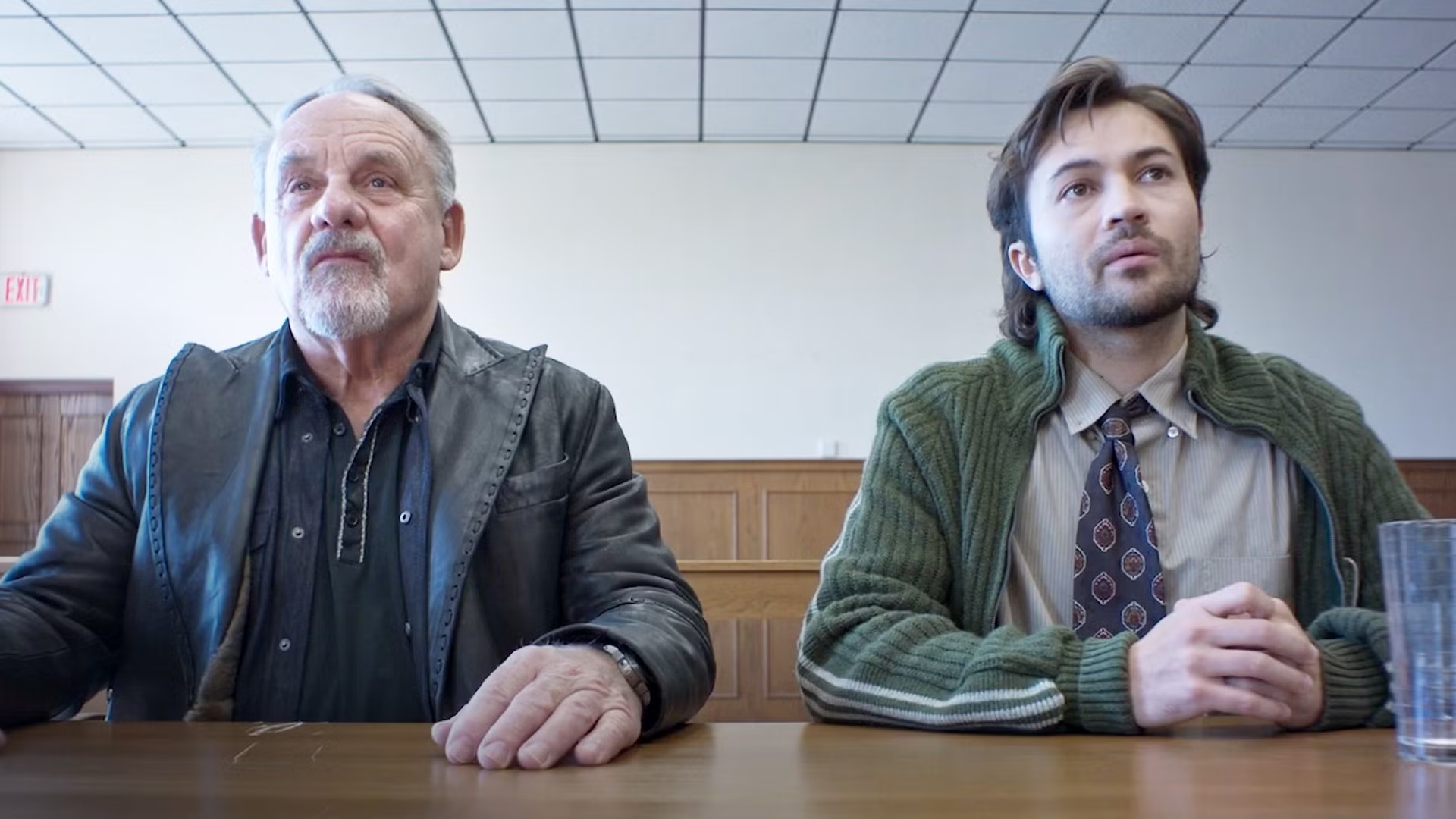
Stars: Paul Guilfoyle, Taylor Gray, Alexandra Templer

Synopsis: To stage a masterpiece of a heist, you need time, friends, and balls. Steve has two of the three


Art thieves are complicated criminals. On the one hand, they seem to have a sense of art history and the value of the medium. On the other hand, they seem nuts because they are taking something that is catalogued and has no other like it on Earth and thus, nearly impossible to move without someone noticing. It takes a certain type of thief to be modestly successful at art theft. Which is not what you think when you meet the crew in Any Day Now.

Writer and director Eric Aronson’s script doesn’t give us much confidence that the crew of art thieves led by Marty (Paul Guilfoyle) could rob a liquor store, much less a guarded museum. At one point, a member of the crew is brought in to intimidate a drug dealer and in a confusing move with a shotgun, seemingly blows his own testicles off. It’s unclear whether it was intentional or not. Much of Aronson’s script evolves that way as we are stuck with point of view character Steve (Taylor Gray), who knows next to nothing about what is happening.

Advertisement

This is both a benefit and a detriment to Aronson’s script. The idea that we’re always on our back foot when it comes to Marty and his schemes is refreshing. This way of revealing things as they become necessary makes sure that the audience shouldn’t be ahead of the action in predicting the outcome of any one plot point. It’s an intriguing way to keep the audience interested.

It’s too bad the other main plot is such a dud. We have seen the lovelorn guy many times before. We’ve seen the girl of his dreams who doesn’t know how he feels and doesn’t understand her own self worth, many times before. We’ve seen the doormat guy who worries about losing his best friend since childhood even though that friend is an incredibly crappy adult. These plot points drag down the more interesting characters and plots.

Marty is a fascinating character. His charm is in his mystery, though, so he never would have worked as the focal character of this film. There is a scene that perfectly encapsulates how he is willing to save Steve from his pushover relationship with friend and roommate Danny (Armando Rivera) while also reminding Steve that he’s a pushover for Marty now. As Steve and Danny’s band play Massachusetts anthem, “Roadrunner” by Johnathan Richman and the Modern Lovers, Marty makes his way to the stage and stares down Danny until he gets the microphone from Danny. Marty then begins to croon the Boston standard, “Dirty Water” by The Standells. He gets the band into it and the crowd into it and completely takes over the space that Danny once held in the crowd’s hearts and minds. It’s a scene that evolves the two overbearing relationships in Steve’s life without forcing the issue with unnecessary dialogue.

Any Day Now' Review: Reimagining an Unsolved Heist

The scene is all the more rich for Paul Guilfoyle’s bruiser charisma. Guilfoyle has been a character actor for a long time and he can give us all we need to know about a character with only a word and a gesture. His presence is felt in every scene he’s in not because he’s speaking, but because he’s thinking. Marty is always thinking and Guilfoyle makes this plain with every look he gives. It’s a masterfully subtle performance that conveys everything dangerous and enticing about Marty.

For the most part, Any Day Now is an enjoyable film. It’s not the best of heist movies, or relationship dramas for that matter, but it has characters and instances that make it intriguing to watch. It’s hard not to want to know what is going to happen when the mystery is held back so well. It’s worth tracking down for Paul Guilfoyle’s performance and for the intrigue of the heist plot.

Advertisement

Grade: C

Movie Reviews

FILM REVIEW: ROSE OF NEVADA – Joyzine

Published

on

FILM REVIEW: ROSE OF NEVADA – Joyzine

‘4’, the opening track on Richard D James’ (Aphex Twin) self titled 1996 album is a piece of music that beautifully balances the chaotic with the serene, the oppressive and the freeing. It’s a trick that James has pulled off multiple times throughout his career and it is a huge part of what makes him such an iconic and influential artist. Many people have laid the “next Aphex Twin” label on musicians who do things slightly different and when you actually hear their music you realise that, once again, the label is flawed and applied with a lazy attitude. Why mention this? Well, it turns out we’ve been looking for James’ heir apparent in the wrong artform. We’ve so zoned in on music that we’ve not noticed that another Celtic son of Cornwall is rewriting an art form with that highwire balancing act between chaos and beauty. That artist is writer, director and composer Mark Jenkin who over his last two feature films has announced himself as an idiosyncratic voice who is creating his very own language within the world of cinema. Jenkin’s films are often centred around coastal towns or islands and whilst they are experimental or even unsettling, there is always a big heart at the centre of the narrative. A heart that cares about family, tradition, culture, and the pull of ‘home’. Even during the horror of 2022’s brilliant Enys Men you were anchored by the vulnerability and determination of its main protagonist. 

This month sees the release of Jenkin’s latest feature film, Rose of Nevada, which is set in a fractured and diminished Cornish coastal town. One day the fishing boat of the film’s title arrives back in harbour after being missing for thirty years. The boat is unoccupied. And frankly that is all the information you are going to get because to discuss any more plot would be unfair on you and disrespectful to Jenkin and the team behind the film.  You the viewer should be the one who decides what it is about because thematically there are so many wonderful threads to pull on. This writer’s opinions on what it is about have ranged from a theme of sacrifice for the good of a community to the conflict within when part of you wants to run away from your roots whilst the other half longs to stay and be a lifelong part of its tapestry. Is it about Brexit? Could be. Is it about our own relationships with time and our curation of memory? Could be. Is it about both the positives and negatives of nostalgia? Could be. As a side note, anyone in their mid-40s, like me, who came of age in the 1990s will certainly find moments of warm recognition. Is the film about ghosts and how they haunt families? Could be…I think you get the point. 

The elements that make the film so well balanced between chaos and calm are many. It is there in the differing performances between the brilliant two lead actors George MacKay and Callum Turner. It is there in the sound design which fluctuates from being unbearably harsh and metallic, to lulling and warm. It is there in the editing where short, sharp close ups on seemingly unimportant factors are counterbalanced with shots that are held for just that little bit too long. For a film set around the sea, it is apt that it can make you feel like you’re rolling on a stomach churning storm one minute, or a calming low tide the next. Dialogue can be front and centre or blurred and buried under static. One shot is bathed in harsh sunlight whilst the next can be drowned in interior shadows. 

Rose of Nevada is Mark Jenkin’s most ambitious film to date yet he has not lost a single iota of innovation, singularity of vision or his gift for telling the most human of stories. It is a film that will tell you different things each time you see it and whilst there are moments that can confuse or beguile, there is so much empathy and love that it can leave you crying tears of emotional understanding. It is chaotic. It is beautiful. It is life……

Advertisement

Rose of Nevada is released on the 24th April. 

Mark Jenkin Instagram | Threads 

Released through the BFI – Instagram | Facebook

Review by Simon Tucker

Keep up to date with all new content on Joyzine via our 
Facebook| Bluesky | Instagram|Threads |Mailing List 

Advertisement

Continue Reading

Movie Reviews

‘Hen’ movie review: György Pálfi pecks at Europe’s migrant crisis through the eyes of a chicken

Published

on

‘Hen’ movie review: György Pálfi pecks at Europe’s migrant crisis through the eyes of a chicken

A rogue chicken observes the world around it—and particularly the plight of immigrants in Greece—in Hen, which premiered at last year’s Toronto International Film Festival and is now playing in Prague cinemas (and with English subtitles at Kino Světozor and Edison Filmhub). This story of man through the eyes of an animal immediately recalls Robert Bresson’s Au Hasard Balthazar (and Jerzy Skolimowski’s more recent EO), but director and co-writer György Pálfi (Taxidermia) maintains a bitter, unsentimental approach that lands with unexpected force.

Hen opens with striking scenes inside an industrial poultry facility, where eggs are laid, processed, and shuttled along assembly lines of machinery and human hands in an almost mechanized rhythm of production. From this system emerges our protagonist: a black chick that immediately stands apart from the others, its entry into the world defined not by nature, but by an uncaring food industry.

The titular hen matures quickly within this environment before being loaded onto a truck with the others, presumably destined for slaughter. Because of her black plumage, she is singled out by the driver and rejected from the shipment, only to be told she will instead end up as soup in his wife’s kitchen. During a stop at a gas station, however, she escapes.

What follows is a journey through rural Greece by the sea, including an encounter with a fox, before she eventually finds refuge at a decaying roadside restaurant run by an older man (Yannis Kokiasmenos), his daughter (Maria Diakopanayotou), and her child. Discovered by the family’s dog Titan, she is placed in a coop alongside other chickens.

After finding a mate in the local rooster, she lays eggs that are regularly collected by the man; in one quietly unsettling scene, she watches him crack them open and cook them into an omelet. The hen repeatedly attempts to escape, as we slowly observe the true function of the property: it is being used as a transit point for migrants arriving in Greece by boat, facilitated by local criminal figures.

Advertisement

Like Au Hasard Balthazar and EO, Hen largely resists anthropomorphizing its animal protagonist. The hen behaves as a hen, and the humans treat her accordingly, creating a work that feels unusually grounded and almost documentary in texture. At the same time, Pálfi allows space for the audience to project meaning onto her journey, never fully closing the gap between instinct and interpretation.

There are moments, however, where the film deliberately leans into stylization. A playful montage set to Ravel’s Boléro captures her repeated escape attempts from the coop, while a romantic musical cue underscores her brief pairing with the rooster. These sequences do not break the realism so much as refract it, gently encouraging us to read emotion into behavior that remains, on the surface, purely animal.

One of the film’s central narrative threads is the hen’s search for a safe space to lay her eggs without them being taken away by the restaurant owner. This deceptively simple instinct becomes a powerful thematic mirror for the film’s human subplot involving migrant trafficking. Pálfi draws a stark, often uncomfortable parallel between the treatment of animals as commodities and the treatment of displaced people as disposable bodies moving through a similar system of exploitation.

The film takes an increasingly bleak turn toward its climax as the migrant storyline comes fully into focus, sharpening its allegorical intent. The juxtaposition of animal and human vulnerability becomes more explicit, reinforcing the film’s central critique of systemic indifference and violence. While effective, this escalation feels unusually dark, and our protagonist’s unknowing role feels particularly cruel.

The use of animal actors in Hen is remarkable throughout. The hen—played by eight trained chickens—is seamlessly integrated into the film’s world, with seamless editing (by Réka Lemhényi) and staging so precise that at times it feels almost impossible without digital augmentation. While subtle effects work must assist at certain moments, the result is convincing throughout, including standout sequences involving a fox and a dog.

Advertisement

Zoltán Dévényi and Giorgos Karvelas’ cinematography is also impressive, capturing both the intimacy of the hen’s low vantage point and the broader Greek landscape with striking clarity. The camera’s proximity to the animal world gives the film a distinct visual grammar, grounding its allegory in tactile observation rather than abstraction.

Hen is a challenging but often deeply affecting allegory that extends the tradition of animal-centered cinema while pushing it into harsher political territory. Pálfi’s approach—unsentimental, patient, and often confrontational—ensures the film lingers long after its final images. It is not an easy watch, nor a comfortable one, but it is a strikingly original piece of filmmaking that uses its unusual perspective to cast familiar human horrors in a stark, unsettling new light.

Continue Reading

Movie Reviews

Movie Review: ‘The Drama’ – Catholic Review

Published

on

Movie Review: ‘The Drama’ – Catholic Review

NEW YORK (OSV News) – Many potential brides and grooms-to-be have experienced cold feet in the lead-up to their nuptials. But few can have had their trotters quite so thoroughly chilled as the previously devoted fiance at the center of writer-director Kristoffer Borgli’s provocative psychological study “The Drama” (A24).

Played by Robert Pattinson, British-born, Boston-based museum curator Charlie Thompson begins the film delighted at the prospect of tying the knot with his live-in girlfriend Emma Harwood (Zendaya). But then comes a visit to their caterers where, after much wine has been sampled, the couple wanders down a dangerous conversational path with disastrous results.

Together with their husband-and-wife matron of honor, Rachel (Alana Haim), and best man, Mike (Mamoudou Athie), Charlie and Emma take turns recounting the worst thing they’ve ever done. For Emma, this involves a potential act of profound evil that she planned in her mind but was ultimately dissuaded from carrying out, instead undergoing a kind of conversion.

Emma’s revelation disturbs all three of her companions but leaves Charlie reeling. With only days to go before the wedding, he finds himself forced to reassess his entire relationship with Emma.

As Charlie wavers between loyalty to the person he thought he knew and fear of hitching himself to someone he may never really have understood at all, he’s cast into emotional turmoil. For their part, Rachel and Mike also wrestle with how to react to the situation.

Advertisement

Among other ramifications, Borgli’s screenplay examines the effect of the bombshell on Emma and Charlie’s sexual interaction. So only grown viewers with a high tolerance for such material should accompany the duo through this dark passage in their lives. They’ll likely find the experience insightful but unsettling.

The film contains strong sexual content, including aberrant acts and glimpses of graphic premarital activity, cohabitation, a sequence involving gory physical violence, a narcotics theme, about a half-dozen uses of profanity, a couple of milder oaths, pervasive rough language, numerous crude expressions and obscene gestures. The OSV News classification is L — limited adult audience, films whose problematic content many adults would find troubling. The Motion Picture Association rating is R — restricted. Under 17 requires accompanying parent or adult guardian.

Read More Movie & Television Reviews

Copyright © 2026 OSV News

Advertisement
Continue Reading
Advertisement

Trending