Entertainment
Meet the Mexican American talent behind ‘KPop Demon Hunters’


The House of Pies, a Los Feliz institution, is bustling on a chilly January morning.
It wouldn’t be shocking if some of the patrons here for breakfast were casually chit-chatting about the cultural behemoth that “KPop Demon Hunters” has become. After all, the 2025 animated saga about three music stars fighting otherworldly foes is now the most-watched movie ever on Netflix; “Golden,” its showstopping track, has since become the first Korean pop song to ever win a Grammy.
But for Danya Jimenez, 29, who sits across from me sipping coffee, the reception to the movie she began writing on back in 2020 isn’t entirely surprising, but certainly delayed.
“When we first started working on it, I was like, ‘People are going to be obsessed with this. It’s going to be the best thing ever,’” she recalls. But as several years passed, and she and her writing partner and best friend Hannah McMechan, 30, moved on to other projects. They weren’t sure if “KPop” would ever see the light of day. Production for animation takes time.
It wasn’t until she learned that her Mexican parents were organically aware of the movie that Jimenez considered it could actually live up to the potential she initially had hoped for.
“Without me saying anything, my parents were like, ‘People are talking about this’ — like my dad’s co-workers or my aunt’s friends — that’s when I started to realize, ‘This might be something big,’” she says.
“But never in my life did I think it would be at this scale.”
“KPop Demon Hunters” is now nominated for two Academy Awards: animated feature and original song. And that’s on top of how ubiquitous the characters — Rumi, Mira and Zoey — already are.
“Everyone sends me photos of knockoff ‘KPop Demon Hunters’ dolls from across the border,” Jimenez says laughing. “My friend got me a shirt from Mexicali with the three girls, but they do not look anything like themselves. She even got my name on it, which was awesome.”
After graduating from Loyola Marymount University in 2018, Jimenez and McMechan quickly found their footing in the industry, as well as representation. But it was their still unproduced screenplay, “Luna Likes,” about a Mexican American teenage girl obsessed with the late chef and author Anthony Bourdain, that tangentially put them on the “KPop” path.
“Luna Likes” earned the pair a spot at the prestigious Sundance Screenwriters Lab, where Nicole Perlman, who co-wrote “Guardians of the Galaxy,” served as one of their advisors. Perlman, credited as a production consultant on “KPop,” thought they would be a good fit.
Jimenez didn’t see the connection between her R-rated comedy about a moody Mexican American teen and a PG animated feature set in the world of K-pop music, but the duo still pitched. Their idea more closely resembled an indie dramedy than an epic action flick.
“If [our version of ‘KPop’] were live-action, it would’ve been a million-dollar budget. It was the smallest movie ever. Our big finale was a pool party,” Jimenez says. “We had all of the girls and the boys with instruments, which obviously is not a thing in K-pop, and everyone was making out.”
Even though their original pitch wouldn’t work for the film, Maggie Kang, the co-director and also a co-writer, believed their voices as two young women who were best friends, roommates and creative collaborators could help the movie’s heroines feel more authentic.
“Maggie had already interviewed all of the more established writers, especially older men,” Jimenez says. “She knows the culture. She knew K-pop, she’s an animator. She just needed the girls’ voices to come through, so I think that’s why we got hired.”
Kang confirms this via email: “It’s always great to collaborate with writers who are the actual age of your characters! Hannah and Danya were exactly that,” she says. “They were very helpful in bringing a fresh, young voice to HUNTR/X.”
Neither Jimenez nor McMechan were K-pop fans at the time. As part of their research, they both started watching K-pop videos, but it was McMechan who got “sucked into the K-hole” first. Still, it didn’t take long until the video for BTS’ “Life Goes On” entranced Jimenez.
“K-pop is a river that you fall into, and it just takes you,” Jimenez says. BTS and Got7 are her favorite groups. For McMechan, the ensemble that captivates her most is Stray Kids.
In writing the trio of demon hunters, the co-writers modeled them after themselves. The characters’ propensity for ugly faces, silliness and a bit of grossness too, stems from the portrayals of girlhood and young womanhood that appeal to them. Jimenez, who says she was an angsty teen, most closely identifies with the rebellious Mira.
“I have a monotone vibe,” says Jimenez. “People always think that I’m a bitch just because I have a resting bitch face,” she says. “But as you can see in the movie, Mira cares so much about having everyone be really close. I feel like that’s how I’m with all my friends.”
Characters with strong personalities that are not simplistically likable feel the truest to Jimenez. In “Luna Likes,” the prickly protagonist is directly inspired by her experiences growing up, as well as the bond she shared with her dad over Bourdain’s “Parts Unknown” show.
“There’s a pressure to show that Mexicans are nice people and we’re hard workers. I was like, ‘Let’s make her kind of bitchy and very flawed,’” Jimenez says about Luna. “She’s a teenager in America and she should be given all the same opportunities — and also the forgiveness for being an ass— and [as] selfish at that age as anybody else.”

Hannah McMechan, left, and Danya Jimenez, co-writers of “KPop Demon Hunters,” met in college.
(Carlin Stiehl / For The Times)
Though their upbringings were markedly different, it was their shared comedic sensibilities that connected Jimenez and McMechan when they met in college. The two were close long before deciding to pen stories together. “Having a writing partner is the best. I feel bad for people who don’t have a writing partner, no offense to them,” says Jimenez.
McMechan explains that their writing partnership works because it’s grounded on true friendship. And she believes they would not have gotten this far without each other. While McMechan’s strong suit is looking at the bigger picture, Jimenez finds humor in the details.
“Danya is definitely funnier than me,” says McMechan. “It’s really hard to write comedy in dialogue versus comedy in a situation because if you’re putting the comedy in the dialogue, it can sound so forced and cringey. But she’s really good at making it sound natural but still really funny.”
Though she had been writing stories for herself as a teen, Jimenez didn’t consider it a career path until as a high schooler she watched the romantic comedy “No Strings Attached,” in which Ashton Kutcher plays a production assistant for a TV series.
“He is having a horrible time. But I was so obsessed with movies and TV, and I was like, ‘That looks incredible. I want to be doing what he’s doing,’” she recalls. “And my dad was like, ‘That’s a job.’”

Danya Jimenez grew up in Orange County.
(Carlin Stiehl / For The Times)
As an infant, Jimenez spent some time living in Tijuana, where her parents are from, until the family settled back in San Diego, where she was born. And when she was around 5 years old, Jimenez, an only child, and her parents relocated to Orange County. Until then, Jimenez mostly spoke Spanish, which made for a tricky transition when starting school.
“I knew English, but it just wasn’t a habit,” she recalls. “I would raise my hand and accidentally speak Spanish in class. My teachers would be like, ‘We’re worried about her vocabulary.’ That was always an issue, so it’s really funny that I turned out to be a writer.”
As she points out in her professional bio, it was movies and TV that helped with her English vocabulary, especially the Disney sitcom “Lizzie McGuire.”
Jimenez describes growing up in Orange County with few Latinos around outside of her family as an alienating experience. She admits to feeling great shame for some of her behaviors as a teenager afraid of being treated differently and desperate to fit in.
“I would speak Spanish to my mom like in a corner because I didn’t want everyone else to hear me speak Spanish,” Jimenez confesses. “If my mom pulled up to school to drop me off playing Spanish hits from the ‘80s or banda, I was like, ‘Can you turn it down please?’”
Like a lot of young Latinos, she’s now taking steps to connect with her heritage, and, in a way, atone for those moments where she let what others might think rob her of her pride.
“During the pandemic I cornered my grandma to make all of her recipes again so I could write them down,” she recalls. “Now I have them all written down on a website. Or if my mom corrects me for something that I’m saying in Spanish, I now listen.”
At the risk of angering her, Jimenez describes her mother as a “cool mom,” and compares her to Amy Poehler’s character in “Mean Girls.” Raised in a household without financial struggles, Jimenez doesn’t often relate to stories about Latinos in the U.S. that make it to film and TV. Her hope is to expand Latino storytelling beyond the tropes.
“That’s very important to me, to just tell Latino stories or Mexican stories in a way that’s just authentic to me and hopefully someone else is like, ‘Yes, that’s me,’” she says. “A lot of people have certain expectations for Latino stories that I’m not willing to compromise on.”
Though they still would like to make “Luna Likes” if given the chance, for now, Jimenez and McMechan will continue their rapid ascent.
They’re “goin’ up, up, up” because it is their “moment.” They recently wrapped the Apple TV show “Brothers” starring Matthew McConaughey and Woody Harrelson that filmed in Texas. They are also writing the feature “Attack of the Fifty Foot Woman” for Tim Burton to direct, with Margot Robbie in talks to star.
“I feel like I’ve just been operating in a state of shock for the past, I don’t know how many months since June,” says Jimenez in her signature deadpan affect. “But if I think about it too much, I’d be a nervous wreck.”

Entertainment
Alannah Keyser is latest fired ‘Love Island USA’ contestant to apologize for using a racist slur

Another former bombshell has apologized for past use of a racist slur that got her ousted from the villa.
Fired “Love Island USA” contestant Alannah Keyser posted a video to TikTok on Saturday addressing a past video that showed her using the N-word as she sang along to the Roddy Ricch song “The Box.” On Friday, Peacock confirmed to The Times that Keyser had been dismissed from the hit reality dating show after the resurfaced video began circulating online.
“I do want to begin by addressing the video of me singing along to a Roddy Ricch song that contains a racial slur,” Keyser says in her video. “I’m sorry to whoever has seen that video and has been offended by it; that was never my intention. The video is from six years ago, and that word is just not in my vocabulary anymore.”
A USC film student from Miami, Keyser also addressed some of the other social media chatter about her that had been making the rounds prior to her dismissal. Included were accusations of racism due to screenshots of her alleged use of the racist slur on Snapchat and Instagram as well as observations that alleged she had interacted less with Black men on the show.
She said those screenshots had been “falsified.”
“What has been shared does not reflect the truth, and it’s never been in my character to discriminate against anybody’s skin color,” Keyser said. “I do want to say directly that I do not support racism or discrimination of any kind, and I never have.
“When I first found out that these things were going around online, it really broke my heart, and I couldn’t do anything about it. But this has definitely been a learning lesson for me, and it sucks that I didn’t get a chance to really show my personality and who I am,” she added.
In the caption of her TikTok video, Keyser wrote that “reality tv is HEAVILY edited & [her] chats/kisses with the other boys were unfortunately not aired.”
Keyser was the second “Love Island USA” contestant who was dismissed from the show this season after video of them using the N-word surfaced on social media. Earlier this month, Peacock axed Oregon-based beauty technician Vasana Montgomery just days after it announced its slate of Islanders for the show’s eighth season. She has since apologized, saying, “There is no excuse” for her use of the slur.
Last year, contestants Cierra Ortega and Yulissa Escobar were dismissed from the show for their use of racist slurs. Ortega had been caught repeatedly using a derogatory slur for Chinese people (and Asian people in general) on social media, while Escobar had used the N-word in a couple of podcasts. Both have since apologized.

The Invite is a remake of the Spanish film The People Upstairs, itself based on a play by the same director Cesc Gay. With all remakes, the question is: What’s this version bringing to the table. In this case, it’s a rock solid cast with great chemistry and some very snappy direction by Olivia Wilde.
Joe (Seth Rogen) and Angela (Olivia Wilde) are a dysfunctional couple with some noisily amorous upstairs neighbours. They invite Hawk (Edward Norton) and Piña (Penélope Cruz) to dinner and hijinks ensue.
There’s a lot to like about The Invite. Each member of the cast is funny in their own way. Rogen plays his usual schlub but his character is more nuanced than usual, with the rapid-fire jokes masking a deep frustration and melancholy. Wilde‘s Angela is a persnickety neurotic, but it’s not hard to see why. Cruz plays a sultry therapist who’s in permanent flirt mode but is also holding something back. Norton steals the show with a quietly hilarious performance as a retired firefighter who is all too eager to share his new age insights. The way each person interacts with the other results in a rollercoaster of cringe comedy, acerbic satire and genuine gut-busters. This is a film that relies entirely on performance and actually succeeds.
The story itself is a little masterpiece. Adapted from Gay’s original by Rashida Jones and Will McCormack, the dialogue is quick, laden with not-very-subtextual motivations and always up to something. It’s very even-handed, and all the characters are sympathetic but flawed in amusing ways. Watching the increasingly desperate Joe and Angela bouncing off the Hawk and Piña is both funny and excruciating. Joe’s attraction to Piña is played fairly straight, but Angela’s attraction to Hawk becomes side-splitting as she pours out her soul to his Zen-calm ears and gets responses that make her even more attracted to him and by the end she’s practically hyperventilating.
The Invite does take something of a turn towards the end, although the film is in a state of continual twist throughout. This final shift throws the couples’ dysfunction into stark terms but doesn’t ruin anything. In the end, it moves from a somewhat misanthropic tone to a sincere and compassionate one. It skillfully makes you complicit in Joe and Angela’s spatting and then forces you to reconsider. The comedy is so intense throughout the film that when this happens it might lose some viewers, but it’s well-earned, true to the characters and it’s a very satisfying payoff.
The Invite is a small film that feels like a return to a better era in cinema. It’s a remake that is worth watching for its performances, and it’s very, very funny. It’s the sort of film that can be watched at home given its confined setting, but it generates enough laughs that seeing with an audience is a real pleasure.
Entertainment
Jesús Ortiz Paz and Jimmy Humilde took their legal dispute to Instagram. Here’s the breakdown
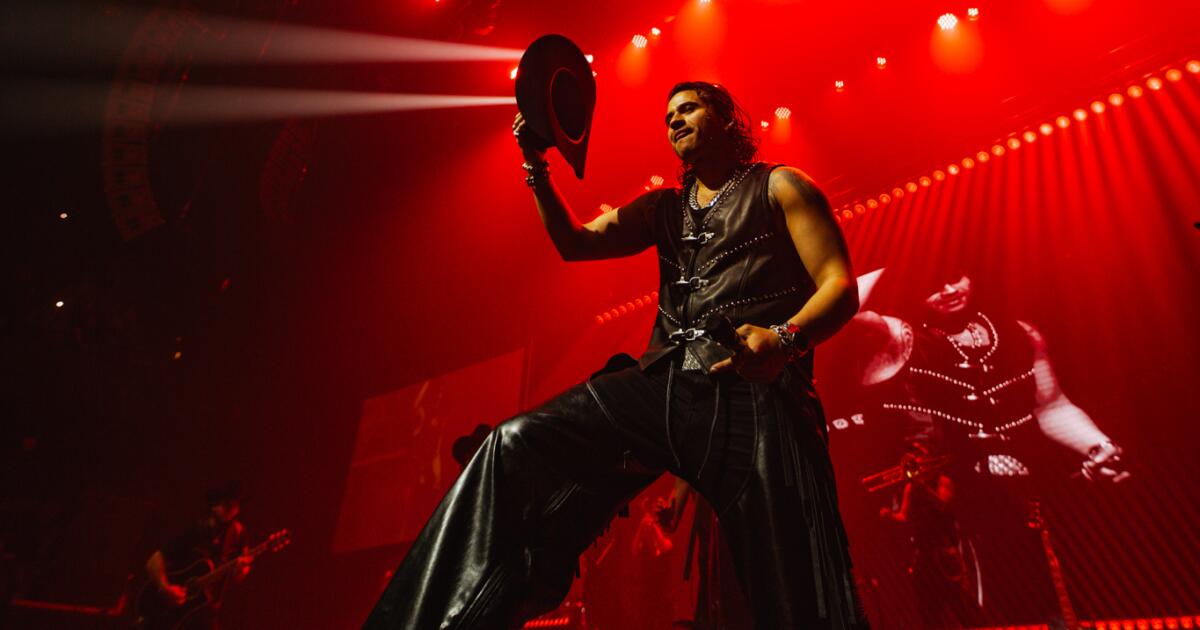
What started off as a trailblazing music partnership between música mexicana band Fuerza Regida and L.A. label Rancho Humilde has now fizzled into a sticky online drama.
On Saturday, Fuerza Regida frontman Jesús Ortiz Paz, better known as JOP, took to his personal Instagram account to post a statement addressing the band’s ongoing legal battle with the independent label led by music mogul Jimmy Humilde, who signed the band in 2018.
“To everyone who supports Fuerza Regida, you deserve to hear our music,” Ortiz Paz wrote in a public statement. “You deserve to see us perform at the World Cup. You deserve to listen to us on the MLB [Major League Baseball] album.”
This statement, which has since disappeared from JOP’s Instagram post, alleged that music created by the música mexicana group “keeps disappearing.”
Among the songs that have been taken down from streaming platforms by Rancho Humilde are “Triston,” “Todos nos Shipean” and “67,” according to the band’s publicist.
In September 2025, Rancho Humilde filed a lawsuit against Fuerza Regida, alleging breaches of contract for unilaterally collaborating with artists outside the label — such as Chino Pacas and Drake — and signing exclusive live performance deals with Apple Music and Live Nation.
Fuerza Regida countersued, alleging that Rancho Humilde withheld millions in royalties and attempted to “sabotage” the band’s success, including by neglecting to submit its music for consideration ahead of the 2024 Latin Grammys.
The case is still making its way through the courts.
“Everyone knows [what’s] going on[.] [You see] it [in the] media, [that’s] why I’m going to let justice do its job, everyone is going to know who you really are,” the post by JOP continued in both English and Spanish. “[He who has nothing to hide has nothing to fear], go let [Jimmy Humilde] & [Rancho Humilde] know how you feel, make your voice heard. Our story isn’t over I promise.”
Humilde responded to the artist in the comment section shortly after the post was made public.
“You asked me for a bigger [deal], I got it done. You asked me for your [masters], I fought to make it happen. You wanted to become one of the biggest artists in the [world], I have everything I had to help build that dream,” wrote Humilde.
“When you needed help, I didn’t just bring business. I brought my lawyers, my doctors, my relationships, my time, and my heart. I stood by you when it mattered the most,” Humilde continued. “You walked away with the biggest check of your [life,] over $50 million. I never complained. I was happy to see you win because your success was our success.”
“What hurts is seeing everything we’ve built together reduced to a public narrative that doesn’t tell the whole story. If you believe people deserve the truth, then honor the agreement we made. Complete the contract the same way I honored every commitment I made to you. I never stopped looking out for you. I only ask that you do the same. [He who has nothing to hide has nothing to fear].”
In a separate comment — which Humilde uploaded to his own Instagram account with Fuerza Regida’s own song “El Dinero Los Cambio” (which describes how money can change someone) — the label head pushed back on allegations of robbery: “I robbed you? Robbed you of what, fool. You didn’t even have a dollar for me to rob.”
The music mogul also accused JOP — who founded his own label Street Mob Records in 2018 — of sabotaging his own bandmates. “Let’s talk about [how] your own band members went from partners to being employees. They didn’t have much of a choice.”
“And let’s not forget I helped you land a $15 million deal for your label. After that, how you choose to take care of your artists is on you. [Let’s] ask Chinito [Pacas], Calle [24] and Armenta!!” added Humilde, including the names of artists signed to Street Mob Records.
JOP of Fuerza Regida performs at South By Southwest on March 13 in Austin, Texas.
(Cat Cardenas / For De Los)
In an email to De Los, Humilde’s lawyer, Mike Trauben, pushed back on claims that Rancho Humilde is trying to stop Fuerza Regida from making music and obtaining other opportunities.
They cite two recent deals that were approved by Rancho Humilde, including Fuerza Regida’s appearance on “Grand Theft Auto” and in the online video game “Fortnite,” which aligns with the contractual framework both parties had negotiated.
With regards to the proposed MLB and FIFA collaborations, Humilde’s council said that Fuerza Regida sought to prevent Rancho Humilde from exercising its claimed contractual rights, which was ultimately denied by a federal court.
The reason certain songs were removed from streaming platforms is because Fuerza Regida chose to release music outside the agreed Rancho/Sony distribution structure and without the approvals required under the parties’ agreements, per Humilde’s lawyers.
“Ultimately, this case is not about stopping an artist from succeeding,” wrote Trauben to The Times. “It is about whether sophisticated parties are required to honor the agreements they voluntarily negotiated after success had already arrived.”
According to Trauben, Rancho Humilde and Fuerza Regida, both parties entered a completely new agreement in 2022 that fundamentally restructured their entire business relationship, fully terminating the initial 2018 contract in place. As a result, Fuerza Regida received a flat million-dollar bonus, Rancho Humilde converted its ownership of existing masters into a 50/50 structure and the two entered into a new agreement, which Humilde’s lawyers claim favors Fuerza Regida.
“This case is not about whether artists should have rights. They absolutely should. Nor is it about preventing Fuerza Regida from making music,” wrote Trauben. “Rather, this case asks a much broader question that affects the entire music industry: Do contracts still matter after artist success arrives?”
The Times reached out to Fuerza Regida’s attorney but did not hear back as of this publication.
-
 Lifestyle22 minutes ago
How should we behave online? : It’s Been a Minute
-

 Technology32 minutes ago
After a great start, DC’s new cinematic universe is already slowing down
-

 World37 minutes ago
UK asylum seekers could have to pay government $13K before applying for settlement
-

 Politics44 minutes ago
Fetterman unleashes on ‘dirtbag’ wing of Dems after far-left victories: ‘Orgy of socialism’
-

 Health47 minutes ago
Doctors thought man had brain cancer — they found live tapeworms instead
-

 Sports52 minutes ago
Paraguay stuns four-time World Cup champions Germany in penalty shootout after controversial call
-
 Business1 hour ago
Comcast is spinning off NBCUniversal media and entertainment assets
-
Entertainment1 hour ago
Alannah Keyser is latest fired ‘Love Island USA’ contestant to apologize for using a racist slur

