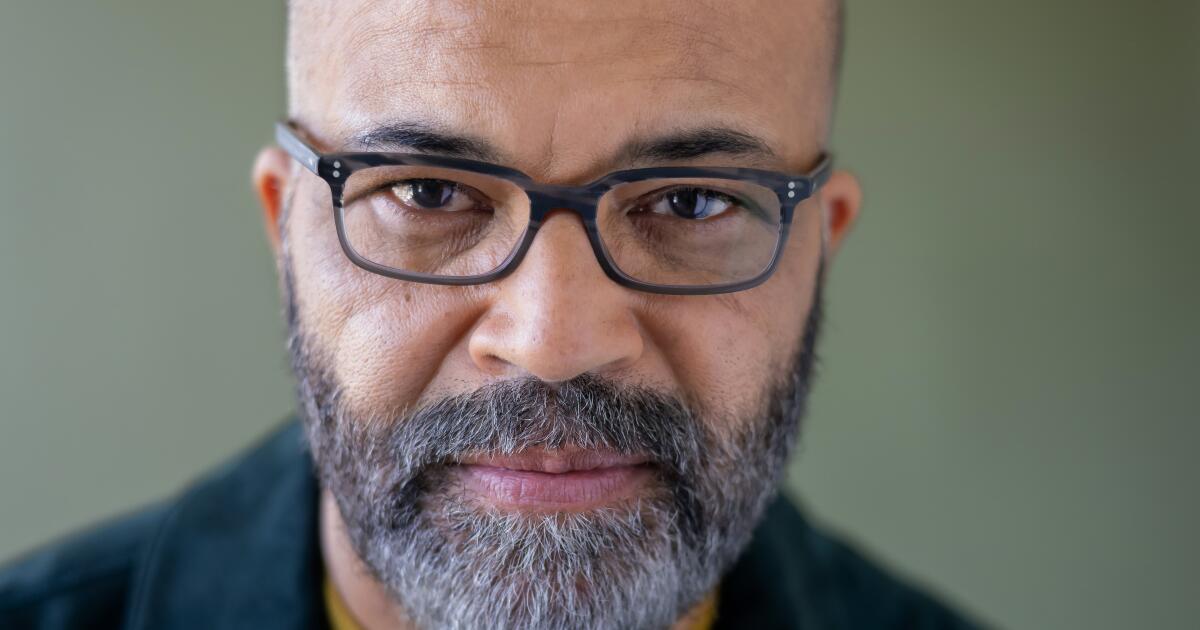
“I’d never had a meeting like that before in my career for any film that I’ve been a part of, and certainly not one that I was the lead in,” Jeffrey Wright says of a post-actors’ strike meeting that was filled with people planning out his promotional schedule for “American Fiction.”
(Christina House/Los Angeles Times)
Jeffrey Wright finished shooting “American Fiction” two Septembers ago and immediately, happily transitioned to becoming what he calls his daughter Juno’s “executive assistant,” helping her navigate her way through college applications and all the other stresses of a high school senior year. When she went off to school in the fall, Wright thought he’d feel liberated, that he’d enjoy, as he puts it, “a new phase of freedom.”
“But I realized that I’ve been doing the father thing for 22 years now, and I think I’m finally good at it,” Wright says, punctuating the thought with a laugh. (He also has a son, Elijah, with ex-wife Carmen Ejogo.)“Being a father has kind of been the primary thing I’ve been … and now I miss it.” He pauses, as he does often in conversation. Wright is a man who considers every word. “Yeah … I wonder what’s next.”
Advertisement
We’d just met 15 minutes ago. Being a father is how you see yourself, I ask. More than an actor?
“Oh, f— yeah,” Wright responds without hesitation.
“So, in a way, my life seems purposeless now,” Wright continues. “It certainly seems empty in multiple ways.”
This sounds serious. And it is, though two things should also be noted up front. First, pretty much everything Wright says in his deliberate, resonant voice echoes with meaning, with contemplation, with weight. He could read the Taco Bell menu — chalupa su-preme — and convince you that it’s a lyrical wonder.
Second: Wright’s doing OK. Really. He’s just a man given to introspection.
Advertisement
In the fall, Wright had time, too much time, really, to reflect. The actors’ strike prevented him from taking a job or going to the Toronto International Film Festival, where “American Fiction” premiered and won the event’s audience award. Wright would have loved to be there and talk about playing Thelonious “Monk” Ellison, an author and professor, who, frustrated with his career, drunkenly cranks out “My Pafology,” a pandering book that fully embraces cliches about the urban Black experience. Improbably or maybe naturally — the film lets you decide — it becomes a bestseller. Monk, an artist, doesn’t know how to feel about its success. After all, he wrote it in a fit of pique.
Jeffrey Wright, left, as Thelonious “Monk” Ellison and Sterling K. Brown as his less responsible brother Cliff Ellison in “American Fiction.”
(Orion Pictures)
So, yes, much to discuss — only Wright couldn’t say a word. So instead he headed west from his Brooklyn home to a Malibu rental just down the coast from fried seafood destination Neptune’s Net, where he keeps his surfboards, truck and bicycle. Time to work on himself. Mind. Body. Spirit. Find some decent waves. Power through eight-mile bike rides through the hills. (“I’ve got a little e-assist,” he says of his electric ride. “I try to use it in moderation … but it is uphill.”) Regular workouts at a wellness center, doing Pilates, acupuncture and weight training.
Advertisement
“I was trying to get back to the old ways a little bit, to the extent that that’s possible in these older times,” Wright, says. He recently turned 58. He knows he’s not going to get back to the shape he was in when he played lacrosse in high school and college. He couldn’t, even with all the training in the world. That’s because when he was 24, Wright was playing Puck in a touring production of “A Midsummer Night’s Dream,” and at the end of the first act, he leaped offstage and tore his ACL.
“The loudest silent scream in the history of theater,” Wright says.
Did you return to stage?
“Limping,” Wright says. “But, yeah, there was a second act to do.”
Being “young and foolish,” he never got the knee fixed until eight years later when it locked up on a backswing playing golf. It’s still not great, but being out in the ocean helps. Wright started surfing about a dozen years ago and became passionate about the sport when he moved to Los Angeles after getting cast on the HBO series “Westworld” in 2015. For the show’s first two seasons, he lived in Santa Clarita. Then he moved downtown. Then to Marina del Rey. Finally he got this seasonal rental, just south of the Ventura County line. It’s his through March.
Advertisement
“The single advantage of living out here is the Pacific Ocean,” Wright says. “It’s just a magnificent creature. I could never leave it.”
The morning after the actors’ strike ended in November, Wright opened his email and found a message from one of the “American Fiction” producers. You want to come in for a meeting? When? Tomorrow morning, 10 a.m. at MGM. When Wright showed up, he was taken aback. There were two dozen people in the room brimming with energy and ideas, spitballing how to support the film. One person handed him a tentative promotional schedule. It ran through March.
“I’d never had a meeting like that before in my career for any film that I’ve been a part of, and certainly not one that I was the lead in,” Wright says.
Really? Not with the three Bond movies, the “Hunger Games” trilogy or the last “Batman” reboot? Or with “Westworld” or the two movies he made with Wes Anderson?
“Nope,” he answers. “Never.”
Advertisement
“The single advantage of living out here is the Pacific Ocean,” Jeffrey Wright says. “It’s just a magnificent creature. I could never leave it.”
(Jason Armond/Los Angeles Times)
When Wright earned his first Oscar nomination a couple of weeks ago, that tentative schedule they gave him became permanent, including more post-screening Q&As, more career retrospectives (“it’s like your life passing in front of your eyes”), more interviews like this lunch conversation we’re having, all of which inspire the kind of “intense self-reflection” that Wright hopes might end up being a constructive exercise somewhere down the line.
After he heard he was nominated, the first person Wright called was his 94-year-old aunt, the woman who helped his late mother raise him. (Wright’s father died when he was 1.) She lived with Wright for a couple of years until Wright had a house built for her near the Chesapeake Bay, where the sisters grew up.
Advertisement
“I called her and asked, ‘Did you hear any news this morning?’ ” Wright says, smiling. He made the call because his aunt’s eyesight isn’t so good. “She said, ‘Oh, I heard. Congratulations.’ ” Pause. “ ‘But you know, you should have been nominated a long time ago. You should have been nominated for “Basquiat.’ ” Wright laughs. “That’s the way she is.”
The aunt was the first person he called, but not the first person he talked to that morning.
“I was in my lounge/office area in Brooklyn. I actually grabbed some dumbbells that my son had in there for whatever reason,” Wright remembers, pantomiming doing bicep curls at a furious pace. “And I glanced at my phone and a message pops up. ‘Congratulations.’ And then I looked up and saw the picture of my mom on the bookshelf.” He smiles. “We had an exchange.”
Wright’s mother, Barbara Whiting-Wright, had come up several times during our conversation. An attorney, she was the first Black woman to serve as customs law specialist for the U.S. Customs Service, where she began her legal career in 1964. She also had season tickets to Washington’s professional football team and a record collection that included Miles Davis’ “Live-Evil.” She died four years ago from colon cancer.
“As far as my life goes, she was a visionary,” Wright says. “My mom basically lined up a series of doors around me from a very early age. And they all led to someplace good.”
Advertisement
“Pretty tough too,” Wright adds, making sure he painted a full picture. “She had expectations.”
Did you feel like you met them?
“When I described to a very good friend of mine how I had taken care of my mom at the end of her time, he said, ‘Her investment paid off,’ ” Wright says. “He knew my mom pretty well. I think what I had described to him, what was reasonably comforting to me, was that she trusted me. And that was cool.”
Wright looks down. Our table has been cleared. We’re well past the time we said we’d talk, and he’s had adequate introspection for the day.
“All right, enough of this,” he says, rising, extending his hand. Time to head home.
Advertisement
Too late to surf? Probably. But Wright already has one session circled on his calendar.
“I’ll be out in the Pacific on the morning of the Oscars,” he tells me. “It calms the system.”
A deliriously funny riff on The Wizard of Oz from director David Wain, Gail Daughtry and the Celebrity Sex Pass is a goofy patchwork of ideas. Some of them don’t work, but most of them do if you’re in on the joke. Written by Wain and his longtime collaborator Ken Marino, the comedy features an incredible number of hilarious people, sometimes playing absurdist versions of themselves. Jon Hamm, Jennifer Aniston, John Slattery, and Elizabeth Banks, among others, cameo alongside a cast of lesser-known but no less talented performers. Headlining the movie is Zoey Deutch, who, amid an impressive list of credits, has proven her knack for ridiculous humor like this (see 2019’s Zombieland: Double Tap). Wain directs a series of episodic segments that follow characters who skip along a yellow brick road of surreal gags and jokes about Hollywood. It’s all a bit nonsensical and ludicrous, but it made me laugh a lot.
For those of us who loved MTV’s sketch-comedy show The State (1993-1995) or Wain’s spoof movies such as Wet Hot American Summer (2001) and They Came Together (2014), Gail Daughtry will feel like a warm blanket. The State was a comedy troupe nesting ground for talent, many of whom went on to create and appear in dozens of other shows (Viva Variety, Reno 911!, Childrens Hospital, etc.), while member Michael Showalter has become a well-respected director whose output includes the indie comedy The Big Sick(2017) and the upcoming Colleen Hoover book adaptation Verity. Whenever Wain and Marino reteam with various members of The State (Michael Ian Black, Thomas Lennon, Kerri Kenney-Silver, Joe Lo Truglio, et al.), there’s usually something special in store. Even if the material doesn’t always work as a whole—see The Ten (2007), an anthology movie that pokes fun at the Ten Commandments—the result is bound to include some big laughs.
Deutch plays the titular Kansas bumpkin, a hairdresser who plans to marry her fiancé and lifelong sweetheart, the ingeniously named Tom Soursap McNoodleman (Michael Cassidy), in two weeks. At once naive and intense, she’s never been with anyone else. Neither has Tom. But after sharing their picks for a celebrity sex pass, Tom almost instantly encounters his choice in the flesh and then takes advantage of the opportunity. Burned because she didn’t actually think they were serious about following through, Gail resolves to seek out her chosen celebrity, Jon Hamm, and have sex with him to balance the scales. And so, Gail is off to see The Wonderful Wizard of Hollywood, alongside her coworker named Otto (Miles Gutierrez-Riley), an anagram of Toto. As the story unfolds, Gail Daughtry spoofs the structure of Dorothy’s adventure to Oz, except that Gail’s destination is Tinseltown.
Just as New York was “another character” in They Came Together, Los Angeles becomes one here. But instead of capturing the city’s flavor, Gail and Otto gravitate toward CityWalk at Universal Studios and, based on their hotel concierge’s recommendations, other local hotspots such as McDonald’s, Starbucks, and 7-Eleven. Gail and Otto begin searching for Hamm and gather friends along the way. Among them are Vincent (Marino), a former paparazzo who dreams of snapping a photo of Hamm; Caleb (Ben Wang), an aspiring CAA talent agent; and the crazed Slattery, who wants to work with Hamm again after their Mad Men days. Hot on their trail are two cartoonish mobsters (Joe Lo Truglio, Mather Zickel) desperate to recover a briefcase that was switched with Gail’s at LAX and contains information about their boss’ (Sabrina Impacciatore) plans to dismantle the global financial system. Their quest eventually brings them to Hamm, whose private security (Tobie Windham) enforces not with his fists or a taser, but with an obscure promise to make anyone who tests him “real sick.”
Advertisement
Gail’s travels are occasionally interrupted by Fourth Wall-breaking commentary from the film’s narrator, a mailman played by Fred Malmed. It’s one of the aspects of the movie that doesn’t work, but Gail Daughtry’s frameworkis less essential than the inspired jokes throughout. Wain and Marino riotously showcase the most banal aspects of LA, a signature of their delightfully dumb humor, which almost always lands as intended. Granted, some unfamiliar with their brand of comedy may take a while to get on its wavelength, and others may never understand why it’s funny. Still, there are enough non sequiturs and random punchlines blended with raunchy and occasionally dark-as-hell asides to keep the viewer off-kilter yet chuckling throughout.
There’s an irreverent surprise around every corner in Gail Daughtry, and Deutch fits right in with her comedian costars. Her impressive range renders the silliest moments without winking at the audience, but she also never reduces her character to a mere comic device. It’s also a joy to watch celebrities of Hamm and Aniston’s caliber poke fun at their image, even if the movie doesn’t challenge Being John Malkovich (1999) in its self-referentiality. Outside of last year’s disappointing The Naked Gun, few comedies today attempt to be pure joke machines. Wain and Marino deliver a movie that will probably take some time to be discovered and cherished for what it is, but after a few rewatches, much like the director’s other features, it’s sure to become a cult favorite.
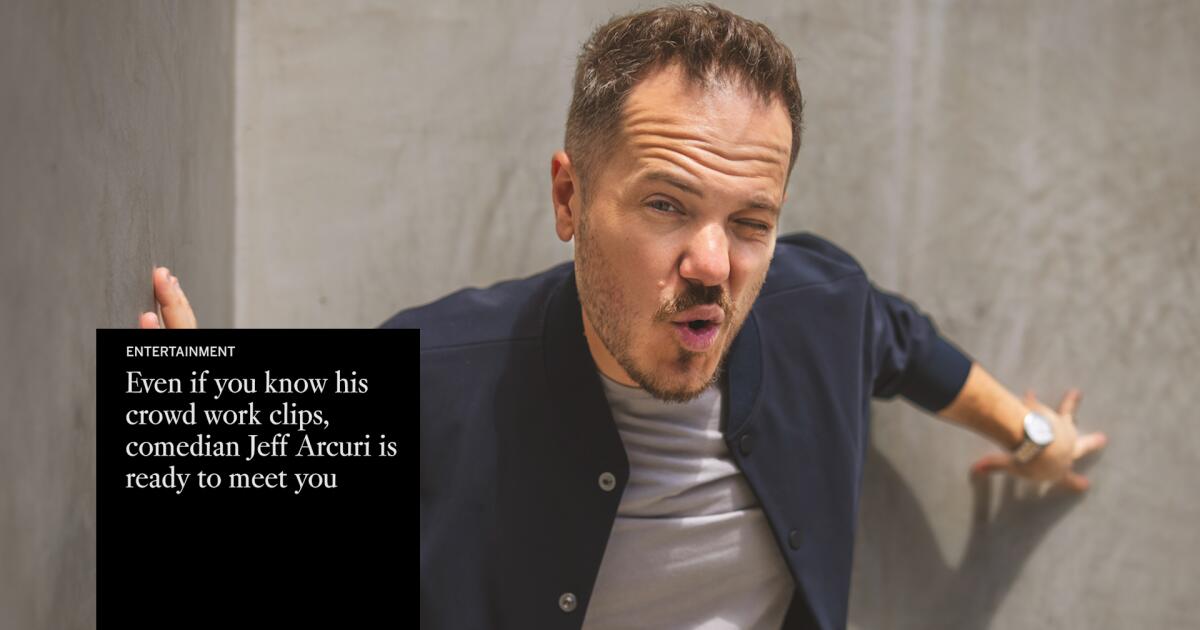
Life is a bit surreal for Jeff Arcuri these days. Though he’s been a stand-up comedian for over 14 years, most people in the world never knew it until clips of him joking around with audiences at spots like the Comedy Cellar in New York started going viral a few years ago. But while there’s no shortage of comics who’ve cracked the code to instant follows and likes (and plenty of scorn) by posting crowd work, Arcuri’s path in comedy has always been a coping mechanism for ADHD and razor-sharp situational awareness mixed with an overall lack of filter. At heart he’s always been a people person, even if he believes them less and less when they now say they’re fans of his.
“Is this ‘The Truman Show?’ I have that thought all the time where everyone’s just being nice and following me because they feel bad for me,” he tells The Times. “It’s crazy, all of it is crazy and I appreciate it every day.”
What he’s referring to, other than the millions upon millions of views online, is how recent internet fame combined with long-term anonymity in the comedy scene has fueled the rocket that’s sending him into a new level of notoriety on Netflix when his debut special “Nice to Meet You” drops on Tuesday. The new hour, performed in the round, tests Arcuri’s ability to remember minute facts and callbacks from random people in the crowd as well as his written material about his personal observations on life, family and his wife Katie Thurston — star of “The Bachelor” and “The Bachelorette” — who is currently battling Stage 4 breast cancer. Despite the low moments they’ve gone through this year, getting a debut special was his chance to share how he and his reality star spouse have found ways to laugh through their everyday struggles.
This interview has been edited for length and clarity.
Let’s talk about the weird level of fame that you’ve attained right now. You are the guy everyone sees on their Instagram reels but at the same time they’re like, “Who is that guy?”
Advertisement
Oh, 100%! My Uber driver, on a 45-minute ride here, we talked the entire time. As soon as I got in, he goes, “You do comedy?” I go, “Yeah, man,” We start talking, he’s asking me questions, we’re talking about comedy, and then we pull up, and he goes, “What’s your name, by the way?” He was quoting videos of mine the whole time, and then I wrote it down for him, I was like, “My special comes out July 7, give it a watch,” and he’s like, “All right, man, I only have YouTube, though.” I was like, all right, just lie, you don’t need to say that… In the airport I get a lot of people squinting and then I’ll see them look at their phone and try to figure out “how do I know this person.”
How have your crowd work clips on social media changed your career?
Immensely. I think it was the only way for me to put out as much content as I could and still perform live. It’s a beautiful thing, in my opinion. I get to show my improvisation, and yet still work on the written part personally, and like I get to repeat that joke for a year touring, as opposed to a crowd work moment, it happens, it’s done, I’m not gonna ever repeat that moment ever. So I think it’s just kind of a blessing that social media and everything took off at the same time the improvised crowd work took off, something that I had been honing for years prior to that, just because that’s what I did in my comedy, I just never had social media.
There’s so many opinions out there about crowd work, which, as I’m sure you know, aren’t always positive. Why do you think people are so triggered by crowd work?
There’s a lot of bad crowd work out there, just like there is bad anything else — fledgling or whatever rookie stuff. I think it’s died down, if I’m being honest. I think the main reason for the hate is because a lot of people started to try it that weren’t doing it, or whatever. And so there’s a lot of people that tried it because they saw the success. I was fortunate enough that I was already doing it, and so then I just applied it to social media. At no point in my career did I say, “I’m going to start talking to the audience.” I always did that. I’ve done that for over 14 years at that point when I started doing crowd work stuff, where it’s just a fun way to extrapolate on an idea. The fourth wall is broken in stand-up comedy the second you walk on stage. Any comedian that tells you otherwise is a liar. [If a comedian is saying] you don’t get to talk, just watch this, it creates this elitism that I don’t like in comedy. I want it to feel like it’s a conversation, so why would I shut off the other half of that conversation?
Advertisement
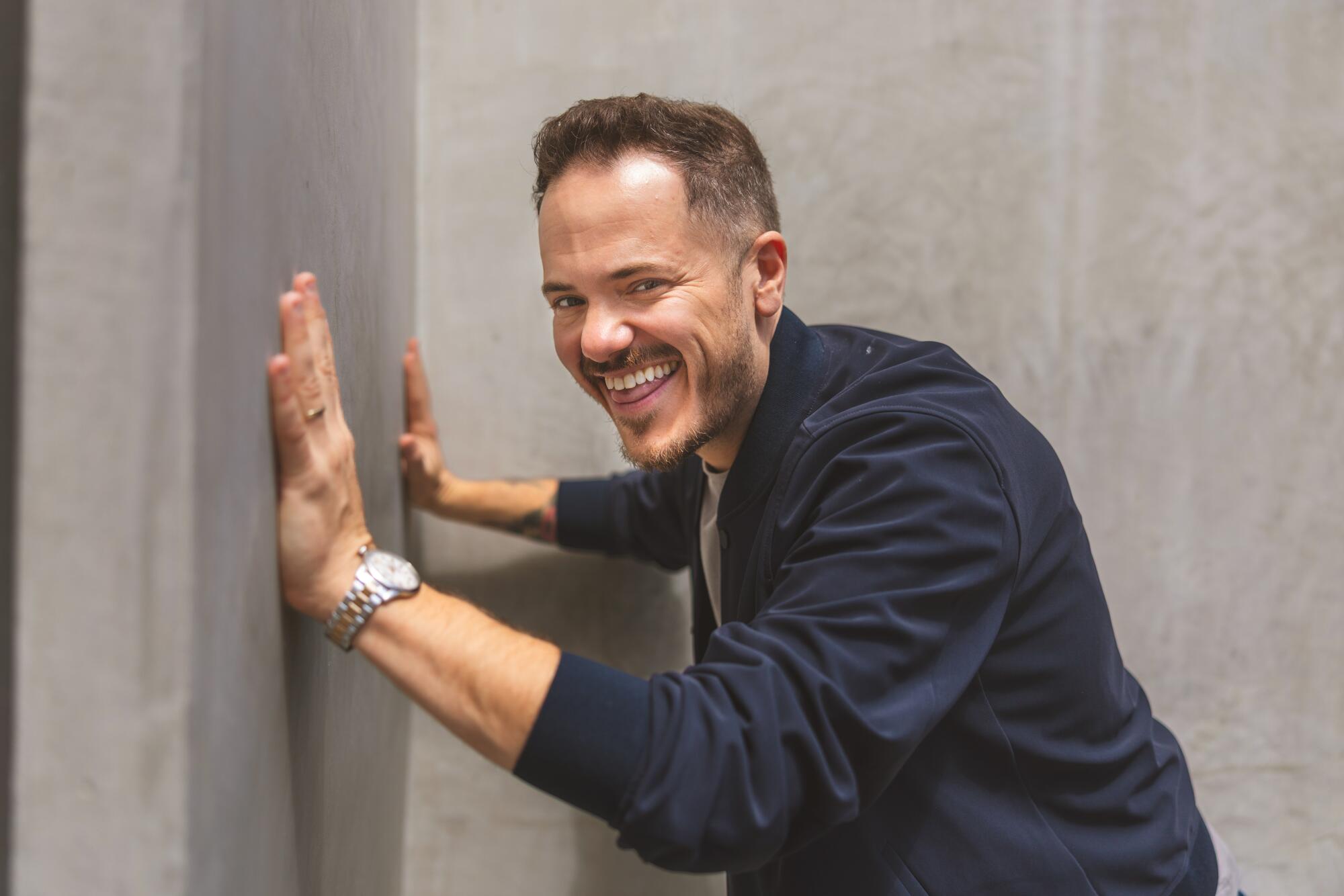
Jeff Arcuri considers his stand-up comedy to be a conversation.
(Jason Armond / Los Angeles Times)
What about comedians who complain about it?
It makes me cringe when I see comedians complaining about crowd work. Why are you worried about what you’re not doing? Do your thing, and then succeed. Don’t try and latch on to whatever the success is, and then complain that it didn’t work for you when that wasn’t your forte to begin with. I’m not gonna say I’m the best at certain things. There are comedians that have way better written jokes than I do, of course, that’s great, and I think that they should follow that.
Advertisement
I would say your skill falls somewhere between like situational awareness and ADHD.
Dude, I’m ADHD mid-sentence. I’ll forget why I was even talking about what I started talking about. It happens all the time. It’s a superpower.
Share via
Advertisement
Advertisement
After Netflix called you, what was the first thing you did to prepare for the special?
So that’s kind of hard, because last year was a big year for, like, health-wise for my wife. She was diagnosed with cancer and everything, so it was a lot of adjusting on the fly. [We found out about the special] within a day or so of finding out that she was misdiagnosed and her cancer was actually in a better place than where we thought it was … so it was a great week for us. So, it was very surreal, but it was then a switch to [prepping for a special] because I’m not going to record a special talking about [my life] prior to my life. It felt weird being able to talk about dating, talking about sex life, things like that when I just got married, so a lot of the special, I would say at least half, was written within a year of the taping, on the road that year, going through what I was going through with my wife. A lot of comics, especially for a special, [are] cooking for 10-15 years, and then you get to put out the body of work.
Your wife Katie Thurston has been the star of hit reality TV shows “The Bachelor,” “The Bachelorette.”After getting married,did comedy prepare you in any sort of way to kind of take that level of scrutiny?
Yes, I would say so. I had to, you know, take it on the chin, or whatever. Every comic knows when you scroll your video for comments to see what people said, you’re not scrolling to read all the appreciation. You’re scrolling, looking for one person that’s like, “this guy stinks” and then you go, “that’s my day. This is what everyone thinks of me right now.” So, I guess I was used to that in a certain way, a little bit, but her type of fame, I guess you could say, is way different than mine, and that hers is based on her personality and person completely, and mine is my presence on stage. So I always had that separation of privacy versus public. Hers was always intertwined, so that’s something that I didn’t really get used to.
Jeff Arcuri’s written work for “Nice to Meet You” is recent because his and his wife’s lives changed in the last year.
(Jason Armond / Los Angeles Times)
Advertisement
You guys find a way in the special of battling through it with jokes about Stage 4 cancer.
There’s jokes that she’s made throughout the year that I would do on stage even after clearing it and saying, “my wife said this and she has cancer, and here’s the joke,” I still get people like, “Oh, come on, don’t make that joke, dude.” I’m like, “I didn’t. She did. I’m just telling you what happened.”
So it was kind of like dancing around that. We’re like, “We want to let people know that we make dark jokes about her life, about her cancer, about our situation, and not every joke, just like every couple, not every joke is meant for to be for everybody,” but I really wanted to let everyone know she is so funny, and she handles handles with such a smile. We just deal with it with with humor, and I wanted to express that. I think I did. I think I was able to do that without putting too many people off.
You’ve been a New York guy for a long time. What are some of the main differences between the N.Y. scene and L.A. scene?
Advertisement
I would say I’ve met more comedians that just want to do comedy in New York, met more comedians that love stand-up for stand-up. I’ve met a lot of comedians in L.A. that have five projects going on, and so when I wanted to pursue stand-up further, that’s where I decided to harness and go in there and do that, because I’m like, I don’t care about anything else right now, I want this to work for me. In terms of the comedy, like I do feel L.A. is the more there’s a lot more performance in the comedy, which is great in itself too, but I feel like sometimes L.A. leans more on performance and New York leans more on structure and word economy. There’s a lot more dry comedians coming out of New York. I’m a mix of both. I’m not the best writer, not the best performer. I’m right in the middle there, baby. I can do a little bit of both.
Jeff Arcuri is a New York-based comedian but loves performing in the Midwest.
(Jason Armond / Los Angeles Times)
What’s the best city you’ve ever experienced for crowd work?
I love the middle of the country. I love the Midwest and the “flyover states.” Because you go there, people will tell you stories that are normal to them and you’re like, what the f—? And it’s their ex, they’re expressing it there, you know. You go to New York and you do a set in Brooklyn or in Manhattan, wherever, that’s the ninth show they’ve seen that week. It’s more of a big deal to people in the Midwest, and you’re getting more real answers, you’re getting people that are going back to work the next day.
Olivia Wilde’s new comedy drama is “the kind of smart, well-crafted film for adults we are constantly complaining we don’t get enough of,” said Benjamin Lee in The Guardian. Wilde, in her third directorial offering, co-stars as a stay-at-home-mom who, to the consternation of her failed musician husband, Joe, has invited the freewheeling couple upstairs to dinner. With Seth Rogen, Edward Norton, and Penelope Cruz filling out the cast, the charged get-together soon turns into “a night that Edward Albee would approve of,” except that this evening hits peak tension when the guests extend a surprise invitation to join them for a night of group sex.
The Week
Escape your echo chamber. Get the facts behind the news, plus analysis from multiple perspectives.
SUBSCRIBE & SAVE
Advertisement
Sign up for The Week’s Free Newsletters
From our morning news briefing to a weekly Good News Newsletter, get the best of The Week delivered directly to your inbox.
From our morning news briefing to a weekly Good News Newsletter, get the best of The Week delivered directly to your inbox.
Latest Videos From
Perhaps because it’s an adaptation of a 2016 Spanish play that has spawned overseas film versions, The Invite is “an American film that feels vaguely international,” said Matt Zoller Seitz in RogerEbert.com. Though the first half is overdirected to the point of being “irritating,” the showy camerawork fades away as the actors take over, creating a second half that’s “the best work Wilde has yet done as a director.” While all four actors excel, “it’s Rogen who’s the revelation,” said Alissa Wilkinson in The New York Times. “His line readings fill out Joe’s backstory brilliantly, a guy who was always used to being rejected, somehow landed a girl way out of his league 20 years ago, and now is miserable that she doesn’t really want him anymore.” In this movie, relationships change because people change. “To me, that feels true.”
‘Minions & Monsters’
Directed by Pierre Coffin (PG)
★★★
Advertisement
Though they’re “one of the more enduring creations of 21st-century cinema,” the Minions “still get no respect,” said Scott Roxborough in The Hollywood Reporter. Maybe, though, this seventh film in the Despicable Me franchise will finally end a 16-year awards shutout, because it’s a love letter to cinema that argues, between its mile-a-minute gags, that the highest-grossing animated franchise of all time deserves a place in Hollywood’s canon. Minions & Monsters is “very much a film of two halves,” said Drew Taylor in The Wrap. In the first, a quick history tour revisits how bad Minions have been in their quest to find villains to serve, until one group lands in 1920s Hollywood and stumbles into stardom. A flurry of homages to Buster Keaton and other legends follows, until talkies arrive and put the gibberish-spouting Minions out of work.
Join 350,000+ subscribers and keep yourself informed with a selection of
The Week’s most interesting, enlightening and entertaining stories – plus daily puzzles.
The second half offers more-conventional Minion action, yet it “builds to an open-hearted tribute to the power of the communal moviegoing experience.” When two of the Minions start work on creating a monster movie using real monsters, this outing “does rather lose momentum,” said Guy Lodge in Variety. But as the film speeds toward a standard save-the-world climax, the latest Minions serves up the usual mayhem “with gusto and a delirious cartoon grin.” It’s “a clear peak for the series: a Minions movie with an actual idea at its core beyond general cheerful chaos.”