Entertainment
From Chris Isaak to Karen O, David Lynch's musical collaborators recount his strange, sonic mysticism


Back in 2013, David Lynch was in his home recording studio late one morning, surrounded by electric guitars of different shapes and colors. With effects pedals scattered at his feet, he opened a case with an orange sunburst lap-slide guitar inside. “This is the guitar that Ben Harper gave me,” Lynch said with a smile and genuine awe in his voice, dressed in a black suit jacket and shirt, gray hair piled high on top. “That thing makes a hell of a sound.”
The occasion was the coming release of his second solo album, “The Big Dream,” but it wasn’t the first or last time we talked about his music. He was a self-taught improviser on guitar, and a high school trumpeter, but he was drawn to any sounds that tapped meaningfully into feelings of heartache and tension, beauty and noise.
Over a half-century of work, he built a well-earned reputation as a surrealist auteur and master filmmaker. But Lynch, who died last week at 78, was equally passionate about other creative mediums, from painting and photography to designing furniture, and nothing held his imagination more powerfully than the music that filled his life and work.
We were in his fully equipped recording facility, called Asymmetrical Studio — built inside the house he once used as a location for his 1997 film “Lost Highway.” He spent a lot of his time there, and it was just one sign of his lifelong obsession with sound. It held an essential role in his life as a filmmaker and, eventually, a recording artist, songwriter and producer.
Angelo Badalamenti performs at the David Lynch Foundation Music Celebration at the Theatre at Ace Hotel in 2015.
(Chris Pizzello / Invision / AP)
Lynch was a rare director with a recognizable musical aesthetic, created with the help of composer and close friend Angelo Badalamenti, among many others. He was attracted to smoky electric guitar twang and the most abrasive industrial sounds, and to rich female voices and lush layers of strings and organ. The through-line were sounds that leaned toward the smoldering and idiosyncratic — from his use of achingly passionate songs of heartbreak by Roy Orbison and Chris Isaak to his own shadowy recordings with modern torch singers Julee Cruise and Chrystabell.
Among his musical collaborators was Karen O, singer for the Yeah Yeah Yeahs, who appeared on his first solo album, 2011’s “Crazy Clown Time,” and remembers Lynch’s sound as tense and passionate. “There’s an eroticism, there’s an urgency, there’s mystery, there’s darkness, there’s the edginess, the rebellion,” she says. “All that is in David’s musical taste.”
They recorded an ominous, twangy, thunderous tune called “Pinky’s Dream,” featuring a breathless Karen O vocal. “I’ve never met a Pinky,” she says now with a laugh. “It’s a character that inhabits a David Lynch dreamscape. The music is chugging along and you just feel like you’re on one of those lost highways.”
“I guess I like it low and slow, but I also like so many kinds of music,” Lynch told me during a 2015 visit to the painting studio behind his home high up in the Hollywood Hills. “I love what sound can do, what music can do, and to marry to the picture and make the whole thing greater than the sum of the parts.”
As a director, he showed a gift for placing music with stunning impact, from Samuel Barber’s deeply emotional “Adagio For Strings” in 1980’s “The Elephant Man,” to the raging thrash metal riffs of Powermad in 1990’s “Wild at Heart,” and Rebekah Del Rio’s torrid Spanish a cappella reading of “Llorando” in “Mulholland Drive.”
In “Blue Velvet,” Lynch created an eerie moment of romance and nostalgia in an otherwise disturbing scene as actor Dean Stockwell, in paisley tuxedo jacket, lip-syncs Orbison’s 1963 hit “In Dreams.” The song’s use in the film helped spark an Orbison revival, and Lynch soon co-produced a new version of the song with the singer and T-Bone Burnett for a 1987 retrospective, “In Dreams: The Greatest Hits.”
That love of music ultimately led the director to begin dabbling in creating some of his own, starting with his distinctive collaborations with Badalamenti, which stretched from “Blue Velvet” in 1986 until the composer’s death in 2022. It was an especially close relationship between director and composer that Nick Rhodes of Duran Duran compares to Federico Fellini and Nino Rota, who scored all of the Italian filmmaker’s films from 1959 to 1979.
Likewise, Lynch and Badalamenti were “so closely linked that they almost can feel each other’s heartbeats,” says Rhodes, whose band of hitmakers also worked with Lynch on a few occasions, including his remixing two of their songs.
“I always say Angelo Badalamenti brought me into the world of music,” Lynch said. “I played the trumpet when I was young and I understand music, but I was in love with sound effects. So I wanted to build a studio to experiment with sound, but I knew I wasn’t a musician really. Angelo said, ‘David, I need lyrics.’ So I started writing lyrics for Angelo, and we worked together. And that was a combo — the David Lynch and Angelo Badalamenti combo, and it brought out those things. That gave me more confidence.”
By the late 1980s, that impulse led the duo to Excalibur Sound Productions in New York City, where they worked on music with a young unknown singer, Julee Cruise, who had recorded their song “Mysteries of Love” for “Blue Velvet.” An album, 1989’s “Floating into the Night,” emerged after a year and a half of sessions, launching the single “Falling,” which had a second life as a theme for “Twin Peaks.”
In 2017, as the acclaimed third-season revival of “Twin Peaks” unfolded on Showtime, Cruise recalled to me the original directions from Lynch during her sessions. “He said, ‘Julee, you are a child full of wonder,’” said Cruise, who also performed the dreamy, mournful “The World Spins” on the series.
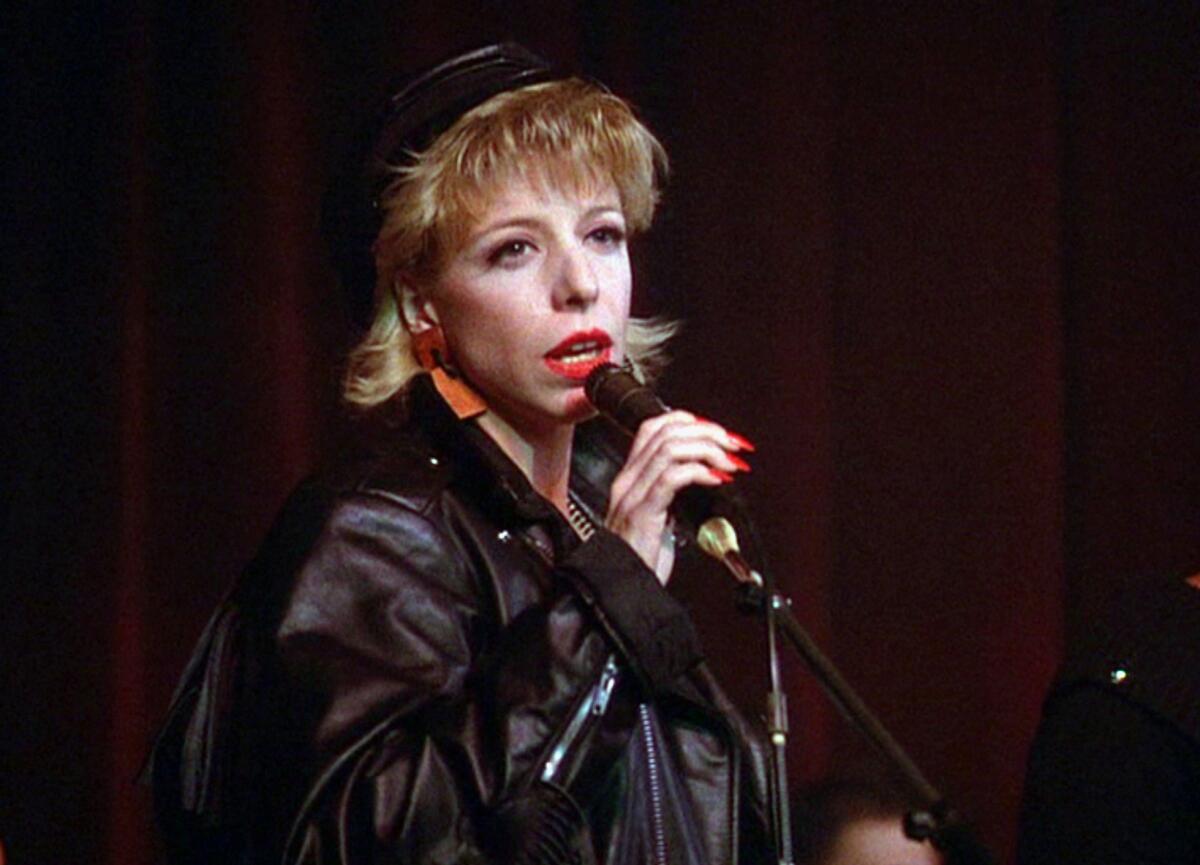
Julee Cruise sings the show’s theme song, “Falling,” in the pilot episode of “Twin Peaks.”
(CBS Photo Archive / Getty Images)
“I will always be known as this, and I will always be proud of this,” said Cruise, who died in 2022. Lynch also directed a one-hour musical film starring Cruise, “Industrial Symphony No. 1,” released in 1990 by Warner Bros. Records.
In subsequent years, Badalamenti was based in New Jersey, and made occasional trips to L.A. “Wherever we were, we would sit and make music,” Lynch said. Last year, the director expressed lasting sadness over the 2022 death of Badalamenti, who he called “my brother.”
“It just doesn’t seem possible that he’s gone,” Lynch said. “It just seems like I could call him up and we could make music again.”
In time, Lynch created multiple workspaces adjacent to his home in the Hollywood Hills: the recording studio, painting studio, wood shop and offices. He performed music live only one time, with his band Blue Bob in 2002, an experience he called “a traumatic thrill,” and something he wasn’t anxious to repeat.
“He wasn’t a musician. He couldn’t tell you, ‘I want an E minor here, and then I want to have eight bars of this,’” says Isaak, whose “Wicked Game” became a hit after appearing in 1990’s “Wild at Heart.” “We didn’t talk in that language.” Lynch went on to direct the music video for “Wicked Game.”
Aside from creating music alongside Lynch, Isaak appeared on camera in a prominent role in “Twin Peaks: Fire Walk With Me.” “I sure got lucky for how the stars aligned, that I got to work with him and hang with him and get to know him a little. I must have somebody up there looking over me because what a treat.”
Lynch was a filmmaker who treasured music enough to turn the Roadhouse bar in the 2017 season of “Twin Peaks” into a world-class nightclub, and included performances of complete songs in many episodes from the likes of Moby, Eddie Vedder and “The” Nine Inch Nails. In 1997, he’d recruited NIN’s Trent Reznor to create a soundscape for “Lost Highway,” and together they landed on the cover of Rolling Stone. (Lynch would later create a music video for NIN’s “Come Back Haunted.”)

Trent Reznor arrives at the Rock & Roll Hall of Fame induction ceremony in 2019.
(Evan Agostini / Invision / AP)
Some collaborations were less expected but just as rewarding. In 2011, Duran Duran asked Lynch to direct the livestream of a concert from the Mayan Theater in Los Angeles, as part of the American Express “Unstaged” series that matched musicians with filmmakers. The result was fully in character, photographed in murky black-and-white for a worldwide online audience, and layered with Lynchian imagery and juxtapositions: smoke, fire, strange objects and dead animals superimposed over the band.
“When something magical like that happens, you embrace it as quickly as you can,” says Duran Duran’s Rhodes. “I just love his vision and the world that he creates. I knew that merging with Duran Duran would be something mad, something surreal and beautiful and extraordinary that nobody would’ve ever expected. I felt that he had the same intention with what he was making with us. It was an absolute joy.”
For several years, Lynch harnessed his musical connections to raise funds and awareness for the David Lynch Foundation, established to promote the benefits of Transcendental Meditation. He hosted a series of music and art events on both coasts, including his popular Festival of Disruption, and a 2009 benefit concert with former Beatles Paul McCartney and Ringo Starr at Radio City Music Hall.
On his next solo album, 2013’s “The Big Dream,” he recruited Swedish singer-songwriter Lykke Li soon after she relocated to Los Angeles. He handed her a coffee-stained note with a few lyrics jotted down and said, “Make this into a song.” She accepted Lynch’s note as “a clue, a puzzle, a question” toward something new. She recast his words “I’m waiting here” as the title of the aching bonus track “I’m Waiting Here.” Recording the track was unlike a normal session.
“I’ve never done that again with anyone else,” Lykke Li says now. “He stood next to me and it was almost like he directed me how to sing. It was almost like a seance. It was really based on feeling and intuition.”
Lykke Li also notes that Lynch “saved my life,” by introducing her then to Transcendental Meditation at a time when things were fast-moving and chaotic in her life. “It was like only when I started meditating that I really found a center and it’s unlocked everything for me,” she says.
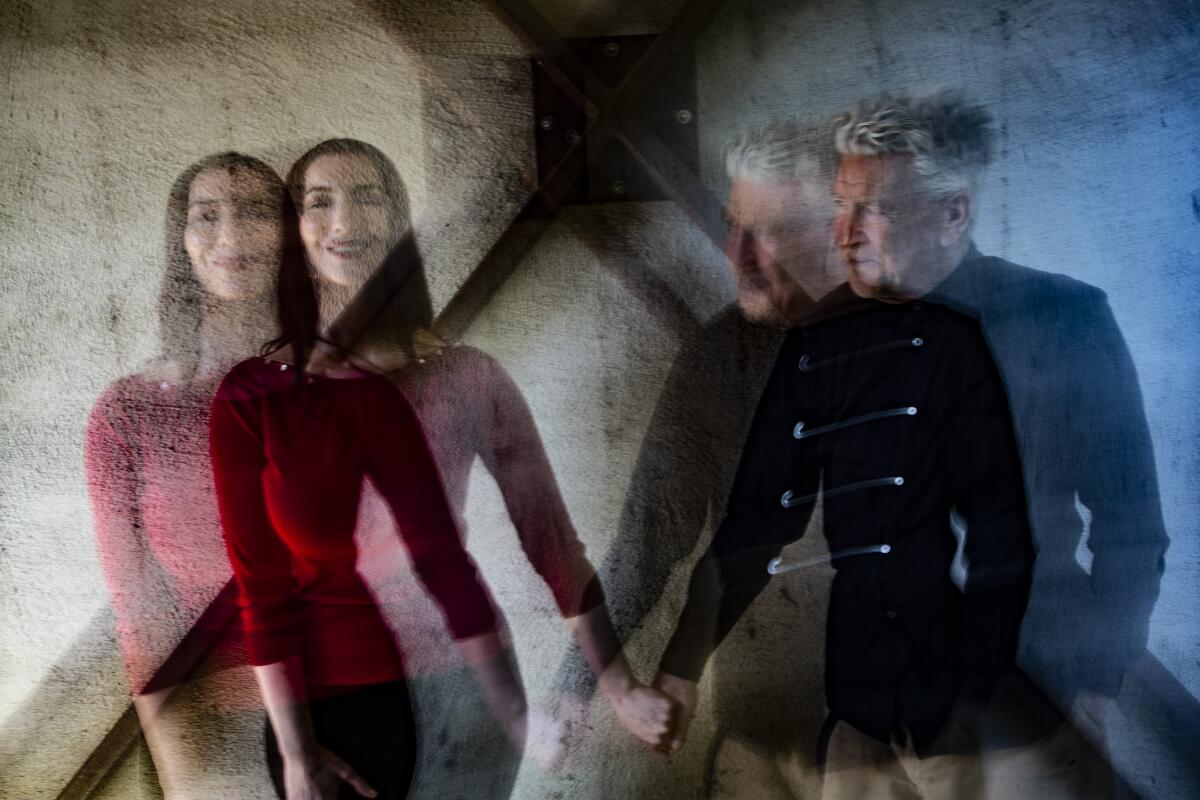
A David Lynch photo of himself with singer Chrystabell, with whom he collaborated on his final musical project.
(David Lynch)
The final project Lynch finished and released before his death was “Cellophane Memories,” a collaboration with Chrystabell, recorded at his home in 2023 and 2024. Unlike the songs of romance from their previous work together, the record was marked by an experimental layering of vocals and other effects that eased it deeper into the avant-garde.
“We were both doing what we love to do, which is to experiment and to create,” Chrystabell says now, days after Lynch’s passing. “His mind was always alive, always inspired. There were always things brewing.”
Along the way, the duo recorded several other songs in different modes, including an unfinished project that was to be called “Strange Darling.” But the filmmaker-painter-musician was already looking to their next round of songs together.
“David loved a great pop song,” the singer recalls. “That was the next thing we were going to do. He was like, ‘Chrystabell, should we write some hits next time?’”
Instead, Lynch’s musical friends and collaborators have been in mourning this week, grateful for their moments together, diving back into the work he left. Chrystabell says she has dealt with her close friend’s death by listening to music left behind.
“So much of our music is really tailor-made for these moments,” she says, recalling Lynch lyrics like “the great unknown,” “angel star” and “10 trillion miles of dark.” “He was right there, and we explored that territory. Lyrics could be cute and fun backseat kind of sexy or cosmic, otherworldly, spiritual, almost hymnal music. I was marveling at that. It all hits different now.”

Movie Reviews
‘Night Nurse’ Review: A Caretaker Explores Her Kink for Elder Abuse in the Year’s Strangest Erotic Thriller

There are any number of erotic thrillers in which rich old men are robbed blind and/or left for dead, but Georgia Bernstein’s admirably bizarre “Night Nurse” might be the first movie of its kind where elder abuse is the source — and possible subject— of its erotic thrills. If there are others, I’m not sure I want to know.
But this woozy debut feature doesn’t rely on its audience being turned on by the relationship between a nubile caretaker and her dementia-addled patient. Their psychosexual bond, meanwhile, hinges on cold-calling vulnerable old people under the guise of a grandchild in financial distress. (“I’m in trouble, nana, send me $10,000 or I’ll be left to rot in jail!” That sort of thing). With its slim wisp of a premise stretched into a Strickland-esque dreamscape that substitutes kink for conflict, the film itself hardly seems convinced by its own wrinkled lust — all desperate kisses and non-touching poses of subservience. More important to Bernstein is what that lust reveals about her characters’ deepest needs, specifically how their need to care and be cared for can be as easily perverted as any other form of desire.

As moody and weightless as the noir-accented score that blows through the movie like a curlicue gust of wind in an old cartoon (credit to musicians Sam Clapp and Steven Jackson), “Night Nurse” lacks the pulse required for its stray feelings to come alive. Still, the film ambiently taps into the latent eroticism of teasing out the distance between how you see yourself and who you really are. Bernstein plays with that distance like a telephone cord wrapped around her fingers, and Eleni — played by the excellent newcomer Cemre Paksoy, powerfully helpless — only frays even more as the receiver is brought near the hook. “Everything I did before today wasn’t me,” the nurse tells co-worker Mona (Eleonore Hendricks) after starting a new job at an Illinois retirement home. “It was somebody else.”
What she did before today remains unexplored (specifically, what she did to get herself fired from her last gig), but I’m guessing she’s probably changed less than she thought. There’s a faraway flicker in her eyes the moment she catches the vibe between Mona and Douglas (a ribald and elusive Bruce McKenzie), a white-haired seventysomething who shows early signs of dementia but still commands an undiminished sexual energy. “I’m not an invalid,” he coos as Mona bathes him in the tub, to which she replies, “yes, you are,” in a supplicant tone that hints at a rich history of power games between them.
Later that same night, Douglas will force Eleni to call a stranger, pretend that she’s their granddaughter, and ask for money — he’ll wrap the phone cord around the nurse’s body as she talks and shove her against the wall as they kiss. She’s into it. So into it that he has to clarify the terms of his whole deal: “If you’re looking for a pogo stick, I’m really not your guy.” But Eleni isn’t looking for anything to bounce on. She just wants to be needed, and maybe to need someone in return. Someone who will see her for who she really is and allow her the fantasy of pretending she isn’t being herself when she cons vulnerable strangers out of their money — when she exploits how enthralled those strangers are by the care they have for their loved ones.
“Night Nurse” doesn’t belabor the psychology, as Bernstein prefers to express her story through heavy-lidded suggestion. Somnambulating from the moment it starts, the film moves through a series of beautifully arranged poses that stretch their latent meaning thin across the surface (Lidia Nikonova’s cinematography lacquers every shot with a seductive dreaminess). We see Douglas smoking in a lawn chair with Mona and Eleni curled around his feet. Eleni riding in the backseat of a convertible as the wind blows through her curls. The full staff of nurses — all of them under Douglas’ sway — stumbling around his condo in a state of zonked out bliss as they roll on the prescription drugs they’ve stolen from the residents.
Once you’ve seen one shot of this movie, you’ve practically seen them all, at least until things escalate during a rushed and unsatisfying third act that forces Eleni into an honest confrontation with herself. People will do just about anything to feel needed — they’ll give whatever degree of care allows them to receive it in return. “Night Nurse” understands that desire, but remains far too numb to treat it.
Grade: C+
The Independent Film Company will relase “Night Nurse” in theaters on Friday, July 10.
Entertainment
Lucas Museum to give free annual passes to South L.A. neighbors, host community preview day

The Lucas Museum of Narrative Art, which is moving at light speed toward its Sept. 22 opening, announced Thursday that it will give free annual passes to its South L.A. neighbors living in the 90037 ZIP Code. The 300,000-square-foot, $1-billion museum located in Exposition Park will also host a special community preview day on Sept. 13, more than a week before the general public gets to step inside.
The 90037 ZIP Code has a population of more than 65,000 and is bordered roughly by the 110 Freeway to the west, Slauson Avenue to the south, Central Avenue to the east and Martin Luther King Jr. Boulevard to the north. Residents can register for passes at lucasmuseum.org/lm37 and will be alerted in August when the program launches. Pass holders can reserve tickets for themselves and one guest.
Tickets for non-pass holders go on sale July 21. They cost $25 for adults and $21 for seniors. Kids 17 and under are free.
“Storytelling has the power to bring people together and create a sense of community,” said Lucas Museum Chief Executive Tracey Bates in a news release about the program. “Through LM37, we are inviting our South Los Angeles neighbors to make the museum part of their lives and take their own path of discovery through the art, programs and experiences that will help shape this new cultural hub for Los Angeles.”
The community preview day is designed to give local business owners, community partners, civic leaders and registered LM37 pass holders a sneak peak of the 10,000 square feet of exhibition space, as well as the expansive gardens with 11 acres of park space.
The opening programming, curated by co-founder George Lucas, features 20 inaugural exhibitions across more than 30 galleries, including one titled “Star Wars in Motion,” containing vehicle designs, high-speed racers, flying vessels, props, costumes and illustrations from the first six films in the beloved franchise.
More than 1,200 objects will be on display from Lucas’ personal collection of narrative art. Highlights include work by Norman Rockwell and Dorothea Lange, as well as a variety of manga, children’s book illustrations and comics.

Last year’s “Superman” ended with Iggy Pop singing “Because I’m a punk rocker, yes I am” — an ironic coda for a superlatively square hero. But it rings straightforwardly true for Superman’s cousin.
Milly Alcock’s Kara Zor-El, or Supergirl, sports not a spandex suit but a Blondie T-shirt. When we meet her in Craig Gillespie’s “Supergirl,” she’s been on an interstellar bender for days. She’s more Courtney Love than Clark Kent.
Nonchalant and sarcastic, Kara is also a little Han Solo-ish, you might say, given that she moves capriciously through the galaxy in her junky spaceship while getting in fights in extraterrestrial bars. She’s a welcome, jagged riff on more buttoned-up superheroes, and Alcock is terrific in the role. If only “Supergirl” was as good as she is.
While the latest DC release, and second under James Gunn’s stewardship, has its moments, “Supergirl” struggles to match Kara’s punk-rock energy with an equally spirited supporting cast and story.
Skepticism seems to have gathered for “Supergirl” ahead of its release. Many fans have argued it wasn’t the right next step for DC Universe. But I’m not so sure. Alcock’s breezy cameo in “Superman” was one of that movie’s highlights. Handing the follow-up to her, and her faithful floating dog Krypto, strikes me as an extremely natural next step. When in doubt, follow the dog.
And much of “Supergirl” is winning. It resides almost entirely in space, touching down only momentarily on Earth. In its consistently creative production design, clever needle drops and underdog story arc, “Supergirl” resides a little closer to Gunn’s “Guardians of the Galaxy” movies than other DC entries. Its outer space is filled with cosmic detritus, mean characters and cute critters. Seth Rogen as the voice of a tiny alien co-piloting a space bus is an inspired concoction, as is a shabbier sci-fi realm with rest stops along the intergalactic highway.
-

 Dallas, TX3 minutes ago
How to buy France World Cup semifinal soccer tickets in Dallas
-

 Miami, FL11 minutes ago
Miami-Dade Schools names six semifinalists for superintendent
-

 Boston, MA13 minutes ago
Lawsuit: ICE detained East Boston father despite legal status
-

 Denver, CO19 minutes ago
Victor Marx wins GOP primary for Colorado governor, defeating veteran lawmaker after unorthodox campaign
-

 Seattle, WA26 minutes ago
Widower of pregnant woman who was shot to death in Seattle sues homelessness authority
-

 San Diego, CA29 minutes ago
Terrifying moment huge sea lions chase tourists off popular California beach
-

 Milwaukee, WI41 minutes ago
Milwaukee leaders condemn ICE arrests as agency ignores City mask ordinance
-

 Atlanta, GA43 minutes ago
Georgia Secretary of State opens investigation into voter registration mailers sent to deceased residents

