Entertainment
Britney Spears twisted her ankle but is safe at home after Chateau Marmont 911 call

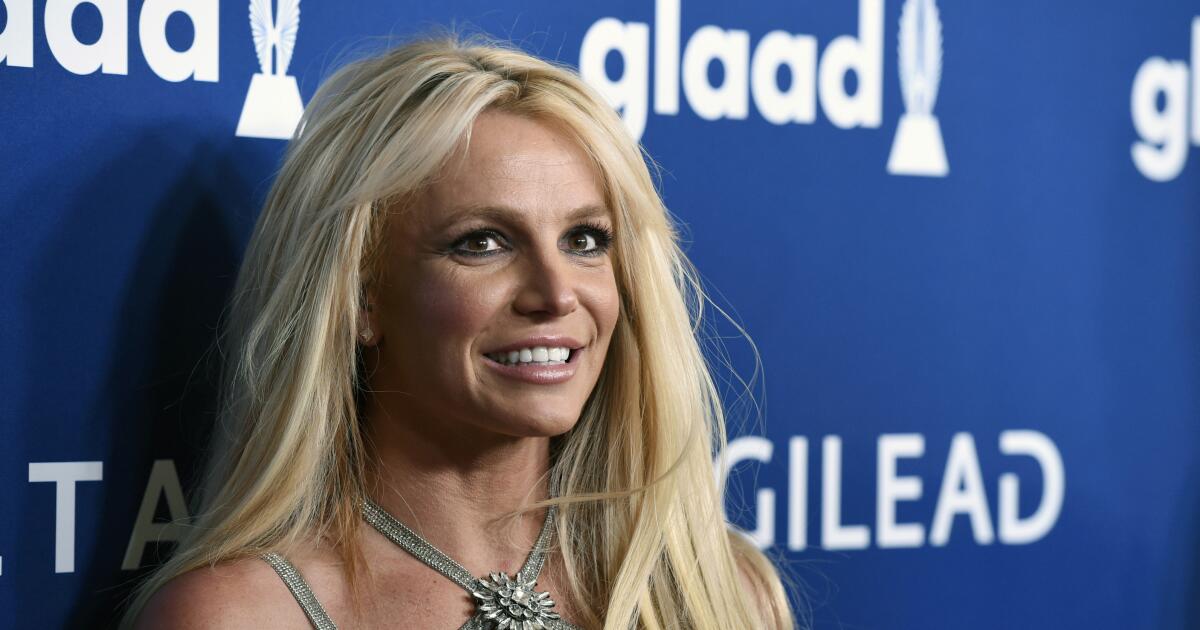
Britney Spears had a fight with her boyfriend at Chateau Marmont this week, resulting in paramedics being called to the vaunted Hollywood establishment and the pop star leaving the hotel with her own security team, The Times has confirmed.
The “… Baby One More Time” singer injured her foot and was not treated by medical personnel but is fine and safe at home, The Times confirmed Friday.
Spears, 42, appeared to address the incident Thursday, declaring on Instagram that “the news is fake” after a wide-reaching TMZ report about her and boyfriend, Paul Soliz, cited sources who feared that she had a “mental breakdown” at the hotel. The Grammy Award winner confirmed that she twisted her ankle and alleged that paramedics “showed up at my door illegally.”
“They never came in my room but I felt completly [sic] harassed. I’m moving to Boston !!! Peace,” wrote Spears, whose past erratic behavior resulted in her infamous 13-year conservatorship that was terminated in 2021.
Late Thursday, Spears posted a video showing her swollen ankle and saying that she injured it while she was trying to do a leap in the living room of her hotel suite. She said she “fell and embarrassed herself” and that the paramedics’ arrival “caused this huge scene, which was so unnecessary” when all she needed was ice.
“It is actually pretty bad, but s— happens,” the “Toxic” and “Hold Me Closer” singer said in the video.
Spears’ personal attorney Mathew S. Rosengart declined to comment Friday when reached by The Times. A Chateau Marmont spokesperson did not immediately respond to a message requesting comment.
It’s unclear who called authorities.
Brian Humphrey, a spokesman for the Los Angeles Fire Department, confirmed Friday that the agency had received a 911 call to the Chateau Marmont at 12:42 a.m. Thursday but, citing medical privacy rules, could not identify the person the call was made for.
Humphrey confirmed that paramedics were dispatched to the hotel after a caller requested aid for an adult female who had been injured. He said the caller did not offer specifics about the injury.
“At this time it is not clear if the crew encountered the injured person or offered any medical assistance,” he said, adding that the ambulance left Chateau Marmont at 1:17 a.m. without transporting the person and that there was no law-enforcement response.
Humphrey had no comment on the allegations Spears made on social media.
In the caption of Spears’ Thursday video post, she alleged that her mother, Lynne Spears, was probably involved in the incident, which was documented in part by paparazzi. She also complimented Rosengart, who spearheaded the effort that released her from the conservatorship of her personal and financial affairs that was installed in 2008 after a spate of high-profile incidents.
“I know my mom was involved !!! I haven’t talked to her in 6 months and she called right after it happened before the news being out !!! I was set up just like she did way back when !!!” Spears alleged in the post. “I wish I had grandparents !!! I can’t stand her !!! I honestly don’t care I will say it 👍🏻🤷🏼♀️ !!!”
Then, posting a photo of Rosengart, Spears added: “Psss this man is wonderful !!! He’s like a father to me and he got me through last night !!! I adore you and admire you mister Mathew !!!”
Last week, Rosengart helped wrap up the singer’s years-long dispute with her father and former conservator, Jamie Spears, over payment of his legal fees and how he managed his daughter’s finances during the controversial legal arrangement.
“The Woman in Me” author also reached a divorce settlement agreement with estranged third husband Sam Asghari that was filed in Los Angeles County Superior Court earlier this week.


A Hollywood portrayal of OpenAI Chief Executive Sam Altman portrayed by actor Andrew Garfield will be released later this year, after Amazon MGM Studios dropped the movie.
“Artificial,” which chronicles Altman‘s 2023 ouster from OpenAI and his reinstatement as CEO, was acquired by Neon, the studio announced Tuesday.
“The acquisition underscores Neon’s commitment to partnering with visionary filmmakers, and bringing ambitious cinema to audiences around the world,” the studio said in a statement. “Artificial will compete in this year’s Oscar race.”
The film has a critical take on artificial intelligence, according to three sources briefed on it who declined to be named. That portrayal caused Amazon to want to distance itself from the film, given the company’s $50 billion investment in OpenAI, two of the sources said.
Amazon declined to comment on the claims. In a statement, the company said it has “the utmost respect and admiration” for the movie’s director Luca Guadagnino. “We believe that ‘Artificial’ will be better served if it were released by a different studio and are working closely with the filmmaking team to find the film a new home,” Amazon said.
The deal was negotiated by Neon, CAA Media Finance and Amazon. CAA and Amazon declined to comment. A Neon spokesperson did not immediately respond to questions regarding the financial terms of the deal.
Puck News first reported Amazon dropping the movie.
Other studios, including Netflix, A24 and Focus Features, screened “Artificial.” Netflix and Focus passed on the film.
Amazon’s decision to drop the film comes at a time when Hollywood is grappling with the growth of artificial intelligence. Some creatives are concerned that the technology could displace jobs; others worry that their likenesses are being used to train AI models without their permission or compensation.
Meanwhile, many AI companies are eager to work with studios, saying their AI tools can help speed processes and reduce costs.
To foster more nuanced discussions about artificial intelligence, Google is collaborating with talent management firm Range Media Partners to develop films that present a less dystopian view of the technology.
Amazon passing on the film raises questions about whether tech company-backed studios would be willing to release movies that are critical of innovations in which they have a stake. It could create a chilling effect, said Robert Thompson, director of Syracuse University’s Bleier Center for Television and Popular Culture.
“The chilling effect could not only be on films critical of AI, they could be on films critical of all kinds of things that these companies have their tentacles in,” Thompson said.
Stories about tech company founders can be attractive to audiences, most notably with the 2010 film “The Social Network” about the founding of Facebook. That film earned $225 million worldwide at the box office, according to Paul Dergarabedian, head of marketplace trends at Rentrak. “The Social Network” came out a time when many people were talking about Facebook and had big talent behind it, including director David Fincher, Dergarabedian said.
“Neon is a perfect custodian for this film, and they will shepherd it to the big screen, I think very effectively,” he said. “They’re very filmmaker-centric … I think they found the perfect home with Neon.”
“Artificial” features major talent, with actor Monica Barbaro portraying former OpenAI Chief Technology Officer Mira Murati, and Ike Barinholtz as Elon Musk. Other actors include Jason Schwartzman and Billie Lourd.
Director Guadagnino has worked on films including “Challengers” and “Call Me By Your Name.”
Staff writer Samantha Masunaga contributed to this report.

While a bit hollow as a character study, painting with broad thematic brushstrokes that often keep its hero at a distance, Young Washington is a compelling historical drama, with a grandiose scope that is rare in Hollywood, and an inspirational story befitting of America at its best.
About the Film
It’s trendy for Hollywood to disparage the United States with films that highlight how the country has fallen short of its lofty ideals (and the beauty of American liberty is that such critical self-reflection is possible). Last year’s One Battle After Another was the darling of the Academy Awards with such a tale. But this Independence Day, and in celebration of 250 years as a nation, audiences can be reminded that (like the men who founded it) America may be imperfect, but the American spirit is a noble and beautiful thing worth fighting for. Young Washington is the origin story, not just of one of those brave Founding Fathers, but of the patriotic spirit and noble values they inspired. While a bit hollow as a character study, painting with broad thematic brushstrokes that often keep its hero at a distance, Young Washington is a compelling historical drama, with a grandiose scope that is rare in Hollywood, and an inspirational story befitting of America at its best.
Director Jon Erwin (House of David, I Can Only Imagine) again proves to be one of the best all-around storytelling talents in Hollywood right now, faith-based or otherwise. Produced and distributed by Angel and Wonder Project, the film is among the most ambitious projects to emerge from the new wave of faith-based entertainment, even if Young Washington isn’t explicitly “faith-based” in a rigid sense. When I interviewed screenwriter Diederik Hoogstraten, he aptly referred to the storytelling approach as “values based.” It may not be a gospel-preaching cinematic tract (and it’s the better for it), but Christians will find plenty to affirm and celebrate here.
If we do count the film among the “faith-based” genre family, then it’s easily a peak achievement. It’s a visually beautiful and well-crafted film. For as good as the modern faith-based genre has become, few movies have warranted a theatrical viewing, being built more on wholesome narrative than visual spectacle. In contrast, seeing Washington gallop on a horse as cannon fire and the pandemonium of battle rages all around him is a full-blown cinematic experience that has rarely been achieved in the genre – other than perhaps Erwin’s own The House of David.
Young Washington is solid from start to finish, but it never fully soars. The film is more interesting than engrossing; good in most areas, but never quite great at any one of them. The clearest comparable, due to the subject matter, is perhaps Mel Gibson’s The Patriot (2000). Historical inaccuracies aside, that film packed a cinematic punch of action, spectacle, and emotional storytelling. Young Washington offers the first two but lacks the third. It’s a story that appeals more to the head than the heart, historically informative, but not making me feel much toward the story.
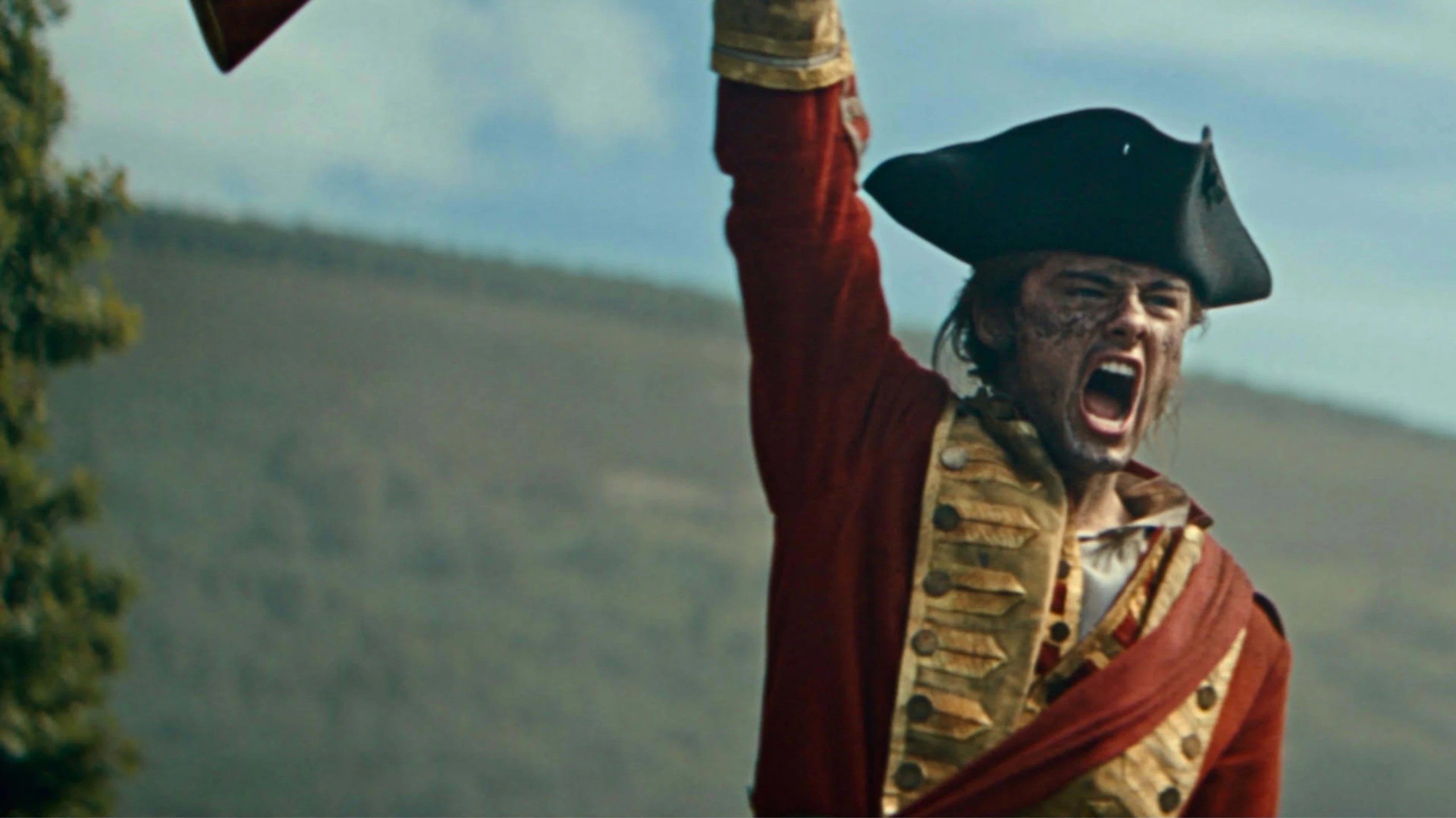
The creative decision to focus the story on a limited, formulative period of Washington’s early life shapes the film in significant ways. Many biopics fall into the trap of dutifully checking boxes, adapting a Wikipedia page more than unfolding a character journey. There’s still some of that with Young Washington, but the limited parameters lend the film a greater sense of focus and an opportunity to breathe. It feels like a story about something more than just putting historical events onto the movie screen.
At the same time, the film also feels like “part one” of a larger story, or a prequel for a film that doesn’t yet exist. The story seems constantly building toward something but then ends on the cusp of reaching it. Perhaps a future sequel is in the cards (although Middle Aged Washington doesn’t have the same ring to it), but the climactic pay off feels lacking. Interestingly, while the movie remains largely historically accurate (as far I can tell), the climactic final battle is more positively framed as a sort of inspirational victory, even when the historical battle was a crushing defeat. It’s perhaps an attempt to manufacture a thrilling third act resolution for a historical figure who was still only in the “first act” of his life. The decision mostly works, and that final battle is the film’s greatest triumph, but the story overall, as told, feels incomplete.

Also notable is that despite the intentionally patriotic release date, and centering on George Washington—arguably the American hero—the “Young” part of the film’s title means that the story pre-dates the revolutionary war. It sees Washington spend the duration of the runtime as a proud officer in the British army. Not quite the patriotic celebration the marketing has promised. Beyond existing knowledge of the historical significance of the protagonist, there is no real “America” at all, beyond a focus on his Virginian regiment, and some hints at the “American Spirit” that would one day define the nation (see themes below).
The fact that it has taken until the end of this review to discuss the character of George Washington himself is also telling. Unfortunately, he is the least interesting part of the film. The fault is not with actor William Franklyn-Miller, who does an admirable job. The problem is with the characterization. Washington has understandable motivations and inner conflict, but they are approached more from the perspective of an outside observer, rather than getting into his own headspace (we are told about struggles but rarely feel his turmoil). The film doesn’t probe deep enough into the root causes of these struggles, or the causes of his insecurity and drive for greatness. I left the film having learned about the events his early life, but without a better understanding of him as a man.
In the end, Young Washington boasts enough entertainment and quality filmmaking to please audiences. It’s a high floor, low ceiling type of film. There are no moments where the film fails to deliver consistent quality, but it just never seems able to achieve anything more. It’s good, but not great, which is something rarely said of George Washington himself. Still, I enjoyed it, and in retrospect, its legacy may be more for how it paved the way for the genre to enter a brighter future. Come to think of it, that sounds befitting of George Washington after all.
On the Surface
For Consideration
On the Surface—(Profanity, Sexual content, violence, etc.).
Language: There are three minor profanities (“d—” x2, “b—ard” x1).
Violence: There is plenty of wartime action, including men shot with rifles and cannon fire, although the action remains relatively bloodless. The most extreme violence comes when a man is hacked with an axe, although it is more implied than depicted on screen.
Sexuality: None.
Beneath The Surface
Engage The Film
The Makings of a Leader
George Washington was a larger-than-life person. By the end of the film, he is depicted as a near mythic figure (although, the scenes are adapted from details provided by several Pulitzer Prize winning biographies, so sometimes real life really is a Hollywood story). But one of the film’s central ambitions, and one emphasized in my interview with the screenwriter, is to humanize that mythical figure.

Early in the film, he is not necessarily even very likeable at times. He is stubborn, and his deep insecurities manifest as the appearance of pride and arrogance. His poor choices and refusal to heed wise counsel, such as the defeat at Fort Necessity, lead to serious consequences. Many biopics are hagiographical (such as the recent Michael), but Young Washington demonstrates the biblical truth that all men have sinned and fallen short of God’s standard (Romans 3:23). It answers the age-old question by suggesting that great leaders are not born great, they must become great.
In an early scene, George and his mother argue about their unfavorable circumstances. George’s mother wishes for her deceased husband back, but says, “Providence denied me this.” George responds, “Then providence is cruel!” His mother eventually counters, “God raises what is well grounded.” That exchange represents the heart of the film. We cannot control our circumstances, but we can shape our character (and allow God to shape it) to respond to them. As one character says, “Failure is the tutor sent by God.” Washington lacks the status and social advantages of others, and at first, he attempts to take it into his own hands to rise to prominence. Ultimately, after great failure, he learns that it is through humility and service that he can be used to do great deeds (Matthew 20:16). Interestingly, at the end of the film, even the pagan Indian tribes recognize God’s anointing on Washington’s life.

Entertainment
’47 Ronin’ director Carl Erik Rinsch sentenced to 30 months in prison for Netflix fraud case

Carl Erik Rinsch, the director of the 2013 Keanu Reeves action film “47 Ronin,” will serve more than two years in federal prison for defrauding Netflix of $11 million.
U.S. District Judge Jed S. Rakoff on Monday sentenced 48-year-old Rinsch to 30 months in prison, the U.S. Attorney’s Office, Southern District of New York, announced. Federal prosecutors convicted Rinsch in December of wire fraud, money laundering and other counts. A legal representative for Rinsch did not immediately respond to a request for comment on Tuesday.
Federal prosecutors indicted Rinsch in March 2025, alleging the $11 million went into Rinsch’s personal accounts. The filmmaker “quickly transferred” the money from the Rinsch Co. account, where it had been deposited March 6, 2020, by Netflix, through additional accounts until about $10.5 million wound up weeks later in a personal brokerage account. He lost more than half of that money in less than two months via risky investments in the stock market, the indictment said.
Though Rinsch told the streamer that his sci-fi show “White Horse” was progressing nicely, the filmmaker allegedly moved the remaining money into cryptocurrency and profited from crypto speculation over the next couple of years. The streamer had invested around $44 million in the show. Rinsch was accused of spending around $10 million on five Rolls-Royces, a Ferrari, watches, clothing, luxury bedding and linens, credit card bills, attorneys to sue Netflix for more money, and lawyers to work on his divorce.
He was arrested in West Hollywood and released the same day after agreeing to post a $100,000 bond to guarantee his appearance in a New York federal court.
Rinsch never finished the Netflix show.
During his sentencing, Rinsch and his legal team told the court his behavior was a result of mental health struggles and medication problems and they are working to address those issues with a new care provider, the Associated Press reported.
“I failed to recognize the danger of the state I was in,” Rinsch said, though his mental issues were not described in court, and his attorneys declined to provide further detail.
Ahead of the sentencing, Reeves — the star of Rinsch’s most notable project to date — penned a letter in May requesting “leniency and mercy as well as justice” in the filmmaker’s sentencing.
In addition to prison time, Rinsch must serve three years of supervised release, forfeit the $11 million and pay $700 in mandatory special assessments, according to Monday’s announcement. U.S. Attorney Jay Clayton said in the announcement: “Today’s sentence sends a deterrent message: fraud will not be tolerated.”
The Associated Press and former Times assistant editor Christie D’Zurilla contributed to this report.
-

 News2 minutes ago
In the United States, Every World Cup Team Is a Home Team
-
 Lifestyle41 minutes ago
How does the Kennedy Center board make decisions? This legal filing sheds some light
-

 Technology50 minutes ago
Meta is adding ridiculous ‘rate limits’ and a soft paywall to its smart glasses
-

 World55 minutes ago
Boy, 2, pulled alive from rubble six days after Venezuela’s devastating twin earthquakes
-

 Politics57 minutes ago
Socialism goes west as DSA-backed challenger ousts longtime Democrat
-

 Health1 hour ago
Americans are giving up multivitamins for a different daily health habit, study finds
-

 Sports1 hour ago
2026 World Cup Quarterfinal Odds: Which Squads Will Make Final 8?
-

 Technology1 hour ago
Warehouse robots move packages without human handoff

