Entertainment
Bill Viola, pioneer video artist who explored nature of human consciousness, dies at 73


Artist Bill Viola, whose pioneering work with video since the 1970s opened the door to what would become a major artform internationally, died Friday at his home in Long Beach after a long struggle with early-onset Alzheimer’s disease, according to his wife and artistic partner, Kira Perov. He was 73.
Diagnosed in 2012, he had entered hospice care in October 2020. Viola curtailed his ambitious international practice the year before.
Using video technology, the artist had explored the nature of human consciousness — of what it is, how it operates, what it can endure or truly know. For the next four decades his art would be an extended exploration of the ancient conundrum.
“There are no answers to life or death,” Viola once explained of his aspirations for his art. “I think mystery is the most important aspect of my work. That moment when we open a door and close it without knowing where we’re going.”
In 1985, Viola’s “The Theater of Memory” became the first installation with a major video element to be included along with traditional painting and sculpture in New York’s Whitney Biennial, then the premier survey of new developments in American art.
The projected video is a dreamlike cloud of gray visual static — the vertical rolls, snow and other interference normally banished from a television screen in the living room. Momentary pictures emerge from the crackling cloud and then sink back — a girl walking, a simple clapboard building, a hand holding a teacup, a car careening over a steep embankment and more. No logical narrative materializes.
The installation, which the artist described as “a psychic landscape” meant to evoke the processes of memory, was acquired in 1988 by the Newport Harbor Art Museum (now the Orange County Museum of Art). A year before, the newly opened Museum of Contemporary Art in Los Angeles had acquired Viola’s “Room for St. John of the Cross,” a noisy evocation of spiritual disruptions in modern life as prophesied by a 16th century Spanish mystic.
The work incorporates as primary components both a mural-size video projection on the wall and a miniature color TV monitor sequestered inside a tiny, monastic, cell-like shack. That fall, the installation was a centerpiece in a selection of Viola’s installations and single-channel videotapes that became the first major exhibition at New York’s Museum of Modern Art to feature an artist who worked primarily with the mediums of video and sound.
This heady rush of “firsts” for American video art peaked in 1989 when Viola was awarded a MacArthur Fellowship. Only four subsequent artists working extensively with video have been chosen for the program, nicknamed the “genius grant,” in its 40-year history. In fewer than five years, Viola, then 38, had become the artist perhaps most instrumental for bringing video installation art into the mainstream of American cultural life, where today it is commonplace and occupies a central position.
Viola was born in Queens, N.Y., on Jan. 25, 1951, making him a card-carrying member of the first generation in global history to grow up bathed in the queer blue light of TV. When he was 18, his choice of Syracuse University as an art school destination proved fateful. Video art was taking off following the late-1960s invention of portable — and affordable — television recording equipment for personal use. Viola had enrolled at the school in Upstate New York to study painting, but the region was becoming a center for experimentation with the new video medium.
At the Experimental Television Center in nearby Binghamton, video pioneers Nam June Paik and Shuya Abe built a sophisticated electronic synthesizer, capable of layering, multiplying or dividing a mixture of live and recorded digital imagery into complex moving collages. Critic Bruce Kurtz, teaching in Oneonta, began writing about the new television artform for Arts Magazine, launched with the influential essay “Video Is Being Invented.”
At Syracuse’s Everson Museum of Art, director James Harithas, a supporter of all things artistically novel, hired David Ross as the museum world’s first curator of video art. Viola snagged a part-time job there as a technician and exhibition preparator, and he would have his first exhibition at the Everson in 1973. At school, he overlapped with Paul Schimmel, a young student studying museum studies and art history who would later become chief curator at Newport and MOCA.
Viola also performed in avant-garde composer David Tudor’s germinal musical production “Rainforest.” Presented at the Everson, the sound installation was constructed from such everyday objects as a metal barrel, a glass jar and plastic tubing, all suspended in space to amplify their resonance. Viola’s creative relationship with Tudor would continue until the composer’s death in 1996.
Important as well to shaping Viola’s emerging aesthetic was sculptor Jack Nelson, a Syracuse professor who became the young artist’s mentor. Nelson’s assemblages originated from an introspective spirituality, which he personified in a celestial character named Mr. Moon.
Bill Viola, “The Greeting,” 1995, video/sound installation.
(Kira Perov)
Viola soon took a related direction in his video art, exploring mystical and transcendent subject matter not being widely investigated in other contemporary American art. As his work deepened and matured in the 1990s, emphasizing spiritual and metaphysical inquiries, it would often find more welcoming audiences in Europe and Asia than in the United States.
After graduating from Syracuse with a bachelor of fine arts in experimental studio art, he took a post at a video workshop in Florence, Italy, for 18 months, becoming immersed in Renaissance painting and sculpture. He traveled extensively throughout the Pacific region, including Indonesia, the Solomon Islands, Northern India and Japan, where he lived and worked in 1980 and 1981. An artist-in-residence at Sony Corporation’s research laboratory outside Tokyo, Viola developed a major interest in Buddhist principles of mindfulness.
One Pacific journey brought him to Melbourne, Australia, at the invitation of Perov, then-director of cultural activities at La Trobe University. A relationship blossomed, and Perov began a lifelong collaboration with Viola on complex video and installation works.
The couple married in 1980. They settled in Long Beach, where Ross, nicknamed “Captain Video” among artists, had recently relocated from Syracuse to the Long Beach Museum of Art to launch an exhibition program and, later, establish a post-production video lab. Viola, in addition to utilizing those facilities, became artist-in-residence at Memorial Medical Center in the city, where he was able to explore new imaging technologies aimed at the study of the human body.
Mind and body connections were soon an established theme in Viola’s work. What made his art distinctive was its use of video technologies for a range of metaphors that once derived from nature. Traditional landscape was transformed into the revolutionary environment of digital imagery, where global society now lives.
Viola’s apocalyptic “Theater of Memory” installation was a watershed example. The dead tree, flamboyantly uprooted, is an overturned ruin from the natural landscape — the “blasted tree” frequently employed in 18th and 19th century European and American landscape painting to signify a disappearing concept of wilderness in the face of encroaching industrialization. Around Viola’s felled tree, lamplights of historical knowledge flicker like electrified fireflies. An artificial breeze gently wafts from an oscillating fan positioned nearby, while a gathering storm of thoughts erupts from the high technology of projected video light, crackling and popping in a primordial stew.
As with Plotinus, the Hellenistic founder of Neoplatonic philosophy, Viola’s installation proposes memory as a perceptual function that allows a human soul to acknowledge its own existence. Plotinus drew on obscure ancient Egyptian metaphysics, Viola on the esoteric technology of modern life.
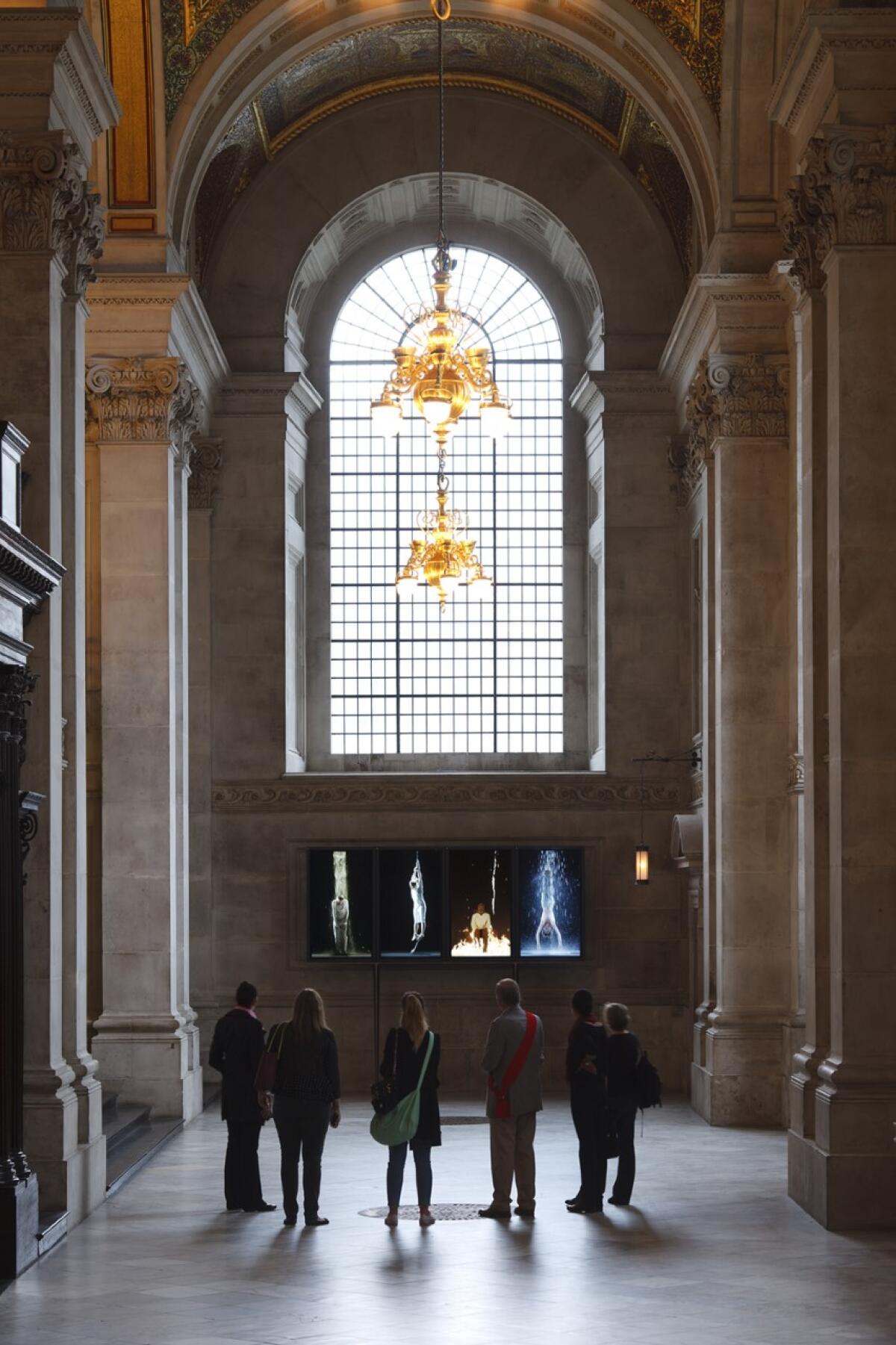
Installation view, Bill Viola, “Martyrs (Earth, Air, Fire, Water),” 2014, South Quire Aisle, St Paul’s Cathedral, London.
(Peter Mallet / Bill Viola Studio)
In 1995, Viola represented the United States at the centennial of the Venice Biennale, the major international art festival in Italy. His exhibition included a hyper-slow-motion video, “The Greeting,” inspired by Mannerist painter Jacopo da Pontormo’s masterpiece “The Visitation” (1528-29), which richly intensifies a convivial interaction among three women. Dressed in flowing, brightly colored garments, two women warmly approach one another on the street as a third observes.
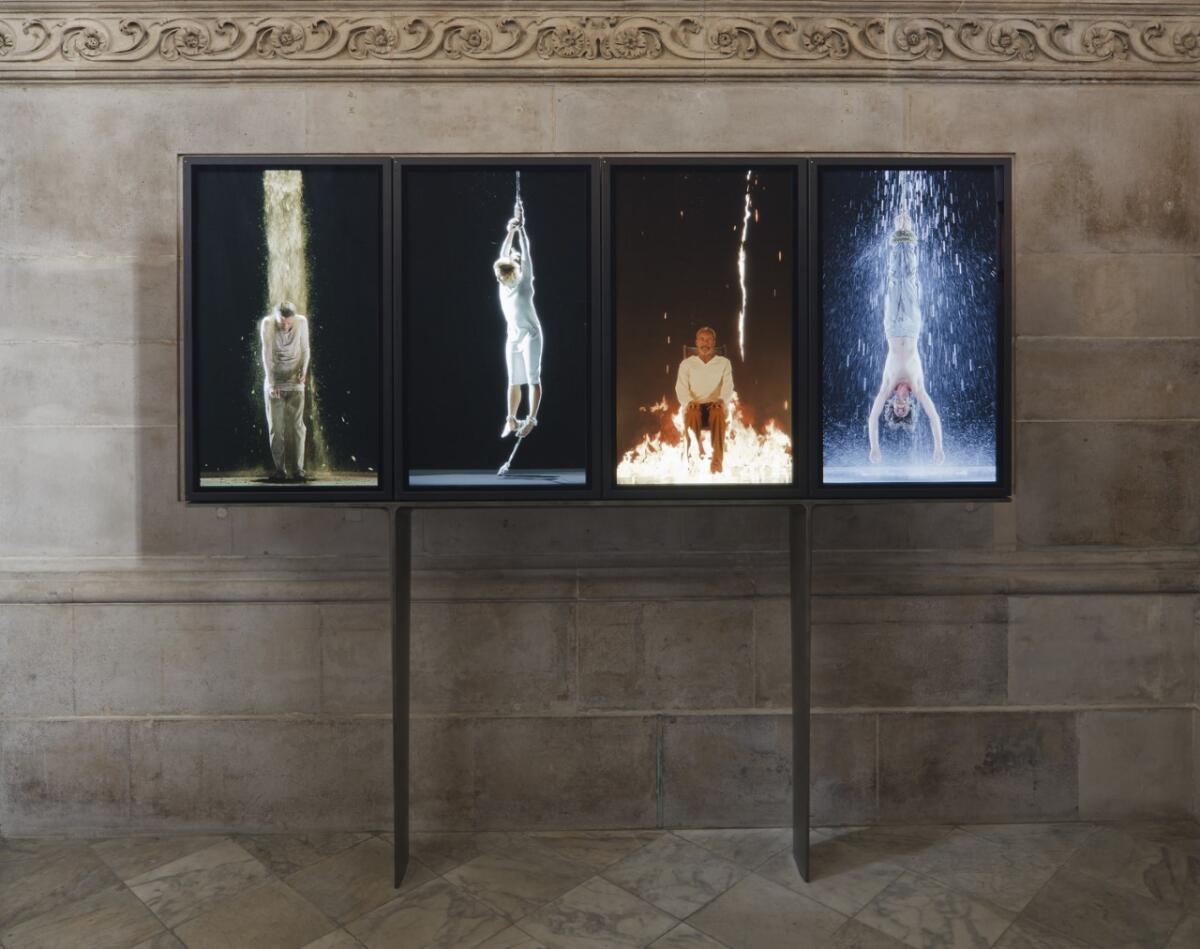
Bill Viola, “Martyrs (Earth, Air, Fire, Water),” 2014, high-definition video polyptych on four plasma displays.
(Peter Mallet)
Employing a stationary, high-speed 35-mm camera shooting 300 stills per second, Viola recorded the scene in one take. The event lasted just 45 seconds, but the video projection unfolds over the course of 10 minutes.
The video’s extreme slow-motion creates anticipation in a viewer, while the pictorial movement yields a desire to leisurely examine the image in a manner more akin to looking at paintings than at traditional camerawork. In 2003, Viola further explored human passions and emotional drives introduced in “The Greeting” in an exhibition at the J. Paul Getty Museum. Flatscreen videos employed imagery related to medieval, Renaissance and Baroque devotional paintings.
Fifteen large-scale video works made over 20 years were the subject of a 1997 Viola survey at the Los Angeles County Museum of Art. In a virtually unprecedented decision, the artist installed the show without a single identifying label or wall text, as museums typically require. Viola’s gesture gave priority to a viewer’s unvarnished art experience. Only at the end of the exhibition, when a visitor was leaving the museum, was an informative brochure available for further consideration.
Viola also produced work meant to be seen entirely outside the usual art context of a museum or gallery. London’s St. Paul’s Cathedral installed a commission, “Martyrs (Earth, Air, Fire and Water),” in a choir in 2014, joined two years later by the triptych “Mary.” The project is the first known example of video rather than painting or sculpture produced for permanent display as contemplative art inside a major church.
“Martyrs” features four vertical plasma screens showing silent suffering and martyrdom through the title’s four elemental forces. The second work is a triptych featuring an episodic narrative inspired by the life of the Virgin Mary but represented in cross-cultural terms of Western and Eastern religious and secular imagery. Among them is a Buddha-like woman breastfeeding an infant in the manner of a Christian Madonna and Child and posed before the Los Angeles skyline, where East and West meet. The pair of works were gifted to Tate Modern and placed on long-term loan to St. Paul’s.
In addition to Perov, Viola is survived by sons Andrei and Blake, daughter-in-law Aileen Milliman, brother Robert Viola and sister Andrea Freeman. A memorial is being planned in his honor.

Movie Reviews
‘Night Nurse’ Review: A Caretaker Explores Her Kink for Elder Abuse in the Year’s Strangest Erotic Thriller

There are any number of erotic thrillers in which rich old men are robbed blind and/or left for dead, but Georgia Bernstein’s admirably bizarre “Night Nurse” might be the first movie of its kind where elder abuse is the source — and possible subject— of its erotic thrills. If there are others, I’m not sure I want to know.
But this woozy debut feature doesn’t rely on its audience being turned on by the relationship between a nubile caretaker and her dementia-addled patient. Their psychosexual bond, meanwhile, hinges on cold-calling vulnerable old people under the guise of a grandchild in financial distress. (“I’m in trouble, nana, send me $10,000 or I’ll be left to rot in jail!” That sort of thing). With its slim wisp of a premise stretched into a Strickland-esque dreamscape that substitutes kink for conflict, the film itself hardly seems convinced by its own wrinkled lust — all desperate kisses and non-touching poses of subservience. More important to Bernstein is what that lust reveals about her characters’ deepest needs, specifically how their need to care and be cared for can be as easily perverted as any other form of desire.

As moody and weightless as the noir-accented score that blows through the movie like a curlicue gust of wind in an old cartoon (credit to musicians Sam Clapp and Steven Jackson), “Night Nurse” lacks the pulse required for its stray feelings to come alive. Still, the film ambiently taps into the latent eroticism of teasing out the distance between how you see yourself and who you really are. Bernstein plays with that distance like a telephone cord wrapped around her fingers, and Eleni — played by the excellent newcomer Cemre Paksoy, powerfully helpless — only frays even more as the receiver is brought near the hook. “Everything I did before today wasn’t me,” the nurse tells co-worker Mona (Eleonore Hendricks) after starting a new job at an Illinois retirement home. “It was somebody else.”
What she did before today remains unexplored (specifically, what she did to get herself fired from her last gig), but I’m guessing she’s probably changed less than she thought. There’s a faraway flicker in her eyes the moment she catches the vibe between Mona and Douglas (a ribald and elusive Bruce McKenzie), a white-haired seventysomething who shows early signs of dementia but still commands an undiminished sexual energy. “I’m not an invalid,” he coos as Mona bathes him in the tub, to which she replies, “yes, you are,” in a supplicant tone that hints at a rich history of power games between them.
Later that same night, Douglas will force Eleni to call a stranger, pretend that she’s their granddaughter, and ask for money — he’ll wrap the phone cord around the nurse’s body as she talks and shove her against the wall as they kiss. She’s into it. So into it that he has to clarify the terms of his whole deal: “If you’re looking for a pogo stick, I’m really not your guy.” But Eleni isn’t looking for anything to bounce on. She just wants to be needed, and maybe to need someone in return. Someone who will see her for who she really is and allow her the fantasy of pretending she isn’t being herself when she cons vulnerable strangers out of their money — when she exploits how enthralled those strangers are by the care they have for their loved ones.
“Night Nurse” doesn’t belabor the psychology, as Bernstein prefers to express her story through heavy-lidded suggestion. Somnambulating from the moment it starts, the film moves through a series of beautifully arranged poses that stretch their latent meaning thin across the surface (Lidia Nikonova’s cinematography lacquers every shot with a seductive dreaminess). We see Douglas smoking in a lawn chair with Mona and Eleni curled around his feet. Eleni riding in the backseat of a convertible as the wind blows through her curls. The full staff of nurses — all of them under Douglas’ sway — stumbling around his condo in a state of zonked out bliss as they roll on the prescription drugs they’ve stolen from the residents.
Once you’ve seen one shot of this movie, you’ve practically seen them all, at least until things escalate during a rushed and unsatisfying third act that forces Eleni into an honest confrontation with herself. People will do just about anything to feel needed — they’ll give whatever degree of care allows them to receive it in return. “Night Nurse” understands that desire, but remains far too numb to treat it.
Grade: C+
The Independent Film Company will relase “Night Nurse” in theaters on Friday, July 10.
Entertainment
Lucas Museum to give free annual passes to South L.A. neighbors, host community preview day
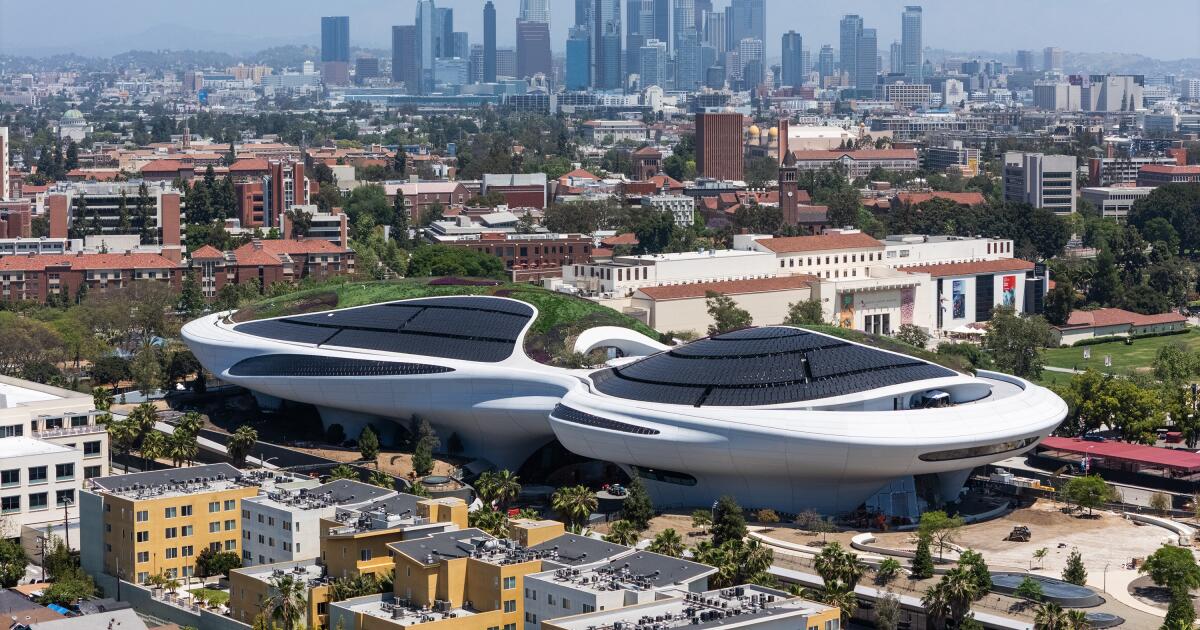
The Lucas Museum of Narrative Art, which is moving at light speed toward its Sept. 22 opening, announced Thursday that it will give free annual passes to its South L.A. neighbors living in the 90037 ZIP Code. The 300,000-square-foot, $1-billion museum located in Exposition Park will also host a special community preview day on Sept. 13, more than a week before the general public gets to step inside.
The 90037 ZIP Code has a population of more than 65,000 and is bordered roughly by the 110 Freeway to the west, Slauson Avenue to the south, Central Avenue to the east and Martin Luther King Jr. Boulevard to the north. Residents can register for passes at lucasmuseum.org/lm37 and will be alerted in August when the program launches. Pass holders can reserve tickets for themselves and one guest.
Tickets for non-pass holders go on sale July 21. They cost $25 for adults and $21 for seniors. Kids 17 and under are free.
“Storytelling has the power to bring people together and create a sense of community,” said Lucas Museum Chief Executive Tracey Bates in a news release about the program. “Through LM37, we are inviting our South Los Angeles neighbors to make the museum part of their lives and take their own path of discovery through the art, programs and experiences that will help shape this new cultural hub for Los Angeles.”
The community preview day is designed to give local business owners, community partners, civic leaders and registered LM37 pass holders a sneak peak of the 10,000 square feet of exhibition space, as well as the expansive gardens with 11 acres of park space.
The opening programming, curated by co-founder George Lucas, features 20 inaugural exhibitions across more than 30 galleries, including one titled “Star Wars in Motion,” containing vehicle designs, high-speed racers, flying vessels, props, costumes and illustrations from the first six films in the beloved franchise.
More than 1,200 objects will be on display from Lucas’ personal collection of narrative art. Highlights include work by Norman Rockwell and Dorothea Lange, as well as a variety of manga, children’s book illustrations and comics.

Last year’s “Superman” ended with Iggy Pop singing “Because I’m a punk rocker, yes I am” — an ironic coda for a superlatively square hero. But it rings straightforwardly true for Superman’s cousin.
Milly Alcock’s Kara Zor-El, or Supergirl, sports not a spandex suit but a Blondie T-shirt. When we meet her in Craig Gillespie’s “Supergirl,” she’s been on an interstellar bender for days. She’s more Courtney Love than Clark Kent.
Nonchalant and sarcastic, Kara is also a little Han Solo-ish, you might say, given that she moves capriciously through the galaxy in her junky spaceship while getting in fights in extraterrestrial bars. She’s a welcome, jagged riff on more buttoned-up superheroes, and Alcock is terrific in the role. If only “Supergirl” was as good as she is.
While the latest DC release, and second under James Gunn’s stewardship, has its moments, “Supergirl” struggles to match Kara’s punk-rock energy with an equally spirited supporting cast and story.
Skepticism seems to have gathered for “Supergirl” ahead of its release. Many fans have argued it wasn’t the right next step for DC Universe. But I’m not so sure. Alcock’s breezy cameo in “Superman” was one of that movie’s highlights. Handing the follow-up to her, and her faithful floating dog Krypto, strikes me as an extremely natural next step. When in doubt, follow the dog.
And much of “Supergirl” is winning. It resides almost entirely in space, touching down only momentarily on Earth. In its consistently creative production design, clever needle drops and underdog story arc, “Supergirl” resides a little closer to Gunn’s “Guardians of the Galaxy” movies than other DC entries. Its outer space is filled with cosmic detritus, mean characters and cute critters. Seth Rogen as the voice of a tiny alien co-piloting a space bus is an inspired concoction, as is a shabbier sci-fi realm with rest stops along the intergalactic highway.
-

 Illinois1 minute ago
Illinois waives tax penalties for 11 counties hit by storms, including Stephenson and Winnebago
-

 Indiana4 minutes ago
Attempted murder suspect arrested in Indianapolis for Bloomington shooting
-

 Iowa9 minutes ago
Iowa WWII veteran approaching 100th birthday honored in Cedar Rapids
-

 Kentucky14 minutes ago
Exantus may be subject to involuntary hospitalization due to Kentucky law
-

 Louisiana24 minutes ago
Parasitic stomach illness that can cause explosive diarrhea rises in Louisiana
-

 Maine31 minutes ago
Is prison in play for Graham Platner?
-

 Maryland34 minutes ago
Office building in Glen Burnie evacuated after shift in parking garage floor
-

 Michigan39 minutes ago
Menominee, Michigan man arrested on sexual assault charges involving a minor

