Entertainment
Bill Viola, pioneer video artist who explored nature of human consciousness, dies at 73


Artist Bill Viola, whose pioneering work with video since the 1970s opened the door to what would become a major artform internationally, died Friday at his home in Long Beach after a long struggle with early-onset Alzheimer’s disease, according to his wife and artistic partner, Kira Perov. He was 73.
Diagnosed in 2012, he had entered hospice care in October 2020. Viola curtailed his ambitious international practice the year before.
Using video technology, the artist had explored the nature of human consciousness — of what it is, how it operates, what it can endure or truly know. For the next four decades his art would be an extended exploration of the ancient conundrum.
“There are no answers to life or death,” Viola once explained of his aspirations for his art. “I think mystery is the most important aspect of my work. That moment when we open a door and close it without knowing where we’re going.”
In 1985, Viola’s “The Theater of Memory” became the first installation with a major video element to be included along with traditional painting and sculpture in New York’s Whitney Biennial, then the premier survey of new developments in American art.
The projected video is a dreamlike cloud of gray visual static — the vertical rolls, snow and other interference normally banished from a television screen in the living room. Momentary pictures emerge from the crackling cloud and then sink back — a girl walking, a simple clapboard building, a hand holding a teacup, a car careening over a steep embankment and more. No logical narrative materializes.
The installation, which the artist described as “a psychic landscape” meant to evoke the processes of memory, was acquired in 1988 by the Newport Harbor Art Museum (now the Orange County Museum of Art). A year before, the newly opened Museum of Contemporary Art in Los Angeles had acquired Viola’s “Room for St. John of the Cross,” a noisy evocation of spiritual disruptions in modern life as prophesied by a 16th century Spanish mystic.
The work incorporates as primary components both a mural-size video projection on the wall and a miniature color TV monitor sequestered inside a tiny, monastic, cell-like shack. That fall, the installation was a centerpiece in a selection of Viola’s installations and single-channel videotapes that became the first major exhibition at New York’s Museum of Modern Art to feature an artist who worked primarily with the mediums of video and sound.
This heady rush of “firsts” for American video art peaked in 1989 when Viola was awarded a MacArthur Fellowship. Only four subsequent artists working extensively with video have been chosen for the program, nicknamed the “genius grant,” in its 40-year history. In fewer than five years, Viola, then 38, had become the artist perhaps most instrumental for bringing video installation art into the mainstream of American cultural life, where today it is commonplace and occupies a central position.
Viola was born in Queens, N.Y., on Jan. 25, 1951, making him a card-carrying member of the first generation in global history to grow up bathed in the queer blue light of TV. When he was 18, his choice of Syracuse University as an art school destination proved fateful. Video art was taking off following the late-1960s invention of portable — and affordable — television recording equipment for personal use. Viola had enrolled at the school in Upstate New York to study painting, but the region was becoming a center for experimentation with the new video medium.
At the Experimental Television Center in nearby Binghamton, video pioneers Nam June Paik and Shuya Abe built a sophisticated electronic synthesizer, capable of layering, multiplying or dividing a mixture of live and recorded digital imagery into complex moving collages. Critic Bruce Kurtz, teaching in Oneonta, began writing about the new television artform for Arts Magazine, launched with the influential essay “Video Is Being Invented.”
At Syracuse’s Everson Museum of Art, director James Harithas, a supporter of all things artistically novel, hired David Ross as the museum world’s first curator of video art. Viola snagged a part-time job there as a technician and exhibition preparator, and he would have his first exhibition at the Everson in 1973. At school, he overlapped with Paul Schimmel, a young student studying museum studies and art history who would later become chief curator at Newport and MOCA.
Viola also performed in avant-garde composer David Tudor’s germinal musical production “Rainforest.” Presented at the Everson, the sound installation was constructed from such everyday objects as a metal barrel, a glass jar and plastic tubing, all suspended in space to amplify their resonance. Viola’s creative relationship with Tudor would continue until the composer’s death in 1996.
Important as well to shaping Viola’s emerging aesthetic was sculptor Jack Nelson, a Syracuse professor who became the young artist’s mentor. Nelson’s assemblages originated from an introspective spirituality, which he personified in a celestial character named Mr. Moon.
Bill Viola, “The Greeting,” 1995, video/sound installation.
(Kira Perov)
Viola soon took a related direction in his video art, exploring mystical and transcendent subject matter not being widely investigated in other contemporary American art. As his work deepened and matured in the 1990s, emphasizing spiritual and metaphysical inquiries, it would often find more welcoming audiences in Europe and Asia than in the United States.
After graduating from Syracuse with a bachelor of fine arts in experimental studio art, he took a post at a video workshop in Florence, Italy, for 18 months, becoming immersed in Renaissance painting and sculpture. He traveled extensively throughout the Pacific region, including Indonesia, the Solomon Islands, Northern India and Japan, where he lived and worked in 1980 and 1981. An artist-in-residence at Sony Corporation’s research laboratory outside Tokyo, Viola developed a major interest in Buddhist principles of mindfulness.
One Pacific journey brought him to Melbourne, Australia, at the invitation of Perov, then-director of cultural activities at La Trobe University. A relationship blossomed, and Perov began a lifelong collaboration with Viola on complex video and installation works.
The couple married in 1980. They settled in Long Beach, where Ross, nicknamed “Captain Video” among artists, had recently relocated from Syracuse to the Long Beach Museum of Art to launch an exhibition program and, later, establish a post-production video lab. Viola, in addition to utilizing those facilities, became artist-in-residence at Memorial Medical Center in the city, where he was able to explore new imaging technologies aimed at the study of the human body.
Mind and body connections were soon an established theme in Viola’s work. What made his art distinctive was its use of video technologies for a range of metaphors that once derived from nature. Traditional landscape was transformed into the revolutionary environment of digital imagery, where global society now lives.
Viola’s apocalyptic “Theater of Memory” installation was a watershed example. The dead tree, flamboyantly uprooted, is an overturned ruin from the natural landscape — the “blasted tree” frequently employed in 18th and 19th century European and American landscape painting to signify a disappearing concept of wilderness in the face of encroaching industrialization. Around Viola’s felled tree, lamplights of historical knowledge flicker like electrified fireflies. An artificial breeze gently wafts from an oscillating fan positioned nearby, while a gathering storm of thoughts erupts from the high technology of projected video light, crackling and popping in a primordial stew.
As with Plotinus, the Hellenistic founder of Neoplatonic philosophy, Viola’s installation proposes memory as a perceptual function that allows a human soul to acknowledge its own existence. Plotinus drew on obscure ancient Egyptian metaphysics, Viola on the esoteric technology of modern life.
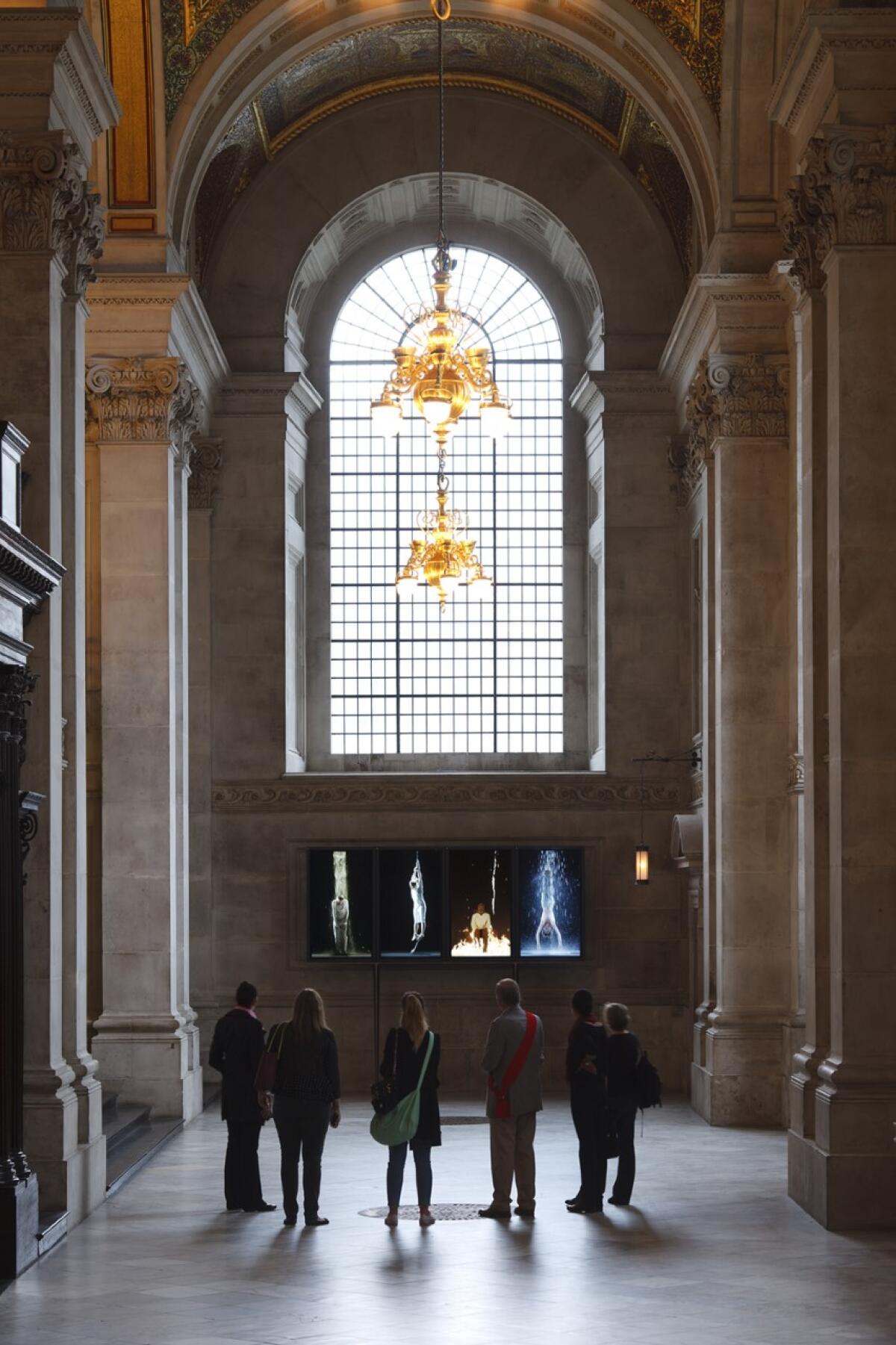
Installation view, Bill Viola, “Martyrs (Earth, Air, Fire, Water),” 2014, South Quire Aisle, St Paul’s Cathedral, London.
(Peter Mallet / Bill Viola Studio)
In 1995, Viola represented the United States at the centennial of the Venice Biennale, the major international art festival in Italy. His exhibition included a hyper-slow-motion video, “The Greeting,” inspired by Mannerist painter Jacopo da Pontormo’s masterpiece “The Visitation” (1528-29), which richly intensifies a convivial interaction among three women. Dressed in flowing, brightly colored garments, two women warmly approach one another on the street as a third observes.
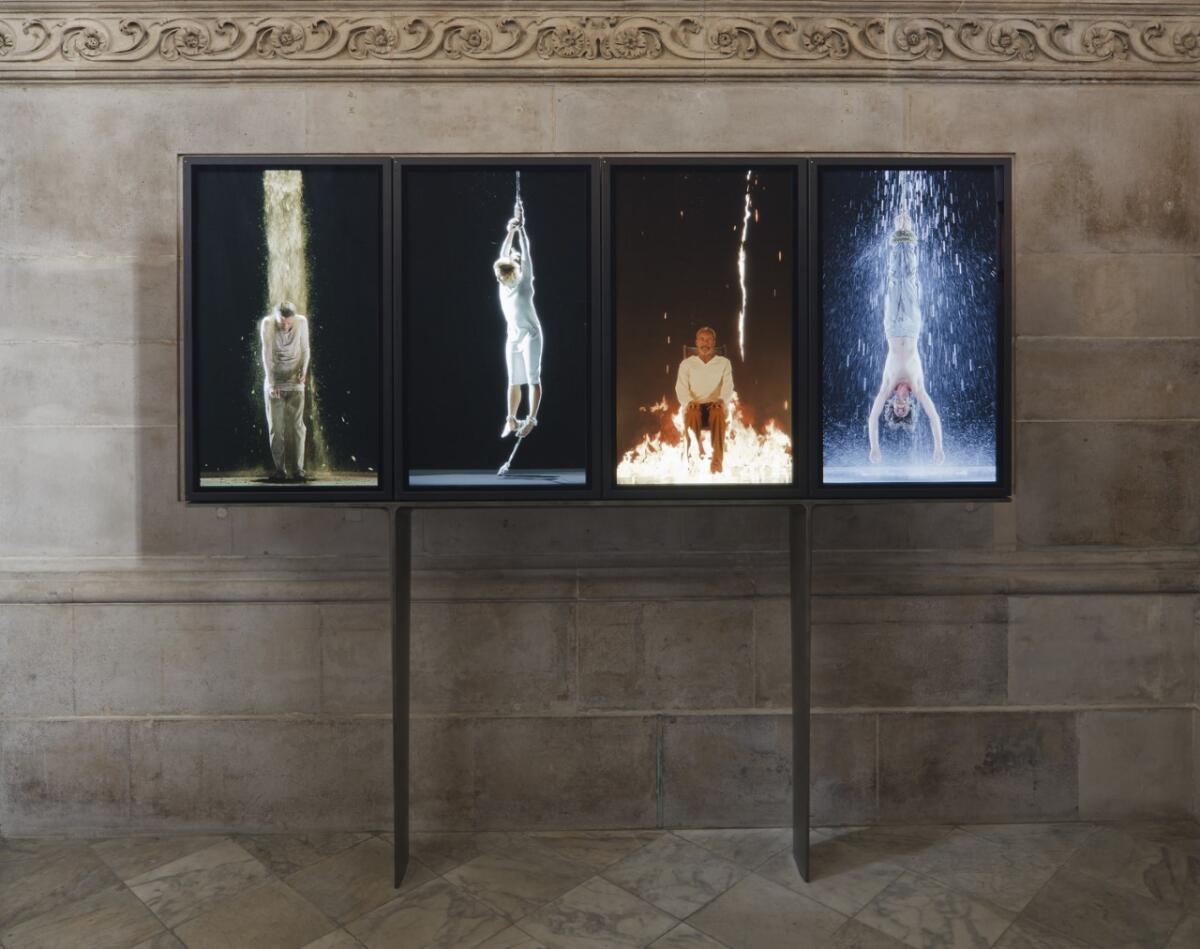
Bill Viola, “Martyrs (Earth, Air, Fire, Water),” 2014, high-definition video polyptych on four plasma displays.
(Peter Mallet)
Employing a stationary, high-speed 35-mm camera shooting 300 stills per second, Viola recorded the scene in one take. The event lasted just 45 seconds, but the video projection unfolds over the course of 10 minutes.
The video’s extreme slow-motion creates anticipation in a viewer, while the pictorial movement yields a desire to leisurely examine the image in a manner more akin to looking at paintings than at traditional camerawork. In 2003, Viola further explored human passions and emotional drives introduced in “The Greeting” in an exhibition at the J. Paul Getty Museum. Flatscreen videos employed imagery related to medieval, Renaissance and Baroque devotional paintings.
Fifteen large-scale video works made over 20 years were the subject of a 1997 Viola survey at the Los Angeles County Museum of Art. In a virtually unprecedented decision, the artist installed the show without a single identifying label or wall text, as museums typically require. Viola’s gesture gave priority to a viewer’s unvarnished art experience. Only at the end of the exhibition, when a visitor was leaving the museum, was an informative brochure available for further consideration.
Viola also produced work meant to be seen entirely outside the usual art context of a museum or gallery. London’s St. Paul’s Cathedral installed a commission, “Martyrs (Earth, Air, Fire and Water),” in a choir in 2014, joined two years later by the triptych “Mary.” The project is the first known example of video rather than painting or sculpture produced for permanent display as contemplative art inside a major church.
“Martyrs” features four vertical plasma screens showing silent suffering and martyrdom through the title’s four elemental forces. The second work is a triptych featuring an episodic narrative inspired by the life of the Virgin Mary but represented in cross-cultural terms of Western and Eastern religious and secular imagery. Among them is a Buddha-like woman breastfeeding an infant in the manner of a Christian Madonna and Child and posed before the Los Angeles skyline, where East and West meet. The pair of works were gifted to Tate Modern and placed on long-term loan to St. Paul’s.
In addition to Perov, Viola is survived by sons Andrei and Blake, daughter-in-law Aileen Milliman, brother Robert Viola and sister Andrea Freeman. A memorial is being planned in his honor.



“So it’s like Avatar?” one character quips in Disney and Pixar’s “Hoppers,” bluntly translating the film’s high-concept premise for the sugar-fueled kids in the audience. And yes, the comparison is apt. The story follows a nature-obsessed teenage girl who manages to quite literally “hop” her consciousness into the body of a robotic beaver in order to spark an animal rebellion against a greedy mayor determined to bulldoze their forest for a freeway.
It’s a clever hook. The kind of big, elastic idea Pixar used to make look effortless. “Hoppers” does not reach the rarified air of “Up,” “Wall-E,” or “Inside Out,” but after a stretch of uneven originals like “Turning Red” and “Luca,” and outright misfires such as “Elemental” and “Elio,” this feels like a genuine course correction. The environmental messaging is clear without being preachy, the animals are irresistibly anthropomorphized, and the studio’s once-signature emotional sincerity is back in sturdy form.
Pixar can afford to gamble on originals when it has a guaranteed cash cow like this summer’s “Toy Story 5” waiting in the wings, but “Hoppers” earns its place in the catalogue. Director Daniel Chong crafts a warm, heartfelt film that occasionally strains under the weight of its own ambition, yet remains grounded by character and theme. Its meditation on conservation and animal displacement feels timely in a way that never tips into after-school-special territory.
We meet Mabel, voiced with bright conviction by Piper Curda, as a child liberating her classroom pets and returning them to the wild. Her moral compass is shaped by her grandmother, voiced by Karen Huie, who imparts wisdom about nature’s sanctity. True to both Pixar tradition and the broader Disney playbook, this beacon of guidance does not survive past the opening act. Loss, after all, is Pixar’s favorite inciting incident.
Years later, Mabel is still fighting the good fight, squaring off against the smarmy Mayor Jerry, voiced with slick menace by Jon Hamm. He plans to flatten the glade where Mabel and her grandmother once found solace. Mabel’s resistance feels noble but futile. The animals have already mysteriously vanished, the machinery is coming, and her last-ditch plan involves luring a beaver back to the abandoned forest in hopes of jumpstarting the ecosystem.
That’s when the film gleefully pivots into mad-scientist territory. At Beaverton University, Mabel discovers her professor, voiced by Kathy Najimy, has developed a device that can project human consciousness into synthetic animals. The process, dubbed “hopping,” allows Mabel to inhabit a robotic beaver and infiltrate the forest from within. It’s an inspired escalation that keeps the film buoyant even when the plotting grows predictable.
Her new posse includes King George, a lovably beaver voiced by Bobby Moynihan with distinct Bing Bong energy; a sharp-tongued bear voiced by Melissa Villaseñor; a regal bird king voiced by the late Isiah Whitlock Jr.; and a fish queen voiced by Ego Nwodim. As is often the case with Pixar, even in its lesser efforts, the world-building is meticulous. The animal hierarchy, complete with titles like “paw of the king,” is layered with jokes that play for kids while slyly winking at adults.
The plot ultimately follows a familiar template. Scrappy underdog rallies community. Corporate villain twirls metaphorical mustache. Emotional third-act sacrifice looms. At times, you can feel the machinery working a little too cleanly. Pixar, and Disney at large, has grown increasingly reliant on sequels and established IP, and “Hoppers” does not radically reinvent the wheel. In an animated landscape where films like “K-Pop: Demon Hunters,” “Across the Spider-Verse,” and “Goat” are pushing stylistic and narrative boundaries, being safe and sturdy may not always be enough.
And yet, there is something refreshing about a Pixar original that remembers how to tug at the heart without squeezing it dry. “Hoppers” is playful, peppered with cheeky needle drops, and builds to a sweet emotional catharsis that may or may not have left this critic a little misty-eyed. It feels earnest and engaged.
“Hoppers” may not be top-tier Pixar. But it is a welcome return to form, a reminder that the studio still knows how to marry big ideas with a bigger heart.
HOPPERS opens in theaters Friday, March 6th.
Entertainment
How a mural of Altadena became a symbol of resilience for one small store, through fire and flood

Every time Adriana Molina drives up Lake Avenue to her retro-style women’s clothing shop Sidecca in Altadena, she sees the new outdoor mural she commissioned for the store by muralist and illustrator Annie Bolding. It gives her hope.
“I’m here to stay, and this mural solidified my decision to reopen my business,” said Molina on a recent winter day, sitting next to Bolding inside the boutique. “I grew up in Altadena. The community has motivated me this whole time, and I want them to drive by this mural and smile.”
“ALTADENA.” The word — in big white letters, set against layers of blue — appears toward the top of the mural, on the store’s brick wall facing Lake. Above are the San Gabriel Mountains, painted a deep brown, California poppies and Mariposa Street and Lake Avenue street signs. Below are green grass, a monarch butterfly and Altadena’s Christmas Tree Lane. A bright blue house is on a multicolored striped path in the middle of the mural. Next to it, on a hiking trail, a sign says, “Welcome Home Altadena… With Love, Sidecca.”
For Molina and Bolding, the mural is a personal ode to the Eaton fire-ravaged community — art as a message of optimism and healing.
A car passes by the new Altadena mural on the side of Sidecca apparel shop, which commissioned the piece after fire and floods devastated the community.
(Genaro Molina / Los Angeles Times)
When the fire tore through Altadena in January 2025, Sidecca and a few other stores on the north side of Mariposa Street’s bustling Mariposa Junction survived, while the other half-block of businesses burned to the ground. The fire leveled Bolding’s parents’ house off Lake and the home of one of Molina’s close relatives.
Molina staged pop-ups and sold merchandise online during months of remediation, and officially reopened Sidecca’s doors in November as part of Mariposa Junction’s larger comeback. Then the store suffered another blow: flooding and damage during rainstorms in late December. While Molina prepped to temporarily close her store yet again for renovations, Bolding began work on the mural. She started painting on the one-year anniversary of the fire and finished eight days later.
“On the day I started it, it was so cold and windy, and I was scared being up on the ladder,” said Bolding. “But getting to talk to community members while I was painting was very special. People were excited and honking as they drove by. That night, I drove up to the lot where my parents’ place was, and I stood there and all the feelings flooded back.”
The mural’s origin story is that of two creative women bound by strength and a desire to give back.
Molina, who has worked in the fashion industry for more than 30 years, opened Sidecca’s Altadena spot in 2023, after closing its longtime Pasadena location. Voted Pasadena’s best women’s clothing store five times by Pasadena Weekly, Sidecca sells fun vintage-inspired merchandise and clothes, from ‘50s style dresses to snazzy magnets, tote bags and sunglasses. A big rainbow zips across the top of one of the store’s walls.

A display in Sidecca in 2023, two years before the Eaton fire devastated Altadena.
(Alejandro R. Jimenez)
“A few months after Sidecca opened in Altadena, my mom walked in and saw how colorful it was, and said, ‘This reminds me of my daughter,’ ” Bolding said. “With zero hesitation, my mom said to Adriana, ‘Here’s her Instagram. This is my daughter’s stuff.’ ”
Bolding, who goes by Disco Day Designs, calls herself “a joyful creator who loves to intentionally transform spaces.” Known for the bright murals she creates for brands and shops, Bolding gained attention on social media for a trash bin she painted with palm trees and stripes. She brought it to the 2024 Coachella Valley Music and Arts Festival as part of a contest organized by the festival’s sustainability partner, Global Inheritance.
“I fixated on the trash can,” said Molina. “I looked at Annie’s murals and was like, ‘Oh, she has to do something in here for us.’ ”
“Game recognizes game,” added Bolding, smiling.
Molina wanted to rebrand Sidecca with a new logo, bags and art, and connected with Bolding about that and a possible mural inside the store. “I wanted ‘Sidecca’ painted across a wall as an acronym that stands for style, individuality, diversity, expression, community, culture and art,” she said. “That’s who we are.”
Then came Jan. 7, 2025.
The store was closed all day for a holiday lunch. Then the winds picked up and the flames roared. Molina, who lives with her husband and two children on the Altadena-Pasadena, evacuated with her family to Long Beach and came back days later. She knew the store was OK because she’d seen it — intact — on the news.
“As soon as we could come up to the shop, we went,” Molina said. “There were ashes all over.”
Bolding and her husband were in Palm Springs fixing up an AirBnb they cohost when Bolding got a call from her mom about the fire in Altadena. She urged her mom, dad and younger brother to evacuate. After they did, their home burned down. Her parents now live in a Pasadena apartment.
When Molina started selling Altadena-themed merch on Sidecca’s website, Bolding donated three designs, including one with lively retro daisies. In July, she wrote an email to Molina reviving the idea of a mural, but outside versus inside, as an ode to Altadena.
“It felt like anything I could do to bring joy, let’s go,” said Molina. “And I really wanted a little house in there, and for it to say, ‘Welcome home.’ ”
The mural would be Bolding’s first public piece of art on a main street.
“Lake always felt like the road going home,” she said. “That rainbow road in the mural, leading to the mountains, is so symbolic. Very ‘Wizard of Oz.’ The mountains, their silhouette, have always felt majestic, safe, and why it was so heartbreaking anytime to see them burn. To me, they feel like mother.”

Muralist Annie Bolding stands in front of her new Altadena mural on the side of the Sidecca apparel shop. The work is Bolding’s first piece of public art on a main street.
(Genaro Molina / Los Angeles Times)
Bolding’s joyful daisies decorated the Sidecca tote bag given to customers at November’s reopening, just before December’s intense rainstorms. Water gushed through Sidecca’s ceiling. Molina and her employee Manisa Ianakiev were overwhelmed.
“We were like, ‘Is this really happening?’ ” said Molina. “Then people started bringing tools and towels. It was an example of community.”
Bolding planned to start painting the mural Jan. 4, during the Altadena Forever Run, but rain swept through. After Molina’s landlord installed a plywood base, Bolding started on the mural several days later.
Since then, the shop’s ceiling has been replaced, and Molina is working on trying to replace the floor — while continuing to stage pop-ups and sell merchandise online — before fully reopening the bricks-and-mortar boutique this spring.
“People say, ‘Every time I go into your store, I just get happy. I’m in a better mood,’ ” said Molina. “I get that all the time. And what Annie has done, this mural, is beautiful. It makes me happy.”

Just when you think Pixar’s petting-zoo cute new movie “Hoppers” is flagrantly ripping off James Cameron, the characters come clean.
movie review
HOPPERS
Running time: 105 minutes. Rated PG (action/peril, some scary images and mild language). In theaters March 6.
“You guys, this is like ‘Avatar’!,” squeals 19-year-old Mabel (Piper Curda), the studio’s rare college-age heroine.
Shoots back her nutty professor, Dr. Fairfax (Kathy Kajimy): “This is nothing like ‘Avatar!’”
Sorry, Doc, it definitely is. And that’s fine. Placing the smart sci-fi story atop an animated family film feels right for Pixar, which has long fused the technological, the fantastical and the natural into a warm signature blend. Also, come on, “Avatar” is “Dances With Wolves” via “E.T.”
What separates “Hoppers” from the pack of recent Pix flix, which have been wholesome as a church bake sale, is its comic irreverence.
Director Daniel Chong’s original movie is terribly funny, and often in an unfamiliar, warped way for the cerebral and mushy studio. For example, I’ve never witnessed so many speaking characters be killed off in a Pixar movie — and laughed heartily at their offings to boot.
What’s the parallel to Pandora? Mabel, a budding environmental activist, has stumbled on a secret laboratory where her kooky teachers can beam their minds into realistic robot animals in order to study them. They call the devices “hoppers.”
Bold and fiery Mabel — PETA, but palatable — sees an opportunity.
The mayor of Beaverton, Jerry (Jon Hamm), plans to destroy her beloved local pond that’s teeming with wildlife to build an expressway. And the only thing stopping the egomaniacal pol — a more upbeat version of President Business from “The Lego Movie” — is the water’s critters, who have all mysteriously disappeared.
So, Mabel avatars into beaver-bot, and sets off in search of the lost creatures to discover why they’ve left.
From there, the movie written by Jesse Andrews (“Luca”) toys with “Toy Story.” Here’s what mischief fuzzy mammals, birds, reptiles and insects get up to when humans aren’t snooping around. Dance aerobics, it turns out.
Per the usual, “Hoppers” goes deep inside their intricate society. The beasts have a formal political system of antagonistic “Game of Thrones”-like royal houses. The most menacing are the Insect Queen (Meryl Streep — I’d call her a chameleon, but she’s playing a bug), a staunch monarch butterfly and her conniving caterpillar kid (Dave Franco). They’re scheming for power.
Perfectly content with his station is Mabel’s new best furry friend King George (Bobby Moynihan), a gullible beaver who ascended to the throne unexpectedly. He happily enforces “pond rules,” such as, “When you gotta eat, eat.”
That means predators have free rein to nosh on prey, and everybody’s cool with it. Because of bone-dry deliveries, like exhausted office drones, the four-legged cast members are hilarious as they go about their Animal Planet activities.
No surprise — talking lizards, sharks, bears, geese and frogs are the real stars here. They far outshine Mabel, even when she dons beaver attire. Much like a 19-year-old in a job interview, she doesn’t leave much of an impression.
Yes, the teen has a heartfelt motivation: The embattled pond was her late grandma’s favorite place. Mabel promised her that she’d protect it.
But in personality she doesn’t rank as one of Pixar’s most engaging leads, perhaps because she’s past voting age. Mabel is nestled in a nebulous phase between teenage rebellion and adulthood that’s pretty blasé, even if a touch of tension comes from her hiding her Homo sapien identity from her new diminutive pals. When animated, kids make better adventurers, plain and simple.
“Hoppers” continues Pixar’s run of humble, charming originals (“Luca,” “Elio”) in between billion-dollar-grossing, idea-starved sequels (“Inside Out 2,” probably “Toy Story 5”). The Disney-owned studio’s days of irrepressible innovation and unmatched imagination are well behind it. No one’s awed by anything anymore. “Coco,” almost 10 years ago, was their last new property to wow on the scale of peak Pixar.
Look, the new movie is likable and has a brain, heart and ample laughs. That’s more than I can say for most family fare. “A Minecraft Movie” made me wanna hop right out of the theater.

Scripps Oceanography granted $15M for deep sea, glacier science

Milwaukee Common Council opposes We Energies’ data center rate plan

2 arrested in deadly drive-by shooting of 7-year-old Atlanta girl, police say

Whitefish council creates proclamation in solidarity with city, citizens of Minneapolis

Noblesville man arrested, accused of rape of UIndy student in dorm room

Florida High School Football Rankings: Top 25 teams – Oct. 21

Cleary's 21 help Le Moyne down Central Connecticut State 69-64 in OT

How old is Bo Nix? What to know about Oregon quarterback ahead of 2024 NFL Draft

99th annual Pony Swim held in Virginia

Indiana Members Credit Union announced as new anchor tenant at Bottleworks District

Fraud-plagued Minnesota sues Trump admin for withholding $243M in Medicaid payments

Is Iran expanding attacks to target energy and civilian sites in the Gulf?

Trump claims US stockpiles mean wars can be fought ‘forever’; Kristi Noem testifies before Congress – US politics live

War in the Middle East: Iran’s broad retaliation in the Gulf • FRANCE 24 English

Trump sends official notification to Congress on strikes against Iran
-

 World6 days ago
Exclusive: DeepSeek withholds latest AI model from US chipmakers including Nvidia, sources say
-

 Massachusetts6 days ago
Mother and daughter injured in Taunton house explosion
-

 Denver, CO6 days ago
10 acres charred, 5 injured in Thornton grass fire, evacuation orders lifted
-

 Louisiana1 week ago
Wildfire near Gum Swamp Road in Livingston Parish now under control; more than 200 acres burned
-

 Oregon4 days ago
2026 OSAA Oregon Wrestling State Championship Results And Brackets – FloWrestling
-

 Florida3 days ago
Florida man rescued after being stuck in shoulder-deep mud for days
-

 Technology1 week ago
Arturia’s FX Collection 6 adds two new effects and a $99 intro version
-

 News1 week ago
Video: How Lunar New Year Traditions Take Root Across America