CANNES, France — In Cannes, the weather changes so fast that you can enter a theater in sandals and exit in desperate need of rain boots and a scarf. On Friday, I ran to my room to grab a warmer shirt for an overcast outdoor party. I checked the window and added a jacket, then checked the window again and was stunned to see the sun. By the time I raced back down the Croisette (in something sleeveless), the cocktail hour was over. C’est la vie.
The mutability is a lovely parallel for the filmgoing itself. At the end of a great movie, you feel like the world has changed. And when a film is bad, the director suffers the shock of their forecast being dramatically upended. Before the premiere, they were chauffeured around in festival-sponsored BMWs and now their friends are stammering how much they like their shoes.
Harris Dickinson, the young British actor who convincingly dominated Nicole Kidman in last year’s “Babygirl,” seemed a tad flustered introducing the premiere of “Urchin,” his directorial debut. Jacket and tieless with his dress shirt’s sleeves rolled up lopsidedly, he hastily joked, “I’m nervous, but I hope you enjoy it — and if you don’t, tell us gently.”
That barometric pressure is especially intense in Cannes, but onscreen (so far, at least), the wind is only blowing one way: south. Almost every film so far has been about a character braving a storm — legal, moral, political, psychological — and getting dashed against the rocks.
Joaquin Phoenix, left, and Pedro Pascal in the movie “Eddington.”
Advertisement
(A24)
“Eddington,” Ari Aster’s twisty and thistly modern-day western, is set in New Mexico during that first hot and crazy summer of the pandemic. To his credit and the audience’s despair, it whacks us right on our bruised memories of that topsy-turvy time when a new alarm sounded every day, from the social-distancing rules of the coronavirus and the murder of George Floyd to the rumors that Antifa was rioting in the streets. With “Hereditary,” Aster made horror trauma hip; now, he’s shifted to satirizing our shared PTSD.
Joaquin Phoenix stars as Joe, a sheriff with a soft heart and mushy judgment, who rejects the mask mandate of Eddington’s ambitious mayor (Pedro Pascal), arguing that COVID isn’t in their tiny rural town. Maybe, maybe not — but it’s clear that viral videos have given him and everyone else brain worms. Joe’s wife (Emma Stone) and mother-in-law (Deirdre O’Connell) are fixated on conspiracies involving everything from child trafficking to the Titanic. Meanwhile, Eddington’s youth activists, mostly white and performative, are doing TikTok dances advertising their passion for James Baldwin while ordering the town’s sole Black deputy (Micheal Ward) to take a knee. No one in “Eddington” speaks the truth. Yet everyone believes what they’re saying.
Phoenix’s Joe watches Henry Fonda movies and wears a symbolic white hat. Yet, he’s pathetic at maintaining order, pasting a misspelled sign on his police car that reads: Your being manipulated. Having lived through May 2020 and all that’s happened since, we wouldn’t trust Aster anyway if he’d pretended a savior could set things right. Still, there’s no empathizing with hapless, clueless Joe when he whines, “Do you really think the power is with the police?”
Advertisement
Well, one person in a Cannes film does: the lead of Dominik Moll’s “Dossier 137,” a single mother named Stéphanie (Léa Drucker), who just so happens to be a cop herself. Once, Stéphanie investigated narcotics. Now, she gathers evidence when her fellow officers are accused of misbehavior. An inspired-by-a-true-story detective movie set in the aftermath of the 2018 Paris demonstrations, the film’s central case involves a squad of undercover officers who allegedly shoot a 20-year-old protestor in the head with a rubber bullet, shattering the front of the boy’s skull.
Moll has made the kind of sinewy procedural that makes your palms sweat. “I have no personal feelings,” Stéphanie insists, even as her ex-husband and his new girlfriend, also police officers, accuse her of being a traitor. More precisely, she allows herself no visible emotions as she questions both the accusers and the accused. It’s impressive to watch the meticulous and dogged Stéphanie put together the pieces and make the liars squirm. But she’s the last person in the movie to see the big picture: No matter how good she is, she can’t be a hero.
Aleksandr Kuznetsov in the movie “Two Prosecutors.”
(Festival de Cannes)
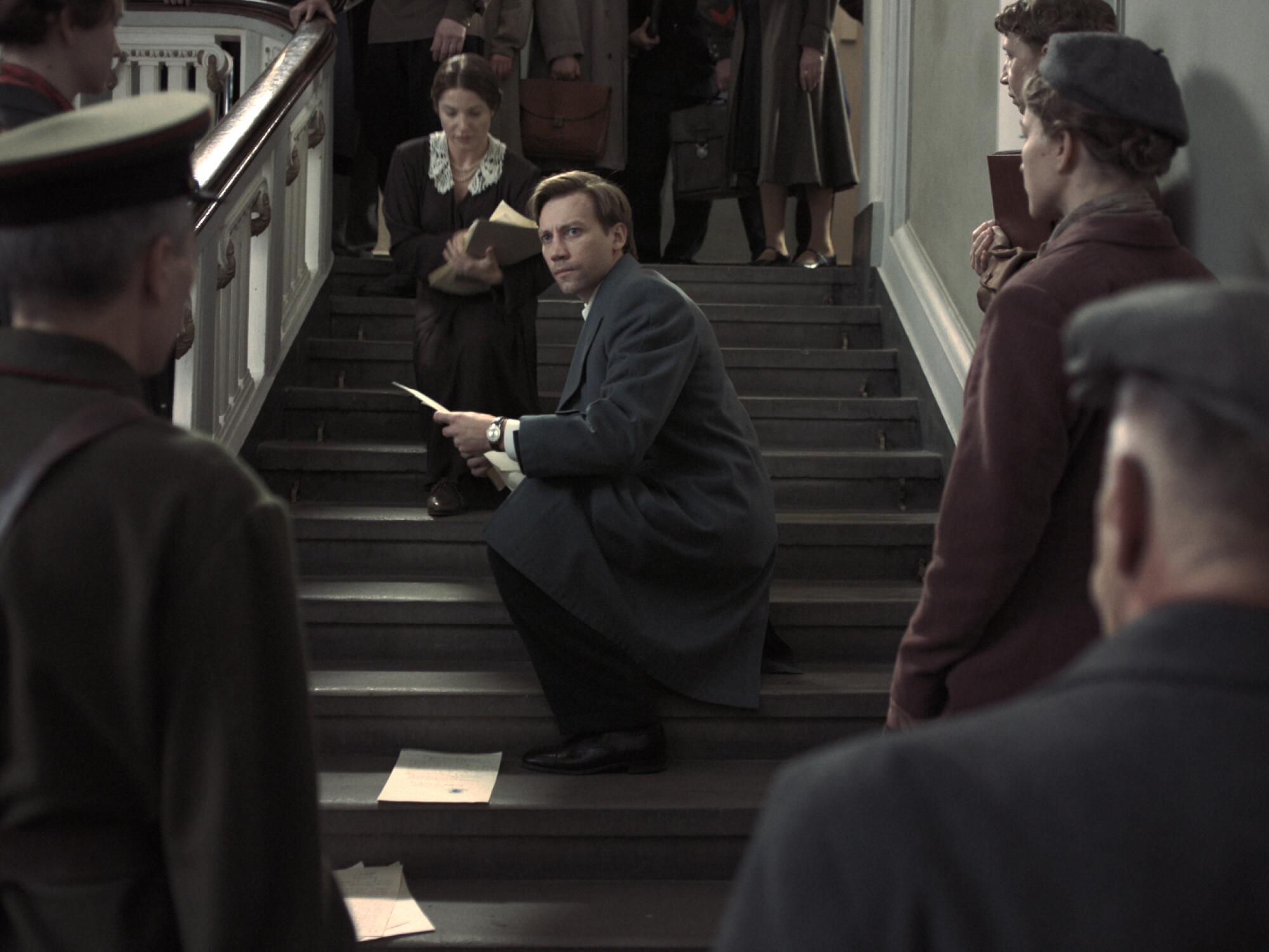
Sergei Loznitsa’s Stalin-era drama “Two Prosecutors” lugs its own protagonist along that exact same journey; it’s affixed to cynicism like a train on a track. Here, the ill-fated idealist is a recent law student (Aleksandr Kuznetsov) who wants to interview a prisoner that the government would rather remain disappeared. The voices that once boldly spoke out against the Soviet regime have long since been silenced. Now, the Great Purge is locking up even the Russians who swear they love their leader.
Advertisement
Methodical and dreary, the film’s key image is of Kuznetsov (who coincidentally-but-on-purpose has a nose that appears to have been busted around) walking down endless dismal hallways. He’s polite and stoic, but we all know he’s not getting anywhere. The film plays like a sour joke with an obvious punchline. I respected it fine, but slow and inevitable don’t make great bedfellows. The jet-lagged stranger next to me nodded off for a nap.
Snores weren’t a problem at “Sirât,” a nail-biter that had its midnight crowd wide awake. The fourth Cannes film by the French-born Spanish director Oliver Laxe, it’s about dirtbag ravers who’ve gathered in a barren stretch of Morocco for a stunning party: orange cliffs, neon lights, thumping EDM beats and dancers thrashing in the dust like the living dead. The only sober attendees are a father (Sergi López) and his young son (Bruno Núñez) who are hoping to find the boy’s sister, a bohemian swept up in the relentless rhythm of this road-tripping bacchanalia. But when the party gets busted up by the police, this fractured family joins a caravan headed in the vague direction of another fest. Next stop, disaster.
An image from the movie “Sirât,” directed by Oliver Laxe.
(Festival de Cannes)
The small ensemble cast looks and feels like they’ve already lived through an apocalypse. Two of his actors are missing limbs and nearly all are flamboyantly tattooed. As these battered vans hurtle through the desert, it’s obvious that “Sirât” believes the age of “Mad Max” has already begun. But Laxe’s cadence of death is nasty and arbitrary and delightful. He’s unconvinced that we can form a community able to survive this harsh world. At best, he’ll give us a coin flip chance of success. I’ve got to watch the film again before I decide whether (a) it’s a comedy and (b) it has anything deeper to say. But a second viewing won’t be a hardship. Even if “Sirât” proves half-empty instead of half-full, witnessing another audience gasp at its mean shocks will be sweet schadenfreude.
Advertisement
Which finally brings us back to Harris Dickinson. His film “Urchin” is good. Great, even. The last time he was in Cannes, it was as the lead in Ruben Östlund’s “Triangle of Sadness,” but he’s a real-deal director. It’s high praise to his acting that I don’t want him quitting his day job just yet.
“Urchin” lopes after a drug-addled boy-man named Mike (Frank Dillane, fantastic) who’s been sleeping and scavenging on the London streets for five years. Yes, Dickinson has gone 21st-century Dickensian; Mike pesters people for ketamine, vodka and spare change like Oliver Twist begged for porridge. But this isn’t a pity piece. “Urchin” is energetic and filled with life: funny asides, tiny joys, stabs of recognition and flourishes of visual psychedelia.
Mike is given multiple chances to change his fortunes. Yet, he’s also stubbornly himself and we spend the running time toggling between being scared for him and being scared of him. Dickinson, who also wrote the film, wants us to know not just how easy it is to slide down the social ladder but what a small step forward looks like, even if his tone is ultimately more Sisyphean than self-help.
After the movie, I ducked into the drizzle, then into a cafe. A man was monologuing to an acquaintance about his career change from tech to film and this is my favorite place to eavesdrop.
“I was rich and successful but I had to look for something more jazzy,” he explained, stabbing at the other person’s plate of charcuterie. He’s now broke, he said, and divorced. But somehow, he seemed content. He’d emailed his script to Quentin Tarantino. Maybe next Cannes, he’ll be the one getting fêted and chauffeured. Maybe the wind would start blowing his way. A great movie really can change your life.
A family and friends gather for a naming-day ceremony at a Danish seaside hotel, but an unexpected appearance by one uninvited attendee (Trine Dyrholm) ruptures the veil of bland, happy-clappy familial unity in director Mads Mengel’s gutsy, well-wrought debut feature, The Guest.
The most audacious move here may be Mengel and co-screenwriter Christian Bengtson’s choice to write something that will inevitably invite comparisons with Festen (The Celebration), arguably the most notorious Danish-language film of the last 30 years, which similarly revolved around a bougie gathering disrupted by angry revelations. But there’s a savvy 2026 vibe about the way the film refuses to create florid melodrama out of quotidian crisis, and instead observes with generosity as the characters grope awkwardly toward emotional détente and mutual forgiveness.
The Guest
The Bottom Line
When wetting the baby’s head goes too far.
Advertisement
Venue: Karlovy Vary Film Festival Cast: Simon Bennebjerg, Trine Dyrholm, Josephine Park, Peter Gantzler, Petrine Agger, Mette Klakstein Wiberg, Kristine Kujath Thorp, Buster Lund Luscher Director: Mads Mengel Screenwriter: Christian Bengtson, Mads Mengel
1 hour 40 minutes
Festen-alumnus Dyrholm, having a bit of a career moment with outstanding performances both here and in the recent The Girl With the Needle among others, leads a uniformly excellent cast in a work that deserves celebration on the festival circuit and beyond.
Dyrholm’s Vibeke is technically the first person we meet, although she’s seen only in shadow at first as she smokes and drives while her unattached seatbelt, caught outside by a closed door, clatters on the road. This is the kind of unsafe driving her son Karl (Simon Bennebjerg) so deplores, a point of contention later on in the story when he will steal her car keys in interest of her own safety and that of others.
Advertisement
But well before we get to that flashpoint, the film introduces Karl, effectively the film’s protagonist, as he arrives at the swanky resort with his wife Emilie (Mette Klakstein Wiberg) and their infant son Elliot (Buster Lund Luscher). The young family, who’ve chosen this new, secular tradition instead of a christening to welcome their child to the world, are there a day before the ceremony to meet up with core family members.
As this advance party settles down for dinner, a table that includes Karl’s sister Rikke (Josephine Park) and Emilie’s parents Frank (Peter Gantzler) and Kirsten (Petrine Agger), there’s a surprise: Vibeke is coming, courtesy of Rikke’s invitation. Karl is quietly furious and seems determined to turn her away, even when she shows up minutes later. Poor Frank and Kirsten look on confused, determinedly polite in their insistence that all family members should be welcome.
Bengtson and Mengel’s economical script carefully dripfeeds backstory as the film unfolds to explain that Karl hasn’t spoken to his mother in years, that Rikke has taken over all the daily mom management and that she’s very worn out by it. Even so, she insists Vibeke is regularly taking her medication and isn’t a problem these days, although to Karl every weird anecdote and moment of emotional intensity is an augur of impending chaos. Rikke counters that their mother is just “big, that’s her personality not her condition.”
Interestingly, that specific condition is never named throughout, although armchair diagnosticians might spot many of the signs of bipolar disorder. But the film’s emotional focus on the person and her actions rather than the label is also very contemporary, reflecting a more holistic, inclusive mindset and approach to dealing with mental health issues.
Which is all fine and dandy, until Vibeke duly does skip a dosage and starts getting manic. One of the first signs of chemical imbalance arrives during the ceremony on the beach, when Vibeke carries little Elliot much further away from the shore than anyone wants, creating a panic. From there it just gets worse as Vibeke picks up on the censorious feeling emerging from the other party guests, who had found her so charming the night before when she’d led everyone to the casino to play roulette and diverted a bunch of partying teenagers from the room next to Karl and Emilie so they could get some sleep. When the toasts at the formal dinner begin, Vibeke’s mood darkens much further, and if we’ve all learned one thing from Festen, it’s be very afraid when a Dane gets up to make a toast.
Advertisement
Cinematographer David Bauer’s nimble-footed lensing and use of natural light does indeed hark back considerably to the look of those Dogme 95 movies back in the day, as does the naturalistic editing style deployed by Louis Emil Ramm Seeberg. But there are plenty of sins against the rules of cinematic chastity that marked that movement, such as the ample space made for Lasse Aagaard’s affecting, low-key score that amps up the anxiety as Vibeke starts to spiral.
That said, Mengel keeps things simple in sonic terms when it really counts, letting the musicality of Dyrholm’s deep, sonorous voice ring out on its own in the big monologue scenes. She is, as ever, utterly mesmerizing but the performance is made even more powerful by the muted, expressive reactions of the rest of the cast as they look on, frozen like deer in the headlights of the car crash of pseudo-christening. Moments of levity puncture the gloom, but the final feeling is one of numbed sorrow and pity for all these kind, fallible people, just trying to do their best.
Rhea Seehorn was nervous about whether “Pluribus” would be recognized by Emmy voters Wednesday when nominations were announced. So she was jubilant when she and the surreal sci-series on Apple TV scored 18 nominations, the most for a first-year drama.
“I’m just so grateful,” the actor said in a phone interview. “People were like, ‘Why were you nervous?’ Honestly, you never actually know. I’m just so thrilled for the show, my co-stars, the production design, the editing, the writing, the music, the sound. I haven’t moved from my couch since they first announced everything because I’m still trying to call everybody on the show.”
Seehorn received a nomination for lead actress in a drama series for her portrayal of cynical Carol Sturka, a fantasy romance author who finds herself in a mystifying situation after a virus seems to have wiped out most of Earth’s population. The series was created by Vince Gilligan, who created the acclaimed series “Breaking Bad” and co-created its spinoff “Better Call Saul,” which also featured Seehorn.
The actor compared her experience of being nominated for “Pluribus” to “Better Call Saul,” which earned her two supporting actress nominations: “ ‘Better Call Saul’ was such a family that supported and cheered each other on, and I’m so grateful I have that environment again. People could not be happier for each other, and we get to celebrate the show together.”
She added, “The only part that feels different is that it’s my first nomination as a lead. It’s the process of Vince writing this for me and seeing the mountain which he wanted me to climb and going through that process. The whole thing has been its own journey, so ending up with awards and nominations, and being so well received by critics and fans is not lost on me.”
Advertisement
The series has been applauded for its mix of drama, comedy and strangeness in its portrait of a woman coming to terms to what seems like an impossible dilemma.
“I love the storytelling, how much Vince and I would drill down on making this as authentic as we could in terms of an everyman who has to deal with an insane situation,” Seehorn said. “Most of us are just not heroic or leaping off the couch to go save the world. And Carol is dealing with immense grief and confusion in an utter dystopian crisis. I love the humor and the drama that comes out of us being as realistic as we can with her amidst an unrealistic event.”
Fans of “Pluribus” have been relentlessly curious since the finale in December about when the second season will launch.
“I don’t know anything about that,” Seehorn said. “I don’t have to keep secrets because I’m not great at keeping them, and I know nothing. I don’t know what I’m doing with an atom bomb in the driveway. I can’t wait to find out. The writers want to have the same quality and reward the intelligence of the fans and never phone a single thing in. So their process is their process.”
In a roundabout way, the fact that I don’t have a strong attachment to The Wizard of Oz as a film (my late mother loved it, so that memory is deeply rooted in me, but the movie itself never did much for me) contributed directly to how amusing I found Gail Daughtry and the Celebrity Sex Pass to be. This comedy spoofs the plot of the classic fantasy movie, though the jokes are largely about Hollywood. The humor is big and broad, with some of the jokes really landing. Others? Not so much. Still, more than enough do to warrant a recommendation.
Gail Daughtry and the Celebrity Sex Pass gets a lot of mileage out of sending up show business, even if the observations, while funny, are not particularly new. Besides the deluge of jokes, there’s also a lot of likably broad characters to spend time with, especially our lead. They make the 90 minutes and change spent together with them go down very easy.
Sony Pictures Classics
For Gail Daughtry (Zoey Deutch), her life as a small town hairdresser is perfect. Engaged to her high school sweetheart Tom (Michael Cassidy), she’s the picture of happiness, at least until a trip to a celebrity book signing. There, Tom meets and ends up sleeping with his “celebrity pass,” a term Gail wasn’t even really previously aware of. Feeling betrayed, Gail impulsively joins her co-worker and friend Otto (Miles Gutierrez-Riley) on a trip to Los Angeles. There, a psychic convinces her that the can save her marriage by sleeping with her own celebrity pass: Jon Hamm (Jon Hamm).
Journeying through Tinseltown in a manner that recalls Dorothy’s adventure in Oz, Gail and Otto won’t have to find Hamm alone. Joining forces with talent agency assistant Caleb (Ben Wang), down on his luck paparazzo Vincent (Ken Marino), and actor John Slattery (John Slattery). As they search for Hamm, some for their own purposes, they meet other celebrities, while also being hunted by a group of Italian assassins after a case of mistaken identity. Eventually, they come across Hamm, and the moment of truth is at hand.
Sony Pictures Classics
Zoey Deutch dives headfirst into a broad comedy like this, absolutely relishing the opportunity to get silly again. She’s able to make Gail a babe in the woods but also someone you laugh with, not at. It’s a wildly enjoyable turn. Deutch started out in comedies and was always a talented comedic actress, so it’s a pleasure to watch her back at it. Miles Gutierrez-Riley and Ben Wang get some very funny moments, while Ken Marino is a reliable comic presence. Jon Hamm and John Slattery are delighted to be sending up themselves, with amusing results. Supporting players here, in addition to Michael Cassidy, also include Kerri Kenney, Richard Kind, Thomas Lennon, Joe Lo Truglio, Fred Melamed, and more, plus some cameos.
Advertisement
Filmmaker David Wain, again co-writing with Ken Marino, continues to make it look easy. Few can make a silly comedy like Marino and Wain, especially as they pack their flicks with extra bits that only subsequent viewings reveal. Is Gail Daughtry and the Celebrity Sex Pass on the same level as Wet Hot American Summer or They Came Together? No, not quite. At the same time, is this, scattershot approach and all, funnier than most other 2026 releases? You bet. Marino and Wain have a hit rate that allows some of the jokes to miss, as you only have seconds to wait before the next one, which probably will hit.
Gail Daughtry and the Celebrity Sex Pass is very amusing, and occasionally hilarious, even if not as many jokes land as you might expect. Zoey Deutch is great in the lead role, David Wain is in his comfort zone, and the laughs come hot and heavy. If you’re a Wain fan, this new movie should be a must see.






 Sony Pictures Classics
 Sony Pictures Classics


