Tuner, now playing in theaters throughout Israel, is an offbeat, interesting drama and crime caper, with some funny moments.
Entertainment
At the Emmys, Brian Cox revealed the odd, and specific, request 'Succession' fans ask of him

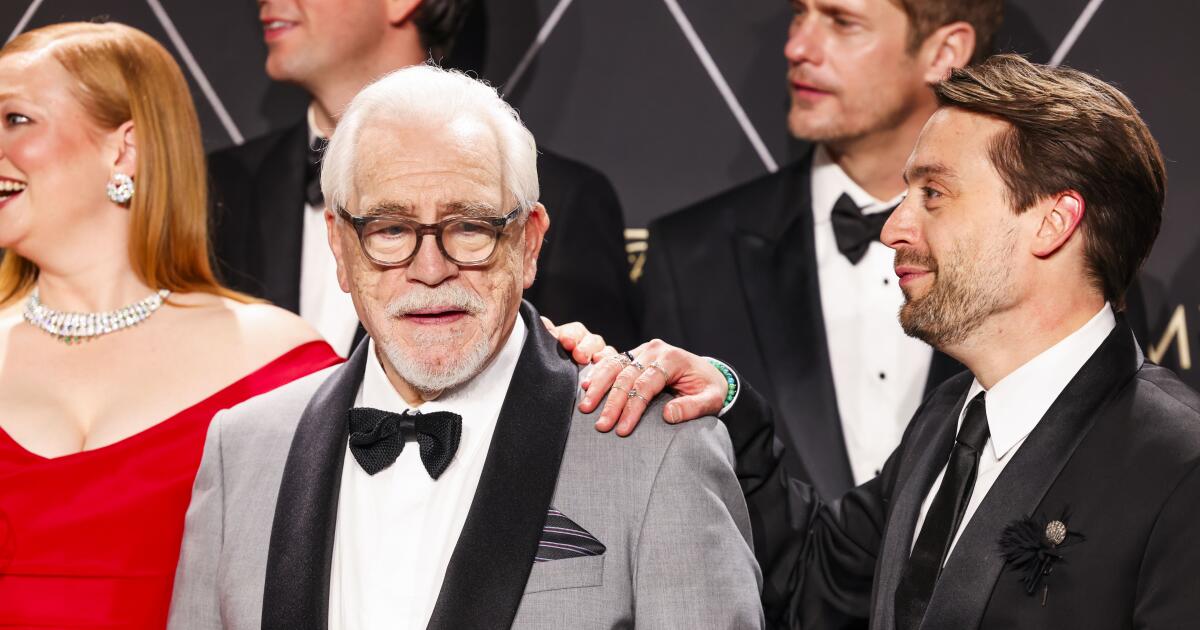
Brian Cox revealed that “Succession” fans often ask him to channel his character Logan Roy when they approach him in public, and he finds their very specific request “extraordinary.”
Cox received an Emmy nomination for lead actor in a drama series for his performance as media tycoon Logan Roy in the final season of HBO’s “Succession.” However, his onscreen baby boy Kieran Culkin ultimately took home the award for his portrayal of Roman Roy.
On the red carpet before the ceremony, Cox told People that he loved playing Logan. “I really did. But I thought he was one of the most misunderstood characters ever. Because he was rough, and he was crude, and he told people like it is. But all he wanted was his own family to take over, and none of them were up to the mark. Except his son-in-law,” he said, adding that he always knew Tom Wambsgans (Matthew Macfadyen) would be the ultimate successor. “He was the one person who showed him kindness when he had a bad time.”
“Succession” star Macfadyen nabbed an Emmy on Monday for supporting actor in a drama series.
Cox also opened up about the unusual request fans have when they spot him in public. “I’m dazzled by the fact that human beings want to be told to f— off, and I find that extraordinary,” he joked to the outlet. “And of course, it’s the easiest thing to say to somebody.”
The Scottish actor has enjoyed widespread acclaim for his work on the series since its premiere in 2018, and fans were reeling when his character was killed off in the third episode of the final season.
The episode Cox submitted for Emmy consideration was “Rehearsal,” in which Logan gave a fire-breathing speech to the newsroom at ATN, his conservative news network, and confronted his adult children for their attempt to thwart an acquisition of the family-run conglomerate Waystar Royco, memorably saying, “You are not serious people.”
It was Cox’s third Emmy nomination for “Succession.” He previously won an Emmy for his performance as Nazi leader Hermann Göring in the TV movie “Nuremberg.”
The actor, a self-described socialist who supports the movement for Scottish independence, has a reputation for being blunt and outspoken, particularly when it comes to politics and the machinations of show business. He has said the British monarchy is an institution that “doesn’t make any sense” and recently signed a letter calling for a ceasefire in the Israel-Hamas war. In interviews, he has expressed reservations about his co-star Jeremy Strong’s “f— annoying” approach to acting and said that he believed his character was written off the show too soon.

Movie Reviews
Film review: ‘Tuner’ mixes classical music, crime, and Dustin Hoffman | The Jerusalem Post

It co-stars Dustin Hoffman in a story of a young piano tuner, Niki (Leo Woodall), a former music prodigy with perfect pitch who suffers from hyperacusis, a condition that makes him extraordinarily sensitive to loud noises.
In a series of events that are a bit improbable but that seem quite credible while you’re watching, Niki discovers his finely tuned hearing gives him a great talent for safecracking, which brings him to the attention of a crime gang.
It features a clever, often surprising screenplay, co-written by its director, Daniel Roher (who won an Oscar for the documentary, Navalny) and Robert Ramsey. There are also wonderful performances from the cast, which also includes distinguished actress Tovah Feldshuh of Nobody Wants This and Fauda star Lior Raz.
The characters have a nice, funny raport
When Tuner opens, Niki is working in a piano-tuning business in New York with a former musician, Harry Horowitz (Hoffman).
The beefy, laconic, young man treats the garrulous, wisecracking Harry with respect, listening patiently to all his jokes and stories about the good old days when he worked with jazz greats.
These two have a nice rapport, as Niki drives Harry all over the New York area in an old van and eats in diners with him.
Niki does the work while Harry sits on a sofa, critiquing him.
The two stick out like sore thumbs in the many mansions where they work on spectacular pianos that haven’t been played in decades, for clients who ask them if they can also repair toilets and modems.
Harry, who never made much of a living despite his talent, has fallen on hard times, and he and his wife, Marla (Feldshuh), are barely scraping by. Niki is also broke.
Recognizing what a great musician Niki is, Harry tries to cajole him into playing again, but the younger man refuses, living an isolated life and trying not to draw attention to himself.
The three incidents that set the plot in motion
Harry has forgotten the combination to his safe and needs to open it. When Niki goes on YouTube to look at a video on how to do it, he discovers that his sensitive hearing makes him a genius at safecracking.
Harry becomes ill and, due to a mess with Medicare, suddenly falls into a huge debt; and Niki meets Ruthie (Havana Rose Liu), an extremely ambitious pianist and composing student, who is astounded by his perfect pitch.
Soon, Niki’s talent for safecracking draws the attention of Uri (Lior Raz), an Israeli who runs a bogus security company, where he uses his knowledge of his client’s homes and passwords to steal what he contends are minor trinkets, but which add up to big money for his gang, much like Jon Hamm’s character in the Apple TV series, Your Friends and Neighbors.
Raz hams it up as a character who fits the stereotype of the obnoxious Israeli in the US, and lords it over his supposedly bright accomplice, Yoni (Gil Frank), and his much dimmer nephew, Benny (Nissan Sakira).
Much of the comedy in the movie comes from Uri browbeating the two, and if you can understand the Hebrew, it’s even funnier than the subtitles.
Criticisms of Tuner
Niki’s romance with Ruthie, which develops quickly, feels a little convenient at times, though the screenplay paints a realistic picture of the competitive world of high-level music students. You know, for most of the movie, that eventually Niki will reveal to her that he was once a great pianist, and when it comes, it’s something of an anti-climax.
After Hoffman’s character gets sick, he disappears from the rest of the movie except for a couple of scenes, and that’s too bad. It’s great to see Hoffman having fun as Harry, and the scenes where he and Niki banter help humanize the younger man, making him more likable and less self-centered.
Woodall is one of the most in-demand young actors. He played a hunky love interest in both Bridget Jones: Mad About the Boy and the Netflix series Vladimir; he also appeared in the second season of The White Lotus.
He has a buff body and conventional leading-man good looks, and generally plays confident, happy-go-lucky guys, which means he is cast against type here.
Niki is the kind of role that might seem better suited for actors like Josh O’Connor, Jeremy Allen White, or Timothée Chalamet. Woodall has to work hard to convince us he is withdrawn and feels out of place in all the mansions where he tunes pianos, but his charm wins out, and soon, you come to accept him in the role.
Mixed music and mixed genres
The soundtrack features a mix of classical music and jazz, and it’s clear it was made by a director who appreciates both.
Tuner settles neatly into a mini-genre of movies that feature plot lines that combine piano-playing characters and crime, that include James Toback’s Fingers with Harvey Keitel, and Jacques Audiard’s remake of it, The Beat that My Heart Skipped with Romain Duris; Francois Truffaut’s Shoot the Piano Player with Charles Aznavour; and Eugenio Mira’s Grand Piano with Elijah Wood. It also recalls the spirit of Bob Rafelson’s Five Easy Pieces, which features Jack Nicholson in one of his best performances; here as a piano prodigy who has rejected his oppressive family and become an oil field worker.
Tuner shares some of the bleakness typical of 1970s films, like Fingers and Five Easy Pieces. At times, the movie moves jarringly between brooding, almost noir-like darkness and scenes with the chatty Harry or the bumbling gangsters.
It might have been a stronger film if Roher had gone in one direction instead of mixing genres, but it would likely have been less entertaining.

Tom Sandoval’s girlfriend Victoria Lee Robinson was arrested after the two had an altercation that involved her father being pushed into a lit fire pit.
Sandoval, known for the cheating “Scandoval” that erupted on the reality television series “Vanderpump Rules,” filed a restraining order against the model and her father J. Will Robinson (who goes by Will) over a June 3 incident that was partially caught on video. He was granted a temporary restraining order and a subsequent hearing was set for July 16.
According to court documents obtained by The Times, the altercation involving Sandoval, Victoria Robinson and J. Will Robinson happened in the early morning hours after the couple returned home from a night out at a bar. Sandoval claimed in the petition that since the two became a couple in February 2024, Victoria Lee Robinson has been violent and attacked him physically, as well as changing the passwords on his phone and social media and tracking him using Airtags.
“The most recent physical incident occurred on June 3 when [she] punched my face and injured my neck and ear. During this same incident, Mr. Robinson, grabbed me and punched an approximately 12-inch hole in the door of my spare bedroom where I was barricading myself,” reads the petition.
In a video, obtained by TMZ, that captured part of the June 3 incident, Victoria Robinson and Will Robinson are seen sitting next to a lit fire pit on the patio when Sandoval and Will Robinson begin arguing. Sandoval is heard yelling at Will Robinson before he asks Victoria Robinson if she is recording and approaches her. Will Robinson stands and wraps his arms around Sandoval, seemingly to get him to back away from Victoria Robinson, and Sandoval turns and pushes Will Robinson, who falls backward into the lit fire pit.
After Will Robinson gets back up, he rushes after Sandoval into the home while Victoria Robinson screams for the men to stop.
According to the petition, the fight escalated, and Will Robinson phoned the police while Sandoval hid inside a spare bedroom. When police arrived, the petition claims that they initially put Sandoval in handcuffs, but after reviewing footage, Victoria Robinson was arrested for intimate partner battery with physical violence.
Robinson bonded out and was released the same day. The Los Angeles Police Department was not able to confirm the reason for Victoria Robinson’s arrest.
Representatives for Sandoval did not immediately respond to The Times’ request for comment. Victoria Robinson could not be reached for comment.
According to the petition, both Victoria Robinson and her father have lived in the Los Angeles rental home with Sandoval. According to the filing, the reality star hopped between hotels and friends’ houses after the June 3 incident.
Will Robinson told TMZ, “The DA did not file the case for a reason. I lifted Tom off of my daughter because he was overpowering and twisting her arm and trying to take her phone aggressively after yelling at us in a very aggressive and threatening manner.”
“This is my daughter’s home and we just want Tom as far away from us as possible and to keep his lies and drunken abuse away,” Robinson said.

“Who lives, who dies, who tells your story?” This is one of the culminating lines from Lin-Manuel Miranda’s smash hit 2015 musical “Hamilton,” but it’s also the animating force behind Michael Sarnoski’s “The Death of Robin Hood,” starring Hugh Jackman in the title role. This legendary figure of English folklore has a specific meaning attached to his name, which is synonymous with the altruistic impulse to redistribute wealth. But in his take on the tale, focusing on the end of his life, Sarnoski suggests that perhaps Robin Hood wasn’t such a good guy, even if he was robbing from the rich to give to the poor. It all depends on who’s telling the story, right?
Sarnoski burst onto the scene in 2021 with his debut feature “Pig,” in which he outfitted Nicolas Cage with a long gray wig and sent him on a dangerous quest (to find his beloved, valuable pet). He does something similar in “The Death of Robin Hood,” outfitting Jackman in a long gray wig and sending him on a quest (to achieve some kind of salvation).
But first, Sarnoski has to establish that this Robin Hood isn’t the one we remember from the movies — he’s not the dashing cartoon Disney fox, or Errol Flynn, or Kevin Costner, or Cary Elwes, or Russell Crowe, or even Taron Egerton. No, this Robin Hood is much worse, sleeping in matted filth on the moors, reduced to a feral life of constant vigilance against murderous revenge-seekers for the years of evil deeds he’s carried out with his compatriot, Little John (Bill Skarsgård).
Now called Edward, Little John has achieved some measure of domesticity, but still, he and Robin go a-murdering once again, resulting in a yet another vengeful attack from a relative of their victims. A wounded Robin ends up in an idyllic priory on a coastal island, tended to by a healer, Brigid (Jodie Comer), learning the ropes from the local leper (Murray Bartlett). In this oasis, Robin’s identity is unknown, and he finds the space to embrace a gentler side of himself, particularly with Little John/Edward’s daughter, Little Margaret (Faith Delaney).
Set on the misty outlying islands of the North Atlantic, with its blend of bloody, brutal violence, primitive spirituality and meditative tone, “The Death of Robin Hood” is situated in the realm of films like David Lowery’s “The Green Knight” and Robert Eggers’ “The Northman.” Cinematographer Pat Scola pulls some arresting images out of the fire and fog, and the score of largely traditional Celtic music by Jim Ghedi is easily one of the best of the year. The film is a fine showcase for a different kind of performance from Jackman, and Comer is always a compelling screen presence.
But “The Death of Robin Hood” isn’t as hallucinatory or weird as it could — or should — be. Sarnoski gestures at bleakness but feints from full existential crisis; he tries and fails to be witchy. Despite all the mud and blood, nothing about this film is particularly earthy or embodied. It ends up as this profoundly dull and utterly pointless commentary on the concept of narrative and mythology. “What if Robin Hood was a bad guy?” OK, what of it? The best concept that Sarnoski presents here is the hell of living in an endless cycle of vengeance, but he allows his anti-hero to escape that all too cleanly and conveniently. This Robin Hood is just an old, tired man who ultimately finds some peace at the end of his life, even if it’s unearned.
As an audience, we’re left wondering what all of this is for, and who it’s for. Why trouble the Robin Hood myth at all, and why now? One can’t help but cynically wonder if the inspiration for this project was merely the convenience of recognizable intellectual property and available financing from Screen Ireland. This theory might be creatively pessimistic, but it is a nagging question, especially when the ones posed by the film are already so stale and tired. Expect no revelations from “The Death of Robin Hood” except the one that’s announced in the title.
‘The Death of Robin Hood’
2 stars (out of 4)
MPA rating: R (for strong bloody violence)
Running time: 2:03
How to watch: In theaters June 19
-
World3 seconds ago
Trump threatens 100% tariffs over EU digital tax
-

 News25 minutes ago
Utah County declares State of Emergency as wildfires ‘ravage’ the state
-

 Los Angeles, Ca2 hours ago
Man found guilty of sex trafficking victim along L.A.’s Figueroa Corridor
-

 Detroit, MI2 hours ago
No. 23 overall pick in the 2026 NHL draft | Detroit Red Wings
-

 San Francisco, CA2 hours ago
San Francisco Pride kicks off with rainbow lasers, ValQueeries celebrate at Valkyries Pride Night
-

 Dallas, TX2 hours ago
How to buy Egypt vs. Australia World Cup soccer tickets
-

 Miami, FL2 hours ago
Helping Venezuela: Miami search-and-rescue team prepares to deploy
-

 Boston, MA2 hours ago
How to buy Paraguay vs. Germany 2026 World Cup tickets in Boston

