Tuner, now playing in theaters throughout Israel, is an offbeat, interesting drama and crime caper, with some funny moments.
Entertainment
Are men OK? Actor Jena Malone genuinely hopes so on a beguiling new album

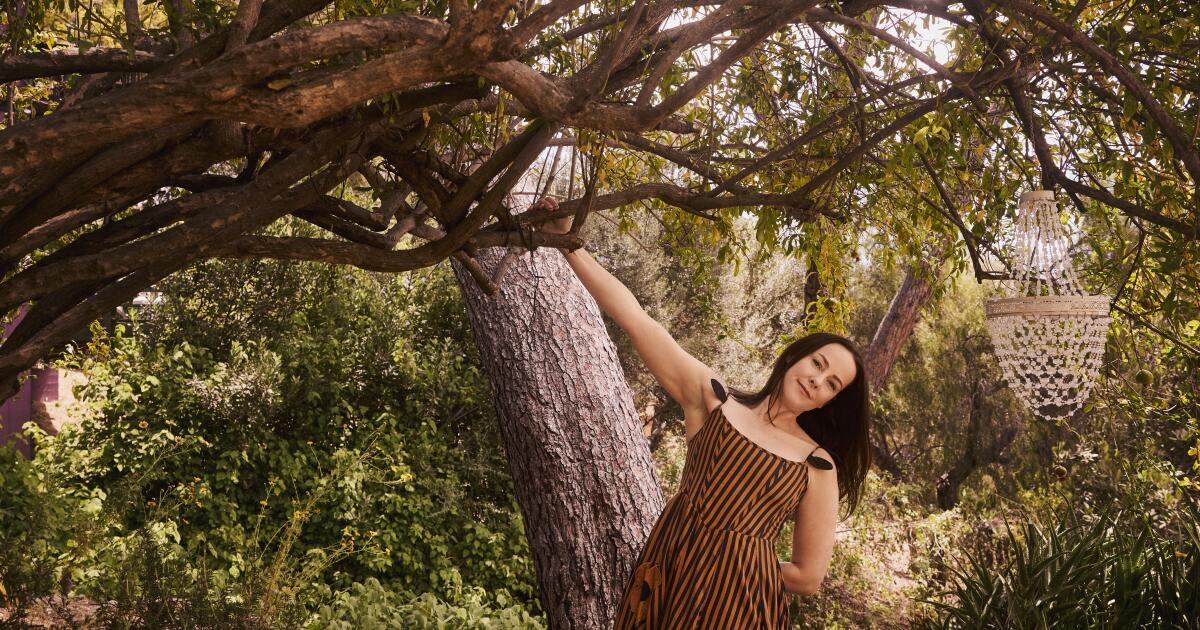
If, god forbid, there’s a natural disaster in L.A. in the near future, Jena Malone might be one of your first responders.
“I’ve been studying Community Emergency Response Team training,” the actor-musician, 41, said, drinking coffee in the living room of her home overlooking pomegranate trees and a canyon in northeast L.A. “Whether it’s fire management or building a neighborhood tool shed, it’s less important for me to hit career milestones now than to transform how I live on this planet. Let’s build something where we’re all taking care of each other’s needs through mutual aid.”
Those are galvanizing priorities from Malone, who’s led generationally beloved films like the sci-fi noir “Donnie Darko,” played the axe-chucking Johanna Mason in two “Hunger Games” tentpoles and recently co-starred in the lesbian bodybuilding revenge flick “Love Lies Bleeding.” For almost as long, she’s also made experimental folk and electronic records that toy with avant-garde noise and quietly poignant songwriting.
This is a wild time in L.A. for anyone concerned about the city and its culture industries, and Malone is deeply invested in both. Just before the release of her new Netflix series, the Duffer Brothers-produced “The Boroughs,” she’s released her first album in nearly a decade. “Flowers For Men” is an effects-shredded, future-primitive record, written after the birth of her son upended her obligations — and expectations — toward the men in her life and the world they’ll inherit.
“It changed everything,” Malone said, about raising a son. “I grew up learning to thrive and mask in masculine spaces. Grind culture is a masculine toxicity that I inherited and indoctrinated myself in. But parenthood offers you this opportunity to burn your entire life down in sacrifice to finding out what’s real. I had no idea what it was to be a man. All of my ideas burned down and not much was being raised back up.”
For millennial film fans, Malone’s been a consistently compelling, trust-anything-she’s-in actor since her child-star turn in 1997’s “Contact.” Few embody a tortured, beguiling Americana quite like her.
“The Boroughs” — a high-profile follow-up to “Stranger Things” from the masters of unreality, created by Jeffrey Addiss and Will Matthews — has a stacked cast that includes Alfred Molina, Geena Davis and Bill Pullman, set amid a bucolic retirement community under supernatural threat. A ragtag group of Duffer Brothers misfits teaming up to fight off eldritch horror might be the last safe bet in television.
Yet that’s also how Malone feels about the current climate of Hollywood — a once-stable neighborhood fending off malign forces. Institutional consolidation and retreat, spiraling costs, technological upheaval — they all add to a creeping sense that an era is over, and worse is coming.
“Film is in such a delicate transition. I think that where music was 20 years ago, film is now,” she said. “It’s like being on an elevator where every floor is on fire. A lot of the things that I loved about it no longer exist, even if what I love about it is still wildly potent. My stress levels go down and my creativity goes up when I’m building a world that does not rely on the film industry, even though it’s my main love.”
That feeling called her back to music on “Flowers For Men,” arriving nine years after her last LP. The ego-shattering experience of giving birth in 2016 and raising a son prompted reflections about what men’s inner lives were really like, and she wanted to write about them.
“I was raised by two moms, and I had this strange aspiration to become the dad,” Malone said, laughing. “I was the breadwinner of my family then. But being a parent was all brand-new to me. I kept seeing my father in him, my grandfather, these older relationships with men. It was asking me to look at him with curious, childlike eyes.”
“Flowers For Men” was written from a sincere curiosity about mens’ strictures, bad influences and better aspirations. To inhabit someone else’s life, she had to sound different, too.
“Film is in such a delicate transition. I think that where music was 20 years ago, film is now,” Malone said. “It’s like being on an elevator where every floor is on fire. A lot of the things that I loved about it no longer exist, even if what I love about it is still wildly potent.
(Evan Mulling/For The Times)
The most prominent instrument on the album is its layers of vocal treatments. Malone has a lovely natural voice — intimately whispered, with hints of ‘70s country rock. But here she douses it in pitch-shifted digital acid, like a late 2000s R&B record dropped in the pool at the Joshua Tree Inn.
It’s an uncanny combo, but its lends modern melancholy to “Barstow,” which has the narrative structure of a Townes Van Zandt banger but is corroded with bleary effects. “Create In Your Name” has a Billie Eilish-worthy late-night murk, with lyrics so devotional they almost sound consumptive. “Disaster Zones” is all blown-out ambience, and the LP closes on a showstopping cover of John Prine’s classic “Angel From Montgomery.”
“I just love that a man wrote a song where the first line is ‘I’m an old woman,’” Malone said. “As a female songwriter, it gives me so much permission. Now all the doors are open. If I was to give flowers to all of the different men that have touched or changed things that deserve celebration, John Prine would be one of them.”
That idea — celebrating men for the good they’re capable of — felt transgressive enough today that it cohered the album for her. But it also came with questions about how romantic partnership fit into her life. Settling into motherhood, she read up on relationship anarchy — which she sees as not abiding by tiers of connection. She bought books on ethical nonmonogamy (“Sex at Dawn” was a big one) to learn how other lives were not just possible, but maybe even more fulfilling.
(Perhaps this was not a stretch from an actor who played the wild child Lydia Bennet in “Pride and Prejudice.”)
“I had been under this societal understanding that hierarchical love, placing one partner above everything else, was the ultimate romantic expression. I could name hundreds of movies that brought that up,” she said. “But while I’m learning to take care of this child, I’m realizing that self-love is one of the most important parts of this equation. I need to have expression, some work in life that felt like another love. And then my family, and how important friends were. And all of a sudden there’s no world where I would just have one love, not even just romantic love.”
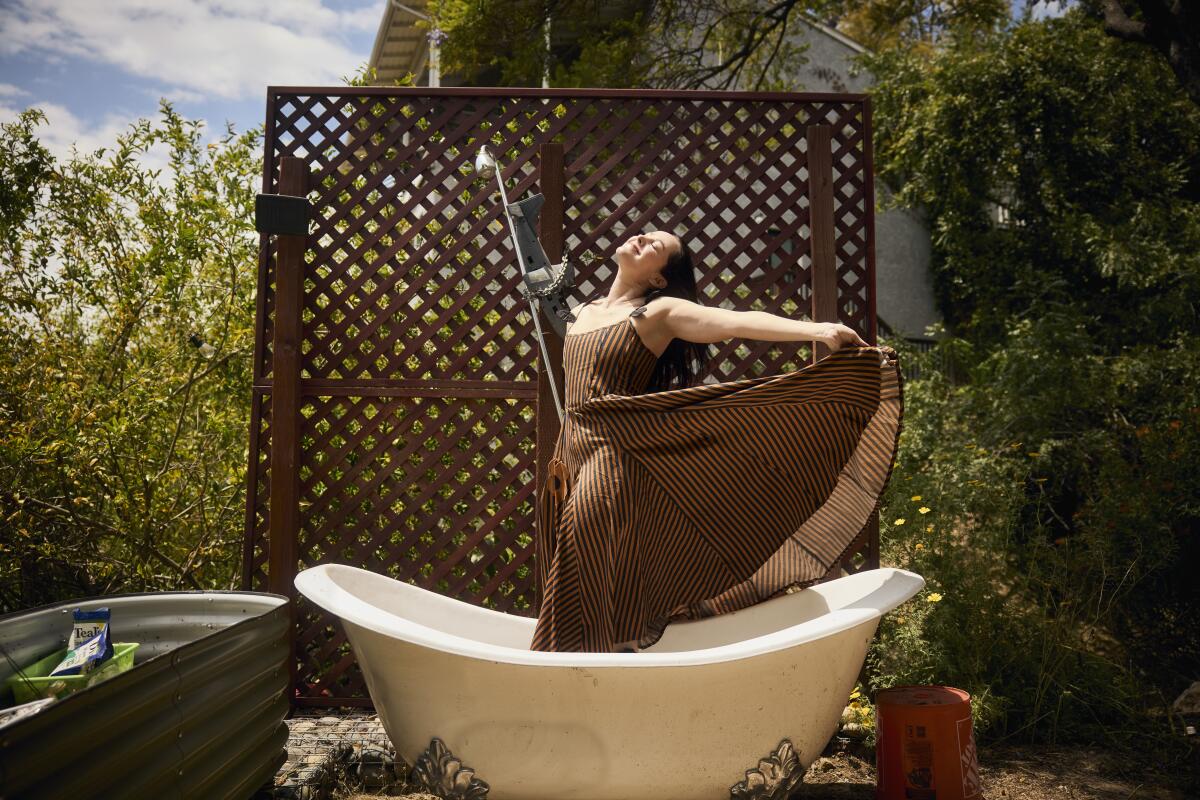
“I had been under this societal understanding that hierarchical love, placing one partner above everything else, was the ultimate romantic expression. I could name hundreds of movies that brought that up,” Malone said. “But while I’m learning to take care of this child, I’m realizing that self-love is one of the most important parts of this equation. I need to have expression, some work in life that felt like another love.
(Evan Mulling/For The Times)
“Flowers For Men” is, in her way, a bargain with that contradiction — to love men deeply, but never put them above all else, even as she got engaged to her partner, actor Jack Buckley, earlier this year.
She’s still sorting out how to present this album live. She said she’s a fan of the Dead City Punx model of renegade shows in forgotten corners of L.A. Maybe as the city seems to fall apart, she’ll find a leafy park or the back of a dingy bar that’s the right home for these strange, lonely yet hopeful songs.
“I want someone to walk into the bathroom and be like, ‘Whoa, why is there a woman singing to me?’” Malone said. “I like the idea that art makes you a little uncomfortable and you don’t have the previously held expectations to know how to hold it.”


In 2015, musician Roberto Carlos launched Boleros de Noche, an annual concert series held in Los Angeles that aimed at preserving and showcasing the Latin American bolero music genre.
This year, the event is celebrating its 10th anniversary with performances at the Ford on Aug. 1 by Puerto Rican singer and former Calle 13 member iLe and L.A.-based bolero trio Voz Bohemia
On Friday, the city of L.A. honored the series’ decade-long run and legacy of uplifting bolero music by declaring Aug.1 “Día del Bolero.”
Boleros are ballads noted for their slow tempo and romantic lyrics accompanied by a crooning vocal style. Though the genre originated in Cuba, it quickly gained popularity across Latin America, with each culture putting their own spin on it. In the early 20th century, the evolving sound of boleros was shaped by the Cuban group Trio Matamoros, Mexican composer Agustín Lara, Puerto Rican artist Rafael Hernández and Ecuadorian singer Julio Jaramillo.
The genre saw a resurgence in popularity in the 1980s and ‘90s when famed Mexican artists Juan Gabriel and Luis Miguel embraced the bolero sound. In recent years, the bolero movement has been modernized and electrified by artists such as Mon Laferte, Romeo Santos, Adrian Quesada and Kali Uchis. In the last five years, Quesada has released two bolero albums, “Boleros Psicodélicos” and “Boleros Psicodélicos II,” that mix the genre’s classic sounds with elements of psychedelic rock.
“Over the past decade, Boleros de Noche has presented numerous concerts featuring both local and international artists, has brought together thousands of people across the city to bask in the lush orchestration of this music,” said City Councilmember Nithya Raman, who presented Carlos with the honor. “For so many in the Latino community and beyond, this isn’t just music, it’s memory, it’s home, and perhaps most importantly, it’s heritage being carried forward.”
Raised in L.A. County by parents who immigrated from the Mexican state of Oaxaca, Carlos says he first fell in love with live performance and bolero music in his midteens, when he would frequent the now-defunct Teatro los Pinos in South Gate.
He yearned for that same level of comfort and awe at music and wanted to share that with a larger audience. The first iteration of Boleros de Noche took place in 2015 at an art gallery in Echo Park.
“Over the years, I have heard countless stories from audience members who tell me how this music reminds them of their parents, grandparents, first loves and family traditions,” Carlos said Friday at City Hall. “Ten years ago, bolero was rarely part of our city’s cultural conversation, and today bolero programming can be found across Los Angeles, and I’m honored that Boleros de Noche has been a driving force behind its growth.”
Boleros de Noche has sold out shows at the Ford over the last few years and has featured artists such as Gaby Moreno, Marisoul and the legendary trio Los Panchos. In 2025, the event made its debut at Chicago’s historic Symphony Center.
The bolero genre’s popularity and cultural significance has been spotlighted outside of L.A. in recent years as well.
On Dec. 5, 2023, UNESCO, the United Nation’s agency aimed at safeguarding social and cultural foundations, recognized the musical genre as an Intangible Cultural Heritage of Humanity.
As part of Friday’s ceremony, Carlos and his bolero group Los Rebeldes Románticos performed several tunes, including the Mexican bolero classic “Sabor a Mí.”
Last year, Carlos spoke with The Times about his ambitions for Boleros de Noche and the mentality that drives the event series.
“At Boleros de Noche, [I want] for us to speak in Spanish, to feel recognized, to do this music as a celebration for all these artists that unfortunately became background music for a lot of like weddings and quinceañeras,” he said. “How about if we celebrate them and give them recognition? How about if, through my events, I can take people back to the 1940s to my experience at Teatro los Pinos?”
Given recent attacks on Latinos on the local and national levels, Carlos said he hoped his events would create a safe and welcoming gathering place.
“It’s about bolero music. It’s about community. It’s about people. It’s about the musicians,” he said. “Many of the musicians were undocumented. They brought this music to L.A. through their hometowns.”
Movie Reviews
Film review: ‘Tuner’ mixes classical music, crime, and Dustin Hoffman | The Jerusalem Post

It co-stars Dustin Hoffman in a story of a young piano tuner, Niki (Leo Woodall), a former music prodigy with perfect pitch who suffers from hyperacusis, a condition that makes him extraordinarily sensitive to loud noises.
In a series of events that are a bit improbable but that seem quite credible while you’re watching, Niki discovers his finely tuned hearing gives him a great talent for safecracking, which brings him to the attention of a crime gang.
It features a clever, often surprising screenplay, co-written by its director, Daniel Roher (who won an Oscar for the documentary, Navalny) and Robert Ramsey. There are also wonderful performances from the cast, which also includes distinguished actress Tovah Feldshuh of Nobody Wants This and Fauda star Lior Raz.
The characters have a nice, funny raport
When Tuner opens, Niki is working in a piano-tuning business in New York with a former musician, Harry Horowitz (Hoffman).
The beefy, laconic, young man treats the garrulous, wisecracking Harry with respect, listening patiently to all his jokes and stories about the good old days when he worked with jazz greats.
These two have a nice rapport, as Niki drives Harry all over the New York area in an old van and eats in diners with him.
Niki does the work while Harry sits on a sofa, critiquing him.
The two stick out like sore thumbs in the many mansions where they work on spectacular pianos that haven’t been played in decades, for clients who ask them if they can also repair toilets and modems.
Harry, who never made much of a living despite his talent, has fallen on hard times, and he and his wife, Marla (Feldshuh), are barely scraping by. Niki is also broke.
Recognizing what a great musician Niki is, Harry tries to cajole him into playing again, but the younger man refuses, living an isolated life and trying not to draw attention to himself.
The three incidents that set the plot in motion
Harry has forgotten the combination to his safe and needs to open it. When Niki goes on YouTube to look at a video on how to do it, he discovers that his sensitive hearing makes him a genius at safecracking.
Harry becomes ill and, due to a mess with Medicare, suddenly falls into a huge debt; and Niki meets Ruthie (Havana Rose Liu), an extremely ambitious pianist and composing student, who is astounded by his perfect pitch.
Soon, Niki’s talent for safecracking draws the attention of Uri (Lior Raz), an Israeli who runs a bogus security company, where he uses his knowledge of his client’s homes and passwords to steal what he contends are minor trinkets, but which add up to big money for his gang, much like Jon Hamm’s character in the Apple TV series, Your Friends and Neighbors.
Raz hams it up as a character who fits the stereotype of the obnoxious Israeli in the US, and lords it over his supposedly bright accomplice, Yoni (Gil Frank), and his much dimmer nephew, Benny (Nissan Sakira).
Much of the comedy in the movie comes from Uri browbeating the two, and if you can understand the Hebrew, it’s even funnier than the subtitles.
Criticisms of Tuner
Niki’s romance with Ruthie, which develops quickly, feels a little convenient at times, though the screenplay paints a realistic picture of the competitive world of high-level music students. You know, for most of the movie, that eventually Niki will reveal to her that he was once a great pianist, and when it comes, it’s something of an anti-climax.
After Hoffman’s character gets sick, he disappears from the rest of the movie except for a couple of scenes, and that’s too bad. It’s great to see Hoffman having fun as Harry, and the scenes where he and Niki banter help humanize the younger man, making him more likable and less self-centered.
Woodall is one of the most in-demand young actors. He played a hunky love interest in both Bridget Jones: Mad About the Boy and the Netflix series Vladimir; he also appeared in the second season of The White Lotus.
He has a buff body and conventional leading-man good looks, and generally plays confident, happy-go-lucky guys, which means he is cast against type here.
Niki is the kind of role that might seem better suited for actors like Josh O’Connor, Jeremy Allen White, or Timothée Chalamet. Woodall has to work hard to convince us he is withdrawn and feels out of place in all the mansions where he tunes pianos, but his charm wins out, and soon, you come to accept him in the role.
Mixed music and mixed genres
The soundtrack features a mix of classical music and jazz, and it’s clear it was made by a director who appreciates both.
Tuner settles neatly into a mini-genre of movies that feature plot lines that combine piano-playing characters and crime, that include James Toback’s Fingers with Harvey Keitel, and Jacques Audiard’s remake of it, The Beat that My Heart Skipped with Romain Duris; Francois Truffaut’s Shoot the Piano Player with Charles Aznavour; and Eugenio Mira’s Grand Piano with Elijah Wood. It also recalls the spirit of Bob Rafelson’s Five Easy Pieces, which features Jack Nicholson in one of his best performances; here as a piano prodigy who has rejected his oppressive family and become an oil field worker.
Tuner shares some of the bleakness typical of 1970s films, like Fingers and Five Easy Pieces. At times, the movie moves jarringly between brooding, almost noir-like darkness and scenes with the chatty Harry or the bumbling gangsters.
It might have been a stronger film if Roher had gone in one direction instead of mixing genres, but it would likely have been less entertaining.

Tom Sandoval’s girlfriend Victoria Lee Robinson was arrested after the two had an altercation that involved her father being pushed into a lit fire pit.
Sandoval, known for the cheating “Scandoval” that erupted on the reality television series “Vanderpump Rules,” filed a restraining order against the model and her father J. Will Robinson (who goes by Will) over a June 3 incident that was partially caught on video. He was granted a temporary restraining order and a subsequent hearing was set for July 16.
According to court documents obtained by The Times, the altercation involving Sandoval, Victoria Robinson and J. Will Robinson happened in the early morning hours after the couple returned home from a night out at a bar. Sandoval claimed in the petition that since the two became a couple in February 2024, Victoria Lee Robinson has been violent and attacked him physically, as well as changing the passwords on his phone and social media and tracking him using Airtags.
“The most recent physical incident occurred on June 3 when [she] punched my face and injured my neck and ear. During this same incident, Mr. Robinson, grabbed me and punched an approximately 12-inch hole in the door of my spare bedroom where I was barricading myself,” reads the petition.
In a video, obtained by TMZ, that captured part of the June 3 incident, Victoria Robinson and Will Robinson are seen sitting next to a lit fire pit on the patio when Sandoval and Will Robinson begin arguing. Sandoval is heard yelling at Will Robinson before he asks Victoria Robinson if she is recording and approaches her. Will Robinson stands and wraps his arms around Sandoval, seemingly to get him to back away from Victoria Robinson, and Sandoval turns and pushes Will Robinson, who falls backward into the lit fire pit.
After Will Robinson gets back up, he rushes after Sandoval into the home while Victoria Robinson screams for the men to stop.
According to the petition, the fight escalated, and Will Robinson phoned the police while Sandoval hid inside a spare bedroom. When police arrived, the petition claims that they initially put Sandoval in handcuffs, but after reviewing footage, Victoria Robinson was arrested for intimate partner battery with physical violence.
Robinson bonded out and was released the same day. The Los Angeles Police Department was not able to confirm the reason for Victoria Robinson’s arrest.
Representatives for Sandoval did not immediately respond to The Times’ request for comment. Victoria Robinson could not be reached for comment.
According to the petition, both Victoria Robinson and her father have lived in the Los Angeles rental home with Sandoval. According to the filing, the reality star hopped between hotels and friends’ houses after the June 3 incident.
Will Robinson told TMZ, “The DA did not file the case for a reason. I lifted Tom off of my daughter because he was overpowering and twisting her arm and trying to take her phone aggressively after yelling at us in a very aggressive and threatening manner.”
“This is my daughter’s home and we just want Tom as far away from us as possible and to keep his lies and drunken abuse away,” Robinson said.
-
 Lifestyle7 minutes ago
Amateurs now conduct most weddings. Here is some basic advice
-

 Technology17 minutes ago
It’s the last day of Prime Day — here are over 140 great deals to choose from
-

 World22 minutes ago
Rubio announces framework deal between Israel and Lebanon as experts warn Iran will fight to sabotage it
-

 Politics29 minutes ago
Lawyer who beat Hawaii gun law calls state’s reliance on Black Code ‘disgraceful’
-

 Sports37 minutes ago
2026 World Cup Group Scenarios: What Remaining Teams Need To Advance To Round of 32
-

 Technology44 minutes ago
Ohio robot cop retires after zero arrests
-
 Business47 minutes ago
Commentary: Puncturing the myth of Alan Greenspan, whose policies gave us the Great Recession
-
Entertainment52 minutes ago
On 10th anniversary, Boleros de Noche’s legacy is celebrated by L.A. City Hall

