Entertainment
6 directors on ‘wasting’ (and saving) money, the future of movie theaters and more


It is often said that film directors are siloed off from one another, that they don’t get to watch how others work. So when you put a group of them together, as with the six participants in The Envelope’s 2025 Oscar Directors Roundtable, they are quick to share all sorts of ideas. Like where they prefer to sit in a movie theater — centered in a row or on an aisle? How far back is the best for sound, or so the screen runs up to the edges of your peripheral vision? Should you even take the worst seats in the house, since somebody will eventually be asked to pay money to sit there?
Guillermo del Toro, there with his adaptation of Mary Shelley’s classic novel “Frankenstein,” likes the top of the first quarter of the theater. Rian Johnson, who finds new twists for Benoit Blanc in his third “Knives Out” detective story, “Wake Up Dead Man,” says, “I look for wherever Guillermo’s sitting.” Nia DaCosta, who made the bold, adventurous Ibsen adaptation “Hedda,” likes the top of the first third. Mona Fastvold, who explores the life of the founder of the religious movement known as the Shakers in “The Testament of Ann Lee,” likes the center a little farther back. Jon M. Chu, who made the second part of a musical adaptation with “Wicked: For Good,” sits dead center — and has been known to talk to the theater manager if the sound isn’t loud enough. And Benny Safdie, who explores the rise and fall of mixed martial arts fighter Mark Kerr in “The Smashing Machine,” tries to find a spot where he can fidget in his seat and not bother anyone.
Read on for more excerpts of their conversation about the art of adaptation, navigating budget constraints at any scale and much more.

Jon, I’ve heard you say that with “Wicked: For Good,” you wanted the film to be deeper but not darker. And it doesn’t pull any punches as far as dealing with themes of antiauthoritarianism. What was it like to have those very serious ideas and yet still have this be a buoyant, crowd-pleasing musical?
Chu: The reason we made it was because it had that meat to it, and it was always a two-movie, yearlong experience that set up the fairy tale first. And Movie 2 is kind of where we all are, this moment of this fairy tale shattered in front of us.
I have five children now, so I’m thinking about how to present stories to my kids. Do I still believe in the possibility of dreams and the American Dream? “For Good” really gets to delve into that stuff. And because it was shorter than the first half, we get more room to do it. We added new songs to explore that idea. So it all felt really fitting. Movie 1 could be an answer. Movie 2 is much more of a challenge: Who are we gonna be now that we know the truth?
All of your films in their own way are speaking to right now. Rian, “Wake Up Dead Man” is specifically set in the year 2025 and all the “Knives Out” pictures have been dealing with our contemporary reality. What makes you want to do that?
Johnson: That kind of started for me with the first movie. This is a genre, the murder mystery genre, that I love and that I’m just seeing so much of growing up. But it’s also a genre where most of what I had seen throughout my whole life, murder mysteries are period pieces set usually in a cozy little bubble of a little “Queensfordshire” place in England.
And I guess my realization was, that’s not what Agatha Christie did. She was not writing period pieces. She wasn’t an incredibly political writer, but she was always writing to her time. It’s not trying to do anything radical in terms of making it new or updating it, but let’s set it very much unapologetically in the modern moment. … You have a group of suspects that have a hierarchy of power amongst them and the person at the top they all wanna bump off — it’s such a potent vehicle for building a little microcosm of society.

Benny, one of my favorite things in “The Smashing Machine” is that it’s funny to realize setting a story at the turn of millennium is a period piece now. What was it like crafting this very specific, recent time period?
Safdie: It’s a time period that I think everybody thinks is just yesterday. But when you actually get into the nitty-gritty, it’s a long time ago. And things were very different and everybody knows exactly what those things are too. Because it was heavily documented, there was so much footage of it, it’s so top of mind. And I think a large amount of people also want to go back there a little bit, to this time where the internet was just kind of happening. People want to go back to this simpler moment. But trying to re-create what that feels like is what I was really going after — just thinking about how you would live in that time, and then represent that in the movie. Because I did want it to kind of feel like time travel.
Guillermo, you’ve spoken so much about how “Frankenstein” has been a lifelong dream project for you. Now that it’s done, where does that leave you?
Del Toro: There’s a massive postpartum depression, No. 1, and it’s real. And it affected me more than I thought it would, to be candid. But fortunately, I’ve been very interested in two new themes that are going to be sure to produce blockbusters, which is memory and regret. The dynamic duo of past 60. And I always thought about that in the abstract, but now I try to make the movies not only about the moment I’m in, but about me.
And I’m seriously trying to express what makes me uneasy, what makes me believe in the possibilities of grace even in the most horrible circumstances. And I’m not talking only social, but personal or philosophical. Something happens when the six clicks in on the counter. And all you can do is [ask], “Do I feel I have something to say, genuinely?” And then you go to that. Cronenberg, I had dinner with him when he was turning 74, and he said you have to scare yourself into being young again.

Nia, “Hedda” is such a bold adaptation of the play “Hedda Gabler.” You switched the gender of one of the main characters. You aren’t afraid to inject issues of race and class and sexual identity into the story. Were you ever concerned that you were asking too much of this classic text?
DaCosta: I wrote it on spec, so I wasn’t thinking about anything besides letting my freak flag fly, basically. I just thought, “This character makes more sense as a woman.” OK, what does that mean now? How does that affect the rest of the story? And then I just go from there. And then it ended up being really bountiful and generative.
And then when I met Tessa [Thompson] three years later, I thought, “Oh, when I write this, eventually Tessa will play Hedda.” So now she’s Black. OK, what does that mean? And Tessa’s also mixed-race. So then you get that element of it as well. And then I chose the 1950s, and then I chose England and the country house. You just treat these things as truths, and the story has to go in a certain direction. So I never worry about those things. Maybe because I’m a Black woman, so my presence or my identity for some people will complicate the story. But for me, it just is life.
Guillermo, in adapting “Frankenstein,” did you feel like you were dealing with the Mary Shelley text and also all the Frankenstein movies that we know?
Del Toro: I put all the cinematic stuff on the side. I didn’t want to make an erudite cinematic movie or a referential movie. I have lived with the three iterations of the text for my entire life. And there’s a lot of the interstitial stuff that I took from her biography, fusing with my biography, because even if you sing a song everybody knows, you’re doing it with your lungs. And your passion and your pain and your throat. … It’s the difference between seeing a living animal and taxidermy. If you just want the text, then buy the text. You cannot be more faithful to that text than reading the text. But if you want to see how we interact and resuscitate something into being emotional again, then that’s what we try to do.

Mona, “The Testament of Ann Lee” is a story told with music, but is it a musical? Is that a question you asked yourself as you were making it?
Fastvold: I consider it a musical. I do. But it’s just a different kind of musical. No one’s singing dialogue. It’s not magic when they start to sing. I think, as I was writing the script with Brady [Corbet], we realized early on it had to be a musical because the Shakers worship through ecstatic song and dance. They would be moved by the divine spirit and then receive a song or a piece of movement, and then they would start to sing and dance. Their life was a musical, so that’s what it had to be. And that was exciting to me, to create the whole structure of that.
But it couldn’t be, “OK, here’s a story and then here’s an amazing musical number.” It had to come from this place of worship. So all the musical bits and pieces of the film, our moments of feeling moved by the spirit and having this sort of religious experience, it had to be grounded in that and it had to be really organic-sounding and -looking. So we had to ground it in live recordings and create the soundscape and the music in dialogue with my choreographers. Every body slap and stomp is part of the rhythm and the music of it, because it couldn’t just be where diegetic audio fades out and then there’s this great, wonderful piece.
Chu: In a weird way, we all make musicals. All the movies, everybody has a take on how music integrates with it.
Del Toro: I was aiming for opera.

Guillermo, Jon, both of your films have a sense of scale to them. What kind of challenges does that present? Is it wrangling all the extras? Is it having the sets built on time? Jon, just the number of florists credited at the end of “Wicked: For Good” is wild.
Chu: It’s like building Disneyland, essentially. We had the warehouses going — there’s first a recording studio, so we’re recording music while their dance rehearsals are going on. You have hundreds and hundreds of people. Then you go to the costumes department and then you have the hair, just the wigs alone. People are getting there at 2:30 in the morning. And that’s before you even start the day.
We were planning two movies at the same time. So we had 20-something musical numbers rehearsed and worked with our cinematographer and our team to understand everything and build sets around these pieces. And then you get there on the day and how do I say, “Hey, all that stuff we did, this is actually happening over here. Let’s move everything over here”? I felt the hardest thing was being OK with wasting money if it was the right thing to do at that moment. I needed to feel free and had everybody aware that if I’m moving all of a sudden, we’ve got to go and we’ve got to figure it out. And I think that’s where the magic is.
Del Toro: To me, it’s three things. The first one is tonal, meaning everything that you do, you’re not doing eye candy, you’re doing eye protein. You’re telling a story. So it’s not about looking good or looking big. It’s about, does the gesture happen at the right moment? Because you can make gestures on the wrong moment of the film, and they don’t have a dramatic impact. I say we designed the movie for the Creature to feel real, of a piece with the world. So that’s the first one.
The second one: Is it expressing something different every time we go to a bigger thing? It’s not about the scale. And the final one to me is, does it feel real in the world? So the way I go at it is, there’s no typeface, no paint, no photograph, nothing, that cannot be investigated and designed to within an inch of its life. Even great movies, I’m very fidgety. I go, “That’s not a painting from the 1930s. Somebody painted it much later.” Or a typeface or a carnival banner or something like that. So at the end of the day, if you do your job right, you have a world and people just get into it almost like a vibe. Nobody should notice, but if you do it right, they want to experience it over and over again.

Rian, you make a really bold decision in “Wake Up Dead Man,” where the signature character of the series, Daniel Craig’s Benoit Blanc, is offscreen for much of the first 45 minutes or so of the movie. Did you have to convince people that’s the way things should go?
Johnson: Not really. For this one, first of all, it is a little closer to actually a traditional detective structure. That’s kind of how most Agatha Christie books work, is you meet the suspects in the first act. You get a very good idea of who’s gonna get bumped off. And then, end of the first act, the murder happens, and then the detective shows up and starts to solve it. So there was a precedent for it. But the real reason I had done backflips in the previous two movies to get around that was so we could get Blanc in there earlier. The reason it made sense for this [is] because Father Jud, who’s played by Josh O’Connor, [is] kind of the protagonist of it because of the themes of religion, and so the whole lay of the land was more complicated and delicate in this one to set up. I felt like the audience would be best served by having that runway and getting the time before this powerhouse that is Daniel playing Benoit Blanc comes in and brings this whole new energy to it.
The other thing that I’ve landed on with them is you have to constantly resist the candy of the mystery. You have to always remind yourself [that] the mystery elements are not a load-bearing wall, that those are never going to keep an audience entertained or engaged. You need to do the same thing you do in any movie where you have an emotional, bold line going that’s thrown at the beginning, that lands at the end. And the mystery then has to support that.
Mona, with “Ann Lee,” but also with “The Brutalist,” it seems like the movies that you and Brady Corbet are collaborating on together, you’re doing so much with relatively limited resources. What is it that the two of you are doing in these films that you’re able to make them seem so grand?
Fastvold: I mean, there’s no trick. I had to prep for almost a year for this one, because I knew that no one was going to give me a lot of money to make a musical about the founders of the Shakers. It was not gonna be this sexy pitch. It was a hard pitch. So I knew that it was going to be a limited budget. But at the same time, I just desperately wanted “Ann Lee” to have a really grand story. And I wanted there to be a believable, lush world. And I wanted to tell a story about her whole life, not just a day in her life.
So I had to make it work somehow. It was so much about saying, “OK, I’m working with my [director of photography], my production designer, my costume designer every weekend and night for months and months before we started official prep. And same with my choreographer and composer and with all of the cast as well, just rehearsing. Amanda [Seyfried] was rehearsing at night while she was shooting something else. She would go and have dance rehearsals at night, on the weekends, so we could keep on adjusting.
So the only way that I could, to quote David Lynch, get dreamy on set, which was something I really wanted, was by having so much prep time, and then just really knowing what my Plan A and B was, and to sort of experiment in advance more. And because I knew there’s no way that you can try and build a world and then have the same flexibility on this budget, it’s all about knowing every line item in my budget, what everything costs in Hungary, what everything costs in Sweden. “OK, this is how much a cherry picker in Hungary costs, and therefore I’m gonna take out two shots and only build half the roof.”

The 2025 Envelope Directors Roundtable. Top row, left to right: Rian Johnson, Benny Safdie, and Mona Fastvold. Bottom row, left to right: Nia DaCosta, Jon M. Chu and Guillermo del Toro.
Chu: I think that’s one of the biggest lessons I learned being a director. You don’t have a right to make your movie, because it costs so much and you need so much help. You do have to earn the right to make your movie. That is a part of our job.
Nia, you come to “Hedda” having just made a Marvel movie. You’ve just also finished a sequel to “28 Years Later.” Is there a secret through line for you that connects all these projects?
DaCosta: Being a nerd, Marvel, horror, comic books, for me, those things that I’ve done that I haven’t written are worlds that I loved as a kid. So “Candyman” was hugely important to me when I was younger. I used to love Marvel comics as a kid. “28 Days Later” is one of my formative films that I watched. And so when the opportunities came up to be a part of those worlds, it was really exciting for me. And then “Hedda,” I’m a theater nerd too, so I just really go by my passion, and I’m really compelled by just interesting characters.
“Hedda” and “28 Years Later” are very different films, but for me, they were so similar because I learned from my experience jumping into the studio system after making a sub-million-dollar movie [“Little Woods”] what works for me and what doesn’t work for me. And what works for me is really being given authorship. And so I’m setting the tone early. We’re not here to battle. We’re here to make the vision that I have. And if you’re into it, cool and great, let’s work together. If you’re not into it, then it doesn’t have to exist or I’ll find another way for it to exist.
Del Toro: The ambition should always be beyond the budget. If they give you $130 [million], you want to make a movie that is $260 [million]. But the way to that I found by doing “Devil’s Backbone,” which is $3 million, or “Shape of Water,” which is $19.3. “Shape of Water” opened with all the different sets in the first 15 minutes. And then it’s two sets. Lab, apartment, lab, apartment, lab, apartment. I always tell the departments, let’s choose meatballs and gravy. Where do we put the real resources? You reach a plateau no matter what the budget. Never spend money on a plateau. It always needs to mean something.
Safdie: You pick and choose the moments when you’re gonna get big. We were doing the hospital scene and then we built the plane in the hallway of the hospital. Because that was the most affordable. But there was a column in the middle of the plane, and I would always joke that we should go through the column. I find those limitations exciting. Because you really have to figure it out.
Rian, “Glass Onion” had a more robust theatrical release than “Dead Man” has gotten. Do you feel like as filmmakers that all of you are being put in this position of fighting for the future of theaters and moviegoing?
Johnson: I actually feel incredibly optimistic at this moment about the future of moviemaking. I don’t feel that way because we’re all picking up signs and marching down the street and preaching to people that they need to keep this sacred. I feel optimistic about it because I go to movie theaters and I see them packed with young people who want to go to movie theaters and have that experience.
And I see them coming out for new movies. I see them at revival cinemas. I see theaters at 2 p.m. on a Tuesday showing a Melville film that are just full of young people who are excited. And then you see it with movies that have come out this year. You see it with something like Ryan [Coogler]’s movie, “Sinners,” or with so many films that have struck chords with audiences and created cultural events. You can’t wag your finger at people and say, “You should be going to the theater and having this theatrical experience,” but you feel it rising right now. And so for me, it’s less that I want to advocate for it. It’s more that I want to ride that wave of it coming up.




Just when you think Pixar’s petting-zoo cute new movie “Hoppers” is flagrantly ripping off James Cameron, the characters come clean.
movie review
HOPPERS
Running time: 105 minutes. Rated PG (action/peril, some scary images and mild language). In theaters March 6.
“You guys, this is like ‘Avatar’!,” squeals 19-year-old Mabel (Piper Curda), the studio’s rare college-age heroine.
Shoots back her nutty professor, Dr. Fairfax (Kathy Kajimy): “This is nothing like ‘Avatar!’”
Sorry, Doc, it definitely is. And that’s fine. Placing the smart sci-fi story atop an animated family film feels right for Pixar, which has long fused the technological, the fantastical and the natural into a warm signature blend. Also, come on, “Avatar” is “Dances With Wolves” via “E.T.”
What separates “Hoppers” from the pack of recent Pix flix, which have been wholesome as a church bake sale, is its comic irreverence.
Director Daniel Chong’s original movie is terribly funny, and often in an unfamiliar, warped way for the cerebral and mushy studio. For example, I’ve never witnessed so many speaking characters be killed off in a Pixar movie — and laughed heartily at their offings to boot.
What’s the parallel to Pandora? Mabel, a budding environmental activist, has stumbled on a secret laboratory where her kooky teachers can beam their minds into realistic robot animals in order to study them. They call the devices “hoppers.”
Bold and fiery Mabel — PETA, but palatable — sees an opportunity.
The mayor of Beaverton, Jerry (Jon Hamm), plans to destroy her beloved local pond that’s teeming with wildlife to build an expressway. And the only thing stopping the egomaniacal pol — a more upbeat version of President Business from “The Lego Movie” — is the water’s critters, who have all mysteriously disappeared.
So, Mabel avatars into beaver-bot, and sets off in search of the lost creatures to discover why they’ve left.
From there, the movie written by Jesse Andrews (“Luca”) toys with “Toy Story.” Here’s what mischief fuzzy mammals, birds, reptiles and insects get up to when humans aren’t snooping around. Dance aerobics, it turns out.
Per the usual, “Hoppers” goes deep inside their intricate society. The beasts have a formal political system of antagonistic “Game of Thrones”-like royal houses. The most menacing are the Insect Queen (Meryl Streep — I’d call her a chameleon, but she’s playing a bug), a staunch monarch butterfly and her conniving caterpillar kid (Dave Franco). They’re scheming for power.
Perfectly content with his station is Mabel’s new best furry friend King George (Bobby Moynihan), a gullible beaver who ascended to the throne unexpectedly. He happily enforces “pond rules,” such as, “When you gotta eat, eat.”
That means predators have free rein to nosh on prey, and everybody’s cool with it. Because of bone-dry deliveries, like exhausted office drones, the four-legged cast members are hilarious as they go about their Animal Planet activities.
No surprise — talking lizards, sharks, bears, geese and frogs are the real stars here. They far outshine Mabel, even when she dons beaver attire. Much like a 19-year-old in a job interview, she doesn’t leave much of an impression.
Yes, the teen has a heartfelt motivation: The embattled pond was her late grandma’s favorite place. Mabel promised her that she’d protect it.
But in personality she doesn’t rank as one of Pixar’s most engaging leads, perhaps because she’s past voting age. Mabel is nestled in a nebulous phase between teenage rebellion and adulthood that’s pretty blasé, even if a touch of tension comes from her hiding her Homo sapien identity from her new diminutive pals. When animated, kids make better adventurers, plain and simple.
“Hoppers” continues Pixar’s run of humble, charming originals (“Luca,” “Elio”) in between billion-dollar-grossing, idea-starved sequels (“Inside Out 2,” probably “Toy Story 5”). The Disney-owned studio’s days of irrepressible innovation and unmatched imagination are well behind it. No one’s awed by anything anymore. “Coco,” almost 10 years ago, was their last new property to wow on the scale of peak Pixar.
Look, the new movie is likable and has a brain, heart and ample laughs. That’s more than I can say for most family fare. “A Minecraft Movie” made me wanna hop right out of the theater.
Entertainment
Ulysses Jenkins, Los Angeles artist and pioneer of Black experimental video, dies at 79
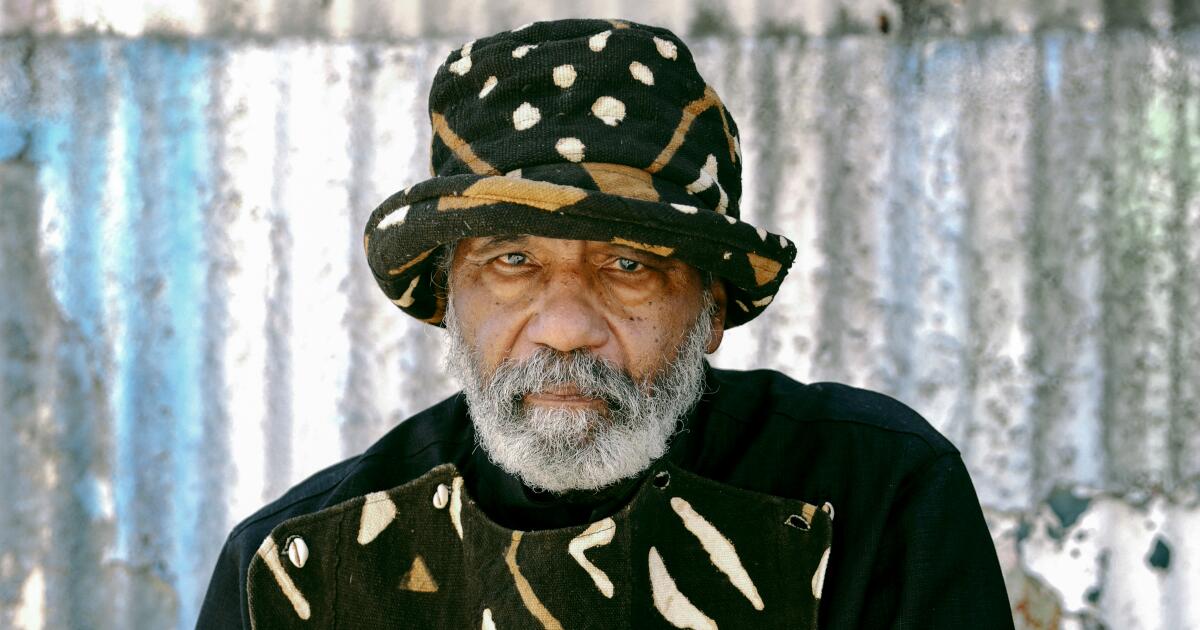
Ulysses Jenkins, the pioneering Los Angeles-born video artist whose avant-garde compositions embodied Black experimentalism, has died. He was 79.
Jenkins’ death was confirmed by his alma mater Otis College, where he studied under renowned painter and printmaker Charles White in the late 1970s and returned as an instructor years later. The Los Angeles art and design school shared a statement from the Charles White Archive, which said, “Jenkins had a profound impact on contemporary art and media practices.”
“A trailblazing figure in Black experimental video, he was widely recognized for works that used image, sound, and cultural iconography to examine representation, race, gender, ritual, history, and power,” the statement said.
A self-proclaimed “griot,” Jenkins throughout his decades-spanning career maintained an art practice grounded in the tradition of those West African oral historians who came before him. Through archival documentaries like “The Nomadics” and surrealist murals like “1848: Bandaide,” he leveraged alternative media to challenge Eurocentric representations of Black Americans in popular culture.
He was both an artist and a storyteller who sought to “reassert the history and the culture,” he told The Times in 2022. That year, the Hammer Museum presented Jenkins’ first major retrospective, “Ulysses Jenkins: Without Your Interpretation.”
“Early video art was about the problems with the media that we are still having today: the notions of truth,” Jenkins said. “To that extent, early video art was a construct that was anti-media … a critical analysis of the media that we were viewing every night.”
Born in 1946 to Los Angeles transplants from the South, Jenkins was ambivalent about the city, which offered his parents some refuge from the blatant systemic racism they encountered in their hometowns, but housed an entertainment industry that had long perpetuated anti-Black sentiment.
“What Hollywood represents, especially in my work, is the classic plantation mentality,” Jenkins told The Times in 1986. “Although people aren’t necessarily enslaved by it, people enslave themselves to it because they’re told how fantastic it is to help manifest these illusions for a corporate sponsor.”
Jenkins, who participated in a group of artists committed to spontaneous action called Studio Z, was naturally drawn to video art over Hollywood filmmaking. “I can address any issue and I don’t have to wait for [the studios’] big OK. I thought this was a land of freedom, and video allows me that freedom and opportunity that I can create for myself and at least feel that part of being an American,” he said.
Jenkins went on to deconstruct Hollywood’s vision of the Black diaspora in experimental video compositions including “Mass of Images,” which incorporates clips from D.W. Griffith’s notoriously racist “The Birth of a Nation,” and “Two-Tone Transfer,” which depicts, in Jenkins’ words, a “dreamscape in which the dreamer awakens to a visitation of three minstrels who tell the story of the development of African American stereotypes in the American entertainment industry.”
Jenkins’ legacy is not only artistic but institutional, with the luminary having held teaching appointments at UCSD and UCI, where he co-founded the digital filmmaking minor with fellow Southern California-based artists Bruce Yonemoto and Bryan Jackson.
As artist and educator Suzanne Lacy penned in her social media tribute to Jenkins, which showed him speaking to students at REDCAT in L.A., “he has been an important part of our histories here in Southern California as video and performance artists evolved their practices.”

4/5 stars
Bounding into cinemas just in time for spring, the latest Pixar animation is a pleasingly charming tale of man vs nature, with a bit of crazy robot tech thrown in.
The star of Hoppers is Mabel Tanaka (voiced by Piper Curda), a young animal-lover leading a one-girl protest over a freeway being built through the tranquil countryside near her hometown of Beaverton.
Because the freeway is the pet project of the town’s popular mayor, Jerry (Jon Hamm), who is vying for re-election, Mabel’s protests fall on deaf ears.
Everything changes when she stumbles upon top-secret research by her biology professor, Dr Sam Fairfax (Kathy Najimy), that allows for the human consciousness to be linked to robotic animals. This lets users get up close and personal with other species.

This spring, have a tea ceremony inside of an art installation and shop the latest Givenchy

Fearing GOP win, California’s Democratic leader urges unviable party candidates for governor to drop out

Mobile clinic brings mammograms to women on Skid Row

Commentary: Will Klein isn’t surprised he saved the Dodgers’ World Series dynasty

Is Iran expanding attacks to target energy and civilian sites in the Gulf?

Florida High School Football Rankings: Top 25 teams – Oct. 21

Cleary's 21 help Le Moyne down Central Connecticut State 69-64 in OT

How old is Bo Nix? What to know about Oregon quarterback ahead of 2024 NFL Draft

99th annual Pony Swim held in Virginia

Indiana Members Credit Union announced as new anchor tenant at Bottleworks District
Is Iran expanding attacks to target energy and civilian sites in the Gulf?

Trump claims US stockpiles mean wars can be fought ‘forever’; Kristi Noem testifies before Congress – US politics live

War in the Middle East: Iran’s broad retaliation in the Gulf • FRANCE 24 English

Trump sends official notification to Congress on strikes against Iran

Unexpected birth brings hope to near-extinct Amazon tribe
-

 World5 days ago
Exclusive: DeepSeek withholds latest AI model from US chipmakers including Nvidia, sources say
-

 Massachusetts6 days ago
Mother and daughter injured in Taunton house explosion
-

 Denver, CO6 days ago
10 acres charred, 5 injured in Thornton grass fire, evacuation orders lifted
-

 Louisiana1 week ago
Wildfire near Gum Swamp Road in Livingston Parish now under control; more than 200 acres burned
-

 Oregon4 days ago
2026 OSAA Oregon Wrestling State Championship Results And Brackets – FloWrestling
-

 Technology1 week ago
Arturia’s FX Collection 6 adds two new effects and a $99 intro version
-

 News1 week ago
Video: How Lunar New Year Traditions Take Root Across America
-

 Florida2 days ago
Florida man rescued after being stuck in shoulder-deep mud for days