Culture
In ‘Rocky Horror,’ Luke Evans Finds His Ballad of Sexual Liberation


There’s a Hollywood action star, standing in silhouette at the top of a creepy manor’s staircase, dressed in a corset and jockstrap, thighs fitted into fishnets and hair secured under a wig that could have been scalped from Charli XCX.
“I’m just a sweet transvestite,” the action star, Luke Evans, croons, suggestively caressing his nipples. “From Transsexual, Transylvania.”
Evans, 47, has taken on the role of Dr. Frank-N-Furter in “The Rocky Horror Show” on Broadway, which opened last month at Studio 54. He has lost almost 20 pounds since performances began at the end of March, he said, and he relies on a small can of oxygen to power through a production in which he barely leaves the stage. Every night, he grabs his blond dachshund, Lala, who waits in his dressing room, and returns to a rented apartment in Manhattan’s Chelsea neighborhood, covered in glitter. At one point, after Evans discovered glitter in her poop, Lala took a brief intermission from the theater.
“It’s mental,” Evans said of the demands of a Broadway show. He has been giving eight high-octane performances a week as a mad scientist who sees himself as a prophet of sexual liberation. It is a role made famous by Tim Curry in the 1975 film version. (Curry also performed in the original production in London in 1973, and the show’s subsequent runs in Los Angeles and New York.) About a week into joining the Broadway production of “Moulin Rouge! The Musical,” the rapper Megan Thee Stallion was hospitalized in March for exhaustion.
But the physical strain of running across the stage in patent leather boots with five-inch heels has garnered him a Tony nomination for best performance by a lead actor in a musical. It may also do wonders for how the world sees Evans. For the past two decades, Hollywood has frequently cast him as an action hero. “I was somebody who could drive a bus, or build a wall, or kill a dragon,” he said.
Well, it was a little more glamorous than that: He has starred in billion-dollar global blockbusters including the “Fast & Furious” franchise and “The Hobbit.” But it is no less confining for an actor who thinks he might have something more to offer audiences than pistol whips and fisticuffs.
A Belated Start
“My career started at a breakneck speed,” Evans told me one morning on the patio of his Chelsea hotel as Lala gently snored in his lap. “For about eight years, I felt like I didn’t breathe.”
The marathon began in 2010 when Evans began the transition from a career on the London stage to one in Hollywood as a dependable Adonis. He played the sun god Apollo in a campy 2010 remake of “Clash of the Titans,” and within the next four years, he earned a promotion in the Greek pantheon (playing Zeus in “The Immortals”), drove expensive cars (playing the villainous Owen Shaw in the “Fast & Furious” series), learned archery (playing Bard the Bowman in “The Hobbit” movie trilogy), and became a vampire (playing the title character in “Dracula Untold”). His career seemed to be hitting a peak in 2017 when he received positive reviews as the meathead Gaston in the live-action remake of Disney’s “Beauty and the Beast.”
These days, Evans is looking ahead to the next 10 years. He has released music, built a clothing brand with his boyfriend, Fran Tomas, and developed properties across Europe, including in the places where he splits his time, Lisbon and Ibiza. He talks often about refusing to dwell on the past, but the past certainly informs his decisions.
Becoming famous in his early 30s left him feeling that he had limited time to make his mark in Hollywood. “This business is all about objectivity,” Evans said. But even as his star ascended, he was looking over his shoulder at the younger stars of the “Twilight” films.
“They were porcelain and perfect. They glowed,” the actor said. “I would never have been cast. Maybe as some haggard, old half-wolf.”
Even a decade later, nobody would describe Evans as haggard. The director of the “Rocky Horror” revival, Sam Pinkleton, prefers to think of him as a “shape-shifter.”
“He contains multitudes,” Pinkleton said. “One of those is a giant dude who can kick your ass, and the next minute he is kitty-cat purr.”
“I remember Luke talking a lot about how he wanted to transform with this role,” the director added, saying that Evans was considered for the part early in the casting process. “He realized that he could do things with this role that he was never allowed to do.”
Evans now has a chance to redefine himself in portraying Frank-N-Furter. And knowing more about his back story is likely to enrich the performance that audiences see onstage.
In his 2024 memoir, “Boy From the Valleys: My Unexpected Journey,” Evans describes being born in Wales on Easter Sunday and being raised a Jehovah’s Witness. His father was a bricklayer and his mother a homemaker; the family lived in a working-class neighborhood. Because of the strictures of the family’s religion, Evans was frequently bullied as a youngster and often felt excluded from typical childhood pleasures: Jehovah’s Witnesses do not celebrate Christmas or birthdays, so there was no singing carols or going to birthday parties for Evans. He described himself as having been exceedingly thin at the time, and struggling with his sexuality.
“Looking back, I didn’t stand a chance,” he wrote.
But in his memoir, Evans is reluctant to blame others for his own hardships. One of the rare exceptions is discussing a neighbor, whom he blames for the death of one of his childhood cats, Tigger. It appeared to have been shot with a lead pellet. “Anyway, I own his house now,” Evans wrote. “And any animal can come and go as they please.” (Evans told me he bought it as a rental property to provide extra income for his parents.)
At 16, Evans left home and started dating an older man. He eventually moved to London with a boyfriend who encouraged him to pursue a career in theater and he went on to build a successful résumé in the West End through the 2000s, starring in productions like “Taboo,” “Avenue Q” and “Rent.” His parents gradually accepted his sexuality, though that came at the cost of being shunned by their community of Jehovah’s Witnesses.
“It took a long time, a lot of conversations and a lot of patience from both sides for us to understand we were on different journeys,” Evans said. “It was not easy because the religion wanted my parents to cut me off, to have nothing to do with me.”
He does not believe in God anymore. “It was something I believe was created by man, and, over centuries, it became a way to control the masses.” But about five years ago, he did get a tattoo on his left thigh. You can see just a glimmer of it through his fishnets in “Rocky Horror.” It’s a quote from Corinthians: “Love bears all things, believes all things, hopes all things, endures all things. Love never fails.” For Evans, it’s the story of how, in his family, love won over everything else.
‘Absolute Pleasure’
Questions about his sexuality came up during the height of his movie career. “I wasn’t hiding, even then,” Evans told me, acknowledging that he may have lost roles because he refused to hide. “I had to do it,” he explained. “I had to walk so that the future generations of gay actors could run.”
“I play straight more than I play gay,” he said. “Why the hell not? I’m acting. I can do anything.”
Evans prefers to think of himself as someone who drives toward the future without dwelling much on the past. It’s a trait that he recognizes in Frank-N-Furter, who hurtles dangerously toward a utopian vision of “absolute pleasure.”
“The past is important, of course, but you can’t read too much into the past,” Evans told me.
“People keep trying,” I said.
“But the present and the future is something you can have a say in, if you so choose,” the actor said.
“Is that a survivor’s mentality?” I asked.
“Possibly,” Evans laughed. “When I was younger and I had to leave home, I had to stop thinking about my past, because my past didn’t want to have anything to do with me. In fact, my past sort of stopped when I left home and left the religion. I lost everyone, all my friends.”
A similar psychology runs through the actor’s performance as Frank-N-Furter, a drag queen’s answer to Victor Frankenstein — if the good doctor had a penchant for sleeping with his monsters.
“There is joy but also danger in Frank,” Evans explained, “because he is a speeding train.”
If the Jehovah’s Witnesses demanded a life of invisibility, and Hollywood demanded a life of rigid masculinity, then Broadway was offering Evans a path to total exposure. It was as Frank-N-Furter says: “Don’t dream it. Be it.”
By the time Evans reaches the show’s hedonistic peak, the parallels between the actor and the character become impossible to ignore. There is a joy in seeing Evans — once a boy who could not celebrate his own birthday — now presiding over the birth of Rocky, the musical’s golden Adonis. He embodies the doctor’s lustful jinx as a man making up for lost time, delivering a version of the character whose occasional glimmers of warmth are singed with rage and regret — two emotions that Evans has spent decades trying to evade in his own life.
“There is a menace to him,” Evans observed of his character, “that sits just under the surface of glamour and charisma. But there is also something very naughty, powerful and subversive.”



Among the many complaints made about the modern American novelist, the loudest, if not the most intelligent, has been the charge that he is not speaking for his country. A few seasons back an editorial in Life magazine asked grandly, “Who speaks for America today?” and was not able to conclude that our novelists, or at least our most gifted ones, did.
This opening paragraph is from an essay titled “The Fiction Writer and His Country” by a writer whose work was influenced by Catholicism, the rural South and peacocks. Who was it?

Welcome to Lit Trivia, the Book Review’s regular quiz about books, authors and literary culture. This week’s challenge is all about an influential group of writers, editors and other creative types known as the Algonquin Round Table. In the five multiple-choice questions below, tap or click on the answer you think is correct. After the last question, you’ll find links to related books and other information about the era if you’d like to do further reading.

A strong sense of place can deeply influence a story, and in some cases, the setting can even feel like a character itself. But as it’s summer here in the Northern Hemisphere and travel adventures abound, this week’s literary geography quiz takes you on a trivia tour of notable libraries around the world. To play, just make your selection in the multiple-choice list and the correct answer will be revealed. At the end of the quiz, you’ll find links to more information if you’d like to do further reading.
-
 Lifestyle47 minutes ago
10 new books you won’t want to miss in July
-

 Technology57 minutes ago
Discord accidentally banned over 8,000 people for posting grids and other ‘benign’ images
-

 World1 hour ago
Video shows bomb rock Damascus hotel where French President Macron is staying during Syrian state visit
-

 Politics1 hour ago
Trump could hand prized stealth jets to NATO ally once seen as alliance headache
-

 Health1 hour ago
Common gym supplement could help fight depression, new research suggests
-

 Sports1 hour ago
SJSU was told of decades-old allegations against volleyball coach during controversial 2024 season
-
 Business1 hour ago
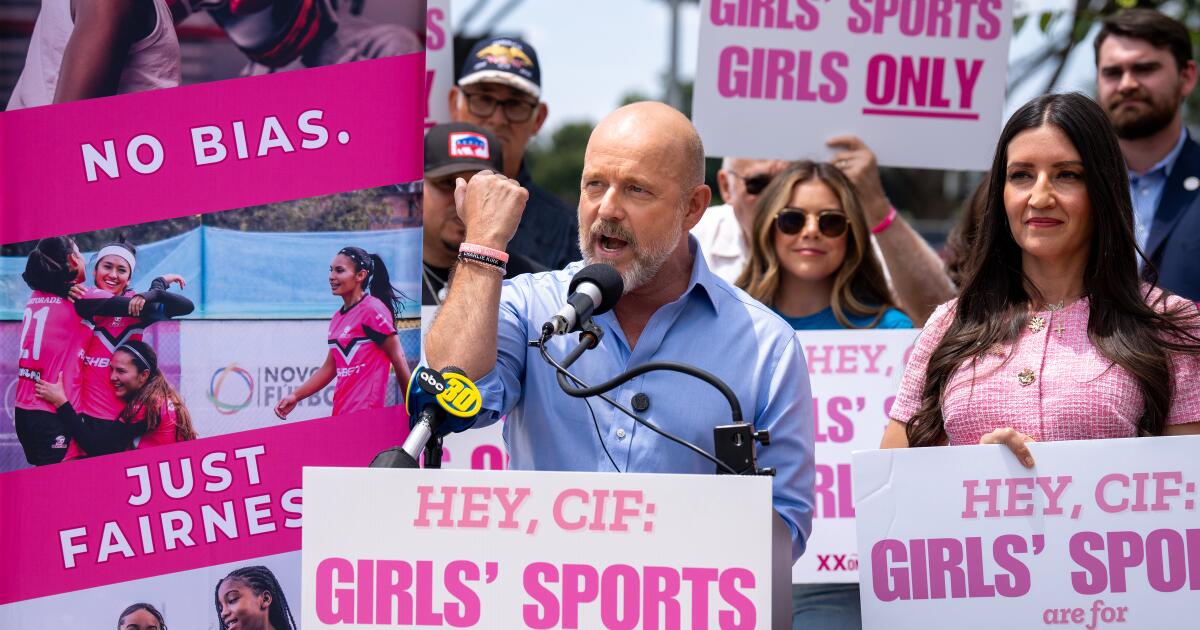
Commentary: How right-wing anti-transgender attacks led to a Supreme Court ruling upholding sex discrimination
-
 Entertainment2 hours ago
Even if you know his crowd work clips and not his name, comedian Jeff Arcuri is ready to meet you

