Crypto
Dogecoin evangelist once again a millionaire after Trump win – Marketplace


More than three years ago, before he became a millionaire the first time around, Glauber Contessoto borrowed $1,500 from his aunt Cristiane Almaraz to invest in Dogecoin, the cryptocurrency that started as a joke about an internet dog meme. In return, once Doge shot to the moon as Contessoto believed it would, he promised her a house.
As of late November when we recorded a Zoom conversation together, Contessoto had $2.2 million in Doge. He has even more in other cryptocurrencies.
He’s planning to sell some of the incredibly volatile Dogecoin in six to eight months, when he thinks the price will more than triple. Alamaraz wants him to sell now.
“Ultimately at that point I’ll have $10 million, so with $10 million even a million-dollar house wouldn’t affect my finances that much,” said Contessoto.
“I don’t need a million dollar house,” Almaraz said.
“You live in Maryland, you need a million dollar house,” said Contessoto.
Almaraz is a housekeeper, her husband works as an Amazon driver and they have two kids. She said after a car theft forced them to buy a new vehicle, they’re down to about $5,000 in savings.
Part of Almaraz’s frustration is that she feels like she’s seen this movie before.
“Cause Dogecoin is very unstable, so how can you guarantee that in six months you will do that, you know?” Almaraz asked.
“Because I’m basing this off of patterns,” said Contessoto. “Trends, patterns, charts, graphs. I do crypto full time now, right? I study this.”
At one point in 2021, after investing his life savings in Dogecoin, Contessoto had about $3 million in the memcoin and became a kind of crypto celebrity. His YouTube channel and social media popularity made the “Dogecoin millionaire” the most famous Dogecoin evangelist not named Elon Musk.
And then just a year later, as all that buzz for Bitcoin and NFTs cooled and crypto winter settled in, the “Dogecoin millionaire” became the “Dogecoin former millionaire.”
“I remember very vividly, I was in the parking lot of the gym that I would go to,” says Contessoto. “And I was sitting in the car watching it just plummet, and watching the amount in my Robin Hood dump down all the way to $200,000.”
But Contessoto stuck with the memecoin that brought him here, and pushed the money he was receiving from crypto-related endorsements into more Doge, as well as other crypto.
“There are days where I think ‘Oh, I kind of wish I would have sold.’ But ultimately that’s not where my heart was, and I’m very big on following my gut feelings on things,” Contessoto said.
That gut ultimately proved right. Doge started rising again in 2024, partly in line with Trump’s poll numbers. The former president had pledged to lighten regulations on crypto on the campaign trail.
And then after the election, something extraordinary happened. One of those glitches in the matrix that makes you question not only whether you’re living in a simulation, but whether it’s a simulation specifically designed to mock you for responsibly stowing your retirement money away in an index fund.
Trump announced plans to create the Department of Government Efficiency — DOGE for short — an organization tasked with slashing the federal bureaucracy, which Musk had half-jokingly proposed before the election.
Dogecoin soared. Since the election, it’s up more than 120%.
“That’s like branding that’s perfect right?,” said Contessoto. “I couldn’t have created that in a better way.”
Trump and his DOGE have been a huge financial boon for Contessoto. But there’s another part of Trump’s agenda that could be a major problem.
“I am currently undocumented as of right now,” said Contessoto. “Yeah, I don’t have papers.”
Contessoto came to the U.S. from Brazil when he was 5. His mother has a green card, but he’s still trying to get legal status.
“I have conflicting emotions about Trump,” said Contessoto. “Financially speaking he’s probably the best bet. On the other side I could get a knock on the door next week and I’m deported. And everything I know just goes up in flames.”
Over the holidays Contessoto is actually outside the U.S., tending to a family emergency. He’s unsure whether he’ll even be allowed back into the United States without his papers.
For the first time in years, he won’t be spending Christmas with aunt Cristiane in Maryland. He said she can have anything she wants as a gift — short of a house.
There’s a lot happening in the world. Through it all, Marketplace is here for you.
You rely on Marketplace to break down the world’s events and tell you how it affects you in a fact-based, approachable way. We rely on your financial support to keep making that possible.
Your donation today powers the independent journalism that you rely on. For just $5/month, you can help sustain Marketplace so we can keep reporting on the things that matter to you.



Key Takeaways
- LAB token cratered 90% over 48 hours, wiping out billions in market cap.
- ZachXBT slammed top centralized exchanges for failing to halt the July manipulation.
- Investors surged to avoid trading LAB as team token unlocks are set for later in July 2026.
LAB Trade Blames ‘Large Market Participants’
LAB, the native token of the multi-chain trading platform LAB Trade, suffered a catastrophic collapse this week, plunging from just over $7 to $1.25 on Wednesday—a staggering 80% decline in under 24 hours. This crash followed an equally brutal sell-off on Tuesday, which saw the token slide from nearly $17. In total, LAB wiped out nearly 90% of its value in just 48 hours.
The financial fallout was swift: a market capitalization that exceeded $5 billion on Tuesday morning evaporated to just $390 million by 3:30 p.m. EST on Wednesday. The freefall prompted the LAB Trade team to address the panic on X, where they expressed disappointment and deflected blame toward external heavy-sellers:
“While today’s market activity is disappointing, our product roadmap and long-term focus remain unchanged. We’re seeing significant selling pressure from large market participants. Several independent trading firms also hold substantial LAB positions that are not affiliated with our team. We’re working closely with our liquidity partners and continue to monitor market conditions,” the team said on X.
With this crash, LAB joins a notorious lineup of volatile tokens, such as RAVE, RIVER and SIREN. Each of these projects experienced meteoric rises followed by near-instantaneous erasures, sparking widespread “pump-and-dump” allegations against their respective teams and murky distribution networks.
Crypto Sleuth Slams Centralized Exchanges
Prominent on-chain detective ZachXBT, who previously flagged suspicious insider loans and market-maker coordination back in May, blasted major centralized exchanges ( CEXs) for failing to protect retail investors. Taking to X, ZachXBT criticized the lack of proactive intervention:
“Disappointing to see how no action was taken by Binance, Bitget, and Gate earlier to prevent it. If CEXs cared, profits from the accounts manipulating the price would be distributed to users at a minimum. Unlocks for investors were scheduled to begin later this month, however, multiple late vesting changes occurred in the past.”
ZachXBT reiterated his previous warnings that insiders have effectively controlled the entire circulating supply, allowing market makers to orchestrate extreme price manipulation on major exchanges. His final advice to the community was blunt: avoid trading LAB under any circumstances.

ZachXBT Names RAVE, RIVER, SIREN, and LAB as Victims of Bitget-Enabled Market Maker Fraud
Blockchain investigator ZachXBT has renewed his assault on Bitget, accusing the exchange of knowingly enabling market makers to run supply…


ZachXBT Names RAVE, RIVER, SIREN, and LAB as Victims of Bitget-Enabled Market Maker Fraud
Blockchain investigator ZachXBT has renewed his assault on Bitget, accusing the exchange of knowingly enabling market makers to run supply…
ZachXBT Names RAVE, RIVER, SIREN, and LAB as Victims of Bitget-Enabled Market Maker Fraud
Blockchain investigator ZachXBT has renewed his assault on Bitget, accusing the exchange of knowingly enabling market makers to run supply…

STARKVILLE – Potentially higher utility bills and sound pollution topped the list of concerns raised by six residents who addressed the board of aldermen Tuesday about a cryptocurrency mining facility proposed for Industrial Park Road.
Vice Mayor Roy Perkins, who represents Ward 6, said he has fielded similar concerns from constituents following the board’s June 12 work session, during which members heard a presentation about the potential project.
“I know these things need to have full accountability, full transparency and different things,” Perkins said. “… Well you can rest assured the vice mayor is going to be on assignment. I’m going to do my part. I’m not going to do anything that’s going to negatively impact this community.”
The proposed facility would be a specialized type of data center designed to mine cryptocurrency, a digital currency that operates independently of government-backed financial systems. It is stored in digital wallets and fluctuates in value.
Mining facilities use specialized computers that draw large energy loads to secure the digital transactions that take place. The center proposed in Starkville would be much smaller than “hyperscale data centers” that store and process data for large tech companies.
Utility usage topped the concerns of most residents with Pam Jones, the first to speak, set the tone.
“I understand that this is on a smaller scale than the hyper-scale facilities, and I just wanted to be sure that we had ordinances in place that will count the noise, especially at night and that there will be water and power management,” Jones said.
Other residents took issue with what they see as a lack of transparency around the proposed project.
“I was quite disappointed to learn (the mining facility) was not an agenda item today,” said Eadie Keenan, a Ward 7 resident. “… Quite frankly, I have more questions than can fit in three minutes.”
Tiffany Womack, another Starkville resident, echoed Kennan’s concerns, adding utility usage and market volatility to her own list of issues.
“If (the center was) to go bankrupt or something like that, would that possibly fall back on the responsibility of Starkville citizens?” Womack asked.
Mayor Lynn Spruill did not answer each question individually, instead encouraging those with questions to watch the June 12 presentation. Due to the project’s early stage, she noted the board does not yet know answers to all the questions raised during Tuesday’s meeting.

“I brought (the center) to the board as an opportunity for us to begin that process of learning so we are nowhere near making a decision,” Spruill said. “Which is why it isn’t on the agenda and won’t be on the agenda for some time.”
Spruill said the proposed center is currently going through the staff vetting process. Once the process is complete, staff will make a recommendation to the board on whether to pursue the center. At that time, Spruill expects to be able to answer residents’ remaining questions.
Spruill said transparency is important to her and the board while going through the process of vetting the mining center.
“Nothing is being hidden. It’s all out there for everybody to see, and we’ll make decisions based on facts not on Facebook craziness,” Spruill said. “… We want facts, and we want all decisions to be made with facts. And so hopefully that will put some of your concerns (to rest), at least to the extent that this is nowhere near something that will be on the agenda.”
Quality, in-depth journalism is essential to a healthy community. The Dispatch brings you the most complete reporting and insightful commentary in the Golden Triangle, but we need your help to continue our efforts. In the past week, our reporters have posted 24 articles to cdispatch.com. Please consider subscribing to our website for only $2.30 per week to help support local journalism and our community.
Quality, in-depth journalism is essential to a healthy community. The Dispatch brings you the most complete reporting and insightful commentary in the Golden Triangle, but we need your help to continue our efforts. In the past week, our reporters have posted 24 articles to cdispatch.com. Please consider subscribing to our website for only $2.30 per week to help support local journalism and our community.
-
 Business4 minutes ago
California soccer fans sue StubHub after it fails to deliver expensive World Cup tickets
-
 Entertainment7 minutes ago
Lucas Museum to give free annual passes to South L.A. neighbors, host community preview day
-
 Lifestyle12 minutes ago
Meow Wolf taps famed L.A. animation house for its new Los Angeles venue
-
Politics19 minutes ago
Column: Trump decries ‘communism’ while his government takes ownership of companies
-
 Science22 minutes ago
‘I’d rather my house burn down than get cancer’: Herbicide use upends California’s fight to save forests
-
 Sports27 minutes ago
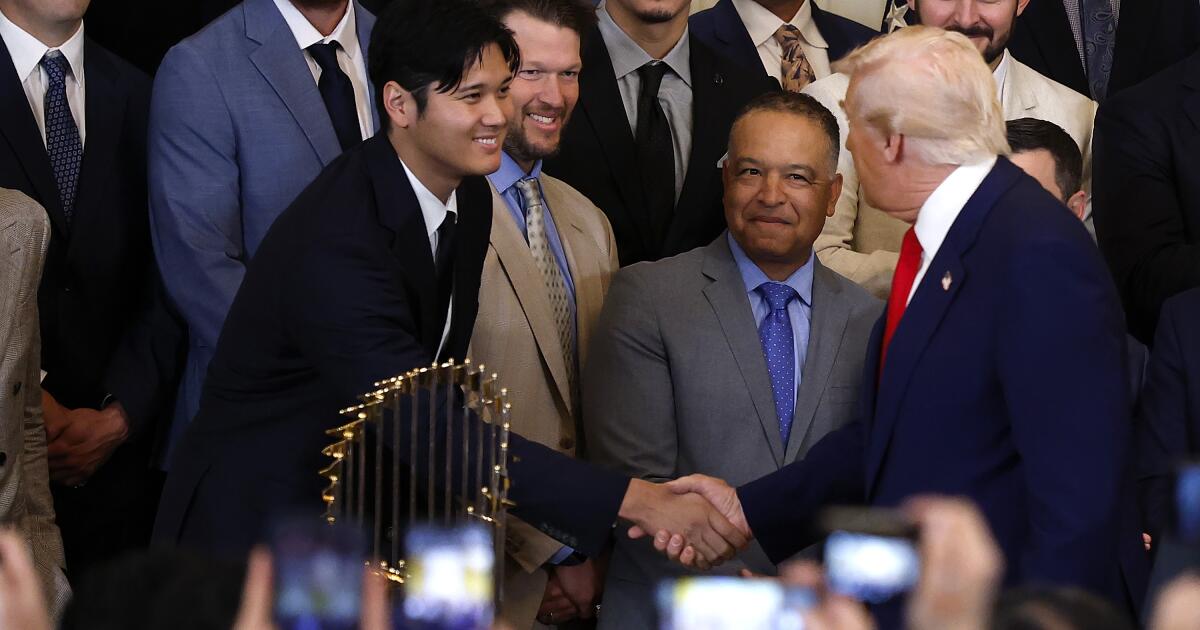
Dodgers scheduled to visit White House in late July to celebrate 2025 World Series win
-

 World37 minutes ago
Former US Olympian pleads not guilty in DC reflecting pool vandalism case
-
 News1 hour ago
Former Olympian pleads not guilty in reflecting pool vandalism charges


