Business
Will Newsom's expanded tax credit program save California's film industry?


Amid mounting pressure from Hollywood to bring production and entertainment jobs back to California, Gov. Gavin Newsom unveiled plans Sunday to significantly raise the annual cap on the state’s film and TV tax incentive program.
During a news conference held at Hollywood’s Raleigh Studios and attended by Los Angeles Mayor Karen Bass, as well as several entertainment union officials, Newsom declared his intent to increase the yearly limit to $750 million from $330 million.
Pending legislative approval, that number would surpass all other capped film and TV tax credit programs around the country. But will it be enough to prevent film and TV shoots from fleeing the state, restore the entertainment job market and solve California’s worsening production crisis?
Many in the industry welcomed the announcement as a significant move in the right direction, while acknowledging that there is more work to be done.
“It’s a start,” said Lindsay Dougherty, principal officer of Teamsters Local 399, which represents studio drivers, location workers and other Hollywood crew members.
“For California to be competitive with these other countries, we might need more money down the road. But this is … good news in a very bad time in a for our members that are not working and haven’t been working for quite some time.”
Rebecca Rhine, western executive director of the Directors Guild of America, agreed that raising the limit “may not be the entire solution, but it is a very, very important first step.”
Newsom and other elected officials have faced growing calls to expand California’s film and TV tax credit program as local production has struggled to rebound in the wake of last year’s strikes by Hollywood writers and actors.
While the entertainment industry at large has been hurting amid a widespread industry contraction, California has been hit particularly hard. Productions are increasingly flocking to other states and countries — such as New York, Georgia, Mexico and the United Kingdom — that offer more generous tax incentives.
The governor’s office said Sunday that 71% of projects excluded from California’s film and TV tax credit program have opted to shoot elsewhere.
Newsom “needed to make this announcement now,” said Kevin Klowden, executive director of the Milken finance institute.
“The morale and the impacts are very real and … if the governor didn’t make an announcement in advance of the budget cycle, there would be an incredible level of uncertainty,” Klowden said.
Runaway production has had an adverse effect on entertainment workers, as well as ancillary businesses, such as prop houses and caterers, that depend on Hollywood to survive.
Gregg Bilson, whose Sunland-based ISS Props has served the industry for three generations, called the governor’s proposed rebate “a great step as it more than doubles our current incentive,” but also recognized that it still doesn’t put the state on par with some other regions.
“Is it enough to be competitive with other parts of the world? No, and it never will be when you look at the income disparity and that other countries are giving as much as 40%,” Bilson said.
“But it is very competitive given it’s in California, which has the greatest infrastructure and crews in the world.”
This year, Bass appointed an entertainment industry task force to address the challenges Hollywood is facing.
Ellen Goldsmith-Vein, chief executive of Gotham Group and the mayor’s task force’s chair, said she is glad the state is “moving towards … putting people back to work and creating opportunities for young people.”
Newsom’s proposal will probably help increase some of the production that has dropped off in California in recent years, said Vanessa Roman, partner at Akin Gump Strauss Hauer & Feld, who advises clients in the entertainment industry. Especially smaller independent producers.
Under California’s current tax credit cap, a handful of productions could get approved early in the year and take up most of the credits.
“It was used up pretty quickly,” she said. “When it comes to tax credits, more is always better.”
Motion Picture Assn. Chief Executive Charles Rivkin said Newsom’s proposal indicated the governor’s “commitment to securing California’s future as a leader in film, television and streaming production.”
Others were more skeptical.
Newsom’s proposed increase to the California film and TV tax credit was “long, long overdue,” said Jody Simon, a partner at law firm Fox Rothschild.
Although an expanded cap may bring some production back, other states have gotten a leg up by building competing hubs with experienced crews and studio facilities.
“Some of the intrinsic advantages of L.A. have been eviscerated,” he said. “I believe there’s still an underlying preference to shooting in L.A., so hopefully this brings more production back.”
Vince Gervasi, president of Santa Clarita-based Triscenic Production Services, called the proposed tax incentives “a drop in the hat.”
“It sounds like a lot of money when you say it’s $400 million more, but in the big picture, it’s nothing like what Georgia is giving out,” said Gervasi, who added that he is struggling to keep his set and scenery storage business afloat. “It’s a nice gesture, but a little too late.”
The higher cap is “a big yawn for” independent productions, said Sky Moore, a partner at law firm Greenberg Glusker.
California’s tax credit program has more limitations on qualifying expenses — excluding big-ticket items such as star and director salaries — and is more complicated. Add to that the lower labor costs in other states, and “I don’t think it’s going to have an impact, at least for the independents,” he said.
Kayla Kitson, a senior policy expert at the California Budget and Policy Center, expressed concerns that greater state funding for the film and TV tax credit program could result in less aid for vulnerable groups, such as people experiencing homelessness and food insecurity.
“When the state has budget shortfalls, we often see safety net programs … on the chopping block,” Kitson said.
If the Legislature approves, the lid on California’s film and TV tax credit program could be raised to $750 million as soon as July.
“We hope that the legislators see the urgency in what the governor is trying to accomplish,” said Thom Davis, president of the California IATSE Council. (IATSE is the union representing Hollywood crew members.)
“Especially those in the L.A., San Francisco, San Diego areas where this is a very important industry to not only our members, but also their local economies.”


Walmart is rapidly expanding its network of electric vehicle chargers designed for customers to use while they shop.
The network could help fill gaps in EV infrastructure in states with greater need for chargers. Walmart, which has more than 5,000 locations in the U.S. and hundreds in California, says more than 90% of Americans live within 10 miles of one of its stores.
The chargers also offer an incentive for customers to choose Walmart — Walmart Plus members will receive a 10% discount off an average price of $0.46 per kilowatt-hour of energy at the company’s chargers.
Walmart chargers are already available at more than 75 locations in 17 states, with Texas boasting the most charging stations, followed by Florida and Arizona.
Matthew Nelson, Walmart’s director of energy policy, said last week on LinkedIn that the network will soon reach 29 states, including California.
“We are delivering on the promise of affordable, reliable and convenient charging,” Nelson said in his post.
According to Walmart’s website, six charging stations are coming to California soon, though the company did not offer a specific timeline.
The chargers will be installed at stores in Antelope, Brea, Fresno, Stockton, Suisun City and Vallejo.
Most charging sites in California will include eight to 16 fast-charging stalls, said Walmart spokesperson Kelsey Bohl.
The company first announced plans in April 2023 to install its own EV chargers at Walmart and Sam’s Club stores, with a goal of installing thousands of chargers by 2030. Partnering with ABB E-Mobility and Alpitronic, it added 25 new charging sites this past May and six more in June.
“Walmart is building a leading retail-integrated EV fast-charging network, focused on delivering an affordable, reliable and convenient charging experience where customers already shop,” Bohl said in an emailed statement. “Customers can charge while they shop, access stations through the Walmart app they already use, and benefit from affordable pricing.”
The charging stations already available include 612 individual charging stalls using 400-kilowatt chargers. Each stall has a dual charging cord with both Combined Charging System and North American Charging Standard connectors. The standard connectors, designed by Tesla, are smaller and lighter than the combined systems.
The primary way to pay for the chargers is through the Walmart app, but the company is also experimenting with built-in credit card readers to allow those without the app to use the stations.
Customers can check charger availability on the Walmart app. The company said the chargers will be available 24 hours a day.

Robotaxis could be turning into robocops.
A self-driving Waymo reported two teens to San Mateo, Calif., police on Monday after they were found drinking alcohol and shooting toy guns in the back of the vehicle.
According to a social media post from the San Mateo Police Department, officers detained two 15-year-olds after the Waymo they were riding in contacted the department and stopped in a parking lot until law enforcement arrived.
“Parents do you know where your teens are?” the San Mateo Police Department wrote on Facebook following the incident. “Waymo does!”
Officers removed both teens from the vehicle and determined they were using toy guns to shoot Orbeez out the windows. Orbeez are small, water-absorbing beads sold at toy stores.
“Toy guns, water guns, and BB guns all pose real dangers, especially to an untrained eye,” the Police Department said. “The simple handling of them can cause fear in [passersby].” “
A video posted on Facebook shows at least five officers and a police dog responding to the scene and approaching the Waymo with their weapons raised.
Waymo did not immediately respond to a request for comment.
Waymo vehicles have internal cameras and microphones that may be used in an emergency or to “promote safety and security,” according to Waymo’s online support page.
The cameras are also used to ensure the vehicles are clean and to help find lost items, according to the support page.
The company said it does not use facial recognition or other biometric identification technologies to identify individuals.
“In more urgent circumstances, support may access live video during a trip,” the Waymo page said.
The San Mateo Police Department’s Facebook post has garnered nearly 60 comments, with one user accusing Waymo of “snitching.”
“At least they got a designated driver?!” one user commented.
Business
Commentary: How right-wing anti-transgender attacks led to a Supreme Court ruling upholding sex discrimination
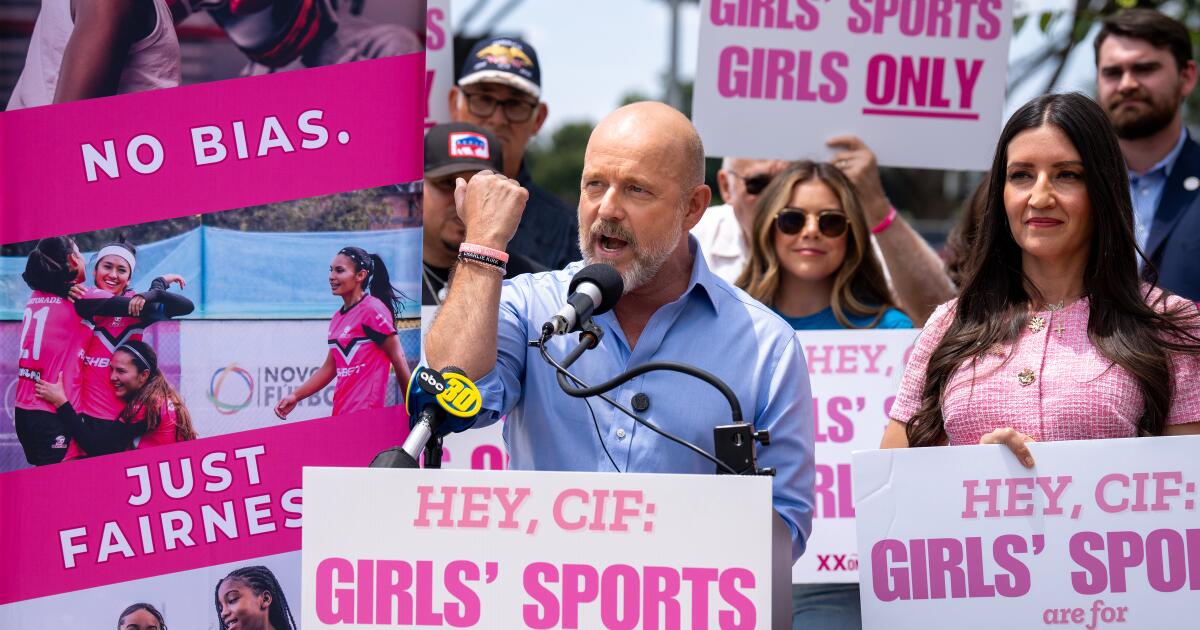
At the Supreme Court, the unfounded fear of boys masquerading as girls in youth sports rolled the clock back on gender equality.
On the surface, the Supreme Court’s June 30 opinion upholding state laws barring transgender girls from women’s and girl’s sports teams looks like a victory for women’s rights.
The 6-3 opinion by Justice Brett M. Kavanaugh certainly presents itself that way. “Females and males have inherent physical differences relevant to athletic performance,” Kavanaugh wrote. “Therefore, in contact sports, forcing female athletes to compete against males can create significant safety risks.” He also asserted that “forcing female athletes to compete against males can undermine competitive fairness.”
The ruling applied to prohibitions enacted in Idaho and West Virginia against “biological” males’ participation on women’s teams in public schools. Federal judges in both states overturned the bans. The Supreme Court majority restored them. The ruling essentially upholds similar bans enacted in 25 other states.
There was no record of any transgender person participating in school sports in the State, let alone any ‘problem’ with transgender students … creating unfair competition or unsafe conditions.
— Justice Sonia Sotomayor, demolishing the Supreme Court’s argument in favor of banning transgender girls from girl’s sports
Kavanaugh, like Donald Trump and others in the anti-transgender camp, maintained that one’s gender is an immutable fact of life, established even before birth.
Anything else, Trump stated in an executive order he issued on inauguration day 2025, could only be the product of “gender ideology extremism.” The U.S., his order stated, recognizes “two sexes, male and female. These sexes are not changeable and are grounded in fundamental and incontrovertible reality.” That’s a “biological truth,” he declared.
In his own version of this overconfident and factually insupportable conclusion, Kavanaugh wrote: “As all agree, females and males have inherent physical differences relevant to athletic performance.”
Science recognizes that some people are “born with sex traits that don’t fit into typical male or female patterns,” to cite a discussion on the Cleveland Clinic web page on the topic “intersex.” The condition “may involve chromosomes, hormones, reproductive organs or genitals.”
From a psychological standpoint, medical science recognizes “gender dysphoria” as a real condition often requiring counseling and medical intervention such as the use of puberty blockers and hormones to stave off the development of secondary sex characteristics until the condition can be resolved.
No one disputes that there are physical differences between the sexes. Few would dispute that on average or even at the median, males may be bigger and more powerful than females, or that in certain contact sports the difference may be telling and on occasion dangerous.
But that’s not the same as asserting that the physical differences between males and females invariably mean that men will invariably prevail over women in all competitions or that their participation will endanger women.
The International Olympic Committee — in a policy statement Kavanaugh cited incompletely — says that in “most running and swimming events,” males have a 10% to 12% advantage over women. That’s a range that would accommodate the full spectrum of outcomes — transgender females win, cisfemales win, they tie. (The “cis” prefix denotes those living consistent with their birth gender.)
West Virginia and Idaho addressed this ambiguity by banning transgender women from all girls’ teams. So under their rules transgender girls can’t play football or soccer with cisgirls. But what’s the argument in favor of banning them from the 100-yard dash, or cross-country track, or diving, or archery?
But something else is going on here. The Supreme Court’s ruling was almost preordained, given the years-long campaign by conservatives to demonize transgender individuals as if they’re members of an alien species.
It will be recalled that during his presidential campaign, Trump spun a despicable fantasy in which children were kidnapped in school and secretly subjected to sex-change operations.
Trump’s executive order wiped out policies aimed at protecting transgender adults from discrimination. He moved to outlaw gender-affirming medical therapies for anyone under 19 by cutting off federal funding for healthcare institutions that provide such care.
He banned transgender individuals from serving in the military and ordered federal prison officials to move transgender inmates into the general populations consistent with their birth genders, which exposes them to physical assault. (Federal Judge Royce Lamberth of Washington, D.C., has blocked the government from transferring three transgender women into the male prison population or terminating their hormone treatments.)
I wrote during Trump’s first term, when his anti-transgender policies were still gestating, that the goal was to show that “one can target any community, as long as it doesn’t have a strong political voice or political power. These are the actions of bullies and cowards, pretending to be strong.”
Last year, the Supreme Court struck its first blow against transgender rights by upholding a Tennessee law banning transgender care, including puberty blockers and hormone therapy, for minors. Similar laws have been enacted in 25 other states. The majority in that ruling by Chief Justice John G. Roberts Jr. was identical to the one in the June 30 ruling — Roberts, Kavanaugh, and Justices Clarence Thomas, Samuel A. Alito Jr., Neil M. Gorsuch and Amy Coney Barrett.
Who are the targets of this ideological campaign? They number only about 1.6 million U.S. adults, or one-half of 1% of the U.S. population. About 300,000 adolescents ages 13 to 17, or 1.4%, identify as transgender, according to a study by UCLA School of Law.
In West Virginia, as Justice Sonia Sotomayor observed in her dissenting opinion, “there was no record of any transgender person participating in school sports in the State, let along any ‘problem’ with transgender students … creating unfair competition or unsafe conditions.”
In endorsing the flat bans directed at transgender women in Idaho and West Virginia, Kavanaugh argued that any attempt to implement case-by-case judgments of students’ requests to join sports teams inconsistent with their biological gender would create “an enormous practical and administrability problem.”
Is that so? That wasn’t the case in Maine, where the annual K-12 population is more than 170,000. There, a committee was charged with determining whether a student’s participation in a sport consistent with their gender identity but inconsistent with their biological sex would “result in an unfair athletic advantage” or present a risk of injury to others. The committee held 56 hearings from 2013 through 2021, or an average of seven per year. During the entire time span, only four involved transgender girls. (The outcome of those hearings couldn’t be learned.)
It was Maine’s policy, one might recall, that provoked a confrontation between Trump and Maine Gov. Janet Mills at the White House last year, when Trump threatened to withhold federal funding from the state unless it barred transgender students from competing on women’s sports teams. “We’ll see you in court,” Mills snapped.
Whether the Idaho and West Virginia laws genuinely protect girls from unfair competition is questionable. (The Idaho law is styled the “Fairness in Women’s Sports Act.”) In practice, the laws may subject women in public schools to “invasive sex verification procedures,” as educational expert George Theoharis of Syracuse University wrote after the court ruling.
They’re also based on a retrograde view of women as fragile creatures needing men’s protection, Theoharis wrote — “the same logic that has historically been used to justify excluding women from making their own healthcare decisions and girls from rigorous math and science; that physically demanding work is simply beyond them.” (There don’t appear to be any state laws barring transgender women from competing in men’s sports.)
Becky Pepper-Jackson, the plaintiff in the West Virginia case, in which she is identified only as B.P.J., is the only transgender girl who sought to join girl’s teams — track and cross-country — in the state. That was in 2021, just after West Virginia passed its law and she was about to enter sixth grade. She didn’t appear to pose any competitive risk to others on the track and cross-country teams she applied to join — her lawyers told the Supreme Court that on those no-cut teams, she “came in near the back.”
Anyway, she had not gone through male puberty, which theoretically might have endowed her with a competitive advantage, because she had been taking puberty blockers and female hormones.
Thanks to the court’s ruling, Sotomayor observed in a dissent joined by Justices Elena Kagan and Ketanji Brown Jackson, West Virginia can deny Becky access to school sports “because it thinks they have an inherent athletic advantage, even if the facts show that they do not.”
B.P.J., Sotomayor wrote, “cannot practice on girls’ teams, even if she would not take anyone’s spot in an eventual competition, even if everyone who tries out for the team makes it, and even if having the chance to participate could aid immensely in treating B. P. J.’s gender dysphoria.”
So whose interest was really protected by the Supreme Court?
-

 New Hampshire5 minutes ago
New hampshire set to approve world’s first $100 million bitcoin-backed municipal bond
-

 New Jersey8 minutes ago
Police conclude investigation at Walmart in Cherry Hill, officials say
-

 New Mexico13 minutes ago
Monsoon high shifts slightly west but rain is still possible Wednesday in New Mexico
-

 North Carolina20 minutes ago
North Carolina Republican operative shaping the state’s early voting plans is reassigned
-

 North Dakota23 minutes ago
West Fargo Attorney Chosen for North Dakota Ethics Commission Position
-

 Ohio28 minutes ago
Jeff’s Donuts opens first Ohio location, open 24 hours
-

 Oklahoma35 minutes ago
5 Things To Know: Oklahoma County inmate death, deadly OKC hit-and-run
-

 Oregon38 minutes ago
Oregon to ask court to delay Paramount deal for 60 days while it reviews records

