Business
Tourists love Los Angeles. Could the fires change that?

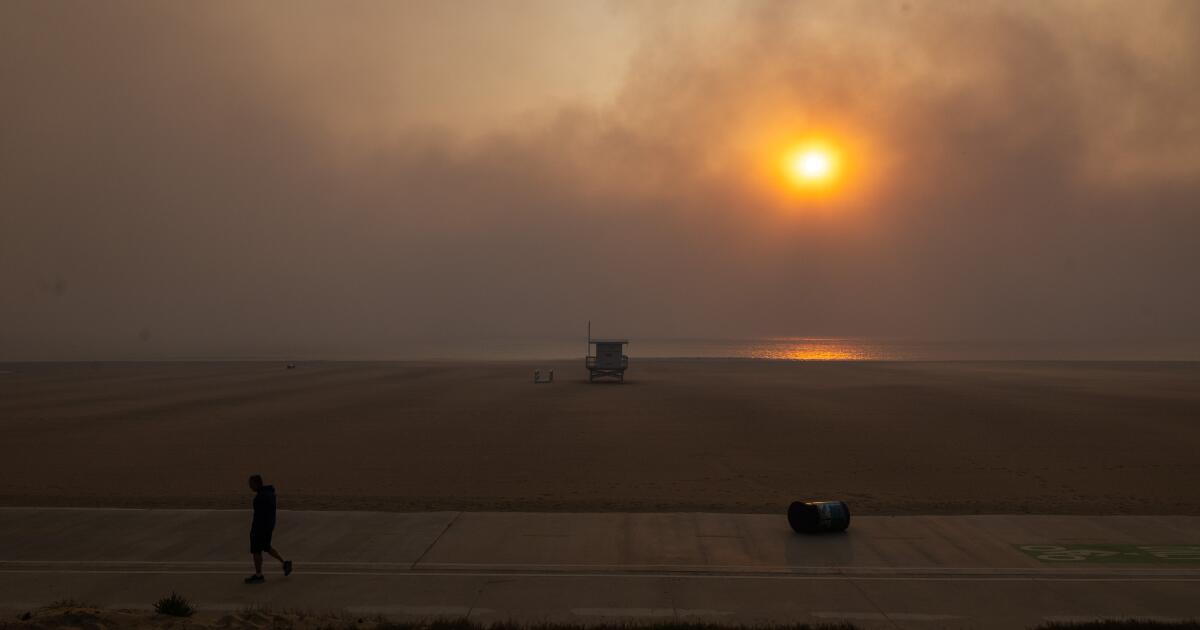
Travelers flying into Los Angeles last weekend were greeted by an apocalyptic sight: billowing clouds of smoke and the red-orange glow of flames against the glittering expanse of city lights.
The stark panorama, and shocking, ubiquitous video of the wildfires, were at sharp odds with images of sun-kissed beaches and glamorous Hollywood that L.A. relies on to draw the flocks of tourists who pump billions of dollars into the local economy each year.
As firefighters begin to bring under control the blazes that laid ruin to Pacific Palisades, parts of Malibu, and the hillside town of Altadena, tourism officials are looking for signs of what short- and long-term toll the disaster may take on L.A.’s prowess as a tourism destination.
“We’re very nervous,” said Jackie Filla, president and CEO of the Hotel Assn. of Los Angeles.
“The first-blush look is obviously there’s a precipitous drop off in shorter-term reservations — people who were supposed to be here this week and next week. We’re seeing some long-term drop-off as well — not as much, but it’s certainly a trend we’re concerned about.”
By some measures, the fires struck as tourism in L.A. finally had recovered fully from the blow dealt by COVID-19. In 2023, the last full year for which statistics are available, Los Angeles tallied $40.4 billion in total tourism revenue, a record. That included 49.1 million visitors, a 3% dip from its 2019 pre-pandemic high.
Filla noted that no L.A County hotels or major tourist draws have been damaged in the fires and major conferences and conventions — a critical component of the tourism industry — are scheduled to go on as planned. The lineup includes the Society of Thoracic Surgeons, whose leadership voted Wednesday night to go ahead with their annual meeting later this month in downtown L.A. and to donate $100,000 to relief efforts.
And another major event, the Grammy Awards, are still scheduled for Feb. 2 in downtown’s Crypto.com Arena.
In normal times, organizers and attendees at these meetings and awards shows would book rooms without hesitation. However, with tens of thousands of people now displaced by the fires, the equation has become more complicated. “We’re very closely monitoring our conventions and conferences,” Filla said, because “everybody is concerned about not taking rooms away from the evacuees, but we have the capacity to do both.”
Occupancy in Los Angeles hotels, which typically hits a low point in January, jumped from 59.3% to 65% as the Palisades and Eaton fires raged in the week that ended Jan. 11 “due to displacement demand from the fires,” lodging industry analyst CoStar found. The biggest surge came over the first three days of the blazes, when average daily rates in the area’s luxury hotels jumped by 22.7% over last year — a rise that may have been driven by evacuees moving into high-priced suites during what is normally a slow time, the company’s senior director of analytics Isaac Collazo said.
The city of Los Angeles includes about 44,000 hotel rooms; the county, roughly 100,000. L.A. County Sheriff Robert Luna said Thursday that about 88,000 people were under evacuation orders.
It remains to be seen whether the region’s recovery will be more like the New Orleans following Hurricane Katrina in 2005, Napa Valley’s rebound after a major wildfire in 2017 or Maui’s ongoing recovery effort since destructive wildfires in 2023.
In the aftermath of Katrina, travel to New Orleans fell to less than half its former level, then gradually recovered. It wasn’t until 2016 that the number of visitors to the city returned to pre-Katrina levels.
Napa and Sonoma counties, by contrast, bounced back relatively quickly after fires blackened more than 110,000 acres and killed 24 people in fall 2017. The fires left most vineyards and tourism infrastructure undamaged and by early 2018 hotel occupancy and revenue were ahead of the year before, according to a local tourism organization, Visit Napa Valley. Local and state officials said the recovery was aided by vigorous marketing, including spending by Visit California, the state’s main marketing organization.
On Maui, where a fire in August 2023 claimed 102 lives and leveled most of Lahaina Town, a major tourist destination, recovery is ongoing. Visitor arrivals in November 2024 remained about 15% below their levels in 2022. Officials there are now pushing hard to bring tourists back following an initial period of mixed messages in which some were calling for travelers to stay away as the community tried to rebuild.
At Visit California, the state’s leading tourism organization, President and CEO Caroline Beteta said in a statement that “we need to make sure travelers understand that their visit helps the community — not hurts — and that the city’s hotels and businesses will be ready to welcome them.”
Beteta acknowledged that “we’re already hearing from restaurants and hotels saying they’re being impacted,” and said her team is at work on a recovery campaign stressing that “everyone, especially California residents, should consider planning a trip to Los Angeles to support its economic recovery.”
Adam Burke, president and CEO of the Los Angeles Tourism & Convention Board, also known as Discover Los Angeles, said, “it’s premature to really understand what the implications are going to be,” but until then, “we’re trying to use our platform to help those who have been directly affected.”
In the longer term, Burke said, he’ll be looking closely at data on web searches for Los Angeles as a destination, international bookings, airport arrivals and hotel occupancy. He noted that in a typical year, hotel tax revenues add more than $300 million to the city’s general fund — money that could helpful fuel recovery efforts.
Despite the devastation of the fire areas, the vast majority of the region’s best-known tourism spots were undamaged by the fires. Though many parks and museums closed because of air quality or other concerns, several have reopened, including Griffith Park, the L.A. Zoo and Autry Museum of the American West on Thursday.
Overall consumer demand typically drops in the aftermath of a natural disaster, since fewer outside visitors to an area will lead to a reduction in leisure, hospitality and entertainment spending, said Raphaelle Gauvin-Coulombe, an assistant professor of economics at Middlebury, who was co-author of a study last year examining satellite data to understand fire activity and its effect on labor markets in counties across the U.S.
Leisure and hospitality is a sector that is particularly important for L.A. County, amounting to about 13.5% of the workforce, much higher than the median across counties, which hovers around 6%, Gauvin-Coulombe said. She did note, however, that destinations with more diverse economies — like that of Los Angeles — tend to be more resilient than those that are heavily dependent on one sector.
The disaster may also force the industry to contend with a shrinking labor force in the region, with fires tending to cause out-migration, she said. A slowing of employment growth can last for three years after a fire, she added.
“When people are traveling, they consider everything,” said Ray Patel, president of the Northeast Los Angeles Hotel Owners Assn. “It’s all perception to the guest. They might go, ‘oh, it’s too many fires.’ ”
It’s an understandable impulse, he said: “We all want to put our heads down at night and make sure we feel safe.”
As Los Angeles looks to stabilize its tourism industry in the wake of the fires, it can rely on an important asset many cities don’t have — its tourism board has staff at seven offices abroad who work with counterparts in Australia, the United Kingdom, India and China.
At a moment when dramatic television images threaten to overshadow the facts of L.A. geography, Burke said, “we’re already working with the travel trade in real time,” aiming to “educate people around the world about why it’s still safe to responsibly travel to Los Angeles.”


The luxury shopping center in Pacific Palisades will reopen next month after more than $100 million in renovations forced by the January 2025 wildfire that devastated the Los Angeles neighborhood.
Palisades Village will reopen Aug. 15, owner Rick Caruso announced Wednesday. The outdoor center survived the blaze that destroyed homes and other businesses but needed refurbishment to eliminate contaminants that the fire could have spread.
Crews are putting finishing touches on mall buildings after tearing them down to the studs, treating the wood and rebuilding the walls, Caruso said.
“Everybody’s working, and stores are moving their products in,” he said. “It’s a really cool feeling that people have really locked arms and are working together.”
An electrician installs lighting for a restaurant at Rick Caruso’s Palisades Village on Thursday. The shopping center is scheduled to reopen mid-August.
(Myung J. Chun / Los Angeles Times)
Pacific Palisades resident Allison Polhill, who is rebuilding the home of 30 years that her family lost in the blaze, said she is “thrilled” at the prospect of returning to the mall she used to frequent. Its comeback is a boost for the community, she said.
“Every single step that we make to reopen our commercial corridors is going to bring more people back into the Palisades,” said Polhill, who expects to move back into her home at the end of August.
A total of 6,822 structures were destroyed in the Palisades fire, including more than 5,500 residences and 100 commercial businesses, according to the California Department of Forestry and Fire Protection.
Caruso previously attributed the mall’s survival to the hard work of private firefighters and the fire-resistant materials used in the mall’s construction.
The $200-million shopping and dining center opened in 2018 with a movie theater and a roster of upmarket tenants, including Erewhon, which may be the only grocer in the heart of the fire-ravaged neighborhood when it opens.
Caruso’s company was able to fill the mall with tenants despite the long shutdown.
Palisades Village is 99% leased, with the majority of tenants returning, said Jackie Levy, chief financial and revenue officer. Nearly one-third of the shops and restaurants are new to the property.
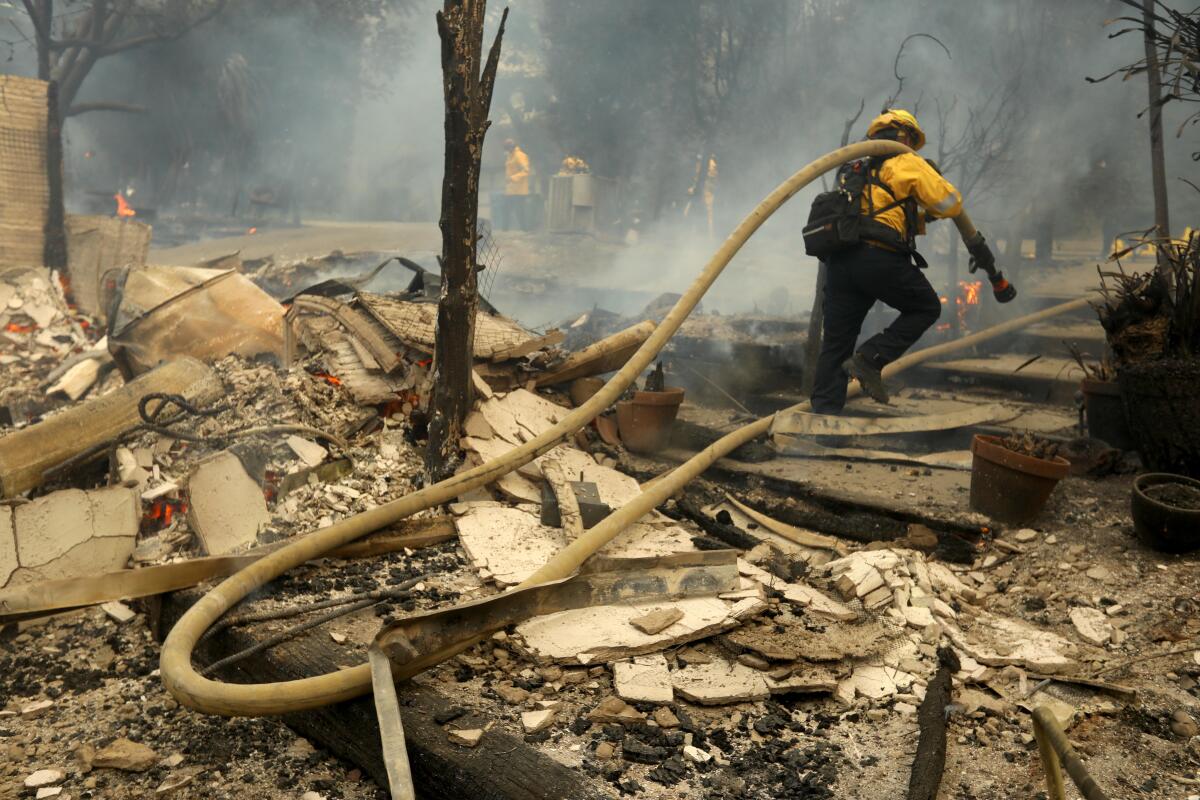
A firefighter carries a hose back to his rig while walking through a destroyed home from the Palisades fire in Pacific Palisades on Jan. 7, 2025.
(Genaro Molina / Los Angeles Times)
Last year, Pacific Palisades-based fashion designer Elyse Walker said she would reopen her eponymous store in Palisades Village after losing her 25-year flagship location on Antioch Street to the inferno.
Other neighborhood shops destroyed in the fire that are reopening at the mall include K Bakery and Loomey’s Toys, which caters to children up to age 12 and used to be across the street from Palisades Elementary Charter School.
“It’s been a journey and I’m excited because I wasn’t sure that there was going to be a place to come back to,” said toy store owner Amanda Rastegar. “Hopefully we can bring some of that magic back.”
Rastegar’s home in the Palisades survived but was damaged by the fire. The family returned about eight weeks ago. Her last memory of the fire was a burning supermarket.
“I just couldn’t wrap my brain around what was happening,” she said. “By the time I left, Gelson’s was on fire.”
Among the returning tenants is Angelini Ristorante & Bar. Well-known Los Angeles chef Gino Angelini said he will be in the kitchen next month for a return of the Italian restaurant.
“We won’t do a big celebrity open,” he said. “We want to have a very soft opening and see our customers come back.”

Construction takes place at Rick Caruso’s Palisades Village on Thursday. The shopping center is scheduled to reopen mid-August.
(Myung J. Chun / Los Angeles Times)
An elaborate celebration would not feel “correct for me,” Angelini said, because the devastation has been “very sad” for so many.
Other new tenants include local chef Nancy Silverton, who has agreed to move in with a new Italian steakhouse called Spacca Tutto. Women’s activewear retailer LESET will open its first West Coast location.
Caruso said he is optimistic that customers will return to the center, even though many Pacific Palisades residents are still dispersed. One tracking system estimated that about 30% of the Village’s customer base was impacted by the fire, he said.
“That means 70% did not get impacted, so there’s a lot of customers still left out there,” Caruso said. Historically, the center drew customers from as far away as Beverly Hills and Calabasas, as well as Malibu, Brentwood and Santa Monica.
He also hopes many will be inspired to visit the revived mall.
“I believe in the goodness of people and I believe that people are going to want to support the Palisades,” he said. “They’re going to want to be there and support the businesses that have had the courage and the heart to reopen.”

Walmart is rapidly expanding its network of electric vehicle chargers designed for customers to use while they shop.
The network could help fill gaps in EV infrastructure in states with greater need for chargers. Walmart, which has more than 5,000 locations in the U.S. and hundreds in California, says more than 90% of Americans live within 10 miles of one of its stores.
The chargers also offer an incentive for customers to choose Walmart — Walmart Plus members will receive a 10% discount off an average price of $0.46 per kilowatt-hour of energy at the company’s chargers.
Walmart chargers are already available at more than 75 locations in 17 states, with Texas boasting the most charging stations, followed by Florida and Arizona.
Matthew Nelson, Walmart’s director of energy policy, said last week on LinkedIn that the network will soon reach 29 states, including California.
“We are delivering on the promise of affordable, reliable and convenient charging,” Nelson said in his post.
According to Walmart’s website, six charging stations are coming to California soon, though the company did not offer a specific timeline.
The chargers will be installed at stores in Antelope, Brea, Fresno, Stockton, Suisun City and Vallejo.
Most charging sites in California will include eight to 16 fast-charging stalls, said Walmart spokesperson Kelsey Bohl.
The company first announced plans in April 2023 to install its own EV chargers at Walmart and Sam’s Club stores, with a goal of installing thousands of chargers by 2030. Partnering with ABB E-Mobility and Alpitronic, it added 25 new charging sites this past May and six more in June.
“Walmart is building a leading retail-integrated EV fast-charging network, focused on delivering an affordable, reliable and convenient charging experience where customers already shop,” Bohl said in an emailed statement. “Customers can charge while they shop, access stations through the Walmart app they already use, and benefit from affordable pricing.”
The charging stations already available include 612 individual charging stalls using 400-kilowatt chargers. Each stall has a dual charging cord with both Combined Charging System and North American Charging Standard connectors. The standard connectors, designed by Tesla, are smaller and lighter than the combined systems.
The primary way to pay for the chargers is through the Walmart app, but the company is also experimenting with built-in credit card readers to allow those without the app to use the stations.
Customers can check charger availability on the Walmart app. The company said the chargers will be available 24 hours a day.

Robotaxis could be turning into robocops.
A self-driving Waymo reported two teens to San Mateo, Calif., police on Monday after they were found drinking alcohol and shooting toy guns in the back of the vehicle.
According to a social media post from the San Mateo Police Department, officers detained two 15-year-olds after the Waymo they were riding in contacted the department and stopped in a parking lot until law enforcement arrived.
“Parents do you know where your teens are?” the San Mateo Police Department wrote on Facebook following the incident. “Waymo does!”
Officers removed both teens from the vehicle and determined they were using toy guns to shoot Orbeez out the windows. Orbeez are small, water-absorbing beads sold at toy stores.
“Toy guns, water guns, and BB guns all pose real dangers, especially to an untrained eye,” the Police Department said. “The simple handling of them can cause fear in [passersby].” “
A video posted on Facebook shows at least five officers and a police dog responding to the scene and approaching the Waymo with their weapons raised.
Waymo did not immediately respond to a request for comment.
Waymo vehicles have internal cameras and microphones that may be used in an emergency or to “promote safety and security,” according to Waymo’s online support page.
The cameras are also used to ensure the vehicles are clean and to help find lost items, according to the support page.
The company said it does not use facial recognition or other biometric identification technologies to identify individuals.
“In more urgent circumstances, support may access live video during a trip,” the Waymo page said.
The San Mateo Police Department’s Facebook post has garnered nearly 60 comments, with one user accusing Waymo of “snitching.”
“At least they got a designated driver?!” one user commented.
-

 Los Angeles, Ca28 minutes ago
Loved ones search for missing 34-year-old Southern California woman
-

 Detroit, MI48 minutes ago
Chickens, geese found at vacant home after nonprofit reports them stolen
-

 San Francisco, CA58 minutes ago
What’s next for San Francisco Giants as MLB trade deadline approaches?
-
 Dallas, TX1 hour ago
Dallas millionaire files lawsuit against groundwater district
-

 Miami, FL1 hour ago
7 more women arrested at southwest Miami-Dade massage parlors, accused of prostitution in undercover sting
-

 Boston, MA1 hour ago
‘They’re my buddies’: 96-year-old Back Bay woman befriends French soccer team
-

 Denver, CO1 hour ago
Denver officers cited for separate incidents, 1 fired
-

 Seattle, WA1 hour ago
Study finds dangerous chemicals in the breast milk of Seattle moms

