Business
TikTok to crack down on content that promotes disordered eating and dangerous weight-loss habits


Saying it does not want to promote negative body comparisons, TikTok is cracking down on posts about disordered eating, dangerous weight loss habits and potentially harmful weight management products.
The wildly popular social media app updated its community guidelines last week, introducing a slate of rules that it hopes will make the platform a safer place for its roughly 1 billion users worldwide.
The initiative comes at a time when TikTok, which is owned by Beijing technology firm ByteDance, is facing increased scrutiny over its operations and content as it fights a potential ban in the U.S.
Weight loss videos make up a huge category on TikTok, with influencers extensively detailing and demonstrating how they slimmed down. Such videos have proliferated in the last few years with the rise of injectable prescription drugs such as Ozempic, Wegovy and Mounjaro, which many people are using to shed weight quickly.
Critics say the skyrocketing demand for the drugs has exposed the cracks in the body positivity movement, showing that there is still immense pressure to look thin at whatever cost. They say TikTok and Instagram, anti-aging filters, selfie culture and relentless celebrity and influencer self-promotion have all contributed to the problem.
TikTok already had policies around body image and disordered eating, but the updated guidelines explicitly break down such content into four categories: allowed; not allowed; restricted to users 18 and older; and ineligible for the “For You Feed,” TikTok’s personalized recommendation algorithm. They go into effect May 17.
The guidelines are intended to “improve understanding and bring greater transparency about our rules and how we enforce them,” Adam Presser, TikTok’s head of operations as well as the company’s trust and safety unit, said in a statement.
In the past, TikTok creators said they would sometimes see posts restricted or removed without understanding why they were flagged.
TikTok now clearly states that it bans videos “showing, describing, promoting, or offering or requesting coaching for disordered eating or dangerous weight-loss behaviors.”
The company defines those behaviors as extreme low-calorie diets, binging and intentional vomiting, misusing medication or supplements for weight loss and exercising through serious injuries or illness.
TikTok specifically called out content that shows or promotes unhealthy body measurements and “body checking” trends, such as comparing the size of body parts to household objects, as not allowed. Facilitating the trade or marketing of weight loss or muscle gain products is also on its way out.
Content that will be restricted to users 18 and older — and which will also be ineligible for the For You Feed — includes showing or promoting “potentially harmful weight-management behaviors” such as restrictive low-calorie diets; using medication or supplements for weight loss or muscle gain; and exercises designed for rapid and significant weight loss, such as “cardio routines that promise to help you lose a waist size in a week,” the company said.
TikTok also said it would restrict before-and-after transformation photos promoting weight loss and muscle gain products, as well as videos that promote body types as “ideal or perfect” when associated with potentially harmful weight management behaviors.
“We want TikTok to be a place that encourages self-esteem,” the company said.
Creators who have documented their weight loss journeys using the new class of trendy medications said they were disappointed by the crackdown. TikTok, they said, has become an important resource and close-knit community for people who have struggled for years to shed pounds and get healthy.
You’re just shutting down and secluding a group of people that is already so used to being shamed and put in a corner.
— Kelsey Martinez, 32, a content creator who has chronicled her weight-loss journey on TikTok
“I think countless amounts of lives have been saved by the ability to communicate about these medications,” said Kelsey Martinez, 32, who began posting about using Mounjaro, a medication intended to treat Type 2 diabetes, to lose weight in September 2022. She weighed 232 pounds when she started using the weekly injectable; by last fall, she was down to 153.
“It’s giving people who are obese access and that’s something we don’t always have,” said Martinez, who lives in Los Angeles and has 296,000 TikTok followers. “So I think it’s going to be very harmful. You’re just shutting down and secluding a group of people that is already so used to being shamed and put in a corner.”
A spokesperson for TikTok said content about medically necessary health interventions under the guidance of a medical or health professional is allowed, including discussions about glucagon-like peptide 1 medications, which includes the diabetes drug Ozempic. The spokesperson added that content about using GLP-1 medications for weight loss could still be discovered in other ways, such as through search tools or by following an account, even if it is ineligible for the For You Feed.
Showing or describing competitive eating contests; fitness routines, sports and nutrition that are not primarily focused on extreme weight loss, marathon training or bodybuilding competitions; and religious diet behavior and fasting will still be allowed.
TikTok users will be permitted to condemn disordered eating, dangerous weight loss behaviors or potentially harmful weight management “as long as it does not show or describe a diet or behavior,” the company said.
Michelle York, a full-time content creator from Moorpark, said she understood that the app is in a “really tough spot” right now as it faces a divest-or-ban bill in the U.S., where it has 170 million users.
“TikTok is under a big microscope, and they need to go out of their way to make sure it’s a safe space,” York, 40, said. But “I think they’re overcompensating by making these new guidelines.”
Even though she believes her content is beneficial and far from promoting “get-thin-quick supplements,” and despite her follower base of 203,000 people imploring her to keep the weight loss content coming, she has already turned some of her old Mounjaro videos private and will focus even more on lifestyle and beauty content going forward.
“It’s really disheartening to be told I can’t share that here anymore, and now it’s at risk of my platform, which I worked so hard to build,” York said. “The problem is, this is now my job — I rely on this as my income and I can’t post things to jeopardize that.”
TikTok’s latest community guidelines also include new and updated definitions on the company’s policies around hate speech and health misinformation.
In announcing the updated rules, TikTok said it would introduce a “warning strike” when a creator violates the platform’s community guidelines for the first time.
“The warning strike does not count toward an account’s strike tally, but any future violations will,” Presser said. “We notify creators about which rule they’ve broken and how they can appeal if they believe a mistake has been made. Zero-tolerance policies (for example, incitement to violence) aren’t eligible for these reminders; accounts will immediately be banned.”


The race to bring air travel to the sky is heating up as Santa Cruz-based Joby Aviation and Toyota launch a joint venture to commercially produce air taxis.
The companies said in a news release Tuesday that they will work together on productivity, quality and costs and move toward mass production of Joby’s electric vertical takeoff aircraft. Joby and Toyota were first linked when Toyota made a nearly $400-million investment in the company in 2020. It has since increased its backing of the company to $900 million.
“It’s really meaningful for us to take on this challenge together with Joby, a partner that shares the same vision,” Toyota Chair Akio Toyoda said. “We believe this strengthened relationship is an important step forward in realizing the future mobility society.”
Joby‘s all-electric vertical takeoff vehicles are designed to hold four passengers and a pilot and can travel at up to 200 mph. The vehicle uses six tilting propellers to achieve vertical takeoff before switching to forward flight.
In February, Joby announced a partnership with Uber to start service in the United Arab Emirates this year, bringing on-demand air taxi rides to the country. It plans to expand to the U.S. after the completion of its final stage of Federal Aviation Administration testing.
Prior to its full FAA certification, Joby is hoping to launch early flight operations later this year as part of a White House program that will bring flights to several states, including New York, Texas and Arizona. Flights in California will not begin until after obtaining FAA certification.
Joby has been in a fierce battle to be the first with taxis in the sky with its Northern California competitor Archer Aviation. The two companies are involved in overlapping lawsuits, with Joby alleging corporate espionage against Archer, and Archer filing a suit alleging dubious ties to China that sparked an investigation into Joby by the U.S. International Trade Commission.
“Toyota has been by Joby’s side for nearly a decade, providing invaluable guidance and support as we built the foundation for manufacturing our aircraft,” JoeBen Bevirt, Joby’s chief executive and founder, said in the news release. “Together, we share a vision of making aerial mobility an everyday reality, and we look forward to delivering on that promise together.”
Joby Aviation’s shares, which have fallen more than 30% this year, climbed 3% on Tuesday to $8.92.

Disneyland Resort in Anaheim will offer $59 tickets for select evening admission to either theme park as part of a new promotion.
The one-day, one-park evening ticket offer will allow attendees to enter Disney California Adventure at 5 p.m. or Disneyland at 7 p.m. Park reservations are still required, as has been the case since the COVID-19 pandemic.
The offer only applies for admission from July 12 through Aug. 5 on Sundays to Wednesdays.
Disneyland Resort is commemorating its 70th anniversary through Aug. 9, and has introduced new shows and additions to rides as part of the occasion.
Walt Disney Co.’s theme parks and experiences business are a crucial boost to its finances, making up about 56% of the company’s operating income last fiscal year.
During the Burbank-based company’s most recent earnings call in May, Disney executives said attendance at its U.S.-based parks was down 1% compared with the prior year, a shift they attributed to “continued softness” in international visitations. However, the company said at the time that it was starting to move past those issues.
Disney’s experiences division reported $9.5 billion in revenue in that fiscal second quarter, up 7% compared with the same period a year ago, something executives said was due to higher guest spending domestically and more capacity on its cruise line.

An aging downtown office complex will be converted into apartments as part of an ambitious plan by local real estate companies to create 4,000 affordable housing units in Los Angeles.
The first project will be a $200-million makeover of the L.A. World Trade Center, a sprawling white elephant of an office complex on Figueroa Street built in the 1970s that will be turned into 512 apartments in one of the largest affordable housing conversions to date downtown.
Future projects being planned in the central city for delivery over the next five years will include other office-to-apartment conversions and new housing built from the ground up.
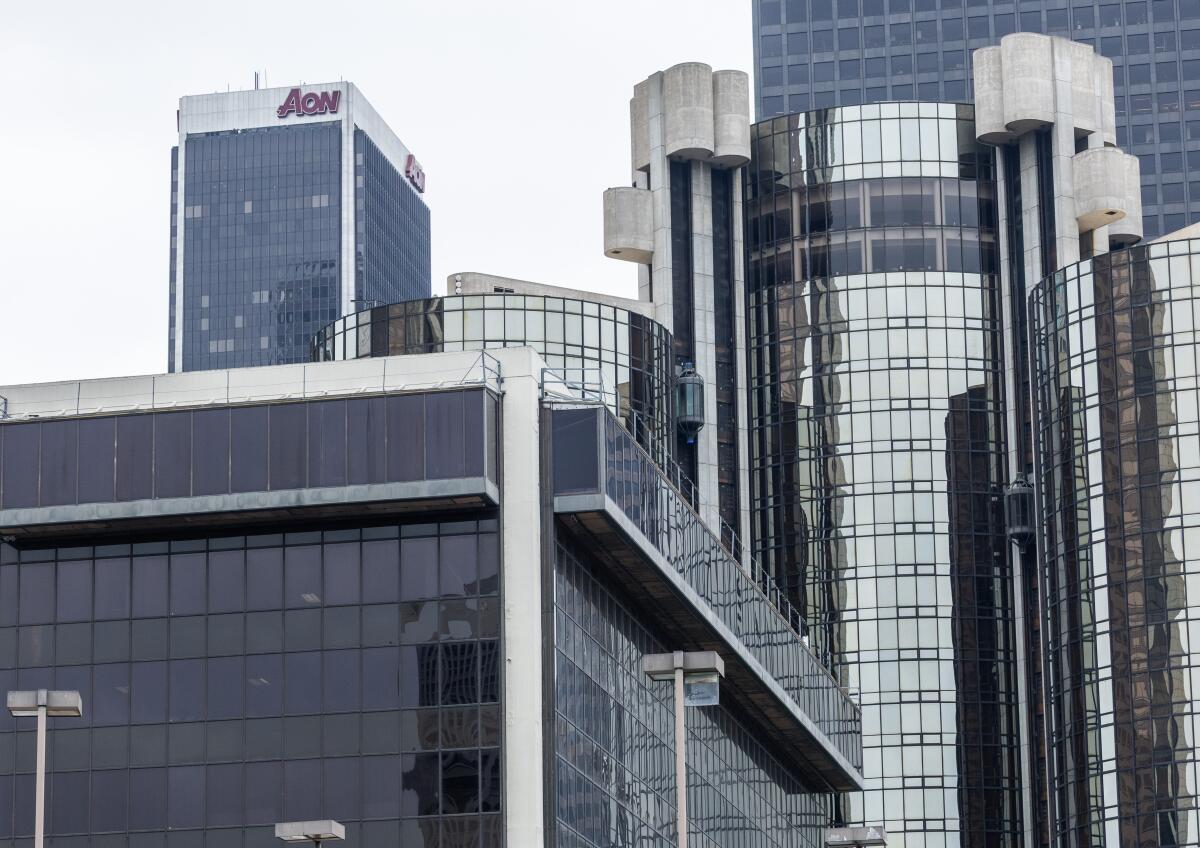
The 10-story World Trade Center, right, at Figueroa and Fourth streets in downtown Los Angeles, was built in the mid-1970s.
(Myung J. Chun / Los Angeles Times)
Behind the building campaign unveiled Monday are two of the region’s largest real estate companies, Jamison and Kennedy Wilson. Jamison is the city’s most prolific converter of offices to market-rate apartments and currently has a major makeover of a downtown office skyscraper underway for tenants who can pay top rents.
Kennedy Wilson, a real estate investment company based in Beverly Hills, owns Vintage Housing, which builds and operates affordable housing using tax credits and other state and federal financing to help fund it.
Vintage Housing and Jamison’s new affordable housing division, Arden Residential, will take on the campaign to build the housing where qualified tenants will pay rents below market rates.
Rents in the World Trade Center — which will be renamed Sky Castle when it opens in early 2028 — are expected to start at $937 for a one-bedroom unit. Some two- and three-bedroom units would rent for $1,100 and $1,300 per month, respectively, developers said.
Sky Castle will have shared amenities found in more expensive modern apartments, the developers said, such as a fitness center, resident lounge and co-working space. It already has six tennis courts on the roof, which may be converted to pickleball courts, Jamison Chief Executive Garrett Lee said.
The goal is to build higher quality affordable housing by using efficient construction methods Jamison has learned through building more than 8,000 market-rate apartments in the past, Lee said. The makeover of the World Trade Center will mark Jamison’s 15th conversion of an office building to housing.
The plan to redevelop the L.A. World Trade Center, bottom left, is one of the largest affordable housing conversions to date downtown.
(Myung J. Chun / Los Angeles Times)
The 10-story World Trade Center was built in the mid-1970s to fanfare saying it would be home to international companies. In 1976, The Times described the center as a place to prepare for an overseas trip where visitors could get passports and visas, as well as exchange dollars for francs, marks, rubles and other currency. There was a language school and branches of U.S., Swiss and Japanese banks.
By the mid-1980s, the 400,000-square-foot office complex covering a city block at Figueroa and Fourth streets had lost its international flavor and was falling out of favor with corporate tenants who were moving into glossy new skyscrapers on Bunker Hill and in other locations.
The building has been cleared of remaining office tenants to allow work to begin in August, Lee said.
Kennedy Wilson is a nationwide operator of market-rate apartments that has also moved into building affordable housing in the last decade, said Nicholas Bridges, global head of capital markets at the company.
Building affordable, workforce housing “in almost all cases requires public subsidies,” Bridges said, and Kennedy Wilson has developed expertise in assembling “a cocktail of public financing sources” that includes low-income housing tax credits and tax-exempt bonds.
In the past, many housing developers have shied away from building affordable housing because assembling the subsidies needed to make construction profitable is challenging.

An artist’s rendering shows what the L.A. World Trade Center could look like after being redeveloped into affordable housing. The new complex is to be called Sky Castle.
(Ian Camarillo)
“It’s complicated,” Bridges said, “and not for the faint of heart.”
Eligible tenants must earn between 30% and 80% of the median income in the area where the housing is built.
Jamison and Kennedy Wilson will develop about 15 affordable housing projects between downtown and the 405 Freeway, Bridges said, many of them in aging office buildings such as the World Trade Center that are already owned by Jamison and are close to public transit.
Substantial potential for affordable housing lies in L.A.’s underused office buildings, he said.
“In this post-COVID world, the way people are utilizing office buildings, particularly older office buildings, has just fundamentally changed,” he said.
It makes sense for developers of conventional multifamily housing to move to building affordable housing, Lee said, because the government supports it through subsidies, zoning reform and the fast-tracking of construction permits. The city of Los Angeles also recently streamlined its adaptive reuse rules to make it easier to convert office buildings to housing.
“There are a lot of incentives pushing us in this direction,” Lee said.
-

 Arizona2 minutes ago
Arizona still pursuing nuclear energy despite hurdles | Arizona Capitol Times
-

 Arkansas7 minutes ago
Arkansas Postcard Past: Wynne in 1909 | Arkansas Democrat Gazette
-

 California14 minutes ago
As fireworks pop off for July 4, which are legal to use in California?
-

 Colorado17 minutes ago
Avalanche Signs Beckman | Colorado Avalanche
-
 Connecticut22 minutes ago
Immigrant advocates urge Connecticut to prepare after Supreme Court TPS ruling
-

 Delaware29 minutes ago
Delaware’s dangerous heat wave impacts pets. How to keep them safe
-

 Florida31 minutes ago
Cocaine, guns reported found after gas station surveillance in Florida
-

 Georgia37 minutes ago
LIVE BLOG: Severe storms threaten North Georgia

