Business
This California city lost thousands of homes to fire. Santa Rosa’s rebuilding has lessons for L.A.


SANTA ROSA, Calif. — The sky above their newly built homes was clear, and the ground beneath their feet reassuringly soggy from recent winter rains. But as residents in the Coffey Park neighborhood made their way to a community gathering on a recent evening — passing one yard after another devoid of trees or brush or anything readily flammable — many said they still have flashbacks to a night of smoke and flames and fear.
It’s been more than seven years since homes in this Santa Rosa neighborhood were incinerated by the Tubbs fire, which swept across Napa and Sonoma counties in a matter of hours before jumping six lanes of the 101 Freeway. The residents of Coffey Park — about 9,000 people — were roused from their beds in a panic and fled through flames and whipping embers. In some cases, people walked miles to safety, with singed pets struggling in their arms and only the clothes on their backs.
A scorched lawn statue stands amid the rubble of the Coffey Park neighborhood in Santa Rosa in October 2017.
(Luis Sinco / Los Angeles Times)
Five neighborhood residents died in the fire, among 22 total in Sonoma County. At the time, it was the most destructive fire in California history — although that record would quickly be broken, and then broken again in the coming years.
Fire wasn’t supposed to do what it did that night. No one had predicted the flames would move so fast, or consume so much of this city of 175,000 and surrounding communities. No one could have predicted, either, that Santa Rosa would manage to build back so quickly, or that residents would say that, in some ways, their communities emerged stronger: safer from fire and more closely knit.
Just more than a week into Los Angeles’ ordeal by fire, the neighbors of Coffey Park were gathering in Tricia Woods’ rebuilt kitchen to raise funds to send to fire victims in L.A. They also wanted to send a message: You can’t imagine it now, but it is possible to recover from this.
Yes, the aftermath is hard: “I moved seven times in three years,” Diane Farris said of the uncertainty and dislocation.
And you never get over the trauma: “I still have a go bag packed,” Anita Rackerby confided, as her neighbors nodded in recognition.
But they knew from shared experience that communities can, indeed, rise from ashes.

Santa Rosa streamlined the process for rebuilding neighborhoods leveled in the 2017 Tubbs fire.
(Paul Kuroda / For The Times)
People in Santa Rosa are acutely aware that they are in the unenviable position of having hosted one of California’s first and most brutal megafires in this new age of unpredictable burns.
On the night of Oct. 8, 2017, the Tubbs fire ignited near the town of Calistoga. Within five hours, the blaze — spitting embers that helped it leapfrog in all directions — had traveled 12 miles, over the hills that separate Napa and Sonoma counties and down into Santa Rosa. Then, it did the unthinkable, jumping the freeway and burning through homes that were viewed as being at low risk for wildfire.
Santa Rosa has been in a state of recovery ever since. Along the way, some residents have become unofficial disaster consultants, jetting off to scenes of devastation around the country — to Paradise, which the Camp fire eviscerated in 2018; and Lahaina, the Maui community that burned to the ground in 2023 — to counsel people on how to pick up the pieces.

A grassy lot is all that remains of a home lost in the Tubbs fire.
(Paul Kuroda / For The Times)
Gabe Osburn, Santa Rosa’s planning director, said the L.A.-area fires were still raging when he got his first call from representatives of the city of Los Angeles. The question was simple: What do we do?
Osburn was Santa Rosa’s deputy director of city services in 2017. He found out his city was on fire the way most residents did: He woke to a blaring alarm.
His house, just outside Coffey Park, was filled with smoke, and it had a distinct smell that he recognized as wildfire. He glanced out his second-story window and saw a terrifying orange glow over his neighborhood. He and his wife grabbed what they could, which included their three cats, and fled to a relative’s house in southern Sonoma County.
Then, he reported to work.
It wasn’t long before the scope of the disaster became clear. Twenty-two people dead. And tens of thousands were homeless. With more than 3,000 homes burned within city limits — and more than 5,000 in the surrounding area — Santa Rosa had just lost 5% of its housing stock.
In a city that already had a housing crunch, this was a crisis. Where were all the people whose homes had burned going to live? And given that many of them were relatively wealthy, would their search for housing have the domino effect of pushing other renters out? What could or should government officials do about it?
Amid the charred rubble, residents were starting to ask themselves the same questions.

Brad Sherwood, center, with his wife, Brandy, and son Grant in front of their rebuilt home in Santa Rosa.
(Paul Kuroda / For The Times)
In Larkfield Estates, a neighborhood just north of the city limits, Brad Sherwood and his wife, Brandy, had long reassured their children that they had nothing to fear from wildfire. “I live on a valley floor,” he said of his thinking. “This is not the wild/urban interface” that is prone to burning. “They can stop it.”
He was wrong, as so many others have been in recent years when predicting what wildfires would do based on what they have done in the past.
Sherwood said he “will never forget looking up this canyon as I’m running from my house, seeing fire tornadoes ripping down” toward him. And yet, he added: “On Day 1, my wife and I said, we are rebuilding. This is our home.”
But first, they had to find a place to live. And of course, they were dealing with insurance, and the hundreds of things they had to account for in order to get paid.
And life didn’t stop. Both he and his wife had jobs, and they had to take care of their children, who had been through the ordeal of watching their home burn down.

Brad and Brandy Sherwood had a dining table made from a signature walnut tree on their property that was damaged in the Tubbs fire.
(Paul Kuroda / For The Times)
He and his wife decided they would “divide and conquer.” Brandy would take the “front-line approach,” taking the lead with the insurance company and, eventually, the builder who constructed their new home. Brad “would focus on community outreach.”
“I knew that if we weren’t working together as a community, we would not be successful as a whole,” he said.
In the weeks after the fire, he built a website that would serve as an information hub for Larkfield Estates, whose residents were now scattered across the county and beyond. The community began holding neighborhood meetings and inviting local officials. The area supervisor, James Gore, created a “block captain” program for burned-out neighborhoods, to simplify communication and allow neighbors to speak collectively.
The community developed a “needs assessment.” In addition to rebuilding homes, recovery would require debris removal, reconstruction of power, water and sewer systems and fixing streets.
They also needed to figure out how to efficiently rebuild. Should every family find its own contractor? Or should the city bring in home builders who could mass-produce homes, which would be cheaper and faster?
And along the way, Sherwood said, something remarkable happened: The neighbors, mostly friendly, but often distant, got to know one another better and began to trust and rely on each other.
Three miles south, in Coffey Park, a similar effort was unfolding. They called the group “Coffey Strong.” They had a website. They held meetings with elected leaders, home builders, city officials.
And then, eight months after the Tubbs fire, another blaze ignited in nearby Lake County. Smoke drifted to Santa Rosa, traumatizing many.
Woods, the woman who summoned folks to her rebuilt home last week as Los Angeles burned, was among those who felt shaken. But she decided to do something about it. She blasted out a message to her neighbors telling them she would be sitting in a camp chair next to the burned-out husk of her home. She would have wine. Everyone was welcome.

This October 2018 photo shows Coffey Park residents gathering for “Wine Wednesday” as the neighborhood was rebuilding from the Tubbs fire.
(Los Angeles Times)
A neighborhood tradition was born. They began to meet every Wednesday evening. At first the gatherings took place in the street, amid the rubble. Eventually, as neighbors slowly rebuilt, they gathered for housewarming parties.
“We didn’t have many friends in the neighborhood before this,” said Melissa Geissinger, who was seven months pregnant when her house burned down and endured the trauma of having her newborn baby go through open-heart surgery while the family was displaced.
By 2020, just three years after the fire, more than 80% of the neighborhood homes lost in the fire had been rebuilt and families had moved back in.
Osburn, Santa Rosa’s planning director, said the city played a key role in making that possible. “We made this commitment to the community that we would understand where they were getting stuck and implement creative solutions to remove the impediment,” he said.
That meant a range of actions, including coordinating with state, federal and county officials in the early days of recovery to help people get their feet under them, stripping back discretionary regulations and processing permits within days or hours instead of months.
The signs from the Tubbs fire are still visible in Santa Rosa for those who know how to read them.
In the Fountaingrove neighborhood, in the hills east of downtown, many replacement homes are still under construction. And some lots are still empty, the grass from winter rains wafting in the wind, along with the sharp echoes of hammers and nail guns.
In Larkfield Estates, Sherwood and his family have moved into their new home. The old walnut tree that used to shade his frontyard has been transformed into an elegant dining room table. Many of his neighbors, also returned, did the same thing with their trees.
In some ways, the neighborhood has more amenities than it did before. It finally got a sewer system so residents could move off septic; the county offered loans at a low interest rate to make it affordable. A new park, which the community is helping to raise funds for, is coming. And there is a new sidewalk on busy Mark West Springs Road so children can more safely walk to school.
But across the street from Sherwood’s gorgeous new house — white with dark trim and cheerful flowers in the frontyard — is still an empty lot, a forlorn swimming pool surrounded by chain-link fencing the only reminder of what used to be. A plastic chair that blew into the pool the night of the fire is still there; the water protected it from the flames, and no one has touched it since.

For now, this pool is all that remains of a property lost in the Tubbs fire.
(Paul Kuroda / For The Times)
In Coffey Park, there are still a few houses under construction, but the biggest reminder of fire is in the landscaping: very few big trees, and yard after yard ornamented with rocks and other materials that can’t burn.
At the wine gathering, one person after another said they hoped the people of Los Angeles could take hope from Coffey Park.
Until the fire, said Rackerby, “I lived here for 30 years, and I didn’t know the people across the street.” Now, she said, she feels like she knows everyone. In the months before the local park was refurbished, she opened up her yard as a play area for neighborhood children. She also helped her neighbors make mosaic artwork using scorched jewelry, dishes and other sifted wreckage from their homes — something to memorialize what they had lost.
Standing nearby was Geissinger, whose son is now a playful 7-year-old. She recently published a young adult novel, “Nothing Left But Dust,” that includes themes about a fire. Coming through the blaze, she said, gave her the courage to pursue her dream of being a writer.
Michelle Poggi, who seven years ago escaped with her husband on foot, walking three miles with their cat through smoke and burning embers, echoed that sense of what’s possible.
“This community really did take something horrible, and it’s kind of like we all found the silver linings where we could,” she said. Her neighbors nodded in agreement.

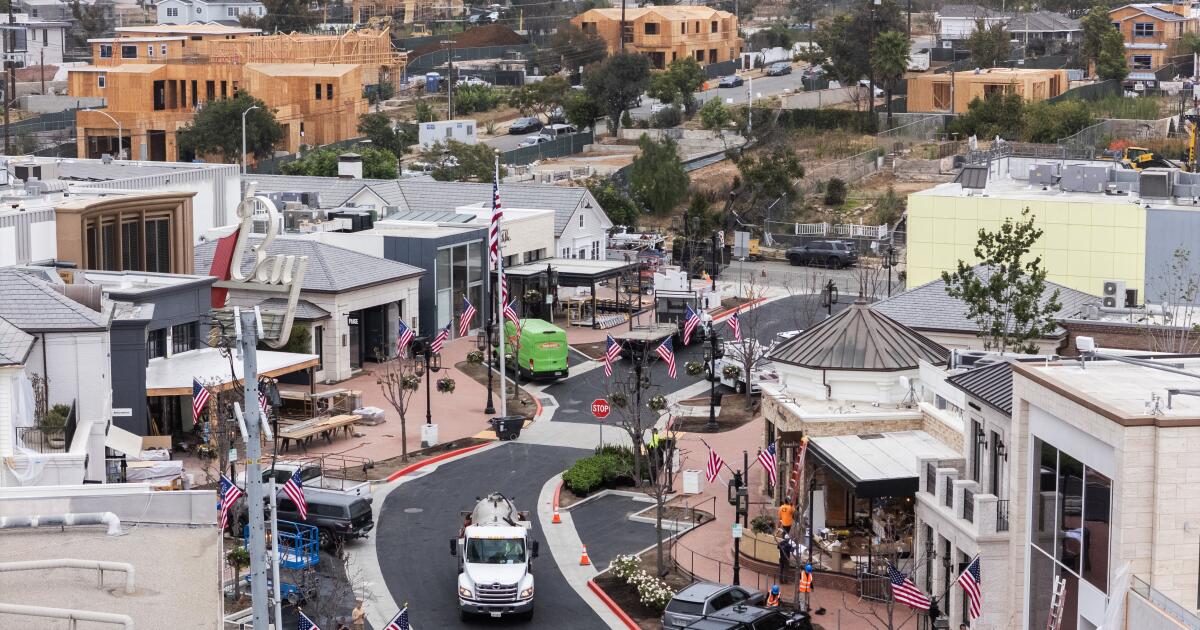
The luxury shopping center in Pacific Palisades will reopen next month after more than $100 million in renovations forced by the January 2025 wildfire that devastated the Los Angeles neighborhood.
Palisades Village will reopen Aug. 15, owner Rick Caruso announced Wednesday. The outdoor center survived the blaze that destroyed homes and other businesses but needed refurbishment to eliminate contaminants that the fire could have spread.
Crews are putting finishing touches on mall buildings after tearing them down to the studs, treating the wood and rebuilding the walls, Caruso said.
“Everybody’s working, and stores are moving their products in,” he said. “It’s a really cool feeling that people have really locked arms and are working together.”
An electrician installs lighting for a restaurant at Rick Caruso’s Palisades Village on Thursday. The shopping center is scheduled to reopen mid-August.
(Myung J. Chun / Los Angeles Times)
Pacific Palisades resident Allison Polhill, who is rebuilding the home of 30 years that her family lost in the blaze, said she is “thrilled” at the prospect of returning to the mall she used to frequent. Its comeback is a boost for the community, she said.
“Every single step that we make to reopen our commercial corridors is going to bring more people back into the Palisades,” said Polhill, who expects to move back into her home at the end of August.
A total of 6,822 structures were destroyed in the Palisades fire, including more than 5,500 residences and 100 commercial businesses, according to the California Department of Forestry and Fire Protection.
Caruso previously attributed the mall’s survival to the hard work of private firefighters and the fire-resistant materials used in the mall’s construction.
The $200-million shopping and dining center opened in 2018 with a movie theater and a roster of upmarket tenants, including Erewhon, which may be the only grocer in the heart of the fire-ravaged neighborhood when it opens.
Caruso’s company was able to fill the mall with tenants despite the long shutdown.
Palisades Village is 99% leased, with the majority of tenants returning, said Jackie Levy, chief financial and revenue officer. Nearly one-third of the shops and restaurants are new to the property.
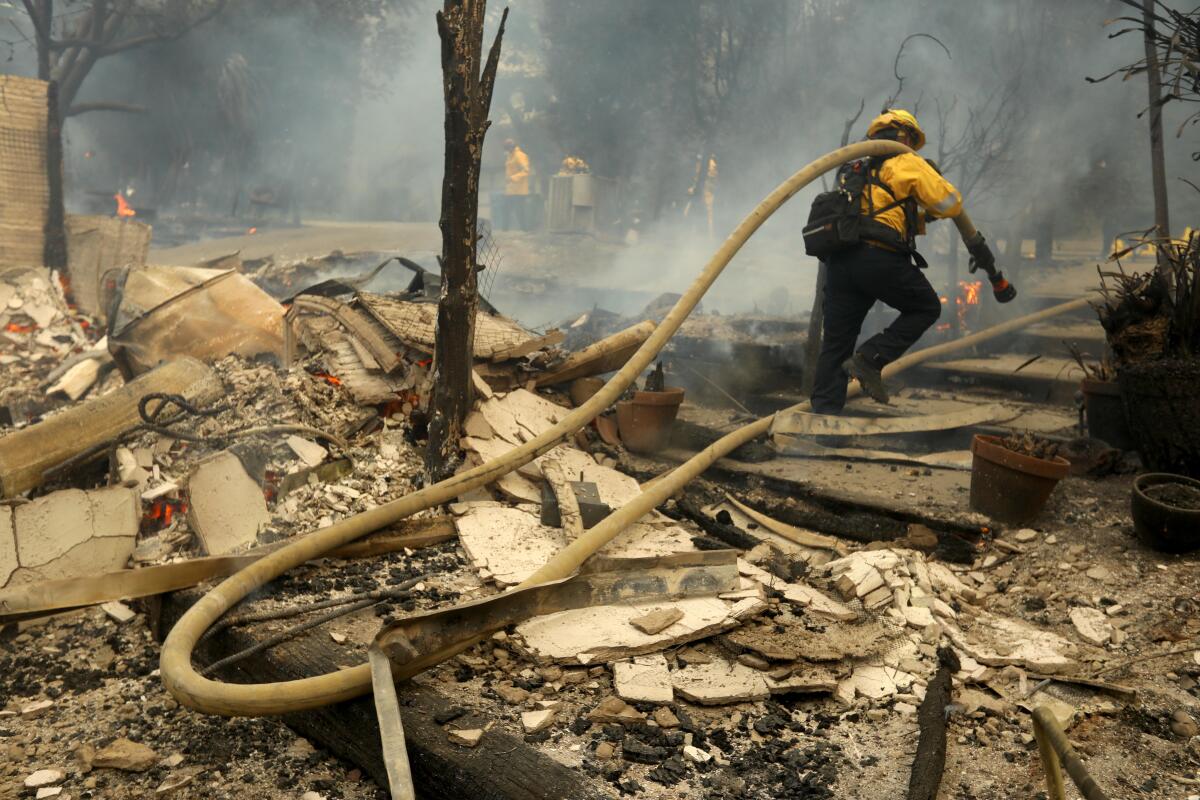
A firefighter carries a hose back to his rig while walking through a destroyed home from the Palisades fire in Pacific Palisades on Jan. 7, 2025.
(Genaro Molina / Los Angeles Times)
Last year, Pacific Palisades-based fashion designer Elyse Walker said she would reopen her eponymous store in Palisades Village after losing her 25-year flagship location on Antioch Street to the inferno.
Other neighborhood shops destroyed in the fire that are reopening at the mall include K Bakery and Loomey’s Toys, which caters to children up to age 12 and used to be across the street from Palisades Elementary Charter School.
“It’s been a journey and I’m excited because I wasn’t sure that there was going to be a place to come back to,” said toy store owner Amanda Rastegar. “Hopefully we can bring some of that magic back.”
Rastegar’s home in the Palisades survived but was damaged by the fire. The family returned about eight weeks ago. Her last memory of the fire was a burning supermarket.
“I just couldn’t wrap my brain around what was happening,” she said. “By the time I left, Gelson’s was on fire.”
Among the returning tenants is Angelini Ristorante & Bar. Well-known Los Angeles chef Gino Angelini said he will be in the kitchen next month for a return of the Italian restaurant.
“We won’t do a big celebrity open,” he said. “We want to have a very soft opening and see our customers come back.”

Construction takes place at Rick Caruso’s Palisades Village on Thursday. The shopping center is scheduled to reopen mid-August.
(Myung J. Chun / Los Angeles Times)
An elaborate celebration would not feel “correct for me,” Angelini said, because the devastation has been “very sad” for so many.
Other new tenants include local chef Nancy Silverton, who has agreed to move in with a new Italian steakhouse called Spacca Tutto. Women’s activewear retailer LESET will open its first West Coast location.
Caruso said he is optimistic that customers will return to the center, even though many Pacific Palisades residents are still dispersed. One tracking system estimated that about 30% of the Village’s customer base was impacted by the fire, he said.
“That means 70% did not get impacted, so there’s a lot of customers still left out there,” Caruso said. Historically, the center drew customers from as far away as Beverly Hills and Calabasas, as well as Malibu, Brentwood and Santa Monica.
He also hopes many will be inspired to visit the revived mall.
“I believe in the goodness of people and I believe that people are going to want to support the Palisades,” he said. “They’re going to want to be there and support the businesses that have had the courage and the heart to reopen.”

Walmart is rapidly expanding its network of electric vehicle chargers designed for customers to use while they shop.
The network could help fill gaps in EV infrastructure in states with greater need for chargers. Walmart, which has more than 5,000 locations in the U.S. and hundreds in California, says more than 90% of Americans live within 10 miles of one of its stores.
The chargers also offer an incentive for customers to choose Walmart — Walmart Plus members will receive a 10% discount off an average price of $0.46 per kilowatt-hour of energy at the company’s chargers.
Walmart chargers are already available at more than 75 locations in 17 states, with Texas boasting the most charging stations, followed by Florida and Arizona.
Matthew Nelson, Walmart’s director of energy policy, said last week on LinkedIn that the network will soon reach 29 states, including California.
“We are delivering on the promise of affordable, reliable and convenient charging,” Nelson said in his post.
According to Walmart’s website, six charging stations are coming to California soon, though the company did not offer a specific timeline.
The chargers will be installed at stores in Antelope, Brea, Fresno, Stockton, Suisun City and Vallejo.
Most charging sites in California will include eight to 16 fast-charging stalls, said Walmart spokesperson Kelsey Bohl.
The company first announced plans in April 2023 to install its own EV chargers at Walmart and Sam’s Club stores, with a goal of installing thousands of chargers by 2030. Partnering with ABB E-Mobility and Alpitronic, it added 25 new charging sites this past May and six more in June.
“Walmart is building a leading retail-integrated EV fast-charging network, focused on delivering an affordable, reliable and convenient charging experience where customers already shop,” Bohl said in an emailed statement. “Customers can charge while they shop, access stations through the Walmart app they already use, and benefit from affordable pricing.”
The charging stations already available include 612 individual charging stalls using 400-kilowatt chargers. Each stall has a dual charging cord with both Combined Charging System and North American Charging Standard connectors. The standard connectors, designed by Tesla, are smaller and lighter than the combined systems.
The primary way to pay for the chargers is through the Walmart app, but the company is also experimenting with built-in credit card readers to allow those without the app to use the stations.
Customers can check charger availability on the Walmart app. The company said the chargers will be available 24 hours a day.

Robotaxis could be turning into robocops.
A self-driving Waymo reported two teens to San Mateo, Calif., police on Monday after they were found drinking alcohol and shooting toy guns in the back of the vehicle.
According to a social media post from the San Mateo Police Department, officers detained two 15-year-olds after the Waymo they were riding in contacted the department and stopped in a parking lot until law enforcement arrived.
“Parents do you know where your teens are?” the San Mateo Police Department wrote on Facebook following the incident. “Waymo does!”
Officers removed both teens from the vehicle and determined they were using toy guns to shoot Orbeez out the windows. Orbeez are small, water-absorbing beads sold at toy stores.
“Toy guns, water guns, and BB guns all pose real dangers, especially to an untrained eye,” the Police Department said. “The simple handling of them can cause fear in [passersby].” “
A video posted on Facebook shows at least five officers and a police dog responding to the scene and approaching the Waymo with their weapons raised.
Waymo did not immediately respond to a request for comment.
Waymo vehicles have internal cameras and microphones that may be used in an emergency or to “promote safety and security,” according to Waymo’s online support page.
The cameras are also used to ensure the vehicles are clean and to help find lost items, according to the support page.
The company said it does not use facial recognition or other biometric identification technologies to identify individuals.
“In more urgent circumstances, support may access live video during a trip,” the Waymo page said.
The San Mateo Police Department’s Facebook post has garnered nearly 60 comments, with one user accusing Waymo of “snitching.”
“At least they got a designated driver?!” one user commented.
-

 Maine2 minutes ago
Graham Platner says he’ll withdraw from Senate race in Maine
-

 Maryland9 minutes ago
Maryland man sentenced to 15 years for attempting to join ISIS
-

 Michigan12 minutes ago
Sherrone Moore’s former assistant sues University of Michigan over alleged FOIA violations
-

 Massachusetts17 minutes ago
Max McColgan and Joseph Lenane share stroke play medals at 118th Massachusetts Amateur Championship – The Boston Globe
-

 Minnesota24 minutes ago
Man seriously injured in north Minneapolis shooting; no arrests
-

 Mississippi27 minutes ago
Ben Crump seeks independent autopsy in Nolan Wells death
-

 Missouri32 minutes ago
Missouri politicians champion unity, diversity on America’s 250th
-

 Montana39 minutes ago
Montana signs onto data center energy cost protection pledge

