Business
Palmer Luckey: Millennial slayer of U.S. defense giants

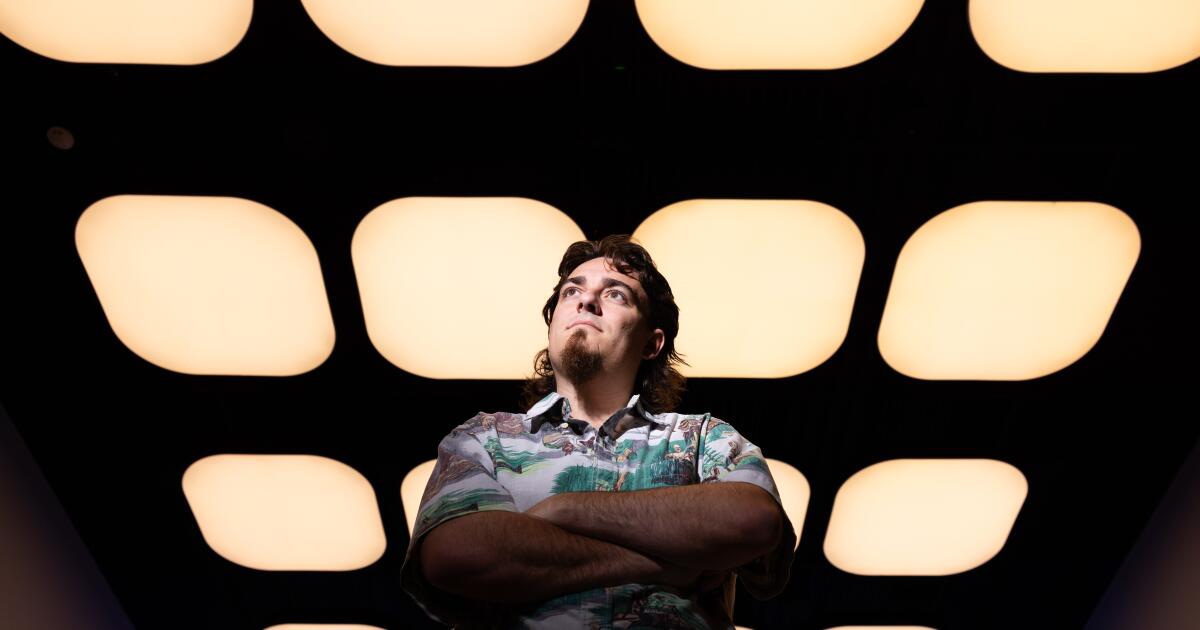
A red phone sits on Palmer Luckey’s desk at the Costa Mesa headquarters of his military tech company, Anduril Industries.
The phone is a genuine article from the U.S. nuclear command, once connected to the network that led to the bunkers dug into the Rockies west of Colorado Springs that could order up the apocalypse. Luckey owned the red phone before he started Anduril, back when he was only famous for inventing the Oculus virtual reality headset in a trailer in the driveway of his childhood home in Long Beach, then selling that company to Facebook for $2 billion at age 21.
Discover the changemakers who are shaping every cultural corner of Los Angeles. This week we bring you The Disruptors. They include Mattel’s miracle maker, a modern Babe Ruth, a vendor avenger and more. All are agitators looking to rewrite the rules of influence and governance. Come back each Sunday for another installment.
Back then, the phone was just kitsch, a physical piece of history he could gaze at as he worked on VR for a social media company. But after he donated $10,000 to an anti-Hillary Clinton political group in the fall of 2016, then got fired from Facebook a few months later, the red phone changed from a prop to a proposition. Flush with cash, unemployed and annoyed at Silicon Valley, he decided to become a military mogul — possibly the first whose office uniform is a Hawaiian shirt, cargo shorts and flip-flops.
“That was the dream, to be the guy with the red phone who gets The Call,” Palmer, now 31, said in an interview at Anduril’s headquarters.
He founded his new enterprise with four others. One had worked with Luckey at Oculus, but the remaining three came from Palantir, the intelligence analytics software company founded by Peter Thiel, the billionaire tech investor and right-wing political donor. When Thiel founded Palantir in 2003, he named the firm after the magical seeing-stones from Tolkien’s “Lord of the Rings.” Luckey followed in Thiel’s footsteps. Anduril is the elvish name of the reforged sword of Aragorn, king of men and hero of the forces of good in Tolkien’s epic. Translated into English from Quenya, the name means “Flame of the West.” A replica of the sword from the “Lord of the Rings” films hangs on the wall in Anduril’s office.
“The first page of our first pitch deck said that Anduril is a company that will save Western civilization by saving taxpayers hundreds of billions of dollars a year as we make tens of billions of dollars a year,” Luckey said.
“We’re not making tens of billions of dollars a year yet,” he said, “but we’re getting there.”
Six years later, Anduril has signed well over $1 billion in public contracts with the U.S. and allied governments and raised more than $2 billion in venture funding. Last year, it brought in around $500 million in revenue, according to investor presentations reported by the Information.
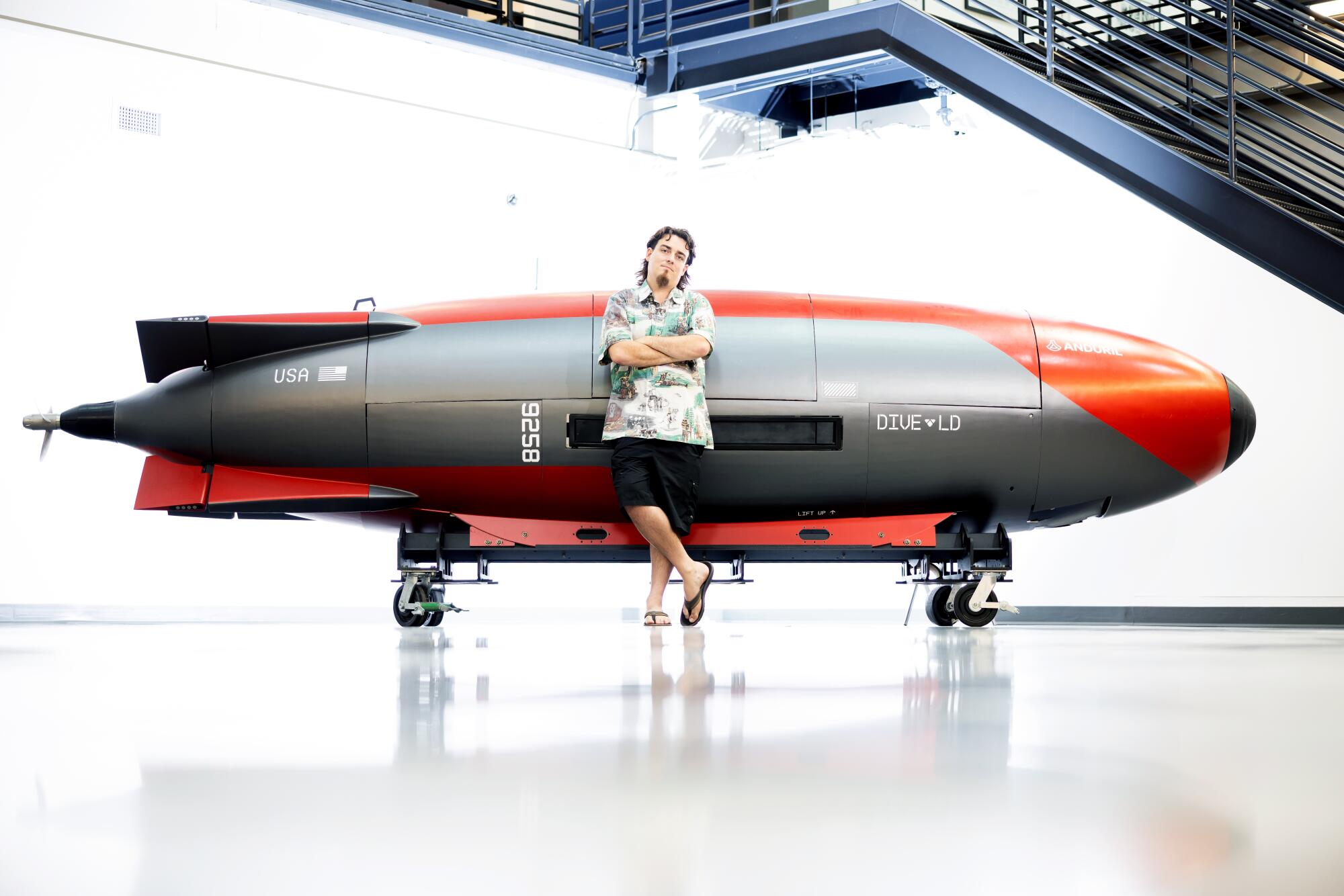
Of those contracts, $250 million are with the U.S. Border Patrol, which is in the process of deploying a network of 189 Anduril sensor towers to form a “virtual border wall” of semiautomatic surveillance across the U.S.-Mexico border. Another $100 million is with the Australian navy, which hired Anduril to build submarine drones. Its biggest deal came in 2022, when the U.S. Special Operations Command awarded a 10-year, billion-dollar contract to Anduril for counter-drone defense systems that combine sensors, AI software and drones like Anduril’s Anvils, which can physically ram enemy drones to knock them out of the sky.
‘We are preemptively being invited to conversations to help solve problems — most companies will just never get that call.’
— Palmer Luckey
Luckey’s company has also developed a tube-launched drone with a “loitering munition” model (a.k.a. an exploding drone) and bought a rocket engine manufacturer in Mississippi that makes propulsion systems for hypersonic missiles. In late 2023, it unveiled a jet-powered drone that could be flown multiple times for surveillance missions, or equipped with a warhead for suicide missions. In April, Anduril beat out Boeing, Lockheed Martin and Northrop Grumman in an Air Force competition for a new autonomous fighter drone that can fly alongside manned warplanes like robot wingmen.
That red phone on Luckey’s desk isn’t connected to a live line — but he is undoubtedly getting The Call.
“We are preemptively being invited to conversations to help solve problems — most companies will just never get that call,” Luckey said. “It’s the dream come true for someone with my ideological bent.”
Luckey’s bent, at least when it comes to business, runs counter to the last few decades of America’s economic development. When he was working at Facebook and trying to scale up the production of the Oculus headset in Chinese factories, he started to believe that something had gone seriously wrong.
“I felt that we lived in a unique period of U.S. history where we had allowed our technological innovation apparatus to be completely hijacked by a foreign power: China,” Luckey said. “Almost none of the major tech companies in the United States were willing to work with the DoD in a major way, because doing so would get them locked out of China, Chinese capital, Chinese markets, Chinese manufacturing.”
“Apple could not pivot away from China even in the event of World War III,” Luckey said. “So you get to this weird situation, I realized, where these people who are supposed to be the most powerful people in the country are actually handcuffed and prohibited from saying anything that they might believe,” including criticizing the Chinese government’s mass detention of Muslim minorities. “If you’re the CEO of Apple, you can’t go out and say, ‘I think concentration camps are wrong, no matter where they are.’ I looked at that and said, ‘Oh my God, this is terrifying.’”
This line of thinking was considered fringe in the tech industry in 2016, when Luckey left Facebook, but after COVID-19 pandemic supply-chain disruption and wars in Europe and the Middle East, a growing slice of the tech industry has switched to Luckey’s point of view, emphasizing the need to bring manufacturing back to U.S. shores — or at least U.S. allies — and disentangle from the Chinese economy.
Luckey’s enthusiasm for working with the military was unpopular for much of the last decade, but his basic pitch for Anduril is classic Silicon Valley: Use software, venture capital money and a new business model to disrupt an industry full of lumbering incumbents. He and his co-founders thought that they could tap tech talent to bring machine vision and other AI technologies to military operations, and outflank the defense giants of Lockheed Martin, Raytheon, General Dynamics, Boeing and Northrop Grumman — known as the five “primes” in the industry — by pitching the military on a new way to pay. Instead of billing on a cost-plus basis, where the government covers all the costs of development and manufacturing, plus a little profit margin on top, Anduril talks to Department of Defense decision-makers up front, uses its own capital to develop new software and drones, and then sells the finished product to the military.
The company is not profitable, and has no intention of becoming profitable in the next few years. “We should not be profitable” in the near future, Luckey said. “We should be taking all of the money that we’re making and putting it back into growing the company, launching new product lines, trying to become the next major defense prime.”
It was an uphill fight to secure his first round of funding. Investors would tell him, “We love your people, we love your tech. You’re very patriotic, you’re very smart, but we don’t think you can actually get the government to buy your stuff.” “I pointed out to people that every defense company that had been founded by a billionaire was a success,” Luckey said, referring to Elon Musk’s SpaceX and Thiel’s Palantir. “I hate that we live in a country where that’s the case, but I realized that I had a unique responsibility as one of the very few people who was willing to work on national security and blessed with the resources to actually make a real go at it.”
Luckey has also used those resources to give millions to Republican political candidates and committees across the country, drawing criticism from a number of his peers in the tech industry, who tend to lean toward Democrats over the GOP.
‘I’m supporting the people who are generally very pro-innovation and national security.’
— Palmer Luckey
In the 2020 cycle, Luckey and his wife poured nearly $3 million into the coffers of Republican Party committees and congressional candidates in 45 states, and threw in $1.7 million for Donald Trump’s campaign on top. That October, Luckey also hosted a reported $100,000-a-person fundraiser for Trump, with the candidate in attendance, at his waterfront home on the tip of Newport Beach’s Lido Isle.
His political giving has kept up in the years since. In the 2021-22 cycle, federal election records show Luckey donated over $1.4 million to Republican committees and candidates. In 2023, he donated an additional $726,000. His sister, Ginger, is married to Rep. Matt Gaetz (R-Fla.).
“I’m supporting the people who are generally very pro-innovation and national security,” Luckey said. He doesn’t see a contradiction in building weapons for the Ukrainian army and supporting members of a political party that has been wobbly in its support for the war. “They are almost universally very supportive of using Ukraine as an opportunity to show Russia that they are not gonna get away with being an expansionist regime,” he said.
“At the end of the day, I would love it if I could only give money to the politicians who agree with me on everything, and only to the groups that agree with me on everything. Unfortunately, I have not found those groups.”
Earlier this month, Luckey again co-hosted a fundraiser for Trump in Newport Beach. Combined with other events in the region, it was expected to raise about $27.5 million for the presumptive Republican nominee’s campaign committee. Besides running a company, Luckey has a growing collection of toys to occupy his time. An 82-foot boat used by the Navy SEALS called the Mark V Special Operations Craft floats at the end of the dock outside his Lido Isle house, visible on Google Maps’ satellite view.
Through a series of LLCs with names such as Luckey Arms, Luckey Air Transport and Luckey Ground Technology, he owns a couple of submarines, a Black Hawk helicopter and a fleet of motorcycles and cars. On the day we met, he drove a Tesla stripped of all paint to the bare aluminum to work. He drove a 1990s Mazdaspeed Autozam converted to electric drive and skinned hot pink with graphics from the anime series “Gun Gale Online” to the annual Anime Expo at the L.A. Convention Center last summer. During his time at Facebook, the Wall Street Journal reported that he would drive a military Humvee to the Menlo Park, Calif., offices, complete with fake guns in its machine-gun mount.
Real guns are also a hobby. “I have a huge number of guns. Massive collection of guns.” His main interest is failed gun designs, stabs at innovation that led to technological dead ends. “I will say I’ve got the extreme machine gene,” Luckey said.
And then there are the nuclear missile silos. “I own a lot of ICBM sites all over the United States.” Corporate filings show that a decommissioned Atlas ICBM silo in rural Saranac, N.Y., is owed by Black Omen LLC, which is in turn managed by Fiendlord’s Keep LLC, whose chief executive is listed as Palmer Luckey.
Luckey would not confirm nor deny his ownership of that site, but he did say that he’s in the process of collecting the entire U.S. ground-based nuclear deterrent system. His goal, he says, is to turn it into a vast museum. “There are so many air museums, quite a few naval museums and ship museums, and there’s literally only one missile museum in the United States, the Titan II in Tucson, Arizona,” he said. “It’s just kind of weird that one of the three pillars of the nuclear triad has just been completely ignored by all the people that build museums. So I’m collecting those and restoring them.”
Like the red phone, only bigger.


Robotaxis could be turning into robocops.
A self-driving Waymo reported two teens to San Mateo, Calif., police on Monday after they were found drinking alcohol and shooting toy guns in the back of the vehicle.
According to a social media post from the San Mateo Police Department, officers detained two 15-year-olds after the Waymo they were riding in contacted the department and stopped in a parking lot until law enforcement arrived.
“Parents do you know where your teens are?” the San Mateo Police Department wrote on Facebook following the incident. “Waymo does!”
Officers removed both teens from the vehicle and determined they were using toy guns to shoot Orbeez out the windows. Orbeez are small, water-absorbing beads sold at toy stores.
“Toy guns, water guns, and BB guns all pose real dangers, especially to an untrained eye,” the Police Department said. “The simple handling of them can cause fear in [passersby].” “
A video posted on Facebook shows at least five officers and a police dog responding to the scene and approaching the Waymo with their weapons raised.
Waymo did not immediately respond to a request for comment.
Waymo vehicles have internal cameras and microphones that may be used in an emergency or to “promote safety and security,” according to Waymo’s online support page.
The cameras are also used to ensure the vehicles are clean and to help find lost items, according to the support page.
The company said it does not use facial recognition or other biometric identification technologies to identify individuals.
“In more urgent circumstances, support may access live video during a trip,” the Waymo page said.
The San Mateo Police Department’s Facebook post has garnered nearly 60 comments, with one user accusing Waymo of “snitching.”
“At least they got a designated driver?!” one user commented.
Business
Commentary: How right-wing anti-transgender attacks led to a Supreme Court ruling upholding sex discrimination
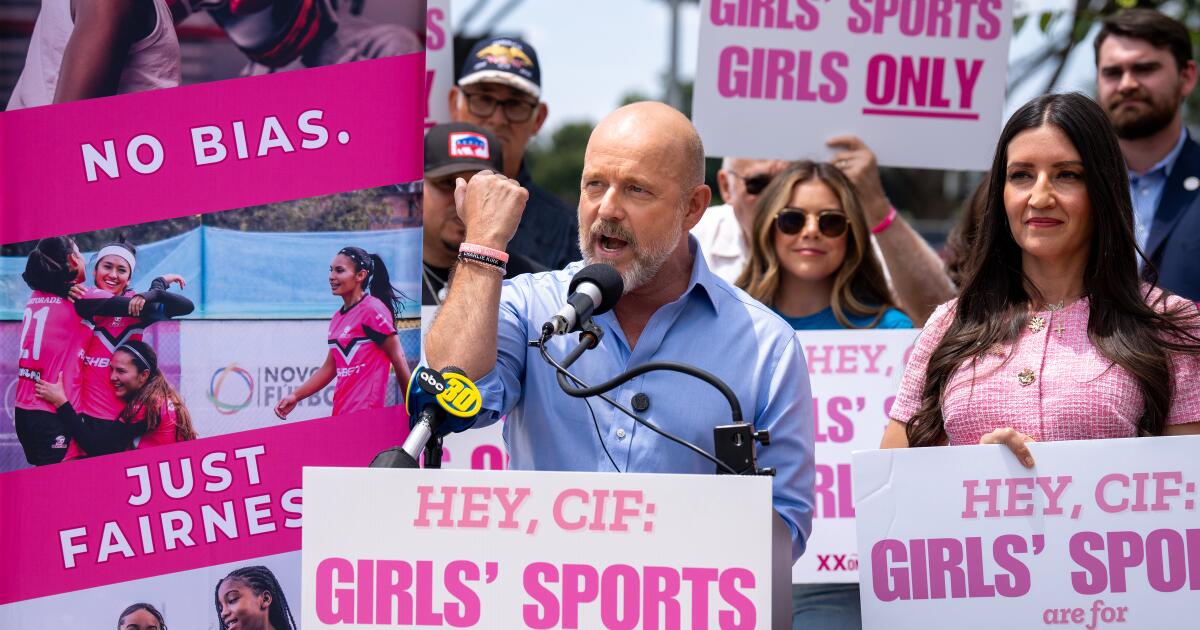
At the Supreme Court, the unfounded fear of boys masquerading as girls in youth sports rolled the clock back on gender equality.
On the surface, the Supreme Court’s June 30 opinion upholding state laws barring transgender girls from women’s and girl’s sports teams looks like a victory for women’s rights.
The 6-3 opinion by Justice Brett M. Kavanaugh certainly presents itself that way. “Females and males have inherent physical differences relevant to athletic performance,” Kavanaugh wrote. “Therefore, in contact sports, forcing female athletes to compete against males can create significant safety risks.” He also asserted that “forcing female athletes to compete against males can undermine competitive fairness.”
The ruling applied to prohibitions enacted in Idaho and West Virginia against “biological” males’ participation on women’s teams in public schools. Federal judges in both states overturned the bans. The Supreme Court majority restored them. The ruling essentially upholds similar bans enacted in 25 other states.
There was no record of any transgender person participating in school sports in the State, let alone any ‘problem’ with transgender students … creating unfair competition or unsafe conditions.
— Justice Sonia Sotomayor, demolishing the Supreme Court’s argument in favor of banning transgender girls from girl’s sports
Kavanaugh, like Donald Trump and others in the anti-transgender camp, maintained that one’s gender is an immutable fact of life, established even before birth.
Anything else, Trump stated in an executive order he issued on inauguration day 2025, could only be the product of “gender ideology extremism.” The U.S., his order stated, recognizes “two sexes, male and female. These sexes are not changeable and are grounded in fundamental and incontrovertible reality.” That’s a “biological truth,” he declared.
In his own version of this overconfident and factually insupportable conclusion, Kavanaugh wrote: “As all agree, females and males have inherent physical differences relevant to athletic performance.”
Science recognizes that some people are “born with sex traits that don’t fit into typical male or female patterns,” to cite a discussion on the Cleveland Clinic web page on the topic “intersex.” The condition “may involve chromosomes, hormones, reproductive organs or genitals.”
From a psychological standpoint, medical science recognizes “gender dysphoria” as a real condition often requiring counseling and medical intervention such as the use of puberty blockers and hormones to stave off the development of secondary sex characteristics until the condition can be resolved.
No one disputes that there are physical differences between the sexes. Few would dispute that on average or even at the median, males may be bigger and more powerful than females, or that in certain contact sports the difference may be telling and on occasion dangerous.
But that’s not the same as asserting that the physical differences between males and females invariably mean that men will invariably prevail over women in all competitions or that their participation will endanger women.
The International Olympic Committee — in a policy statement Kavanaugh cited incompletely — says that in “most running and swimming events,” males have a 10% to 12% advantage over women. That’s a range that would accommodate the full spectrum of outcomes — transgender females win, cisfemales win, they tie. (The “cis” prefix denotes those living consistent with their birth gender.)
West Virginia and Idaho addressed this ambiguity by banning transgender women from all girls’ teams. So under their rules transgender girls can’t play football or soccer with cisgirls. But what’s the argument in favor of banning them from the 100-yard dash, or cross-country track, or diving, or archery?
But something else is going on here. The Supreme Court’s ruling was almost preordained, given the years-long campaign by conservatives to demonize transgender individuals as if they’re members of an alien species.
It will be recalled that during his presidential campaign, Trump spun a despicable fantasy in which children were kidnapped in school and secretly subjected to sex-change operations.
Trump’s executive order wiped out policies aimed at protecting transgender adults from discrimination. He moved to outlaw gender-affirming medical therapies for anyone under 19 by cutting off federal funding for healthcare institutions that provide such care.
He banned transgender individuals from serving in the military and ordered federal prison officials to move transgender inmates into the general populations consistent with their birth genders, which exposes them to physical assault. (Federal Judge Royce Lamberth of Washington, D.C., has blocked the government from transferring three transgender women into the male prison population or terminating their hormone treatments.)
I wrote during Trump’s first term, when his anti-transgender policies were still gestating, that the goal was to show that “one can target any community, as long as it doesn’t have a strong political voice or political power. These are the actions of bullies and cowards, pretending to be strong.”
Last year, the Supreme Court struck its first blow against transgender rights by upholding a Tennessee law banning transgender care, including puberty blockers and hormone therapy, for minors. Similar laws have been enacted in 25 other states. The majority in that ruling by Chief Justice John G. Roberts Jr. was identical to the one in the June 30 ruling — Roberts, Kavanaugh, and Justices Clarence Thomas, Samuel A. Alito Jr., Neil M. Gorsuch and Amy Coney Barrett.
Who are the targets of this ideological campaign? They number only about 1.6 million U.S. adults, or one-half of 1% of the U.S. population. About 300,000 adolescents ages 13 to 17, or 1.4%, identify as transgender, according to a study by UCLA School of Law.
In West Virginia, as Justice Sonia Sotomayor observed in her dissenting opinion, “there was no record of any transgender person participating in school sports in the State, let along any ‘problem’ with transgender students … creating unfair competition or unsafe conditions.”
In endorsing the flat bans directed at transgender women in Idaho and West Virginia, Kavanaugh argued that any attempt to implement case-by-case judgments of students’ requests to join sports teams inconsistent with their biological gender would create “an enormous practical and administrability problem.”
Is that so? That wasn’t the case in Maine, where the annual K-12 population is more than 170,000. There, a committee was charged with determining whether a student’s participation in a sport consistent with their gender identity but inconsistent with their biological sex would “result in an unfair athletic advantage” or present a risk of injury to others. The committee held 56 hearings from 2013 through 2021, or an average of seven per year. During the entire time span, only four involved transgender girls. (The outcome of those hearings couldn’t be learned.)
It was Maine’s policy, one might recall, that provoked a confrontation between Trump and Maine Gov. Janet Mills at the White House last year, when Trump threatened to withhold federal funding from the state unless it barred transgender students from competing on women’s sports teams. “We’ll see you in court,” Mills snapped.
Whether the Idaho and West Virginia laws genuinely protect girls from unfair competition is questionable. (The Idaho law is styled the “Fairness in Women’s Sports Act.”) In practice, the laws may subject women in public schools to “invasive sex verification procedures,” as educational expert George Theoharis of Syracuse University wrote after the court ruling.
They’re also based on a retrograde view of women as fragile creatures needing men’s protection, Theoharis wrote — “the same logic that has historically been used to justify excluding women from making their own healthcare decisions and girls from rigorous math and science; that physically demanding work is simply beyond them.” (There don’t appear to be any state laws barring transgender women from competing in men’s sports.)
Becky Pepper-Jackson, the plaintiff in the West Virginia case, in which she is identified only as B.P.J., is the only transgender girl who sought to join girl’s teams — track and cross-country — in the state. That was in 2021, just after West Virginia passed its law and she was about to enter sixth grade. She didn’t appear to pose any competitive risk to others on the track and cross-country teams she applied to join — her lawyers told the Supreme Court that on those no-cut teams, she “came in near the back.”
Anyway, she had not gone through male puberty, which theoretically might have endowed her with a competitive advantage, because she had been taking puberty blockers and female hormones.
Thanks to the court’s ruling, Sotomayor observed in a dissent joined by Justices Elena Kagan and Ketanji Brown Jackson, West Virginia can deny Becky access to school sports “because it thinks they have an inherent athletic advantage, even if the facts show that they do not.”
B.P.J., Sotomayor wrote, “cannot practice on girls’ teams, even if she would not take anyone’s spot in an eventual competition, even if everyone who tries out for the team makes it, and even if having the chance to participate could aid immensely in treating B. P. J.’s gender dysphoria.”
So whose interest was really protected by the Supreme Court?

An Orange County real estate investor accused of criminally defrauding an Arizona bank of nearly $100 million pleaded not guilty Monday and remains in custody.
Mahender Makhijani, 44, of Corona del Mar — who also was ordered by an arbitrator to pay $1.34 billion in a separate civil fraud case — was arraigned in Santa Ana federal court on two charges.
He is accused of bank fraud and making a false statement to a bank in a June 8 case involving a $100 million real estate loan made by Phoenix-based Western Alliance Bank. He was taken into custody on June 10.
Makhijani is accused of providing bogus collateral for the October 2024 loan now in default. In a civil lawsuit, Western Alliance said the outstanding balance as nearly $99 million.
Prosecutors say he falsified title insurance policies that showed the bank would have a first lien on the underlying collateral if the loan went bad, when in fact it did not.
A trial was set for August 11 before U.S. District Judge David O. Carter in Santa Ana.
Michael Schachter, his criminal defense attorney, did not respond to messages seeking comment.
In the civil case, an arbitrator in May ordered Makhijani to pay Laguna Beach real estate mogul Mohammad Honarkar $1.34 billion after ruling he had fraudulently induced him into a 2021 joint venture — and then wrested control and lost to creditors more than two dozen properties Honarkar had owned.
Makhijani has not been criminally charged in that case, but prosecutors alleged in an affidavit in support of the bank fraud charges that he used “force and threats” in his dealings with Honarkar and others — including taking over the landmark Hotel Laguna in 2023 that Honarkar was renovating.
Prosecutors sought to hold Makhijani without bail after his arrest.
The affidavit noted he is a legal Indian immigrant with a home and bank accounts in that country, has access to private jets and threatened to “run away” if caught in a difficult situation.
The request was denied and he was granted $500,000 bail.
However, Makhijani remains in custody after a hearing sought by prosecutors last month before Magistrate Judge Autumn Spaeth.
The judge declined to accept a $450,000 cashier’s check submitted by a Makhijani associate for the bail, finding insufficient proof the source of the funds was legitimate, according to court records.
Makhijani is not prominent outside Orange County real estate circles, but he established a thriving distressed-assets business over the last decade that attracted prominent Southern California real estate investors.
Prosecutors said it paid for a lifestyle that included two multimillion-dollar homes in Corona del Mar, a luxury apartment in Newport Beach and various luxury vehicles.
As of last month, prosecutors had not fully traced his assets, which they believe are not held in his name and some of which may be in India.
The businessman employed an array of shell companies and strawmen to sign documents on his behalf, and to stand in for him as operators of his companies, according to the affidavit.
Makhijani told an associate he took extra precautions because wanted to insulate himself from litigation and that “they were sharks in the distressed world who took advantage of people,” the affidavit stated.
-

 Alaska3 minutes ago
Opinion: Alaska’s whale-strike risk is growing while regulators keep studying the obvious
-

 Arizona10 minutes ago
Arizona Lottery Mega Millions, Pick 3 Evening results for July 7, 2026
-
Arkansas13 minutes ago
Arkansas Lottery Mega Millions, Cash 3 winning numbers for July 7, 2026
-

 California25 minutes ago
California still hasn’t released Newsom’s Baby2Baby diaper contract as lawmakers weigh longer public records delays
-

 Colorado28 minutes ago
Colorado River, public lands reopen as Snyder Fire containment increases
-

 Connecticut33 minutes ago
Opinion: A lifeline in CT’s childcare desert
-

 Delaware40 minutes ago
Talk & Film Bring Delaware’s Revolutionary Story to Life at Archives’ First Saturday Program – State of Delaware News
-
 Florida43 minutes ago
Heat alerts expand across Florida as dangerous temperatures return

