Business
Newsom taps Magic Johnson, Casey Wasserman, Mark Walter to lead philanthropic L.A. fire recovery initiative

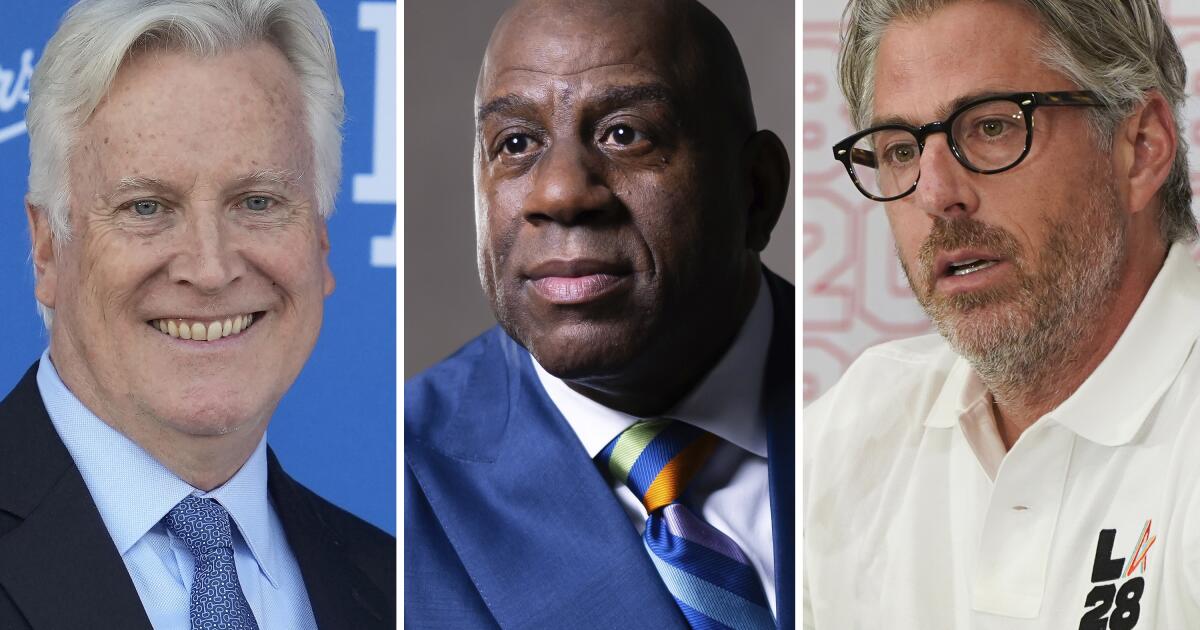
Gov. Gavin Newsom is tapping Magic Johnson, Dodgers Chairman Mark Walter and 2028 Olympics organizer Casey Wasserman to lead a new private-sector initiative to support wildfire recovery in Los Angeles.
The California governor’s office said the philanthropic effort, called LA Rises, will bring together business leaders to work with city, county and state officials to support rebuilding after the devastating fires. Walter, his foundation and the Los Angeles Dodgers Foundation will provide up to $100 million to jump-start fundraising.
“It’s not just about the state and federal government supporting local responses, it’s about the private sector, the civic society coming together,” Newsom said Tuesday, standing with Wasserman, Johnson and Dodgers Chief Executive Stan Kasten in the stadium parking lot overlooking the city. “It’s about active, engaged citizenship. It’s about people volunteering.”
The decision to lean on high-profile Angelenos outside government comes as state and local leaders face the monumental challenge of rebuilding the mixed-income community of Altadena and the wealthy Pacific Palisades neighborhood.
There will be enormous pressure on leaders to not just rebuild swiftly but also equally.
If the Palisades — where now-burned homes look out on sweeping ocean vistas and the newly homeless include enormously well-connected political donors — appears to be favored over the diverse enclave of Altadena, the disparity will undoubtedly become emblematic of the recovery efforts and potentially haunt Newsom’s political career.
Altadena is an unincorporated area, meaning its rebuilding effort will fall outside the purview of Mayor Karen Bass.
“My focus will be on Altadena because those people may be left behind and I want to make sure that that doesn’t happen,” Johnson said Tuesday.
The governor said he asked Johnson, the Hall of Fame Lakers point guard-turned-entrepreneur; Wasserman, an entertainment and sports executive; and Walter, the chief executive of the investment firm Guggenheim Partners and controlling owner of the Dodgers, to serve as co-chairs of the initiative because of their “proven leadership and deep commitment to Los Angeles.”
LA Rises will expand access to the philanthropic and private capital needed to rebuild in close coordination with government at all levels, come up with financing strategies to “close the gap between available resources and the cost to rebuild” and communicate information to residents, the governor’s office said.
Newsom’s new initiative comes weeks after Bass detailed her own plan to look outside City Hall to support recovery.
Bass appointed longtime civic leader and real estate developer Steve Soboroff to pilot the first phase of the city’s rebuilding efforts.
Soboroff, a onetime senior advisor to former Mayor Richard J. Riordan, also previously led the police commission and helped bring Crypto.com Arena (formerly Staples Center) to downtown Los Angeles.
As the city’s chief recovery officer, he will help build out the city’s plan for debris removal and streamlining rebuilding approvals and create a detailed program to rebuild parks and libraries, among other things.
Bass said her and Soboroff’s efforts would be closely coordinated with the governor’s office.
“Efforts to rebuild are underway in the City of Los Angeles and this announcement will be a vital component of a comprehensive effort to bring Angelenos home,” Bass said in a statement. “The number one question on the minds of Angelenos is about recovery and rebuilding.”
Wasserman, who worked with former Mayor Eric Garcetti to land the Olympics for the city, and Johnson, a part-owner of the Dodgers who has invested heavily in South L.A., have both long been involved in L.A. civic life.
“The private sector has to come together, both operationally and philanthropically, as part of the rebuild and in many ways, the rebirth of L.A.,” Wasserman said, noting that the Olympics will be welcoming the world to Los Angeles in 2028. “This process and this journey we’re about to start with LA Rises is not about the next month or the next year. This is about what L.A. is going to be like for the next 50 or 100 years.”
Newsom said Tuesday that community organizations had also received tens of millions of dollars in additional donations, including money from the Latino Community Foundation and the California Community Foundation. Kasten declined to specify Tuesday what “up to $100 million” meant, or if $100 million had been definitively pledged to LA Rises.
“The LA fires have wreaked havoc on LA’s neighborhoods,” Walter, who was not present Tuesday, said in a statement. “It’s time for those with means to come forward and make a positive impact to build back better.”

Business
Commentary: Trump wants to let companies make fewer disclosures, thus keeping investors in the dark

Trump’s SEC is considering eliminating the mandate for quarterly corporate financial reports, but even some big investors call it a lousy idea.
This being the “information age,” it would be understandable if investors sometimes feel inundated with too much information to wade through about the stocks in their mutual fund portfolios.
The Securities and Exchange Commission, bowing like a puppy to the urgings of President Trump, is considering exactly the wrong solution to this supposed burden. It’s proposing to allow public companies to give their investors less information, as though that’s a good thing.
On May 8, the SEC proposed rescinding its mandate that public companies report financial results on a quarterly schedule. Instead, it suggests, semiannual and annual reports should suffice.
This takes an already-unlevel playing field where Main Street investors are already disadvantaged, and makes it more unlevel.
— Dennis Kelleher, Better Markets
The SEC left its proposal open for public comment for 60 days, meaning the window closed Monday. By then, the agency had received more than 68,000 comments, according to a tracker posted online by accounting professor Tzachi Zach of Ohio State.
Almost 99.9% of the comments were negative. Several organizations of institutional investors and auditing professionals, as well as a tsunami of individual investors, expressed opposition.
A similar initiative the SEC aired in 2018, during Trump’s first term, received an overwhelmingly negative response and was eventually dropped.
The tide of opposition coming from individual investors shouldn’t be surprising. “Taking away basic quarterly information means investors are blind for six months at a time,” says Dennis Kelleher, co-founder and chief executive of the investor advocacy nonprofit Better Markets.
That’s especially true for small investors, though perhaps not so much for major institutions, insiders or deep-pocketed individuals. “If you’re a big dog, you’ll get the information anyway,” Kelleher told me. “And insiders, who are trading in their own stock all the time, will have the information. This takes an already-unlevel playing field where Main Street investors are already disadvantaged, and makes it more unlevel.”
Trump set off the latest initiative with a social media post on Sept. 15, advocating the move to a six-month reporting schedule. It read, in part, “This will save money, and allow managers to focus on properly running their companies. Did you ever hear the statement that, ‘China has a 50 to 100 year view on management of a company, whereas we run our companies on a quarterly basis???’ Not good!!!”
As was usual with Trump, his argument was a string of uninformed and irrelevant non sequiturs.
It’s doubtful that eliminating quarterly reports will save much, if any, money. Most 10-Qs are cookie cutter documents disclosing financial figures already embedded in corporate records.
The idea that managers would become empowered to “focus on properly running their companies” if only they were relieved of the burden of preparing a report every three months is just malarkey: Any CEOs who feel the impulse to drop everything and involve themselves in what is essentially an automated process can’t be very good at their jobs.
As for China’s “50 to 100 year view on management of a company,” what would that even mean, even if it were true? China doesn’t operate on a 50 to 100 year corporate horizon, but rather on a string of five-year plans. The most recent of these was adopted by the government in March, covers the period up to 2030, and is its 15th in a row.
Despite the flaws in Trump’s arguments, Trump’s SEC Chairman Paul Atkins, a former corporate lawyer and securities industry consultant, fell into line. Within a few days of Trump’s post, he showed up on CNBC to minimize the potential effect of the change. Private companies rely on semiannual reports, after all, he noted, although the idea of taking private companies as models for publicly traded corporations might not strike experienced investors as the wisest thing.
Atkins cited an enduring chestnut, for which there’s no evidence, that quarterly reporting is responsible for “short-term thinking” in corporate suites (though he admitted that his evidence was “anecdotal”). And he suggested that small investors have ample access to corporate information even without quarterly reports — why, he said, they can just tune in to CNBC!
“To propose change in what our rules are now would be a good way forward,” he said. “So I welcome the president’s putting this up for discussion.”
Something more insidious undergirds the SEC’s proposal than its immediate effect on corporate behavior. The agency rationalizes its proposal as seeking “a tradeoff between reducing regulatory burdens … and promoting efficient financial markets through timely disclosure.”
The problem here, Kelleher points out, is that “reducing regulatory burdens” isn’t part of the SEC’s mission in any way, shape or form. It’s a regulatory agency, and its mission since its founding in 1934 has been to protect investors, not to make things fluffier for stock issuers.
The history of financial disclosure in the U.S. shows a long-term trend favoring more disclosure, not less. In the 1880s, quarterly reporting by railroads and other transportation companies were common.
Early on, pressure for more frequent disclosure came not from government regulators, who barely existed before 1934, but from investors. The reporting of quarterly earnings, notes corporate finance expert Owen Lamont of Acadian Asset Management, was “a bottom-up historical phenomenon reflecting voluntary arrangements between firms and investors, not a top-down phenomenon imposed by law.”
By 1931, according to financial historians, 63% of New York Stock Exchange-listed firms were publishing their quarterly earnings. The Big Board mandated that frequency for most listed companies in 1939. The SEC mandated semiannual reports in 1955 and quarterly reports, as Atkins said, in 1970.
The evidence in favor of dropping the quarterly reports is uniformly thin. Some advocates cite a 2018 op-ed in the Wall Street Journal by JPMorgan Chase CEO Jamie Dimon and Warren Buffett that was headlined “Short-Termism Is Harming the Economy.”
Couple of points about this: First, the target of Dimon and Buffett wasn’t quarterly financial reporting, but quarterly earnings guidance — that is, the practice of some top executives who project their earnings into the future. (This guidance usually comes at the same time they issue their SEC disclosures.)
It’s guidance, they wrote, that is “a major driver” of short-termism in corporate behavior. That’s because management is giving itself a target it feels obligated to meet, even if factors outside its control interfere with the quest.
Furthermore, Dimon and Buffett wrote, “Our views on quarterly earnings forecasts should not be misconstrued as opposition to quarterly and annual reporting.” They called transparency about financial and operating results “an essential aspect of U.S. public markets … so that the public, including shareholders and other stakeholders, can reliably assess real progress.”
Individual investors may be unmoved by the SEC’s proposal because — let’s be candid — how many of them read quarterly earnings reports, anyway? But that’s unimportant, Kelleher says, because other market participants are reading them. “So that information is in the marketplace, and that’s what actually enables price discovery, so stock prices roughly reflect what’s going on at a company, most of the time.”
More to the point, the quarterly reports reflect the highest-quality, detailed information, the information the SEC requires executives to disclose on pain of facing a civil lawsuit from the agency or even criminal liability for faking data. “Main Street investors, whether they read quarterly reports or not, are the real beneficiaries,” Kelleher says.
That’s so. The bottom line is that quarterly financial reporting helps investors. It doesn’t promote short-term behavior and its costs, modest as they are, don’t outweigh its benefits.
Over the decades, scandal-ridden corporations have hidden fraudulent behavior in the interstices between mandated disclosures—think Enron, WorldCom and Tyco, among others. Why give any corporation, even an honest one, the opportunity to disclose less?

The luxury shopping center in Pacific Palisades will reopen next month after more than $100 million in renovations forced by the January 2025 wildfire that devastated the Los Angeles neighborhood.
Palisades Village will reopen Aug. 15, owner Rick Caruso announced Wednesday. The outdoor center survived the blaze that destroyed homes and other businesses but needed refurbishment to eliminate contaminants that the fire could have spread.
Crews are putting finishing touches on mall buildings after tearing them down to the studs, treating the wood and rebuilding the walls, Caruso said.
“Everybody’s working, and stores are moving their products in,” he said. “It’s a really cool feeling that people have really locked arms and are working together.”
An electrician installs lighting for a restaurant at Rick Caruso’s Palisades Village on Thursday. The shopping center is scheduled to reopen mid-August.
(Myung J. Chun / Los Angeles Times)
Pacific Palisades resident Allison Polhill, who is rebuilding the home of 30 years that her family lost in the blaze, said she is “thrilled” at the prospect of returning to the mall she used to frequent. Its comeback is a boost for the community, she said.
“Every single step that we make to reopen our commercial corridors is going to bring more people back into the Palisades,” said Polhill, who expects to move back into her home at the end of August.
A total of 6,822 structures were destroyed in the Palisades fire, including more than 5,500 residences and 100 commercial businesses, according to the California Department of Forestry and Fire Protection.
Caruso previously attributed the mall’s survival to the hard work of private firefighters and the fire-resistant materials used in the mall’s construction.
The $200-million shopping and dining center opened in 2018 with a movie theater and a roster of upmarket tenants, including Erewhon, which may be the only grocer in the heart of the fire-ravaged neighborhood when it opens.
Caruso’s company was able to fill the mall with tenants despite the long shutdown.
Palisades Village is 99% leased, with the majority of tenants returning, said Jackie Levy, chief financial and revenue officer. Nearly one-third of the shops and restaurants are new to the property.

A firefighter carries a hose back to his rig while walking through a destroyed home from the Palisades fire in Pacific Palisades on Jan. 7, 2025.
(Genaro Molina / Los Angeles Times)
Last year, Pacific Palisades-based fashion designer Elyse Walker said she would reopen her eponymous store in Palisades Village after losing her 25-year flagship location on Antioch Street to the inferno.
Other neighborhood shops destroyed in the fire that are reopening at the mall include K Bakery and Loomey’s Toys, which caters to children up to age 12 and used to be across the street from Palisades Elementary Charter School.
“It’s been a journey and I’m excited because I wasn’t sure that there was going to be a place to come back to,” said toy store owner Amanda Rastegar. “Hopefully we can bring some of that magic back.”
Rastegar’s home in the Palisades survived but was damaged by the fire. The family returned about eight weeks ago. Her last memory of the fire was a burning supermarket.
“I just couldn’t wrap my brain around what was happening,” she said. “By the time I left, Gelson’s was on fire.”
Among the returning tenants is Angelini Ristorante & Bar. Well-known Los Angeles chef Gino Angelini said he will be in the kitchen next month for a return of the Italian restaurant.
“We won’t do a big celebrity open,” he said. “We want to have a very soft opening and see our customers come back.”

Construction takes place at Rick Caruso’s Palisades Village on Thursday. The shopping center is scheduled to reopen mid-August.
(Myung J. Chun / Los Angeles Times)
An elaborate celebration would not feel “correct for me,” Angelini said, because the devastation has been “very sad” for so many.
Other new tenants include local chef Nancy Silverton, who has agreed to move in with a new Italian steakhouse called Spacca Tutto. Women’s activewear retailer LESET will open its first West Coast location.
Caruso said he is optimistic that customers will return to the center, even though many Pacific Palisades residents are still dispersed. One tracking system estimated that about 30% of the Village’s customer base was impacted by the fire, he said.
“That means 70% did not get impacted, so there’s a lot of customers still left out there,” Caruso said. Historically, the center drew customers from as far away as Beverly Hills and Calabasas, as well as Malibu, Brentwood and Santa Monica.
He also hopes many will be inspired to visit the revived mall.
“I believe in the goodness of people and I believe that people are going to want to support the Palisades,” he said. “They’re going to want to be there and support the businesses that have had the courage and the heart to reopen.”

Walmart is rapidly expanding its network of electric vehicle chargers designed for customers to use while they shop.
The network could help fill gaps in EV infrastructure in states with greater need for chargers. Walmart, which has more than 5,000 locations in the U.S. and hundreds in California, says more than 90% of Americans live within 10 miles of one of its stores.
The chargers also offer an incentive for customers to choose Walmart — Walmart Plus members will receive a 10% discount off an average price of $0.46 per kilowatt-hour of energy at the company’s chargers.
Walmart chargers are already available at more than 75 locations in 17 states, with Texas boasting the most charging stations, followed by Florida and Arizona.
Matthew Nelson, Walmart’s director of energy policy, said last week on LinkedIn that the network will soon reach 29 states, including California.
“We are delivering on the promise of affordable, reliable and convenient charging,” Nelson said in his post.
According to Walmart’s website, six charging stations are coming to California soon, though the company did not offer a specific timeline.
The chargers will be installed at stores in Antelope, Brea, Fresno, Stockton, Suisun City and Vallejo.
Most charging sites in California will include eight to 16 fast-charging stalls, said Walmart spokesperson Kelsey Bohl.
The company first announced plans in April 2023 to install its own EV chargers at Walmart and Sam’s Club stores, with a goal of installing thousands of chargers by 2030. Partnering with ABB E-Mobility and Alpitronic, it added 25 new charging sites this past May and six more in June.
“Walmart is building a leading retail-integrated EV fast-charging network, focused on delivering an affordable, reliable and convenient charging experience where customers already shop,” Bohl said in an emailed statement. “Customers can charge while they shop, access stations through the Walmart app they already use, and benefit from affordable pricing.”
The charging stations already available include 612 individual charging stalls using 400-kilowatt chargers. Each stall has a dual charging cord with both Combined Charging System and North American Charging Standard connectors. The standard connectors, designed by Tesla, are smaller and lighter than the combined systems.
The primary way to pay for the chargers is through the Walmart app, but the company is also experimenting with built-in credit card readers to allow those without the app to use the stations.
Customers can check charger availability on the Walmart app. The company said the chargers will be available 24 hours a day.
-

 Arkansas2 minutes ago
Arkansas Storm Team Forecast: Very hot today; isolated showers/t’storms late
-

 California9 minutes ago
Popular California Fast-Casual Chain Mendocino Farms Opens 100th Location in Santa Barbara – edhat
-

 Colorado12 minutes ago
United Way of Southern Colorado raises over $400,000 for Aspen Acres Fire victims:
-

 Connecticut17 minutes ago
This Underrated Connecticut Town Is Getting National Recognition as One of the Best Places to Live
-

 Delaware24 minutes ago
Plans advance for Delaware city’s first Chick-fil-A restaurant
-

 Florida27 minutes ago
Summer Scheming ‘26: Florida State Seminoles
-

 Georgia32 minutes ago
Travel and Leisure listed unique experiences in each state, including GA
-

 Hawaii39 minutes ago
Three West Hawaii sex offenders arrested – West Hawaii Today

