Business
Markets devastated as recession fears grow over Trump tariff plan


WASHINGTON — A second day of market devastation shook Washington on Friday, vanishing more than $5 trillion in value in one of the largest 48-hour losses on record — an extraordinary rout caused not by pandemic, war, terrorism or bank failure, but by policy set by the American president.
The policy, announced by President Trump on Wednesday, would levy steep tariffs on nearly every nation in the world in the coming days, starting with a base tariff rate of 10% but climbing higher for some of the largest U.S. trading partners, including China, South Korea, Japan and the European Union.
The market drop has prompted a small but influential group of Republican senators to partner with Democrats in a nascent effort to wrest back control over tariff policy from Trump.
The Standard and Poor’s 500, NASDAQ and the Dow Composite all reeled over the news from the morning bell to close. The Dow dropped 2,231.07 points, or 5.5%, in its largest drop since the pandemic started, following a 1,679-point drop the day prior. The S&P 500 fell 5.97% to 5,074.08, and the NASDAQ dropped 5.8%, to 15,587.79, entering bear market territory.
Before the markets opened Friday, China announced it would reciprocate with a 34% tariff on imported U.S. goods. And as markets spiraled, the Federal Reserve chair, Jerome Powell, warned of “persistent” negative effects from the new trade policy.
“We face a highly uncertain outlook with elevated risks of both higher unemployment and higher inflation,” Powell said Friday. “Tariffs are highly likely to generate at least a temporary rise in inflation.”
Reacting to the markets, Treasury Secretary Scott Bessent told Tucker Carlson in an interview on Friday that “Wall Street’s done great. It can continue doing well.” But, he added, “it’s Main Street’s turn.”
“This is transformational for the American economy, for the American worker and for the new Republican alignment,” Bessent said. “I think this is the beginning of a process. We are going to reindustrialize. We have gone to a highly financialized economy — we have stopped making things, especially a lot of things that are relevant for national security.”
J.P. Morgan increased its assessment of the risk of recession this year to 60%, up from a 40% chance it had published just days prior. And the World Trade Organization warned of deep trouble to come if Trump refuses to change course.
“While the situation is rapidly evolving, our initial estimates suggest that these measures, coupled with those introduced since the beginning of the year, could lead to an overall contraction of around 1% in global merchandise trade volumes this year, representing a downward revision of nearly four percentage points from previous projections,” said Ngozi Okonjo-Iweala, director-general of the WTO. “I’m deeply concerned about this decline.”
Asked about the chances of a U.S. and global recession hitting this year, Senate Minority Leader Chuck Schumer, a Democrat from New York, said, “I’m very worried about it.”
“This is one of the most disastrous and poorly thought out policies that the Trump administration has done thus far, and that’s saying a lot,” he added.
Responding to the crisis, Sen. Charles E. Grassley (R-Iowa) partnered with Democratic Sen. Maria Cantwell from Washington state to introduce a bill that would require the president to submit new tariff policies to Congress for notification, review and approval.
“I’ve long expressed my view that Congress has delegated too much authority on trade to the executive branch under Republican & Democrat presidents,” Grassley wrote on X.
The bipartisan bill already has three additional Republican sponsors — Sens. Jerry Moran of Kansas, Lisa Murkowski of Alaska and Mitch McConnell of Kentucky. Other Republicans, including Trump supporter Sen. Thom Tillis of North Carolina, are expressing interest in the bill.
The Grassley-Cantwell bill marks the second time senators pushed back on Trump’s new import taxes in just a week. On Wednesday, in a rare rebuke of the president, the Senate passed a resolution Wednesday designed to thwart the imposition of tariffs on Canada.
Four Republicans — including Murkowski and McConnell — joined all Democrats in passing the resolution on a 51-48 vote.
Democratic leadership in the House of Representatives hopes the Grassley-Cantwell bill might have a path to passage in their chamber eventually, but one senior congressional aide said that leadership is doubtful anything will move in the short term.
“I don’t see it yet,” the aide said, granted anonymity to discuss internal deliberations, “but down the road, it’s possible.”
The White House said that its base tariff rate of 10% would go into effect at midnight Saturday, and that its country-specific duties would go into force Wednesday.
Trump, meanwhile, told investors on social media Friday, “MY POLICIES WILL NEVER CHANGE.”
But in a separate post, the president said he had discussed a deal with leadership in Vietnam — one of the nations hardest hit, with a 46% tariff rate — in a sign he is willing to negotiate over the policy.
Trump stated that Vietnam would be willing to cut its tariffs “down to ZERO” to strike an agreement with the United States. But Vietnam’s tariffs on the few U.S. goods it purchases are already low. Instead, the high rate imposed by the Trump administration on Vietnam actually targets the U.S. trade deficit with Vietnam — a capitalist result of U.S. consumers wanting to purchase more Vietnamese goods than the other way around.
As with other countries, such as Israel and Switzerland, which have no import duties on U.S. goods, it is unclear what will be required from each country for Trump to lower or eliminate rates. A consistent measure for success has not been articulated by the administration. To the contrary, senior aides to Trump have repeatedly referred to the 10% baseline tariff rate as a new normal.
Cambodia, hit with a 49% import tax, also asked Trump on Friday to postpone implementation of the new rate.
The president is in Florida golfing at his resort for the weekend.






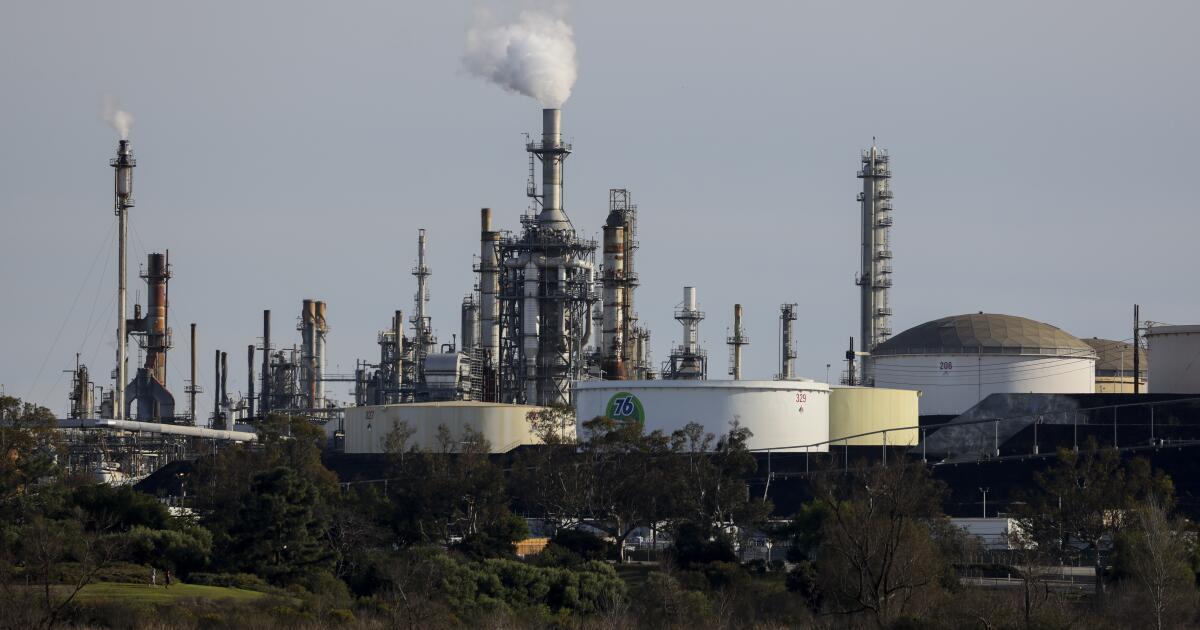
The U.S. attack on Iran is expected to have an unwelcome impact on California drivers — a jump in gas prices that could be felt at the pump in a week or two.
The outbreak of war in the Middle East, which virtually closed a key Persian Gulf shipping lane, spiked the price of a barrel of Brent crude oil by as much as $10, with prices rising as high as $82.37 on Monday before settling down.
The price of the international standard dictates what motorists pay for gas globally, including in California, with every dollar increase translating to 2.5 cents at the pump, said Severin Borenstein, faculty director of the Energy Institute at UC Berkeley’s Haas School of Business.
That would mean drivers could pay at least 20 cents more per gallon, though how much damage the conflict will do to wallets remains to be seen.
“The real issue though is the oil markets are just guessing right now at what is going to happen. It’s a time of extreme volatility,” Borenstein said. “We don’t know whether the war will widen or end quickly, and all of those things will drive the price of crude.”
President Trump has lauded the reduction of nationwide gas prices as a validation of his economic agenda despite worries about a weak job market and concerns of persistent inflation.
The upheaval in the Middle East could be more acutely felt in the state.
Californians already pay far more for gas than the rest of the country, with the average cost of a gallon of regular at $4.66, up 3 cents from a week ago and 30 cents from a month ago, according to AAA. The current nationwide average is about $3 per gallon.
The disruption in international crude markets also comes as refiners are switching to producing California’s summer-blend gas, which is less volatile during the state’s hot summers. The switch can drive up the price of a gallon of gas at least 15 cents.
The prices in California are largely driven by higher taxes and a cleaner, less polluting blend required year-round by regulators to combat pollution — and it’s long been a hot-button issue.
The politics were only exacerbated by recent refinery closures, including the Phillips 66 refinery in Wilmington in October and the idling and planned closure of the Valero refinery in Benicia, Calif., which reduced refining capacity in the state by about 18%.
California also has seen a steady reduction in its crude oil production, making it more reliant on international imports of oil and gasoline.
In 2024, only 23.3% of the crude oil refined in the state was pumped in California, with 13% from Alaska and 63% from elsewhere in the world, including about 30% from the Middle East, said Jim Stanley, a spokesperson for the Western States Petroleum Assn.
“We could see a supply crunch and real price volatility” if the Middle East supply is interrupted, he said.
The Strait of Hormuz in the Persian Gulf, through which about 20% of the world’s oil passes, was virtually closed Monday, according to reports. Though it produces only about 3% of global oil, Iran has considerable sway over energy markets because it controls the strait.
Also, in response to the U.S. attack, Iran has fired a barrage of missiles at neighboring Persian Gulf states. Saudi Arabia said it intercepted Iranian drones targeting one of its refinery complexes.
California Republicans and the California Fuels & Convenience Alliance, a trade group representing fuel marketers, gas station owners and others, have blamed Gov. Gavin Newsom’s policies for driving up the price of gas.
A landmark climate change law calls for California to become carbon neutral by 2045, and Newsom told regulators in 2021 to stop issuing fracking permits and to phase out oil extraction by 2045. He also signed a bill allowing local governments to block construction of oil and gas wells.
However, last year Newsom changed his stance and signed a bill that will allow up to 2,000 new oil wells per year through 2036 in Kern County despite legal challenges by environmental groups. The county produces about three-fourths of the state’s crude oil.
Borenstein said he didn’t expect that the new state oil production would do much to lower gas prices because it is only marginally cheaper than oil imported by ocean tankers.
Stanley said the aim of the law was to support the Kern County oil industry, which was facing pipeline closures without additional supplies to ship to state refineries.
Statewide, the industry supports more than 535,000 jobs, $166 billion in economic activity and $48 billion in local and state taxes, according to a report last year by the Los Angeles County Economic Development Corp.
Bloomberg News and the Associated Press contributed to this report.

Fintech company Block said Thursday that it’s cutting more than 4,000 workers or nearly half of its workforce as artificial intelligence disrupts the way people work.
The Oakland parent company of payment services Square and Cash App saw its stock surge by more than 23% in after-hours trading after making the layoff announcement.
Jack Dorsey, the co-founder and head of Block, said in a post on social media site X that the company didn’t make the decision because the company is in financial trouble.
“We’re already seeing that the intelligence tools we’re creating and using, paired with smaller and flatter teams, are enabling a new way of working which fundamentally changes what it means to build and run a company,” he said.
Block is the latest tech company to announce massive cuts as employers push workers to use more AI tools to do more with fewer people. Amazon in January said it was laying off 16,000 people as part of effort to remove layers within the company.
Block has laid off workers in previous years. In 2025, Block said it planned to slash 931 jobs, or 8% of its workforce, citing performance and strategic issues but Dorsey said at the time that the company wasn’t trying to replace workers with AI.
As tech companies embrace AI tools that can code, generate text and do other tasks, worker anxiety about whether their jobs will be automated have heightened.
In his note to employees Dorsey said that he was weighing whether to make cuts gradually throughout months or years but chose to act immediately.
“Repeated rounds of cuts are destructive to morale, to focus, and to the trust that customers and shareholders place in our ability to lead,” he told workers. “I’d rather take a hard, clear action now and build from a position we believe in than manage a slow reduction of people toward the same outcome.”
Dorsey is also the co-founder of Twitter, which was later renamed to X after billionaire Elon Musk purchased the company in 2022.
As of December, Block had 10,205 full-time employees globally, according to the company’s annual report. The company said it plans to reduce its workforce by the end of the second quarter of fiscal year 2026.
The company’s gross profit in 2025 reached more than $10 billion, up 17% compared to the previous year.
Dorsey said he plans to address employees in a live video session and noted that their emails and Slack will remain open until Thursday evening so they can say goodbye to colleagues.
“I know doing it this way might feel awkward,” he said. “I’d rather it feel awkward and human than efficient and cold.”

The Writers Guild of America West has canceled its awards ceremony scheduled to take place March 8 as its staff union members continue to strike, demanding higher pay and protections against artificial intelligence.
In a letter sent to members on Sunday, WGA West’s board of directors, including President Michele Mulroney, wrote, “The non-supervisory staff of the WGAW are currently on strike and the Guild would not ask our members or guests to cross a picket line to attend the awards show. The WGAW staff have a right to strike and our exceptional nominees and honorees deserve an uncomplicated celebration of their achievements.”
The New York ceremony, scheduled on the same day, is expected go forward while an alternative celebration for Los Angeles-based nominees will take place at a later date, according to the letter.
Comedian and actor Atsuko Okatsuka was set to host the L.A. show, while filmmaker James Cameron was to receive the WGA West Laurel Award.
WGA union staffers have been striking outside the guild’s Los Angeles headquarters on Fairfax Avenue since Feb. 17. The union alleged that management did not intend to reach an agreement on the pending contract. Further, it claimed that guild management had “surveilled workers for union activity, terminated union supporters, and engaged in bad faith surface bargaining.”
On Tuesday, the labor organization said that management had raised the specter of canceling the ceremony during a call about contraction negotiations.
“Make no mistake: this is an attempt by WGAW management to drive a wedge between WGSU and WGA membership when we should be building unity ahead of MBA [Minimum Basic Agreement] negotiations with the AMPTP [Alliance of Motion Picture and Television Producers],” wrote the staff union. “We urge Guild management to end this strike now,” the union wrote on Instagram.
The union, made up of more than 100 employees who work in areas including legal, communications and residuals, was formed last spring and first authorized a strike in January with 82% of its members. Contract negotiations, which began in September, have focused on the use of artificial intelligence, pay raises and “basic protections” including grievance procedures.
The WGA has said that it offered “comprehensive proposals with numerous union protections and improvements to compensation and benefits.”
The ceremony’s cancellation, coming just weeks before the Academy Awards, casts a shadow over the upcoming contraction negotiations between the WGA and the Alliance of Motion Picture and Television Producers, which represents the studios and streamers.
In 2023, the WGA went on a strike lasting 148 days, the second-longest strike in the union’s history.
Times staff writer Cerys Davies contributed to this report.

Is Iran expanding attacks to target energy and civilian sites in the Gulf?

Trump claims US stockpiles mean wars can be fought ‘forever’; Kristi Noem testifies before Congress – US politics live

Ohio courtroom devolves into chaos after sentencing in death of teen

Travis County DA faces renewed ‘soft on crime’ criticism after career criminal charged with murder

Alleged criminal history of missing mom found after 24 years catches up with her

Florida High School Football Rankings: Top 25 teams – Oct. 21

Cleary's 21 help Le Moyne down Central Connecticut State 69-64 in OT

How old is Bo Nix? What to know about Oregon quarterback ahead of 2024 NFL Draft

99th annual Pony Swim held in Virginia

Indiana Members Credit Union announced as new anchor tenant at Bottleworks District
Is Iran expanding attacks to target energy and civilian sites in the Gulf?
Trump claims US stockpiles mean wars can be fought ‘forever’; Kristi Noem testifies before Congress – US politics live

War in the Middle East: Iran’s broad retaliation in the Gulf • FRANCE 24 English

Trump sends official notification to Congress on strikes against Iran

Unexpected birth brings hope to near-extinct Amazon tribe
-

 World5 days ago
Exclusive: DeepSeek withholds latest AI model from US chipmakers including Nvidia, sources say
-

 Massachusetts6 days ago
Mother and daughter injured in Taunton house explosion
-

 Denver, CO6 days ago
10 acres charred, 5 injured in Thornton grass fire, evacuation orders lifted
-

 Louisiana1 week ago
Wildfire near Gum Swamp Road in Livingston Parish now under control; more than 200 acres burned
-

 Oregon4 days ago
2026 OSAA Oregon Wrestling State Championship Results And Brackets – FloWrestling
-

 Technology1 week ago
Arturia’s FX Collection 6 adds two new effects and a $99 intro version
-

 News1 week ago
Video: How Lunar New Year Traditions Take Root Across America
-

 Florida2 days ago
Florida man rescued after being stuck in shoulder-deep mud for days