Business
Malls have rebounded thanks to an unlikely source: Gen Z

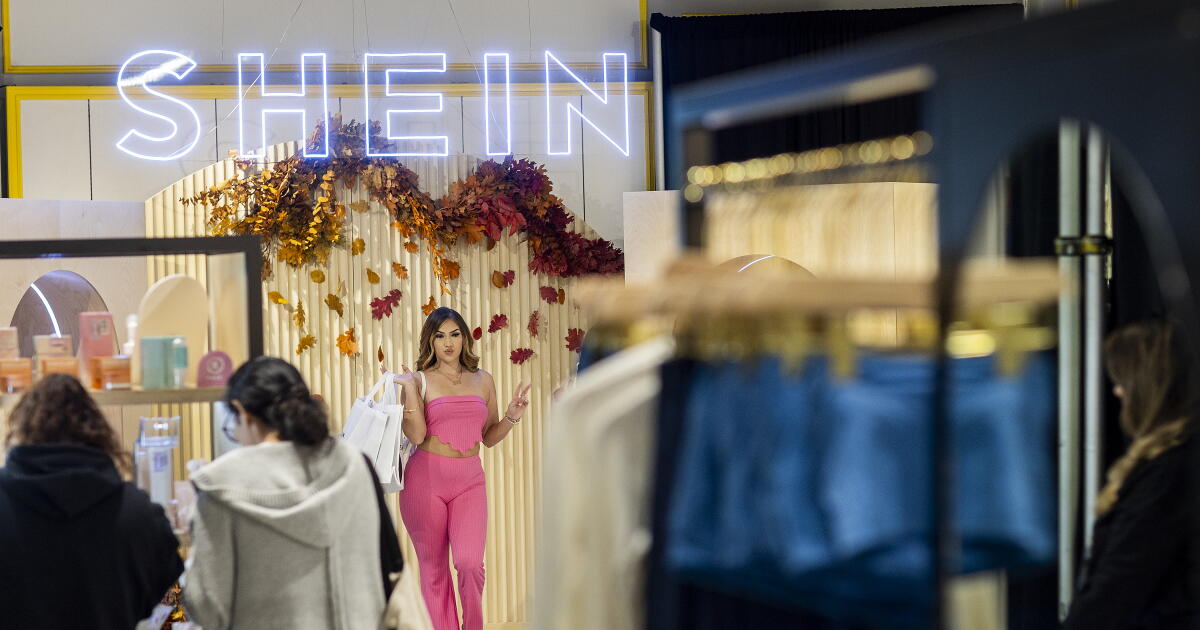
Gen Z hasn’t crossed over into the metaverse just yet.
Retail experts say these young shoppers have helped malls bounce back after the downturn brought on by the pandemic, in part because the digital space has turned Gen Z into a generation that expects instant gratification. The immediacy of touching, trying out and buying products may be the thing driving them to physical stores.
“This digitally savvy generation is used to having things immediately that they can download, access, watch,” said USC Marshall School of Business Assistant Professor Stephanie Tully. “And so from that perspective, the desire to get physical products immediately makes sense and would explain interest in brick-and-mortar.”
Gen Z — people from the ages of 16 to 26 — prefer in-person as much as online shopping, if not more, according to a 2023 report by the International Council of Shopping Centers. According to the trade group, about 97% of survey respondents said they shop at brick-and-mortar stores; 95% said they shop online for the convenience.
“Gen Z shoppers are bringing back the mall shopping center experience,” said Kristin Grove, senior vice president of national retail leasing at the global real estate firm JLL. “They want a sense of community. They want to bridge the gap between the social media that they’re doing, and meet and shop in-person.”
The trade group’s study didn’t inquire about other generations’ shopping habits. But a 2022 report by the marketing agency CM Group, now Marigold, and the retail consulting group F’inn found that 47% of Gen Z respondents said they prefer to shop in store over online — more than any other generation.
“Despite being the first digitally native generation, virtually all Gen Z customers shop in-store and prefer physical retail at similar rates to previous generations,” Ali Esmaeilzadeh, executive vice president at Brookfield Properties, said about shoppers at that company’s Glendale Galleria.
There is good reason for malls to bank on Gen Z, which makes up 40% of global consumers with spending power clocking in at $360 billion.
For 23-year-old Nicole Tan of West Hollywood, online shopping is for browsing while in-person shopping is for buying.
“I like to try things on,” she said as a song from the K-pop group New Jeans played in the background at the Westfield Century City shopping center. “If I see ads on social media and there are sales online, I’d maybe buy stuff online, but I usually like to shop in-store.”
Teens have long been the lifeblood of malls, with films such as “Fast Times at Ridgemont High” and “Clueless” depicting shopping centers as a beehive of excitement and activity. But the popularity of online shopping and recent economic turmoil took a toll, with many retail centers either closing altogether, being converted into office space or apartments or taking on unconventional tenants such as grocery stores.
With the easing of pandemic restrictions and the slowing of e-commerce, some malls have been revived by targeting teens and young shoppers who want more than just a place to spend money: a place to hang out, dine and meet friends.
And then there is the loneliness factor.
“There’s a lot of data showing that Gen Z is a particularly lonely generation and that it needs more social interactions,” Tully said. “[Gen Z] would benefit probably more so than other generations from going out and having those experiences in-person.”
According to the International Council of Shopping Centers survey, 60% of Gen Z respondents said they would rather spend their money on experiences than material items, which means that refining the in-person shopping experience is front of mind for retailers.
Westfield Century City and South Coast Plaza in Costa Mesa, among other major Southern California malls, are focused on maximizing “hang time,” Grove said — the amount of time customers spend there.
“It is usually a combination of not just retail … but also great food and beverages and opportunities to do things like [take care of] daily needs,” she said. “You’re multitasking and doing some other things, not just shopping.”
Louis Schillace, senior general manager of Westfield Century City, said that in addition to shopping outlets, the mall houses a gym, an escape room, movie theaters and fine dining restaurants — keys to attracting diverse visitors.
“When you think about Gen Z and how they use the space, it gives them another opportunity to choose this space as their place to go for a night out,” he said.
Tan, who works at a talent agency across the street from Westfield Century City, said she often goes there not to shop, but to grab dinner with a co-worker or go for a walk.
“I do more leisure non-shopping things at the mall,” she said.
About 70% of Gen Z survey respondents said that retail centers and stores offer fun places to gather, according to the ICSS report.
The malls that are thriving have the financial resources to reinvest in and renovate their spaces to meet the evolving demands of today’s shoppers, according to a 2023 Coresight Research report. And malls that cannot make those investments are suffering for it, experts say.
Shuttered stores populate the Puente Hills Mall, best known as the Twin Pines Mall from the 1985 movie “Back to the Future,” in the San Gabriel Valley. And the University of California recently announced plans to acquire the former Westside Pavilion, once a popular L.A. mall that was later converted to office space.
Tully said turning malls into multipurpose destinations where Gen Z flocks will become increasingly important for their survival as online retailers offer shipping, delivery and return options that could disincentivize people from going to the mall to shop.
“There could be drones that deliver things to us,” she said. “Who knows what is going to transform with AI? But one thing you will not be able to have [delivered] are those [in-person] types of experiences.”
Successful shopping centers also must bring in the kinds of brands that are trendy among Gen Z shoppers, as well as socially and environmentally conscious retail stores those customers are likely to support, Grove said.
Gentle Monster — a South Korean sunglasses brand that grabbed the attention of Gen Z in recent years thanks to collaborations with the likes of K-pop superstar Jennie of Blackpink — opened a boutique at South Coast Plaza in late 2022.
Hundreds of shoppers flocked to the opening of America’s first physical store of Princess Polly, an Australian fast fashion boutique popular among Gen Z and millennials, at Westfield Century City in September 2023.
“When we open a store like Princess Polly and we see the reaction, it was clearly generational,” Schillace said. “When we saw the lines of 500 Gen Z-ers waiting for the doors to open, the connection was there.”
More than half of Gen Z survey respondents said they were interested in supporting brands that prioritized mental health, according to the ICSS report. About 47% said they cared about brands that address sustainability and racial and gender equity.
“I try to shop small, independent brands or brands in line with my ethos,” Tan said.
Brands such as Victoria’s Secret and Abercrombie and Fitch went through highly publicized reckonings over body and racial inclusivity in the 2010s as maturing Gen Z students watched from their various social media platforms. As these legacy brands undergo major rebranding to appeal to the new generation of shoppers, those preaching body positivity and diversity such as Fenty Beauty, American Eagle Outfitters Inc.’s Aerie brand and Skims have found commercial success.
“I think that’s all attributable to a really educated new generational shopper,” Grove said. “That’s the future.”

Business
Commentary: Puncturing the myth of Alan Greenspan, whose policies gave us the Great Recession

Noah Cross, the archvillain of the movie “Chinatown,” had the definitive line on how old age brings respectability. “‘Course I’m respectable,” he tells Jake Gittes. “I’m old. Politicians, ugly buildings and whores all get respectable if they last long enough.”
I wouldn’t necessarily slot former Federal Reserve Chairman Alan Greenspan into any of those categories, but the general reaction to his death Monday at age 100 puts the lie to Cross’ observation.
As much as he was revered during his nearly two decades as Fed chairman for protecting the stock market from a series of crashes and near-crashes, his obituaries take a more measured view. The headline on the Wall Street Journal’s main take on his legacy is: “The Myth of Alan Greenspan as ‘The Maestro.’”
Stripped of its academic jargon, the welfare state is nothing more than a mechanism by which governments confiscate the wealth of the productive members of a society to support a wide variety of welfare schemes.
— Alan Greenspan, writing as an Ayn Rand cultist (1966)
The Journal blames Greenspan for fostering “the great credit mania of the mid-2000s” and observes that “the music stopped in 2008, producing the panic that did so much harm to the free-market economy that Greenspan promoted.” That was the Great Recession, which started with the 2008 crash in the housing market and persisted into 2012.
That is from a publication that was more or less in accord with Greenspan’s goals of less regulation and lower taxes. His contemporary adversaries were harsher. “R.I.P. Alan Greenspan: You were charming, thoughtful, powerful, and wrong,” writes Robert Reich, who served as Bill Clinton’s Labor secretary while Greenspan led the Fed.
The Great Recession, “in which in which millions of Americans lost their jobs, their savings, and even their homes — resulted from the deregulation of Wall Street that Greenspan advocated,” Reich wrote. But he had to admit that Greenspan’s “iron grip” over Fed policy forced Clinton “to do exactly what Greenspan wanted — which was to reduce the federal budget deficit and thereby destroy much of the agenda Clinton ran on.”
It would be unfair to depict Greenspan’s influence as invariably pernicious. Social Security advocates still think highly of his work chairing the so-called Greenspan Commission of 1982-1983, which developed a series of changes in benefits and revenues for that program to address a looming, immediate fiscal crisis.
Greenspan led the bipartisan panel “masterfully,” recalls William J. Arnone, the former chief executive of the National Academy of Social Insurance, who witnessed its deliberations as a consultant to the New York Citizens Committee on Aging.
Before the commission’s formation, “Republicans and Democrats fiercely disagreed over underlying data,” Arnone told me. “Greenspan used his expertise as an economic empiricist to convince both sides to agree on a singular, shared set of actuarial facts. Quite an accomplishment.”
To the public, Greenspan was known for his impenetrably cryptic speaking style and for the relative tranquility in the American economy during his tenure, which has been termed “the great moderation” despite recurrent short-term crises.
Greenspan was the second-longest serving Fed chair. But he may have had the weirdest background. Having grown up in an affluent New York household, he was talented enough on clarinet and saxophone to have sat in with Stan Getz’s band and attended Juilliard for a time.
He began his economics education in 1945 at New York University and got as far as a master’s degree, but by then he was already working on Wall Street, where his skill at financial analysis propelled him toward the top echelons of high finance.
Somewhere along the line he fell in with the arch-libertarian Ayn Rand, becoming part of her inner circle of economic cultists. Referring to his dour mien and predilection for charcoal gray garb, Rand called him her “undertaker.”
Greenspan provided a veneer of rigorous economic analysis for Rand’s ideology, which lionized the rich and described them as fighting a ferocious battle with the lazy and grasping hoi polloi. He contributed three essays to her 1966 anthology “Capitalism: The Unknown Ideal.”
His association with Rand was seldom highlighted during his Fed tenure, but even a casual reading of those essays exposes the Randian underpinnings — and the Randian self-contradictions — of his Fed policies.
One essay defended the gold standard, which had been discredited in the 1930s. Greenspan blamed “welfare-state advocates” for the developed world’s abandonment of the gold standard.
He wrote, “Stripped of its academic jargon, the welfare state is nothing more than a mechanism by which governments confiscate the wealth of the productive members of a society to support a wide variety of welfare schemes…. Gold stands in the way of this insidious process. It stands as a protector of property rights” — language that could have come right out of the text of Rand’s “Atlas Shrugged.”
Another essay called for the dismantling of government regulators such as the Food and Drug Administration and the Securities and Exchange Commission. Greenspan’s argument was that the consumer was adequately protected by the businessman’s profit-seeking, which in turn depended on maintaining a reputation for honesty and fair-dealing.
For drug companies, he wrote, “the loss of reputation through the sale of a shoddy or dangerous product would sharply reduce the market value of the drug company.” The same goes for securities brokers — “The slightest doubt as to the trustworthiness of a broker’s word or commitment would put him out of business overnight.”
One might ask what inspired Greenspan’s faith in, well, the faithfulness of business enterprises, given centuries of proof otherwise. Anyway, he refuted his own argument. “The guiding purpose of the government regulator is to prevent rather than to create something,” he wrote. “He gets no credit if a new miraculous drug is discovered by drug company scientists; he does if he bans thalidomide.”
He didn’t bother to question why his trustworthy drug companies had tried to market as a morning-sickness drug in the U.S. a formulation that already had been shown to produce severe birth defects in the children of mothers who took it overseas. (American families were largely saved from this tragedy by Frances Oldham Kelsey, who blocked its importation as an official of, yes, the FDA.)
To stock market investors, Greenspan’s chief legacy was the “Greenspan Put.” This was an implicit commitment by the Fed to counteract sharp declines in the market by pumping liquidity into the economy through the mass purchase of Treasury bonds.
The term comes from the options market, in which a “put” gives the holder the right to sell the underlying stock at a set price in the future, even if the market price has fallen below that price. In effect, it establishes a floor to the investor’s losses in a downturn.
The Greenspan put first appeared on Oct. 19, 1987, when the stock market suffered its greatest one-day percentage crash ever, 20.47%. Greenspan had been in office for only a few weeks, but his Fed issued a statement promising to inject liquidity into the system and cut interest rates. “We will back you,” he told bankers in a series of phone calls.
In truth, Greenspan had no legal authority to make that pledge. In any event, the market recovered the next day, and the Fed’s image as a willing bulwark against market declines was born.
The problem was that the idea that the Fed would act in a market crisis encouraged ever more flagrant risk-taking on Wall Street.
The harvest was a series of crises, notably the 1998 collapse of the hedge fund Long Term Capital Management, which was founded by Nobel economics laureates to pursue abstruse arbitrage trades. It was brought low by market moves that confounded their projections. LTCM was so deeply embedded in Wall Street trading it had to be saved with a $3.6-billion bailout the Fed orchestrated.
The Greenspan put, like so many other such grand schemes, worked well right up until it stopped working. That moment came in 2008, with a crash and a long, throbbing hangover.
Testifying to Congress in 2008, Greenspan acknowledged that maybe self-regulation, that watchword of his economic worldview, didn’t work.
“I made a mistake in presuming that the self-interest of organizations, specifically banks and others, were such that they were best capable of protecting their own shareholders and their equity in the firms…. Something which looked to be a very solid edifice, and, indeed a critical pillar to market competition and free markets, did break down.”
That, he said, “shocked me.” It was a rare admission of blame by a man who, as my former colleagues Thomas S. Mulligan and Don Lee reported in their Greenspan obituary, had told CNBC a few months earlier that he had “no regrets” about his policies.

San José tech company Cisco plans to cut 471 workers in three Bay Area offices, according to layoff notices filed to a state agency.
The company, which provides networking devices along with other services including video conferencing and cybersecurity, told employees in May that it was going to cut fewer than 4,000 jobs or less than 5% of its workforce.
The notices, processed by the California Employment Development Department this week, provide more details about what jobs Cisco will cut in California.
The artificial-intelligence boom has fueled more investments in data centers, commercial real estate and other areas. But advancements in AI tools have also been reshaping jobs, especially in Silicon Valley, the epicenter of the tech industry.
Cisco’s layoffs in California impacted workers in its San José, Milpitas and San Francisco offices. The company cut a variety of roles in software engineering, product management, design, business operations and other areas, the notices show.
Cisco said it didn’t have anything additional to share beyond what it published in May about its restructuring plans.
Tech companies have been citing various reasons for layoffs including prioritizing investments in artificial intelligence. As workers use AI-powered tools to generate code, words and other content, some executives have said they don’t need as many employees. There’s also skepticism, though, about how big a role AI is playing at companies with a large amount of workers globally.
From January to May, U.S. technology companies announced 123,653 cuts, up 66% from the same period in 2025, according to a June report from global outplacement and executive coaching firm Challenger, Gray & Christmas. The firm said that AI was the leading reason companies cited for cuts but it still isn’t the “jobpocalypse some predicted.”
Meta, Snap, Block, Oracle and Amazon are among tech companies that have announced mass layoffs this year.
Cisco markets itself as a company that “provides critical infrastructure for the AI era” and has benefited from the AI boom, reaching a record revenue of $15.8 billion in the third quarter this year. The company’s net income grew 35% to $3.4 billion year-over-year during that quarter.
Cisco Chief Executive Chuck Robbins told employees in May it’s cutting costs in certain areas while prioritizing other investments. That includes employee use of AI across the company.
He said Cisco will be among winners in the AI era, but that means “making hard decisions — about where we invest, how we’re organized, and how our cost structure reflects the opportunity in front of us.”
As of July 2025, Cisco had roughly 86,200 employees, according to its annual report.

Social media company Snap is being sued by the parents of a girl who was raped when she was 12 years old by a man she met on disappearing messaging app Snapchat.
The 111-page lawsuit, filed this week in a Missouri Circuit Court, alleges that Santa Monica-based Snap “enabled and facilitated the grooming, exploitation, and sexual abuse” of the minor who is referred to as “J.F.”
The company failed to disable or warn users about “dangerous” features that predators use on the app to find and abuse their victims, according to the lawsuit.
Missouri resident Gabriel Joel Valentin-Rios, who was 25 years old at the time, raped the girl in September 2021 after she sneaked out of her house, the lawsuit alleges. The parents are also suing the attacker, who pleaded guilty to sexually assaulting the girl and is serving 18 years in prison, according to the Social Media Victims Law Center.
The center and the Holland Law Firm announced Thursday they filed the lawsuit on behalf on the victim’s family.
“This assault did not happen in a vacuum — it happened because Snapchat’s product design made it easy for a predator to reach and manipulate an unsuspecting child,” said Matthew Bergman, founding attorney of the Social Media Victims Law Center, in a statement. “Snap executives have long known that their features create a perfect environment for predators to exploit children, yet they have repeatedly failed to make the platform safe.”
A Snap spokesperson said in a statement the company cares “deeply about the safety and well-being of all Snapchatters.”
“Our teams have worked for years to build safeguards, launch safety tutorials, partner with experts, and work with law enforcement to help prevent the misuse of our platform,” the spokesperson said in a statement.
The lawsuit is the latest legal hurdle facing Snap. Multiple parents who lost their children have previously sued the company, alleging that Snap failed to provide enough safeguards on the messaging app. Parents and child safety groups have voice concerns about how the app can be used to connect young people with drug dealers and child predators.
Other tech companies such as gaming platform Roblox, Google-owned YouTube and Facebook parent company Meta have also faced lawsuits over safety and mental health issues.
In March, a Los Angeles jury found that Meta-owned Instagram and YouTube were liable for the suffering of a California woman who alleged the platforms were built to addict young users. Snap settled that lawsuit before the trial started.
The latest lawsuit against Snap highlights safety concerns surrounding several features on the messaging app including “Quick Add,” which suggests users to connect with on Snapchat. Valentin-Rios used that feature to connect with the girl along with others to disguise his identity and groom her into sending explicit photos, the lawsuit said. The company’s “Snap Maps” feature allowed him to find the girl’s home address. And he used a cartoon avatar known as Bitmoji on Snapchat to conceal his age and present himself as a “a young, innocuous, and friendly looking boy.”
Families have faced challenges holding tech companies accountable for safety issues because a U.S. law shields platforms from being held liable for content posted by its users.
The lawsuit against Snap, though, says that it seeks to hold the company liable for the design and marketing of “unreasonably dangerous social media products.” It alleges that Snap co-created content such as Bitmojis abused by child predators and it designed the app to entice users to spend more time messaging others.
The lawsuit accused Snap of consistently turning a “blind eye” to underage users of its app. Snapchat requires users be at least 13 years old to sign up for an account, but J.F. started using the app when she was 11 years old. Snapchat was popular among her peers and friends so J.F. downloaded the app, which was presented as lighthearted and entertaining platform, without her parents’ knowledge or consent. The company failed to warn users about potential dangers, verify the ages of minors and lacks adequate parental controls, the lawsuit alleges.
Snapchat has a “family center” where parents can see their teen’s friends, view time spent and other insights about how their children are using the app. But the lawsuit said it isn’t enough because parents can’t restrict teens from sending private messages and children can create accounts without their parents’ knowledge.
The plaintiffs’ counsel also tested Snap’s “Quick Add” feature in 2023 and found that many of the usernames “generated by Snap’s recommendation algorithm appeared on their face to belong to predatory users,” the lawsuit said.
Valentin-Rios was also able to create a second Snapchat account with the username “Nocits21g” to connect with J.F. and to conceal the activity from his girlfriend, according to the lawsuit.
The rape victim, who was diagnosed with PTSD, anxiety and depression, started to engage in self-harm and expressed suicidal thoughts, the lawsuit states.
The lawsuit seeks a jury trial and financial damages for the harm allegedly caused by the company to the family.
“J.F. feels embarrassed and ashamed, but she is also angry that Snap facilitated this by design, and angrier still that Snap continues to operate its platform in the same manner today,” the lawsuit said.
-

 Pittsburg, PA5 minutes ago
Reunited! Penguins Get the Other Twin Ruck in Round 2
-

 Augusta, GA11 minutes ago
Richmond County elections board seeks dismissal of Myles election challenge
-
Washington, D.C14 minutes ago
Your access has been blocked – The Atlantic
-

 Cleveland, OH20 minutes ago
Cleveland boy, 13, dead following ATV crash in Erie County
-

 Austin, TX26 minutes ago
Cedar Park greenlights Texas Materials HQ move with $14M incentive deal
-

 Alabama29 minutes ago
The legend of Alabama’s black panthers: Why the sightings never stop
-

 Alaska34 minutes ago
Delmonico’s Love Letter To America: A Red, White, And Blue Baked Alaska
-

 Arizona42 minutes ago
With water cuts looming in Arizona in US, locals fight data centres

