Business
Hollywood, accusers condemn reversal of Weinstein conviction: 'We know what happened'
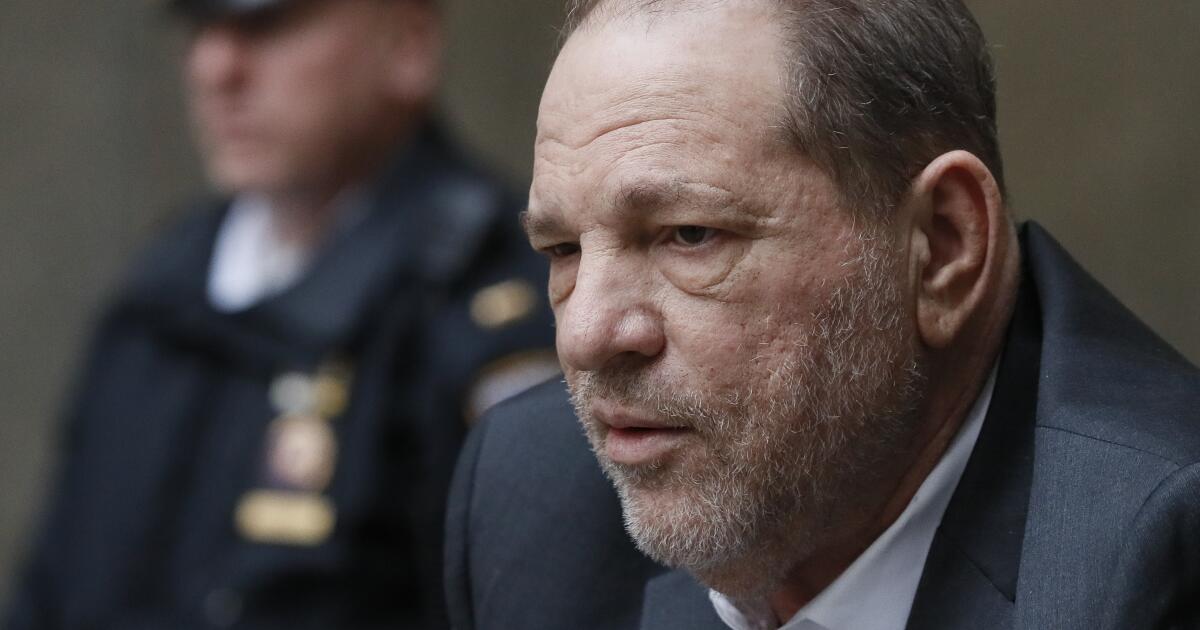
Harvey Weinstein’s accusers and opponents of sexual violence in Hollywood and beyond are speaking out against the reversal of the disgraced movie mogul’s rape conviction in New York.
Ashley Judd, Mira Sorvino and others who have accused the former Hollywood producer of sexual misconduct condemned a New York court of appeals’ decision on Thursday to overturn the verdict.
Weinstein has been serving a 23-year sentence since he was convicted in 2020 of rape and a felony sex crime after allegedly assaulting former production assistant Mimi Haley and once-aspiring actor Jessica Mann.
“This today is an act of institutional betrayal. And our institutions betray survivors of male sexual violence,” Judd said during a news conference at the Millennium Hilton hotel in New York . “I stand shoulder to shoulder with women who have bloody knees because male sexual violence may knock us down, but we get right back up. And together we are in the struggle for freedom from male entitlement to our bodies.”
“This is unfair to survivors,” Judd added on her Instagram story. “We live in our truth. We know what happened.”
Tarana Burke, founder of the #MeToo movement, remarked during the news conference that “moments like this underscore why movements are necessary and … why we keep going.”
“We are devastated for the survivors who are connected to this case and the survivors who have found some solace and catharsis in the original verdict,” Burke said. “We will always stand with resolve and resilience. … This is not a blow to the movement. It is a clarion call, and we are prepared to answer that call.”
The New York appeals court found, in a 4-3 decision, that the judge who presided over Weinstein’s trial prejudiced the case by allowing four women who said Weinstein had assaulted them to serve as witnesses, even though their allegations were not part of the case.
The trial judge also made a mistake, the court determined, in permitting prosecutors to question Weinstein about uncharged and decades-old allegations if he decided to testify.
Weinstein was also convicted of rape in California and the New York ruling will have no practical effect on his imprisonment.
Sorvino wrote on X that she was “horrified” by the news, which surfaced during Sexual Assault Awareness Month.
“Since when don’t courts allow evidence of pattern of prior bad acts to be admitted?” Sorvino said. “He’s a prolific serial predator who raped/harmed 200+women! Disgusted w/justice system [skew toward] predators not victims.”
Weinstein has denied all allegations of sexual assault.
The Silence Breakers — a coalition of 23 women who have accused Weinstein of sexual misconduct that includes actors Judd, Rose McGowan and Rosanna Arquette — issued a statement calling the reversal “disheartening” and “profoundly unjust.”
“This ruling does not diminish the validity of our experiences or our truth; it’s merely a setback,” the Silence Breakers said.
“The man found guilty continues to serve time in a California prison. When survivors everywhere broke their silence in 2017, the world changed. We continue to stand strong and advocate for that change. We will continue to fight for justice for survivors everywhere.”
Anita Hill, chair and president of the Hollywood Commission, said in a statement that Thursday’s reversal evinces “a lack of progress in addressing the power imbalances that allow abuse to occur” and proves that “sexual assault continues to be a pervasive problem.”
“Many survivors do not pursue justice because they believe nothing will be done,” Hill added.
“Today’s decision underscores the urgent need for systemic changes in our institutions — and redoubles our commitment to survivors to push for the policies and systems that will ensure accountability and bring about workplaces free from the behavior that drives the need for these systems in the first place.”
Attorney Douglas Wigdor — who has represented eight Weinstein accusers, including two of the witnesses at the New York criminal trial — denounced Thursday’s decision as “a major step back in holding those accountable for acts of sexual violence.”
“Courts routinely admit evidence of other uncharged acts where they assist juries in understanding issues concerning the intent, modus operandi or scheme of the defendant,” Wigdor said in a statement.
“The jury was instructed on the relevance of this testimony and overturning the verdict is tragic in that it will require the victims to endure yet another trial.”
In a statement provided to The Times, a spokesperson for the Manhattan district attorney’s office said, “We will do everything in our power to retry this case, and remain steadfast in our commitment to survivors of sexual assault.”
Times staff writer Jenny Jarvie contributed to this report.

Business
Kennedy Is Driving a Vast Inquiry Into Vaccines, Despite His Public Silence
Health Secretary Robert F. Kennedy Jr. has said little publicly about vaccines in recent months, at the behest of a White House worried that his unpopular stance will hurt Republicans in November’s midterm elections. But he has not abandoned his quest for evidence that they are unsafe.
Working behind the scenes, Mr. Kennedy is spearheading an intense push, across health agencies under his purview, for government scientists and federal data contractors to examine his long-held theory that vaccines are helping to fuel an epidemic of chronic disease, according to multiple people familiar with the effort.
They said the wide-ranging inquiry is a top priority for Mr. Kennedy, who sees vaccines as a “potential culprit” in various neurological and autoimmune disorders, including asthma and allergies. It resurrects research into a number of ideas Mr. Kennedy has espoused, including whether vaccines are linked to autism and whether thimerosal, a preservative that has largely been removed from vaccines in the United States but remains in some flu shots, is dangerous.
The effort is being led by Martin Kulldorff, a biostatistician and vaccine safety expert who rose in prominence during the pandemic as a critic of Covid restrictions and vaccine mandates, and is now the health department’s chief science and data officer.
Career scientists at the Food and Drug Administration and the Centers for Disease Control and Prevention are conducting the research alongside contractors who provide statistical expertise and access to millions of patient medical records. The initiative was described to The New York Times by six people who are close to it, all of whom insisted on anonymity because it is not public.
The work is raising alarms among some vaccine scholars and critics of Mr. Kennedy, who have long accused the secretary of cherry-picking data and misinterpreting studies to claim that vaccines are unsafe and to limit their use. They fear Mr. Kennedy will use the findings to further erode confidence in vaccines, which the World Health Organization estimates saved 154 million lives over the past half-century.
Mr. Kennedy, who came into office saying he would do nothing to discourage people from getting vaccinated, has already taken steps to scale back the number of vaccines children receive. Public health experts complain that by spending money on issues that have already been thoroughly studied, he is taking funds away from research that might answer the very questions he is asking, including what causes autism.
“It just demonstrates that no matter what the general tone is about vaccines, whether we talk about them or not, the secretary is going to continue to try and look at the data and analyze it in a way that will help support the conclusions that he’s already made,” said Dr. Daniel Jernigan, who oversaw vaccine safety at the C.D.C. until he resigned in August. “And that, to me, is a real problem.”
Andrew Nixon, a spokesman for Mr. Kennedy, said in a statement that the effort reflected President Trump’s dedication to advancing “gold-standard vaccine research” that will enable policymakers to “better understand vaccine safety and efficacy and to assess how vaccine exposure, timing and patterns affect health across the life span.”
Mr. Nixon said the work would “inform vaccine recommendations, address critical gaps identified by scientific and medical organizations, including the Institute of Medicine, and strengthen public trust in public health.”
He said the initiative also involved the National Institutes of Health and universities. It remains unclear what the effort will cost and whether it is supplanting other routine government vaccine surveillance.
A former plaintiff’s lawyer, Mr. Kennedy has long said that he wants to build a body of scientific evidence on the harms of vaccines and environmental exposures, which he believes are behind an epidemic of chronic disease. That evidence, he has said, will lay the groundwork for legal action.
“That’s how you really change policy,” Mr. Kennedy said in a podcast as a presidential candidate in 2024. He added, “I’m going to provide that enough science, sufficient science, on each one of these exposures and each one of these injuries, to show who’s causing what and hold them responsible in court.”
During a daylong meeting on the new vaccine research initiative in late February, officials from the Health Department and the C.D.C. gathered to discuss specific studies and methods, including a look at the overall effect of the childhood vaccine schedule. Representatives from major health systems such as Kaiser Permanente were also at the table, given their role in allowing the C.D.C. access to vast troves of data through its Vaccine Safety Datalink system.
As part of the new effort, Mr. Kennedy has tasked some government scientists with studying the health status of vaccinated children compared with those who were not vaccinated. Mr. Kennedy coauthored a book, “Vax-Unvax: Let the Science Speak,” calling for such studies, which he believes will prove harm from vaccines.
Researchers say that such comparison studies would be riddled with pitfalls. Vaccinated children are more likely to receive medical care than those who are unvaccinated, and are thus more likely to receive additional medical diagnoses that could be wrongly attributed to vaccines.
Mr. Kennedy is also asking for the group to undertake new studies looking at the link between vaccines and autism.
The project is also looking at the question of harm from thimerosal, a mercury-based vaccine preservative, according to people close to the effort. The preservative has been thoroughly studied and found to be unrelated to autism, but Mr. Kennedy has remained concerned about it, and has rescinded federal recommendations for flu vaccines that contain thimerosal.
Through the C.D.C. alone, the cost of the project is estimated at $40 million to $50 million, according to a person familiar with the matter.
The project is being overseen by Mr. Kennedy and Stefanie Spear, his closest adviser. Mr. Kennedy’s new senior counselor for public health, Dr. Sara Brenner, a veteran of the F.D.A. who has voiced skepticism of vaccines, is expected to propel the studies forward in her new role, according to people familiar with the plan.
The new vaccine initiative is not the first time the secretary has waged a behind-the-scenes effort to study vaccine safety. Last year, Mr. Kennedy faced significant pushback within federal agencies and from Congress when he deployed David Geier, whose vaccine research is considered deeply flawed, to dig into vaccine safety data to explore some of the secretary’s longstanding concerns.
Mr. Kennedy’s team put pressure on C.D.C. officials, including Dr. Jernigan, who delayed Mr. Geier. When Mr. Kennedy ousted Susan Monarez, the agency’s director, Dr. Jernigan and other C.D.C. leaders quit.
Within the C.D.C. and F.D.A., scientists have registered some relief that Dr. Kulldorff, a pioneer in methods to examine vaccine safety, is leading the new inquiry. He worked on research that was groundbreaking in 2009 to monitor the safety of the H1N1 flu vaccine as it was being rolled out. The team he worked with found a slightly elevated rate of Guillain-Barré syndrome, an autoimmune condition associated with some vaccines.
“Martin had been known for decades as a top-notch vaccine safety scientist,” said Daniel Salmon, a Johns Hopkins University vaccine researcher who worked with Dr. Kulldorff on a vaccine data system that predated one the F.D.A. now uses.
Some scientists who worked with Dr. Kulldorff in the past, though, wonder if the evenhanded biostatistician they once knew changed during the pandemic. They point to a federal document, coauthored by Dr. Kulldorff, justifying sharp limitations on vaccines recommended to children in the United States, saying it left out reams of studies supporting flu and hepatitis B vaccines for infants and children.
In 2024, Dr. Kulldorff joined Mr. Kennedy in litigation against Merck, the makers of Gardasil, a vaccine for the human papilloma virus, earning $400 per hour as an expert witness, court records show. Merck, the vaccine’s maker, challenged Dr. Kulldorff’s standing as an expert based on his prior research finding that the vaccine was safe.
Dr. Kulldorff did not respond to a request for comment, and the health department did not respond to a request to make him available. Mr. Kennedy and Ms. Spear also did not respond to requests for comment.
The C.D.C. and the F.D.A. already devote considerable effort to investigating vaccine safety, using a number of databases and research methods. But Mr. Kennedy’s fellow vaccine critics, including Retsef Levi, a mathematician at the Massachusetts Institute of Technology who serves on Mr. Kennedy’s handpicked a panel of C.D.C. vaccine advisers, find fault with the current studies.
“Many of them have serious methodological flaws,” Dr. Levi said.
Mr. Kennedy began raising questions about vaccines’ safety about 20 years ago, and became a champion for mothers of children with autism who blamed the condition on vaccines. People familiar with his thinking say he still feels deeply committed to those women, and cannot reconcile their often heartbreaking stories with the vast body of research that discounts a link.
For parents who believe vaccines have harmed their children, Mr. Kennedy is fulfilling a major promise. Katie Wright, whose 24-year-old son has autism and got to know Mr. Kennedy through her advocacy for parents who question the safety of vaccines, said more research is necessary to restore trust in childhood immunization.
“There’s been tremendous pushback; they say, ‘Well, the research has been done.’ ” Ms. Wright said. “Well, you know what? A lot of families are concerned. I don’t understand the fear of delving deeper into safety research.”
As health secretary, Mr. Kennedy has demonstrated an unorthodox view of what makes for reliable findings about vaccines. He dismissed a major vaccine study of 1.2 million Danish children over 24 years as “a deceitful propaganda stunt,” for failing to highlight a subset of about 50 children who were more likely to have gotten Asperger’s syndrome, a diagnosis previously applied to high-functioning people with autism, after getting vaccines.
In the language of vaccine science, such findings are considered a signal to be examined in more depth. Dr. Kathryn Edwards, a Vanderbilt University expert in vaccinology, said she was concerned that selective attention to such signals could be “used to further erode the confidence that people have in vaccines.”
Mr. Kennedy has also made hasty changes to vaccine policy, often with minimal scientific justification for decision making. Among those pivots was an overhaul in January of vaccine recommendations, reducing the number of immunizations for American children to 10 from 17.
Though the plan was held up in court, Dr. Edwards said it portends a scenario where the findings of the current effort get a big splash in the media or drive new policies before scientists can understand the reasoning.
“What they’ve done is also worrisome,” she said, “because there have been so many things that haven’t been open and transparent.”
Business
Fears of an AI breakthrough force the U.S. and China to talk
CHONGQING, China — Three years ago, in the idyllic town of Woodside south of San Francisco, the United States and China held their first high-level talks on the dangers posed by artificial intelligence. President Xi Jinping and his longtime foreign minister appeared serious in their conviction that a channel should be a established between Beijing and Washington — a red phone for AI in case of emergencies.
They authorized a diplomatic effort that would begin in 2024 in Switzerland, only months before the U.S. presidential election. A large U.S. delegation arrived with high hopes that were abruptly dashed, according to four sources who attended the talks. The Chinese contingent dismissed American concerns over runaway AI as academic, almost theoretical, quickly turning the conversation to export controls seen in Beijing as yet another U.S. effort to hold China back.
“They naturally view any American diplomatic initiative involving limitations or restrictions of one flavor or another on a capability as being a trap,” Jake Sullivan, U.S. national security advisor under President Biden, said in an interview.
Despite the distrust — and Democrats losing the White House to Donald Trump — an accord was struck in November of that year in Peru, where both sides agreed to keep AI out of the command and control of nuclear weapons.
“It was a breaking of the seal that we could actually do something on AI,” Sullivan said. “In the transition, I told the incoming Trump team that they should really pick up that dialogue. But the Trump administration’s view was just far more laissez-faire, and they didn’t seem particularly interested in it.”
“That’s all changed in the past few weeks,” he added.
A Trump administration once eager to gun for technological supremacy is now, for the first time, reckoning with the power AI could unleash if left unchecked.
In a surprise reversal, quiet discussions have taken place ahead of President Trump’s state visit to China this week to explore reviving talks on an emergency channel, officials told The Times, prompted by shared alarm in Beijing and Washington over the debut of Mythos, Anthropic’s powerful new model.
One senior administration official told reporters Sunday that the White House was looking to create a channel of communication for AI like others that they have “in many areas that have intense focus with the U.S. and China.”
“I think what that channel of communication looks like, its formality and what that looks like, is yet to be determined,” the official said, “but we want to take this opportunity with the leaders meeting to open up a conversation. We should establish a channel of communication on that matter.”
Mythos’ capabilities are seen across the industry and government as those of an unprecedented cyberweapon, able to infiltrate and exploit digital communication systems — including government databases, financial institutions and healthcare programs — with untold consequences.
Whether an announcement will come to fruition this week is not yet clear. Any talks between the United States and China over AI regulations — designing some kind of arms control agreement governing the use of a technology that neither side fully understands or controls — will be fraught with suspicion, misunderstandings and risk, experts say.
“Right now, there is almost no support from U.S. policymakers to engage in formal discussions on AI governance with China,” said Aalok Mehta, director of the Wadhwani AI Center at the Center for Strategic and International Studies.
“The logic is that this is a winner-takes-all race,” Mehta said, “and that it’s imperative to accelerate AI progress to ensure that the United States wins that race.”
America in the lead
China would enter those discussions with a powerful argument, that U.S. leadership in AI — and the prevailing strategy of American AI companies — is propelling the world to a fraught frontier.
Every major U.S. player in the arena — OpenAI, Google, Anthropic, Microsoft and Meta Platforms — is racing to be the first to build a model capable of artificial general intelligence, or AGI, a threshold without a common definition, but that most agree will require a model to perform any intellectual human task.
The prevailing theory is that the first to achieve AGI will secure a prize that multiplies itself: a self-training, recursively improving intelligence, growing exponentially and leaving all competitors in its wake.
Chinese companies, by contrast, are following a state-sanctioned strategy focused on integrating AI into siloed industries and systems, training models to improve individual tasks and accelerate growth in a more tailored approach.
“The Chinese believe there is no single race, but multiple races,” said Scott Kennedy, senior advisor on Chinese business and economics at the Center for Strategic & International Studies. “The U.S. is focused on achieving AGI, while China is focused on diffusion and applications of AI into the rest of their economy — manufacturing, humanoid robotics, all aspects of the internet of things.”
China scholars, AI industry insiders and successive administrations have questioned Beijing’s strategic thinking and forthrightness.
“It’s so baked into the community here that AGI will have this transformative potential that people can’t believe China isn’t focused on this, as well,” said Matt Sheehan, a scholar of global technology issues at the Carnegie Endowment for International Peace with a focus on China. “It says it’s focused on applications, but is that a fake out for an AGI program hidden in the mountains somewhere?”
But most insiders believe that Beijing’s guidance to Chinese companies reveals its true intentions.
“They are not as AGI-pilled as the United States is, and I think that remains the case today,” Sullivan said, “so they regarded a lot of the conversation in the U.S. around extreme frontier risk — misalignment and loss of control — as a bit abstract, and not really as relevant to how they saw AI diffusing in China.”
President Biden greets Chinese President Xi Jinping in Woodside, Calif., in 2023.
(Doug Mills / Pool Photo)
Although China’s progress has exceeded U.S. expectations — especially since DeepSeek released its model over a year ago — the state has focused computer power on specific applications rather than the broad strategy needed to develop more powerful models capable of advancing toward AGI.
“It’s not just chips. It’s money,” Sheehan added. “China’s leading companies are much more financially constrained than U.S. companies. There’s concern over a bubble here, but OpenAI is valued at something near $800 billion. Leading Chinese companies that have gone public are valued at $20 billion. There’s just an orders-of-magnitude gap in available financing.”
Still, some in the U.S. government fear China won’t need comparable computing power if it simply steals the technology wholesale.
Doing so isn’t simple. But last month, in a memo, the White House Office of Science and Technology Policy accused Chinese actors of “industrial-scale campaigns to distill U.S. frontier AI systems,” in effect replicating the performance of the most advanced existing models “at a fraction of the cost.” The memo did not accuse Beijing of endorsing the activity.
In the process, the memo added, carefully constructed security protocols are deliberately stripped away.
China’s negotiating advantage
Whatever its strategic calculus may be, China would enter talks with the Trump administration trailing in the race — while disagreeing on the nature of the finish line.
AGI, in theory, could reach a stage of recursive self-improvement that results in a loss of human understanding or control. But if it is only the Americans, and not the Chinese, seeking to reach that threshold, then who is responsible to stop it?
Daniel Remler, who led AI policy at the State Department during the Biden administration and took part in the Geneva talks, cast doubt on Chinese claims of disinterest in AGI and ignorance of its risks. China falling behind in the race is no strategic design, he said.
“Chinese technologists are close observers of the U.S. AI ecosystem, and sometimes they say what they think,” Remler said. “Many were impressed by the [Mythos] model to the point of despair. Leaders in China’s top AI labs have been vocal in recent months, even before Mythos, about how compute-constrained they are at the frontier. Some have said they may never catch their American competitors.”
Talks at this point in the race could follow a familiar pattern in the recent history of U.S.-China diplomacy, in which Beijing claims it is behind the United States in development, ultimately securing a handicap and greater concessions at the negotiating table.
In other competitive domains — such as with China’s entry into the World Trade Organization and in cybersecurity negotiations between Beijing and the Obama administration — agreements were ultimately reached that Washington believes in hindsight disadvantaged American companies.
The Trump administration, Remler added, “needs to approach AI diplomacy with China with clear-eyed expectations anchored to our own national interests.”
Silicon Valley itself is divided over regulating AI. Anthropic, which was founded on concerns that other AI companies were failing to take safety and alignment concerns seriously, raised alarms over Mythos, its own model, to the Trump administration, a moment that has prompted reflection at the White House on the best path forward.
Spooked after meeting with leaders from America’s top banks over their vulnerabilities, Treasury Secretary Scott Bessent internally advised U.S. government reviews of future model releases — a practice already underway in China, where the training parameters for models, known as “weights,” have been publicly released.
Even the suggestion of government oversight sparked backlash from Silicon Valley. Last week, the White House sent out a memo to reassure industry allies that submitting new models for federal review would be strictly voluntary.
If talks ultimately resume between Washington and Beijing on AI, experts believe the negotiations would be far more complex than those that resulted in arms control agreements governing nuclear weapons in the Cold War.
The superpowers would not only be discussing threats of instability to the global financial system, but also fears of proliferation — advanced AI tools getting into the hands of bad actors interested in using bio- or cyberweapons that could target both countries.
And they ultimately would have to decide whether to discuss regulating the integration of AI into the Chinese and U.S. militaries, an almost unfathomable goal between the world’s biggest adversaries, where trust is lowest and verification would be hardest.
Those in the industry who most fear what artificial superintelligence could bring have told the Trump administration that talks with China are an existential necessity.
Dario Amodei, the chief executive and co-founder of Anthropic, speaks at an event in New York in 2025.
(Michael M. Santiago / Getty Images)
But even within Anthropic, which has championed diplomacy, there are concerns that Beijing could exploit its current disadvantage to entangle American industry at the cusp of its crowning achievement.
Rather than pushing for a single sweeping agreement, industry insiders are advising the administration to pursue targeted deals with Beijing to mitigate specific risks, like the pact on nuclear command and control, two industry sources said.
In private, both Xi and Chinese Foreign Minister Wang Yi seemed to understand that the gravity of the emerging technology before them required some form of cooperation, Sullivan said.
“At a conceptual level, I believe they had a conviction on that and authorized it,” Sullivan said, “but I believe their level of urgency was considerably lower than ours, and saw this as a longer-term process that would play out over time.”
“Their level of urgency and their stake in it has gone up,” he added.
Business
Why Some People Are Allergic to ‘Peanut Butter Raises’
Both peanut butter and salary increases are widely loved, but put them together and you may get some grumbles.
“Peanut butter raises” are across-the-board pay bumps to employees, spread out thinly like a creamy condiment on bread. The term popped up all over business media this year after a report from Payscale, a compensation data company, suggested that some employers would be giving such raises instead of larger merit-based increases to a select few.
This metaphorical use of peanut butter has been lurking around corporate America for years: In 2006, Brad Garlinghouse, then a senior vice president at Yahoo, wrote an infamous memo criticizing the company’s strategy of “spreading peanut butter across the myriad opportunities that continue to evolve in the online world” — in his view, failing to focus on priorities or reward top performers with higher pay. “I hate peanut butter. We all should,” he wrote in what he called the Peanut Butter Manifesto.
How it’s pronounced
/pē-nət bə-tər/
Are peanut butter raises fair? It depends on whom you ask, said Nick Bloom, an economist at Stanford. Are they a best practice? Not really, he argued.
“Good management involves setting tough targets, evaluating employees against this and rewarding those that make their targets,” Mr. Bloom wrote in an email. “This means some folks will get paid and others won’t.”
Firms turn to peanut butter raises in two situations: when they can’t really distinguish strong performers from weak and when managers just want to take “the course of least resistance,” Mr. Bloom said. Generally, he added, a well-managed firm will pay its top performers well and keep an eye on the market.
Kevin J. Murphy, an expert on compensation at the University of Southern California’s business school, argued that peanut butter raises “send exactly the wrong signals,” telling top performers that their employers “just don’t care that much.”
Still, the idea that only stars should get pay bumps is not a law of physics. In previous generations, the notion that people across an organization — not just the top performers — should get consistent raises was common, said Peter Cappelli, a professor at the Wharton School.
But, he said, “that has changed over time,” starting in the winner-take-all, Jack Welch management era. Lately, executives who see themselves as top performers deserving high pay apply that framework to their employees.
Mr. Cappelli is skeptical that peanut butter raises will be a new norm in corporations — they actually strike him as a more generous approach than leaders are likely to take right now. In a tight job market, employers felt pressure to give everyone a little something, he said, but now, in a low-fire, low-hire job market, so few openings are available that bosses are not too worried that employees will quit to go elsewhere.
“Efforts to retain people have faded,” he said. Even peanut butter may be more than some should expect.
Framing raises around peanut butter “takes away some of the seriousness” of discussions about compensation, Mr. Murphy said. Peanut butter is cheap and ubiquitous. It is also associated with children, Mr. Cappelli noted, so it reads as a pejorative in a business setting. It’s not as though executives, he added, are referring to Grey Poupon or caviar raises.
-
South Dakota1 minute agoBlack Hills Bottlenecks: Road work update for the week of May 11
-
Tennessee7 minutes agoNew Tennessee law allows K9 officers to be transported by helicopter, ambulance to vet
-
Texas13 minutes agoTexas sues Netflix, alleges platform spied on kids and collected data
-
Utah19 minutes agoTeens airlifted to Utah County hospitals after rollover of at least 50 yards | Gephardt Daily
-
Vermont25 minutes agoCommentary | Afonso-Rojas: Who pays when businesses ignore risks?
-
Virginia31 minutes agoVirginia Supreme Court voids voter-approved redistricting referendum
-
Washington37 minutes ago
19-Year-Old Transgender University of Washington Student Fatally Stabbed
-
Wisconsin43 minutes agoSuspected human bones found in northern Wisconsin