Business
Fred Segal failed to compete in the 'very hard beast' of L.A. fashion retail. Here's what went wrong

It was peak 1990s when Cher Horowitz, the fashionable teen queen in the hit film “Clueless,” needed her “most capable-looking outfit” to take her driving test at the DMV.
“Lucy!” she bellowed from her Beverly Hills bedroom, a mound of discarded designer clothes at her feet. “Where’s my white collarless shirt from Fred Segal?”
The beloved Los Angeles boutique retailer got another shoutout in the 2001 rom-com “Legally Blonde”: “Two weeks ago, I saw Cameron Diaz at Fred Segal,” Reese Witherspoon’s Elle Woods said, “and I talked her out of buying this truly heinous angora sweater.”
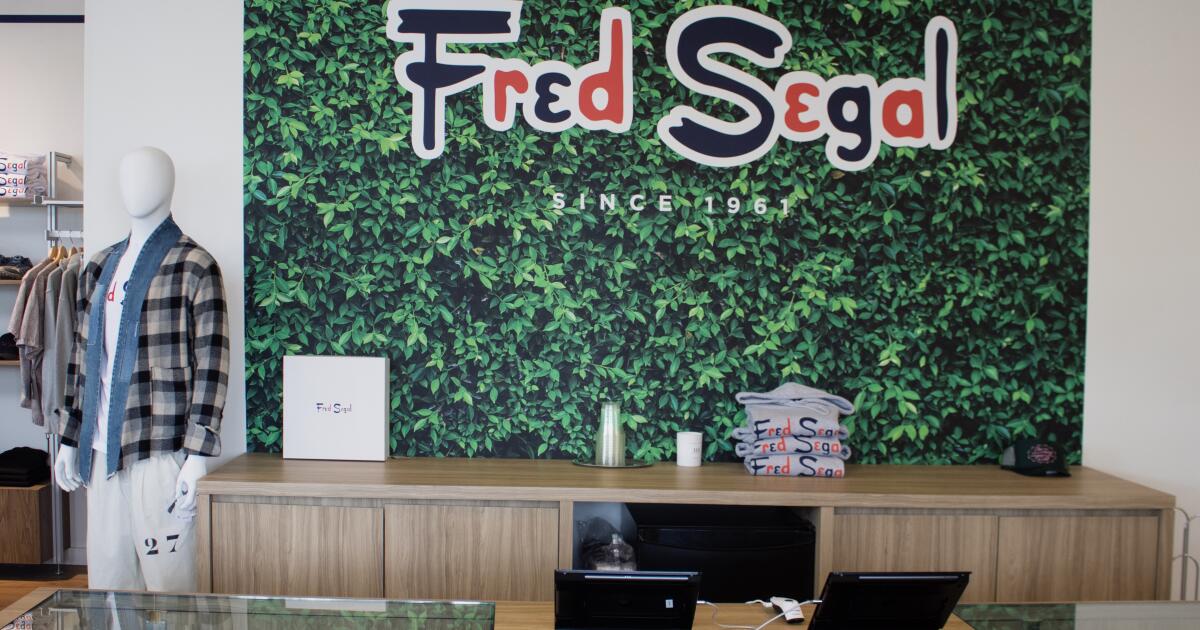
For more than six decades, Fred Segal was a fixture of L.A.’s retail landscape and a pop culture touchstone. Locals and tourists alike flocked to its ivy-covered walls for upscale but laid-back looks that epitomized effortless Southern California style. It was also one of the city’s most reliable hot spots for A-list celebrity sightings, from the Beatles in the 1960s to, more recently, stars including Britney Spears, Kendall Jenner, David Beckham and Jennifer Aniston.
That all but came to an end Tuesday, when Fred Segal shut its two remaining L.A.-area clothing stores: its West Hollywood flagship on Sunset Boulevard and its Malibu location. (A Fred Segal Home showroom in Culver City remains open.) The retailer — which once had nine locations in California and outposts in Switzerland and Taiwan — blamed the lingering financial effects of the pandemic and the challenges of running a multi-brand company that carried nearly 200 labels.
“Things were really going great until COVID hit,” owner Jeff Lotman, who bought Fred Segal in 2019, told The Times in an interview announcing the closures.
Industry watchers and rivals said the brand’s downfall was the result of several missteps. Once at the forefront of cutting-edge L.A. style, Fred Segal had become stagnant and lacked newness, they said. A lack of product differentiation, stiff competition and the shift to e-commerce also contributed to the chain’s demise.
“One of the challenges for us was that 90% of the brands that we carried were available elsewhere online,” Lotman said in a follow-up conversation Thursday. “Margins became very thin.”
In a city where retail stores flame out quickly, Fred Segal for years was able to stay on top of the latest trends — and set many of them, thanks to its visionary founder.
In 1961, the Chicago-born, Los Angeles-raised Fred Segal opened his first store, a 300-square-foot space on Santa Monica Boulevard in West Hollywood. Segal had already been embellishing denim with rhinestones, elevating them from everyday closet staples into something one-off and bespoke, and pioneered an in-store “jeans bar,” a concept that would be copied by rivals around the world.
“When Fred Segal the man opened Fred Segal, it was a truly unique place,” Lotman said. “He invented the fashion jean, pop-up shops and experiential shopping. Also he had brands that were not sold anywhere. It was truly one of a kind. He was the original curator of cool.”
In 1965, having outgrown the original space, Segal relocated to the corner of Melrose Avenue and Crescent Heights Boulevard. By buying up other properties in the area, he cobbled together what would eventually be a 29,000-square-foot complex that kick-started the transformation of that stretch of Melrose into the designer-filled destination it is today.
Segal began to experiment with the then-novel shop-in-shop concept, first tapping employees to take charge of different areas within the store, and later recruiting other retail innovators to fill the warren of disparate spaces, making sure each complemented the others.
“They were influencers before there were influencers, before there was social media,” said Nicole Craig, a professor at the Arizona State University Fashion Institute of Design and Merchandising. “One of the reasons why they were successful is that they curated a lot of really cool, up-and-coming brands.”
Among them: Kate Spade, Juicy Couture, J Brand and Hard Candy, all fledgling businesses when Fred Segal granted them coveted floor and shelf space.
But in recent years, amid the 2019 ownership change, the pandemic and a challenging retail environment that has led to a rash of store closures for brands big and small, Fred Segal struggled.
“It’s much harder to stand out than it used to be,” Craig said. “That’s where Fred Segal lost its way a little bit. They didn’t have enough of that fresh product that you couldn’t get elsewhere.”
Shelda Hartwell, a vice president at the retail and fashion consultancy Doneger Group, said that although consumers value heritage brands with history and name recognition, Fred Segal needed to do more to keep the excitement going.
“They stayed too much in the sameness for too long,” she said. “You had other retailers that were coming in and opening up their first brick-and-mortar stores that were just offering much more of an experience.”
The experiential aspect is even more important nowadays because so much shopping can be done online, said Mac Hadar, buyer and director of operations for H.Lorenzo, a competing boutique retailer with a store a couple of blocks away from the now-shuttered Fred Segal flagship.
“The retail stores that have continued to do well are the ones that are continuing to push the boundaries and push the limits,” Hadar said. “With the rise of online, you can find almost anything, so you have to have a very original point of view and be pretty daring with what you choose to bring into the store.”
Fraser Ross, owner of Kitson, one of Fred Segal’s biggest rivals, called retail “a very hard beast right now.” Successful brands need to figure out how to evolve quickly, he said.
The Fred Segal store in Santa Monica.
(Fred Segal)
“People aren’t shopping the way they did,” he said. “In the days when you didn’t have Instagram and the web, you could open lots of stores in every neighborhood in L.A. But now, you’ve got to be specific in trying to get the traffic through your door.”
One change that Kitson made is that “we’re not really chasing the hottest brands anymore,” Ross said, because those brands can easily be found online.
Instead, Kitson, which was founded in 2000 and now has four L.A.-area stores, has leaned more heavily into exclusive merchandise and SoCal-inspired products and brands that appeal to tourists, such as Aviator Nation, FreeCity and Sol Angeles. Fred Segal, he said, didn’t embrace that lifestyle aesthetic as much.
Fred Segal also failed to amplify its online presence, which hurt the brand’s relevance, said Ilse Metchek, an industry analyst and former president of the California Fashion Assn. She said the company did a poor job of advertising on social media and through fashion influencers, who now play an outsize role in the industry.
“The idea of legacy brands doesn’t appeal as much anymore,” Metchek said. “You’d rather look at something new that Instagram or TikTok is showing you.”
Lotman, who is chief executive of licensing company Global Icons, bought Fred Segal with ambitious plans to open roughly 20 new shops in major cities around the world and oversee a move into home decor and accessories. Before the pandemic, he had pending deals to open stores in Dubai, Canada and Japan.
Now, the future of the storied brand is unclear.
The Segal family owns the Fred Segal trademark, Lotman said, and any decision about whether to open new stores or begin selling online again would be up to them. Two Fred Segal shops at Resorts World in Las Vegas, which Lotman is not involved with, are still operating.
Larry Russ, the family’s attorney, said this is not the end of the road for the brand but could not share more details.
“We are going to be looking for a new operator to open up more stores in the future,” he said.


Shares in Elon Musk’s rocket company SpaceX halted their three-day slide that had erased roughly $600 billion off its market value.
SpaceX shares closed at $156.11 with a nearly 1% gain on Tuesday, a slight recovery from a 16% fall on Monday.
That loss dropped the stock below $160.95, where it ended the day June 12 after a 19% surge during its record initial public offering. The IPO gave it a market cap of $2.2 trillion, making SpaceX one of the world’s most valuable public companies.
It also turned Musk into the world’s first trillionaire, a status he retains despite the sell-off.
The downturn probably reflects investor unease over the company’s spending plans and potential debt load, analysts say.
SpaceX raised a total of $86 billion after underwriters exercised their right to sell additional shares, on top of the $75 billion initially raised. It was the largest IPO in history.
A little more than half a billion shares were distributed to institutional and retail investors at a price of $135, with the stock opening at $150 as some holders immediately flipped shares for a profit.
Shares rose as high as $176.52 during the IPO before settling at the $160.95 price. In the weeks since, shares reached a high of $225.64, meaning that some investors lost money or are underwater with paper losses.
Since the IPO, SpaceX has dropped some big bucks.
It announced last week that it was acquiring AI coding startup Cursor for $60 billion in a deal expected to close in the third quarter. The San Francisco company, founded in 2022, enables engineers to instruct software in English to run coding tasks autonomously.
It also sold $25 billion in bonds on Tuesday , unusual for a company that just went public, much less for one that just raised a record sum.
The IPO surpassed the 2019 offering by Saudi Aramco, Saudi Arabia’s state-owned oil giant, which raised $29.4 billion, the prior record holder.
S&P Global issued a report last week that assigned SpaceX a “BBB” credit rating, the lowest possible rating to qualify as an investment grade credit risk. It noted the company will have “elevated capital expenditure” through 2029.
SpaceX rivals OpenAi and Anthropic filed this month for initial public offerings that, while not expected to be as large as Musk’s company, will be large in their own right.
Wedbush analyst Dan Ives, who has been bullish on SpaceX stock, said the market is digesting “massive debt and equity raises from Big Tech players” in the coming years.
“This is part of an industry wave of debt offerings on Wall Street, like Alphabet and SpaceX among others,” he wrote in an email.
With the stock already giving up gains since the IPO, it will be further tested when tranches of locked-up shares held by current and former employees are released.
At least 20% of the shares will be released after second-quarter results are disclosed sometime in the coming months, with all the lockups expiring in December.
SpaceX, based in Texas, is the leading launch services company in the world, with its Falcon 9 rocket accounting last year for the vast majority of satellites sent into space.
It is also the leading satellite-based broadband provider with its Starlink service. But the extraordinary interest in the IPO was driven by Musk’s plans to make the company an AI leader — including plans to launch orbiting satellite data centers powered by the sun that crunch AI data.
He merged his xAI artificial intelligence company into SpaceX this year, with the combined entity recently announcing it was leasing computer power to rivals Anthropic and Google at two terrestrial data centers it has constructed.
Musk moved the company’s headquarters from Hawthorne to Texas in 2024, but it retains large operations in the South Bay city and blasts off regularly from Vandenberg Space Force Base in Santa Barbara County.
Investment research firm Morningstar placed a $780-billion valuation on SpaceX, focusing on its core rocket and Starlink broadband satellite businesses. It suggested investors wait a few months for the stock to settle before buying in.
“I think the day-to-day stock price movements are usually based on market sentiment,” said report co-author Nicolas Owens, an equity analyst at Morningstar. “So I was not surprised when it went way up right after the IPO — and I’m not surprised it [came down]. Not much has really changed in the fundamentals.”
Mike Alves, founder of Pasadena’s Vida Vision Fund, has a stake in SpaceX that accounts for 46% of his AI and robotics fund.
He said he was not perturbed by the stock drop, noting that Facebook fell under $18 a share just months after its May 2012 IPO closed at $38 a share. It has since risen more than 1,000% above its offering price.
“The volatility doesn’t really matter because you’re going to multiply your best investment many times, so I’m not so worried about it,” he said, adding that investors seeking shares could now “scoop them up at a good deal.”

The nation is awash in data center hate and California is no exception.
Temporary bans have cropped up across the state as residents from Imperial County to San José fight proposals in their communities. Monterey Park became the first city in the country earlier this month to permanently ban data centers by a popular vote. And a recent poll sponsored by the environmental group Net-Zero California showed 70% of state residents don’t want data centers in their communities.
But unlike in Virginia, Texas, Ohio and other states where residents are fighting 400-plus megawatt hyperscaler facilities in their backyards, California has some major barriers keeping data centers at bay.
Sky high industrial electricity prices are more than double the national average. Long wait times to connect to the grid have some new data centers sitting empty in Silicon Valley. And the state regulates the size of the backup generators that keep the centers running when the grid goes down. That has limited most facilities to a fraction of the size that artificial intelligence increasingly demands.
That all means that California is seeing less of a boom — fewer proposed data centers, and smaller in size — than in the country’s hot spots.
“California isn’t even on the map today,” said Mehdi Paryavi, chairman of the International Data Center Authority. “Taxes are high, land is expensive, water is scarce, energy is difficult to find, communities are pushing back. There are all kinds of problems.”
Northern California and Southern California were hubs for an earlier generation of data centers. “But over time, as the sector has grown, the overwhelming majority has been developed elsewhere,” said Andrew Batson, head of data center research at real estate intelligence firm JLL.
“Almost all the data center demand being generated from California is being serviced by adjacent states,” from places such as Phoenix and Las Vegas, Batson said, “where power is much cheaper, land is more affordable, and regulations are quite less.”
Still, “California can’t outsource all it’s data center capacity,” and the state expects to see growth over the coming years.
Fifty-one facilities are currently planned in the state, according to a recent study from the Pew Research Center, an 18% increase over the 277 operating today. According to a study from UC Riverside, data center electricity use in the state doubled between 2019 and 2023.
But some grid operators elsewhere are already seeing overwhelming loads, such as the Pennsylvania-New Jersey-Maryland Interconnection that expects about 40% to be added to its total demand, largely from data centers, by 2035. Compare that to the California Energy Commission which expects data centers to drive an increase of about 2 gigawatts by 2030, and 5 GW by 2040. That’s about 4 and 9% of its 52 GW peak load respectively.
“It’s a significant amount of demand growth, but it’s not dwarfing all the other factors,” said Mark Specht, a senior energy manager at the Union of Concerned Scientists who put out a report on California data center growth last month. “Some of the projections we’re seeing for increased electricity demand from electric vehicles in 2045 is actually higher than the demand from data centers.”
California regulations are part of what’s keeping data centers relatively small: A state rule requires any backup generator bigger than 100 megawatts to be certified as a power plant.
Specht’s report found none of the current data centers in California and almost none of the proposed ones require that certification because they fall under the 100 MW cap. (Exceptions include a 417 MW planned facility in Santa Clara and a 330 MW one in Imperial County blocked Tuesday by a moratorium vote.)
One hundred MW could power a small city’s peak demand, yet the average U.S. data center is expected to demand over 600 MW by 2030, according to the energy intelligence company Cleanview.
A San Francisco Chronicle analysis showed that California facilities currently make up about 5% of national data center power demand, but that share is expected to fall to 1% if building proceeds as planned across the country.
Still, the growth that does exist is raising concerns among utility ratepayer advocates and environmentalists, not to mention the general public.
“There are real costs at stake,” said Mark Toney executive director at The Utility Reform Network, a ratepayer advocacy group.
He noted Pacific Gas & Electric anticipates a massive amount of new demand from data centers — about 10 GW worth — or enough to power 7.5 million homes. That would require grid upgrades he estimates at about $10 billion, partly borne by ratepayers. Interest has been high in PG&E territory because it serves the San Francisco Bay area, where California’s projected data center buildout is concentrated around San Jose, now that Santa Clara has reached capacity.
Data center electricity projections come with uncertainty, and PG&E says its confirmed large load in the pipeline — mostly data centers — is closer to 5.3 GW.
Whatever demand materializes, TURN and others are fighting to shield ratepayers from the costs of PG&E’s buildout, a battle playing out at the Public Utilities Commission.
PG&E spokesperson Rob Stillwell said data centers help reduce rates by spreading the costs of grid maintenance over more customers. He noted data centers already have to pay the up front costs of connecting to the grid, under a temporary rule.
But TURN says those don’t include all of the infrastructure and broader grid updates that PG&E will have to invest in to support data centers.
And the rule only applies for PG&E territory and doesn’t require data centers to bring their own clean power.
TURN is now backing a bill from State Sen. Steve Padilla (D-Chula Vista) that would require all data centers to pay for 100% of the costs of new transmission upgrades as well as new clean energy to cover at least half their required electricity. The industry is opposing the effort.
Another Padilla bill would approve data centers faster if they use more clean energy. One from Assemblymember Rebecca Bauer-Kahan (D-Orinda), would require data centers to disclose their energy use to the state. And bills by Assemblymember Diane Papan (D-San Mateo) would require them to project and report their water use as part of permitting and licensing.
Yet politicians have been hesitant to regulate. Last year, similar bills were either watered down, didn’t make it through the legislature or were vetoed by Gov. Gavin Newsom.
At a panel in January, gubernatorial candidates were asked how they would balance environmental concerns about data centers with their potential to drive economic activity.
“We have to make sure that those data centers are paying their fair share,” said Xavier Becerra, adding that businesses need to move away from diesel backup generators.
Former candidate Tom Steyer of San Francisco answered with a dodge or a dose of realism, depending on your view.
“What data centers are looking for is cost to compute and speed to compute, and the good news is that California’s energy is so expensive on a cost basis, they’ll never come here,” Steyer said. “We may talk all we want about data centers, but they’re not coming.”

Bed Bath & Beyond is looking to stage a comeback as the decades-old company reopens stores in partnership with the Container Store in 22 cities, including two in Southern California.
To the delight of die-hard fans and coupon collectors, for a limited time the new stores will accept the chain’s blue and white coupons, no matter how old they are.
Customers can use their expired coupons until July 13. The company is also holding a contest to find the oldest coupon out there, with a prize of a home renovation worth $100,000.
“For decades, our customers treated these coupons like treasure,” said Bed Bath & Beyond Inc. President Amy Sullivan in a statement Monday. “They tucked them into purses, filing cabinets, cookbooks and memory boxes because they believed they would be valuable someday. We think they were right.”
Bed Bath & Beyond, which sells home goods including towels and kitchen gadgets, filed for bankruptcy in 2023 and shut down all its locations. Following its bankruptcy, Bed Bath & Beyond was bought by Overstock.com, which has since rebranded to Beyond, Inc.
The company announced the first phase of its brick-and-mortar reopenings last week. In addition to stores in New York, Colorado, Illinois and other states, two locations will open in California in the coming weeks in Costa Mesa and Century City in Los Angeles.
Over the last few years, social media users lamented that they could not use their expired Bed Bath & Beyond coupons.
“Found my entire stash of Bed bath and beyond coupons today,” one Reddit user said earlier this year. “Sad I never got to use them.”
Another Reddit user said they found a large stack of expired coupons two years ago. “I know I should probably toss them out at this point, but they were fun to collect,” they wrote.
In 2025, Beyond, Inc.’s executive chairman Marcus Lemonis vowed he would never reopen stores in California due to the “over-regulated, expensive” business environment. He ruled out future retail stores in the state in a statement posted on X last August.
Less than a year later, however, the company announced 12 planned storefronts in the Golden State, including five in Southern California. The new stores, dubbed Bed Bath & Beyond + The Container Store, will offer home organizational products as well as bed sheets, pillows and more.
Gov. Gavin Newsom welcomed the retailer back to the state.
“With a thriving economy growing faster than all other developed nations, California always reaches out with an open hand — not a closed fist,” he posted on X in April.
The Container Store filed for bankruptcy in 2024 and emerged from it in early 2025. Bed Bath & Beyond acquired the Container Store in April for about $150 million in stock and convertible notes, part of the company’s attempt at a comeback after its own bankruptcy.
“Our customers don’t think about their homes in categories,” Lemonis said in a statement. “By bringing Bed Bath & Beyond and The Container Store together, we’re creating a destination where customers can buy products, organize their spaces, design custom solutions and access services all under one roof.”
-
 News10 minutes ago
Appeals court allows Trump administration expanded use of speedy deportations
-

 Los Angeles, Ca1 hour ago
‘What’s going on with our society?’ Elderly L.A. street vendor violently beaten
-

 Detroit, MI2 hours ago
Trailblaze Detroit: Blazing New Trails while Backpacking Metro Detroit | Visit Detroit | Visit Detroit
-

 San Francisco, CA2 hours ago
Giants open to moving big names before Trade Deadline
-

 Dallas, TX2 hours ago
Reports: Mavericks acquire Sergio De Larrea in four-team Draft night trade
-

 Miami, FL2 hours ago
Miami Gardens police make arrest in cold case murder from 2019
-

 Boston, MA2 hours ago
Woman killed in Mattapan carjacking crash honored at vigil
-

 Denver, CO2 hours ago
Nuggets trade 26th pick in NBA Draft to Spurs, moving out of first round

