Business
Commentary: Crypto was already in bad odor before jumping into bed with Trump. Now it smells worse


One problem that promoters of cryptocurrencies have faced since the asset class first emerged is that its reputation stinks.
Crypto trading has become identified by regulators and in the public mind as a haven for scams, theft and other forms of sharp practice. The FBI, in its most recent annual report on cryptocurrency, found that crypto-related fraud has exploded. Criminality is “pervasive” in the field, the agency warned.
The elusive use case for crypto assets seemed to have been narrowed down to facilitating criminal fraud, ransomware attacks, drug and human trafficking.
Trump’s cryptocurrency ventures are nothing more than a fig leaf for pay offs from foreign nationals.
— Sen. Richard Blumenthal (D-Conn.)
Then came Donald Trump. During the presidential campaign and after his election, crypto promoters thought they were entering the nirvana of officially recognized legitimacy.
Trump signaled that he would end government regulatory initiatives on crypto, “in order to promote United States leadership in digital assets and financial technology while protecting economic liberty,” to quote the executive order he issued Jan. 23, effectively wiping out federal regulations on the class.
Things aren’t working out as they hoped. Since Trump returned to the presidency, his and his family’s involvement in crypto-related deals has critics charging that crypto has become an entirely new path for official corruption and conflicts of interest in the White House.
“Trump’s cryptocurrency ventures are nothing more than a fig leaf for payoffs from foreign nationals & foreign gov’ts,” Sen. Richard Blumenthal (D-Conn.) tweeted on May 7. Blumenthal’s target was the offer of a sit-down private dinner with Trump scheduled for May 22 at his Virginia golf club, and personal tours of the White House for the biggest buyers of $TRUMP, a “memecoin” assiduously promoted by Trump and his family.
The price of the coin soared to about $74 on Jan. 19, the day before Trump’s inauguration. It immediately fell in value, though its price has been propped up by the offer of the dinner and tours; the most recent quotes place it at about $13. The top 220 holders of the Trump coin, who are entitled to the dinner, spent nearly $148 million for the privilege, according to an estimate by Reuters.
More than half of the biggest holders appear to be foreign entities, according to an analysis by Bloomberg. That implies that the purchases might be designed to circumvent federal laws barring foreigners from making political contributions in the U.S.
Democratic Sens. Adam Schiff of California and Elizabeth Warren of Massachusetts demanded that the federal Office of Government Ethics, an independent executive branch agency, open an inquiry into the “severe risk that President Trump and other officials may be engaging in ‘pay to play’ corruption by selling presidential access to individuals or entities, to include foreign nationals and corporate actors with vested interests in federal action, while personally enriching the President and his family.”
DWF, a crypto firm based in the United Arab Emirates, announced last month that it had bought $25 million in coins issued by the Trump-affiliated firm World Liberty Financial, in part to “enhance regulatory engagement with U.S. policymakers.” Freight Technologies, a Houston logistics company, announced April 30 that it had borrowed $20 million to buy Trump coins, calling the transaction “an effective way to advocate for fair, balanced, and free trade between Mexico and the US.”
The unease has spread to Republicans on Capitol Hill, who fear that the Trumps’ crypto deals will undermine their efforts to enact crypto-friendly regulations.
“This gives me pause,” Sen. Cynthia Lummis (R-Wyo.), a leader in the legislative movement to pass a pro-crypto law, told NBC News. “Even what may appear to be ‘cringey’ with regard to meme coins, it’s legal, and what we need to do is have a regulatory framework that makes this more clear, so we don’t have this Wild West scenario.”
Trump’s activities already have derailed, if temporarily, the so-called GENIUS Act, which would regulate a form of cryptocurrency known as “stablecoins,” which are supposedly pegged to the value of underlying currencies such as dollars. Schiff and eight other Senate Democrats who had supported the measure have bailed on it, making passage in its current form virtually impossible.
Democrats in both chambers have introduced the “End Crypto Corruption Act,” which would bar the president, vice president, members of Congress and high-level executive branch appointees from issuing, sponsoring or endorsing any “cryptocurrency, meme coin, token, non-fungible token, stablecoin, or other digital asset that is sold for remuneration.”
Even some crypto promoters are no happier than the politicians. “They’re plumbing new depths of idiocy with the memecoin launch,” Nic Carter, a crypto investor and Trump supporter, told Politico.
As a crypto category, memecoins are disdained even by many participants in the field. They generally have even less utiilty or authenticity than mainstream cryptocurrencies, often originate as joke investments, and ride waves of pure hype. The Trump coin has no discernible value apart from its identification with Trump himself.
I asked the White House for comment on the accusations of corruption and received this reply from spokeswoman Karoline Leavitt: “President Trump is compliant with all conflict-of-interest rules, and only acts in the best interests of the American public.”
The memecoin isn’t Trump’s only venture into crypto, though some of his arrangements seem designed to give him plausible deniability if legal or ethics questions are raised. World Liberty Financial, which markets a crypto token designated $WLFI and a stablecoin designated USD1, is 60% owned by Trump and members of his family, who are entitled to up to 75% of the proceeds of sales of $WLFI.
The firm’s website features an image of Trump striking a heroic pose and says the WLFI token is “inspired by Donald J. Trump.” In the small print it asserts, however, that “any references to or quotes or imagery attributed to or associated with Donald J. Trump or his family members should not be construed as an endorsement or representation or warranty.”
Crypto investors really stepped up to the plate with political donations during the 2024 election cycle. Fairshake, the super PAC representing the class, spent nearly $41 million in contributions. That included $13 million to defeat two congressional candidates in Democratic primaries, Rep. Katie Porter (D-Irvine) and Rep. Jamaal Bowman (D-New York). Both were known to favor stricter regulation of the asset class, and both lost their races.
The biggest crypto firms spent lavishly in 2023 and 2024 to fatten Fairshake’s war chest, which collected more than $162 million in that time frame; Coinbase contributed $46.5 million, Ripple Labs, $45 million and Andreessen Horowitz, a major crypto investor, $44 million. Much of the total was funneled to two other crypto-related political action committees, according to federal election records.
After the election, many of the firms, like more traditional businesses, made contributions of $1 million or more to Trump’s inauguration fund.
One can hardly deny that the crypto camp has gotten its money’s worth from the Trump administration so far. The Securities and Exchange Commission has dropped or deferred more than a dozen enforcement cases against Ripple, Coinbase, Gemini, Kraken and other crypto promoters.
The largest victory arguably belongs to Coinbase, the biggest crypto trading platform in the U.S. The SEC in 2023 charged the firm with running an unlawful trading exchange and marketing unregistered securities. The case reflected the SEC’s position that what crypto firms are marketing are securities by a different name, and thus need to be registered as securities so buyers and sellers get the same legal protections as stock and bond investors.
A federal judge in New York cleared the enforcement action to move ahead in 2024, after finding that the SEC had made a plausible case that Coinbase was operating illegally. The SEC dropped the case in February. Coinbase had asserted that the SEC was wrong “on the facts and the law,” and that “the case should never have been filed in the first place.”
Earlier this month, the agency settled its case against Ripple, which it had charged in 2020 with having raised $1.3 billion through unregistered securities. As part of the settlement, the SEC agreed to return to Ripple $75 million of a $125-million penalty it held in escrow. The settlement elicited a crisp rebuke from Commissioner Caroline A. Crenshaw, a member of the commission’s Democratic minority.
Crenshaw noted that the deal was part and parcel of the SEC’s effective abandonment of crypto regulation. “This settlement, alongside the programmatic disassembly of the SEC’s crypto enforcement program, does a tremendous disservice to the investing public,” she wrote.
That won’t be the end of the deregulation drive. On April 7, Deputy Atty. Gen. Todd Blanche — who was Trump’s defense attorney in the New York criminal case that resulted in guilty verdicts on 34 felony counts of falsifying business records — ordered an end to Justice Department regulatory cases based on interpreting crypto assets as securities or commodities. That closed down the government’s principal regulatory initiative against crypto promoters.
Blanche directed the DOJ’s Market Integrity and Major Frauds Unit to “cease cryptocurrency enforcement,” and disbanded the National Cryptocurrency Enforcement Team, “effective immediately.”
There doesn’t seem to be any sign that Trump’s involvement with crypto will slow down even as he disembowels the government’s regulatory capacity over crypto ventures.
World Liberty Financial recently announced that Abu Dhabi would use its stablecoin to invest $2 billion in Binance, a multinational crypto firm that pleaded guilty and paid a $4.3-billion penalty in 2023 on charges of financial crimes including money laundering. Binance’s chief executive, Changpeng Zhao, also pleaded guilty and spent four months in U.S. prison.
Last month, the SEC put its civil case against Binance on hold for at least 60 days.
On its investor advice webpage, the SEC used to post a warning on its website about crypto. “Trendy investments are especially ripe for fraudsters so be aware there is a real risk of fraud,” it said. “Cryptocurrencies may be today’s shiny, new opportunity but there are serious risks involved.”
That page has been taken down.





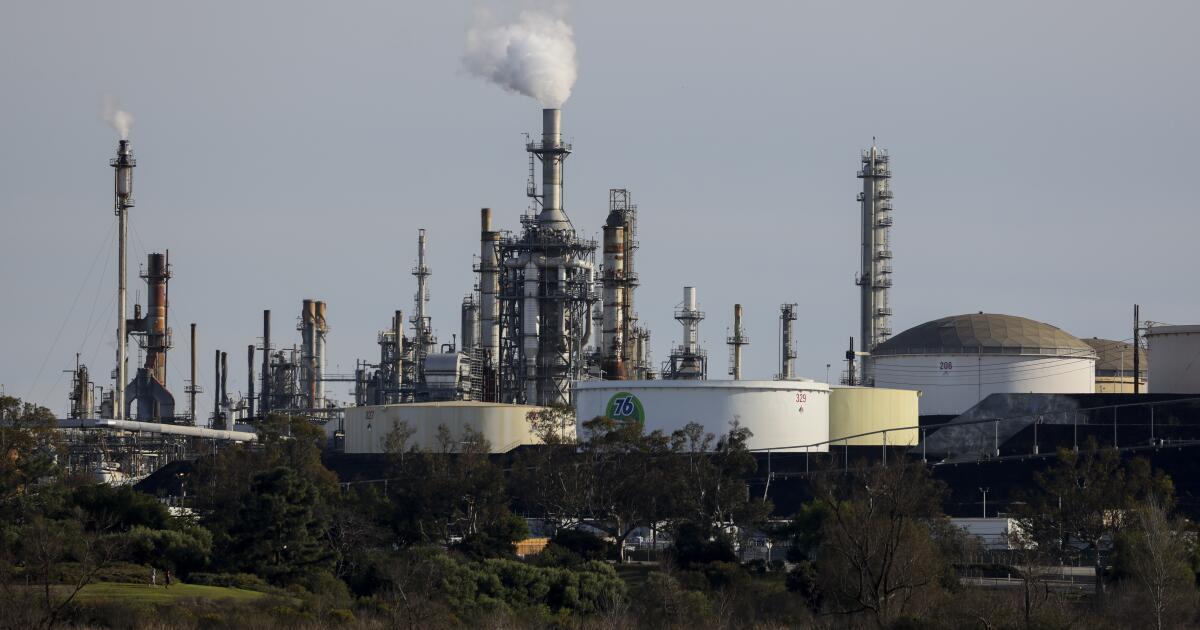
The U.S. attack on Iran is expected to have an unwelcome impact on California drivers — a jump in gas prices that could be felt at the pump in a week or two.
The outbreak of war in the Middle East, which virtually closed a key Persian Gulf shipping lane, spiked the price of a barrel of Brent crude oil by as much as $10, with prices rising as high as $82.37 on Monday before settling down.
The price of the international standard dictates what motorists pay for gas globally, including in California, with every dollar increase translating to 2.5 cents at the pump, said Severin Borenstein, faculty director of the Energy Institute at UC Berkeley’s Haas School of Business.
That would mean drivers could pay at least 20 cents more per gallon, though how much damage the conflict will do to wallets remains to be seen.
“The real issue though is the oil markets are just guessing right now at what is going to happen. It’s a time of extreme volatility,” Borenstein said. “We don’t know whether the war will widen or end quickly, and all of those things will drive the price of crude.”
President Trump has lauded the reduction of nationwide gas prices as a validation of his economic agenda despite worries about a weak job market and concerns of persistent inflation.
The upheaval in the Middle East could be more acutely felt in the state.
Californians already pay far more for gas than the rest of the country, with the average cost of a gallon of regular at $4.66, up 3 cents from a week ago and 30 cents from a month ago, according to AAA. The current nationwide average is about $3 per gallon.
The disruption in international crude markets also comes as refiners are switching to producing California’s summer-blend gas, which is less volatile during the state’s hot summers. The switch can drive up the price of a gallon of gas at least 15 cents.
The prices in California are largely driven by higher taxes and a cleaner, less polluting blend required year-round by regulators to combat pollution — and it’s long been a hot-button issue.
The politics were only exacerbated by recent refinery closures, including the Phillips 66 refinery in Wilmington in October and the idling and planned closure of the Valero refinery in Benicia, Calif., which reduced refining capacity in the state by about 18%.
California also has seen a steady reduction in its crude oil production, making it more reliant on international imports of oil and gasoline.
In 2024, only 23.3% of the crude oil refined in the state was pumped in California, with 13% from Alaska and 63% from elsewhere in the world, including about 30% from the Middle East, said Jim Stanley, a spokesperson for the Western States Petroleum Assn.
“We could see a supply crunch and real price volatility” if the Middle East supply is interrupted, he said.
The Strait of Hormuz in the Persian Gulf, through which about 20% of the world’s oil passes, was virtually closed Monday, according to reports. Though it produces only about 3% of global oil, Iran has considerable sway over energy markets because it controls the strait.
Also, in response to the U.S. attack, Iran has fired a barrage of missiles at neighboring Persian Gulf states. Saudi Arabia said it intercepted Iranian drones targeting one of its refinery complexes.
California Republicans and the California Fuels & Convenience Alliance, a trade group representing fuel marketers, gas station owners and others, have blamed Gov. Gavin Newsom’s policies for driving up the price of gas.
A landmark climate change law calls for California to become carbon neutral by 2045, and Newsom told regulators in 2021 to stop issuing fracking permits and to phase out oil extraction by 2045. He also signed a bill allowing local governments to block construction of oil and gas wells.
However, last year Newsom changed his stance and signed a bill that will allow up to 2,000 new oil wells per year through 2036 in Kern County despite legal challenges by environmental groups. The county produces about three-fourths of the state’s crude oil.
Borenstein said he didn’t expect that the new state oil production would do much to lower gas prices because it is only marginally cheaper than oil imported by ocean tankers.
Stanley said the aim of the law was to support the Kern County oil industry, which was facing pipeline closures without additional supplies to ship to state refineries.
Statewide, the industry supports more than 535,000 jobs, $166 billion in economic activity and $48 billion in local and state taxes, according to a report last year by the Los Angeles County Economic Development Corp.
Bloomberg News and the Associated Press contributed to this report.

Fintech company Block said Thursday that it’s cutting more than 4,000 workers or nearly half of its workforce as artificial intelligence disrupts the way people work.
The Oakland parent company of payment services Square and Cash App saw its stock surge by more than 23% in after-hours trading after making the layoff announcement.
Jack Dorsey, the co-founder and head of Block, said in a post on social media site X that the company didn’t make the decision because the company is in financial trouble.
“We’re already seeing that the intelligence tools we’re creating and using, paired with smaller and flatter teams, are enabling a new way of working which fundamentally changes what it means to build and run a company,” he said.
Block is the latest tech company to announce massive cuts as employers push workers to use more AI tools to do more with fewer people. Amazon in January said it was laying off 16,000 people as part of effort to remove layers within the company.
Block has laid off workers in previous years. In 2025, Block said it planned to slash 931 jobs, or 8% of its workforce, citing performance and strategic issues but Dorsey said at the time that the company wasn’t trying to replace workers with AI.
As tech companies embrace AI tools that can code, generate text and do other tasks, worker anxiety about whether their jobs will be automated have heightened.
In his note to employees Dorsey said that he was weighing whether to make cuts gradually throughout months or years but chose to act immediately.
“Repeated rounds of cuts are destructive to morale, to focus, and to the trust that customers and shareholders place in our ability to lead,” he told workers. “I’d rather take a hard, clear action now and build from a position we believe in than manage a slow reduction of people toward the same outcome.”
Dorsey is also the co-founder of Twitter, which was later renamed to X after billionaire Elon Musk purchased the company in 2022.
As of December, Block had 10,205 full-time employees globally, according to the company’s annual report. The company said it plans to reduce its workforce by the end of the second quarter of fiscal year 2026.
The company’s gross profit in 2025 reached more than $10 billion, up 17% compared to the previous year.
Dorsey said he plans to address employees in a live video session and noted that their emails and Slack will remain open until Thursday evening so they can say goodbye to colleagues.
“I know doing it this way might feel awkward,” he said. “I’d rather it feel awkward and human than efficient and cold.”

The Writers Guild of America West has canceled its awards ceremony scheduled to take place March 8 as its staff union members continue to strike, demanding higher pay and protections against artificial intelligence.
In a letter sent to members on Sunday, WGA West’s board of directors, including President Michele Mulroney, wrote, “The non-supervisory staff of the WGAW are currently on strike and the Guild would not ask our members or guests to cross a picket line to attend the awards show. The WGAW staff have a right to strike and our exceptional nominees and honorees deserve an uncomplicated celebration of their achievements.”
The New York ceremony, scheduled on the same day, is expected go forward while an alternative celebration for Los Angeles-based nominees will take place at a later date, according to the letter.
Comedian and actor Atsuko Okatsuka was set to host the L.A. show, while filmmaker James Cameron was to receive the WGA West Laurel Award.
WGA union staffers have been striking outside the guild’s Los Angeles headquarters on Fairfax Avenue since Feb. 17. The union alleged that management did not intend to reach an agreement on the pending contract. Further, it claimed that guild management had “surveilled workers for union activity, terminated union supporters, and engaged in bad faith surface bargaining.”
On Tuesday, the labor organization said that management had raised the specter of canceling the ceremony during a call about contraction negotiations.
“Make no mistake: this is an attempt by WGAW management to drive a wedge between WGSU and WGA membership when we should be building unity ahead of MBA [Minimum Basic Agreement] negotiations with the AMPTP [Alliance of Motion Picture and Television Producers],” wrote the staff union. “We urge Guild management to end this strike now,” the union wrote on Instagram.
The union, made up of more than 100 employees who work in areas including legal, communications and residuals, was formed last spring and first authorized a strike in January with 82% of its members. Contract negotiations, which began in September, have focused on the use of artificial intelligence, pay raises and “basic protections” including grievance procedures.
The WGA has said that it offered “comprehensive proposals with numerous union protections and improvements to compensation and benefits.”
The ceremony’s cancellation, coming just weeks before the Academy Awards, casts a shadow over the upcoming contraction negotiations between the WGA and the Alliance of Motion Picture and Television Producers, which represents the studios and streamers.
In 2023, the WGA went on a strike lasting 148 days, the second-longest strike in the union’s history.
Times staff writer Cerys Davies contributed to this report.

Commentary: Will Klein isn’t surprised he saved the Dodgers’ World Series dynasty

Is Iran expanding attacks to target energy and civilian sites in the Gulf?

Trump claims US stockpiles mean wars can be fought ‘forever’; Kristi Noem testifies before Congress – US politics live

Ohio courtroom devolves into chaos after sentencing in death of teen

Travis County DA faces renewed ‘soft on crime’ criticism after career criminal charged with murder

Florida High School Football Rankings: Top 25 teams – Oct. 21

Cleary's 21 help Le Moyne down Central Connecticut State 69-64 in OT

How old is Bo Nix? What to know about Oregon quarterback ahead of 2024 NFL Draft

99th annual Pony Swim held in Virginia

Indiana Members Credit Union announced as new anchor tenant at Bottleworks District
Is Iran expanding attacks to target energy and civilian sites in the Gulf?
Trump claims US stockpiles mean wars can be fought ‘forever’; Kristi Noem testifies before Congress – US politics live

War in the Middle East: Iran’s broad retaliation in the Gulf • FRANCE 24 English

Trump sends official notification to Congress on strikes against Iran

Unexpected birth brings hope to near-extinct Amazon tribe
-

 World5 days ago
Exclusive: DeepSeek withholds latest AI model from US chipmakers including Nvidia, sources say
-

 Massachusetts6 days ago
Mother and daughter injured in Taunton house explosion
-

 Denver, CO6 days ago
10 acres charred, 5 injured in Thornton grass fire, evacuation orders lifted
-

 Louisiana1 week ago
Wildfire near Gum Swamp Road in Livingston Parish now under control; more than 200 acres burned
-

 Oregon4 days ago
2026 OSAA Oregon Wrestling State Championship Results And Brackets – FloWrestling
-

 Technology1 week ago
Arturia’s FX Collection 6 adds two new effects and a $99 intro version
-

 News1 week ago
Video: How Lunar New Year Traditions Take Root Across America
-

 Florida2 days ago
Florida man rescued after being stuck in shoulder-deep mud for days