Business
Battered by ICE raids, L.A.’s Fashion District desperately needs Black Friday miracle

Lizzie Osorio remembers customers flooding Lion Boots in early May, browsing embroidered shoes and tasseled suede dresses.
Beyoncé had four concerts scheduled in Los Angeles at SoFi Stadium for her Cowboy Carter tour. So the store tucked in Santee Alley, where 24-year-old Osorio works selling cowboy boots and other Western-style clothing, was the perfect stop for fans.
Osorio expected, or perhaps hoped, the store would see similar traffic at the start of the Thanksgiving holiday week.
After the tumult of President Trump’s immigration crackdown, that remains to be seen. Over the summer, several raids in the neighborhood sparked protests. But the mass arrests and fears of deportation turned the Fashion District into a ghost town for several weeks after, with storefronts shuttered and frightened workers staying home.
The story was the same in other business districts that cater to immigrants. Although conditions have improved in recent months, merchants are still feeling the pain and in desperate need of a holiday retail miracle.
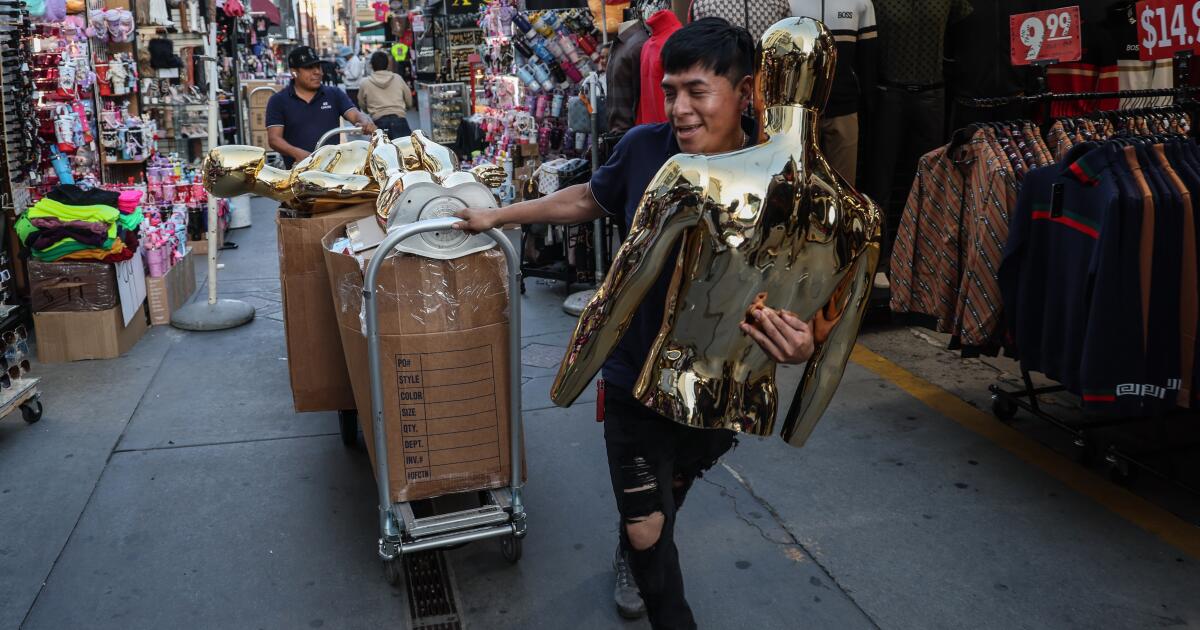
Shoppers stroll through the Santee Alley in downtown’s Fashion District where business owners are working to recover from losses caused by recent immigration enforcement.
Local officials and activists are encouraging people to shop on Black Friday and beyond, including by holding a festival over the weekend. But it remains unclear how many will feel safe enough to come out.
Some merchants are “living sale to sale, customer to customer,” said Anthony Rodriguez, president of the Fashion District’s business improvement district, a private group of property owners in the area.
“These aren’t big-box stores,” Rodriguez said. “These are family-owned and, in some cases, generational businesses that more than ever need L.A.’s support. If people can come down and just spend $10 to $15 … that’s how we can make a difference.”
On Monday, Osorio said she made just one sale: a pair of utility boots.
She opened the store at 9:30 a.m. and sold the boots at around 2 p.m. They had been marked down $30 from their typical price of $160 because customers have been so reluctant to spend money, she said.
“We are waiting for the good times,” Osorio said. “Honestly, I felt like it was going to be better this week, but it’s been really, really slow. We just pray and keep the faith. Let’s see what happens.”
Small businesses in the area — which includes the historically vibrant, bustling open-air shopping corridor Santee Alley, known for bargain prices — are looking for ways to recoup some of their losses through holiday sales.

Shoppers stroll along Santee Alley in downtown’s Fashion District. More than half a dozen businesses in the alley and on Santee Street said their sales remained down after the onslaught of federal immigration raids, with some doing better than others.
Foot traffic in the area is back at levels seen before federal immigration raids began in Los Angeles in early June, according to the business improvement district.
But Rodriguez said traffic fluctuates day to day and is “at the mercy” of rumors, at times false, of federal enforcement operations circulated among group chats of merchants and community members.
Such alerts prompt businesses to shut down at a moment’s notice with “people literally running from their stores,” Rodriguez said. He said that, one day, agents from the U.S. Fish and Wildlife Service were conducting an investigation in the area and were confused for Customs and Border Protection officers.
Rodriguez said there are “very valid reasons” to pay attention to alerts but that minimizing their harmful effects is crucial for economic recovery.
Visitors to stores and businesses in the Fashion District dropped dramatically in the week or so after the initial raids on June 6. Foot traffic in the Fashion District dropped 33% while visitors to Santee Alley specifically dropped by 50%, according to the business improvement district.
Rodriguez said it took at least three weeks to recover foot traffic, and even so, vendors are struggling because “people are not spending like they used to.”
And the typical holiday boost has yet to make an appearance, Rodriguez said.
“As of right now, we are not seeing the holiday spike we have seen in previous years,” he said.
In May, the Fashion District saw some 1.98 million visitors, while in June that number dropped to 1.2 million, according to the group. In September, the district saw 1.3 million visitors, far below the the 1.5 million the area saw in the same period last year.

Santee Alley in downtown’s Fashion District where business owners are working to recover from losses caused by recent immigration enforcement.
Pop music blared from open doors on Monday afternoon on Santee Street as the light faded. A smattering of storefronts were closed, but most were open, ready to welcome tourists and local families doing their holiday shopping. Clumps of customers gathered. The alley was lively compared with the weeks after the first summer raids.
Maria Fuertes, 43, and her daughter had prowled the area for more than seven hours, since 9 a.m., shopping for outfits for a December wedding. They had made the more-than-hourlong trek from Eastvale in Riverside County to look for formal dresses and shoes. Fuertes said she often shops in the area around the holidays and that it “feels empty” compared to years past.
“It’s kind of creepy and lonely,” Fuertes said.
More than half a dozen businesses in the alley and on Santee Street told The Times their sales remained down after the onslaught of federal immigration raids, with some doing better than others. A lingerie shop saw a dip but not a severe one, with online sales remaining strong. The owner of an accessories store said business was down 30%, while an employee at a jewelry store said business was down 70%.
A local merchants association known as Somos los Callejones and the Los Angeles Tenants Union partnered with Councilmember Ysabel Jurado to host a street festival Saturday in an effort to attract customers in the lead-up to Black Friday.
According to Jurado’s office, the festival drew some 500 attendees. Vendors set up booths and racks of clothing along Olympic Boulevard between Santee Street and Maple Avenue, which was closed to vehicle traffic. The event featured live music, and organizers raffled off 10 turkeys.

Shoppers stroll along Maple Avenue in downtown’s Fashion District.
The raffling of turkeys highlighted the food insecurity many families in the area are facing, Jurado said in an interview. Some have lost their primary breadwinners to the Trump administration’s deportation efforts, and children have begun to skip school to keep their households afloat.
“Some were so excited to win [turkeys],” Jurado said, adding that the food insecurity “has been really sobering.”
“These are the realities that people are continuing to grapple with,” she said, “as their loved ones have been taken.”
Businesses said they were marketing deals when possible — and emphasizing customer service.
The California Mirage Jewelry Design Center, which is on prime real estate at the entrance to Santee Alley and has been in operation since the 1990s, has been offering 30% off on all items since last week, a promotion that will last through Black Friday.
Carolina Medrano, 38, a store employee who on Monday evening rearranged twinkling gold chains, said that even with the discount, business had been “super slow.”
“I believe everybody is struggling,” said Jessica Morales, 40, an employee at a nearby dress retailer who asked that the store not be named, since she didn’t have permission from her supervisor.
As she used a long pole with a hook to hang a glittery pink dress on a high rack, Morales noted that some customers had become more aggressive in trying to negotiate a lower price, threatening to go to other vendors.
She tries to emphasize the quality and variety of the store’s dresses, and that some other nearby retailers are no longer able to afford to keep their inventory well-stocked.
Some customers talk of quinceañeras being canceled, or their husbands telling them to stay home from parties for fears of raids, Morales said.
“People are trying to save their money. Everyone’s scared to come out,” Morales said. “You have to find a way to connect with customers.”

Women’s attire on display at the corner of Olympic Boulevard and Maple Avenue in downtown’s Fashion District where business owners are working to recover from losses caused by recent immigration enforcement.
The hit to sales in the aftermath of immigration raids comes as the local economy is already suffering, weakened by the rise of e-commerce, tourism disruptions from COVID-19 lockdowns and inflationary and other economic pressures pushing consumers to spend less.
Ilse Metchek, a former president of the California Fashion Assn. who has worked in the industry since the 1950s, said the merchandise sold in Santee Alley had changed in recent years. It shifted from the good-quality excess products of local brands — which were then sold at bargain prices — to imitation or cheap goods often imported from abroad.
Famously, Richard Riordan, who served as mayor of Los Angeles from 1993 to 2001, “took a very publicized walk [through Santee Alley] where he paid $10 for a silk shirt and made a whole big to-do about it,” Metchek said.
The move by then-President Reagan to grant amnesty, giving legal status and a path to citizenship to many immigrants lacking authorization, helped pave the way for a booming fashion economy, she said.
Immigration crackdowns in recent years, regulations that have increased labor costs and China’s manufacturing boom in the early 2000s have created a difficult economy for California fashion brands and workers.
“It’s a pity,” Metchek said. “There’s a clear pattern of why and what has happened here. This is not nuclear physics.”
Gloria Andrade, 53, owns a business selling makeup, accessories and miscellaneous electronics in the Maple Alley Fashion Center in downtown L.A. that has operated for some 25 years. In May, her family opened up a second storefront nearby in Santee Alley, without anticipating the raids and resulting downturn.

A view of the corner of Olympic Avenue and Santee Street in downtown’s Fashion District where business owners are working to recover from losses caused by recent immigration enforcement.
Andrade said the rent for her new location is about $4,500, and that she’s two months behind. Many neighboring businesses are in a similar situation, she said.
“It’s the first day of vacation and nobody came,” she said of the Thanksgiving holiday. “We’ll wait for Christmas to see how it goes.”



Robotaxis could be turning into robocops.
A self-driving Waymo reported two teens to San Mateo, Calif., police on Monday after they were found drinking alcohol and shooting toy guns in the back of the vehicle.
According to a social media post from the San Mateo Police Department, officers detained two 15-year-olds after the Waymo they were riding in contacted the department and stopped in a parking lot until law enforcement arrived.
“Parents do you know where your teens are?” the San Mateo Police Department wrote on Facebook following the incident. “Waymo does!”
Officers removed both teens from the vehicle and determined they were using toy guns to shoot Orbeez out the windows. Orbeez are small, water-absorbing beads sold at toy stores.
“Toy guns, water guns, and BB guns all pose real dangers, especially to an untrained eye,” the Police Department said. “The simple handling of them can cause fear in [passersby].” “
A video posted on Facebook shows at least five officers and a police dog responding to the scene and approaching the Waymo with their weapons raised.
Waymo did not immediately respond to a request for comment.
Waymo vehicles have internal cameras and microphones that may be used in an emergency or to “promote safety and security,” according to Waymo’s online support page.
The cameras are also used to ensure the vehicles are clean and to help find lost items, according to the support page.
The company said it does not use facial recognition or other biometric identification technologies to identify individuals.
“In more urgent circumstances, support may access live video during a trip,” the Waymo page said.
The San Mateo Police Department’s Facebook post has garnered nearly 60 comments, with one user accusing Waymo of “snitching.”
“At least they got a designated driver?!” one user commented.
Business
Commentary: How right-wing anti-transgender attacks led to a Supreme Court ruling upholding sex discrimination

At the Supreme Court, the unfounded fear of boys masquerading as girls in youth sports rolled the clock back on gender equality.
On the surface, the Supreme Court’s June 30 opinion upholding state laws barring transgender girls from women’s and girl’s sports teams looks like a victory for women’s rights.
The 6-3 opinion by Justice Brett M. Kavanaugh certainly presents itself that way. “Females and males have inherent physical differences relevant to athletic performance,” Kavanaugh wrote. “Therefore, in contact sports, forcing female athletes to compete against males can create significant safety risks.” He also asserted that “forcing female athletes to compete against males can undermine competitive fairness.”
The ruling applied to prohibitions enacted in Idaho and West Virginia against “biological” males’ participation on women’s teams in public schools. Federal judges in both states overturned the bans. The Supreme Court majority restored them. The ruling essentially upholds similar bans enacted in 25 other states.
There was no record of any transgender person participating in school sports in the State, let alone any ‘problem’ with transgender students … creating unfair competition or unsafe conditions.
— Justice Sonia Sotomayor, demolishing the Supreme Court’s argument in favor of banning transgender girls from girl’s sports
Kavanaugh, like Donald Trump and others in the anti-transgender camp, maintained that one’s gender is an immutable fact of life, established even before birth.
Anything else, Trump stated in an executive order he issued on inauguration day 2025, could only be the product of “gender ideology extremism.” The U.S., his order stated, recognizes “two sexes, male and female. These sexes are not changeable and are grounded in fundamental and incontrovertible reality.” That’s a “biological truth,” he declared.
In his own version of this overconfident and factually insupportable conclusion, Kavanaugh wrote: “As all agree, females and males have inherent physical differences relevant to athletic performance.”
Science recognizes that some people are “born with sex traits that don’t fit into typical male or female patterns,” to cite a discussion on the Cleveland Clinic web page on the topic “intersex.” The condition “may involve chromosomes, hormones, reproductive organs or genitals.”
From a psychological standpoint, medical science recognizes “gender dysphoria” as a real condition often requiring counseling and medical intervention such as the use of puberty blockers and hormones to stave off the development of secondary sex characteristics until the condition can be resolved.
No one disputes that there are physical differences between the sexes. Few would dispute that on average or even at the median, males may be bigger and more powerful than females, or that in certain contact sports the difference may be telling and on occasion dangerous.
But that’s not the same as asserting that the physical differences between males and females invariably mean that men will invariably prevail over women in all competitions or that their participation will endanger women.
The International Olympic Committee — in a policy statement Kavanaugh cited incompletely — says that in “most running and swimming events,” males have a 10% to 12% advantage over women. That’s a range that would accommodate the full spectrum of outcomes — transgender females win, cisfemales win, they tie. (The “cis” prefix denotes those living consistent with their birth gender.)
West Virginia and Idaho addressed this ambiguity by banning transgender women from all girls’ teams. So under their rules transgender girls can’t play football or soccer with cisgirls. But what’s the argument in favor of banning them from the 100-yard dash, or cross-country track, or diving, or archery?
But something else is going on here. The Supreme Court’s ruling was almost preordained, given the years-long campaign by conservatives to demonize transgender individuals as if they’re members of an alien species.
It will be recalled that during his presidential campaign, Trump spun a despicable fantasy in which children were kidnapped in school and secretly subjected to sex-change operations.
Trump’s executive order wiped out policies aimed at protecting transgender adults from discrimination. He moved to outlaw gender-affirming medical therapies for anyone under 19 by cutting off federal funding for healthcare institutions that provide such care.
He banned transgender individuals from serving in the military and ordered federal prison officials to move transgender inmates into the general populations consistent with their birth genders, which exposes them to physical assault. (Federal Judge Royce Lamberth of Washington, D.C., has blocked the government from transferring three transgender women into the male prison population or terminating their hormone treatments.)
I wrote during Trump’s first term, when his anti-transgender policies were still gestating, that the goal was to show that “one can target any community, as long as it doesn’t have a strong political voice or political power. These are the actions of bullies and cowards, pretending to be strong.”
Last year, the Supreme Court struck its first blow against transgender rights by upholding a Tennessee law banning transgender care, including puberty blockers and hormone therapy, for minors. Similar laws have been enacted in 25 other states. The majority in that ruling by Chief Justice John G. Roberts Jr. was identical to the one in the June 30 ruling — Roberts, Kavanaugh, and Justices Clarence Thomas, Samuel A. Alito Jr., Neil M. Gorsuch and Amy Coney Barrett.
Who are the targets of this ideological campaign? They number only about 1.6 million U.S. adults, or one-half of 1% of the U.S. population. About 300,000 adolescents ages 13 to 17, or 1.4%, identify as transgender, according to a study by UCLA School of Law.
In West Virginia, as Justice Sonia Sotomayor observed in her dissenting opinion, “there was no record of any transgender person participating in school sports in the State, let along any ‘problem’ with transgender students … creating unfair competition or unsafe conditions.”
In endorsing the flat bans directed at transgender women in Idaho and West Virginia, Kavanaugh argued that any attempt to implement case-by-case judgments of students’ requests to join sports teams inconsistent with their biological gender would create “an enormous practical and administrability problem.”
Is that so? That wasn’t the case in Maine, where the annual K-12 population is more than 170,000. There, a committee was charged with determining whether a student’s participation in a sport consistent with their gender identity but inconsistent with their biological sex would “result in an unfair athletic advantage” or present a risk of injury to others. The committee held 56 hearings from 2013 through 2021, or an average of seven per year. During the entire time span, only four involved transgender girls. (The outcome of those hearings couldn’t be learned.)
It was Maine’s policy, one might recall, that provoked a confrontation between Trump and Maine Gov. Janet Mills at the White House last year, when Trump threatened to withhold federal funding from the state unless it barred transgender students from competing on women’s sports teams. “We’ll see you in court,” Mills snapped.
Whether the Idaho and West Virginia laws genuinely protect girls from unfair competition is questionable. (The Idaho law is styled the “Fairness in Women’s Sports Act.”) In practice, the laws may subject women in public schools to “invasive sex verification procedures,” as educational expert George Theoharis of Syracuse University wrote after the court ruling.
They’re also based on a retrograde view of women as fragile creatures needing men’s protection, Theoharis wrote — “the same logic that has historically been used to justify excluding women from making their own healthcare decisions and girls from rigorous math and science; that physically demanding work is simply beyond them.” (There don’t appear to be any state laws barring transgender women from competing in men’s sports.)
Becky Pepper-Jackson, the plaintiff in the West Virginia case, in which she is identified only as B.P.J., is the only transgender girl who sought to join girl’s teams — track and cross-country — in the state. That was in 2021, just after West Virginia passed its law and she was about to enter sixth grade. She didn’t appear to pose any competitive risk to others on the track and cross-country teams she applied to join — her lawyers told the Supreme Court that on those no-cut teams, she “came in near the back.”
Anyway, she had not gone through male puberty, which theoretically might have endowed her with a competitive advantage, because she had been taking puberty blockers and female hormones.
Thanks to the court’s ruling, Sotomayor observed in a dissent joined by Justices Elena Kagan and Ketanji Brown Jackson, West Virginia can deny Becky access to school sports “because it thinks they have an inherent athletic advantage, even if the facts show that they do not.”
B.P.J., Sotomayor wrote, “cannot practice on girls’ teams, even if she would not take anyone’s spot in an eventual competition, even if everyone who tries out for the team makes it, and even if having the chance to participate could aid immensely in treating B. P. J.’s gender dysphoria.”
So whose interest was really protected by the Supreme Court?

An Orange County real estate investor accused of criminally defrauding an Arizona bank of nearly $100 million pleaded not guilty Monday and remains in custody.
Mahender Makhijani, 44, of Corona del Mar — who also was ordered by an arbitrator to pay $1.34 billion in a separate civil fraud case — was arraigned in Santa Ana federal court on two charges.
He is accused of bank fraud and making a false statement to a bank in a June 8 case involving a $100 million real estate loan made by Phoenix-based Western Alliance Bank. He was taken into custody on June 10.
Makhijani is accused of providing bogus collateral for the October 2024 loan now in default. In a civil lawsuit, Western Alliance said the outstanding balance as nearly $99 million.
Prosecutors say he falsified title insurance policies that showed the bank would have a first lien on the underlying collateral if the loan went bad, when in fact it did not.
A trial was set for August 11 before U.S. District Judge David O. Carter in Santa Ana.
Michael Schachter, his criminal defense attorney, did not respond to messages seeking comment.
In the civil case, an arbitrator in May ordered Makhijani to pay Laguna Beach real estate mogul Mohammad Honarkar $1.34 billion after ruling he had fraudulently induced him into a 2021 joint venture — and then wrested control and lost to creditors more than two dozen properties Honarkar had owned.
Makhijani has not been criminally charged in that case, but prosecutors alleged in an affidavit in support of the bank fraud charges that he used “force and threats” in his dealings with Honarkar and others — including taking over the landmark Hotel Laguna in 2023 that Honarkar was renovating.
Prosecutors sought to hold Makhijani without bail after his arrest.
The affidavit noted he is a legal Indian immigrant with a home and bank accounts in that country, has access to private jets and threatened to “run away” if caught in a difficult situation.
The request was denied and he was granted $500,000 bail.
However, Makhijani remains in custody after a hearing sought by prosecutors last month before Magistrate Judge Autumn Spaeth.
The judge declined to accept a $450,000 cashier’s check submitted by a Makhijani associate for the bail, finding insufficient proof the source of the funds was legitimate, according to court records.
Makhijani is not prominent outside Orange County real estate circles, but he established a thriving distressed-assets business over the last decade that attracted prominent Southern California real estate investors.
Prosecutors said it paid for a lifestyle that included two multimillion-dollar homes in Corona del Mar, a luxury apartment in Newport Beach and various luxury vehicles.
As of last month, prosecutors had not fully traced his assets, which they believe are not held in his name and some of which may be in India.
The businessman employed an array of shell companies and strawmen to sign documents on his behalf, and to stand in for him as operators of his companies, according to the affidavit.
Makhijani told an associate he took extra precautions because wanted to insulate himself from litigation and that “they were sharks in the distressed world who took advantage of people,” the affidavit stated.
-
Augusta, GA1 second ago
Textron plans split that could spin off Augusta’s E‑Z‑GO | Exclusive
-

 Washington, D.C3 minutes ago
DC is second riskiest city for driving, Allstate says
-
Cleveland, OH8 minutes ago
Rachelle M. Hale Obituary Jul 3, 2026 – Slone and Co. Funeral Directors
-

 Austin, TX15 minutes ago
Texas Stock Exchange launches in Dallas, big implications for Austin start-ups
-

 Alabama18 minutes ago
Alabama adds commitment from in-state linebacker to 2028 class
-

 Alaska23 minutes ago
Opinion: Alaska’s whale-strike risk is growing while regulators keep studying the obvious
-

 Arizona30 minutes ago
Arizona Lottery Mega Millions, Pick 3 Evening results for July 7, 2026
-
Arkansas33 minutes ago
Arkansas Lottery Mega Millions, Cash 3 winning numbers for July 7, 2026

