Business
Altadena’s latest roadblock to rebuilding: Sewage


Michele Hanisee has been doing everything in her power to expedite the arduous process of rebuilding her Altadena home.
But after navigating permitting delays, insurance stalemates and design flaws, there’s still one big unresolved issue that’s complicating her progress: sewage.
Hanisee owns one of nearly 700 properties in Altadena that’s never had sewer lines, instead operating for decades on now-outdated septic tanks or even more archaic and environmentally hazardous cesspools.
L.A. County officials — and many residents, included Hanisee — would like to connect these pockets of Altadena to the county sewage system.
But the cash-strapped county government said it simply cannot afford the estimated $70 million the new lines would cost. And although officials hope the county can eventually acquire state and federal funding for the project, the lack of certainty on the issue has left hundreds of fire survivors in a stalemate.
“Do I build [with] septic or wait for a sewer line?” said Hanisee, 59. She said this issue has been particularly frustrating as the county promised expedited rebuilding permits; “It doesn’t help much if they don’t expedite the infrastructure work,” she said.
It’s also a major financial concern. Several fire survivors in this situation told The Times that they feel torn between planning for an upgrade to county-run sewers, or just moving ahead with rebuilding and improving their onsite wastewater systems. Either option could bring hefty costs, particularly if the county doesn’t end up paying for the sewer line upgrade and it falls on residents. The worst-case scenario, many said, would be fixing up their septic system to meet current requirements, and subsequently having to pay for the sewer line installation and connection later on.
“How do you move forward when you don’t know how much money you have to spend on the build?” Hanisee said.
On Alpine Villa Drive, shown May 1, 2026, homes have mostly operated on now-outdated cesspool systems for sewage.
County officials say they are aware of the quagmire facing these residents, yet they have no timeline for — or guarantee of — a resolution on the issue.
“Everything comes back to money,” said Anish Saraiya, the Altadena recovery director for L.A. County Supervisor Kathryn Barger. “We have more than $2.5 billion worth of public infrastructure we have to rebuild, including these sewers.”
He said the county remains hopeful that Congress will come through with $16 billion requested in federal aid for the region’s recovery from the Eaton and Palisades fires, which could be used on the sewer project — but that hasn’t yet been allocated or even promised. His team also is exploring potential state funding or other outside money, he said.
But even if the cash were available tomorrow, Saraiya noted that the engineering and construction could be lengthy, and the project could be completed after homes that need it are otherwise ready to be occupied.
“There are a lot of uncertainties,” Saraiya said. “We feel confident we can secure the funding necessary to make sure that it’s not an obligation on homeowners, but that is a bit of a timing challenge.”

Michele Hanisee is trying to rebuild her home on Gaywood Drive as fast as possible. But she said it’s hard to move forward with looming uncertainty around her home’s sewage system.
Timing, however, is of the essence for fire survivors. Many say they can’t afford to lose momentum on their rebuild, concerned about losing contractors, rising construction costs or how additional delays could further shrink their already-dwindling insurance payouts for temporary housing.
Others feel completely stymied by this latest headache, which only builds on other unexpected costs and hurdles in an already complicated process.
“Will we be forced to go onto the sewer?” said Patricia Anderson, Hanisee’s neighbor, who still hasn’t decided whether she can or will rebuild. “And will we have a big expense for that? Those kind of issues are a concern.”

Patricia Anderson, 83, would love to rebuild her Altadena lot on Gaywood Drive, but the lack of clarity around potential sewage upgrades for her street has exacerbated the already overwhelming process.
About half of the 682 lots with on-site sewage systems — most of which are septic tanks — experienced fire damage or total destruction, according to county records. These systems, scattered across Altadena, “pose significant risks of groundwater contamination, surface water pollution and potential public health hazards,” according to a statement from the L.A. County Department of Public Works. But the department noted that replacing all of them at once is a large-scale project that “requires a level of cross-departmental integration that has historically been difficult to achieve in disaster recovery settings.”
So far, the county has funded technical planning for the sewer expansion, but environmental reviews, feasibility studies and securing resident permissions — as many of the affected streets are private — have not been completed.
Even though county officials hope to find a way to pay for a widespread sewer upgrade, they’ve also presented residents with an option to form small community improvement districts, or property tax assessment groups, to finance small portions of municipal sewer lines. About a dozen neighborhood groups are considering that option, but many fire survivors worry it only adds to their already-squeezed budgets; estimates of up to $70,000 per lot have been circling neighborhood group chats, if not more. The county’s estimate of the cost by parcel is actually higher: between $85,000 and $134,000, depending on a property’s location and topography.
But the idea of a fragmented sewer installation and residents footing the bill misses the context of this moment, said Morgan Whirledge, a new representative on the Altadena Town Council, which can pass along concerns or recommendations to Los Angeles County leaders, but holds no real governing power or spending authority. He is a fire survivor whose home previously ran on a cesspool system.
“This work presents an opportunity to coordinate,” Whirledge said, noting ongoing undergrounding of power lines by Southern California Edison and other widescale construction. “You don’t want to come rip a street up twice.”
The county’s Department of Public Works has said that residents rebuilding like-for-like, without major changes to the size or setup of their home, can continue to use on-site septic systems, if they’re in good condition. But any other rebuild requires additional testing and potential upgrades or expansions.

Morgan Whirledge surveys the initial stages of rebuilding at his Altadena lot on May 1, 2026, including where his outdated cesspool system still sits underground.
If residents are willing to take a gamble on the unfunded sewer expansion project, rebuilds can be approved “with the intent to connect later, even if the sewer installation isn’t yet scheduled,” the Public Works Department statement said.
Barger, Altadena’s most direct governmental representative, said she understands this is an issue “that can slow recovery if we don’t get it right.”
“My focus is on finding a path forward that gives residents clarity, avoids unnecessary costs, and ensures we’re rebuilding Altadena in a way that is sustainable for decades to come — not just patching together short-term fixes,” Barger said in a statement.
Some worry that 16 months after the fire, it’s already too late for that.
Hanisee is still waiting on her permits, which if approved, include plans to connect to a new county-run sewer, which she hopes isn’t too optimistic.
“There’s this huge unknown liability for people whose streets didn’t have a sewer line,” Hanisee said. “We just want to go home and also not be forced to sell and leave because of all these issues that are creating obstacles to rebuilding.”
Because she’s not building like-for-like, if she ends up needing to rely on her old septic tank, it will require additional testing and possibly an expansion or update, both of which would add more costs to her rebuild. She also worries that she’ll end up having to pay for the new sewage lines.
What once felt like quirks of their Altadena neighborhood — helping upkeep the road, running on a cesspool — “all these things … have turned into nightmares,” Whirledge said. “It’s this cumulative effect of these incremental cost increases and complicating factors. That can be a huge blow at a time when you’re already really vulnerable.”
He and his family transitioned from the cesspool to septic for their rebuild, while also building for the possibility of a future sewer line connection — a plan he realizes is cost-prohibitive for many fire survivors, especially when there’s still a real chance that residents have to fund the new sewer line.
Decommissioning his old cesspool and buying the new septic tank already cost almost $10,000, he said, and installation and testing could easily triple that. His insurance policy does provide some reimbursement for code upgrades, but he said it won’t come close to the costs the family is facing.
“It’s a lot of money,” Whirledge said, “especially for something you want to never have to think about.”

A worker pumps sewage from a portable toilet on the property of Morgan Whirledge, who is in the initial stages of rebuilding at his Altadena lot.


An aging downtown office complex will be converted into apartments as part of an ambitious plan by local real estate companies to create 4,000 affordable housing units in Los Angeles.
The first project will be a $200-million makeover of the L.A. World Trade Center, a sprawling white elephant of an office complex on Figueroa Street built in the 1970s that will be turned into 512 apartments in one of the largest affordable housing conversions to date downtown.
Future projects being planned in the central city for delivery over the next five years will include other office-to-apartment conversions and new housing built from the ground up.
The 10-story World Trade Center, right, at Figueroa and Fourth streets in downtown Los Angeles, was built in the mid-1970s.
(Myung J. Chun / Los Angeles Times)
Behind the building campaign unveiled Monday are two of the region’s largest real estate companies, Jamison and Kennedy Wilson. Jamison is the city’s most prolific converter of offices to market-rate apartments and currently has a major makeover of a downtown office skyscraper underway for tenants who can pay top rents.
Kennedy Wilson, a real estate investment company based in Beverly Hills, owns Vintage Housing, which builds and operates affordable housing using tax credits and other state and federal financing to help fund it.
Vintage Housing and Jamison’s new affordable housing division, Arden Residential, will take on the campaign to build the housing where qualified tenants will pay rents below market rates.
Rents in the World Trade Center — which will be renamed Sky Castle when it opens in early 2028 — are expected to start at $937 for a one-bedroom unit. Some two- and three-bedroom units would rent for $1,100 and $1,300 per month, respectively, developers said.
Sky Castle will have shared amenities found in more expensive modern apartments, the developers said, such as a fitness center, resident lounge and co-working space. It already has six tennis courts on the roof, which may be converted to pickleball courts, Jamison Chief Executive Garrett Lee said.
The goal is to build higher quality affordable housing by using efficient construction methods Jamison has learned through building more than 8,000 market-rate apartments in the past, Lee said. The makeover of the World Trade Center will mark Jamison’s 15th conversion of an office building to housing.
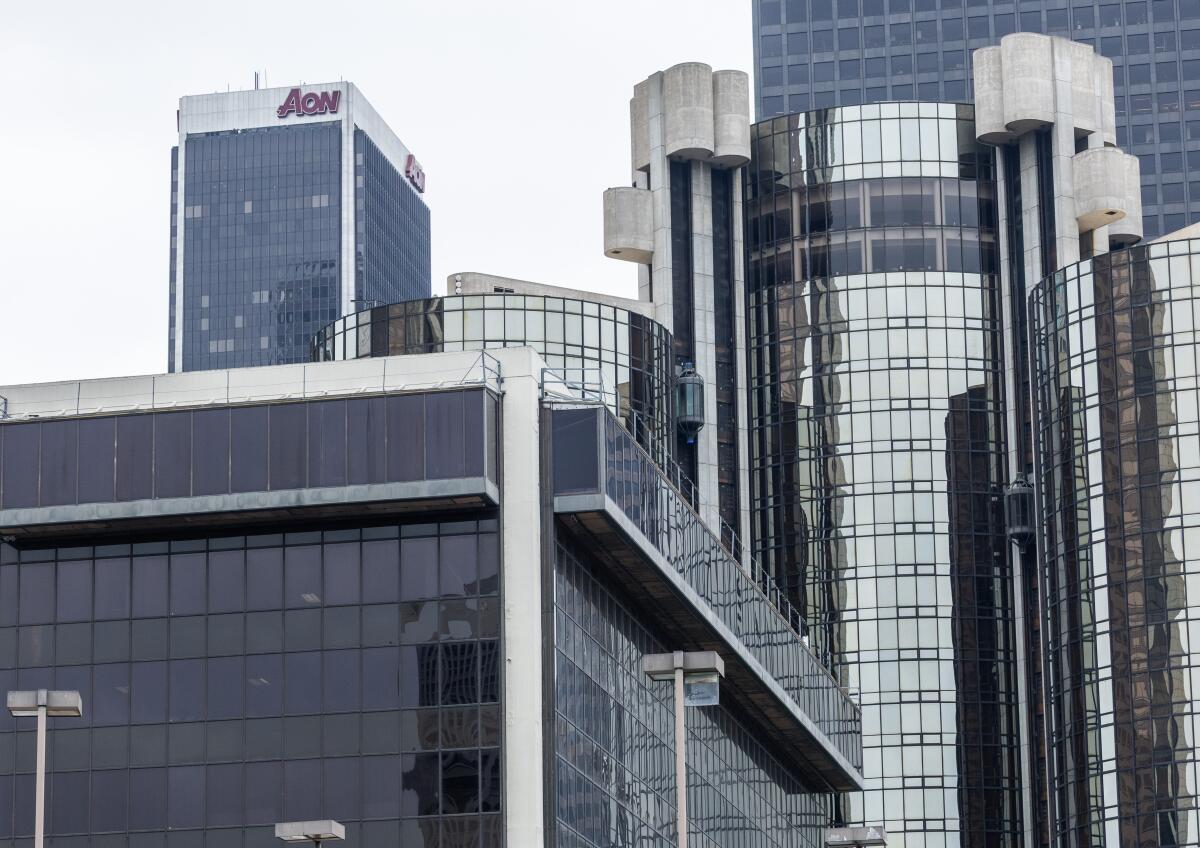
The plan to redevelop the L.A. World Trade Center, bottom left, is one of the largest affordable housing conversions to date downtown.
(Myung J. Chun / Los Angeles Times)
The 10-story World Trade Center was built in the mid-1970s to fanfare saying it would be home to international companies. In 1976, The Times described the center as a place to prepare for an overseas trip where visitors could get passports and visas, as well as exchange dollars for francs, marks, rubles and other currency. There was a language school and branches of U.S., Swiss and Japanese banks.
By the mid-1980s, the 400,000-square-foot office complex covering a city block at Figueroa and Fourth streets had lost its international flavor and was falling out of favor with corporate tenants who were moving into glossy new skyscrapers on Bunker Hill and in other locations.
The building has been cleared of remaining office tenants to allow work to begin in August, Lee said.
Kennedy Wilson is a nationwide operator of market-rate apartments that has also moved into building affordable housing in the last decade, said Nicholas Bridges, global head of capital markets at the company.
Building affordable, workforce housing “in almost all cases requires public subsidies,” Bridges said, and Kennedy Wilson has developed expertise in assembling “a cocktail of public financing sources” that includes low-income housing tax credits and tax-exempt bonds.
In the past, many housing developers have shied away from building affordable housing because assembling the subsidies needed to make construction profitable is challenging.

An artist’s rendering shows what the L.A. World Trade Center could look like after being redeveloped into affordable housing. The new complex is to be called Sky Castle.
(Ian Camarillo)
“It’s complicated,” Bridges said, “and not for the faint of heart.”
Eligible tenants must earn between 30% and 80% of the median income in the area where the housing is built.
Jamison and Kennedy Wilson will develop about 15 affordable housing projects between downtown and the 405 Freeway, Bridges said, many of them in aging office buildings such as the World Trade Center that are already owned by Jamison and are close to public transit.
Substantial potential for affordable housing lies in L.A.’s underused office buildings, he said.
“In this post-COVID world, the way people are utilizing office buildings, particularly older office buildings, has just fundamentally changed,” he said.
It makes sense for developers of conventional multifamily housing to move to building affordable housing, Lee said, because the government supports it through subsidies, zoning reform and the fast-tracking of construction permits. The city of Los Angeles also recently streamlined its adaptive reuse rules to make it easier to convert office buildings to housing.
“There are a lot of incentives pushing us in this direction,” Lee said.

Comcast is spinning off its NBCUniversal entertainment and news media businesses into a separate publicly traded company, a move that would unwind an audacious play the cable giant made for the storied Hollywood assets 15 years ago.
The plan would put broadcast networks NBC and Telemundo, NBC News, cable network Bravo, streaming service Peacock, the Los Angeles-based Universal film and television studios, Universal theme parks and British TV service Sky in a new stand-alone company.
Philadelphia-based Comcast would remain in its core business of distributing pay-TV channels, broadband internet and wireless services.
The spinoff would be the second such move by Comcast in two years. Late last year, the Brian L. Roberts-controlled company cast off most of its cable portfolio, including CNBC, USA Network, MS NOW and Golf Channel to form a new entity called Versant.
But the maneuver failed to budge Comcast’s listless stock, which has languished for years as its primary business lost thousands of broadband customers.
Comcast executives needed to make a bolder move to mollify frustrated investors.
Comcast stock peaked at nearly $26 per share Monday before closing at $24.22, up roughly 4.5% from Friday. Still, the stock remains below its 52-week high of $34.34.
The plan announced Monday would unravel Comcast’s bold decision to acquire NBCUniversal from General Electric Co. in 2011. At the time, Comcast saw tremendous value in marrying NBC’s entertainment operations, including its then-lucrative cable channels, with its cable TV distribution service that Roberts’ late father, Ralph, launched in Tupelo, Miss., in 1963.
“They were two distinct businesses,” longtime cable analyst Craig Moffett wrote in a Monday note to investors. “Having them under the same roof didn’t make either better.”
Consumers shifted to streaming, and Comcast’s attempt to build a top-tier digital service, Peacock, has fallen well short of its goal. Peacock lags behind rivals despite billions of dollars in investment from Comcast.
The concept of unwinding its NBCUniversal operation began in earnest in the fall, when Comcast joined the bidding for Warner Bros. Discovery. Comcast executives knew they could ill afford to spend billions to buy a rival; Wall Street would have pummeled the company.
So Comcast offered to spin off NBCUniversal and pair it with Warner Bros., turning two original Hollywood studios into a new media colossus.
But 43-year-old billionaire David Ellison prevailed in the bidding, agreeing to pay $111 billion to capture Warner Bros. Discovery. Losing the auction forced Comcast to find a different path forward.
On a call with investors, Roberts said the separation would bolster the two firms as they navigate increasing competitive challenges while technology companies continue to transform entertainment.
“We asked ourselves three basic questions,” Roberts said. “One, can these businesses stand alone and have the heft to stand alone in separate companies? Two, do they have a clear, viable capital allocation path to invest? And three, is now the right time? And the answer we came back with was yes to all counts.”
A free-standing NBCUniversal, home of the “Minions” and “Jurassic Park” franchises, probably would be an acquisition target, as media companies have been consolidating in an effort to get more content and mass distribution for their streaming services. Ellison’s Paramount is on track to close its Warner Bros. purchase, which would combine such media assets as HBO Max, CBS, CNN, Paramount Pictures and Warner Bros. studios.
With its Sky business, NBCUniversal has a toehold in Britain and Europe at a time when Amazon and Netflix are flexing their global distribution muscles.
Comcast would be positioned to combine with another cable and internet provider, such as Connecticut-based Charter, which owns the Spectrum television service. Charter is in the process of buying the smaller Cox cable service, which also has operations in Southern California.
Comcast is expected to complete the spinoff next year and will retain an 19% stake in the new entity.
The timetable could put NBCUniversal up for grabs by 2028 — when the company is set to broadcast the Summer Olympics, which will be held in Los Angeles.
Comcast acquired NBCUniversal in 2011. The industry-reshaping deal combined the largest distributor of TV channels with a provider of top-rated TV channels and a movie studio. But the streaming revolution has decimated the cable television business. Traditional TV viewing has been in a steady decline over the last decade. NBC has relied heavily on NFL broadcasts, and more recently, NBA and Major League Baseball games to remain relevant.
NBCUniversal has invested heavily in its streaming service, Peacock, but has been unable to reach the scale necessary for profitability. Comcast‘s stock price has struggled as a result.
Roberts, chairman and chief executive of Comcast, will continue to be involved in the leadership of Comcast and NBCUniversal, working in partnership with the CEOs of both companies.
Mike Cavanagh will remain as CEO of NBCUniversal, and Comcast’s former chief financial officer, Michael Angelakis, will return to run Comcast after the spinoff.
“Perhaps the best part of today’s welcome announcement … is that Mike Angelakis is coming back,” Moffett, the analyst, wrote. “He will now helm the cable business, [which] is unequivocally good news. With Mike Angelakis’s return, Comcast has come full circle.”
Moffett added that, despite Monday’s announcement, the 2011 combination was not a complete bust.
“The deal to acquire NBCU from GE was financially brilliant,” he said. “It was structured so that Comcast paid for just half of the acquisition and then let NBCU’s own cash flow pay for the rest.”
Over the years, Comcast has raked in billions in profit from its media holdings.
Comcast executives on the analyst call played down the notion that the two companies were being positioned for another deal.
“Absolutely not,” Roberts said. “This is the right move to put each company in the strongest position to create value, fully monetize its assets and aggressively pursue its own organic growth strategies.”
Cavanaugh, who has been running the combined company for three years, sounded more like a buyer than a seller.
“Our plan for NBCUniversal and Sky is to build and invest for growth,” he said. “We have the freedom now to explore adjacent businesses where we have the right to play, and that’s thanks to the stability of our company and management team.”
The spinoff announcement comes a week after Fox Corp. announced its deal to purchase the streaming platform Roku for $22 billion. The deal is aimed at ensuring that Fox has a means to get its portfolio of sports, news and entertainment channels into viewers’ homes as the traditional pay-TV business continues to erode.

Rocket Lab took a big step Monday to better compete with rivals SpaceX and Amazon, announcing an $8-billion acquisition of satellite communications company Iridium.
The Long Beach rocket-and-satellite maker is buying a company that provides critical communications services to pilots, mariners and others, while giving Rocket Lab a foothold in the emerging satellite-based mobile phone market.
“We are going to absorb it, optimize it and scale it into something that is really truly fantastic,” said Rocket Lab Chief Executive Peter Beck in a YouTube presentation of the deal.
Rocket Lab is paying $54 a share for McLean, Va.-based Iridium — $27 in cash and the rest in shares. Deutsche Bank and Wells Fargo are providing $3.6 billion in financing in the deal, which is expected to close next year.
Iridium’s 66 low-Earth-orbit satellites provide voice, data, navigation and other services to remote regions and across the globe to 2.55 million government, defense, aviation, maritime and commercial subscribers.
Iridium reported net income of $114 million in 2025, up 2% from the previous year. Revenue climbed 5% to $872 million.
The market for mobile cellular and other satellite-based communications is growing rapidly.
Elon Musk’s SpaceX spent $17 billion last year to acquire spectrum from EchoStar and then followed it up with a $2.6-billion purchase. The spectrum will allow its Starlink broadband satellite network to provide mobile phone service worldwide.
In April, Amazon agreed to acquire satellite operator Globalstar in a roughly $11.6-billion deal that would expand the services of its satellite system and the so-called direct-to-device smartphone market.
The competition has raised concerns about Iridium’s ability to compete.
SpaceX went public this month in the largest initial public offering ever, raising $86 billion, with the company now valued at more than $2 trillion.
In February, Iridium Chief Executive Matthew Desch said the company has shown it’s not “in decline,” dismissing concerns that it couldn’t compete with Starlink, according to Morningstar.
Founded in 2006 in New Zealand, Rocket Lab moved to the U.S. a decade ago and opened its Long Beach headquarters in 2020. It has manufacturing and mission operations in Virginia, New Mexico, Colorado, Maryland, Toronto and New Zealand.
The company manufactures a small rocket called Electron that has launched 262 satellites into space, making it the second-busiest U.S. launch provider behind SpaceX. Rocket Lab is developing a larger rocket called Neutron, and it also makes satellites, subsystems and space components.
Beck said the acquisition of Iridium will propel Rocket Lab into the satellite communications business. That would otherwise be a slow process, requiring the acquisition of spectrum, satellite development and establishment of a customer base.
“We think we’ve found a little bit of a shortcut here,” Beck said, noting the combined company will be vertically integrated, able to design, build, launch and operate its own satellites.
The deal is “very strategic” for Rocket Lab, William Blair analyst Louie DiPalma said in a note to clients, according to Morningstar.
Rocket Lab has announced multiple contracts this year.
Last week, the company said it would launch Electron rockets for three NASA missions from its New Zealand site.
In May, Rocket Lab announced a $30-million contract with Costa Mesa defense contractor Anduril for multiple hypersonic test flights in Virginia using Rocket Lab’s HASTE launch vehicle.
The company is among scores of businesses that have revitalized Southern California’s aerospace and defense industries since SpaceX was founded in 2002. SpaceX, now headquartered in Texas maintains operations in Hawthorne.
Secretary of Defense Pete Hegseth visited Rocket Lab’s headquarters in January during a stop on his tour of defense contractors in Southern California and across the country.
“This company, you right here, are front and center, as part of ensuring that we build an arsenal of freedom that America needs,” Hegseth told several hundred cheering workers. “The future of the battlefield starts right here with dominance of space.”
Iridium investors cheered the news. Its shares gained 25% to close Monday at $54.59. Rocket Lab shares jumped 16% to close at $97.95.
-

 Los Angeles, Ca31 minutes ago
Los Angeles County man convicted of sex trafficking, abusing woman he was dating
-

 Detroit, MI51 minutes ago
Detroit Tigers tee off on New York Yankees with 5 homers in win
-

 San Francisco, CA1 hour ago
Popular brewery shutters San Francisco location amid industry woes
-

 Dallas, TX1 hour ago
Eight arrested after repeated attempts to enter World Cup matches without tickets
-

 Miami, FL1 hour ago
Reports: Heat add potent bench scorer in Tim Hardaway Jr.
-

 Boston, MA1 hour ago
Boston Pops gearing up for major July 4th celebration: ‘You only turn 250 once’ – Boston News, Weather, Sports | WHDH 7News
-

 Denver, CO1 hour ago
Colorado wildfires destroy more than 100 structures, force more evacuations
-

 Seattle, WA1 hour ago
Will Katie Wilson’s endorsements help or hurt Seattle’s position in Olympia?

