As negotiations between Washington and Tehran remain deadlocked, US President Donald Trump convened a high-level meeting Friday with senior US national security officials, including the CIA director, secretary of defense, and vice president, to discuss scenarios for a possible return to military confrontation with the Islamic Republic.
Washington
H.W. Brands on the Making of George Washington


H. W. Brands holds the Jack S. Blanton Sr. Chair in History at the University of Texas at Austin and is the author of more than a dozen biographies and histories. His latest book is American Patriarch: The Life of George Washington.
In this week’s conversation, Yascha Mounk and H. W. Brands discuss why Washington’s reputation has endured despite the controversial legacies of other founding fathers, how his frontier upbringing shaped his character, and what Washington’s voluntary relinquishment of power reveals about leadership and ambition.
This transcript has been condensed and lightly edited for clarity.
Yascha Mounk: George Washington is, I suppose, the most famous figure in American history. Many biographies have been written about him. Looking at him from the vantage point of 2026, as we celebrate the 250th anniversary of America’s founding, what stands out to you about George Washington that may be different from what other historians emphasized when they wrote about him throughout American history?
H W Brands: The principal thing, since you mentioned the vantage of the 250th anniversary, is Washington’s staying power. Upon his death, one of the eulogies described him as “first in war, first in peace, and first in the hearts of his countrymen.” It’s hard to say where Washington sits in the hearts of his countrymen today, but he is one figure from that era who has survived most of the revisionism that has eventually come for people like Thomas Jefferson and any number of other figures from that era. This is not an accident of history. The capital city of the United States is named for George Washington, so it would be pretty difficult to de-platform him.
Washington wears well. He has a level of gravity with which he fulfilled his roles as president that has given him a long shelf life. Any complaints that people might make about Washington are easier to make about other figures from the founding. Jefferson is the one who said all men are created equal and owned slaves. Washington owned slaves too, but he didn’t say all men are created equal. So he seems to be a very solid figure.
There is always interest in the first of anything, including the first president and the first victorious general. Washington is more responsible for the creation of the American Republic than any other person. If his Continental Army had lost to the British, American independence wouldn’t have happened—at least it wouldn’t have happened then. He is an important figure and somebody who is easy to come back to again and again.
Mounk: There are many aspects of his life that I want to get into—his childhood and upbringing, which you portray very interestingly, and his responsibility for the American Republic. That responsibility stems in part from his military victory, and in part because he clearly did not have the ambition to become a dictator or monarch. The longer history goes on, the more positive a light that puts him in.
If you look at many of the newly independent republics around the world that threw off colonial shackles, the number of times in which the courageous, charismatic independence leader who leads the rebellion against colonial forces becomes the first president of a country and then stays there for fifty years—making the country corrupt and concentrating power in their own hands—is enormous, especially in the twentieth century. With more knowledge of how easy and how tempting it is for those kinds of figures to declare themselves indispensable, the fact that Washington gives up power after two terms, setting the informal norm that presidents should be limited to two terms, is even more significant than it may have looked at the time.
Brands: Your point is very well taken. When King George III of Britain heard that Washington, upon the end of the Revolutionary War, had resigned his command and returned it to the Continental Congress, George III is said to have remarked that if that report was true, he was the greatest man in the world—for doing exactly what you said: not being beguiled by political ambition.
When we get to that point in the narrative, I’ll explain why it would have been a different thing for Washington to attempt that than for any number of other victorious generals later on. But it certainly serves his reputation well that he did it. In fact, as you suggest, he did it twice: once at the end of the Revolutionary War, when he resigned command of the army, and then after two terms as president, when he retired and returned to Mount Vernon.
Mounk: Let’s go back to the beginning and work our way up to these later stages. Washington is often portrayed as the consummate patrician—as somebody born at the top of a social hierarchy, a revolutionary leader who is, in some ways, to the manner born.
You argue that this is an oversimplification. Even though he is born into a reasonably privileged class of landed gentry, and into a slave-holding family, he is not nearly as elite as some of those portrayals have made him out to be.
Brands: Both parts of that story are crucial. Washington was born into the Virginia gentry—the upper class of Virginia in the early eighteenth century. Compared to the people around him, Washington was privileged. He did not have to worry about where the next meal was coming from.
On the other hand, this was a colonial gentry, a frontier gentry. The serious members of the aristocracy of the British Empire all lived in England. The Fairfax family was one that was transatlantic, and Washington was fortunate enough to have got to know the Fairfaxes—Thomas Fairfax and others—when he was young. That gave him one leg up on climbing the ladder, because even within a gentry, even within an aristocracy, there are always gradations. Washington was not born at the top of that, and so he had to aspire. He had to work to ascend. He wasn’t born particularly wealthy—certainly wealthy by comparison with the yeoman farmers of Virginia, and certainly by comparison with the enslaved population of Virginia—but he couldn’t simply rest on his inheritance. He wanted to make more of it.
A continuous theme in Washington’s life was his desire to acquire more land. Everybody in Virginia essentially made their living by the land. Washington was a landowner, but he wanted more. This is what took him on his first adventures to the West. Although Washington was born and grew up in Virginia—which was the first permanent colony and has a seaboard—he was associated with the western part of the state. The western part of Virginia at that time included what is now West Virginia, Kentucky, and parts of Ohio. He was constantly heading out to the West, and it was as someone who had been to the West that he came to the attention of the government of Colonial Virginia and eventually to the British government in London.
Mounk: What does he do in the West? He’s a surveyor, but what precisely did that mean? When I picture a surveyor today, I picture somebody in a high visibility vest with a strange machine standing around suburban London.
Brands: If you were surveying property in the wilderness, as in Alaska, you would have to go out and do some serious measurement. If you survey in a city today, everything is already measured and you simply find the post that has already been located. Washington went out into western Virginia, which had never been surveyed before, in part because he was looking for the best land in a large grant that had been given to the Fairfax family. He was hired by the Fairfaxes and went out with one of the younger Fairfax men on this surveying trip. It was his first expedition into the wilderness.
At that point, Washington began something that would be his great gift to biographers and historians: he kept a diary, a journal, almost every day of his whole life. It starts here, and so it is possible to find out what he was doing each day and how he was responding to the challenges he faced. One of the things Washington learned about himself on this journey—and that the reader of biographies learns about Washington—is that he was somebody who thrived in the outdoors. This was not a given for a member of the gentry, many of whom were more comfortable in parlors and salons. Washington really liked being outdoors. It was a great adventure. He was camping out, getting rained on and snowed on, falling into rivers, and nearly freezing—and he thought it was the greatest thing in the world. He was good at it and he liked it, and this was going to serve him very well.
He kept his journal, he came back, and the surveying was fine. But he also developed a reputation—and he was a teenager at this point—as somebody who was resourceful, who could find his way in the wilderness, who could get along with the various Indians and frontiersmen who were out there, and accomplish what needed to be accomplished.
When the Virginia governor required somebody to carry a message to the French, who were trying to colonize the Ohio country—claimed by Virginia but also by the French—he said Washington was the man to do it. Washington had developed a reputation as somebody who could take on challenges, figure a way through wherever he had to go, and get the message to where it had to go.
He also discovered that he was a wonderful horseman, and this was a significant distinction in those days—not only for getting around, which was how you got around, but for winning the admiration and even the envy of your fellows. A man who was good on a horse cut a commanding figure. It didn’t hurt that Washington was big for his age: tall, well-built, and imposing on horseback. That is often a metaphor, but in Washington’s case it would become an actuality, because Washington on a horse was a very persuasive military commander.
Mounk: Of course, it’s how he’s often still portrayed when you look at statues. Like many other people of that age, he’s shown on his horse.
Brands: The fact that so many military figures are portrayed on horseback is testament to the impression that a man on a horse made. When you are on a horse—especially if you are a tall man like Washington—you are head and shoulders and torso above everybody else. In those days before radio communications, your soldiers had to be able to see you. The fact that the enemy could see you too, and level their guns at you, and perhaps kill you, made it all the more impressive when you survived. Washington cut an impressive figure on a horse, and that was quite important in his day.
Another thing Washington figured out at an early age was that he had to develop a character. He would ascend by reputation. Reputation was the coin of the realm among the gentry—did you have a reputation as a brave man, a capable man, an honorable man, a generous man? Washington decided that he needed to win that reputation. How do you win a reputation? You do the things that are conducive to it. Washington created this public character, set this model for himself: he was going to become this person. He took the steps and the actions to allow him to live up to the reputation he was aiming for, and he did this his whole life. It shows the degree to which virtue of this kind—civic virtue, public virtue—can be developed. It is not innate. You say, this is the man I am going to become, and then you strive to become that man.
Mounk: Looking at this from 2026, what is striking is that the incentives toward good character—or at least what was at the time regarded as good character—were aligned. An ambitious man like Washington, born to some privilege but very conscious of wanting to rise in the social hierarchy, thought that both appearing to have a good character and cultivating the virtues that actually gave him a good character would be conducive to that goal. It is not clear that the same is true today. If you are born with some social advantages and you are thinking about how to get ahead in life, cultivating the best possible character is probably not where the incentives lie. If what you want is fame, renown, or political power, the incentives go in a different direction.
Tell us a little about the society that produced him. Americans, I think, are a little confused about this. We have a sense that there was a kind of gentry in the eighteenth century, but we also have a strong sense that unlike in Britain, there was not an aristocracy. How should we think about this? It is a world in which virtue is rewarded and certain character traits are highly regarded, but it is also a world in which people are scheming to acquire more land, in which people justify slavery, and in which there is a great deal of partisan contestation—different factions and groups plotting against each other. How should we understand the social background against which Washington’s rise takes place?
Brands: The first thing to keep in mind is that this was a pre-capitalist world—one in which not everything had been monetized. Washington made his living as a planter. He planted crops, harvested them, and sold them. Tobacco was the largest cash crop, but tobacco was hard on the soil, so he shifted to wheat, oats, and other ordinary farm crops. He did not get into cotton, which came later and would change the face and economics of the South. Washington came along before cotton became a viable commercial crop.
Since it was a pre-capitalist society in which things were not particularly monetized, people did not compete on the size of their bank account. They competed in terms of hospitality and the quality of their homes. Washington inherited a home and gradually enlarged it. If you were a member of the gentry—a relatively small class, a few hundred people, somewhat larger when you add in the relatives—you were expected to be a gracious host. In Virginia, where the economy was based largely on slavery, you were a slave owner, or perhaps more precisely a slave manager. Most of the slaves that Washington controlled he did not own, which meant he could not have sold them or emancipated them even if he had wanted to—but we will get to that.
We hope you’re enjoying the podcast! If you’re a paying subscriber, you can set up the premium feed on your favorite podcast app at writing.yaschamounk.com/listen. This will give you ad-free access to the full conversation, plus all full episodes and bonus episodes we have in the works! If you aren’t, you can set up the free, limited version of the feed—or, better still, support the podcast by becoming a subscriber today!
If you have any questions or issues setting up the full podcast feed on a third-party app, please email leonora.barclay@persuasion.community
Because Virginia had no cities and was entirely countryside, travelers could not expect to find a hotel or inn. They stayed in private homes. Washington had open house at Mount Vernon pretty much every day. Anybody traveling from the southern part of Virginia toward Maryland would stop in, expect to be given dinner, and if the weather were poor or they could not continue on, expect a room for the night. This was also the way news traveled and the way Washington kept informed about the world.
A member of the gentry might appear very wealthy while being deeply in debt. The best example of this is Thomas Jefferson, who had his wonderful place at Monticello outside of modern Charlottesville, was constantly rebuilding, and seemed to live the life of a wealthy man—but was always deeply in debt. At the time he died, everything he owned had to be sold off to pay his creditors. Even Washington, at times one of the largest landholders in Virginia, could not come up with the cash to pay a relatively small debt and had to ask for more time. That was a mortifying thing for a man of Washington’s reputation, but that was how it worked.
One of the things that being a planter, being a member of the gentry, gave you was practice in being—the term fits—a commander. You were the commander of your little village. You were literally in command of the enslaved people who worked under you, and the boss of the free people who worked alongside them. You had executive experience in a way that a lawyer in Massachusetts—to take John Adams, the second president—did not. It is not an accident that of the American presidents before the Civil War, a majority had been slaveholders and planters. They had the advantage of managing large operations and making decisions within them.
Mounk: There is a similar point to be made in a totally different context. There is sometimes a line of argument that if artificial intelligence displaces a lot of human work, that will be fine, because we will be in a very affluent society, give people universal basic income, and they will be like latter-day aristocrats, enjoying their leisure and cultivating their skills. That slightly mischaracterizes what the life of the average aristocrat was actually like—not just in the context of the American gentry, but of European aristocracy as well. You could neglect your lands and the people cultivating them, and you would probably end up with a lot less money than you were passed and pass on a lot less to your offspring. You could do that for a generation, but it constituted a deep failure of honor. If you actually wanted to be a good steward of your inheritance and your family’s position, you were running a small to mid-sized business. If you were bad at it, that might be tolerable for a generation, but it was genuinely discrediting and created significant problems.
To return to the eighteenth century: Washington really starts off as a British loyalist. He thinks of himself as part of an extended British aristocracy and part of the project of building the British Empire. How does that change? How does he turn from a British loyalist into an American revolutionary?
Brands: This is one of the principal tasks that a biographer of Washington, or a historian of the period of the American Revolution, has to tackle. It is important to remember that when the United States declared independence in 1776, that did not signify that all people living in America were in favor of independence. There was a large category of people—called Loyalists or Tories at the time—who said that independence was a terrible idea. Many of them took up arms against George Washington and the Continental Army and fought on the side of the British against American independence.
The question is, why would somebody like George Washington come out in favor of independence? Why would he become a rebel, a traitor? This is an important question because typically the people who turn against their regime are people who are not succeeding within it. The successful ones are happy enough and stay around. Washington was quite successful. By the time of the American Revolution, he had risen even farther up the hierarchy of the Virginia gentry. He had married well—a wealthy widow—and acquired a great deal more land, more slaves, and more property. He was well respected and had a reputation as Virginia’s top soldier. Not America’s top soldier, but Virginia’s. That distinction matters, because talking about America in 1770 was like talking about Asia today—a vast collection of different peoples and places. There were Virginians, New Yorkers, Pennsylvanians. People who lived in Virginia thought of themselves as Virginians and as subjects of the British crown, but not as Americans. They felt they had more in common with people living in London than with people living in Boston.
Things were going well for Washington, but there were certain annoyances. Annoyances are one thing, but what turns annoyances into grievances that rise to the level of sedition and treason? Virginians, like other people living in the American colonies, had over a period of roughly one hundred and fifty years grown accustomed to the idea that they would pretty much govern themselves. This was due primarily to inattention and laxity on the part of the British government. When colonists left England and went off to America, they fell out of sight and out of mind, and were allowed to do more or less whatever they wanted.
Mounk: The distances involved were so enormous that it created a kind of principal-agent problem. The principal had great difficulty instructing even the agent of the British Crown sitting in Virginia exactly what the preferences were. Some amount of self-government was inevitable as a result.
Brands: From the standpoint of London, there was very little of interest in North America. Further south, in the West Indies, there were sugar plantations and money to be made. But out of North America, not much at all. Decades would go by and the colonists in America would have very little to do with what was going on in London, or vice versa. They got of a mind that they ran their own affairs, and they interpreted this in ways that served themselves. They thought, for example, that they ought to have the right to raise and spend money as they wanted. If they got dragged into one of Britain’s wars, they did so sometimes with less than perfect grace.
When the government in London went to war with France over something that had nothing to do with America, Americans found themselves drawn in anyway, usually because the French controlled Louisiana and parts of the West Indies. They were dragged into a war they had no part in starting and no benefit from at the end. That got annoying.
This brings us to what began in America as the French and Indian War—not the French against the Indians, but the British and their Indian allies against the French and France’s Indian allies. It was a war of crucial importance for Washington and for people who lived in Virginia and Pennsylvania, and it was a war that Washington helped start, because it was over control of the Ohio country—roughly where Ohio is today, including western Pennsylvania and West Virginia. This mattered enormously to people like Washington because Virginians and Pennsylvanians had their eye on that western territory, particularly its land. The population of the American colonies was growing rapidly. Benjamin Franklin calculated around this time that the population doubled roughly once a generation, and since nearly all of them were farmers, they needed land to make a living and to bequeath to their children. Land in the West was cheap.
Washington joined Franklin and others in something called the Ohio Company, a speculative venture in which they would acquire title to a large tract of land in Ohio, survey it—which is why Washington got involved—and sell it to others. Over time, this habit of purchasing land and reselling it at an appreciated value would make more fortunes in American history than almost any other means. If the French took control of the Ohio country, those dreams of speculative fortunes would vanish. The Virginians had a real stake in the outcome, and so they were more than happy to join the British in the French and Indian War.
The conflict eventually became what was called the Seven Years War, the later years of which had nothing to do with North America and everything to do with empire and Europe. From the American standpoint, the fighting ended in the late 1750s, but there was no peace treaty until 1763. At the end of it, Americans were rather miffed to receive what amounted to the bill for their part of the war. The British, having run up an enormous debt fighting the French, did what governments do when facing a deficit: they reduced spending and increased revenues. Reducing spending meant, among other things, reducing the number of troops in the western territory just won from France—the very territory that people like Washington had expected to survey, settle, and profit from. Instead, Americans were told they could not settle there, because no troops would be stationed to protect them and because, to avoid trouble with the Indians, the western territory would be closed to settlement. This policy was articulated in the Proclamation of 1763.
Then Parliament passed the Sugar Act and the Stamp Act—a series of taxes. Americans had fought the war and won it, and now they were being told they could not enjoy the benefits of winning, and would moreover face higher taxes as a consequence. This was not what they had signed up for. The idea of being taxed by Parliament would not have surprised anyone living in Britain, but it did surprise the people living in America, because it had not been the case before. The understanding had been that colonists funded their own local taxes, which they voted on themselves, and that the British could levy taxes on imports as a way of regulating trade. But internal taxes were another matter. This is when people in America began thinking that perhaps their connection with Britain was not such a good idea after all.
It was not unthinkable. If you lived in the south of England and said you didn’t want to be governed by London, you simply couldn’t do that. But if you were living in Virginia, three thousand miles away, and the British had shown up only rarely for the previous three generations, going it alone seemed possible. This is what somebody like Washington began thinking. Resistance followed. There were protests against the Stamp Act and a boycott of British imports—economic sanctions, which have been around forever. The thinking was that British merchants would feel the pain and go to Parliament demanding that the colonists be appeased so that trade could resume.
Mounk: At this point, the rebellion is against the fact that the deal has changed—that suddenly the colonists are supposed to pay a great deal more in tax while receiving fewer services in return.
Brands: I wouldn’t use the term rebellion yet. Protest would be a better word.
Mounk: At this point, the people involved are thinking that they need to resist and send a message, but they are not yet thinking of themselves as the founders of a new nation.
Brands: The colonists made a point of saying they were loyal Englishmen, standing on their rights as Englishmen to be free of taxes except those they voted upon themselves. This had roots all the way back to Magna Carta in English history. When it served their purposes, the Americans said they were Englishmen who must be treated as Englishmen and granted the rights of Englishmen.
This did not always sit well with the people back in Britain, who thought of the colonists as provincials—second-class subjects who had gone out to live on the frontier. There was a certain disdain that developed in Parliament and in England generally toward the colonists, and the colonists felt it. That too entered into the consideration.
Mounk: Was there something provincial about American life at this juncture? If you were at Mount Vernon or Monticello, were you ten years behind the fashion in London,? Did it feel like London was a metropole and America the periphery, or had a different culture already begun to grow up even before 1776?
Brands: It really did depend on where you lived. If you lived in or around Boston, you thought of Boston as fairly up to date. Boston had Harvard College, a literary circle, and libraries. It looked like a miniature version of London, and partly as a result, people in Massachusetts were even more annoyed by the disdain shown to them by people in London. But somebody like Washington in Virginia—which, as mentioned, had no cities anything like Boston or New York—tended to deal directly with agents. If you were a planter like Washington, you had an agent in London who handled the sales of your produce, tobacco for example, and who handled the purchase of whatever you wanted. Washington might write to say that his carriage was wearing out and ask for the latest model with his specifications. Jefferson in particular would write to his agent asking him to go to the local booksellers and acquire the fifty most important books published in the last year. They certainly tried to keep up that way.
There was as yet little in the way of higher education, arts, or sciences in America, though a beginning had been made. Benjamin Franklin helped establish the American Philosophical Society. There was Harvard College, Yale College, and the College of William and Mary in Virginia. But if you were a wealthy family and wanted your son to become a lawyer, you might very well send him to London to study at the Inns of Court. It was clear that London was the cultural capital of the realm that included the North American colonies. Boston was a partial exception. New York was a world of its own, having been founded by the Dutch and being more commercially and bourgeois-minded. But Virginia, in many ways, should have been the most loyal of the colonies.
Mounk: Part of what is involved in this conflict, beyond the dispute over taxation, is a sense of feeling disrespected—of having the rights of Englishmen but not being treated as equals, of being treated as second-class subjects. How does this conflict escalate? In retrospect, was escalation inevitable, or could other choices by London have kept America within the British Empire for decades, centuries, or perhaps indefinitely?
Brands: Taking that last question first: it is very difficult to imagine that in 2026 the United States might remain part of a British Empire—empires have long gone out of fashion. But it is not impossible to imagine a change of government in London in the 1770s, before the American Declaration of Independence, that concluded it was better to keep the Americans as friends than to have them as enemies and chose to compromise. Had London been willing to compromise, there were plenty of people in America willing to meet them halfway. There were very few people before about 1774 who were calling for independence. There was no real groundswell in favor of it until relatively late in the game.
What would become the United States might very well have evolved as Canada evolved. Canada was invited by the American colonies, upon independence, to join their revolt against Britain. The Canadians said they were doing well enough within the British Empire and declined. They gradually received more and more home rule until, by the 1860s, Canada was effectively independent—still recognizing the British crown, but to all intents and purposes self-governing.
America broke with Britain in the 1770s and made it effective as of the 1780s. The two countries were formally at war in what Americans call the War of 1812 and were at odds with each other for some time after that. But since 1900, the United States and Britain have been the closest of allies—in some ways closer to each other than Britain and Canada were to each other. So today, had there been no American Revolution, or had it failed, we would probably be roughly where we are today, arrived at by a different timetable and somewhat different means. If those different means included avoiding a war in which thousands of people died, that would not have been a bad thing. If you can avoid wars, you should try to do so.
Mounk: Counterfactual history is always difficult. A later separation could also have led to a much bloodier war fought with more modern technology, and perhaps one that would have soured relations between Britain and America far more deeply. In a sense, it is healthy for adolescents to separate themselves from their parents, because it becomes easier in early adulthood to come back and develop a strong relationship. If you delay the period at which you create autonomy for yourself, the relationship can get much more complicated and rocky later on.
Brands: There is one other thing to consider. The British Parliament in the 1830s decreed an end to slavery within the British Empire. The United States would not end slavery until 1865, with the passage of the 13th Amendment at the close of the Civil War. If America had remained part of the British Empire in the 1830s, slavery in America might have ended thirty years before it actually did.
This is complicated, because ending slavery within an empire that included the cotton-growing American southern states would have been a far bigger undertaking and might have been more difficult to achieve. But what made it so hard to end slavery in the United States was that the people who owned slaves and benefited from slavery had to vote to end it themselves—they had to absorb the economic hit personally. There were no slaveholders in London when Parliament decreed an end to slavery; the burden fell on planters in the West Indies. Parliament could, in theory, have told South Carolinians to give up their slaves as well. It is useful as an exercise to consider these things.
Mounk: One other possibility is that the war for independence and the war to preserve slavery might have coincided. Rather than having a Revolutionary War and a Civil War as separate events, a number of states might have broken away from Britain over the issue of slavery in the 1830s—and had they prevailed, they might have preserved slavery. The possibilities are many.
Brands: One last point on that: had the slave states broken away in the 1830s, they would not have been opposed merely by the northern states of the United States. They would have been opposed by the northern states and the rest of the British Empire.
Mounk: Or they might have been able to forge a coalition with the northern states, because the conflict would not have been about the nature of the future political settlement within an independent republic. They might have been able to wed the issue of slavery to the issue of self-determination for the colonies and forge a coalition of northern states against Britain. We can play this game forever, but let’s get back to actual history.
Where does the phase shift occur? Where does protest turn into rebellion, turn into revolution?
Brands: When the Americans protest, the British, instead of compromising, double down. Within British politics, the party that favors acting tough on the Americans wins out—it is a popular thing in a campaign to promise strength and the enforcement of the law. When the British escalate, the Americans escalate in turn. The Americans stage violent protests, the British send troops, and there are more protests. When the Americans see that British troops are coming to be used not against the French or the Indians but against them, Britain begins to look like a foreign country with an army of occupation.
The fighting begins when a Massachusetts militia moves to defend one of its armories. Every colony had its own militia—part-time soldiers who farmed during the day and took up arms when trouble arose—and their own stashes of weapons. The British decided to seize one of these armories so that the Massachusetts militia could not use the weapons against British troops. The militia refused, and the battles of Lexington and Concord took place—a firefight between the two groups that marks the start of the American Revolutionary War. At the time, nobody realized it was a war, nobody realized it would last a long time, and nobody quite knew what it was about.
Just two months after this, Washington is appointed commander of a new army. The Continental Congress—an ad hoc, self-appointed body, not authorized by British law—met in Philadelphia, the largest and most centrally located city in the colonies, and decided they needed a unified organization among the different militias. This is 1775, and their stated purpose is to defend their rights as Englishmen—not as Americans, but as Englishmen. Looking around for the most accomplished soldier available, they settled on George Washington.
From his beginnings as a surveyor in western Virginia, Washington had gone on to command the Virginia regiment and won a reputation fighting in the French and Indian War. Crucially, he had served right alongside British officers during that war, and he and his men had performed much better under fire than the British troops and their officers. Until that point, the British had sustained the mystique of having the best army in the world—the best uniforms, the best drilling, the most precise formations. But when they came under attack in conditions that existed in America, they fell apart. It was Washington’s soldiers who saved the day and prevented a complete rout. At that point, Washington realized that British soldiers were not ten feet tall—that he was a better officer than theirs and his men were better soldiers than theirs.
At one point during the French and Indian War, Washington had sought a commission in the British army. He was a colonial officer, and the British soldiers fighting alongside him refused to take orders from a mere provincial. Washington went to the British commander in chief with a recommendation from the governor of Virginia, arguing that a commission would give his orders proper weight. The commander in chief refused, for his own political reasons, though he did tell the British soldiers to listen to Washington. Various people have thought that had the British seen what was coming, they would have been smart to commission Washington as an officer. His loyalties might then have shifted from Virginia to the British crown.
As it was, this episode showed Washington that there was a ceiling on what he could accomplish—on the reputation he could acquire and on how he would be seen—as long as he remained part of the British Empire. He might be the greatest man in Virginia, but he would always be looked down upon precisely because he was a provincial. The idea that people could lord it over him for no good reason made him think he could get along without the British.
Washington is appointed commanding general of the new Continental Army and sent to Boston, where the British are besieged inside the city by the colonial militias. The fighting has developed a momentum of its own. The British don’t want to be surrounded and captured; the Americans don’t want them to get away. Nobody could have told you exactly what they were fighting about—once you are playing a contest, you want to win, whatever the larger purpose may be. For the first more than a year of his command, Washington didn’t know what the war aims were. He was trying to keep from being captured by the British and trying to keep the British from getting away. The British did get away—they sailed away from Boston. Washington then retreated to defend New York, though the question of what exactly he was defending it for, and what the war was ultimately about, remained unresolved.
Mounk: What is the last step? We have a protest that turns into a rebellion, that turns into a war in which you are trying to win. How does that then turn into a revolution? How do the war aims clarify, and how do they clarify in the form of a declaration of independence?
Brands: In the winter of 1775–1776, fighting had largely ceased—in those days, armies generally stopped campaigning in winter because the roads turned to mud and nobody could move. Washington and his men were waiting for the spring fighting season, uncertain what they would do when it came. In the middle of this, Thomas Paine—a recent arrival from England—wrote a pamphlet called Common Sense. Its conclusion was that Americans had been fighting for several months and needed to decide what they were fighting about. The only thing that made any common sense to fight for was independence. Without it, you could win a particular campaign and two years later have to refight the same battle, having never established the principle that Americans make laws for Americans.
The pamphlet was an immediate sensation—one of the fastest-selling pieces of political propaganda in American history. All sorts of Americans suddenly found themselves nodding in agreement. When the Continental Congress met in the spring of 1776, it did not take long for the question of independence to come to the fore. But everybody understood it was a big step. To say they were defending their rights as Englishmen was one thing—something George III could understand even if he disagreed with it. To say they were fighting for independence was to commit treason. The people who signed the Declaration of Independence were putting their lives on the line. If they lost the war, they could lose everything.
From Washington’s standpoint it was a big step, and he was in favor of it. It also clarified things dramatically. He could now tell his soldiers they were fighting for their own country, their own rights, their own destiny—that if they won, they would no longer be subject to the whim of a distant king. They were creating a republic, a political system in which authority emanates from the people, not from above. When news reached Washington’s camp that the Declaration of Independence had been passed by the Continental Congress, there were celebrations. Now they knew what they were fighting for.
It is worth pausing here to note that when the protests against the Stamp Act began in 1765, nobody knew where things would end. It is an example of one thing leading to another. There were plenty of people in America in 1776—the Loyalists—who said this was too big a step, that bad laws were one thing but that breaking up the British Empire over them was an overreaction. There were people in London who said that had they known it would come to this, they would have been more willing to compromise earlier. Just as Americans were not unified behind the Declaration of Independence, people in Britain were not unified behind the campaign to suppress the Americans. Many in Britain said the Americans had legitimate grounds for their complaints.
This is crucial to understanding how the war was handled. It was a war that began in politics and would end in politics. The political question for Americans was where their loyalties lay. The political question for Britain was how much pressure to apply and how important it really was to keep the colonies formally subservient to the British Empire. Washington understood this, and it is one of the keys to his success as a military commander. He realized he did not have to defeat the British army outright. He did not have to win the war in a positive sense. He simply had to avoid losing it, because as long as he kept his army intact, the British would have to keep fighting. At any moment, people in Britain had the option to decide that the war in America was too expensive and too much trouble and simply end it. That is ultimately how the war ended.
To put it plainly: Washington lost almost every battle except the one that mattered—the last battle at Yorktown. He knew this all along. He could lose and lose and lose, but if he won the last battle, he won the war, because it would be that final battle that convinced the British that enough was enough and it was time to go home.
Mounk: Alongside the question of independence, there was a whole parallel set of debates about what the nature of this new country should be—should it be a republic or a monarchy, should it be a very loose federation of states or a United States of America with a stronger federal element? What role does George Washington play in those debates? To what extent is the picture of him as somebody who stays above the partisan and ideological battles—like those between Jefferson and Hamilton—accurate, and to what extent is he really just one more ideological combatant in the fights over what nature this new state should have?
Brands: George Washington was no political theorist, and he was surrounded by political theorists. Alexander Hamilton, James Madison, Thomas Paine, and others were writing political treatises about how this new country ought to be structured from first principles, going back to the Roman Republic. Washington was not one of those. He was an example of military and then political leadership, and between the theory and the practice of leadership there is sometimes a large gap. Washington’s example—first as commander in chief of the army and then as president—gave the advocates of republicanism cause for confidence that the American people could actually govern itself.
It was a big step. There was very little historical evidence, certainly in the last 2,000 years, that a republic could work. There had been a Roman Republic, so the idea was not created out of whole cloth, but there were no active republics in the eighteenth century that Americans could use as a model. They were trying something that had never been done before—creating a country by sitting down together in Philadelphia, holding a convention, and writing a constitution.
The government that Americans created for this new republic—the one we know today—was in fact the second try. The first had to deal with thirteen separate countries. Several of the newly independent states called their chief executive a president rather than a governor—South Carolina had a president, Georgia had a president. The states considered themselves fully sovereign and independent, owing nothing to each other except proximity and perhaps neighborliness. The shared incentive of winning the war against Britain elicited enough voluntary cooperation among them to make it work. But in some ways, victory over Britain was the worst thing that could have happened for this nascent republic. With the British threat gone, the separate states went their own way. They began bickering among themselves, imposing tariffs on imports from other states, and treating each other as rivals rather than allies.
Washington in particular became very dismayed at this. He had spent eight years of his life, risking his life, trying to create this newly independent country, and within a few years of the war’s end he saw it beginning to fall apart. He became convinced that a stronger central government was needed. Though he had no political ambitions—he had handed in his commission after winning the Revolutionary War and returned to Mount Vernon intending to spend the rest of his life as a planter—he was talked into joining a convention in Philadelphia to write a new constitution that would strengthen the central government. Washington was immediately elected president of the convention, though that meant only presiding officer. One effect of the role was that it spared him the necessity of speaking on the floor of the Constitutional Convention. This brings out a secret of Washington’s. He understood the power of silence. If you don’t speak, people cannot draw negative conclusions about whatever you’re saying.
Mounk: Is this a brilliant strategy, or is it simply his personality? He was surrounded by political theorists who loved to argue about these things—was he personally just not as interested in them?
Brands: It is both. He was not interested in doing it and he was not good at it. But it also enhanced his reputation. Put yourself among all these lawyers and politicians in a small room in Pennsylvania, all arguing with each other and basically lowering themselves to each other’s level. Washington is sitting there silent at the head of the table. People are imagining what Washington is thinking. He doesn’t say. They can all imagine that he is wiser, that he has the answers.
Mounk: It is always tempting to think that since he is wise, and since I know what is best, he must agree with me—he may not be at liberty to say it, but since we are both wise, he must hold the same opinion.
Brands: There is that. But there is also the very practical matter that whichever side wins a particular aspect of the debate can claim Washington, and Washington doesn’t have to disavow anything he said or didn’t say. His silence serves him well. There is also the crucial fact that he had the reputation of being the victorious general, and no one else in that room did. That alone put him head and shoulders above everybody else.
With the exception of Benjamin Franklin—who was some twenty-five years older than Washington—he was a generation older than almost everybody else in the room. If they were founding fathers, he was a founding grandfather.
There is one last thing, and it really gets at Washington’s attitude toward being president and toward leaving the presidency. Washington recognized that his reputation was as high as it was ever going to get at the end of the Revolutionary War. He was the victorious general, the father of the country. He realized that anything he did after that could only tarnish his reputation, and so he had every incentive to stay out of politics.
When George III called Washington the greatest man in the world for relinquishing command, consider the counterfactual: suppose Washington had said in 1783 that he was not giving up command and intended to take over the government. What would he have taken over? There was no government to take over. America was an alliance—something like, today, a German, British, or French general deciding to take over NATO. You march on Brussels and what do you have? All the power and all the wealth are elsewhere.
In the rest of this conversation, Yascha Mounk and H.W. Brands discuss how Washington shaped the presidency and what lessons this period has for the United States 250 years later. This part of the conversation is reserved for paying subscribers…


BOISE, Idaho (CBS2) — KXLY is reporting that a skydiver was killed Sunday evening in a midair collision near Ritzville, Washington.
The Adams County Sheriff’s Office is investigating what exactly occurred, but early information indicates that two skydivers collided in midair, killing one and seriously injuring the other. The survivor was transported to a local hospital, but their condition remains undisclosed at this time.
This is a developing story.

At the same time, Qatar and Pakistan launched last-minute, ultimately fruitless mediation efforts to prevent further escalation.
Sources close to the White House say Trump has grown increasingly frustrated with the stalled diplomacy and is now weighing the option of a “decisive final military operation” as a way to end the crisis.
Although no final decision has yet been made, the confrontation appears to be approaching a potentially dangerous turning point, raising a deeper strategic question: Does the CIA, in coordination with Mossad, now see regime change not as a distant aspiration but as an increasingly realistic objective?
If one moves beyond merely examining the “behavior of the regime” and confronts the larger question, who exactly is the United States truly dealing with in Iran’s regime?, one arrives at a dilemma that America’s intelligence community, particularly the CIA, has wrestled with for decades.
The United States still speaks to the Islamic Republic’s “diplomatic façade,” while real authority remains concentrated within the ideological-security structure of the IRGC and, outwardly, the office of Khamenei.
When the upheaval of 1979 succeeded in Iran, the CIA did not truly understand who Khomeini was, nor did it fully grasp that the ideological engine driving him, the dictatorship of the Shiite cleric and the doctrine of Velayat-e Faqih, would ultimately give birth to a religious dictatorship and a Shiite Islamic caliphate in Tehran.
The CIA also failed to accurately foresee that America’s most loyal and strategically important ally in the Middle East, the late Shah of Iran, Mohammad Reza Pahlavi, would ultimately lose power. Even after the 1983 bombing of the US Embassy in Beirut, the CIA still appeared unable to fully comprehend the mushroom-like rise of Islamist terrorism across the region. That reality cannot simply be concealed or erased from history.
During the years 1975–1978, whenever SAVAK, one of the CIA and Mossad’s closest intelligence partners during the Cold War, warned the CIA that the KGB stood behind both Marxist terrorist movements and Islamist militant networks, those warnings were frequently dismissed or underestimated.
Khomeini’s inner circle also cultivated the illusion that the CIA had orchestrated a coup in Iran in 1953 and removed a so-called “popular prime minister.” Yet few ever asked a more fundamental question: when exactly had that prime minister been elected by the Iranian people, under what election, and through what constitutional authority?
Under Iran’s constitutional monarchy, the Shah possessed the legal authority to appoint and dismiss prime ministers. That populist prime minister had ruled under martial law, attacked and burned opposition newspapers, and effectively paralyzed the national parliament. Had he succeeded, Iran itself could very likely have fallen into the orbit of the Soviet Union in 1953.
What remains remarkable is that even figures close to Khomeini later acknowledged maintaining contacts with the United States and the CIA between 1953 and 1979. In that sense, the narrative of the so-called “CIA coup” in Iran gradually evolved into a repetitive, mythologized, and politically convenient tale. The late Shah himself later wrote in his memoirs that the CIA neither protected him nor stood by its longtime ally, and that in 1979 it ultimately “stabbed him in the back.”
Creating a ‘new Middle East’
Now, after 47 years, the CIA, in coordination with Mossad, may have assumed responsibility for a campaign against the Islamic Republic in pursuit of what many describe as a “new Middle East.”
On the first day of the attack, Tehran’s dictator, Ali Khamenei, was removed from the scene. Since 2001, following the September 11 attacks and the formal launch of the war on terror, the CIA has gradually removed a series of obstructive figures from its path: from Imad Mughniyeh (2008) and Osama bin Laden (2011) to Qassem Soleimani (2020) and Ali Khamenei (2026).
In each of these historic eliminations, cooperation with Mossad reportedly continued in various forms.
But why did the Tehran regime not collapse after the humiliating death of Ali Khamenei? Because regime change was never Washington’s primary objective. Nor has genuine political will for regime change ever truly existed within Washington’s strategic establishment. Even though, over the past 47 years, with the rise of the radical Khomeinist Shiite caliphate in Tehran, America effectively surrendered the Iranian arena to Soviet influence, while the regime itself increasingly fell under the dominance of Russophile networks and figures.
Under these circumstances, the CIA now confronts several major dilemmas. Iran’s formal government is no longer the true center of power. In practice, the presidency, the foreign ministry, and even parliament have gradually evolved into ceremonial, hollow, and largely ineffective institutions.
Strategic decisions, regarding nuclear activity, chemical and biological capabilities, regional terrorism, military structures, and security networks, are ultimately made by the regime’s core power structure.
In reality, the Trump-Netanyahu strikes accelerated the emergence of a military junta in Iran, making any future negotiations significantly more difficult because power no longer hides solely behind the façade of the Shiite clerical establishment.
To put it differently: America negotiates with the state Iran presents, not the system that actually rules it. It has not been long since Trump correctly designated the IRGC as a terrorist organization.
Many of Khomeini’s followers, who had received military and terrorist training in Yasser Arafat’s camps in Palestine, later became founders of the Islamic Revolutionary Guard Corps, an institution that, notably, does not even contain the word “Iran” in its name.
Over the course of this 40-day war, America’s security establishment gradually came to realize that Iran increasingly resembled a military garrison disguised as a nation-state.
IRGC has ‘become the system’
The IRGC is no longer merely a military force; it has evolved into an ideological army, an economic empire, a vast network of intelligence organizations, an internal security apparatus, and the mafia-like engine driving regional terrorism. Even during the ceasefire period, the IRGC effectively emerged as the de facto actor shaping the succession to Khamenei.
One particularly striking detail was that individuals affiliated with the IRGC, some of whom reportedly appeared on CIA watchlists, continued to participate openly within Iran’s diplomatic delegations in Pakistan, while the CIA observed the situation without any meaningful response.
And this is the crucial point: the IRGC no longer protects the system. It has become the system.
Throughout 1,400 years of Islamic caliphates, succession crises have repeatedly shaped the destiny of regimes and ruling structures. Following Khamenei’s death, Iran entered that same historical pattern. Yet after 37 years of dictatorship, the removal of Khamenei did not lead to the collapse of the structure itself.
Although the power structure became increasingly fragmented, the IRGC steadily absorbed authority into its own hands. They raised cardboard images of Mojtaba Khamenei and claimed he remained alive, hoping to preserve the regime’s security cohesion, maintain internal control, and ensure institutional survival.
The IRGC did not merely manufacture a symbolic leader. It reconstructed command centers, intelligence networks, financial structures, and security command systems while simultaneously shaping the broader architecture of Iran’s future order.
The CIA likely understands this transformation. Washington’s politicians do not.
Certainly, elements within the American intelligence community understand that “civilian diplomacy” in Iran is deeply constrained and that the real nucleus of power prioritizes regime survival above all else. The elimination of individual commanders or officials means little to the system itself. Amid economic collapse and the broader destruction of Iran, survival remains the regime’s overriding objective.
Yet Washington still feels compelled to pretend that Iran’s foreign ministry remains the regime’s principal actor — even though its leadership itself emerges from the broader IRGC structure. This contradiction becomes increasingly visible when Iran’s foreign minister resembles little more than a puppet figure with virtually no authority over the regime’s actual strategic direction.
What exists in Washington today is an ongoing conflict between intelligence realism and diplomatic theater, a taboo contradiction that major media institutions continue to reinforce and reproduce.
One must also openly acknowledge another deeply uncomfortable reality: the United States fears the collapse of the Islamic Republic as much as it fears its survival. Washington simultaneously fears a nuclear-armed Iran and an uncontrolled Iranian collapse that could destabilize the Persian Gulf and the broader region. This dual fear has produced a state of strategic paralysis.
Many in Washington fear the collapse of the Islamic Republic more than the consequences of its continued survival. Meanwhile, the demands and aspirations of the Iranian people themselves were neither prioritized nor meaningfully represented in negotiations between Washington and Tehran.
The central problem is no longer Iran’s diplomacy. The deeper problem is that America may still be negotiating with institutions that no longer truly govern Iran. Washington does not negotiate with Ahmad Vahidi or with the real nucleus of power directing events inside the country. Instead, it continues wasting time speaking to political puppets.
Washington still speaks to the façade of the Iranian state while the security apparatus quietly absorbs the state itself. For these reasons, the CIA’s dilemma in dealing with Iran’s hardline power structure has not been successful, and likely will not be.
The central challenge facing Washington is no longer Iran’s nuclear program alone. It is whether the United States is ultimately prepared to acknowledge that the institutions it negotiates with may no longer be the institutions that truly govern Iran.

A bystander who was struck by gunfire after a man fired on a checkpoint outside the White House and was fatally shot by U.S. Secret Service officers remains in serious but stable condition Sunday.
The Secret Service said the bystander, who has not been identified, suffered a gunshot wound described as not life-threatening. It was not clear how he was shot.
Authorities have released few additional details about the shooting, which happened early Saturday evening. The Metropolitan Police Department said the suspect, identified as 21-year-old Nasire Best, started shooting toward a White House security checkpoint when Secret Service officers returned fire. Best, of Dundalk, Maryland, was later pronounced dead at a hospital.
President Donald Trump was in the White House at the time of the shooting.
It was the third shooting near the president in the past month, after a man stormed the White House Correspondents’ Association Dinner in April armed with guns and knives, and Secret Service officers shot and wounded a man who fired at them earlier this month near the Washington Monument.
In a Truth Social post, Trump said the suspect in Saturday’s shooting had a “possible obsession with our Country’s most cherished structure.” He also used the shooting to promote the ballroom he is seeking to build on the site of the White House’s former East Wing, saying the shooting “goes to show how important it is, for all future Presidents, to get, what will be, the most safe and secure space of its kind ever built in Washington, D.C.” Trump is asking Congress for $1 billion for security additions for the White House campus, including the ballroom.
Best had a previous run-in with law enforcement near the White House, according to D.C. court records. He was arrested last July for attempting to enter White House grounds near a different checkpoint. He failed to heed officers’ commands to stop, claimed to be Jesus Christ and said he wanted to be arrested.
Best was a track and field athlete at Dundalk High School, from which he graduated in 2023.
A woman who identified herself as Best’s mother told The Washington Post that she learned about the shooting on social media and was in disbelief. She said her son “was never violent, regardless of what people are posting.”
-

 Nebraska23 seconds ago
Arnold among tire cleanup event sites in Nebraska – Sandhills Express
-

 Nevada6 minutes ago
Memories of Nevada PEPCON explosion resurface in light of California chemical emergency
-

 New Hampshire12 minutes ago
From circus clown to Army Night Stalker: Stratham veteran finds new purpose in NH
-
 New Jersey18 minutes ago
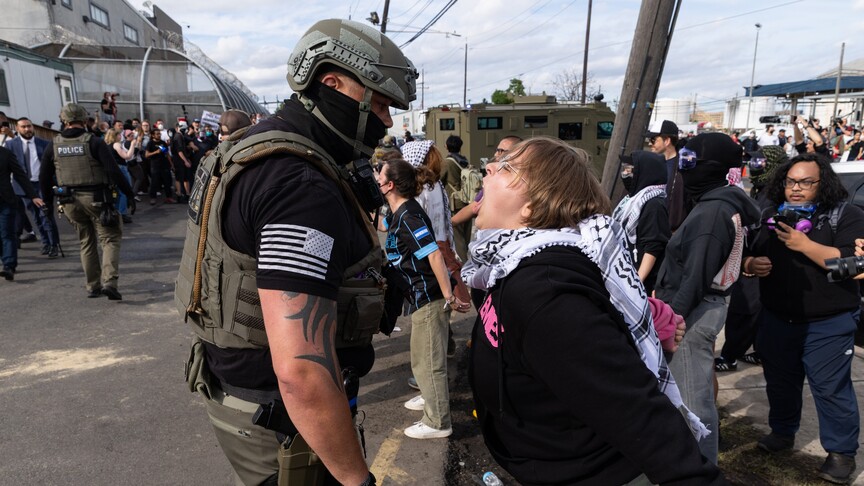
Protesters, US immigration agents clash outside New Jersey facility
-

 New Mexico24 minutes ago
New Mexico law requires meth house disclosures | Column
-

 North Carolina30 minutes ago
How Matt Able’s Decision Will Affect North Carolina
-
North Dakota36 minutes ago
Behind the Badge – Boating in Low Water Years (Lake Sakakawea)
-

 Ohio42 minutes ago
Ohio University online nursing program earns top national recognition

