Lifestyle
Exercise is vital to your health, but so are the arts. Here’s how to reap the benefits


When she has time, Daisy Fancourt likes to sit at the piano and play something by Bach, Francis Poulenc or, if her children are with her, a nursery rhyme.
There’s nothing frivolous about playing or listening to music. It can reduce stress and inflammation, improve heart health, lift moods and slow cognitive decline, according to Fancourt’s book, “Art Cure: The Science of How the Arts Save Lives,” out in February. Other artistic pursuits, from painting landscapes to taking salsa lessons, have similar benefits.

Shelf Help is a wellness column where we interview researchers, thinkers and writers about their latest books — all with the aim of learning how to live a more complete life.
“I think somehow the arts are still seen as ‘fluffy,’ even though we have such strong evidence about everything they do,” says Fancourt, a professor of psychobiology and epidemiology at University College London, and director of the World Health Organization’s Collaborating Centre for Arts and Health. She calls art the forgotten fifth pillar of health, alongside diet, exercise, nature and sleep.
“With physical activity, we all take it seriously — even if people don’t do it, they know they ought to be doing it. And I think it would be wonderful to get to that same place with the arts.”

Portrait of author Daisy Fancourt.
(Tom Burton)
Despite Fancourt’s skill as a pianist (as a college student, she played for a classical radio station between taking classes at Oxford University and interning at a hospital arts program), she insists that people needn’t be master artists to improve their physical health and mental well-being. A simple visit to a museum or a live theater production can do wonders, as can a humble activity such as knitting.
Scientist that she is, Fancourt presents plenty of evidence for art as a cure to what ails us. But her main concern is helping people “see how they can apply the evidence in their daily lives and make changes that will improve their health.”
This interview has been condensed and edited for clarity.
What are some of the most important ways that the arts can make us healthier?
When we engage in the arts, we activate reward and pleasure networks in the brains, we experience the release of dopamine as a happy hormone, and we also psychologically give our brains what they need to be happy. We give our brains a sense of autonomy, control, mastery and a way of regulating our emotions, all of which are fundamental to our mental health.
Arts engagement affects nearly every region of the brain. And if we engage regularly, it actually affects the size, structure and functioning of those brain regions, which can help with the development of brains in young children. It can help with the preservation of cognition as we get older. It can even help our brain to develop new neural pathways around brain injuries.
Every system in the body is affected by art. So when we breathe through singing, we support our respiratory muscles. When we dance, we reduce our blood pressure and glucose levels. When we look at relaxing paintings, we actually activate our pain analgesic response.
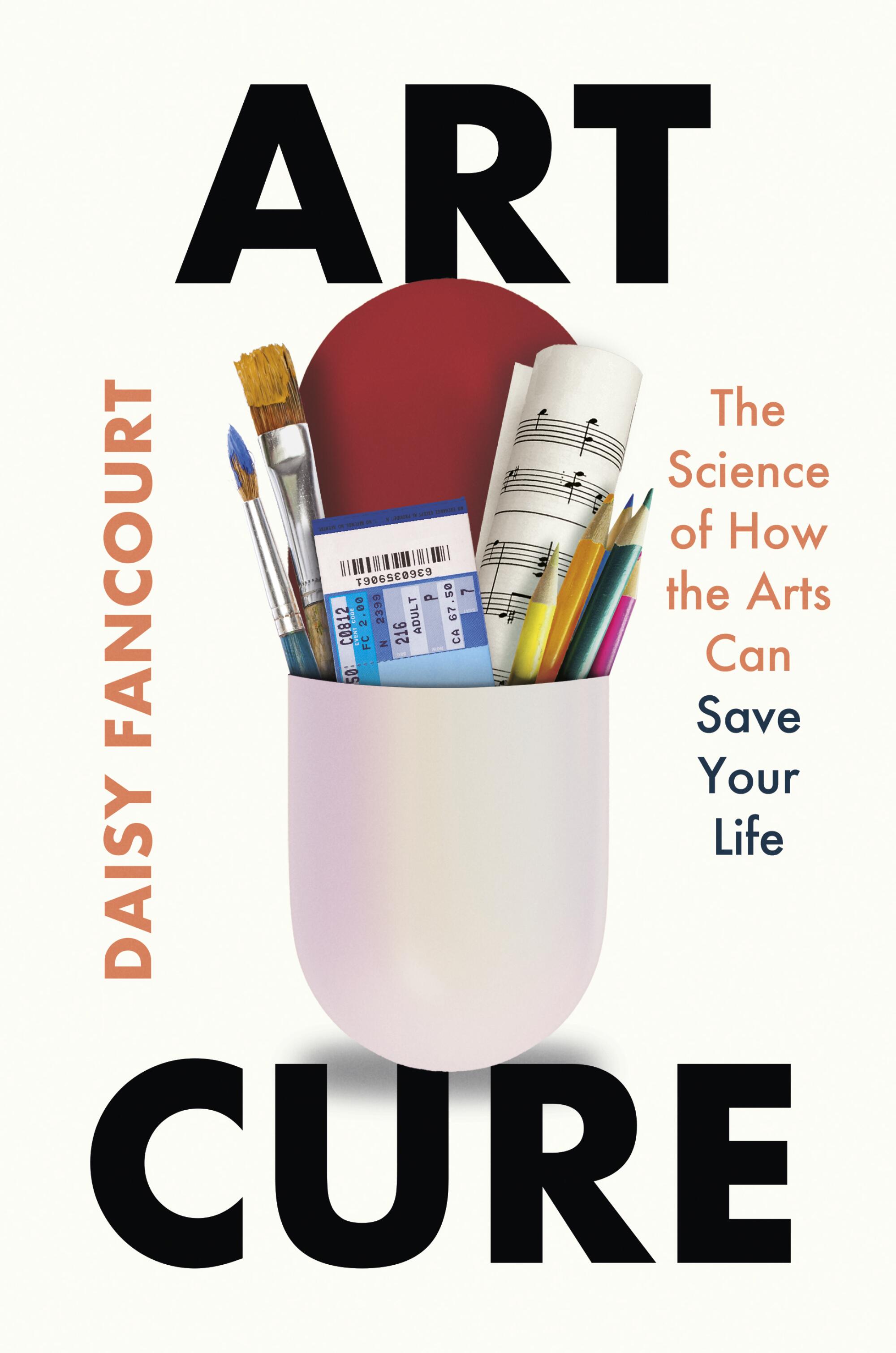
“Art Cure” by Daisy Fancourt book cover.
(Celadon Books)
In the book, you describe screen time as the “ultra-processed food” of the arts. Why isn’t watching content on screens as beneficial as experiencing the arts in person?
When we looked at people going to the cinema versus going to live theater or music gigs, we found there were no benefits to cognition from regularly going to the cinema as they got older, but they had better cognitive preservation if they were going to live performances instead. That’s not to say [engaging in the arts] online is necessarily bad for you — there are plenty of examples where it’s good. But it can dilute benefits you would get from real-life social interactions.
You point out that narratives on TV can have some benefits, but now people are migrating to even shorter videos on TikTok and Instagram. How do you think about the difference between consuming content on, say, Netflix versus scrolling on TikTok?
We know that shortened engagement just doesn’t provide the same kind of meaning that you can get from longer engagement. And it’s not just online. We’re guilty of that even when we go to museums. The average amount of time that people spend looking at artwork in museums is 28 seconds. If you really want to enjoy the arts, you have to give them your attention, whether that’s really looking at a picture properly in a gallery and thinking about your response to it, or whether it’s taking the time — not for a 30-second clip on TikTok — but a 30-minute drama that’s actually going to allow you to get into the details of storylines and characters.
So, I recently tried and failed to read “Ulysses.” People might have lofty ambitions to read a great novel or learn how to play an instrument, but at the end of the day they turn on the TV because they’re exhausted. What are some strategies to engage with the arts in a meaningful way when people have limited time and energy?
Pick the art you want to do, not the art you think you ought to do. So if “Ulysses” is what you want to be reading, then great, but don’t think that some kind of highbrow art is going to be the best for you. It’s not. You need to pick art that you think you’re going to enjoy, that speaks to you, that you have a frame of reference for. So that’s my first point. My second point is to make it equal to your energy level. If you don’t have the energy to read a book, why not turn on a concert on the radio? But don’t be on your phone. Don’t be doing anything else. Don’t multitask. Just sit and enjoy that concert and that experience.
Another thing to consider: How can you make [regularly engaging with the arts] doable? If you would normally go out and meet up with friends in the evening for a drink, well, how about going and meeting up and doing a craft activity instead? So it’s not requiring any more time. If you’d normally read the news on your way to work, swap that for a book. Those simple swaps can make it much more feasible.
TAKEAWAYS
From “Art Cure: The Science of How the Arts Save Lives”
I was fascinated by the “tragedy paradox” that you mentioned in your book. Can you talk about why art that deals with depressing and scary situations can actually make us feel happier at times?
It makes sense that happy art would make you happy. But actually, reading sad books or listening to sad songs, even watching scary films, people say that makes them feel happier. In our real lives, if we experience a sad or scary thing, then it’s sad or scary. But when we’re experiencing it through art, because it’s art, we know it’s not real, therefore there’s a detachment from it. Our brains get to use that experience almost as a learning process, to think about, “How can I regulate this emotion? How would I respond in the real world?” Also, we find that when we have negative and positive emotions together, we find events much more memorable, including arts events.
[Note: Fancourt writes in the book that sad or scary works of art that trigger negative memories from our past do not help us regulate our emotions.]
How often should we be engaging with the arts to get the full health benefit?
Think about it like you think about food. So we all need to be eating every day. We should all be doing some kinds of arts every day.

(Maggie Chiang / For The Times)


Once rivals on the tennis court, Martina Navratilova, left, and Chris Evert have become close friends in retirement. They are pictured above at the French Open in 1986.
Trevor Jones/Getty Images Europe
hide caption
toggle caption
Trevor Jones/Getty Images Europe
Chris Evert and Martina Navratilova were the most successful women’s tennis champions of their generation. Both were 18-time Grand Slam tournament winners — and each other’s greatest rivals.
Evert, a Florida native, became a tennis star in her teens. Navratilova was born in communist Czechoslovakia, and emerged as a player after Evert was established. They first faced off during a match in Akron, Ohio, in 1973, when Evert was 18, and Navratilova was 16. Evert won, but Navratilova left an impression.
“I remember thinking to myself, holy cow, when this young girl gets into better shape, she is going to be a force to be reckoned with,” Evert says. “She had so much talent. Her hands were quick, she had a big first serve, she had a big forehand, and she just was so powerful.”

Two years later, on the day she lost a semifinals match to Evert at the U.S. Open, Navratilova defected to the U.S. In the years that followed, her tennis game improved. Though she and Evert had initially been friendly, the friendship cooled as their rivalry heated up.
“Playing Chris was difficult because how can you not like Chris? What’s not to admire?” Navratilova says. “She was like the epitome of cool.”
The new Netflix documentary Chris & Martina: The Final Set tells the story of how Evert and Navratilova re-established their friendship and how they both faced cancer in retirement. Evert was diagnosed with ovarian cancer in 2021; Navratilova was diagnosed with throat and breast cancer in 2022.
“I can’t get away from her,” Evert jokes. “We had a 15-year career, and then we got cancer at the same time. It really is freaky, but I always say: If I want someone to be in the trenches with me, it’s Martina because she has been so supportive and so understanding.”

Navratilova agrees: “We have such a level of trust that we know whatever we say to each other, it stays there. We give each other the best advice we know how to. And there is no ulterior motive, no playing games.”
At the time that this interview was taped, Evert and Navratilova were both in remission from cancer. But late last week, Evert disclosed she’d recently been diagnosed with a recurrence of ovarian cancer.

“We know whatever we say to each other, it stays there,” Martina Navratilova says of her friendship with Chris Evert.
Netflix
hide caption
toggle caption
Netflix
Interview highlights
On supporting each other through cancer
Evert: There are a lot of phone calls between us. … I don’t cook, but Martina would bake bread for me, and her wife Julia would cook, make some chicken soup. … I got a lot of food from Martina. She got a necklace from me.
Navratilova: I get jewelry from Chris, she gets food from me.
Evert: Martina’s and my relationship — because we’ve had one for 50 years — is not the type where we have to talk to each other every day to maintain the closeness. I always knew she was there. She always knew I was there if we needed to talk, and that was that.
On the weakness they experienced with cancer
Navratilova: Chris’ diagnosis and treatment was much more life-threatening than mine, percentage wise, but my treatment was more difficult physically. … I was in New York for seven weeks and I literally sat on a yoga mat, maybe half an hour of the seven weeks, and did some stretching. I couldn’t even do the down dog pose because I would have fallen down. I had absolutely zero strength left.
Evert: The chemo kicked my butt, let’s put it that way. … It left me very weak, very, very weak. After chemo I would have three or four days of intense nausea and I just would feel tingling in my body and it just wasn’t nice. I didn’t have the energy. To walk six blocks was a big deal for me. And it was foreign. You know, it felt like it wasn’t my body, for sure.
On watching the old footage of their matches together for the documentary
Navratilova: For me, it was fun watching with Chris, because we had different reactions to what happened on the court. But what impressed me is how well we played with those wooden rackets. Because you know what? Those rackets are not easy to play with. But you try to put yourself in there physically, what it was like, mentally, what it is like. And it’s like, “Oh, I should have gone down the line,” or, “I can’t believe I missed that shot.” Or “Chris, you had such a great pass.” It was amazing. So it was impressive. … I wish I could still have that six-pack, but anyhow.

Evert: I remember feeling genuinely happy for her. I remember it was her first Wimbledon. That’s always been her dream since she defected. Her family couldn’t be there to watch her. She was all alone. And I just was happy for it. And I knew that this was gonna be one of many for her to win.
On defecting to the U.S. in 1975 when she was 18 years old
Navratilova: I was thrilled to be in the States. I always loved American cars. And when you ordered a ham sandwich, you got, like, two inches of ham and two slices of bread. Whereas growing up, you had thick bread and one slice of ham. So I thought I was in heaven. And it was $2.30 for that sandwich. I still remember it. I couldn’t believe how much ham I was getting.
Lauren Krenzel and Nico Gonzalez Wisler produced and edited this interview for broadcast. Bridget Bentz, Molly Seavy-Nesper and Beth Novey adapted it for the web.


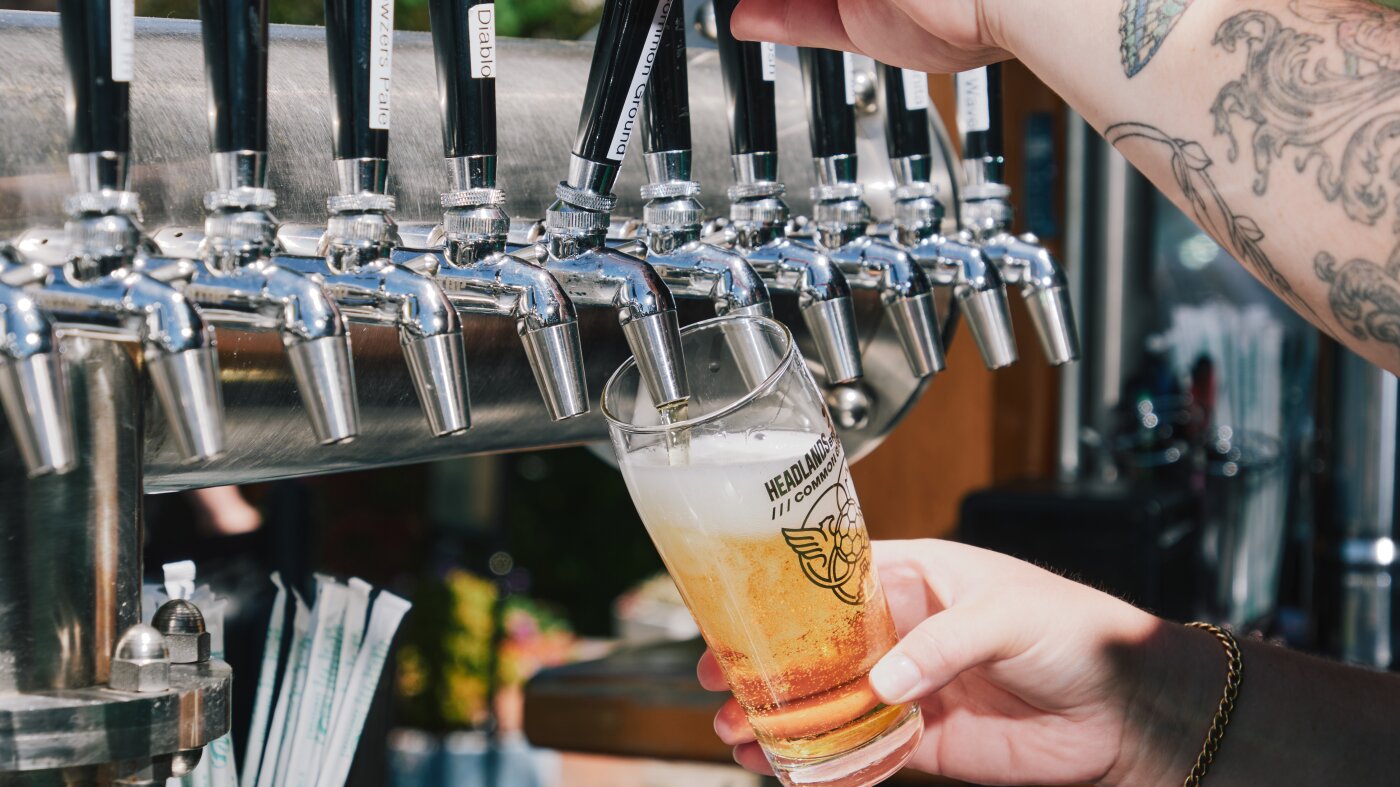
Headlands Brewing launched its World Cup-themed beer Common Ground ahead of the first World Cup game in June.
Justin Gellerson for NPR
hide caption
toggle caption
Justin Gellerson for NPR
The British betting company William Hill predicts that soccer fans will throw back more than 5 million pints of beer in stadiums and fan zones during this year’s World Cup. And that number doesn’t even account for the millions of pints being poured in bars as fans tune in to the global soccer event.
But while international soccer crowds are focusing on goals and penalties, a trio of craft breweries from the tournament’s three host nations are using the tournament to brew something increasingly rare: cross-border solidarity.

A shared recipe with local spin
The collaboration began months ago over a flurry of video chats and emails. The beermakers at Rey Árbol Brewing Co. in Mexico, Headlands Brewing in the United States, and Cabin Brewing Co. in Canada set out to design a single, unified recipe representing the brewing traditions of all three nations.
“It’s a Mexican lager,” said Alejandro Gomez, founder of Rey Árbol.
“That’s like a West Coast IPA,” said Ryan Frank, chief operating officer and brewmaster for Headlands.
“And up in Canada, most of our beers are hop driven,” said Haydon Dewes, co-founder of Cabin. “So we thought, let’s go for a dry-hopped Mexican lager.”
While all three breweries share the exact same recipe, each is giving the final product a distinct local spin, including unique, regionally designed labels. A four-pack of the U.S version costs $15.99. Frank said Headlands has produced about 130 cases of the limited-run brew.
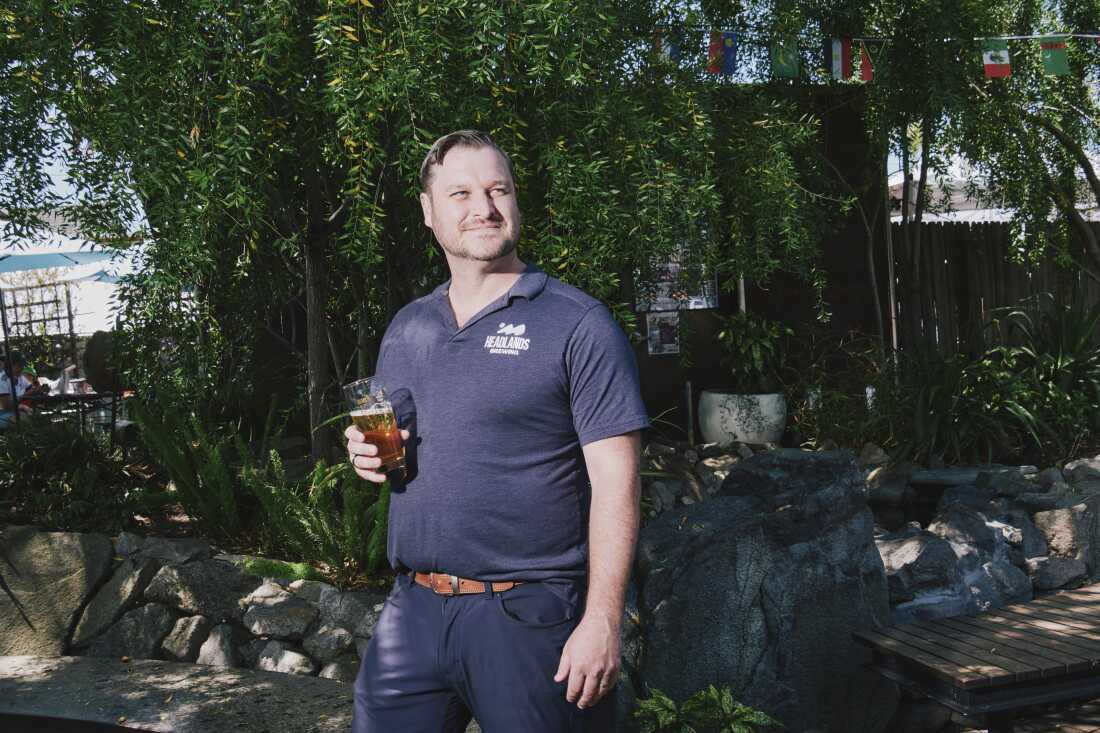
Headlands Brewing COO and brewmaster Ryan Frank drinks a Common Ground beer in Berkeley, Calif., on June 11.
Justin Gellerson for NPR
hide caption
toggle caption
Justin Gellerson for NPR
For the brewers, however, the project is less about marketing and more about connection: They named the multinational beer “Common Ground.”
“When I go to California or Canada, they will treat me like family,” Gomez said.
“It makes the world feel so much smaller,” said Dewes.
“It’s about building bridges and knowing what’s important in life,” said Frank. “And for us, that’s soccer and beer.”
Geopolitical friction in the taproom
The official rhetoric surrounding World Cup 2026 mirrors the brewers’ optimism, with promotional materials promising a tournament where billions are “united as individuals, united as billions.”
Yet this idealistic messaging stands in sharp contrast to a prickly geopolitical reality. Tensions between the U.S., Mexico and Canada have mounted over trade tariffs and auto manufacturing standards as the three nations renegotiate long-standing trade agreements.
The independent brewers behind Common Ground are feeling that friction firsthand through the rising costs of aluminum cans and raw ingredients.
“There are 15% tariffs slapped on any European-grown hops, which are really critical to some of our core brands,” Frank said.

Headlands Brewing brewmaster Ryan Frank and CEO Austin Sharp share a Common Ground beer in Berkeley, Calif., ahead of the first World Cup game on June 11.
Justin Gellerson for NPR
hide caption
toggle caption
Justin Gellerson for NPR
The political discord hasn’t just been confined to trade boards.
When signing an executive order to establish a White House Task Force for the World Cup in March 2025, President Trump suggested that cross-border hostilities might actually benefit the tournament. “Oh, I think it’s gonna make it more exciting,” the president said.
A bittersweet reminder
Tension on the soccer field is one thing; between nations, it’s another.
“It’s true that when it comes to the actual soccer, we’ve developed a very healthy, vibrant rivalry between the three countries,” said Andrés Martinez, the author of The Great Game: A Tale of Two Footballs and America’s Quest to Conquer Global Sport and co-director of Arizona State University’s Great Game Lab, which studies the intersection of sports, media and geopolitics. “But we’re also linked together in this very symbiotic relationship.”
Martinez said that when the U.S., Canada and Mexico initially launched their collaborative bid to host the World Cup back in 2017, the political climate was warmer.
“It was meant to showcase these tight bonds that had developed between the three countries,” Martinez said.

The makers of Common Ground used a shared recipe, but all created their own distinct packaging for the beer: Canada’s Cabin Brewing Co.; Mexico’s Rey Árbol Brewing Co.; the United States’ Headlands Brewing.
Cabin Brewing Company, Rey Árbol Brewing Company, Headlands Brewing
hide caption
toggle caption
Cabin Brewing Company, Rey Árbol Brewing Company, Headlands Brewing
But relations have soured since then, making cross-border business collaborations like Common Ground an anomaly rather than the norm for this tournament.
“To see craft beers across the three countries coming together like this, it’s a bittersweet reminder of what we were hoping to see a lot more of,” Martinez said.
Finding the real common ground
If trade wars and political posturing are looming large in Washington, D.C., Ottawa and Mexico City, they feel a world away at Headlands Brewing’s busy North Berkeley location.
As fans gathered to watch a crucial match between Mexico and South Africa at the start of the tournament, the sunny patio erupted into cheers and shrieks of “Goal!” when Mexico found the back of the net.

Headlands Brewing hosts a screening of the first World Cup game on June 11 in Berkeley, Calif.
Justin Gellerson for NPR
hide caption
toggle caption
Justin Gellerson for NPR
Hovering over a pint of the collaborative brew, soccer fan Roberto Mandujano reflected on the cross-border experiment.
“Three different ways, three different taste buds come together to make something cool,” he said.
When asked about the underlying political tensions between the host nations, Mandujano shrugged off the discord.
“We live in a world where everyone wants to make everything political,” Mandujano said. “But I think we’re all here for soccer. So I guess that’s the common ground.”
-

 Fitness33 seconds ago
This unspectacular full-body exercise could be the secret to long-term fitness
-

 Movie Reviews13 minutes ago
‘The Invite’ Movie Review – Spotlight Report
-

 World27 minutes ago
Russia's ruling party runs Ukraine war veteran among lead candidates for September election
-
Politics36 minutes ago
Supreme Court Expands Presidential Powers to Fire Independent Regulators
-

 Culture1 hour ago
Test Your Knowledge of New York’s Algonquin Round Table
-
Lifestyle1 hour ago
They were world-class tennis rivals. Now friends, they’ve teamed up against cancer
-

 Technology1 hour ago
T-Mobile is booting customers from its oldest plans
-

 World1 hour ago
Gunman kills 6 at youth welfare facility in suspected child custody dispute: reports

