Montana
Protestors back at Montana Capitol, other ‘No King’ rallies double


Following weeks of uncertainty as to whether the state would allow another large No Kings rally on the state Capitol steps, more than 1,000 people stood on the lawn as they protested what they said is creeping authoritarianism in the United States.
Montana poet and author Chris La Tray, along with former Gov. Steve Bullock headlined the event, with stark criticism of President Donald Trump, the Gianforte Administration and attacks on voter rights.
Event organizers scrambled as the state Department of Administration went back-and-forth on a blanket ban of weekend events at the Capitol that was eventually nixed after pressure from legislators and the public.
“When the current governor tried to silence your voice to make it so that you could not gather here on the steps of the people’s house, you stood up and said, ‘No, that’s not who we are,’” Bullock, a Democrat, said. “Today, Montanans and Americans are finding their voices.”
More than 30 No Kings rallies took place across Montana, drawing more than 10,000 to Missoula and at least 5,000 in Billings, according to organizers.
In Helena, Bullock was sharply critical of state Secretary of State Christi Jacobsen, now a Congressional Candidate in the western district, saying, “We still don’t know what she’s given to Trump’s DOJ (Department of Justice).”
Former Montana Poet Laureate La Tray spoke about bringing people together and how that’s both important to him, but also sees it important within the bounds of his Anishinaabe culture, specifically pointing to his nation, the Little Shell Chippewa — a tribe that was not federally recognized until 2019.
After speaking about the complicated relationship he has with the American flag, he pointed to the Little Shell flag, which flies along with Montana’s other sovereign nation flags on the steps of the Capitol, and spoke to the nature of the rally.
“We are a sovereign nation, and we are here to build this future with everybody else,” La Tray said. “So what does that look like? I don’t know, but I think this is where we begin to see it.”
Attendees of all ages stood on the Capitol grounds, including Katy Mays, a Helena woman who had a sign saying “86 47” with a plushie of Kermit the frog.
It became personal to her when the Trump Administration came after public broadcasting.
“They came after PBS, and Kermit didn’t like that very much,” Mays said, who has taken the sign to several No Kings events.
U.S. Senate candidate Alani Bankhead spoke to voters while holding a sign saying “Pedo Hunter for U.S. Senate.” Bankhead, a retired Air Force Lieutenant Colonel, has made child protection and public safety a centerpiece of her campaign for the Democratic nomination in the state. She’s also been active in discussions around the city, also giving public comment in favor of an immigration resolution in Helena earlier this week.
Bankhead said she was encouraged by the protests, adding, “I tell people, make your casserole for someone who needs to be encouraged, and drop it on their stoop. That’s just as powerful as running for Senate.”
Across the state, organizers in Fort Benton said they reached 100 people at their event — 8% of the town’s population — adding it was nearly double their event in October. Miles City saw about 135 people, which was in line with their last rally. Havre had 151, according to Indivisible organizers there.
“People are concerned about a lot of issues from the Epstein files, ICE and giving lots of money to Argentina, but not supporting farmers here,” said Kurt Reinhart, with Indivisible’s chapter in Miles City.
Billings: Largest turnout yet
At the Yellowstone County Courthouse lawn and stretching for several blocks north and south, Billings’ “No Kings” organizers estimated 5,000 to 6,000 people showed up, making it the largest protest turnout so far in the “Magic City.”
“Our voices are louder than money,” said event organizer and leader of Yellowstone Indivisible Elizabeth Klarich. “Sign up for something, get involved because this is how we get change.”
The organizers and speakers at the two-hour event coalesced around the theme of registering to vote and boosting Initiative 194, a measure that hopes to drive out corporate spending in campaigning and politics. In Montana, some cities have elections for school board members in April, a primary in June and a general election in November.
The rally also saw a number of younger speakers, as well as speakers who had a bit more gray hair, including those who hearkened back to the rallies they participated during the Vietnam War era.

Billings Senior High School junior Gage Duffy was the youngest speaker of the day, though it wasn’t his first time speaking or organizing. Earlier this year, he led a walk-out of the high school to protest Immigration and Customs Enforcement treatment of people.
“We call on the abolition of ICE not out of hatred, but out of humanity,” Duffy said, who was spending his 17th birthday speaking to the crowd and rallying. “We have to rethink how justice and immigrants are handled. Justice is not just something we celebrate, it’s something we work for.”
Scott Frazier, a Santee and Crow tribal member who is also Quaker, said he was inspired to participate because the Santee people had been rounded up, held against their will, not so unlike the same people who ICE is detaining.
“Those children who are being put in those camps will suffer for the rest of their lives,” Frazier said. “Yes, I am a Quaker, and you may know them for staying quiet, but we have to be talking about peace. The essence of peace is not hating each other, and guess what? It takes work to have peace.”
After speaking, Frazier sung a traditional sundancing song that is used in the morning called “Meadowlark.”
Tom Curry of Billings is a U.S. Navy veteran and brought a sign to protest for his first rally. He said he missed the other two because of medical issues, but said that his service was part of a NATO mission in Italy, and he wanted to show support for both the Armed Services and NATO.
“But there are 100 really good reasons to be out here,” Curry said.

The March 2026 No Kings rally in Missoula drew more than 10,000 people, organizers said. (Keila Szpaller/The Daily Montanan)

The March 2026 No Kings rally in Missoula drew more than 10,000 people, organizers said. (Keila Szpaller/The Daily Montanan)

The March 2026 No Kings rally in Missoula drew more than 10,000 people, organizers said. (Keila Szpaller/The Daily Montanan)

The March 2026 No Kings rally in Missoula drew more than 10,000 people, organizers said. (Keila Szpaller/The Daily Montanan)

No Kings in March 2026 drew more than double the crowd of the first No Kings rally in Missoula. (Keila Szpaller/The Daily Montanan)

Alex King and Shannon Tillotson of Missoula said they fear for their marriage under the Trump administration because King is transgender. They believe Trump’s hatred has led to more fighting and violence in general. (Keila Szpaller/The Daily Montanan)

No Kings in March 2026 drew more than double the crowd of the first No Kings rally in Missoula. (Keila Szpaller/The Daily Montanan)

Two mothers came with their newborns to participate in the “No Kings” rally on the lawn of the Yellowstone County Courthouse in Billings, Montana on March 28, 2026 (Photo by Darrell Ehrlick of the Daily Montanan).

Laurel Tynes of Missoula showed up to the No Kings rally to defend democracy against Trump. “He’s going to kill us all.” (Keila Szpaller/The Daily Montanan)

A protestor holding a sign at a “No Kings” rally on the Yellowstone County Courthouse lawn in Billings, Montana on March 28, 2026. The sign references Alex Pretti and Renee Good, who were shot by Immigration and Customs Agents in Minneapolis (Photo by Darrell Ehrlick of the Daily Montanan).

A protestor who attended the “No Kings” rally at the Yellowstone County Courthouse lawn in Billings, Montana on March 28, 2026 (Photo by Darrell Ehrlick of the Daily Montanan).

Protestors during the “No Kings Rally” in Billings, Montana on March 28, 2026 (Photo by Darrell Ehrlick of the Daily Montanan).

A protestor at the “No Kings” rally in Billings, Montana on the Yellowstone County Courthouse lawn on March 28, 2026 (Photo by Darrell Ehrlick of the Daily Montanan).

A protestor in an inflatable costume at the “No Kings” rally in Billings, Montana on March 28, 2026. The protestor was pointing to an exchange between President Donald Trump and a female journalist in which Trump didn’t appear to like a question and replied, “Quiet, Piggy.” (Photo by Darrell Ehrlick of the Daily Montanan)

A mother and her daughter walk through the crowd at the “No Kings” protest at the county courthouse lawn in Billings, Montana on March 28, 2026 (Photo by Darrell Ehrlick of the Daily Montanan).

Billie Weston of Billings, Montana holds her sign at the “No Kings” rally on March 28, 2026. She said she had never attended a rally or protest before the first “No Kings” and this is her third (Photo by Darrell Ehrlick of the Daily Montanan).

Protestors holding signs during the “No Kings” rally in Billings, Montana on March 28, 2026 (Photo by Darrell Ehrlick of the Daily Montanan).

A man holds a sign referencing the Epstein files at the “No Kings” rally in Billings, Montana on March 28, 2026 (Photo by Darrell Ehrlick of the Daily Montanan).

Tom Curry, a U.S. Navy veteran, came to protest the war in Iran and the treatment of NATO at the “No Kings” rally in Billings, Montana on March 28, 2026 (Photo by Darrell Ehrlick of the Daily Montanan).

Two protestors at the “No Kings” rally in Billings, Montana on March 28, 2026 (Photo by Darrell Ehrlick of the Daily Montanan).

A woman holds up a sign during the “No Kings” rally along one of the city’s thoroughfares, North 27th Street in Billings, Montana on March 28, 2026 (Photo by Darrell Ehrlick of the Daily Montanan).

Organizers of the “No Kings” rally in Billings, Montana collect current and previous signs for community use on March 28, 2026 (Photo by Darrell Ehrlick of the Daily Montanan).

Over 1,000 people came to the grounds of the state Capitol in Helena, MT, on Saturday, March 28, 2026 for a No Kings rally. (Jordan Hansen / Daily Montanan)

Former Montana Governor Steve Bullock speaks during a No Kings event in Helena, MT, on Saturday, March 28, 2026. (Jordan Hansen / Daily Montanan)

For Kita Mays, a Helena resident who has attended multiple No Kings rallies, it became personal when the Trump Administration went after public broadcasting. “They came after PBS, and Kermit didn’t like that very much,” she said Saturday at a Helena, MT, event on Saturday, March 28, 2026. (Jordan Hansen / Daily Montanan)
The places where he served are now in danger because of the escalating war in Iran, he said.
“That scares the sh—t out of me,” he said. “There was no imminent danger. There was no nuclear threat. There were no missiles that were going to strike the U.S. — there never has been.”
Billings Public Schools Trustee Luke Ashmore, who ran on a platform of no corporate donations, said that sometimes the headlines of news can feel isolating and that’s why he’s participating in these rallies.
“On the worst days, I feel alone, but then look around,” Ashmore said. “But if we rely on each other, and if we stand with each other, and if we join together we can make a difference.”

Billings resident Billie Weston said this was her third “No Kings” rally in Billings. She said that she had never attended a rally or protest before these began.
“I am 67 and had never been to a protest before,” she said.
When asked what made her decide to attend, Weston replied, “How can I not?”
Missoulians protest war in Iran, SAVE Act
In Missoula, more than 10,000 people turned out to protest the Trump administration at a peaceful gathering that started and ended with song.
They came to protest the war in Iran, the SAVE Act, the flagrant disregard for the U.S. Constitution, the erasure of history, attacks on the press, and the enrichment of billionaires at the expense of poor people.
Many veterans showed up to state their disagreement with President Trump’s decision to drop bombs on Iran. Sandy Pisauro, of Seeley Lake, said she is a military veteran who believes in the U.S. Constitution and is tired of seeing Trump fan the flames of hatred.
“Where is the love in our society?” she asked.
Pisauro said she is retired and might be “kind of OK” financially, but she worries for young people who can’t afford homes. She said Trump is creating pain and suffering as he helps rich people make even more money off the backs of others.
“I am sickened by what Republicans have done to this country. I don’t even know how to put it into words,” Pisauro said.
A parade that started at the north end of downtown extended all the way to Caras Park blocks away at the other end, and demonstrators drummed and chanted and even expressed sign envy along the route. Jody Hammond, of Missoula, made eight signs on four boards, including one to which she attached small balls.
“Free Balls For Members of Congress Who Have Lost Theirs,” read one of her signs.
Hammond said she’s so worried for the country, “I can’t stand it.”
She made the signs last week that she and her friends used on Saturday.

“What I worry about more is not so much Trump but the people who know what he’s like and vote for him anyway,” Hammond said.
Penny Bertram, of Florence, drew admirers who stopped to take pictures of her sign: “Trump Sandwich. White Bread. Full of Baloney. W/ Russian Dressing. And A Small Pickle.”
Bertram said she wanted to have fun with the sign despite the attacks on democracy she sees in the country.
“I can’t imagine anything more serious that’s facing our country right now,” Bertram said.
Before the parade started, Laurel Tynes sat in a wheelchair at the head of the No Kings banner, and asked why she showed up to the event, her eyes flickered, and she paused.
“He’s going to kill us all,” Tynes said.
On the parade route, the demonstrators chanted: “Hey, hey! Ho, ho! Donald Trump has got to go;” “No kings. No tyrants. The people will not be silent.”
Previous demonstrations in Missoula have drawn thousands, and the one Saturday, organized by Missoula Resists, Indivisible Missoula and Stand Up Fight Back, was estimated at more than double, possibly triple, the first No Kings rally.
Joanna Morrison, who watched the parade for a few minutes before going to work, described herself as a child of the ‘60s and ‘70s. She said she was arrested in her 20s in front of Malmstrom Air Force Base to protest the nuclear arms race. Morrison said she appreciated the attendance Saturday, both the high number of people and the lack of heckling.
“I’m thankful to see so many people on the same page,” Morrison said.

One speaker, Amber Shaffer of Missoula, said she’s an enrolled tribal member attending her first No Kings rally. Shaffer said she feels like she’s been judged for not participating in the past, but many Native Americans don’t feel secure in the country.
“I just want to acknowledge the privilege that everyone here has to feel safe enough to gather in these spaces,” Shaffer said. “Many of my Indigenous relatives don’t feel that sense of safety in our country, or any marginalized people.”
Lindsey Stout, who came to the rally with her daughter, Morgan Taylor, said she opposed the fear Trump was bringing not just to the country but the world. Stout also said under the SAVE Act, she wouldn’t even be able to vote as a woman who changed her last name.
“I think that’s insane,” Stout said.
Sean Eudaily, a professor of political philosophy and Constitutional studies at the University of Montana-Western, also spoke to the crowd, although as a concerned citizen. Eudaily said he watched his dad, a conservative Republican from western Montana, work on conservation efforts in the Bob Marshall Wilderness and the Rock Creek drainage. He said Montana’s political history offers “good, old common sense wisdom” for people today.
“We were the first state to systematically regulate the influence of corporate money in politics. We were the first state to send a woman to Congress, Jeannette Rankin,” Eudaily said.
He also said when it was time to rewrite the Montana Constitution in 1972, Montana sent everyday people to do it, not politicians, and it has a model document in the country.
“If you let the politicians write the constitution, the people will be sidelined. So that’s not how we do it,” Eudaily said.
Organizers said more than 10,000 people showed up, and possibly as many as 15,000. Rose Zee, with Missoula Resists, said the protests weren’t about political parties, but about protecting the country.
“It is about standing up for what we know to be right and taking action against what is wrong,” Zee said. “Today (Saturday), about 15,000 Montanans came together in Missoula because we can no longer remain silent while our Constitution and our rights are under attack.”



Severe storms moved through parts of Montana on Thursday, prompting a total of 5 Severe Thunderstorm Warnings. Reports included strong wind gusts and hail in several communities, including Augusta, Choteau, Sunburst, Bigfork, Kalispell and Evergreen.
The strongest reported wind gust was 60 mph near Augusta, while hail up to 1 inch was reported near Evergreen and Kalispell.
STORM REPORTS:
12 SE Grant — 56 mph thunderstorm wind gust
7 NNE Augusta — 60 mph thunderstorm wind gust
5 ENE Choteau — 59 mph thunderstorm wind gust
Sunburst — 54 mph thunderstorm wind gust
Ennis — 59 mph thunderstorm wind gust
3 SSW Ennis — 52 mph thunderstorm wind gust
2 E Helena — 54 mph thunderstorm wind gust
19 E Swan Lake — 56 mph thunderstorm wind gust
2 NNW Yaak — thunderstorm wind damage – Multiple downed trees reported along Highway 2 between MM 3 and 8
3 WSW Blacktail — 53 mph thunderstorm wind gust
1 NNW Troy — 49 mph thunderstorm wind gust
5 ENE Choteau — 56 mph thunderstorm wind gust
Turah — 0.88″ hail
1 NNW Bigfork — 0.75″ hail
3 SW La Salle — 0.50″ hail
2 N Evergreen — 1.00″ hail
1 W Kalispell — 1.00″ hail
3 WNW Kalispell — 0.75″ hail
BE THE FIRST TO COMMENT
Have a storm photo to share, UPLOAD it at NBCMontana.com/chimein

LAS VEGAS (KSNV) — A man from Las Vegas has been sentenced after stealing coins and precious metals from a Helena shop in Montana.
This comes after Bishop Lott, 47, pleaded guilty in January to one count of interstate transportation of stolen property.
A judge sentenced Lott on Thursday to 27 months in prison, followed by three years of supervised release. He was also ordered to pay $276,153.08 in restitution to the Helena business as well as five other theft victims.
MORE | Southern California man pleads guilty to importing, trafficking 70 pounds of ketamine
The government alleged in court documents that Lott, along with Ricky Rynell Rose, broke into Wayne Miller Coins in Helena and stole nearly $59,000 in coins and precious metals from a Helena business.
Rose pleaded guilty last year and was sentenced to 39 months in prison.
The Helena Police Department received a call on March 3, 2024, reporting that Wayne Miller Coins had been burglarized earlier that day.
BE THE FIRST TO COMMENT
As part of their investigation, Helena police officers reviewed surveillance footage from multiple businesses. They analyzed email account data, which led them to Lott and Rose, who had taken the stolen material to Nevada.

Political spending that is funneled into elections from a variety of nonprofits is known as dark money — and unlike campaign spending or the money deployed by PACs and super PACs, these sources are not required to disclose their donors. Following the Supreme Court’s 2010 Citizens United decision, which created the country’s current election spending landscape, this has ramped up dramatically, with the 2024 election seeing a record $1.9 billion in dark money spending, nearly double the $1 billion spent in 2020. Now, some campaign finance reformers think they’ve found a state-level reform that can rein in this spending.
Now, campaign finance reformers think they’ve found a solution, and it’s already in place in Hawaii.
A newly enacted corporate law, SB 2471, changes the powers that corporations, or other artificial persons like nonprofits, are granted by the state of Hawaii. In the United States, states grant artificial persons powers as part of an agreement that allows those artificial persons to operate in the state. SB 2471 works by changing the powers that Hawaii grants these entities to disallow them from spending on politics at all.
Tom Moore, a senior fellow at the Center for American Progress and former chief of staff to Federal Election Commission commissioner Ellen Weintraub, told Salon that the law operates upstream of Citizens United by dealing with the powers granted to corporations and other artificial persons, rather than trying to regulate what they can and cannot do with those powers.
“Citizens United said, ‘Hey, if you’re a corporation that is empowered to spend in politics, your right to spend independently in politics can’t be infringed,’” Moore said. “Fine. What this [Hawaiian law] does is say, ‘You know, we’re not going to create that kind of corporation anymore. We’re going to create the kind of corporation that doesn’t have any political spending powers.’ Citizens United and all the other campaign finance cases that the courts have ever decided do not speak to that.”
In his analysis, Moore said this strategy also has a better chance of standing up to scrutiny from the Supreme Court because courts have long upheld a state’s ability to assign powers to corporations operating within their borders, going back hundreds of years.
“They’re gimmicks, and the Supreme Court is not usually impressed by gimmicks.”
“The Supreme Court has said for 200 years that the states can do whatever they want in terms of assigning powers to corporations. They made a fatal assumption in Citizens United that 100 years ago, when states gave away all the powers and said, ‘You can do anything that a human could do,’ they assumed that states would never change their mind on that,” Moore said. “But they never said the states couldn’t change their mind on that, and now they are.”
For example, a recent court ruling in Delaware allowed a change to a town charter that would allow corporations to vote there under some circumstances.
Moore believes that this Hawaiian law, and others like it in the works in other states, have a good chance of surviving at the Supreme Court. However, some critics disagree, saying this legal maneuver is likely to be struck down.
Brad Smith, the chairman and founder of the Institute for Free Speech, a nonprofit that advocates against limits on political speech, including political spending, called the move an “end run” around Citizens United.
“They’re gimmicks, and the Supreme Court is not usually impressed by gimmicks. If you want to do it, you probably have to change the makeup of the Supreme Court or be willing to pack the court and have the political muscle to do it,” Smith said.
In his opinion, the court is likely to see Hawaii’s law as a violation of the First Amendment and is unlikely to look favorably on the argument that these laws deal with powers rather than with rights and that this has to do with how corporations have changed in the past 200 years.
Start your day with essential news from Salon.
Sign up for our free morning newsletter, Crash Course.
Smith explained that in the past, states used to create bespoke statutes for corporations to do something like operate a ferry or a toll bridge. These days, however, the laws governing corporations are more uniform.
“That’s just not how corporations operate in the modern world,” Smith said.
Smith added that he suspects the court will see this law as conditioning the creation of a corporation, or similar artificial person, on forfeiting the right of the people forming a corporation to political speech in the form of spending.
“You could not have the state say we’re going to allow you to register your home, but only if you agree that you won’t spend any money from your home equity line of credit on any kind of political activity,” Smith said. “You can’t deny people the benefits of the law based on a determination that they give up some type of constitutional rights.”
Notably, under Hawaii’s law, the people who form corporations are still allowed to engage in political spending; it’s just that the artificial person in question is disallowed. Still, Smith said, he believes the court will still see the law as unconstitutional.
What’s clear is that this new law, or one like it, will likely be headed to the Supreme Court and that’s because there are already other states where people are mobilizing to create similar laws.
Jeff Mangan, the founder and president of the Transparent Election Initiative, is already spearheading an effort to get a similar statute on the ballot in Montana in 2026, telling Salon that the group is only about 1,000 signatures away from meeting the petition requirements, with four weeks left.
“It’s an all-volunteer effort in Montana, we don’t have any paid signature gatherers, and it’s something that hasn’t been seen in a couple of decades here,” Mangan said.
While election finance reform is typically seen as a progressive issue, Mangan said that the initiative has been well-received by Montanans of all political leanings and that he’s optimistic that the measure will pass, though he’s expecting a significant political battle once the ballot measure is approved.
“We start with a very simple question: Do you believe there’s too much money in politics?” Mangan said. “Citizens will say ‘Yes,’ and they may not agree exactly what the solution is, but we can all agree that there’s too much money in politics.”
Mangan acknowledged that the law, if passed in Montana, would be limited in that it only addresses dark money, which is a relatively small portion of political spending. While 2024 saw nearly $2 billion in dark money spent, it saw some $15 billion in outside political spending, according to the election spending watchdog OpenSecrets. Still, Mangan said, he’s already had organizers in all 50 states reach out expressing interest in the project and in starting similar efforts in their home states.
The Montana measure has also already survived a legal challenge at the Montana Supreme Court, which makes organizers optimistic that the law will survive a federal challenge. The court ruled that the law was not an infringement of rights because the law “speaks only to powers, not rights, and it does not expressly revoke any constitutional rights.”
Still, Mangan expects that his group and the supporters of the measure will have to fight tooth and nail to get the bill passed via referendum if and when it appears on the ballot in November.
“It’ll certainly be a David versus Goliath battle. They’ve already started. The Chamber of Commerce and industry groups attempted to stop the initiative right at the beginning of the signature-gathering phase. They sued the state to stop us from gathering signatures. They were unsuccessful,” Mangan said. “We expect litigation at every step of the way through this, not to mention whatever political campaign they choose to throw at us, and I would imagine it’ll be expensive and immense. It almost makes our point. Exactly the reason we need the Montana plan is because of exactly what we’re seeing being thrown against us.”
-
 Entertainment4 minutes ago
This Puerto Rican filmmaker honored his family with an unconventional movie called ‘TheyDream’
-
 Lifestyle10 minutes ago
L.A. Affairs: I went on 53 first dates in one summer. Here’s a look at my spreadsheet
-
 Politics16 minutes ago
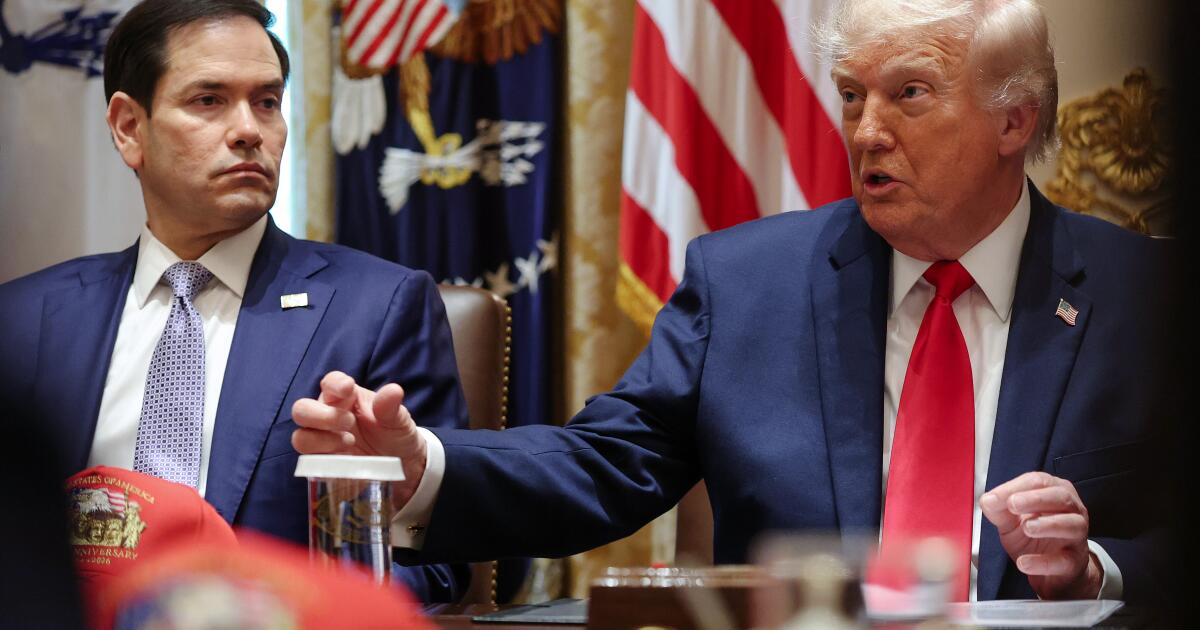
Trump holds Situation Room meeting to decide on Iran deal
-
 Science22 minutes ago
Oxnard man smuggled baby crocodiles, among 1,700 reptiles, gets 5 years
-
 Sports28 minutes ago
A new board game mocks Shai Gilgeous-Alexander for ‘foul baiting.’ He wants it destroyed
-

 World40 minutes ago
Israel, Russia among new additions on UN sexual violence ‘blacklist’
-
 News1 hour ago
Which first lady feared her husband might be having a stroke? The quiz knows
-

 Los Angeles, Ca3 hours ago
Rescued sea lion pups released in Manhattan Beach

