
Connect with us

Finance

These Stock Market Indicators Are Sounding the Alarm. Here’s What Investors Should Do Right Now. | The Motley Fool

Published

on

These Stock Market Indicators Are Sounding the Alarm. Here’s What Investors Should Do Right Now. | The Motley Fool

There’s no better time to start preparing your portfolio for volatility.

Stock prices may be surging, but many investors are having mixed feelings about the market.

While nearly 40% of investors still feel optimistic about the next six months, according to the most recent weekly survey from the American Association of Individual Investors, roughly 30% worry that stock prices will fall in the coming months.

Nobody can predict the future, especially the short term. But there are a couple of warning signs investors may want to pay attention to right now — along with some steps to prepare for a potential downturn.

Image source: Getty Images.

Advertisement

Will the stock market crash in 2026?

There’s no way to predict what the market will do this year, but it can sometimes be helpful to use historical context to get a sense of what’s happened in similar circumstances. And there are two stock market metrics that have not-so-good news for investors.

First, the S&P 500 Shiller CAPE (cyclically adjusted price-to-earnings) ratio. This metric is based on the average inflation-adjusted earnings over the last 10 years, and it’s commonly used to determine whether the S&P 500 is over- or undervalued. The higher the figure, the more overvalued the index may be.

Historically, the average Shiller CAPE ratio sits at around 17. As of February 2026, though, this metric is nearing 40. This is the second-highest value in history, next to the peak prior to the dot-com bubble in the early 2000s.
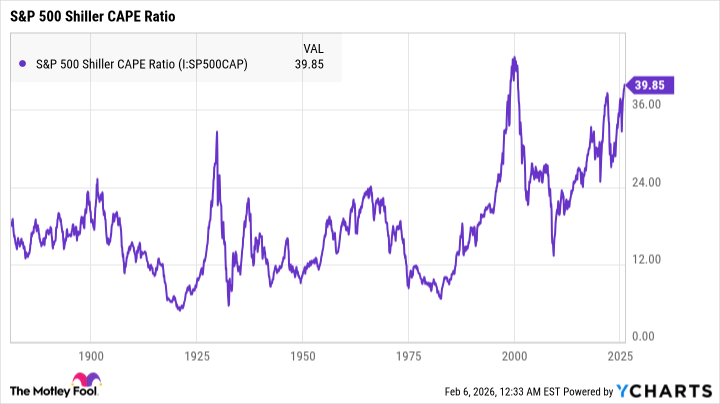
S&P 500 Shiller CAPE Ratio Chart

S&P 500 Shiller CAPE Ratio data by YCharts. CAPE Ratio = cyclically adjusted price-to-earnings ratio.

The second metric to watch is the Buffett indicator, which measures the ratio of U.S. gross domestic product (GDP) to the total market value of U.S. stocks. It was popularized by Warren Buffett, who explained in a 2001 interview with Fortune magazine how he used the metric to correctly predict the dot-com bubble burst.

Advertisement

“For me, the message of that chart is this: If the percentage relationship falls to the 70% or 80% area, buying stocks is likely to work very well for you,” he said. “If the ratio approaches 200% — as it did in 1999 and a part of 2000 — you are playing with fire.”

As of this writing, the Buffett indicator sits at 221%. The last time the metric neared 200% was in November 2021, just before stocks entered a bear market that would last nearly a year.

What should investors do right now?

No stock market metric is perfect, as past performance doesn’t predict future returns. Even if there are strong historical patterns suggesting a downturn could be looming, that doesn’t necessarily mean a crash, recession, or bear market is imminent.

Perhaps the best thing investors can do right now is ensure their portfolios are prepared for volatility, just in case. That involves double-checking that you’re only investing in stocks with strong fundamentals, such as:

  • Healthy finances: A company needs to be on a solid financial footing to survive an economic downturn. Shaky companies can still thrive when the market is surging, so stock price alone isn’t necessarily a sign of financial health. Now is a good time to comb through financial statements to review metrics such as profitability, debt, revenue growth, and other factors that can indicate whether a company is likely to survive tough economic times.
  • Competitive advantage: When the dot-com bubble burst in the early 2000s and much of the tech sector collapsed, the companies that survived were those that had a leg up over their peers. Organizations that didn’t offer anything unique or had nonviable business models crashed and burned, and the same could happen again if we face another significant downturn.
  • A strong leadership team: Sometimes, a company’s survival depends on the decisions by leadership during pivotal moments. Even a strong business may struggle if the executive team consistently makes poor choices, making this a key factor for long-term success.

The stronger your portfolio, the more likely it is that it will survive even the worst bear market or recession. By double-checking all your investments now, you’ll be prepared no matter what may lie ahead.

Advertisement
Continue Reading
Click to comment

Leave a Reply

Your email address will not be published. Required fields are marked *

This site uses Akismet to reduce spam. Learn how your comment data is processed.

Finance

UK financial regulator publishes landmark AI review

Published

on

UK financial regulator publishes landmark AI review

The UK’s Financial Conduct Authority (FCA) published a landmark review on Monday that proposes recommendations to regulate the impact of artificial intelligence (AI) on the financial decisions made by consumers.

The review, titled the Mills Review, anticipates that both consumers and firms will start delegating “more financial decision-making to AI systems,” including for agreements, initiating transactions, and executing decisions “within agreed parameters.” One of the key findings of the review outlined that while AI can help bridge advice gaps and “support growth,” there remain risks “associated with fraud, cyber security, and consumer harm.” Conducting the review, Sheldon Mills highlighted that “AI can also amplify risks: bias, discrimination, exclusion, opaque decision-making (particularly when multiple AI models interact), misleading or hallucinatory advice and erosion of consumer trust.”

The review stated that presently, one in five adults in the UK are “already open to AI making decisions for them,” particularly when decisions feel “complex or high stakes.” It found that roughly 26 percent of the population “trust general-purpose tools such as ChatGPT, Claude or Gemini for financial advice” with little awareness that such platforms provide no “formal routes to recourse” or protections.

Overall, the Mills Review identified four areas that it anticipates will be impacted by AI in the financial sector: “the transformation of firms,” “new consumer journeys,” “a reshaped competition landscape,” and “amplified financial crime and cyber risk.” The FCA projected the shift in how consumers and firms consult AI to take place by 2030.

The Mills Review put forth seven “priority” recommendations to be considered by the FCA Board. It recommended that any transitions to autonomous AI models be monitored and that regulatory frameworks and perimeters be adapted and secured. The review called for the strengthening of “system-wide coordination and oversight,” the scaling up of the FCA’s AI Lab to enable it to support AI models and innovation for agentic finance, and an “AI-enabled agentic supervisory model” to be built and adopted.   Finally, it recommended that a trusted “public-interest AI-enabled financial capability service” be developed.

Advertisement

The FCA announced, in the press release, that it will launch an AI “good and poor practice publication” in late 2026.

Continue Reading

Finance

Fayette County Public Schools Board of Education approves audit contract, new finance director position

Published

on

Fayette County Public Schools Board of Education approves audit contract, new finance director position

LEXINGTON, Ky. (WKYT) – The Fayette County Public Schools Board of Education approved a one-year audit contract capped at $131,750 plus $225 per hour during a virtual meeting Monday, along with a new finance director job description.

The contract is with Mauldin & Jenkins Certified Public Accountants, an Atlanta-based firm, and covers the 2025-26 fiscal year and the restatement of the 2024-25 fiscal year and ancillary services through FY 2029-2030. The work is set to be completed by Nov. 15.

The board approved the contract in a 5-0 vote.

Audit contract details

Interim Chief Financial Officer Kyna Koch said the cost is already accounted for in the district’s budget.

“And is actually less than we expected given our current situation — we were thrilled with the bid,” Koch said.

Advertisement

Koch said she believes this is Mauldin & Jenkins’ first school district audit in Kentucky, but that the firm works with school districts of more than 100,000 students throughout the Southeast.

“Quite frankly when I spoke to the folks at KDE they were thrilled because we’re running kind of short of auditors who want to do school district audits — so all around I think this was a win-win for everyone,” Koch said.

New finance director position

The board also approved a new job description for the position of Director of Finance. Acting Superintendent Dr. Bill Bradford said the title will replace two associate director positions.

“Which will not only save the school district money but it’s also going to streamline our work and align internal controls to make room for a more efficient unit,” Bradford said.

Koch said the position will be posted as soon as possible following the board’s approval.

Advertisement

Closed session

The board went into closed session for more than an hour to discuss pending investigations that could lead to employee discipline. When the board returned, it took no action and adjourned the meeting.

Copyright 2026 WKYT. All rights reserved.

Continue Reading

Finance

UK Watchdog Urged to Consider Broader Oversight of AI Financial Firms | PYMNTS.com

Published

on

UK Watchdog Urged to Consider Broader Oversight of AI Financial Firms | PYMNTS.com

The UK’s financial regulator should consider expanding its oversight to cover advanced artificial intelligence models used in financial services, according to a review commissioned by the Financial Conduct Authority (FCA), as policymakers assess whether existing rules can keep pace with rapidly evolving AI technology.

According to Bloomberg, the review recommends that the FCA evaluate whether large language models developed by companies including OpenAI and Anthropic should fall within the regulator’s remit if they play an increasingly significant role in consumer financial services. The report was led by Sheldon Mills, an executive director at the FCA, and was published on Monday.

The review concludes that the UK’s current activity-based regulatory framework does not require a wholesale overhaul. However, it warns that continued advances in AI capabilities and wider adoption of AI-powered financial products could expose gaps in existing oversight if technology providers increasingly influence regulated financial activities, Bloomberg reported.

Among its recommendations, the report calls for a review of the FCA’s regulatory perimeter and suggests strengthening the regulator’s authority under the UK’s Critical Third Parties regime. Such changes could allow the watchdog to exercise greater oversight of technology providers whose services have become integral to financial markets, including major AI developers and cloud infrastructure companies.

The recommendations reflect growing concern that artificial intelligence is reshaping how financial products are designed, distributed and used. Banks and other financial institutions are increasingly deploying generative AI to support customer service, fraud detection, compliance functions and financial guidance, while consumers are also turning directly to general-purpose AI tools for financial information.

Advertisement

The review also raises broader competition and market structure issues. As financial institutions rely on a relatively small number of AI model developers and cloud computing providers, operational dependencies could become concentrated among a handful of technology companies. That concentration may create systemic risks if disruptions or failures affect widely used platforms, while also potentially shifting market power away from regulated financial institutions toward large technology providers.

Those concerns mirror recommendations made earlier this year by the UK Parliament’s Treasury Committee, which urged the government to designate major AI and cloud providers as Critical Third Parties, arguing that regulators need stronger supervisory tools as digital infrastructure becomes increasingly central to financial stability.

The FCA launched the Mills Review in January to examine how artificial intelligence could transform retail financial services by the end of the decade. The consultation considered AI’s impact on competition, consumer behavior, market structure and the regulatory framework, with the aim of identifying whether financial regulation should evolve alongside technological change.

According to Bloomberg, the FCA will now consider the report’s recommendations, including whether its regulatory responsibilities should be expanded to reflect the growing influence of general-purpose AI systems in financial services. Any changes to the regulator’s statutory powers would require action by the UK government and would form part of broader efforts to balance innovation, consumer protection, financial stability and effective competition as AI adoption accelerates.

Source: Bloomberg

Advertisement
Continue Reading
Advertisement

Trending
