Lifestyle
‘Starfleet Academy’ interrogates the values at the center of ‘Star Trek’ itself


Sandro Rosta as Caleb Mir and Zoë Steiner as Tarima Sadal in Star Trek: Starfleet Academy.
John Medland/Paramount+
hide caption
toggle caption
John Medland/Paramount+
It’s one of the most perilous challenges any crew can take on in the modern Star Trek universe: Building a new series around a bunch of characters who do not include Captain Kirk or Mr. Spock.
The collection of Trek series on Paramount+ have done yeoman’s work in that regard — starting with Sonequa Martin-Green’s principled Starfleet officer Michael Burnham on Star Trek: Discovery way back in 2017, birthing a bold new universe of characters that also made room for superstar supporting actors like Michelle Yeoh and Jason Isaacs.
Divided as fans could be about that series — originally set years before the days of Kirk and Spock, only to jump from the 23rd century to the 32nd century in a wild recalibration of the story — Discovery set the tone for big swings when it came to rebuilding the world of Trek for a modern streaming audience on Paramount+.
Now fans have another big swing coming their way in Star Trek: Starfleet Academy, a series set in the 32nd century that Discovery landed in — a time when the venerated Federation of Planets is pulling itself back together after a massive disaster called “The Burn” shattered the alliance. This new Federation is rebuilding the school for starship officers and staff that produced legends like Kirk and Spock hundreds of years earlier.
Many of the best Trek series revolve around intrepid explorers in a starship stumbling on new adventures in new corners of the galaxy in every episode. Starfleet Academy tries to tell that tale in a different way — presenting the Academy as a school that is also a giant starship with a warp drive that gets waylaid while traveling through space to its home on Earth in San Francisco.

Paul Giamatti as Nus Braka and Holly Hunter as Nahla Ake.
Brooke Palmer/Paramount+
hide caption
toggle caption
Brooke Palmer/Paramount+
The first episode of the series is among its most action-packed, featuring Oscar-winner Holly Hunter as Nahla Ake, the Academy’s chancellor and the starship’s captain. At over 400 years old, she’s part Lanthanite — a particularly long lived alien species introduced on Star Trek: Strange New Worlds — so she remembers the pre-calamity days when the Federation was in full bloom and the Academy was regularly churning out ace starship personnel.
Paul Giamatti chews the scenery as Nus Braka, a ruthless criminal who has history with Ake and attacks the Academy for payback. And new face Sandro Rosta plays Caleb Mir, a well-muscled, rebellious kid who was separated from his mom by Ake back in the day and has agreed to attend Starfleet Academy if the chancellor helps him track down his mother (played by, of all people, Orphan Black star Tatiana Maslany; be still my sci-fi geek heart!).


If this sounds like a lot, that’s because it is. In fact, over its first few episodes, Starfleet Academy is so stuffed with new characters, subplots and franchise references, it’s not clear this program knows what kind of series it wants to be. Is it a rollicking adventure building out the damaged universe first revealed after Discovery’s time jump? Or is it a bizarre blend of Buffy the Vampire Slayer and Beverly Hills: 90210 set in the stars, featuring an idiosyncratic group of young aspirants coming of age in the most bizarre college on television?
Consider this sampling of storylines: Hunter’s hippie-ish leader Ake is struggling to make amends while teaching Caleb the ways of the Federation. Caleb, meanwhile, is on his own journey, trying to find a mom he hasn’t seen for many years, who he learns has escaped from a Federation prison.
He’s surrounded by cadets with their own odd stories, including a sentient hologram trying to learn if her people can trust humanoids and a member of the warlike Klingon race who seems uncharacteristically peaceful and non-combative. Comic Gina Yashere is particularly entertaining as Lura Thok — the cadet master and second-in-command at the academy who also happens to be a hybrid of two of Trek’s most combative races: Klingons and the Jem’Hadar from Star Trek: Deep Space Nine.
There’s also the requisite fan service, including the return of Robert Picardo as the now-900 year old Doctor, the emergency medical hologram he played on the UPN series Star Trek: Voyager back in 1995. Comic Tig Notaro pops up as Jett Reno, an engineer from Discovery who now teaches at this brand new Starfleet Academy.
There are many moments when Starfleet Academy shows promise. Once the first episode gets past the predictable dynamic of a damaged Caleb rebelling against a remorseful Ake, it becomes a bracing adventure that shows off how this new clutch of cadets can excel by working together. The sets are sprawling and lovingly detailed, with special effects comparable to any feature film.
The sixth episode of the season, featuring cadets pitted against a hostile force trying to take over a junked starship, offers similar excitement — along with several powerhouse scenes between Hunter and Giamatti, sparks flying as their characters play a cat-and-mouse game.
As a longtime Trek fan, I love the series’ habit of winking at franchise history in key moments. One episode features the holographic cadet excavating the story of Avery Brooks’ legendary character from Star Trek: Deep Space Nine (DS9), Benjamin Sisko. Given how Trek often seems to treat DS9 like an afterthought, it was particularly nice to see the newest series nod at a program often considered the franchise’s most daring departure.
In the Trek universe, the Federation of Planets has often been an allegory for America’s belief in itself. During the original series in the late 1960s, that meant the Federation was an unquestioned force for good and equitable order — too many episodes were centered on persuading wayward alien species to just get with the program and join the Federation, already — in the same way real-life American politicians were fighting to keep countries around the world from aligning with Communist systems.
Subsequent Trek series have interrogated those ideas in all kinds of ways. Starfleet Academy finds itself in a unique position to ask potent questions about the values at the heart of Trek itself. When the Academy teaches these young cadets about the Federation, what values are they passing along?
Do the Federation and Starfleet really stand for an advanced way of uniting life forms across the galaxy? Or is it a collection of myths humanoid species have told each other to justify colonizing increasing numbers of sentient species?
There are hints Starfleet Academy is positioning itself to tackle questions like that in future episodes — Giamatti’s Nus Braka gives a speech in one episode that really takes on the Federation’s capacity for arrogant condescension.
But, so far, the episodes shared with critics — the first six of 10 in the season — seem more like a promising collection of characters and storylines just setting the table for future achievement, not quite ready to prove its value beyond the legends of Kirk and Spock.



Can you say no to a friend’s wedding?
Getty Images/Getty images
hide caption
toggle caption
Getty Images/Getty images
Are we spending too much on other people’s weddings?
Going to a friend’s weddings can be so fun and meaningful… but it can also really hurt your wallet. A survey by LendingTree found that 31% of people who had been to a wedding in the past five years had accrued debt to attend. So what’s driving up the cost of weddings for guests? And what makes it so hard to say no to these expenses?
Brittany breaks it down with Allyson Rees, senior analyst at trend forecasting firm WGSN, and Annie Joy Williams, assistant editor at The Atlantic.
This episode was produced by Liam McBain, with additional support from Corey Antonio Rose. It was edited by Neena Pathak. Our Supervising Producer is Cher Vincent. Our Executive Producer is Barton Girdwood. Our VP of Programming is Yolanda Sangweni.
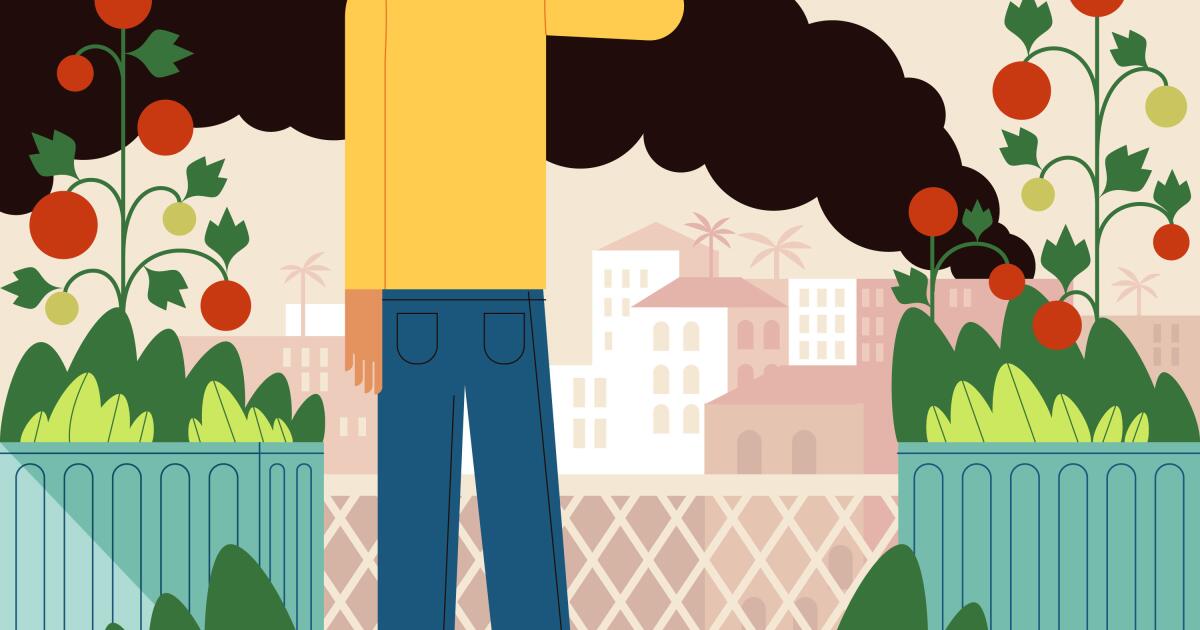
After the eight-day-long fire in a 500,000-square-foot Boyle Heights warehouse, eastern Los Angeles residents are contending with putrid smells, soot and potentially hazardous airborne chemicals after heavy plumes of smoke spread throughout the city. But those who grow food in nearby neighborhoods may also be wondering: How will the fires affect the plants and produce in my garden?
The Boyle Heights warehouse, owned by Lineage — a global temperature-controlled storage facility operator — housed 85 million pounds of frozen food and other products. In the days since the fire, local emergency visits for smoke inhalation and throat pain spiked while agencies still scramble to measure the amount of PM 2.5 — harmful fine particles — and heavy metals, like lead and arsenic, in the air.
According to researchers, any toxic airborne chemicals would likely stem from the charred foam insulation, metal exterior, burned solar panels and any lithium batteries that might have been present inside the warehouse.
After a fire, heavy metal particles can spread through ash and smoke over gardens and inhibit growth, said Olukayode Jegede, an agricultural toxicologist and assistant professor at UC Davis. Since the warehouse fire is so recent and cleanup has just begun, Jegede said the precise impact on gardens can’t be measured until comprehensive soil tests are conducted in the area.
While the L.A. city government hasn’t announced plans for soil testing, the Contaminant Level Evaluation and Analysis for Neighborhoods project at USC is offering free contaminant testing for Boyle Heights and East L.A. residents. Residents can collect soil samples and deliver them to Boyle Heights City Hall and other locations for an evaluation of lead, arsenic, chromium and mercury levels.
The good news is produce, plants and roots can still be preserved. According to Jegede, many of the soil tests conducted last year in the Altadena area after the Eaton fire showed that gardens and poultry were not as contaminated as one might expect.
“Quite a number of the soils we tested [in Altadena] were not really contaminated,” Jegede said. “We weren’t seeing many soils with concerning elevated levels of metal, so gardeners should not be too alarmed when these things happen.”
Nevertheless, there are several measures that gardeners can take to keep themselves, their children, plants and produce safe from potentially harmful contaminants stemming from the fire. Researchers, gardening experts and horticulturists offered some guidance on the handling, recultivation and cleanup that can keep you and your garden in good health.
How do I remove ash and contaminants from my garden?
Altadena horticulturist Leigh Adams said Boyle Heights plants and produce already live in a difficult environment, surrounded by industrial warehouses that spread contaminants daily.
“That area has been used industrially for 100 years, and the soil is impacted by many, many, many things,” Adams said. “Low-income neighborhoods and gardens usually don’t have a lot of resistance against dominant manufacturing.”
This means that the contamination of gardens in eastern L.A. won’t be as catastrophic as compared with those in Altadena, a more suburban environment, Adams said. But fallen ash still poses major health risks if ingested or inhaled.
An advisory from University of California Agricultural and Natural Resources last year recommended suiting up in an N95/KN95 mask, long sleeves, pants, close-toed shoes and gloves before attempting to deal with ash in the garden to limit exposure to potentially toxic contaminants. The advisory added that individuals should make sure all of this gear is cleaned thoroughly before bringing it back inside.
Once in the proper gear, Adams recommends removing the top two inches of topsoil from gardens, where the highest concentration of contaminants will settle after a fire. Using a plastic bag to collect the soil and disposing of it in the garbage — not green yard waste bins — will help to reduce the spread of airborne chemicals.
Gardeners with raised beds are advised to remove approximately six inches of soil, because excess ash can raise the pH level and prevent nutrients from soaking into the soil bed.
After this, watering the garden gently but plentifully will help to promote soil health and get rid of most of the ash present on plant leaves and stems. Adams said replacing the top two inches of soil with store-bought mulch or straw will help to contain any remaining ash and prevent it from spreading any further.
Experts say to avoid using leaf blowers if ash is present in the garden because they can send particles airborne. Doing so will increase the likelihood of heavy metal particles, which can carry lung irritants and carcinogens, being spread and inhaled.
A Boyle Heights resident keep a watchful eye on the fire at the 5,000-square-foot commercial building, which stores 85 million pounds of frozen food.
(Genaro Molina / Los Angeles Times)
Is it safe for me to eat produce from my garden?
Several studies, including one from the UC Cooperative Extension of Sonoma County, have shown that consuming produce in a fire-affected area poses minimal health risks.
Jegede said most root vegetables like potatoes and carrots, along with any fruit that has an outer layer, can be washed to remove potential contaminants, even if they were covered in ash. Peeling the outer layer of your produce can also help to reduce potential risks, he said.
Lettuce and other leafy foods with multiple layers pose a higher risk of contamination, but with a vigorous wash and peeling the outer layers, even the greens can be saved. The County of Los Angeles Department of Public Health recommends soaking leafy produce and fuzzy fruits like peaches in a 10% white vinegar and 90% water mixture.
Jegede said if the leaves or fruit are too delicate to wash or ash is still visible, it would be best to dispose of the produce.
How can I tell if my soil is contaminated?
After ridding your garden of visible ash, you might wonder how to tell if your plants will still thrive in the soil.
At-home soil tests that measure for alkaline, fertility and pH levels are widely available and can be purchased for $15 to $100 (for more detailed results) online. But Jegede said these tests can’t tell the full story of soil health.
Comprehensive soil testing is “something you can’t do properly at home,” Jegede said. “In labs, we are testing for metals like lithium and zinc, stuff that an at-home test will not show … If it comes to the point that you’re worried about your soil, I would just send it out to a lab.”
Wallace Laboratories in El Segundo, Babcock Laboratories in Riverside, Waypoint Analytical in Anaheim and other labs offer more detailed soil tests that measure heavy metal particles in addition to other fertility factors. Prices at Wallace Laboratories can range from $115 to $295 for a complete compost test.
The soil below two inches should be unharmed, Adams said, so long as new compost is set and plants are watered plentifully, which will promote natural biological cycles.
“What you’re doing is capping the soil, so that moisture stays in there, and instead of being dirt, it’s a living system called soil,” Adams said. “The more carbon we can get into our soil, the better.”
What can I do to help my soil recover?
For the last 12 years, Adams has been working with Metabolic Studio, a Los Angeles-based art and research hub focused on environmentalism, on methods for bioremediation, the practice of using additional fungi, plants and compost to decontaminate ash and break down contaminants.
Adams said straw, mushrooms, corn, rye and sunflowers are great bioremediators that can help to repair damage to soils. She said certain samples she’s worked on with Metabolic Studio have gone from testing at high heavy metal levels to nearly contaminant-free.
But for a more immediate fix, wash your produce, water your plants and have a little patience during ash cleanups. Your garden should look better in no time, Adams and Jegede said.
-
 Entertainment3 minutes ago
Rhea Seehorn celebrates her ‘Pluribus’ Emmy nomination as she waits to hear about Carol and the atom bomb
-

 Lifestyle6 minutes ago
Urban Jürgensen: Introducing Elite Watchmaking to New Audiences
-
 Politics11 minutes ago
Commentary: On Skid Row, it’s been decades of frustration. Will the next mayor have a plan?
-
 Science18 minutes ago
What’s the deal with … coffee enemas?
-
 Sports21 minutes ago
LAPD weighs canceling academy classes to get more cops on streets for Olympics
-

 World33 minutes ago
Trump ordered to pay E Jean Carroll $5.8m after failed appeal
-
 News56 minutes ago
Supreme Court financial disclosures reveal how their books add to their income
-

 Los Angeles, Ca2 hours ago
Waymo video could determine charges after teens’ bizarre California ride

